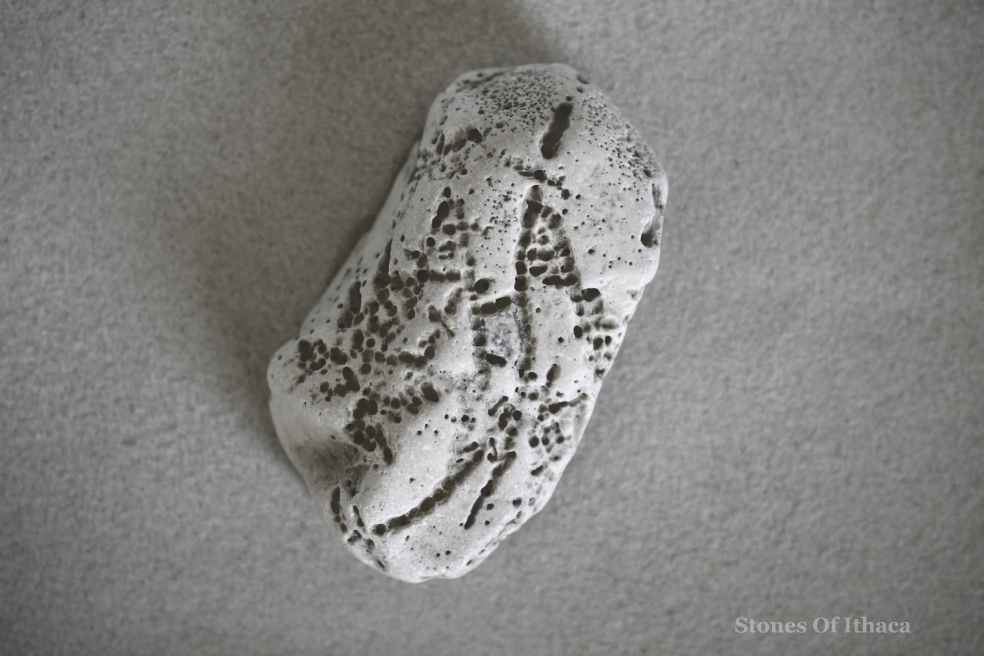
The Little Prince

This stone is a remarkable portrayal of the story of The Little Prince by Antoine de Saint-Exupéry and the rose he has tamed (or that has tamed him) on his little planet with its two active volcanoes and one extinct one, the rose that has demanded his attention and is then sorry to see him go, the rose he himself is eager to get back to, even if he must leave his body behind, at the end of the story, after his experiences travelling and his meetings with various characters, including the fox that gives him some sound advice and makes him realize the importance not of any old rose, but of his rose. The rose is on the left, not so proud, I think, leaning over towards him, lovely in its loveliness. The Little Prince is on the right, his head on a level with that of the flower, sitting on the ground, his legs bent up towards him, his arms resting on his knees, dressed in a gleaming white shirt and grey trousers. The fox tells the Little Prince that the most important things, the most valuable things, can only be seen with the eyes of the heart, not with our physical eyes. The most important things may be just out of our sight. This is an important lesson.


Meanwhile, in language, I would like to look at four connections made by the addition of a letter, in this case the vowel i (or its corresponding semi-consonant y). We saw before how Christ’s death on the Cross releases us from our debt if we believe in him – “death” and “debt” are clearly connected (a-b, addition of h). So it is we find “I owe” in “obey” (b-v-w are linked phonetically). I think when we begin to obey Christ’s commandment to love the Lord our God with all our heart and to love our neighbour as ourself, the debt we contracted by our sinful nature is washed away. We find this result in the link between “serve” and “receive” (c is pronounced s). When we serve the other, we actually receive – a sense of fulfilment; it is when we slight the other that we begin to feel smaller or mean. “Receive” is connected with “believe” (phonetic pair l-r, alphabetical pair b-c). The word “God” in Greek is “theos”, which, while also connected with “other” (thereby proving Christ’s commandment of earlier), can be connected with “theory”. We may have all kinds of theories about God, life, existence, but at some stage we may need to let go of our powers of reasoning and step into the realm of faith. Finally, “trade” and “betray”. When we trade, when we buy and sell goods, often to the detriment of others and the environment, when we use things to make money, in short, I think we are somehow betraying our calling to be stewards of the planet we inhabit. It is a question of whether you see yourself as an author (things belong to you and therefore you can do with them what you like) or a translator (you are just passing through, or they are passing through you).

House on Hill

House at the Top of the Hill. Little House on the Prairie. This house seems to have come out of a story. It is full of shapes: the triangle and square of the house itself, a parallelogram down below, which could also be a kite, the dissected square (that is, two triangles) next to the house. And full of faces: faces peeking out, looking on in surprise, basking in the rays. We do not actually see the sun, but we get a sense of its rays shining down (for who can say which comes first, the sun or its light?). This house that peeks out at us, making additions, subtractions, multiplications and divisions, versions of the line, or the construction of a cross, which is only toppled when we multiply.


Meanwhile, in language, “saint” is very close to “sent”. A saint is sent to us at the right time, to provide guidance, assistance, succour. A “saint” is a human who has purified himself of what he contains, namely “sin”. By working on himself, by applying to God, he has removed the “stain”. A “saint” is a step in the progression from A to I to O away from “Satan”. Here the ego has worked for the good (well, for God, actually). If we rearrange the letters of “Satan”, we find “Santa”, originally based on the figure of St Nicholas, who would go around at night, distributing aid, but now perhaps yoked in to highlight the commercial nature of Christmas and to dissociate it from what it really is – a celebration of the Incarnation of the Word of God, who became human that we might go in the opposite direction, that is, become saints.

Round Tree in Square Field

I love this picture of a round tree in a square field. It even seems that there is a miniature replica of the tree to the left. Or the tree could represent a balloon on a string, or a planet suspended (by a string?) in space. The tree – the round crown and the straight trunk – reflect what I have written about the progression from I to O. I is O in profile or from above. Perhaps the I is hollow; after all, most of an atom is said to be empty, isn’t it? Are we mainly space? What do we choose to fill this space with? An I – like an eye – when it is opened becomes a circle: O. So O (live to love, sin to son) is an opened I. The field, however, is square. This responds to the indefinite article, a/an, which can only be applied to something that is individual. We are individuals, but how long can we remain so?


Meanwhile, in language, I am struck by how similar the words “will” and “evil” are. It is very easy to apply our will to do evil, but this isolates us, leaves us alone. We are not part of a community. “Will” is also the auxiliary to speak about the future, our plans, our intentions. If we combine “I” and “will”, we get “I’ll” (or “ill”); if we combine the plural, however, “we” and “will”, we get “we’ll”, that is “well”. An incentive to think in terms of the plural, just as “me” can become “we” if we upturn the first letter, or the plural of “you” is “us” (isn’t it?). Let us apply the progression from I to O to our “will”. We get “low” in reverse, we become humble.

Twin Peaks

On this stone found on the beaches of Ithaca, we can see twin peaks, perhaps with snow on them, and a path running in between, a path that seems to want to invite us to take it and to progress to the field beyond. There is a larger figure overshadowing the right of the peaks, swaying in the wind, perhaps unstable, bending to the contours of the landscape. We must remember that these drawings are done by stones or else planted on them by external forces.


Meanwhile, in language, there is a striking parallel between the words “planet” (which itself is a derivation of “plant”, which itself is a derivation of “land”, and so on) and “template”. A template is a model, something we can use to make our own creation, but it is not the finished version. Is there a chance that this planet spinning in space in a cul-de-sac of the universe is a template for us to learn to live our lives, to learn values, to learn cohabitation, to learn humility, certainly, and also joy? If this is so, planet-template, then that should make us re-evaluate our position on this planet and place it in a wider context. Because once the template has been saved and closed, the “Undo” function becomes unavailable. While the environment and protecting the environment are important, so is caring for our souls. The earth is like a heart, says my wife, with rock and fire, but around this, enclosing this, is a thin layer, a surface of soil that feeds us. Earth-heart, soil-soul.