Word in Language (2): Alpha and Omega

There is the story of a desert monk who was told by his elder to plant a stick in the ground and to water it until it grew leaves. This is an example of monastic obedience (obedience means you do not ask the question ‘why?’), and this is what we must do to our ego – water it until it grows leaves.


We live in the era of the ego, after the Fall (when we acquired carnal knowledge in order to have children, in order to give birth to the body of the Church). That is, in the era of the I. It is remarkable that in English the ego is a line: I. LINE, by a step in the alphabet (l-m), is connected to MINE – we like to lay claim to things in this world, to draw a line and say ‘this is mine’.


I think we are in this life to learn to move away from the ego (which paradoxically enough leads us to affirm the self, who we really are – this is one of many paradoxes in Christianity). How do you move away from the I?


As I see it, there are three ways of moving away from the I. The first is to make reference to a third point, to understand that in our relations with others it is never a two-way process, there is always a third person present. This is why the best kind of conversation is prayer, because instead of two people talking to each other, two people turn to face in the same direction and address themselves in communion to that third person, whom we name God. Prayer is conversation with a common purpose – it doesn’t have to be in church.


When you make reference to a third point, as if when crossing a river you remember the source, then you have a triangle: Δ. And a triangle is close to the letter A (in effect, the letter A is a triangle on stilts).


So that is one way of moving away from the I: Δ > A.


The second way is to draw a line through the I, to delete it. This is the meaning of the Gospel message to lose our life in order to find it. It is the opposite of what this world tells us to do – to keep our life, to prolong it as long as possible and to make it as comfortable as possible. It is not that we seek our death, far from it, but we lay down our life for the other, we make sacrifices for the other, we actually gain salvation through the other. When we draw a line through the I, of course the symbol we get is the Cross: †. The Cross is an I with a line drawn through it.


So how can we lose our life in order to find it? Surely this doesn’t make sense. Is Christ telling me to throw my life away and then to go and find it again? Well, in a way, yes, because as a desert father, Abba Alonius, once said, ‘If I had not destroyed myself completely, I should not have been able to rebuild and shape myself again’ (The Sayings of the Desert Fathers, trans. Benedicta Ward, Cistercian Publications, 1984, p. 35).


But I think the true meaning of the Gospel message is this: a Cross is also a plus-sign, +. So when we lose our life (the Cross, †), we actually find it (the plus-sign, +). I would go so far as to say we only find it when we lose it.


This is the second way of moving away from the I: † > +.


And the third way of moving away from the I is to see it as a number – 1 – and then to count down to 0. The ego, the I, is actually a spiritual eye that is closed. You will see this if you cock your head like a bird. It is an eye on its side, and it is closed. This is why ‘I’ and ‘eye’ sound the same.


We must open our spiritual eyes (our spiritual Is), and then, when we open the letter I, we get O.


This is the third way of moving away from the I: 0 > O.


If we put these three ways of moving away from the I together, we get:


A + O


Now this is a remarkable fact, because when we move away from the ego, we are actually calling on God, Alpha and Omega. This is our purpose in life: to shift our focus of attention from ourselves to God, and language wishes to confirm this.


But what is truly remarkable for me is that the name Alpha and Omega is contained in the middle conjunction: ‘and’. We will see it better if we write it with capital letters: AND. AND is A ’N’ O (we have the shortened form of the conjunction, ’n’, as in rock ’n’ roll), and in reverse it reads DNA. It is in our DNA to turn to God – it is he who will make us whole.


We see this same choice between following our own inclinations and bowing down before another in the connection between EGO and GOD. They are only a step in the alphabet (d-e) apart. It reminds me of Christ’s injunction that we cannot serve God and mammon (or, in word-connection terms, we cannot serve GOD and GOLD – what letter does GOLD contain that GOD does not? The letter l, which equates to the ego).


So it seems that the SELF must go the way of all FLESH (SELF in reverse, with the addition of h). The SELF in terms of self-seeking, privately harboured ambitions, is FALSE (addition of a), it makes us a SLAVE (phonetic pair f-v). When we enter the world, when we respond to its call, I think we find at some point that what we had taken to be freedom – the ability to do whatever we liked – has in fact enslaved us, has turned us into a slave. Like the Prodigal Son, we come to our senses and seek another path, one that will truly free us and bring us to fulfilment. It is a common misconception that freedom equates to the ability to do what we like (within reason). This is the tenet of democracy. But the Church is not democratic – it is not ruled by people, although it may consist of them. It is hierarchical, and the head of the Church is Christ.


What do we do with the SELF when we come to this realization? There is a simple answer in terms of language, but again you must know your phonetic pairs: f-v and l-r. Then you can turn SELF into SERVE (repetition of e).


Or, as with the connection between GOD and GOLD, you remove the ego from SLAVE. Again, we will see this better if we use lower-case letters – ‘slave’. What happens when you remove the I from ‘slave’? What word do you get?


Language, like the desert elder who sent his disciple off to plant a stick in the ground, or Abba Alonius, who realized that you have to break the ego down in order to rebuild it, is clearly showing us in these examples that we have a choice between becoming enslaved to the impulses of the ego (and there are plenty of substances lying in wait to help us with this task) and turning to God.


It is all a question of opening our spiritual Is – or having them opened for us.


The semi-vowel y corresponds to the vowel i (that is the line, I). When we turn to God in repentance, when we lay our ego on the altar of obedience, we OBEY. I think we reach a point, having made our choice, where we actually decide we don’t really want our free will (there is a parallel here with marriage, where we become one body – and see what fruit that bears).


I am not talking about subjection to a tyrant. I am talking about Christ. With Christ (yes, it is difficult sometimes), I want what he wants, not what I want, because I know it will lead to better things. It will lead to life in all its fullness. And at that point I am capable of declaring, not OBEY, but O, BE I! (the exclamation mark shows that I have opened my eyes; a question mark does the same, it just takes longer to get there).


Jonathan Dunne, http://www.stonesofithaca.com
Word in Language (1): Countable and Uncountable Nouns

The basic unit of language is a noun. Nouns refer to people or things – nurse, firefighter, book, table. They may also be concepts, things that we cannot visualize, but that affect our behaviour – right, wrong, inflation, jealousy.


This difference between nouns referring to people and things that we can see and nouns referring to concepts we can only attempt to describe is very important. When it’s someone or something that I can point out and say, ‘That is a nurse,’ or, ‘That is a book,’ then the noun is preceded by the indefinite article a or an – a nurse, a book. This is because the person or thing exists in the world around me, I can draw the noun or indicate it with my finger, it is in front of me. When it’s a concept, we have no way of pointing it out, of saying, ‘There it is!’ And for that reason what each of us understands by the concept may be different. Concepts are not preceded by the indefinite article, unless we are talking about a specific example. Right and wrong are concepts. A right or a wrong would be a specific example that was done to me on a particular occasion (in a way, I am beginning to visualize the concept and to point it out, which is why I use the article).


I am interested here in nouns that we can visualize – people and things – because the fact that I can visualize the noun, I can see it with my own two eyes, means it is somehow separate from me, or at least I consider it to be somehow separate. If I refer to a book, for example, it is a book on the shelf or a book on the table. I am standing in the room and pointing to it. I may even pick it up. But I can put it down again and walk away. So it is separate.


We might say that I can draw a line around it. Let us look at the example of light. Light as a concept is uncircumscribable, I cannot draw a line around it. In a sense, it can contain me, but I cannot contain it. But if I talk about a light (with the indefinite article before it), then I have contained light in a bulb or a torch, for example. The expression ‘Give me a light’ refers to a single light emanating from a matchstick, not the concept of light – I am not asking you to illuminate my world, just to provide me with an example of fire that will burn out eventually.


This difference between light as a concept and an example of light (a bulb, a torch, a matchstick) is the difference between an uncountable noun (the concept) and a countable noun (an example of that concept). Countable nouns can have a line drawn around them, they can be made separate from ourselves, they have a beginning and an end. Uncountable nouns – the concept at least – are eternal.


But let us turn our vision to ourselves. We are countable nouns. We come into existence. We are born of our mothers – a bundle of flesh that emerges from the womb. You can draw a line around this and say, ‘That is a child.’ Countable nouns, by definition, can be counted. We can count the children in a family or in a class. Each child sits on a chair at a desk. The chairs and desks can also be counted. They can be separated one from another, or piled into a stack.


I would like to suggest that this is what God did in creation – he created separate beings, Adam and Eve, separate creatures, trees and plants, each one of which was an example of that particular species. He created countable nouns, nouns that could have a line drawn around them, as in a child’s drawing. A man, a woman, an oak, a leopard… a word (because he created the world by speaking). All separated off from himself, endowed with its own specific qualities and characteristics. We ourselves imitate this process – when we speak, we emit words, separate beings that once spoken cannot be retrieved.


And he endowed us with free will. In fact, I would go so far as to say he created separate beings, countable nouns, precisely with that purpose, so that they would have free will, because if a human or a rabbit was part of him, it would not be able to function independently (within the limits of its species) and so would resemble a machine.


So, in the case of God, I would say this separation into countable nouns had a noble purpose, a purpose which he has given us to proceed (we create our own children, animals produce their own offspring, trees produce seeds).


If I could just refer to language, the name of God that he reveals to Moses at the burning bush in Exodus 3:14 is I AM WHO I AM, which we can shorten to I AM, or simply AM. One of the seven phonetic pairs – pairs of consonants that are pronounced in the same part of the mouth – is m-n. If we apply this pair to AM, we get AN, the indefinite article, and together they give A MAN. This is just a coincidence.


So man (I am talking about the concept here, not a particular individual) has been given the ability to create separate beings, just as God did. We can create a child, a light. We can build a house. We can write a book. But what we cannot do is create a concept. We cannot create a new species (we can create hybrids). And we cannot create light.


That is, we can use the ingredients, the things that are already provided for us, and transform them into something else, but we cannot provide the ingredients. Put simply, this means that we are translators – we take what is given to us and we transform it into something else. We are not authors.


And if we are not authors, because nothing begins with us, nothing proceeds from us, things pass through us, then this means that the concept of ownership is flawed. Things do not belong to us. Or rather only our response to them does, the way we choose to use them, and this is what constitutes our free will.


I think this difference between countable and uncountable nouns is very important because at one point I would like not to have a beginning and an end, I would like to be immortal, but to do that I must participate in a concept – God – that is uncountable, who is capable of creating new ingredients. I cannot do this on my own. I cannot make myself uncountable. Only God can do this by allowing us to participate in his energies.


And secondly it is our claim to ownership that gives rise to the system of capitalism, whereby we take the products that have been (freely) given to us and package them in order to sell them at a cost. This turning concepts such as flour or oil, metal or wood, into something sellable involves making them countable (otherwise how can I transport them, and how can I charge you for them?). So I create a bag of flour, a barrel of oil, a car or a table. I use the concepts that were put there by God, I transform them (because this is my purpose: to translate), but then I sell them, and as soon as I sell them, I must draw a line around them in the form of packaging. It is the waste product of this process that causes our environment so many problems. It is, in effect, the waste product of our own definition.


When we treat the other as a source of profit, we have distorted God’s purpose. God gave us the other, a separate being, as a source of joy, to learn how to love (not to learn economics).


One final word connection. The Greek word for ‘God’ is THEOS. We saw in the previous article on the Coronavirus that LOVE is connected to OTHER. If we take a step in the alphabet, r-s, we will see that OTHER is connected to THEOS. So the other is God. When we see them as part of ourselves, we participate in them, the dividing lines are broken down and we become separate, but also one.


Jonathan Dunne, http://www.stonesofithaca.com
Word in Language (0): Coronavirus – Human Voice

It is almost two months now since the Coronavirus has taken hold of our lives and we have been in lockdown, confined to our homes except for necessary trips to work or for food. People have fallen seriously ill, and some have died. Health workers have shown admirable courage and perseverance in the face of adversity, one of humanity’s greatest characteristics. There have undoubtedly been some positive aspects. We have had time, some of us, to recollect, to pay attention to aspects of our lives that we had perhaps neglected. Of course, no one wants this to continue for ever, but we have perhaps understood that life is not about production and movement, the earth is not an amusement park, the environment has had time to recover, CO2 emissions are down and fish have been spotted in the canals of Venice. We also have a heightened sense of our own mortality. This makes us humble and a little less proud. In a sense, we have been forced to listen, and this is important because to LISTEN you must be SILENT, you must slow down.


There have been various debates as to the cause of this outbreak: it escaped from a lab, it was a bat, it was poor hygiene in a fish market. I am not a scientist and I do not know the cause, but it seems to me that while there is always a superficial reason for something (something or someone we can blame), there is also always an underlying reason (where the blame has more perhaps to do with ourselves).


I work with word connections. Language is like the environment – there is much more to it than may initially appear to be the case. We treat them both two-dimensionally, as having been put there for our own use. But they have a deeper meaning, hidden secrets which only come to light when we stop to pay attention, when we look at them less for our own profit (in this case we see nothing at all) and more for what they themselves might have to say. Scientists examine life under the microscope, they observe and take notes, hidden wonders come to view that may have something to tell us about the way we lead our lives.


Language is just the same. Words have their own meaning, not just the meaning we would give them. And this hidden meaning can be very illuminating. This hidden meaning can be unearthed in the following ways: by rearranging the letters (sometimes reading them back to front) and by making changes to the letters according to where in the mouth they are pronounced (phonetics), according to their position in the alphabet and according to their appearance (a letter may be turned upside down, for example).


It seems remarkable to me that no one has noticed the name of the city where the virus began, WUHAN in China – if we rearrange the letters and turn the W upside down – spells HUMAN. I saw a video of some inhabitants of Wuhan describing their experience of the lockdown, and they were very much like anybody else – human beings with their family ties, their hopes and aspirations, their sense of humour, their sense of right and wrong. Isn’t that what defines us? Hasn’t the virus to some extent reminded us of what we hold in common?


The Coronavirus is often referred to by another name: COVID-19. Now this time instead of paying attention to the appearance of the letters, we are going to take a step in the alphabet. If we change one of these letters according to its position in the alphabet – and of course rearrange the letters – we get VOICE. So perhaps the underlying reason for the Coronavirus is to make us hear the human voice, to hear human need.


You may think I’m making this up. Well, I’ve worked with language long enough to know that these are not isolated examples. Let us look at the word VIRUS. I wonder if it reminds you of any other word in the English language. I have mentioned three ways of making word connections – it is also possible to repeat a letter or to add a letter (especially a final e). You will then see that VIRUS is in SURVIVE – the purpose of the virus is to survive, and our purpose, when we catch the virus, is also to survive. But surviving, as any adult will tell you, is not always easy.


Now here comes the difficult part, because you cannot make word connections without knowing your phonetic pairs – pairs of consonants that are pronounced in the same part of the mouth. One such pair is f-v  – both these letters are pronounced with the teeth on your lower lip, the only difference is that f is voiceless and v is voiced (you feel a vibration in your throat when you say it).


If we apply this pair f-v, it shouldn’t be too difficult to see that SURVIVE contains I SUFFER. Well, yes, we do suffer in this life, but isn’t that the point somehow – that we are meant to rein in the ego, not to succumb to our selfish desires, not to want everything for ourselves, but to love the other? To love the other – ah, there is the secret! Would it surprise you if I told you these two words, LOVE and OTHER, are connected?


The vowels, o and e, are the same. Then there is the phonetic pair l-r (both these letters are pronounced with the tongue against the roof of the mouth), and the alphabetical pair t-v (we take a step in the alphabet, as we did before with d-e in COVID, but in this instance we miss out the intervening vowel, u). After that, all we have to do is add the letter h, which represents breath; h and e are the most commonly added letters.


I think the Coronavirus has brought out much love for the other in society. While there has been much suffering, there has also been great appreciation for the work carried out by doctors, nurses, shop staff, factory workers, waste collectors, couriers… The people who help our lives to function. In a way, with the Coronavirus, life has been stripped down to its bare necessities, to what is necessary. This doesn’t mean we want to continue in this way – we don’t – but it does remind us of something important. Love for the other.


So language can be seen to confirm what many people have felt – that in this difficult time it is important to have respect and love for the other, to appreciate what people do to make our lives better, to hear the human voice of the other – not to see people as two-dimensional, as put there for our own use (like language or the environment), but rather as human beings with their own intrinsic value. This seems to me to be the experience of the vast majority of the human race. Language is just confirming it.


Jonathan Dunne, http://www.stonesofithaca.com
Beardy

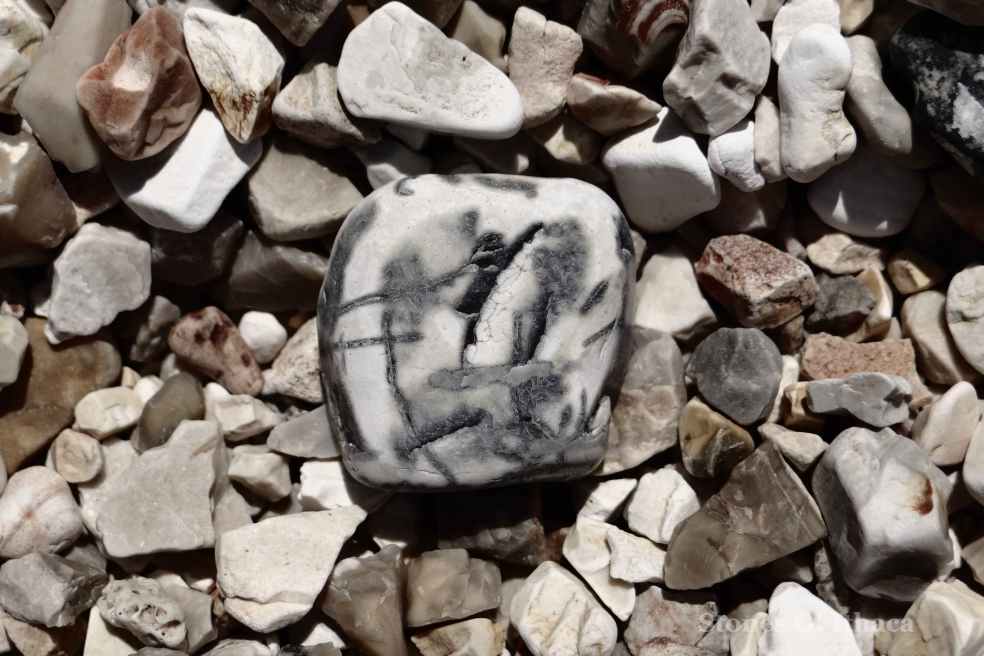
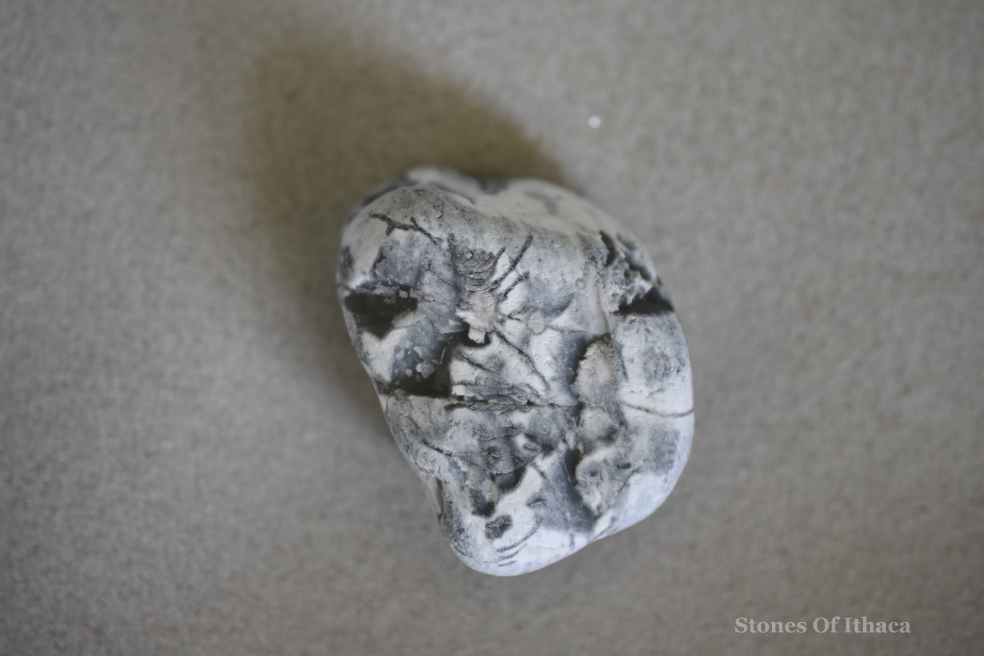
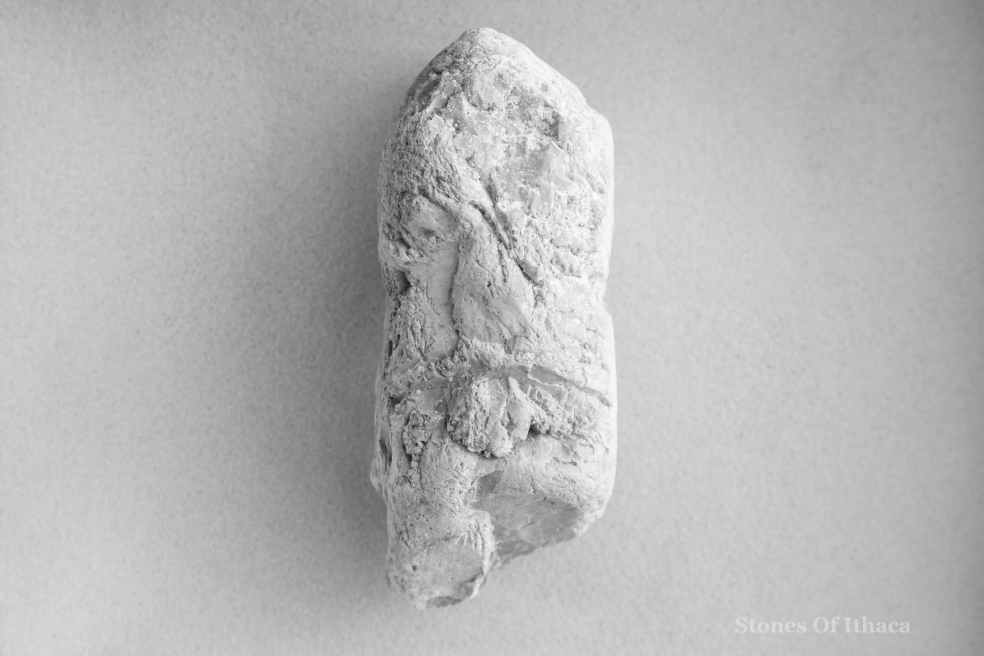
This is a heavy stone and is therefore most likely to be from Cemetery Beach, next to Kioni, where the stones of faces are large and heavy and can resemble skulls. This stone, however, does not resemble a skull. It resembles Treebeard in Tolkien’s Lord of the Rings, with the piercing gaze and the beard like a ginkgo-biloba leaf. There is another magical creature here. If we take the left-hand side of the face to be a covering of bark, and the line of the mouth a branch, then we might discern a phoenix, such as Fawkes in Harry Potter, with its head upraised. The ginkgo-biloba leaf is now its tail feathers.


Meanwhile, in language, we know how important wood is to the Christian religion. Christ was crucified on a tree. The Cross is a deleted I, an I with a line drawn through it. He taught us in this way to subdue the ego’s selfish impulses, and to serve the other, through which we will find our own true identity. It is this submission that sets us free. Standing in one place. Learning to be patient and long-suffering, much as we may not like the treatment. For this reason, the tree gives shade, warmth, food and oxygen. It may even allow itself to be cut down. It is that sacrificial. “Tree”, which is obviously connected to “free”, is also connected to “three” – the Holy Trinity. It was Christ nailed to the tree, who came to act as a translator for us of the meaning of human life (this translation is called the Gospel). But Christ is intimately linked to God the Father and God the Holy Spirit – the Father who sent him, the Spirit who descended at Pentecost and enables us to breathe. Like the tree. Root, seed. The WOOD – Holy Trinity.

Triple Cross

In this stone, we are reminded of the Gospel accounts of the Crucifixion and how Christ was crucified with two bandits, one on either side. St Luke tells us that one of the criminals rebuked the other for mocking Christ, since they were there for crimes they had committed, whereas this man had done nothing wrong, and he asked Christ to remember him in his kingdom. According to tradition, the Good Thief was crucified to Christ’s right. We see Christ’s cross in the middle, a shining star in his face. The left part of the transverse beam, as we look it, may remind us of the boa constrictor digesting an elephant in The Little Prince. The Good Thief’s cross is similarly high, birds singing from the top of it, but the upright stake is missing and has been replaced by a white line, as if the Good Thief is already ascending into heaven. What is noticeable is the other thief’s cross, which is much smaller and is also attached to the ground by only a white line. The head of this cross reaches up to the arm of Christ; the other goes much higher. The face on this side looks towards us; on the other, it looks to the left and gapes open.


Meanwhile, in language, let us continue with connections made by the addition of a letter. There is a beautiful connection between “die” and “tide”, as if our life in this world was a breath on the shore before we are pulled away by forces out of our control, the water seething and bubbling as it sinks into the sand and is replaced by oxygen. Similarly, “fish” and “shift” – I love this image of the fish darting through the waters, seen for a moment and then shifting out of view with a twist of its tail. Or how about “trail” and “ritual”? A ritual is something we perform on repeated occasions. It can sometimes appear boring, but it wears away a path for us to walk on. Like the fish, we twist and turn and suddenly shift out of view, for while the beach is shallow and covered in shingle, the sea (contained in the middle of “beach”) is deep, there are currents, the line is held in place by surface tension.

Girl Reaching Up to Shelf

This is one of the most precious stones I have found on the beaches of Ithaca. It seemingly depicts a small girl reaching up to place something on or to retrieve something from a shelf. What secret is this? Perhaps something insignificant, but for her it has great value. We enter into her world, where the values are different – something adults often fail to do, imparting knowledge to children they find superfluous. And yet there is more to this stone than that. On the left and right are strange figures. At the bottom right, one figure seems to be sinking into the ground, or rising from it. And there is an elongated cross with its roots in the ground, maintaining the balance, spilling drops of blood on the old man below. Up above, along the top, a question mark. And the whole is looking at us, like the front of a train.


Meanwhile, in language, Christ was given as a ransom for many. He came to translate for us the meaning of life, which is theosis. He became human in order that we might become gods. All he asks from us is a little willingness. The name of God in the Old Testament is AM (this is the name God gives to Moses at the burning bush when he asks who he should say has sent him). AM, of course, is the first and last letters of the Greek alphabet: Alpha and Omega (except the Omega is upside down). Also in “ransom”, apart from AM, we find “son” (the letters are in the middle, rearranged, but clearly visible, I think). So language is telling us that God gave himself a ransom for many in the person of his Son. Another theological connection we might find is between “blood” and “spirit”. How so? Well, first the phonetic pairs b-p, d-t and l-r, and then the vowels i-o, with the addition of s. Blood, spirit. Our first calling may be to our bonds of kinship, the blood that runs through our veins, but we soon discover there is a higher calling, one that makes us members of the body of Christ. Everything is in place, we just need to show a little willingness.

The Little Prince

This stone is a remarkable portrayal of the story of The Little Prince by Antoine de Saint-Exupéry and the rose he has tamed (or that has tamed him) on his little planet with its two active volcanoes and one extinct one, the rose that has demanded his attention and is then sorry to see him go, the rose he himself is eager to get back to, even if he must leave his body behind, at the end of the story, after his experiences travelling and his meetings with various characters, including the fox that gives him some sound advice and makes him realize the importance not of any old rose, but of his rose. The rose is on the left, not so proud, I think, leaning over towards him, lovely in its loveliness. The Little Prince is on the right, his head on a level with that of the flower, sitting on the ground, his legs bent up towards him, his arms resting on his knees, dressed in a gleaming white shirt and grey trousers. The fox tells the Little Prince that the most important things, the most valuable things, can only be seen with the eyes of the heart, not with our physical eyes. The most important things may be just out of our sight. This is an important lesson.


Meanwhile, in language, I would like to look at four connections made by the addition of a letter, in this case the vowel i (or its corresponding semi-consonant y). We saw before how Christ’s death on the Cross releases us from our debt if we believe in him – “death” and “debt” are clearly connected (a-b, addition of h). So it is we find “I owe” in “obey” (b-v-w are linked phonetically). I think when we begin to obey Christ’s commandment to love the Lord our God with all our heart and to love our neighbour as ourself, the debt we contracted by our sinful nature is washed away. We find this result in the link between “serve” and “receive” (c is pronounced s). When we serve the other, we actually receive – a sense of fulfilment; it is when we slight the other that we begin to feel smaller or mean. “Receive” is connected with “believe” (phonetic pair l-r, alphabetical pair b-c). The word “God” in Greek is “theos”, which, while also connected with “other” (thereby proving Christ’s commandment of earlier), can be connected with “theory”. We may have all kinds of theories about God, life, existence, but at some stage we may need to let go of our powers of reasoning and step into the realm of faith. Finally, “trade” and “betray”. When we trade, when we buy and sell goods, often to the detriment of others and the environment, when we use things to make money, in short, I think we are somehow betraying our calling to be stewards of the planet we inhabit. It is a question of whether you see yourself as an author (things belong to you and therefore you can do with them what you like) or a translator (you are just passing through, or they are passing through you).

Creepy-Crawly

In this stone, we see a plethora of creatures. I would go so far as to say that this stone represents day six of Creation, as related in chapter one of the Book of Genesis, which is when God created the land animals – cattle, creepy-crawlies, beasts of every kind (domestic and wild animals and insects) – together with man. In the middle of the upper half of this stone is a creepy-crawly, a spider perhaps, its legs outstretched as when it balances on its web. Indeed, slung across the paths of Ithaca are numerous fat spiders waiting on their webs. But there are the faces of other animals, also – I see a happy dog, laughing and playful, barking to receive a ball; a dinosaur looms out of the primitive forest, gone but not forgotten; and there is the figure of a seated child with its shadow, that insubstantial form that follows us about and sometimes takes our attention.


Meanwhile, in language, some Church Fathers claim that at our death our souls will be released from our bodies and have to pass through a series of toll houses as they ascend through the sky. It is as if there is a net slung over the world, preventing our escape, and “net” in reverse reads “ten”, which is the number accorded to humans in the celestial hierarchy, after archangels and angels. How are we to get through this net? Well, we are fortunate in that a net has meshes, those interstices – is that the word? – those gaps in the paper, those gaps of silence, through which, if we are lucky, we can wriggle to our freedom. They are like the tiny pockets of light we glimpse in the leaves of trees when we look upwards, which, if they are caught by the sun, turn into blazes of light that can blind us. This is how I understand Christ when he says that, like camels, we must pass through the eye of a needle. This seems impossible and yet, caught at the right angle, perhaps the eye of a needle is vast. “Net” and “mesh” – they are perfectly connected (steps in the alphabet, m-n and s-t, with the addition of breath, h). So let us not lose heart. If we have our eyes set on the light, we can swim to freedom.

Yacht Attached by Umbilical Cord

This stone is tectonic. One can almost see the plates of the Earth being crushed together. And the deep vein of the Mariana Trench reaching upwards. Of course, the plates – faces of passengers on the London Underground being squashed together – can also represent the waves of the sea, on which there is a boat, a yacht, whose mast is the Mariana Trench and whose sail is a letter, A. This ship is held down to the ocean floor by the trench, a kind of umbilical cord. It may strike us as flimsy, kindling waiting to be splintered and thrown on to the fire, or fragile, like a matchbox. And yet it is held down, connected. It will travel to and fro across the surface of the ocean, and mirror the ocean floor.


Meanwhile, in language, there are some wonderfully expressive connections between words. Let us take the example of a pudding, “trifle”, which without the e spells “flirt”. Or let us look at the word “plot”, which in reverse, keeping the consonantal cluster together, spells “topple”. One of my favourites is “episode”, at the end of which there is often a cliffhanger and the story is left awaiting an outcome, “poised”. Opposites are never far away, and I am intrigued by the proximity of the archetypal white and black birds – “swan” and “raven”. They are actually connected by the alphabetical pairs r-s and v-w, addition of e. Opposites can attract or repel, like the poles of a magnet. Word connections can also define, but they are not always obvious. “Roam”, for example, spells “alone” (phonetic pairs l-r, m-n, addition of e), but “alone” can also be found in “belong” (alphabetical pair a-b, addition of g), as can “noble”. And here’s a riddle to end with: what does a “plug” do when it’s finished? “Gulp”, of course.