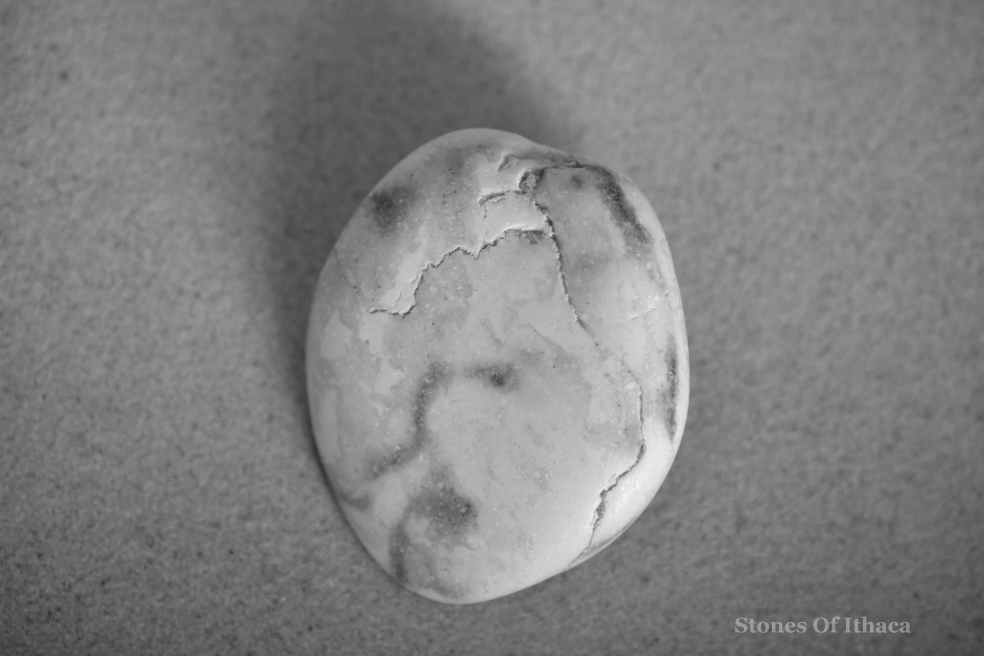
Monk in Cave at Night

A stone is a story. Here, we have a monk in his cave at night. We can see the moon in the darkened sky above him. His head is surrounded by a halo because of his asceticism, his wish to refrain the impulses of the ego and to bow down before God. And yet there are other figures in this remarkable drawing. There is a bust to the right of the monk. His left shoulder forms the mouth of a face, and there is another face below him. In the door of the cave is a large hound, a little whitish. It seems to occupy a lot of the space. It is difficult to discern whether the hound, which exceeds the monk in size, is evil or friendly, but see how the word “evil” is in the first four letters of “friend” (phonetic pairs f-v and l-r). To the left is a white staircase and what could be a potted plant. The complexity of this drawing is unusual.


Meanwhile, in language, we think of opposites as being unconnected, and yet we are told in the Gospel that we must lose our life in order to find it, or that the first will be last and the last, first. So there is an obvious paradox in language. This can be found in the connection between “fast” and “feast”. To fast, to deprive our body of the luxury of food, even if only for a short period, is to reap benefits in other ways, as the monk would no doubt be able to teach us. We might find a similar connection in the words “starve” and “harvest” (addition of h). Of course, we need food for nourishment and healing. Both “feast” and “starve” are connected with “breast”, a source of nourishment for babies. And if we take away the s, we will be able to extract the words “feed” and “bread” (change of vowels; phonetic pair d-t). St Maximus the Confessor is clear when he says that to overcome the passions – excess – we need love and self-mastery. So perhaps “fast” is to “feast” and “starve” to reap the benefits of holding back.

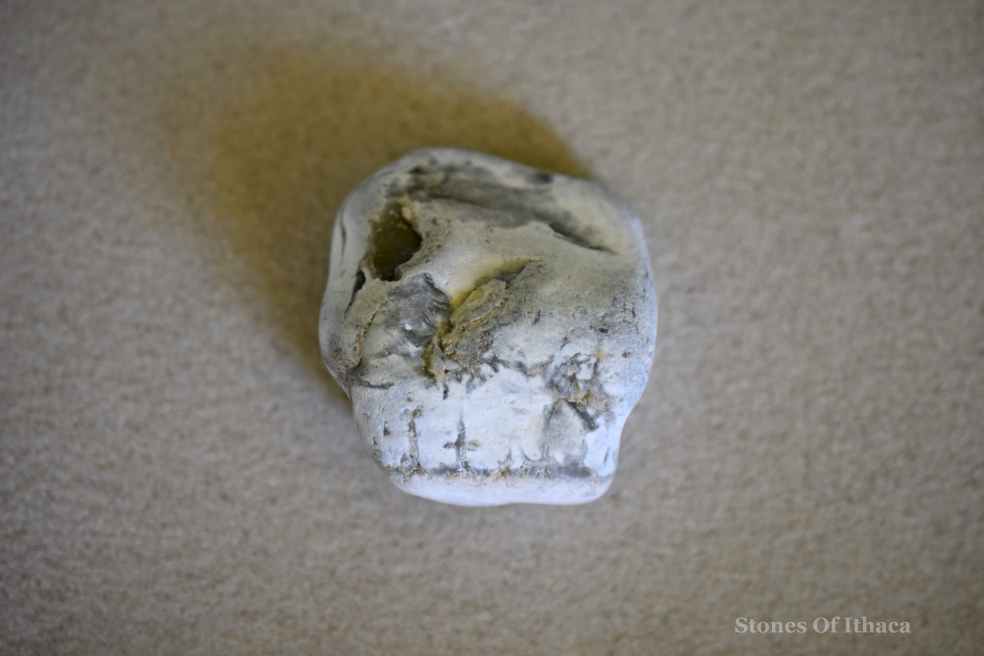
Odysseus in Helmet

This is the first stone I have kept from Ithaca. I found it on our first visit, on Polis Beach, where there is a cave in which was discovered a votive tablet to Odysseus, and which is also near to where Odysseus’ Palace is said to have been (very strategically) located. I was struck by this stone. It seemed to represent a link to the past, to a time when this legendary king may have walked along the very beach where I was, surveying the horizon, Cephalonia in the distance, the blue waters of the strait. The curious thing about this knob of land is that it is located on the west of the island, but looks east. It is the last piece of land one sees as one returns to the mainland, so I can quite understand why he would choose to place his Palace here, and also why he would choose Ithaca out of all the islands as his base. There is nowhere quite like it. See the helmet (or is it his hair?), the outline of the eyelid, the nose with its nostril and mouth, the spattering of crosses (as on virtually every stone). This is my Odysseus stone.


Meanwhile, in language, there are clusters of words, words that stick together. Let us take the example of “birth”. “Birth”, if we turn it around, gives us “third” (b-d), and indeed the normal outcome of a birth is to have a third person. It is also close to “breath” (we only need to open the vowels), and breath is the first thing a newborn infant must take when it is born. It is also very usual for a newborn creature to be “blind”, and we can see that these two words are also connected (phonetic pairs d-t and l-r, physical pair – pair that looks alike – h-n). So the two things we would normally associate with a birth are in the word: breath and blind. We might note that the reverse of “birth” gives “thrive” and “tribe” by the addition of a final e; also, “writhe”, and anyone who has witnessed a birth will see the relevance of this. But I would like to finish with a connection made by the phonetic pairs d-t and l-r and the alphabetical pair b-c: “birth” – “child”. “Child” is also in “Christ” (addition of s) – he became a child in order to show us the way.

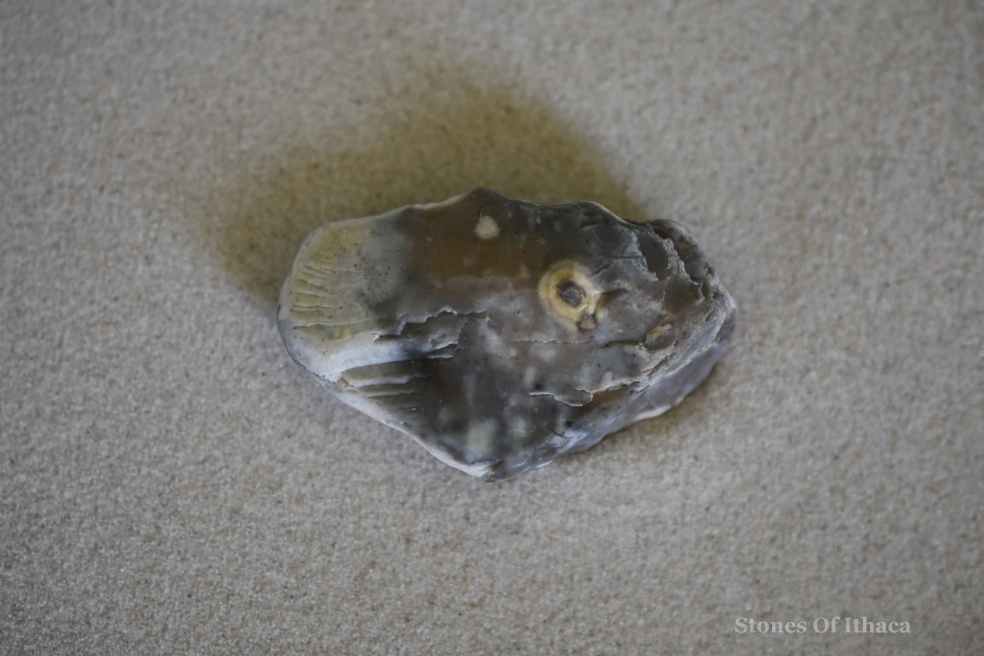
Rugged

The texture of this face is remarkable. He looks like an army sergeant sporting a crew cut, or a boxer who has been through a few too many rounds and has since retired from the ring. The stone is unusually like a sculpture, it is not just a face, we have the whole head and part of the neck, it could almost be on display in a museum. And yet despite the ravages of time, of personal experience, there is a peacefulness about the face; he has been patched up, layer upon layer, one eye may be slightly bruised, the nose squashed to one side, and yet he is here.


Meanwhile, in language, we have seen how “earth” and “heart” are connected (as are “soil” and “soul”). Perhaps when we die, a part of us remains here. Certainly, in our earthly life, we invest a lot. We have seen the connection between “heart” and “fear” (two steps in the alphabet, addition of t). There is also the obvious connection with “hear”. For us to effect the short but difficult journey from the “head” to the “heart” (d-t, addition of r), we must open our ears and “hear” the Word of God. This is why you will find “see” in “seed”. But there are other wonderful connections that make me think they are deliberate. If we take a step in the alphabet (s-t), we will find “share” in “heart”. Isn’t that the purpose of feeling? We will also find “yearn” (t-y in the alphabet; physical pair h-n – a pair of letters that look alike). The letters are turned, our heart is aquiver, we catch sight of a rustle of feathers and follow it into the sky.

Cross under Tree

This is one of my favourite stones, and it was found on a beach under the shade of the trees, overlooking the northern part of the island. I love the outline of the cross. It is so firmly established, so deep, like a trench, like an incision. The transverse beam is almost black, though in reality the stone is a little blue, blue like the open expanse of sky, the branches resembling the footprints of primitive monsters (waders or dinosaurs).


Meanwhile, in language, the cross is a denial of the self (the self in English is a line, I; the cross is the I with a line drawn through it). And yet this same cross can also be a plus-sign. This is one of the most wonderful of Christian paradoxes, and it is given to us by Christ himself in Matthew 10:39: “Those who find their life will lose it, and those who lose their life for my sake will find it” (NRSV). I think the cross indicates to us how it might be possible both to lose our life and to find it by being a plus-sign as well, but it is a difficult paradox to take, since I don’t think anyone wants to lose their life, to suffer persecution, to be poor. Perhaps it is more a change of attitude; we accept that the things of this world are not ends in themselves, but the means to giving and receiving love. This is why Christ invites us to lose our life “for his sake”; we are getting much more in return. And, in case we were in any doubt, there is the word connection, simple jumps in the alphabet, but invisible at first sight: lose-more (l-m, r-s). We lose our life, our self-centred concerns and ambitions, and find ourselves in Christ. “Find” may just turn out to be the purpose of “life” (steps in the alphabet, d-e, l-n).

Skier

After the figures of a pilgrim (heel-sole) and a tightrope walker, here we have the figure of a skier, also from Gidaki Beach, that cold and yet beautiful beach on the east side of Ithaca, overlooking the mainland, with ferries and the odd cargo ship passing down the strait. The waters turquoise blue, the stones like ink drawings, and we swim round and round the buoy. Meanwhile, this skier is flying through the air, bouncing off the snow, taking advantage of the winter conditions to leap down the slope, in joy, in confidence, his mind on the present, the glistening surface, the hidden stones, and also on what awaits around the corner, the unseen, the treacherous, but gliding on his skis, if he can just keep his balance…


Meanwhile, in language, the Greek word for the underworld, used as a kind of synonym of hell, the place where the souls of the damned must go, is Hades. Isn’t it strange that the letters of this word rearranged should spell “shade”, since this is precisely the abode of the shades, those without bodies, the ones Odysseus meets in his visit to the underworld in Book XI of the Odyssey, who will only speak the truth once they have tasted of the drink offering? Even stranger, perhaps, is that a step in the alphabet will connect “Hades” and “death” (s-t). We do not know where Hades is, but it is meant to be an underworld – under the world – and by another alphabetical pair, r-s, and the phonetic pair d-t we will find “Hades” in “earth” also.

House on Hill

House at the Top of the Hill. Little House on the Prairie. This house seems to have come out of a story. It is full of shapes: the triangle and square of the house itself, a parallelogram down below, which could also be a kite, the dissected square (that is, two triangles) next to the house. And full of faces: faces peeking out, looking on in surprise, basking in the rays. We do not actually see the sun, but we get a sense of its rays shining down (for who can say which comes first, the sun or its light?). This house that peeks out at us, making additions, subtractions, multiplications and divisions, versions of the line, or the construction of a cross, which is only toppled when we multiply.


Meanwhile, in language, “saint” is very close to “sent”. A saint is sent to us at the right time, to provide guidance, assistance, succour. A “saint” is a human who has purified himself of what he contains, namely “sin”. By working on himself, by applying to God, he has removed the “stain”. A “saint” is a step in the progression from A to I to O away from “Satan”. Here the ego has worked for the good (well, for God, actually). If we rearrange the letters of “Satan”, we find “Santa”, originally based on the figure of St Nicholas, who would go around at night, distributing aid, but now perhaps yoked in to highlight the commercial nature of Christmas and to dissociate it from what it really is – a celebration of the Incarnation of the Word of God, who became human that we might go in the opposite direction, that is, become saints.

Thick-Billed Bird

There is a quite remarkable bird perched on the right of this stone, with a thick bill. What impresses me about this stone are the thick, charcoal-like lines. A face looms out of the central part of the stone (again the thick, charcoal lines). To the left is a sea with dotted islands and, above it, another face points upwards, but it is the bird with its thick bill that draws our attention, perched on white, the different parts of the drawing emphasized by meandering cracks in the stone.


Meanwhile, in language, that white space continues to attract my attention, spiritual elevation through purification, we must cultivate silence, not fill our surroundings with bits of ourselves, noise, loud laughter. Silence, when allowed, grows and gives understanding. The letters of “silent” rearranged spell “listen” – to listen to the other, we must be silent in ourselves. The letters of “silence” rearranged (with a shift in the vowels) give “cleanse”. So is this what silence does, it cleanses us? It also makes us “sincere” (phonetic pair l-r). The white space that takes over, just for a while, and makes us whole again.

Three-Masted Ship

On this stone, to the left, I see a cross in the air, a kind of lamp post, and below it the letter “h”, a figure sitting in a chair. The main scene, of course, is in the centre of the stone, a three-masted ship. The three masts are like brothers-in-arms, the two outer figures supporting the one in the middle, or perhaps it is the middle figure spreading light and strength to those on the outside. “Out of the believer’s heart shall flow rivers of living water” (John 7:38). The ship is like a book that can be opened and closed, a picture book that when you open it, the figures rise up. Sitting on the eastern side of Ithaca, looking across the gulf towards the Greek mainland, I saw a ship like this, a cargo ship that had three masts, sailing across my field of vision.


Meanwhile, in language, the word for “heart” in Greek is actually “belly”, and in the Genesis account of creation the woman is given the name “Eve” because it is related to the Hebrew word (verb!) for “living”: belly + Eve = believe. This line from the Gospel of St John is contained in the word “believe”, as so much of God’s truth is contained in language, if only we have eyes to seek it out. Let us remember the phonetic pair l-r and a jump in the alphabet, b-c; we quickly see that “believe” gives “receive”. Christ says in his encounter with the Samaritan woman at the well that whoever drinks this living water will never be thirsty, but will have “a spring of water gushing up to eternal life” (John 4:14). We see this in the connection between “believe” and “receive”. We also see it in the connection between “source”, the head of the river, and “course”, the main body of the river as it flows towards the sea, the line that meanders like a tramline through a snowy forest. Once we drink of this living water, from the “course”, we become part of the “source”; our life acquires meaning, and we are never thirsty again.

Cemetery with Angel and Bird

This is an extraordinary stone. We see here a cross in a field, with to the right a small church that also seems to have a cross on top of it. To the left of the cross in the field, there is a figure standing, surveying the cross, and to his left is a large rock, but what is astounding is the presence of two figures that dominate this landscape. First, in the middle of the stone, seemingly perched on a branch, there is a large bird, and above the bird is what looks like the figure of an angel. I cannot say whether they bode well or ill, but it seems to me that this is a scene of death, of the silence before resurrection, when we are not sure of the whereabouts of the soul, which has left the body, but we trust in this shining symbol, two pieces of wood attached crosswise and sturdily.


Meanwhile, in language, when we become aware of the presence of God, a seminal moment because it changes our perspective, we no longer rely solely on the I, on the self, but we count down from this letter to O, the letter of repentance, the letter of exclamation, of recognition, of the truth finally dawning. O can represent God, it is an eternal figure. This shift in our perspective is revealed in words such as “obey” and “joy”. They become exclamations: “O be I!” and “I O I!” (remember that j and y are the semi-consonants that correspond to the vowel i). Whereas before we were in debt (a word closely related to death by a shift in the alphabet, addition of breath), we find that “owe” now spells “O we!” and the debtor’s note has become a note of recognition of the other: “I O you!” The debt is lifted by the figure of Christ on the Cross. This is not some abstract religion, this is a person, united with the Father and the Holy Spirit in the Trinity, whom we recognize when we see him: O (an open I).