Word in Language (6): Chemistry

God is no one, just as he is nowhere. NO is the result of the progression from the name of God in Exodus 3:14 – AM – through the selfish I’M to OM if we apply the progression AIO that we studied in the last article. OM is famous as a mantra, but I actually understand it to refer to the Holy Trinity if we rotate the final letter, m, and make it into a number, 3: O3.


This is because God, who is often represented by the eternal figure O, is made up of three persons: Father, Son and Holy Spirit. If we then apply the phonetic pair m-n to OM, we get NO, the reverse of which, with the addition of final e, is ONE: NO ONE. This is why I can say that God is no one, just as he is NOWHERE, which we take to mean that he is nowhere to be seen, but which also has the meaning NOW HERE.


If God is no one, the translator is no man. He does not exist, he is ignored, he is paid little or late or not at all, his name is often omitted (sometimes deliberately) from the texts that he has translated lest we realize that what we are holding is not original. Yes, but everything we are holding is not original, only God is original, and we cannot hold him.


The translator does not believe in the line that separates people and things. So what does he do? He goes to live on this line that he does not believe in and, like a tireless spider working in the night, he stitches the line, criss-crossing it until it is healed.


The translator is no man. He lives in no man’s land, between the opposing forces who have laid claim to the land. He doesn’t lay claim to the land, he spends his time endeavouring to stop the fighting, he raises his arms, he puts himself in the firing line, just as Christ did on the Cross. Christ is God, but he also became a translator when he assumed our human nature. By living on the line, which is how time is represented, the translator acknowledges the line, yes, but his attention is placed on the space underneath, the whiteboard, which represents eternity and without which a timeline cannot be drawn. That is to say that time cannot exist without eternity because otherwise there is nowhere to draw it.


God is no one – O1 – but in chemistry the subscript 1 is not normally included, so we can say that God is O. We see this in the Greek word for ‘God’, which is theos. In modern Greek, the final s is often omitted, as it is in the vocative case, when we call someone’s name. If we omit the final s of theos, we get THEO and, if we introduce a space, just as we did with NOWHERE-NOW HERE, we get THE O. God is ‘the O’.


The word ‘God’ itself is made up of three Os: G O D. All three letters resemble a circle. And here is a remarkable discovery, because if we add the letter W to the beginning, as we did in the previous article with HOLE-WHOLE, we find the word WOOD. WOOD is made up of three Os, with the number 3 representing the Holy Trinity at the beginning. The relevance of WOOD to Christianity is obvious, I think.


In fact, in an earlier article, we talked of the connection between TREE and THREE (addition of breath or h) and how a simple child’s drawing of a tree will show a trunk and two branches, which can be likened to the Father (the trunk), the Son (begotten of the Father) and the Holy Spirit (which proceeds from the Father). In this analogy, we see the incorrectness of affirming in the Creed that the Holy Spirit proceeds from the Father and the Son, as is done in Western Churches – this would make the Holy Spirit a sub-branch of the Son, which it is not, and would make the drawing a little lopsided. The Holy Spirit proceeds only from the Father, as is correctly stated in the Orthodox Creed. All three share the same essence (in this analogy, that is WOOD).


Church Fathers sought an adequate analogy for the Holy Trinity. St Spyridon, whose relics are in Corfu Town, at the First Ecumenical Council in Nicaea in 325 is said to have demonstrated how one can be three by taking a potsherd or a brick and squeezing it. As he did so, fire rose into the sky, water dripped down to the ground and only clay was left in his hand. Thus he demonstrated how the three constituent elements – fire, water, clay – could be one, and one could be three.


St Gregory the Theologian, at the end of his famous Fifth Theological Oration, likens the Trinity to an eye, a fountain and a river, but is ultimately dissatisfied with the analogy. St John of Damascus, in his Exposition of the Orthodox Faith (I.8), likens the Trinity to three suns ‘cleaving to each other without separation and giving out light mingled and conjoined into one’.


But I wonder if language has something to teach us about the doctrine of the Holy Trinity, which is said to be three in one. Three in one.


How can there possibly be three in one? We will have a better idea if we write ‘three in ONE’. Do you see how the only number that ONE does not contain is itself: 1? It contains 0, 2 (on its back) and 3 (back to front), but it does not contain the number, 1, that relates to the ego. This is because, as I have already mentioned, the subscript 1 is omitted in chemistry.


In this analogy of the number ONE containing the three numbers 0, 2 and 3, God the Father is O(1) – or no one; God the Son is O2, the chemical formula for oxygen, what we breathe; and God the Holy Spirit is O3, the chemical formula for ozone, the layer that protects us from the Sun’s heat.


So the Holy Trinity is literally three in ONE: O(1), O2, O3.


We may also notice that these three letters – ONE – resemble the letters that appear in icons of Christ Pantocrator – O WN – the Greek Septuagint translation of the name of God in Exodus 3:14, I AM. We only have to rotate one letter.


This is normal, we should expect it, because Christ does nothing without the cooperation and agreement of the other two persons in the Trinity, the Father and the Holy Spirit. They are one.


We may also notice the correspondence between SON and SUN. Christ is not only the Word that we speak, not only the oxygen that we breathe, he is the light that fills our world and enables us to live. You might think that I am making this up. One of the phonetic pairs – pairs of consonants that are pronounced in a similar way in the mouth – is b-p. There is a similar correlation between LAMB and LAMP. And if we observe that the c in Christ is pronounced k and apply the phonetic pairs g-k and l-r, we will find that LIGHT is in CHRIST – just as CHILD is (phonetic pair d-t) – with the addition of the letter s.


It is St John the Baptist who, seeing Christ approach, declares him to be the ‘Lamb of God’ (Jn 1:29). We have already seen how he is the confirmation of the Old Testament when he declares, ‘I am the way, and the truth, and the life’ (Jn 14:6), because WAY is I AM.


Here is further proof that Jesus Christ is who he declares himself to be, because if we take the name of God in Exodus – ‘I am’ – and join the two words together, we get ‘lamb’ (I have changed capital I into lower-case l, the two are practically identical; the final b of lamb is silent). The word ‘lamb’ is the logical continuation of ‘I am’.


Language is genetically encoded. It contains information about God, about human life, about the environment. It is a question of putting it under the microscope and obeying a simple set of rules (the seven phonetic pairs, changing letters according to their position in the alphabet or their appearance). That is all, but most people, if I talk about this, give me a nervous look and start to edge away. If I talked about etymology, the academic science of the evolution of words over time, they would nod sagely and feel themselves to be on safe ground. But etymology will teach us far less about God and the meaning of life than word connections. It is just a question of belief, because faith in Christ cleanses our spiritual vision. In Orthodoxy, great emphasis is placed on vision, as it is on deification, the process of becoming gods by grace through the acquisition of humility and the alignment of our will with God’s.


SON-SUN, LAMB-LAMP, CHRIST-LIGHT. Christ warms us by day and reflects his light at night. How so? If God the Son is O2 and God the Holy Spirit is O3, then we can see that they combine to make the MOON (2 on its back, 3 on its front). The Holy Spirit is often likened to breath. Christ breathes the Holy Spirit on his disciples in John 20:22 – he is able to do this not because the Holy Spirit proceeds from him, it does not, but because he is the Word and breath forms part of speech. The letter for breath is H. If we combine this symbol for the Holy Spirit with the symbol for Christ, O2, we get H2O, the chemical formula for water. I would say that the MOON and water (H2O) are – literally – a combination of Christ and the Holy Spirit. Without God, we have no life – we will not breathe, eat or drink, language shows us this – but so often we choose to ignore him.


We seek fulfilment in other ways, often in earthly ways. We may not even acknowledge the spiritual side of things. And yet language has one last thing left to teach us – language, which is made up of breadcrumbs, fragments of the Word. We have come across six of the seven phonetic pairs, pairs of consonants pronounced in a similar way in the mouth, one of which is m-n. We have seen that it is common to add the letter h in word connections. The letter h represents breath. When we add h, we are literally inflating the word a little, like a balloon, so it will take flight.


If we apply the phonetic pair m-n, addition of h, to ONE, what word do we get?


HOME. The Trinity – ONE – takes us home. All that searching in different directions, and the answer was right before us. God is NO ONE. He is NOW HERE. All we have to do is open our mouths, shuffle our feet a little, bow our heads – and breathe.


Jonathan Dunne, http://www.stonesofithaca.com

Word in Language (5): WHOLE

We saw in the previous article that the letters O WN in icons of Christ Pantocrator refer to the verse Exodus 3:14, in which God meets Moses at the burning bush and reveals his name to him:


God said to Moses, ‘I am who I am.’ He said further, ‘Thus you shall say to the Israelites, “I am has sent me to you.”’ (NRSV)


O WN is the Greek Septuagint translation. It literally means ‘the being’, but in English translations of the Bible the name of God is rendered I AM.


I live in Bulgaria. Here, I have seen these Greek letters, O WN, written O WH, possibly because the letter N is written H in Cyrillic. These two letters are closely connected – in effect, the crossbar between the two parallel lines has simply been straightened, H could be a stylized version of N. If we make them lower case, h is simply an extension of n. We find this a lot in word connections – letters that have been extended: h-n, i-l, v-y.


But there is another reason for introducing the letter H, and that is because ‘the being’ in Greek has a rough breathing: ὁ ὢν. Do you see that little c atop the letter o (which is the definite article, ‘the’)? This little cup or cap atop the letter o represents the sound h in Greek (though it is ignored in modern Greek pronunciation, which I think is a shame). So actually the correct transcription would be HO WN.


Let us look at the alternative spelling, O WH. It is remarkable that as O WN spelled OWN, WON and NOW, so these three letters spell WHO and HOW.


The answer to both questions is Christ.


WHO? The answer is I AM (the English translation of the name of God in Exodus 3:14).


HOW? Christ gives us the answer to this question when in John 14:6 he says, ‘I am the way, and the truth, and the life.’ WAY is I AM written with the semi-vowel y (and the m turned upside down).


So the answer to life’s most important question is contained in language. WHO and HOW. In the act of creation (related in the first two chapters of the Book of Genesis), the question word was WHAT: what is this creature, what will you call it? Today we are in the habit of selfishly asking WHY. WHY corresponds to the demands of the ego, that is I. In WHAT to WHY, there has been a progression from the first letter of the alphabet – A – to I.


But it is the wrong question. The right question, the only one that will give us an answer, is WHO. When we ask this question, we get the answer: I AM.


In this way, we make the progression from the letter of creation – A – to the ego – I – to O. We count down. The Greek alphabet makes this progression because the last letter in the Greek alphabet is Omega. The Latin alphabet, which we might equate with a more rationalistic, legalistic way of thinking, does not make this progression. It counts up – from I to Z (or 1 to 2).


If we write the correct progression AIO but replace the final letter o with the Greek way of writing Omega, w, that is AIW, we find we are back to I AM. AIO (AIW) is the progression of human life, but the Latin alphabet makes the fatal mistake of counting up: AIZ. Once you start counting up, there is no end. You will never reach an answer (and all the time the answer was right behind you, but you have to have humility, you have to turn around, you have to count down, from I to O).


AIZ is an act of hubris, AIO is an act of humility. But what do we teach our children in school? We teach them to count from 1, not 0 – starting with the ego, I, not with God, O.


I do not think it is an exaggeration to say that this then affects our whole way of thinking: we see everything from our own point of view, in terms of ownership, instead of seeing things as God would have us see them, in terms of service. It is a real wrench to change our way of thinking, but this is what we should be teaching our children. To take a step back, not to affirm the ego (don’t worry, as soon as we lose ourselves, Christ has promised us we will find ourselves again, just as in the act of translation, where the text must disappear momentarily before it reappears in another language).


So we make the progression from WHY to WHO. This progression from I to O is found in other word connections. We make the progression from I to O in LIVE to LOVE, for example, instead of turning LIVE around, perverting it, and getting EVIL. That is the choice that is open to us in this life. Another example of the progression from I to O is SIN to SON. We stop sinning, or at least we try to, and become children of God. Even CHRIST made this progression when he submitted to death on the CROSS for our sakes. He counted down (look at the vowels), albeit he is God already, to show us the way. He deleted the I and turned it into a Cross, †, which is also a plus-sign, +. We saw this in the article Alpha and Omega.


But the answer only became available with the Incarnation of Christ, that is with the New Testament. The New Testament fulfils the Old. The Old is not enough – it contains the law and the prophets, that is it looks forward to the coming of Christ in human form. We know this because perhaps the most famous name of God in the Old Testament is the Tetragrammaton, YHWH (which is normally transcribed Yahweh). YHWH corresponds to the question word WHY. It has not made the progression to O WH (WHO).


Another name of God in the Old Testament is EL. We find this name at the end of the names of archangels, such as Michael and Gabriel. And what happens when we combine this name of God in the Old Testament, EL, with the name of Christ, O WH. What word do we get?


EL + O WH = WHOLE.


Christ makes us whole.


We like to think of ourselves as isolated beings, with parapets around us protecting us from unwanted intrusions, but the fact is we are peppered with holes. They are called pores. Actually they are what permits our skin to breathe, they are necessary.


But on a metaphysical level, we feel we have a hole when we are not fulfilled and we might try all kinds of ways, all kinds of substances, to block up this hole – we might seek comfort in drink, in drugs, in anything that takes our mind off the gaping hole at the centre of our lives.


Only the Holy Trinity will do this, will supply the answer. The Holy Trinity can be linked with the number 3. When we add the number 3 to HOLE (and rotate the number 3 so that it becomes the letter W), we get WHOLE. WHOLE is HOLE with God (3) at the beginning.


And once we have made that change, once we have repented, a miracle takes place. Because what word is contained in WHOLE that is not in HOLE?


Word connections sometimes involve the addition of a letter, most commonly h (the letter that represents breath). The letters v and w are closely connected – they are next to each other in the alphabet, and their pronunciation can be confused (think of Latin and German).


If we make these changes – v-w, addition of h – to WHOLE, what word do we get? LOVE.


WHOLE is a combination of EL and O WH – the New Testament fulfils the Old.


It is a combination of our HOLE and the Holy Trinity, represented by the number 3 (or the letter W).


And it contains LOVE, which is what happens when we take the ego, I, and count down to O.


All of this – all this message – is contained in language, in the words we use every day, but we have no idea. We study language horizontally, in terms of history. We don’t study language spiritually, apart from time. That is why I compare language to the environment. We look on them both two-dimensionally, as put there for our own use, but they reflect their Maker. The environment reflects the Creator, who created it in the first two chapters of Genesis, and gave us the creatures to translate (that is, to name). Language reflects the Word, the Son of God, Jesus Christ. For all we know, the words we use are fragments of him – breadcrumbs.


But to perceive this, we need God at the centre of our lives, not ourselves. We need to open our spiritual Is so that they become Os.


O is simply an I that has been opened. An eye that sees for the first time, a progression we all need to make in this life.


Jonathan Dunne, http://www.stonesofithaca.com
Word in Language (4): Christ the Translator

But we prefer to own things. We prefer to draw a line and say ‘this is mine’. We are authors. And yet this is not true. Things pass through us, they do not begin with us. Air, food, words, experiences, even the gift of life, pass through us. We take what we need (meaning) and in the process we give meaning.


We are translators. Just as a translator allows the text to pass through him in order to translate it into another language, so the things of this world pass through us. But meaning is a two-way process. It is not only the text that passes through the translator, but the translator who passes through the text. He also is changed by the experience. He acquires meaning himself.


So it is with the things of this world – they pass through us, but we also pass through them. Money passes through our hands, for example, but we also pass through a house. Neither of them remains with us, we will leave them both behind. So neither truly belongs to us. What belongs to us, I think, is our reaction, how we use the things with which we are entrusted, how we react to situations. Our reaction – the destiny of our souls – is our belonging.


So is there nothing else we can truly be said to OWN? Well, I think there is, but it is not a thing, he is a person. And the process of meaning is the same.


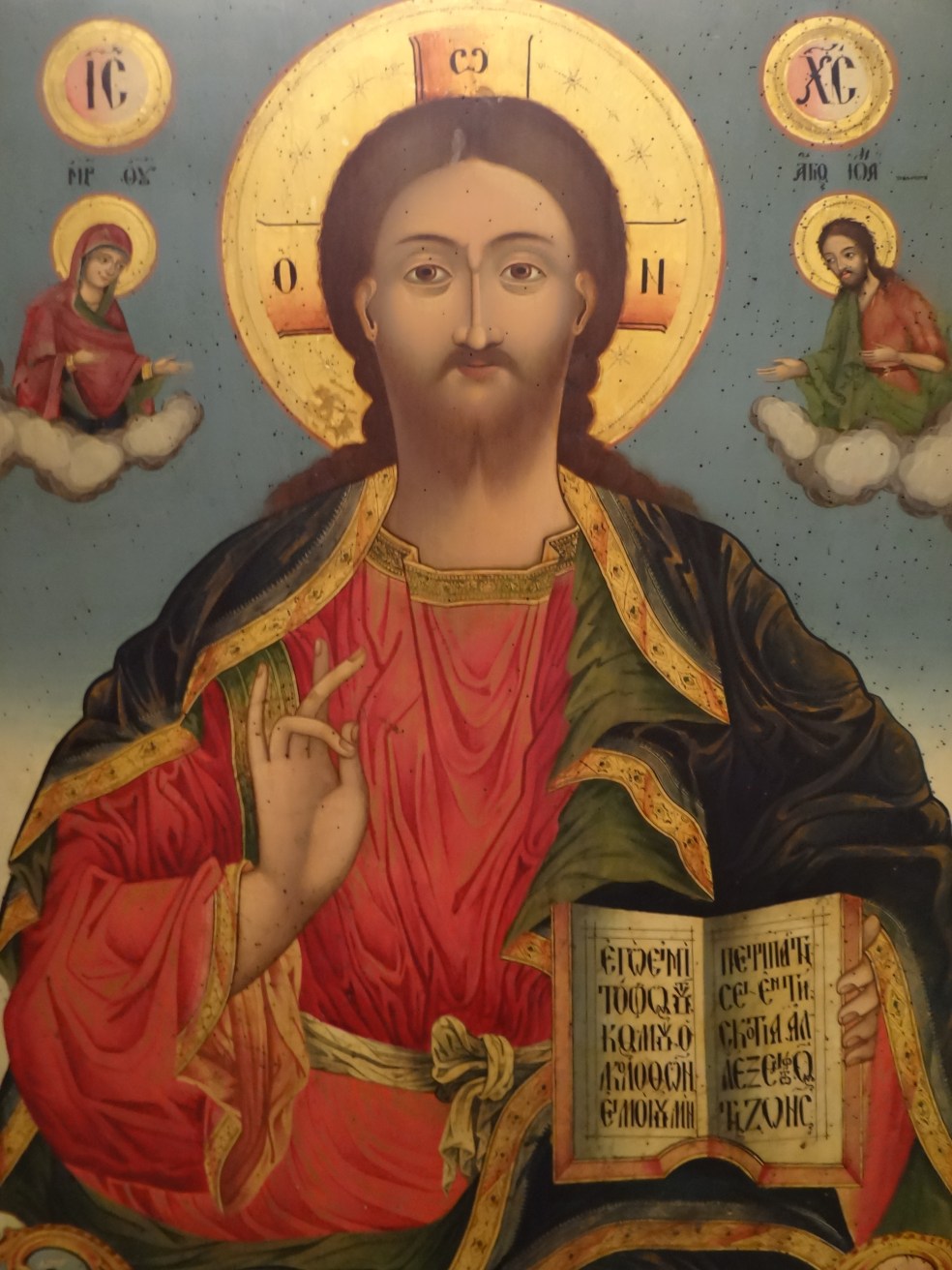
If you have ever seen an icon of Christ Pantocrator, you might have noticed that inside the halo, in the beams of the Cross, are three letters: O WN. These are Greek letters and represent the Greek Septuagint translation of a verse from the Old Testament (perhaps the most important verse in the whole of the Old Testament, in my opinion): Exodus 3:14.


In Exodus 3:14, God meets Moses at the burning bush and replies to Moses’ question who he should say has sent him to the people of Israel to free them from the Egyptian overlords:


God said to Moses, ‘I am who I am.’ He said further, ‘Thus you shall say to the Israelites, “I am has sent me to you.”’ (NRSV)


In Greek, this text reads:


καὶ εἶπεν ὁ Θεὸς πρὸς Μωυσῆν λέγων· ἐγώ εἰμι ὁ ὤν. καὶ εἶπεν· οὕτως ἐρεῖς τοῖς υἱοῖς ᾿Ισραήλ· ὁ ὢν ἀπέσταλκέ με πρὸς ὑμᾶς. (LXX)


I have underlined the names of God in the Greek text: ‘I am who I am’ (ἐγώ εἰμι ὁ ὤν) and ‘I am’ (ὁ ὢν).


O WN (ὁ ὢν) literally means ‘the being’. It is sometimes translated ‘the One Who is’. In reference to this appearance of God before Moses, when he revealed to him his name, these three letters are included in icons of Christ, because according to Orthodox tradition all appearances of God in the Old Testament are by the Logos, the Word of God, that is Christ.


But this has meaning in English because those same three letters spell OWN. We could be said to ‘own’ Christ inasmuch as we form part of his body in the Church. He is ours. But ownership in Christian terms is not about exerting control, it is about expressing love. In the same way, he could be said to ‘own’ us. He gives himself to us in the Eucharist; we give ourselves to him unconditionally. It is a two-way process.


OWN in English spells another two words: WON and NOW. Christ’s is the victory; with his Resurrection he has conquered death. The end of the world has yet to come (this is for another reason), but the victory is assured, even if it seems at certain points in our lives that the opposite is true. NOW because Christ is with us now. How does the illuminating Gospel of Matthew end? ‘I am with you always, to the end of the age.’ His presence with us is permanent.


This, for me, is the meaning of ownership: to own Christ and to be owned by him. It is not to fight over portions of the earth. It is not to draw lines (supine egos) on the ground, around our property (which one day will not be ours). It is to give ourselves unconditionally. The giving the other way round (by Christ) has already been done, and that is the meaning of time: to turn meaning into a two-way process, to make it mutual.


The destiny of our souls depends on our reaction, our acceptance or not of Christ, our clinging to the letter of the law or its spirit, its deeper meaning, its greater good. This is ownership: to react with love or anger, to claim for ourselves or for the other, to cling to self-preservation (a futile task) or to lose our life in order to find it. This is why, having found the pearl, the merchant went and sold all that he had in order to buy it.


But there is something else – something that points to Christ as the Messiah, the fulfilment of the Old Testament prophets. The name of God in Exodus 3:14 is translated into English as ‘I am’. I think the whole of existence is contained in these three letters. First of all, we should note that ‘am’ contains the first and last letters of the Greek alphabet, Alpha and Omega (AW, do not worry that the m has been turned upside down). This name is found for the first time in Revelation 1:8:


‘I am the Alpha and the Omega’, says the Lord God, who is and who was and who is to come, the Almighty. (NRSV)


The expression ‘Alpha and Omega’ is contained in the verb ‘am’ – God could have just said ‘am’, and it would have been sufficient.


Also interesting is the fact that ‘am’ in reverse gives us the Sanskrit word ma, which means ‘create’. This is because God is the Creator, it is with him that things begin (not with us).


And finally the name revealed to Moses in Exodus 3:14 and reproduced in icons of Christ, ‘I am’, gives us two other words in English. The first of these is ‘law’. I think you can see this – a capital I and a lower-case l are practically identical; again, I have turned the m upside down (this is very common in language). ‘Law’ refers to the Old Testament – the law that Moses brought down from Mt Sinai on the tablets, the Ten Commandments, about worshipping the Lord your God and honouring your father and mother.


But this law is only a preparation for the law in person, that is Jesus Christ. Of itself, it does not give life, it does not conquer death – only Christ can do this.


And we see this when we make the progression from ‘I am’ to ‘law’ to another word in English: ‘way’ (y is the semi-vowel that corresponds to i).


In John 14:6, Christ says to Thomas:


I am the way, and the truth, and the life. No one comes to the Father except through me. (NRSV)


Note how both ‘way’ and ‘Alpha and Omega’ are preceded by the pronoun and verb ‘I am’. It is as if Christ is extrapolating them, is drawing out their meaning. He is, in effect, teaching us to be translators.


Christ came down to earth for two reasons: one is to translate for us the meaning of life, and he does this using Braille (writing for the spiritually blind, that is us). His form of BRAILLE is the PARABLE (another phonetic pair is b-p).


The other reason has to do with the second part of that verse from the Gospel of John, ‘No one comes to the Father except through me’, because not only did Christ come to translate for us the meaning of life (which is to believe in him), he also assumed our human nature (we are translators) so that he could later translate us into eternal life. You cannot do this if you are only an author. You must be a translator as well (the two natures of Christ, as defined at the Council of Chalcedon).


At the end of our lives, when we reach the end of our translation, of acquiring and giving meaning, we will become the word that best defines us, and that word will be spoken by Christ into eternal life. He will translate us. This is why translation is not inferior, it is not second-rate, it is not dog-eared like a book from the library, it is the essence of human life.


The fact that we see translation in a negative way is a reflection on ourselves, not on translation. Our wish to be authors – superior, first-rate and brand-new – reflects our desire to hold on to our lives at all costs. It responds to the instinct of self-preservation. But in the end we will be required to let the Word pass through us – and to pass through him – if we want to inherit eternal life.


Jonathan Dunne, http://www.stonesofithaca.com
Word in Language (1): Countable and Uncountable Nouns

The basic unit of language is a noun. Nouns refer to people or things – nurse, firefighter, book, table. They may also be concepts, things that we cannot visualize, but that affect our behaviour – right, wrong, inflation, jealousy.


This difference between nouns referring to people and things that we can see and nouns referring to concepts we can only attempt to describe is very important. When it’s someone or something that I can point out and say, ‘That is a nurse,’ or, ‘That is a book,’ then the noun is preceded by the indefinite article a or an – a nurse, a book. This is because the person or thing exists in the world around me, I can draw the noun or indicate it with my finger, it is in front of me. When it’s a concept, we have no way of pointing it out, of saying, ‘There it is!’ And for that reason what each of us understands by the concept may be different. Concepts are not preceded by the indefinite article, unless we are talking about a specific example. Right and wrong are concepts. A right or a wrong would be a specific example that was done to me on a particular occasion (in a way, I am beginning to visualize the concept and to point it out, which is why I use the article).


I am interested here in nouns that we can visualize – people and things – because the fact that I can visualize the noun, I can see it with my own two eyes, means it is somehow separate from me, or at least I consider it to be somehow separate. If I refer to a book, for example, it is a book on the shelf or a book on the table. I am standing in the room and pointing to it. I may even pick it up. But I can put it down again and walk away. So it is separate.


We might say that I can draw a line around it. Let us look at the example of light. Light as a concept is uncircumscribable, I cannot draw a line around it. In a sense, it can contain me, but I cannot contain it. But if I talk about a light (with the indefinite article before it), then I have contained light in a bulb or a torch, for example. The expression ‘Give me a light’ refers to a single light emanating from a matchstick, not the concept of light – I am not asking you to illuminate my world, just to provide me with an example of fire that will burn out eventually.


This difference between light as a concept and an example of light (a bulb, a torch, a matchstick) is the difference between an uncountable noun (the concept) and a countable noun (an example of that concept). Countable nouns can have a line drawn around them, they can be made separate from ourselves, they have a beginning and an end. Uncountable nouns – the concept at least – are eternal.


But let us turn our vision to ourselves. We are countable nouns. We come into existence. We are born of our mothers – a bundle of flesh that emerges from the womb. You can draw a line around this and say, ‘That is a child.’ Countable nouns, by definition, can be counted. We can count the children in a family or in a class. Each child sits on a chair at a desk. The chairs and desks can also be counted. They can be separated one from another, or piled into a stack.


I would like to suggest that this is what God did in creation – he created separate beings, Adam and Eve, separate creatures, trees and plants, each one of which was an example of that particular species. He created countable nouns, nouns that could have a line drawn around them, as in a child’s drawing. A man, a woman, an oak, a leopard… a word (because he created the world by speaking). All separated off from himself, endowed with its own specific qualities and characteristics. We ourselves imitate this process – when we speak, we emit words, separate beings that once spoken cannot be retrieved.


And he endowed us with free will. In fact, I would go so far as to say he created separate beings, countable nouns, precisely with that purpose, so that they would have free will, because if a human or a rabbit was part of him, it would not be able to function independently (within the limits of its species) and so would resemble a machine.


So, in the case of God, I would say this separation into countable nouns had a noble purpose, a purpose which he has given us to proceed (we create our own children, animals produce their own offspring, trees produce seeds).


If I could just refer to language, the name of God that he reveals to Moses at the burning bush in Exodus 3:14 is I AM WHO I AM, which we can shorten to I AM, or simply AM. One of the seven phonetic pairs – pairs of consonants that are pronounced in the same part of the mouth – is m-n. If we apply this pair to AM, we get AN, the indefinite article, and together they give A MAN. This is just a coincidence.


So man (I am talking about the concept here, not a particular individual) has been given the ability to create separate beings, just as God did. We can create a child, a light. We can build a house. We can write a book. But what we cannot do is create a concept. We cannot create a new species (we can create hybrids). And we cannot create light.


That is, we can use the ingredients, the things that are already provided for us, and transform them into something else, but we cannot provide the ingredients. Put simply, this means that we are translators – we take what is given to us and we transform it into something else. We are not authors.


And if we are not authors, because nothing begins with us, nothing proceeds from us, things pass through us, then this means that the concept of ownership is flawed. Things do not belong to us. Or rather only our response to them does, the way we choose to use them, and this is what constitutes our free will.


I think this difference between countable and uncountable nouns is very important because at one point I would like not to have a beginning and an end, I would like to be immortal, but to do that I must participate in a concept – God – that is uncountable, who is capable of creating new ingredients. I cannot do this on my own. I cannot make myself uncountable. Only God can do this by allowing us to participate in his energies.


And secondly it is our claim to ownership that gives rise to the system of capitalism, whereby we take the products that have been (freely) given to us and package them in order to sell them at a cost. This turning concepts such as flour or oil, metal or wood, into something sellable involves making them countable (otherwise how can I transport them, and how can I charge you for them?). So I create a bag of flour, a barrel of oil, a car or a table. I use the concepts that were put there by God, I transform them (because this is my purpose: to translate), but then I sell them, and as soon as I sell them, I must draw a line around them in the form of packaging. It is the waste product of this process that causes our environment so many problems. It is, in effect, the waste product of our own definition.


When we treat the other as a source of profit, we have distorted God’s purpose. God gave us the other, a separate being, as a source of joy, to learn how to love (not to learn economics).


One final word connection. The Greek word for ‘God’ is THEOS. We saw in the previous article on the Coronavirus that LOVE is connected to OTHER. If we take a step in the alphabet, r-s, we will see that OTHER is connected to THEOS. So the other is God. When we see them as part of ourselves, we participate in them, the dividing lines are broken down and we become separate, but also one.


Jonathan Dunne, http://www.stonesofithaca.com