

God is no one, just as he is nowhere. NO is the result of the progression from the name of God in Exodus 3:14 – AM – through the selfish I’M to OM if we apply the progression AIO that we studied in the last article. OM is famous as a mantra, but I actually understand it to refer to the Holy Trinity if we rotate the final letter, m, and make it into a number, 3: O3.
This is because God, who is often represented by the eternal figure O, is made up of three persons: Father, Son and Holy Spirit. If we then apply the phonetic pair m-n to OM, we get NO, the reverse of which, with the addition of final e, is ONE: NO ONE. This is why I can say that God is no one, just as he is NOWHERE, which we take to mean that he is nowhere to be seen, but which also has the meaning NOW HERE.
If God is no one, the translator is no man. He does not exist, he is ignored, he is paid little or late or not at all, his name is often omitted (sometimes deliberately) from the texts that he has translated lest we realize that what we are holding is not original. Yes, but everything we are holding is not original, only God is original, and we cannot hold him.
The translator does not believe in the line that separates people and things. So what does he do? He goes to live on this line that he does not believe in and, like a tireless spider working in the night, he stitches the line, criss-crossing it until it is healed.
The translator is no man. He lives in no man’s land, between the opposing forces who have laid claim to the land. He doesn’t lay claim to the land, he spends his time endeavouring to stop the fighting, he raises his arms, he puts himself in the firing line, just as Christ did on the Cross. Christ is God, but he also became a translator when he assumed our human nature. By living on the line, which is how time is represented, the translator acknowledges the line, yes, but his attention is placed on the space underneath, the whiteboard, which represents eternity and without which a timeline cannot be drawn. That is to say that time cannot exist without eternity because otherwise there is nowhere to draw it.
God is no one – O1 – but in chemistry the subscript 1 is not normally included, so we can say that God is O. We see this in the Greek word for ‘God’, which is theos. In modern Greek, the final s is often omitted, as it is in the vocative case, when we call someone’s name. If we omit the final s of theos, we get THEO and, if we introduce a space, just as we did with NOWHERE-NOW HERE, we get THE O. God is ‘the O’.
The word ‘God’ itself is made up of three Os: G O D. All three letters resemble a circle. And here is a remarkable discovery, because if we add the letter W to the beginning, as we did in the previous article with HOLE-WHOLE, we find the word WOOD. WOOD is made up of three Os, with the number 3 representing the Holy Trinity at the beginning. The relevance of WOOD to Christianity is obvious, I think.
In fact, in an earlier article, we talked of the connection between TREE and THREE (addition of breath or h) and how a simple child’s drawing of a tree will show a trunk and two branches, which can be likened to the Father (the trunk), the Son (begotten of the Father) and the Holy Spirit (which proceeds from the Father). In this analogy, we see the incorrectness of affirming in the Creed that the Holy Spirit proceeds from the Father and the Son, as is done in Western Churches – this would make the Holy Spirit a sub-branch of the Son, which it is not, and would make the drawing a little lopsided. The Holy Spirit proceeds only from the Father, as is correctly stated in the Orthodox Creed. All three share the same essence (in this analogy, that is WOOD).
Church Fathers sought an adequate analogy for the Holy Trinity. St Spyridon, whose relics are in Corfu Town, at the First Ecumenical Council in Nicaea in 325 is said to have demonstrated how one can be three by taking a potsherd or a brick and squeezing it. As he did so, fire rose into the sky, water dripped down to the ground and only clay was left in his hand. Thus he demonstrated how the three constituent elements – fire, water, clay – could be one, and one could be three.
St Gregory the Theologian, at the end of his famous Fifth Theological Oration, likens the Trinity to an eye, a fountain and a river, but is ultimately dissatisfied with the analogy. St John of Damascus, in his Exposition of the Orthodox Faith (I.8), likens the Trinity to three suns ‘cleaving to each other without separation and giving out light mingled and conjoined into one’.
But I wonder if language has something to teach us about the doctrine of the Holy Trinity, which is said to be three in one. Three in one.
How can there possibly be three in one? We will have a better idea if we write ‘three in ONE’. Do you see how the only number that ONE does not contain is itself: 1? It contains 0, 2 (on its back) and 3 (back to front), but it does not contain the number, 1, that relates to the ego. This is because, as I have already mentioned, the subscript 1 is omitted in chemistry.
In this analogy of the number ONE containing the three numbers 0, 2 and 3, God the Father is O(1) – or no one; God the Son is O2, the chemical formula for oxygen, what we breathe; and God the Holy Spirit is O3, the chemical formula for ozone, the layer that protects us from the Sun’s heat.
So the Holy Trinity is literally three in ONE: O(1), O2, O3.
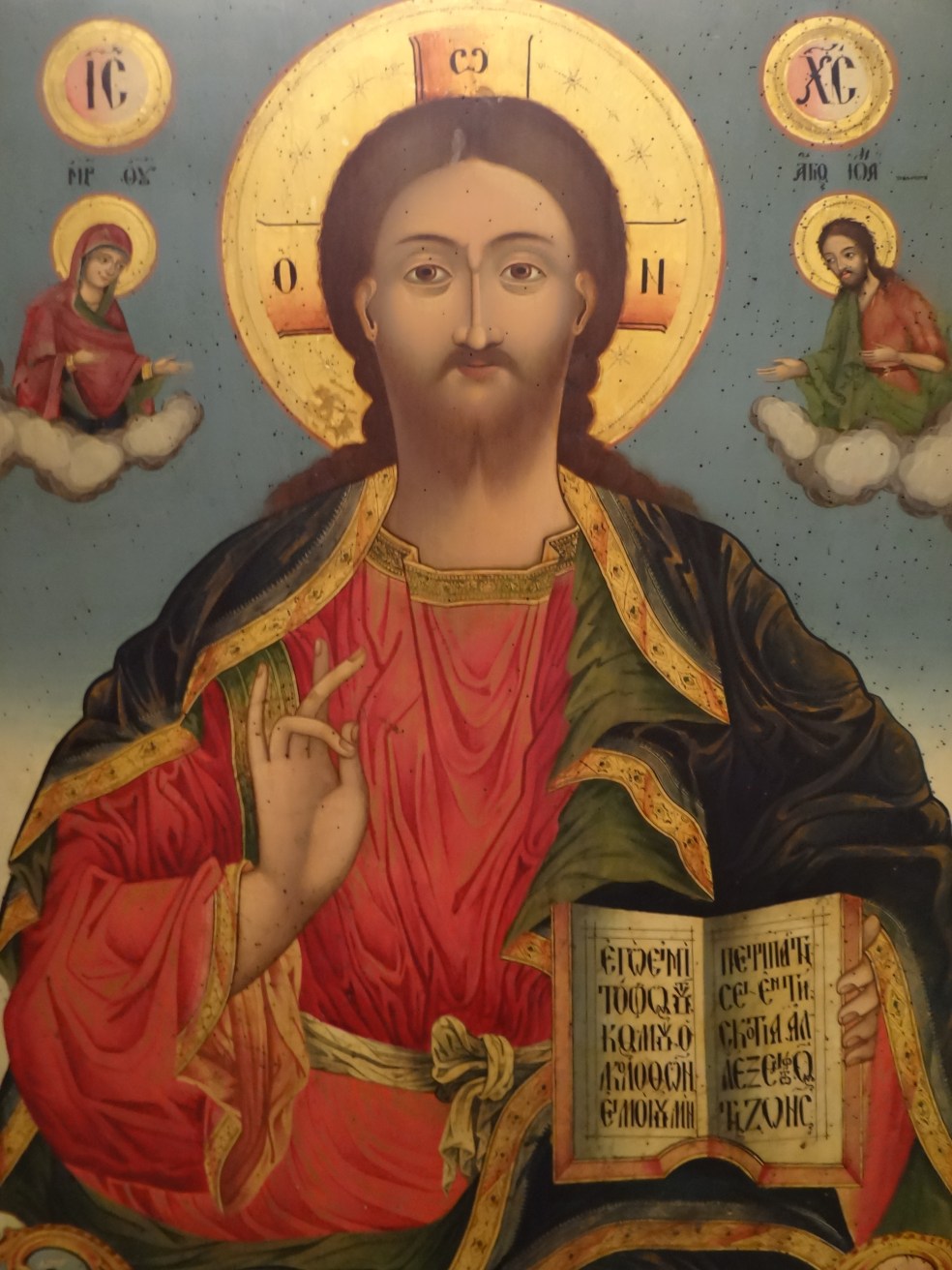
We may also notice that these three letters – ONE – resemble the letters that appear in icons of Christ Pantocrator – O WN – the Greek Septuagint translation of the name of God in Exodus 3:14, I AM. We only have to rotate one letter.
This is normal, we should expect it, because Christ does nothing without the cooperation and agreement of the other two persons in the Trinity, the Father and the Holy Spirit. They are one.
We may also notice the correspondence between SON and SUN. Christ is not only the Word that we speak, not only the oxygen that we breathe, he is the light that fills our world and enables us to live. You might think that I am making this up. One of the phonetic pairs – pairs of consonants that are pronounced in a similar way in the mouth – is b-p. There is a similar correlation between LAMB and LAMP. And if we observe that the c in Christ is pronounced k and apply the phonetic pairs g-k and l-r, we will find that LIGHT is in CHRIST – just as CHILD is (phonetic pair d-t) – with the addition of the letter s.
It is St John the Baptist who, seeing Christ approach, declares him to be the ‘Lamb of God’ (Jn 1:29). We have already seen how he is the confirmation of the Old Testament when he declares, ‘I am the way, and the truth, and the life’ (Jn 14:6), because WAY is I AM.
Here is further proof that Jesus Christ is who he declares himself to be, because if we take the name of God in Exodus – ‘I am’ – and join the two words together, we get ‘lamb’ (I have changed capital I into lower-case l, the two are practically identical; the final b of lamb is silent). The word ‘lamb’ is the logical continuation of ‘I am’.
Language is genetically encoded. It contains information about God, about human life, about the environment. It is a question of putting it under the microscope and obeying a simple set of rules (the seven phonetic pairs, changing letters according to their position in the alphabet or their appearance). That is all, but most people, if I talk about this, give me a nervous look and start to edge away. If I talked about etymology, the academic science of the evolution of words over time, they would nod sagely and feel themselves to be on safe ground. But etymology will teach us far less about God and the meaning of life than word connections. It is just a question of belief, because faith in Christ cleanses our spiritual vision. In Orthodoxy, great emphasis is placed on vision, as it is on deification, the process of becoming gods by grace through the acquisition of humility and the alignment of our will with God’s.
SON-SUN, LAMB-LAMP, CHRIST-LIGHT. Christ warms us by day and reflects his light at night. How so? If God the Son is O2 and God the Holy Spirit is O3, then we can see that they combine to make the MOON (2 on its back, 3 on its front). The Holy Spirit is often likened to breath. Christ breathes the Holy Spirit on his disciples in John 20:22 – he is able to do this not because the Holy Spirit proceeds from him, it does not, but because he is the Word and breath forms part of speech. The letter for breath is H. If we combine this symbol for the Holy Spirit with the symbol for Christ, O2, we get H2O, the chemical formula for water. I would say that the MOON and water (H2O) are – literally – a combination of Christ and the Holy Spirit. Without God, we have no life – we will not breathe, eat or drink, language shows us this – but so often we choose to ignore him.
We seek fulfilment in other ways, often in earthly ways. We may not even acknowledge the spiritual side of things. And yet language has one last thing left to teach us – language, which is made up of breadcrumbs, fragments of the Word. We have come across six of the seven phonetic pairs, pairs of consonants pronounced in a similar way in the mouth, one of which is m-n. We have seen that it is common to add the letter h in word connections. The letter h represents breath. When we add h, we are literally inflating the word a little, like a balloon, so it will take flight.
If we apply the phonetic pair m-n, addition of h, to ONE, what word do we get?
HOME. The Trinity – ONE – takes us home. All that searching in different directions, and the answer was right before us. God is NO ONE. He is NOW HERE. All we have to do is open our mouths, shuffle our feet a little, bow our heads – and breathe.
Jonathan Dunne, http://www.stonesofithaca.com
 Stones Of Ithaca