
Turner’s painting Seascape with a Yacht (?), c. 1825-30, is somewhat cursorily dismissed on the Tate Gallery website. It doesn’t get a display caption, like most of the paintings. There is a catalogue entry, but it is short and rather scathing – “thinly and freely painted […] lack of drama and small size” – and ends: “There are some losses down the left-hand edge and particularly at the top corner. The picture has not yet been restored.” No wonder it wasn’t put on display.
There even seems to be uncertainty about the title (that question mark in brackets) and about the date (circa a period of five years). Everything points to a painting unworthy of our attention. And yet it is the gift of the poet to see something extraordinary in the ordinary, and in her book Turner and the Uncreated Light the Bulgarian poet Tsvetanka Elenkova does just this. Let us look at the painting:
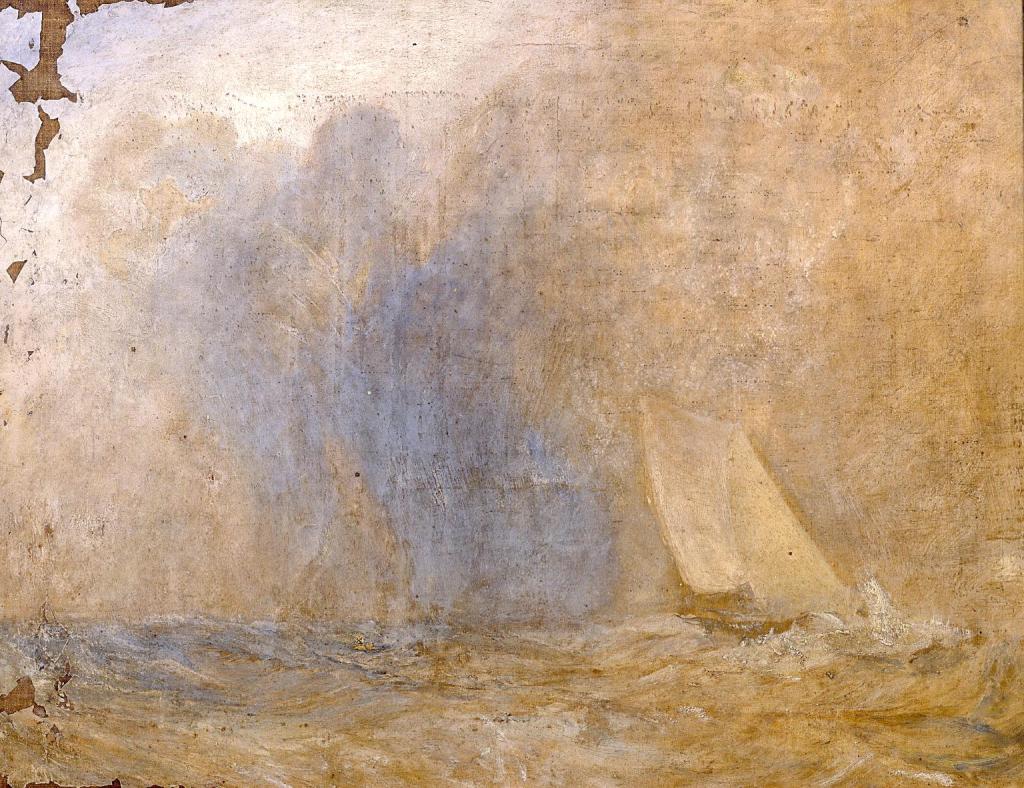
Not much, right? A splodge which is falling to pieces. There appears to be a yacht (is it a yacht?) on the right, and some waves. But the poet has noticed the predominantly ochre colour of the painting. The sea looks less like a sea than a desert. The yacht she understands to represent the people of Israel crossing the desert. And that tall white wave at the bow of the yacht she takes to be the prophet Moses.
Then she draws our attention to the large blue area in the left half of the picture, standing, as it were, on the waves. She understands this to be Archangel Gabriel. We can see the fold of his tunic where it crosses on his chest, in a lighter colour. Out of the tunic appear his neck and head. He is looking towards the yacht, watching over the people of Israel as they make their way to the promised land. Behind him (again in a lighter colour) we can see the outline of his wings.
It may help at this point to reproduce a fresco of Archangel Gabriel found in the medieval Church of Sts Peter and Paul in the old Bulgarian capital Veliko Tarnovo (in central Bulgaria) because there is an obvious similarity between the two images:

Again, the tunic is folded over on his chest. The angel’s skin is darker than the cloth of the garment. And we can see the outline of his wings. He is writing on a scroll (“Wash yourselves and be clean learn to do good”) – perhaps that is the meaning of the dark blue patch to the right of the angel in Turner’s painting.
And in the painting she also sees a horse’s head in the ochre sky above the yacht and slightly to the right. It is possible to make out the horse’s eyes and nostrils. Admittedly we can always disbelieve. Then the magic of the painting begins to recede, and we are left with a tattered painting. But the poet’s vision is so much richer. Here we have a depiction of the Exodus – this is why the painting has not been restored, we haven’t got there yet. We are on the way, a prophet leading us, a guardian angel over our shoulder. As with the other paintings, not for a moment do I think Turner consciously painted these things. It’s just he received the same inspiration as the painter of the fresco in a church in central Bulgaria several hundred years earlier. It is the same Spirit working through him.
Jonathan Dunne, http://www.stonesofithaca.com
 Stones Of Ithaca
Hi Jonathan, interesting. There was a program on Sky Arts recently called Decoding Turner on this subject. The pictures shown were not those in your blog and were a lot less convincing but it is an issue, and they did not seem to find a satisfactory explanation, if I remember correctly. I understand Turner was not beholden to religion, but maybe missed out the middle man and found spirituality directly in his subjects. I get my symbolism in dreams, maybe he saw his in landscapes? Best Wishes.
LikeLike
Dear Tony, thank you for your comment. I didn’t know about this film, “Decoding Turner”, since I live in Bulgaria, but I will try to watch it after I have finished translating the poems from Tsveta’s book. It’s interesting that different people miles apart have both chosen to focus attention on this hidden aspect of Turner’s paintings. What for me is always a question is the extent to which Turner was aware of this hidden code, these figures “hiding in plain sight”. I think the Spirit works through us, and sometimes we are conscious of this, other times we aren’t, but the content is still there. For me, it started with faces on rocks, a hidden meaning in the words that make up language, and now Tsveta’s work on Turner (though she wrote the poems a couple of years ago, I am only translating the second half now). I think the Spirit blows where it will, and it’s not a question necessarily of being a fully paid up member of a religious congregation. I’m always reminded of the film “Amadeus”, in which a young Mozart is depicted as a rude philanderer – not to mention the fact he was buried in a pauper’s grave – and yet he produced the most incredible music. I also remember shortly after I arrived in Bulgaria, I used to go for walks in the local forest and would meet a man wandering around the forest who clearly had his eyes on another dimension. I wasn’t sure what this dimension was, but I could see he was seeing “something else”. Whether one belongs to an established religion, for me, is a personal choice that each one has to make, but I don’t think God is limited by our understanding. He works where he will. Best wishes, Jonathan
LikeLiked by 1 person