Word in Language (15): AIO (0)

Ideally, human life, like the Greek alphabet, should be a progression from the letter A to the letter I to the letter O: AIO.


A represents the act of creation described in chapters 1-2 of the Book of Genesis, in the beginning, when God created the world. It is the first letter of both the Greek and Latin alphabets, so it represents the first act in the history of time, the first thing we have to write about.


We already saw that the name God reveals to Moses at the burning bush in Exodus 3:14 is AM (in this word we see both the A and the O – the latter written W, like the Greek letter omega – because God stands outside time, of which he is the beginning and the end). AM created AN, the indefinite article, the article that is used for countable nouns, for nouns that we can see and draw a line around, that we can separate from ourselves and give free will. AM and AN combine to give A MAN, whose name was Adam.


ADAM also contains the name of God in Exodus 3:14 – AM – as well as both ways of writing the final letter of the Greek alphabet: O/W (D closely resembles O, M is an upturned W). It is as if the new Adam is already present in the old. These two ways of writing the last letter of the Greek alphabet, O/W, can be used to describe the Holy Trinity: O3, or 3 in One. Adam is not a chance name assigned to the first human, it has the imprint of God stamped all over it.


ADAM in reverse reads MADE, just as EARTH in reverse reads THREE (because it was created on day three and is the third planet in order of increasing distance from the Sun). Adam was made by God, who shaped him from the dust of the ground and breathed the Holy Spirit, the Spirit of life, into him.


Adam’s task was not to create all the creatures, it was to name them – that is, to translate – and we see this purpose accorded to Adam in the reverse of MAN, which is NAME (with addition of final e, very common in word connections).


Now NAME, if we rearrange the letters, spells MEAN and AMEN. When we name someone or something, we give them meaning. We acquiesce in the process of God’s creation, we accept our role in the same, and say AMEN.


But, in chapter 3 of the Book of Genesis, Adam and Eve were tempted to eat of the fruit of the tree of the knowledge of good and evil. See how EVE is already taking us away from the letter A and towards the letter I. If we apply the physical pair (pair of letters that look alike) v-y to EVE, we get EYE, and EYE sounds the same as the letter I (which, if we rotate it by ninety degrees, represents a closed eye).


We can see this progression away from the letter A towards the letter I in the name of the garden where Adam and Eve lived, EDEN, which is connected to ADAM by the phonetic pair m-n and the pair of vowels a-e.


With the Fall, described in chapter 3 of Genesis, we have turned our attention away from God and towards ourselves. The Fall corresponds to time. It is the era we live in, the timeline drawn by a teacher of English on a whiteboard, the letter I, when despite being surrounded by all of God’s goodness – the earth and all it contains – we think we can do very well without him (despite the fact we could not even breathe without him).


So, instead of calling on God, AM, we start to say I’M. Instead of saying AMEN to God’s commandments, we lay claim to our surroundings and say MINE. We have made the progression from A to I. This means that, while our physical eyes may be open, our spiritual eyes are closed: I.


Put three of these Is together, and you get the word ‘ill’, a triple ego if you like. We are spiritually sick because we have detached ourselves from the source of all goodness, the Holy Trinity. If you don’t believe me, look at what happens if we make the progression from A to I to I: we get the word ‘ail’. But God in his ineffable mercy always offers us a way out, because if we add breath to the start of this word and slightly alter the vowels, ‘ail’ gives rise to ‘heal’.


We saw in the article Alpha and Omega that one of the ways to escape the ego, I, is to treat it as a number, 1, and to count down to 0. This can be likened to opening our spiritual eyes: I to O. We turn our hearts to God in repentance, we realize we cannot live without him, or at least our life is ultimately without meaning if we do not live in, for and with him. This is the purpose of human life – to realize our need. There is nothing wrong with this. We sink to the bottom of the overturned pyramid, to use St Sophrony of Essex’s image, we descend into the hell of uncertainty and emerge the other side, strengthened and joyful.


Now, instead of saying I’M, we say OM, but I do not mean the mantra, I mean the Holy Trinity: O3. We redirect our sight away from ourselves to the centre of all being.


We saw in the article Chemistry that God the Father can be written O1, or no one. OM is connected to NO by the phonetic pair m-n, and ONE is NO in reverse with the addition of final e. So when we turn away from the I with all its hereditary fears and selfish demands, instead of saying I’M, we call on NO ONE, as we were meant to do because we are human.


The name of God is spread throughout language – language is insisting, albeit unobtrusively, that salvation for ourselves lies in calling upon God, but it must be a question of free will, a freely taken decision. We are given all the time in the world to make this step.


Instead of saying MINE, we say NEMO, which is the Latin word for NO ONE, or OMEN, a sign for the future, perhaps.


We make the progression from A to I to O, the progression of human life, which involves committing a mistake (or many mistakes) and then owning up to it.


AM – I’M – OM/O3/NO ONE


AMEN/MEAN/NAME – MINE – NEMO/OMEN


Now perhaps I have just made this all up. Well, not exactly. We also saw this same progression from A to I to O (AIO) in the question words WHAT – WHY – WHO.


‘What?’ is the question word of Creation: what is this creature? What will you call it?


‘Why?’ is the mantra of modern society, of the Fall: why should I do this? Why should I believe you? (‘Why?’ simply indicates a lack of obedience.)


The real and only valid question is ‘Who?’ (or ‘How?’, it makes no difference), and the answer is Jesus Christ. We see this progression in the Hebrew Tetragrammaton, YHWH, which corresponds to WHY, and in the Greek Septuagint translation of the name of God in Exodus 3:14, O WN (or O WH), found in icons of Christ Pantocrator, which spells WHO and HOW. We have made the progression, we have gone from the letter of the law to the spirit of the law, to the law in human form.


WHAT – WHY – WHO/HOW


Another example. The name of God in Exodus 3:14 is I AM, which gives us ‘law’ if we apply the physical pairs i-l and m-w (one letter is an extension or a reversal of the other). We associate LAW with the Old Testament, a set of rules which must be blindly followed, even to the detriment of people (for example, not healing on the Sabbath). This LAW, as we all know, can be a WALL. It protects us, but it also stands as an obstacle, especially when it is the letter of the law – and not the spirit – that is being applied.


If we make the progression from A to I, from LAW we get WILL: we apply our own will. We don’t obey the commandments to love the Lord our God with all our being and to love our neighbour as ourself. We seek our own will, we place ourselves – our profit, our comfort, our status – above the other and pursue our own self-interest. We have gone from the PROPHETS of the Old Testament to an obsession with PROFITS, as if the purpose of human life was solely to make money. It is not. The purpose of human life is to turn to God and, in God’s love, to show concern for our neighbour. That is to restore God’s image in us, to become properly human. We see many examples of this transformation in our everyday lives.


The Church Fathers, including St Sophrony, are always talking about God’s self-emptying (or kenotic) love. We imitate this love, taking ourselves – the I – out of the equation, opening our arms, making space for the other. We humble ourselves (St Sophrony goes so far as to speak of self-hatred). And what is the position of humility? It is LOW. We give space to the other, we ALLOW them. Instead of saying WILL, we say WON’T.


LAW/WALL – WILL – LOW/ALLOW/WON’T


Language is clearly indicating to us the path of repentance for those who wish to follow the example of Christ. I don’t know how to make it any clearer than this, but I will give just a few more examples. Note that all these examples of the progression AIO are between words. There are also examples of the same progression inside words, and we will see some of those in the next article.


Here is one of my favourite examples. In the Garden of Eden, there was no competition: DRAW. The ethos of our modern society, with its competition and counting up from the number 1, is to WIN. But Christ came along and told us to LOSE our life for his sake in order to gain it (Mt 10:39). Look at the vowels, and you will see the progression of repentance.


DRAW – WIN – LOSE


Losing, as we have seen, can be a frightening experience because it looks as if we are condemning ourselves to self-extinction, but I have likened this to the process of translation, where in order for a text to appear in another language, it must first disappear in the mind of the translator. This, for me, is what death is. It is a matter of having faith in the Translator.


Another favourite example. The SWAN may be taken as a symbol of purity. Certainly, it is very white. On the contrary, SWINE are a symbol of filth, the filth the Prodigal Son found himself literally rolling in when he was reduced to feeding his neighbour’s swine after he had wasted his father’s inheritance. What word will take us to the O of repentance? It is said that no one flake is ever the same. It falls out of the sky and alights on our nose. When we step in it, it soon becomes slush, or it can become frozen and cause us to slip, but newly fallen it transforms the landscape, turning it white again, forming a blanket under which Nature has a chance to rewind. I am talking about SNOW, of course.


SWAN – SWINE – SNOW


And one last example. The creature I most associate with the depths of history is WHALE, this creature that swims the world’s oceans and seems to have been doing so ever since the beginning of time. It is a creature I associate with the Creation, primordial and wise. What word do I get if I make the progression from A to I? WHILE, which corresponds to the process of time, time which has been spread out like a carpet for us to walk on while we make up our minds. And if I count down from the ego and make the progression from I to O? I become WHOLE, a combination of the Old Testament name of God, El, and O WH.


WHALE – WHILE – WHOLE


We already saw other examples of the progression from the I of the Fall to the O of redemption: LIVE-LOVE, SIN-SON and CHRIST-CROSS.


Language is urging us not to count up, not to make out that we are the owners of everything in existence. We are not. We are here to act as vehicles of love, to become sons, children of God, to lose our life for Christ’s sake on the Cross in order that we might receive everlasting joy in the resurrection.


Language confirms this. The Greek alphabet does the same, it provides the example. We may associate this with Eastern spirituality (for me, that is Orthodoxy) or with kenotic love and spontaneity, which doesn’t count the cost. There is another example, however, and I’m afraid it is provided by the Latin alphabet, which may be taken to signify a greater reliance on reason. Reason always counts the cost.


And that is because the Latin alphabet, instead of counting down from I to O, as the Greek alphabet does, counts up: from I to Z. This means that you have taken everything that was created, A, and used it for yourself.


Jonathan Dunne, http://www.stonesofithaca.com

Word in Language (14): Auxiliary Verbs

We live in the white space of eternity, but we cling to the line of time. It is extraordinary that the word TIME contains DIE (phonetic pair d-t, addition of m), but if we take a couple of steps in the alphabet it also gives LIVE (alphabetical pairs l-m, t-v). We have seen how it also contains MEET and DENY – this life on earth is our chance to meet Christ or to deny him, it is as simple as that. This is the purpose of life – do we choose to count down from the ego, I, to God, O, or do we prefer to attend to our own self-interest and to amass possessions by counting up from the ego, I? Once you start counting up, there will be no end, and we have seen how the English alphabet does this – it goes from the letter A to I to Z (1 to 2), it starts to count up, which may be seen as signifying a Western rational way of thinking, counting the cost, whereas the Greek alphabet, which may be taken to signify a spiritual way of thinking, a spontaneous response, counts down, it goes from the letter A to I to O (1 to 0, or omega).


This is very telling. We somehow have to escape the line that is represented by the ego, I, or by the timeline. LINE is close to MINE (alphabetical pair l-m) – when we draw a line, we are limiting ourselves, laying claim to possession, fencing ourselves in. We may find that the LINE leaves us ALONE, whereas in fact we are ALL ONE, and the one we have in common is God.


We see our life on earth in terms of the tenses: present, past and future. How much time do we spend in the present? Perhaps not very much, we are always thinking about events in the past or worrying about the future.


An example of the present tense is ‘I live in London’ or ‘I like to visit Hyde Park on a Tuesday’. It is used to talk about routines, actions or states that we consider to be fixed.


If we want to ask a question or to make a negative in the present, we have to use what is called an auxiliary verb – a verb that ‘helps’ us to ask the question or to make the negative – and the auxiliary verb for the present is ‘do’: ‘Where do you live?’ ‘I don’t like going out in the dark.’ We cannot ask a question or make a negative without the auxiliary ‘do’, or we will sound a little foreign: ‘Where you live?’ ‘I not like going out in the dark.’


Auxiliaries are a feature of the English language. Other languages like Ancient Greek and Bulgarian have little particles that enable the hearer to understand that what is coming is not a statement of fact, but a question: ‘ara’ in Greek, ‘li’ in Bulgarian. Languages like Spanish use intonation. ‘You live in Madrid?’ with a rising intonation informs the hearer that this is a question. I’m not telling you, I’m asking. But English has need of auxiliaries.


So it is in the past, and the auxiliary is the same: ‘I went to school in Clapham.’ ‘Where did you go to school?’ ‘I didn’t like it very much.’


So ‘do’ is the first auxiliary. ‘What do you do for a living?’ ‘Do you often come here?’ ‘Don’t talk to me like that!’


The auxiliary for the future is ‘will’. This little word expresses intention or a prediction: ‘I will come and help you.’ ‘I think it will rain at the weekend.’ ‘Will you tell me what it is?’ Whereas the auxiliaries in the present and past – ‘do’ and ‘did’ – are only used to ask questions or to make the negative, in the future the auxiliary must also be used in positive statements – precisely to signify that it is the future: ‘I come to lunch on Tuesdays, but next week I will come on Wednesday.’


We have seen how language encourages us to think in terms of the collective, not in terms of the individual, and the future provides us with a wonderful example because if we contract ‘I’ and ‘will’ we get ‘I’ll’ – this is a way of talking about plans in the singular – whereas if we contract ‘we’ and ‘will’ and think about the future in terms of the plural, we get ‘we’ll’.


Language appears to be telling us something: ‘I’ll’ and ‘we’ll’. I’LL and WE’LL. Take away the apostrophe that indicates a contraction and you have ILL and WELL. Isn’t this language telling us to think in terms of the plural? We might also notice that ME becomes WE when we turn the letter M upside down (physical pair m-w). And what is the plural of ‘you’ (think not how the word is written, but how it sounds)? Why, ‘us’ of course!


There is an aspect – the perfect – that we can apply to the tenses we have talked about, the present, the past and the future. This perfect aspect has the amazing ability to connect the tenses, to join them together, but our emphasis is still very much on the line.


For example, imagine that I started to live in London in the year 2000. It is now 2020, and I still live in London. You have a past – I moved to London in 2000 – and a present – I live in London now. What if you want to join them together? You can only do this by using the perfect, the auxiliary for which is ‘have’: ‘I have lived in London for twenty years.’


Imagine a point in the future: when you get home. I want to say that between now and the point in time when you get home, that is between the present and the future, I am planning to finish baking a cake. I will say, ‘By the time you get home, I will have baked a cake.’ There is the perfect again, by means of the auxiliary ‘have’, and it connects two points along the line, the past and the present, the present and the future, even the past and a point further back in time: ‘When you came to visit me, I had already put the things away.’ Before that point in time when you turned up, I had performed this other action, between the past and a point further back in time (when I got home from the office, for example).


Well, after that short lesson in grammar, we are equipped to say that the auxiliaries that cover the timeline are ‘do’, ‘will’ and ‘have’.


But doesn’t this tell us something about how we approach time, our lives on earth? Because the first auxiliary, ‘do’, refers to activity – we must always be busy. The second auxiliary, ‘will’, refers to intention – what I want. And the third auxiliary, ‘have’, refers to possession – how much I have. Couldn’t this be said somehow to sum up our approach to life: what I do, what I will and what I have?


This is because we are clinging to the timeline. We are like vines on an arbour or shellfish on a submerged pillar. We cling to what we know. And what we know is what we can see in front of us, what we can lay our hands on. But there is so much more. There is the enormity of space, to start with. There is also the enormity of ourselves – isn’t the kingdom of heaven within us? There is the enormity of our hearts, of our reaching out to one another, of the many examples of endurance and selflessness that humanity has shown. There is the moment when, albeit we are busy or tired, we take time out to focus on the other’s need. We shift away from the timeline, we take a step over the abyss. We enter the white space of the whiteboard. We realize that the battle has already been won and we are picking up the pieces. We step outside of time and into the light. We cease – for a moment – to linger on the past or to harbour concerns about the future. They are always only moments – the past and future quickly reclaim their place, like a tide coming in. But there are moments when we can separate ourselves from the timeline and enter eternity. We are in eternity. Now.


And what is the fourth auxiliary that is used to represent the continuous aspect, to talk about the moment? It is ‘be’. ‘Where are you at the moment?’ ‘I am sitting in the garden.’ Enjoying life, focused on the here and now, amazed by the wonder of it all. Isn’t this life? Amazement at the other, amazement at ourselves. Little coins that jingle in our pockets. Coins that are like suns, shimmering in the light.


Faith is stepping off the line. I don’t have enough money, I don’t have enough time, I’m too busy, I can’t do it for you, otherwise…


Faith is being quiet. In the moment, when we prise the timeline open and expand it, blow a little air into the bag.


When we expand the moment, we use ‘be’ (a word that we have seen is connected to ‘we’ and is contained in both ‘die’ and ‘live’). ‘I was reading a book when you arrived’ (I was unaware of time). ‘We will be waiting for you when the train arrives’ (the train will pull up alongside the platform, but we will already be out of time – waiting for you). ‘Be’ takes us out of time – it is used for actions that may be temporary (‘I am living in London at the moment, but next month I may not be’), continuous (‘we were walking alongside the river when it happened’) or repeated (‘I have been trying to get hold of you for ages’). It takes us away from the apparent security of our own efforts (‘do’), our own wills (‘will’) and our own possessions (‘have’).


There is so much noise in the world, but the truth is that the silence is much greater. There are so many words on this page, but the truth is that the white space is far greater. There is so much substance to our bodies, but the truth is that we are peppered with holes and invaded by space.


So it is with time. Time – the cross (†), I and me – is in eternity. It is the only place it can be. At some point, the teacher of English will come along and rub out the timeline. And then our preoccupations, our money and possessions, our frustrated wills, will count for nothing. All that will count is who we have allowed ourselves to be.


Jonathan Dunne, http://www.stonesofithaca.com

Word in Language (13): Hate

Hate is the opposite of love, it is the dark side of love. All the shoots we have put out in order to communicate with our neighbour, in order to interlink our life to theirs, we begin to withdraw, to take away, to withdraw our favours. And at the same time, our sight, which was focused on those we love, begins to wander, we begin to entertain temptations, even though we know that they will destroy us, so hate engenders self-destruction.


If hate engenders self-destruction, it is a form of death. We are slowly but surely heading towards death, but not death as a portal of life, not DIE so that I can BE, as we saw in a previous article. This is death with no continuation. This is THE END of the film (these two words are beautifully connected: phonetic pair d-t, physical pair – pairs of letters that are an extension or a reversal of one another – h-n). This is the death of the popular imagination, where there is no continuation or, if there is, we don’t want to know about it.


So hate is a negation of God, because if we deny the existence of heaven, we deny the existence of God; if we deny the possibility of good (in ourselves quite apart from anyone else), we again deny the existence of the GOD who is GOOD. Do you see how language, the Word, wishes to teach us? GOD is GOOD, but the DEVIL is EVIL. If you look up these pairs of words in a dictionary and search for the etymology, you will find that their roots – horizontal, over time – are different. Not so in a vertical understanding of language. They are very close for a reason.


So hate makes us first withdraw into ourselves, reject contact with those who are close to us, and then seek to scatter ourselves further afield, to disintegrate, in what may be a call for attention or a means of revenge or a wish for self-annihilation.


But there is always the call of God, the call of our conscience, if we can only overcome the barrier of our ego, of our pride. PRIDE is in DESPAIR, and it is despair that robs us of our willingness and strength, as Saint Porphyrios points out in the book of his life and sayings Wounded by Love (p. 98).


Hate leads us to despair, while love gives us hope, hope of a better future. This is why HOPE is connected to OPEN (that same physical pair I talked about earlier, h-n). Hope keeps us open to the other, to their love, which is calling us, just as a dog hears the call of its owner. Hope keeps us open, but of course this means we can be wounded – the Wounded by Love of the book title.


Dark thoughts explore our mind. They can be a little frightening, these thoughts, even overwhelming. Where do they come from? Are they really ours? Well, given that the whole theme of my writing is that we are translators, not authors, and things pass through us, I am inclined to believe that thoughts also do not start with us. What belongs to us is our reaction, the choices we make, whether we choose to ignore these thoughts, to exercise self-control, to seek the good, or to enact the thoughts, to give free rein to our baser instincts. Does this really mean that no thoughts belong to us, only our reaction does? I am inclined to believe so, and thoughts are like language, roots travelling underground, in the subsoil of our minds.


In which case, we should be able to take a dark thought and simply make it good, turn it around, do the opposite, embrace the one we want to hate. This will hurt, though. It will hurt in that place we have opened up in order to embrace the other, in order to apologize, in order to see it from the other’s point of view, in order really to lessen our own importance in the grand scheme of things. Will anything really happen if I let go of my hatred? Will the world collapse if I forget to maintain my resentment? No, the world will carry on as normal, and I might even feel a little relieved – also a little sore perhaps – the hatred like a mole popping up its head from time to time, breaking the soil, trying to remind me of its existence, trying to draw me down again into the dirt of non-existence.


These thoughts, I let them go. They are nothing. Thoughts are insubstantial, a monk once told me. They have no substance. If they have no substance, they have no reality beyond the reality I choose to give them, even if it doesn’t feel that way when they assault me and seem to control me, not the other way around.


Perhaps I just stop thinking. THINK, after all, is connected to NIGHT by the phonetic pair g-k. It may be over-rated. It may be better just to WAIT. What word connections can I find for WAIT? Well, DAY is in there (phonetic pair d-t, addition of w). So is FAITH (f-v/w, addition of h). Isn’t the meaning of FAITH to WAIT? Maybe God doesn’t expect me to achieve something every day, to justify my existence all the time. After all, he has the bigger picture. He envelops time. Time is an envelope, and he sticks it down, says when it is finished. Perhaps he will put it in the post, send it to the outer reaches, open it later on, while we are all busy or asleep, and see what it is that everybody did with the time allotted to them. Take out the letter of our actions, intentions, good deeds. The desert fathers say that God always sees the intentions behind our actions, our motivations. What is it we are trying to achieve? Are we just trying to get his attention? To call him down, to force him to intersect with our lives because the horizontality of living got too much, too boring, too monotonous, the street, the cars, the coffee, the cake, get up, work, eat, sleep. So much going in and out of ourselves. Things passing by. Ourselves sometimes ineffectual, unprepared, unable to influence events. WAIT, whispered FAITH. Look at me. I am here.


Christ, I am in the night of hatred. Will you love me even down here? Will you see a speck of goodness in me that is worth saving? Is my breath anything to you? Of course, it is. You gave it to me. You are the Word. My breath is yours and the Holy Spirit’s. I beg of you, hold me. Deliver me. See how DELIVER contains DEVIL. Our Father, which art in the heavens…


DEVIL in reverse reads LIVED. Past tense.


DEATH with the letters rearranged spells HATED. Past tense.


There is no future in either of these. If we apply the phonetic pair d-t, we will see that HATE is connected to HEAD. DEATH contains both of them. Perhaps thinking, calculation, is not the way. But where does that leave us?


It leaves us in the moment. In the moment, there is no time. It is the only place where we can escape time. The moment is, in effect, the nullification of time. We are not controlled by past memories or future fears. We simply place ourselves in the O of repentance, the star in the night sky, the pinprick of existence.


A star is not light coming from a long way away. A star is a window, an invitation, a ladder of ascent. It is where the threads of our garments do not meet, where the air passes through, it is the interstice, it is the light, it is the way we slip through the net. It is a hole in the fabric.


Even the flame of a match banishes the night. ‘Flame’ contains ‘I am’, the name of God in Exodus 3:14. It enables us to make a hole in the line of time. We use the flame as a nib, a bubble, a leaf, and begin to write.


Jonathan Dunne, http://www.stonesofithaca.com
Word in Language (12): Love

Let us look at the word ‘love’. We have just received a Cavalier King Charles Spaniel puppy, and it is constantly looking for ways to express its love. Its whole attention is focused on this. What a wonder it would be if we were to approach life in the same way.


The first thing I see in the word ‘love’ is the progression from I to O, whereby we count down from the ego, I, to God, O, we count down from the number 1 to 0 – the opposite of what we teach our children to do, which is to count up from 1. If you count up from 1, you will constantly amass, what you have will never be enough, and there will be no end. It reminds me of our system of buying and selling, of production (whatever the cost to the environment and to our fellow human beings), whereas if you count down to 0, you have already reached your answer, there is no need to search anymore, you have, in effect, attained peace (and all without any damage to the environment or to your fellow human beings).


We saw how it is possible to apply this progression from I to O in pairs of words like LIVE-LOVE, SIN-SON and CHRIST-CROSS. Even Christ, God himself, who came down to earth to translate for us the meaning of life in a form of spiritual writing for the blind called the parable, was prepared to count down from the ego to God (despite being God himself) in order to show us how it was done. In this way, he also acquired a human nature – he became a translator, as well as an author – and in acquiring human nature he exalted it, that we in turn might go the other way and become gods. This process is known in Orthodoxy as theosis and it is the purpose of our existence, to acquire the virtues, to transform the passions, to exercise self-control and to become as we were made: in the image and likeness of God (Gen 1:26).


After this progression, this humbling of ourselves, we find the two letters ‘ve’, which as I have already pointed out can be connected to ‘be’ by the ‘eighth’ phonetic pair b-v-w. So ‘love’ seems to contain a turning to God in order that we might be. We go from the line to the circle, then we slip down into the valley of the v, in order to reach the e, which as a capital letter (E) is three-pronged, perhaps representing what the I can become when it worships the Holy Trinity.


There is a descent, therefore, a lesson in humility, a being brought low, in order to climb again. It is as if we deconstruct ourselves, our false image of what we are meant to be, in order to find our true selves, because if there is one thing I am sure of, it is that if we lose ourselves for Christ’s sake, it is then – and only then – that we will truly find ourselves, in that first and most telling of the paradoxes contained in Christianity (you must lose your life in order to find it).


In effect, we evolve. And EVOLVE can be seen to contain LOVE with the repetition of certain letters. If we again apply the pair b-v-w, we might say that EVOLVE reads WE LOVE or LOVE/BE. There is clearly a connection between communion with others – WE – and existence – BE.


We have different mathematical shapes, most of them filled out, bulging or with sharp edges – a circle, a square, a rectangle – but the shape I associate with love is not so full of itself as these, it is the oval, a clasping of the hands, a sheltering of the light, a timid prayer. LOVE and OVAL are connected by a slight shift in the vowels, from a to e. As if this weren’t enough, having recourse again to the ‘eighth’ phonetic pair, we see that the first three letters of LOVE give LOW. We do not exalt ourselves, place ourselves first – this is not love – we give way to the other, we make a gesture. This is love.


And we already saw how LOVE is connected with OTHER by the phonetic pair l-r, the alphabetical pair t-v, addition of h, in what for me is one of the most remarkable connections. LOVE and OTHER are central words in language. Love implies the other; without the other, there can be no love, or only self-love, which is not really love at all.


OTHER is connected to THEOS (alphabetical pair r-s), the Greek word for ‘God’. The other is God. We find (serve) God in the other. Christ says as much in Matthew 25:40: ‘Just as you did it to one of the least of these who are members of my family, you did it to me.’ We are called to practise our love on our neighbour, to go beyond our rational thinking, our thirst for revenge, and bestow love even on our enemies. How wonderfully illogical! How wonderfully nonsensical! Turn the other cheek? You must be joking!


And yet there it is. A minus leads to a plus when one I combines with another. The other – my wife, my son, my neighbour – gives me back my life. Isn’t it that simple? Whoever gave life to himself?


We also saw that LOVE makes us WHOLE (b-v-w again, addition of h), but it can be misdirected and turned into LOVE for MONEY (l-m-n in the alphabet, physical pair – pair of letters that look alike – v-y) or POWER (phonetic pairs l-r and v-w, addition of p). This is love with a view to the senses, the material world and our place in it.


I would like to finish with two astonishing word connections for LOVE.


If you remember no other word connection, remember this one: LOVE is connected to WORD by the phonetic pairs l-r and v-w and the alphabetical pair d-e. Now we know that God is love (1 Jn 4:8) and God is the Word, so there is confirmation for you because the two words are intimately connected. I would suggest that the connections LOVE-OTHER-THEOS and LOVE-WORD are central to the Gospel message and to our existence. God spoke the world into being – he did this through love. God sent his only-begotten Son, the Word, to redeem us from our sins, to call us back to the straight path – he did this through love. God can be found all around us when we act with love. You should have seen the look of this puppy when it came into my son’s arms – it was a look of pure love. And they had only just met!


Everything else falls away – the structures that we have invented, the scaffolding with which we have surrounded our lives, the lies we have been told ever since we were children. They are not important anymore. The only thing that matters now is love (those two words are surely connected).


And then we come to an extraordinary conclusion because, if I apply the ‘eighth’ phonetic pair b-v-w (again!) and the physical pair i-l, I find that ‘I owe’ is replaced by ‘love’. There is no debt. DEBT, as a word, is connected to DEATH (as it should be). Our debt melts away in a tide of love, and the promissory note – the IOU – becomes an exclamation of recognition: I, O You!


We recognize ourselves in the other. We caress them. And thank them for giving us back our life – our real life, this time.


Jonathan Dunne, http://www.stonesofithaca.com

Word in Language (11): Father (1)

So now we are diving down into the depths of language and discovering that language has a lot to tell us about the meaning of human life and about the world we live in. We are here to count down from the ego, I, to God, O, as we saw in words like LIVE and LOVE, SIN and SON, CHRIST and CROSS. Christ himself, who is God and has no need to count down, came down to earth so that he could show us how to do this. He came down and was incarnate in order to translate for us the meaning of life. He did this by means of parables, writing for the spiritually blind.


But we have also seen that the world is a spiritual womb in which the body of the Church is being formed until the end of time. Just as we have physical and spiritual blindness, so we have a physical and spiritual birth. Sadly, many of us in this life focus solely on the physical side of things, to the detriment of our spiritual growth. We must open not only our physical eyes, but also our spiritual eyes. This is why ‘I’ and ‘eye’ sound the same. Because an open I is O.


God does not let us dive for too long. We must come back to the surface for air. And just as God separated the waters from the waters in order to create the dome of the sky (Gen 1:6-8), so we see that air is extremely important to us. We started this series of articles by talking about the Coronavirus, which has currently got us practising social distancing, something that was foreign to our way of thinking just a few months ago and is now ‘the new normal’. Viruses make it difficult for us to breathe, they precisely attack our air supply, as if we were divers in the water and our air supply was getting low or the connection with the bottle was faulty. We cannot gulp air as we would like to, and we realize how tenuous our connection to life really is.


The ancients spelled ‘air’ like this: ‘aer’. This is how it is written in Latin and Greek, and I find this extraordinarily significant. Imagine yourself on the surface of the sea, this line in creation where so many creatures live, criss-crossing the line in their search for food or to escape predators. A gentle breeze is ruffling the surface of the water, creating an effect like a desert, like pimpled flesh or a crinkled crisp. Our breathing is shallow, barely noticeable, just enough. We are on the line between two frighteningly different elements. And yet for nine months in our mother’s womb the element of water was normal to us and we breathed.


We have already seen how oxygen is present in water, so they cannot be altogether so different. Indeed, if we apply the alphabetical pair r-s, we will see that AER in reverse reads SEA. Just a step in the alphabet, that line we were talking about, a murmur in the ear (oh, EAR is obviously connected as well).


And we may notice that AER is in WATER if we take away the w and the t, thus confirming what we said about oxygen being in water.


AER is also in BREATH, another of the elements of speech/creation, but where does it come from, this element that we breathe? Where does the wind arise? Where is it when we wait in the heat of the day and it seems to have disappeared? Only the other day, I stood in my room and a cold current of air came in through the window, just like the current you sometimes get in Greek seas (off the west coast of Corfu), chilling your feet, providing welcome refreshment.


I can only assume that air, breath, comes from the Father, who breathed into the newly created human being the breath of life. Isn’t he the source of life, the source of all creation? Wasn’t it the Father who separated the waters from the waters in Genesis chapter 1? Hang on a moment, though, at the beginning of that chapter I remember there was a wind that swept over the face of the waters. Can that wind somehow be connected to the Holy Spirit? On the day of Pentecost, didn’t the Holy Spirit descend ‘like the rush of a violent wind’ (Acts 2:2)? Didn’t Christ himself breathe the Holy Spirit on his disciples (Jn 20:22), not because the Spirit proceeds from him, but because they are both part of the Holy Trinity and their lives are intertwined? WIND contains the numbers 0, 1, 2, 3 – a reflection of the Holy Trinity, which can also be found in words like GOD, WOOD and ONE.


But AER is in other words as well, for example FEAR. When fear assails us, we find it difficult to breathe, our breathing becomes rapid, we hyperventilate. What is fear? Well, it can be unfounded when it relates to our predictions for the future. In fact, I would say it generally is unfounded. And yet it can have a profound effect on our behaviour and make us RAGE (alphabetical pair f-g). Another kind of FEAR is SAFE (alphabetical pair r-s), the fear that makes us cling to our Father, what Metropolitan Athanasios of Limassol describes as awe, love and reverence in our hearts.


And what is it that pumps the air, the oxygen, around our bodies? The organ called the HEART. AER is there also. If our heart stops, so does our air supply, just like divers in the water (though there is AER in WATER as well). We saw that HEART is connected with EARTH, and I would say that AER is the main characteristic that we associate with the earth – the ability to breathe.


We are beginning to see that AER is a crucial component of language. It is in SEA and WATER, it is in BREATH (which as the letter h is also in water or its chemical formula H2O), it is in FEAR and HEART (see how these two words are connected – isn’t this where we feel fear most keenly, when it strikes dread into our hearts?).


But interestingly enough we cannot only live by breathing. We must also eat: BREAD. When we are babies, we are reliant on our mother’s milk, which fills our bellies and provides us with protection: BREAST. BREATH-BREAD-BREAST. All three words contain AER and are sources of nourishment. How curious that they should be so similar!


BREAD is connected to WATER by the phonetic pair d-t and the ‘eighth’ phonetic pair, b-v-w, which we talked about at the end of the previous article.


And ‘breath’, if we apply the physical pair b-d, gives ‘thread’. Breath is like a thread, the thread that the Fates are waiting to snip. It is air – isn’t it? – that provides the continuum to our lives. We are alive inasmuch as we are breathing. This is why we can see that ‘breath’ is connected to ‘birth’ if I use the front vowels (a-e-i), but also to ‘death’ if I use the physical pair b-d and remove the r.


Breath is the thread that links birth and death. All this information is contained in language.


I open my mouth. Breath emerges from my mouth. God knows where it has come from. If I add voice, I can speak. I can imitate the Father in the act of creation (CREATE also contains AER). After all, I am made in his image and likeness (Gen 1:26).


There is the Father again, the source of all things, who begat the Son, who gives rise to the Spirit, who created us human beings and all that we can see (and cannot see).


He emerges from the shadows ‘at the time of the evening breeze’. There is AER in him as well. AER is in FATHER, just as BREATH is, EARTH and HEART, FEAR (FAITH) and WATER.


Air carries water; air is in water. We associate air with the letter h, but also with oxygen (O2). Perhaps that dividing line is thinner than we thought. Certainly creatures like gannets and flying fish think so.


Jonathan Dunne, http://www.stonesofithaca.com

Word in Language (10): Father (0)

What do we know about the Father? Perhaps we know about him as much as our ability to love. He is generally portrayed as an old man with white hair and a white beard, next to his Son, with the Holy Spirit hovering above. We may associate him in particular with the act of creation and the Fall in chapters 1-3 of the Book of Genesis. According to Orthodox tradition, all appearances of God in the Old Testament are by the Logos, the Word of God, that is Jesus Christ. The New Testament is associated with the earthly life of Christ, his birth, teaching, crucifixion and resurrection. And the Holy Spirit is associated with Pentecost, the beginnings of the Church. The Father can remain in the background. Certainly, we cannot know his essence, and of God’s qualities St Maximos the Confessor says that it is only infinity that can be grasped fully by the intellect (see the end of his First Century on Love).


In an earlier article, I made the connection between TREE and THREE and put forward the analogy of the Father as the trunk and the Son and the Holy Spirit as two branches, as in a child’s drawing, the Son begotten and the Spirit proceeding. This is why in the Orthodox Creed it is said that the Spirit proceeds from the Father – not from the Father and the Son, as is erroneously stated in Western Churches – because otherwise the Spirit would have to be a sub-branch of the Son, making for a lopsided drawing. This doesn’t make sense.


Christianity is the only religion that professes God the Trinity: Father, Son and Holy Spirit. This is shared love, which crucially involves a third person, otherwise it could be construed as being exclusive. This love among the three persons is not jealous. It is like love in a monastic community – it professes love for the brethren, but also welcomes pilgrims, newcomers. The arrival of newcomers can be very unsettling, but somehow we have to find a place for them, to see that our reaction is immediately, naturally, spontaneously, one of love.


You cannot have the Father without having a Son. His first characteristic is that of being a Father, which immediately places emphasis on relationship. The Holy Spirit can be seen as a kind of conjunction – and – that welds the love together. I have already stated that this little conjunction, AND, contains the name Alpha and Omega (A ’N’ O) and spells DNA in reverse. It is a crucial word in language, and barely a sentence exists without it.


I would like to suggest that there is proof in language for the existence of the Father. This doesn’t surprise me, for from him all things come. The Son is begotten by the Father, the Spirit proceeds from the Father, and we are his creation. We saw in the previous article how the world is a kind of spiritual womb, from which the body of the Church is in the process of being born. We make the mistake of thinking that life in this world is all there is and our birth has already taken place, but I don’t think this is quite true – our physical birth has taken place, sure enough, but our collective spiritual birth is still happening, which is why for me St Paul writes, ‘We know that the whole creation has been groaning in labour pains until now’ (Rom 8:22).


The first indication that the Father is who we understand him to be – the source of all life – can be found in the alphabet. But we should sound a note of caution: if we can find proof for the existence of the Father in language, shouldn’t that point us in the direction of the Holy Trinity? Shouldn’t that suggest that the Father is truly behind and in his creation, just as we make him out to be? How else could he be in language, a set of words we ourselves have come up with in order to communicate, a set of letters which we use to write these words down? This should give us pause for thought – if we can find proof for him in language.


Language is made up of three elements. The first of these is breath. Breath forms the basis of all language. There can be no language without breath. Without breath, we are in effect dead, and we are not going to communicate by means of our bodies. Breath is represented in the alphabet by the letter h, a very important letter since it represents the basis of all speech, and yet (or because of this) it is dropped in dialects like Cockney and not pronounced in languages like Spanish. That for me is a sure sign of its importance.


If all we do is huff and puff, we are not going to make much sense, and so, as anyone who has been present at a childbirth knows, the next thing that comes along is voice, the vowels. We breathe out (the baby breathes out) and add voice (the baby bawls – loudly), and now we have sound. We also have words – words like a, I and o! We can even put a vowel before breath and exclaim, ‘Ah!’ We have the beginnings of speech.


If we hold a vowel for long enough, as when we visit the doctor’s, water will collect in our mouth, and this is because vowels are like a river – they flow. We can see that FLOW and VOWEL are connected by the phonetic pair f-v, addition of e. But the vowels do not emerge from our throat, where language originates, in the same order that they appear in the alphabet. Actually, they emerge in the following order, from the back of the mouth to the front:


u – o – a – e – i


forming a V-shape as they do so. This means that the first word the human apparatus is capable of pronouncing is breath (h) plus the first vowel to emerge from the throat (u): hu (I am assuming that breath on its own does not constitute a word, which I don’t think it does).


You might wonder, ‘So what?’ Well, this little word hu is from Sanskrit and means ‘invoke the gods’. So the first word a human is capable of pronouncing is an invocation of God. It is also the root of our word God, as any good dictionary will tell you. This is extremely interesting, but it doesn’t stop there.


Have you noticed that we are human? The science of etymology, which studies the evolution of language over time and, like all science, is limited in its vision (only faith is not limited, which is why we need it), will tell you that human derives from the Latin word for ‘man’, homo. Yes, maybe. But word connections – which are the study of language outside time, and hence far more interesting – will enable us to see that HUMAN is a combination of HU and MAN. It seems that God stamped us with his seal when he made us. We have already seen how MAN contains AM and AN.


But we still haven’t seen any proof for the Father. Let us continue. If all we had was breath and water, h and the vowels, we would do a lot of whining and exclaiming (some people do that, it is true). But to form words, real words, we need to obstruct the passage of air with our lips and tongue to form the consonants. Now we get proper chunky words. The consonants, as I have explained, can be divided into seven phonetic pairs:


b-p     d-t     f-v     g-k     l-r     m-n     s-z


depending on where in the mouth they are pronounced and which piece of flesh – the lips or tongue – is used to obstruct the passage of air when they are pronounced.


That accounts for twenty letters, but the English alphabet has twenty-six. Three of the remaining letters are semi-vowels – that is, the passage of air is only partially obstructed. The semi-vowels j and y correspond to the vowel i; the semi-vowel w corresponds to u (think of the name of the letter).


And the other three are what I call redundant letters. We don’t need them. They are c, q and x, all of which can be written using a combination of the letters k and s: the letter c is pronounced either k or s, q is pronounced k and x is pronounced ks. And yet they serve a purpose, because the double pronunciation of c as k/s enables me to make word connections through both these letters (we will see an example in a moment).


That accounts for the whole of the English alphabet: h, five vowels, seven pairs of consonants, three semi-vowels and three redundant letters. The letter h corresponds to breath, the vowels to water and the consonants to flesh.


What is very interesting is that the exact same three elements – breath, water and flesh – correspond to the act of creation in chapters 1 and 2 of Genesis. Remember that a wind (breath) swept over the face of the waters (Gen 1:2). Remember that to form the sky (air/breath) God separated the waters from the waters (water) (Gen 1:6-8). Remember that God then gathered the waters under the sky into one place and formed the land (flesh) (Gen 1:9-11). Remember that man was formed from the dust of the ground (flesh) (Gen 2:7) and God then breathed into his nostrils the breath of life (breath).


So the same three elements of breath, water and flesh are involved in the creation. But why should we be surprised, given that we know that God spoke the world into being? Doesn’t almost every paragraph in Genesis chapter 1 begin, ‘And God said’?


Do you remember how the letter c can be pronounced k or s? We might now see a connection between SPACE and SPEAK.


We might also see that WORLD contains LORD and WORD. The WORLD is a combination of LORD AND WORD:


world = lord + word


Hence those three words that are constantly repeated in Genesis: ‘And God said.’


But we still haven’t found proof for the existence of the Father in language. You need to know that there is an ‘eighth’ phonetic pair (and it isn’t even a pair): b-v-w. These letters are closely related. In Modern Greek, b is pronounced v; in Spanish, v is pronounced b. In Latin, v is pronounced w; in German, w is pronounced v. This enables me, through v, to connect b/w with f (the partner of v according to the phonetic pairs), and many word connections are made using this combination.


Now we will begin to see that the three elements of breath, water and flesh – the elements that make up speech, a daily occurrence, and also the creation of the world we inhabit – have one word in common. I am not making this up because I am obeying phonetic rules, so it is in language (not in my imagination!).


BREATH is clearly connected to FATHER by this combination I talked about, f-b/w.


WATER is clearly connected to FATHER by the same combination, f-b/w, addition of h (one of the two most commonly added letters).


FLESH is clearly connected to FATHER by the phonetic pair l-r, the alphabetical pair s-t, addition of a.


The elements of speech and creation have the word FATHER in common. That is remarkable and ought to make us bow our heads in worship. The next time we open our mouths to speak, we might be a little more respectful of what we are doing and remember how the Father is in the elements of speech, in our very human being.


Jonathan Dunne, http://www.stonesofithaca.com
Word in Language (9): The Fall

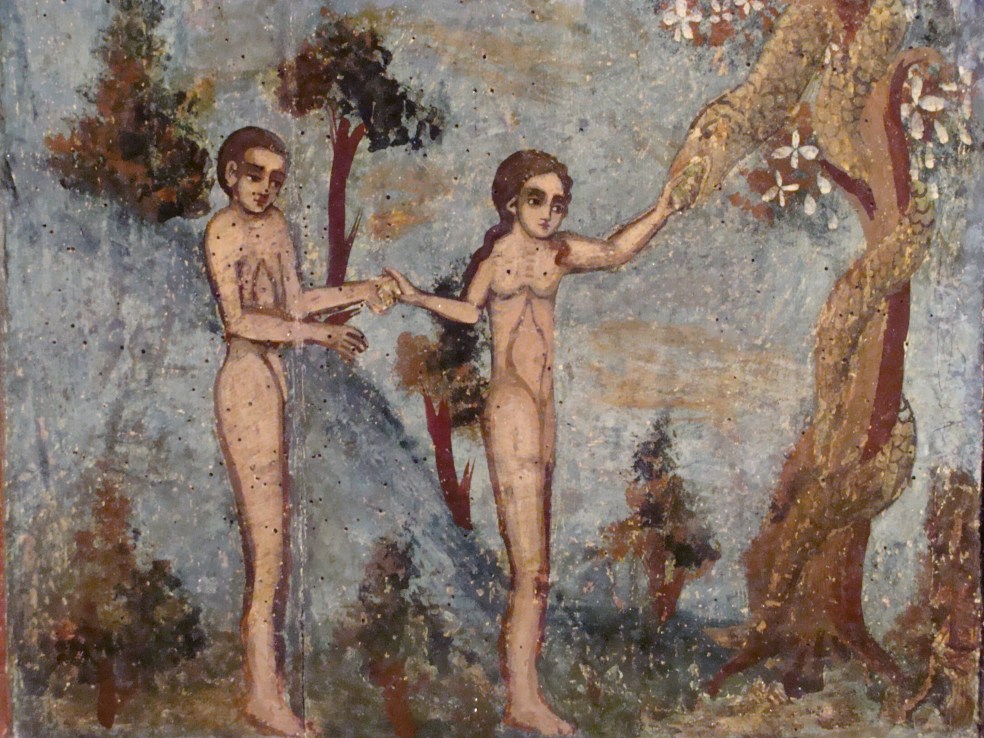
The story of the Fall of humankind is related in chapter 3 of the Book of Genesis. It is generally understood to mean that the woman, Eve, was tempted by the serpent and persuaded Adam to eat of the fruit of the tree of the knowledge of good and evil, which the Lord God had told the man not to eat from or else he would die. The serpent – a representation of evil, or the devil himself – tells Eve that they will not die, but their eyes will be opened and they will be like God, knowing good and evil. The man and the woman eat and then become aware of their nakedness, which causes them to hide when God comes visiting ‘at the time of the evening breeze’. The Lord God asks Adam how it is he knows that he is naked, and he replies that the woman gave him fruit from the tree to eat; she in turn blames the serpent. God pronounces their punishment, and the man and the woman are expelled from the Garden of Eden.


I should perhaps point out one of the most remarkable word connections you will ever find, and that is when we rearrange the letters of GARDEN OF EDEN. I used to do this, sitting down in the early morning (between 6 and 8) while the house martins screeched around on a level with my eighth-floor apartment in Sofia, Bulgaria – rearrange the letters and see what I could find.


GARDEN OF EDEN gives DANGER OF NEED. This is surely a coincidence, language telling us something.


Adam and Eve were in danger of need. But what exactly is wrong with having a knowledge of good and evil, and why should that cause them to die?


I would like to suggest an alternative interpretation, one I thought was unique to me until I discovered that it had been offered and accepted before. This interpretation – which is only that, an interpretation – gives rise to several conclusions, which I would like to list at the end of this article.


I imagine Adam and Eve playing in the Garden of Eden, in innocence, as children do, without a care in the world and with not much to do except to admire God’s handiwork in themselves and the animals and plants that surrounded and delighted them. They must soon have become friends. Life must have seemed like an ‘Eden’ to them – no great responsibilities, no great amount of work, no aches and pains to bother them. Just an eternity of today.


Except, as children do, they began to grow, to become sexually mature, and their curiosity must have been piqued. Eve began to have these bumps on her chest; Adam began to grow hair around his genitals and his long thing got longer. And they must have begun to experience the first sexual stirrings, perhaps in the night, when they were asleep, lying among last year’s fallen leaves. Perhaps they began to experience pleasure and to wonder what pleasure lay in the other.


There is an obvious correlation between the serpent and the man’s penis. The snake has traditionally been associated with the penis and sexuality. So perhaps it was the man who, feeling aroused, suggested they acquire carnal knowledge, knowledge of one another. Certainly carnal knowledge can be for good and evil – good in a loving, committed relationship and in the procreation of children; evil when it treats the other as an object and seeks only its own satisfaction. Undoubtedly, in the history of humankind, sex has been a force for good and evil – on the one hand, a demonstration of love, two people coming together in wonder and amazement; on the other, an abuse of the other person when it is not consensual or merely pleasure-seeking, seeking a meaning where none is to be found.


So we have identified the serpent with the man’s penis, but what of the fruit of the tree of the knowledge of good and evil, the apple? The apple can be related to the woman’s breast, that object that mystified the man and that he is now suggesting they eat of. After all, a fruit has flesh. It also has ‘the seed in it’, as we read in chapter 1 of the Book of Genesis, in the first creation account.


God had said that if they ate of the forbidden fruit – had sexual intercourse – they would surely die, and this is true, but bear in mind that the verb ‘die’ has two meanings: to expire at the end of our earthly lives, but also to expire in orgasm. This latter meaning is well documented.


What is the connection between these two meanings, and again why should the knowledge of good and evil be such a bad thing?


I think the answer is to be found in an article by a Greek bishop and theologian, Metropolitan John Zizioulas. In ‘The Consequences of Man’s Fall’, he writes, ‘In beings with organs – especially mammals – the ageing cycle begins from the moment that the organism reaches the point of reproductive maturity.’ So when we reach sexual maturity, we begin to die (in both senses of the word).


And this ties in with a teenager’s behaviour, because a child who reaches sexual maturity changes somewhat. They become more bashful, more private, they are no longer prepared to appear naked in front of their parents. Isn’t this exactly the behaviour of Adam and Eve when God comes looking for them ‘at the time of the evening breeze’? They hide themselves. They have become aware of their nakedness. And what is it they use to hide their nakedness that now causes them such shame? Fig leaves! Figs are another symbol of sexuality and the male organ.


So they have acquired carnal knowledge, they have slept together, and now they do not want God to see them because they are ashamed of their nakedness and they know that he will see it in their eyes. Their eyes have been opened.


But if sexual maturity coincides with the beginning of the ageing process, there is no other way to have children. So God – who so often is seen as inflicting punishment, as being vindictive, something that is as far away from his nature as it is possible to be – performs an act of charity, of love: he banishes them from the Garden of Eden in case they eat of the tree of life. He wants them to have children (I’m quite sure he knew perfectly well what was going to happen, just as any parent does), but he doesn’t want the ageing process that comes with sexual maturity to last for ever, that would be terrible, so he sends them out of the Garden of Eden to till the land they came from.


He does this in order that we might have children. In order to have children, we must die. This is the meaning of death – it is so that we can have the unparalleled blessing of procreating, of giving our life to another, who is then ‘the apple of our eye’.


This is a great thing – ‘Greater love hath no man than this that a man lay down his life for his friends’ (Jn 15:13) – but it also serves another purpose: it builds up the body of the Church. It prevents God from having to create all the creatures, all the men and women, himself. He involves us in the process (albeit our involvement is slightly different, because life passes through us, it does not begin with us – we are translators, not authors).


In this sense, the earth is a spiritual womb, it is a womb in which a spiritual body – the body of the Church – is being formed, just as we are formed in our mother’s womb. We have not realized this. Just as there is spiritual blindness as well as physical blindness, so there is spiritual birth as well as physical birth. We are still in the womb, but now it is not the body of an individual that is being formed, it is the collective body of the Church, a body made up of many members (in 1 Corinthians 12 and Romans 12, Paul compares us to the different members of the body, each performing his or her own unique function, with Christ as the head).


And this is where we get into the realm of Christian paradox: life passes through us when we receive life from our parents and pass it on to our children; but we also pass through life, in the sense that we are not here for ever and we move on. We form part of the body of Christ, the body of his Church, but in the sacrament of communion it is his body and blood that form part of us. We lose our life and find it. I begin to think the Christian message is true precisely because it is paradoxical.


Is there an indication of the world as a spiritual womb? I think there is, because if we read the first creation account in chapter 1 of Genesis, we find that God created the day on day one (already we have the progression AIO in the word DAY, remember the correlation between O and D and between i and y) and then, on day two, he created the dome of the sky by separating the waters from the waters. Doesn’t that sound like a baby in its mother’s womb, surrounded by water? Perhaps this is why SKY can be connected to KISS and SICK, because for procreation to occur there must be a kiss, but sexual maturity is also the beginning of the ageing process, of what makes us sick.


Is there anything in language to connect the serpent and the man’s penis, to connect the apple and the woman’s breast?


Well, if you allow fluidity to the vowels and change one front vowel for another, you will find that PENIS is in SERPENT, with the addition of r and t. And applying the phonetic pairs b-p and l-r, you will find that APPLE is in the first four letters of BREAST, with the addition of s and t.


This interpretation – and it is only an interpretation – has three consequences:


  1. The Fall was a good thing. Otherwise, we couldn’t have children and the body of the Church could not be formed.


  1. Perhaps the woman is not entirely to blame; in fact it would seem that Adam was the prime mover in response to his sexual desire. We could at least speak about shared responsibility.


  1. While in the Church great emphasis is placed on monasticism, on abstinence and asceticism, it would appear that the purpose of life on earth is to have children, and this would give the option of marriage far greater importance than it is sometimes credited with.


So Genesis, that most remarkable book, is not just the story of the creation of the world and the Fall of humankind, but also the story of each one of us, of human life. We are born, just as the world (the body of Christ) is. We reach sexual maturity in order that we might give that life to others. We then have to die (we have now fast-forwarded to the Crucifixion) because it is the only way to give life – to die, to expire. But there is a greater mystery here. This is not the last word.


The word ‘die’, if we apply the physical pair b-d (a pair of letters that look alike; in this case one is the mirror image of the other), clearly contains ‘I’ and ‘be’. It is a very life-affirming word. The word ‘live’, if we remember the closeness between b and v, contains two ‘I’s and ‘be’ – this may refer to our physical and spiritual selves, to our human and divine natures (the latter acquired by grace in a process known in Orthodoxy as theosis), or to our fallen and resurrected selves. Anyway, it is manifestly not the end.


If we could only see this world for what it is, a place of spiritual growth (not a place to make money!!) – a spiritual womb – we might realize our connectedness. Having been born from our mothers, we are now – all of us, outside the constraints of time – in the process of forming another, spiritual body, one that has Christ as its head and one that will last for all eternity. The world is a spiritual womb. We must die in order to have children, participating in this way in the formation of the Church. And having died, we have no choice but to be born again, but this time without the straitjacket of corruption, without the ageing process. We will be ‘like angels in heaven’ (Mt 22:30). With one great difference: we will not be alone.


Jonathan Dunne, http://www.stonesofithaca.com
Word in Language (8): Economy

In our modern society, we tend to think of ourselves as highly civilized because we can travel large distances by plane, we have made medical advances – the discovery of penicillin, non-invasive surgery – or we can access information on the Internet, but all these advances are technological, they have nothing to do with the morality of society. In fact, I would question whether we are highly civilized at all. Our modern Western society, the one that has been most successful in spreading its model, is based on two concepts: democracy and economy. Neither of these has to do with what I would consider the two criteria for civilization: love for God, love for neighbour. The first asserts the individual’s claim to property; the second asserts the individual’s right to money (even at the expense of his fellow man or the environment); and both are in direct opposition to the Church, because the Church is not democratic, it is hierarchical, and it is not based on the concept of economy (though ‘economy’ has another sense in the context of the Church, the Eastern Church in particular, which is to bend the rules according to the individual’s needs). The Church is just about the only ‘shop’ you will find where you will receive your ‘goods’ for free – namely, the sacraments of confession and communion, the greatest gifts of them all, because these will lead you into eternal life. The Church does not charge for these, and it is the only place I know not to do so. So our modern society and the model of the Church (love for God, love for your neighbour) are in stark opposition.


The word ‘economy’ itself means the law or management of the household – domestic matters. This is very telling because it focuses on the self (‘domestic’) instead of on the foreign (the other). In fact, the aim of countries in our international community is precisely to defend their own interests. That is the remit of diplomats the world over. What would the world be like if countries set out at the first to defend the other’s interests, if diplomats bent over backwards to improve the lot of foreigners – wouldn’t that change the world enormously?


Unfortunately, this ethos of individual success is drummed into our children from an early age at school, where education is cerebral and success is gauged by exam results, and where, as I have mentioned, we teach our children to start counting from 1, the number that relates to the human ego, I, instead of from 0, the figure that relates to God and would place us on a surer footing.


I would go so far as to say that, for me, the word ‘economy’ is the law of the ego, and we can see the connection in the phonetic pair g-k (the c in ‘economy’ is pronounced k). It is remarkable that in all these years, after all these generations, we have gone no further than to lay claim to what is freely given to us – the products of the earth – to package them (to dress them up) and then to sell them. This is the extent of our moral advancement – not love for God, not love for our neighbour, which is something we may do in our free time. The main occupation of man is to make money, but we should beware because language has something to say about this.


First of all, ECONOMY, apart from being the law of the ego, can be read MONEY & CO. if we jumble the letters. And what about the word MONEY? Well, if we change one mid vowel for another, we will see that MONEY is connected to ENEMY, but more telling perhaps is when we read the word in reverse, using the physical pair (pair of letters that look alike) v-y. Then we get the word VENOM. VENOM is MONEY in reverse, with one small change, and certainly it is a cause of great conflict, great suffering – not just the fear that everyone endures at having to have enough to get by, but also the conflicts that arise in the battles to lay claim to territory so that we can make more of it. Where does this need to lay claim to what has been freely given to us – the land and its products – come from? It comes from the Fall and the placing of the ego before God, the self before the other (who is God). But we are deluding ourselves because in this life everything, from food and air to life itself and meaning, passes through us, in a two-way process whereby we effect a change on the things that pass through us and they effect a change on us. So we are translators, not authors, because things do not begin with us, they do not proceed from us, we are not the source of anything, we are – or we ought to be – simply vehicles of God’s love.


LOVE, as you would expect, is a major word in language. It is connected to OTHER by the phonetic pair l-r, the alphabetical pair t-v, addition of h, and OTHER is connected to the Greek word for ‘God’, THEOS, by the alphabetical pair r-s, so we have:


LOVE – OTHER – THEOS


which is the message of the Christian Gospel: love the Lord your God, love your neighbour as yourself. This should come as no surprise because Christ is the Word, so it is normal that language should confirm what he is saying.


But LOVE is also connected to MONEY by the succession of letters in the alphabet l-m-n and the physical pair we saw earlier, v-y. LOVE is in MONEY, and that is why Christ warned us that we cannot love God and mammon, it is one or the other. Love for money is the individual’s wish to keep his money for himself, not to use it for the benefit of others, and I think that banks worldwide will attest to this inclination.


Of course, for someone to be rich, someone else has to be poor. Sometimes it seems there is always someone willing and able to lighten your load (the desert fathers, hermits in Egypt in the fourth century, when coming back to their cells and finding robbers with camels unburdening them of their belongings, would rush to help them, there is even the story of one monk who, on seeing that the robbers had left behind a stick, went running after them in order to hand it over – a different understanding of our place in the world).


If we apply the phonetic pair b-p, we will see that the reverse of ROB is POOR. Meanwhile, the reverse of SELL is LESS, perhaps because we have somehow gone against the commandment of God to love him and to love our neighbour by using our neighbour to make a profit. If our concern was placed always and only on the other, we would feel no need to attach a value to our own exertions, and this would indeed represent a step forward in terms of civilization. But we continue to pay attention to PROFITS instead of listening to those Old Testament figures the PROPHETS, marginalized figures, a bit like translators, who tried to bring people to their senses. We are not here to make a profit out of anybody, we are not here to treat people as a potential market for our product, we are here to do good. Money is an illusion of the devil, as the connection MONEY-VENOM indicates.


And note that it is the packaging of the products we sell that then causes untold damage to the planet and the creatures that inhabit it, especially plastic. We take what was freely given to us – we might have adapted it, turned it into something else, translated it in our own way, but the basic ingredients will have come from the earth because we cannot magic anything into existence – and instead of allowing the tap to flow, as the earth does, we turn it on and off to create supply and demand, we package it, we take what is an incessant stream (uncountable) and make countable nouns, individual items that can be processed at the checkout. Often these items are wrapped in plastic, the result of our definition, and it is this plastic causing damage to the world. PLASTIC contains the word CAPITAL.


The other thing we sell (or claim to own, which is the same thing) is PROPERTY and again, if we apply the phonetic pair b-p (remembering that there is also a strong connection between b and v in language), we will see that PROPERTY contains POVERTY. When we amass property – which doesn’t really belong to us and never will, because we are not responsible for the land or its materials, they were made by someone else and given to us to steward – instead of giving and receiving meaning, which should be the norm in human relationships, we find that we give and receive poverty (those who cannot afford a property, those who are burdened with mortgages or high rents, our own spiritual poverty).


This is an important concept. This is why it is so important to recognize that we are translators, not authors, and things pass through us, they do not belong to us (except for our love for one another). If we accept that things do not truly belong to us, they are only entrusted to us for safekeeping, we will loosen our grip, tension will decrease, we will have a better chance of giving and receiving love. After all, it is well known that suffering is caused by the inability or unwillingness to respond to the other’s love. That is the definition of hell. Heaven is to participate in the other’s love, which is why there are three persons in the Trinity, so that the love can be inclusive.


God brought us into the world to translate. He made the creatures and brought them to us to name (to translate). But we have taken the creatures, the products of the land, the plants and trees, and gone to MARKET. That is the extent of our civilization. We have got no further than this. I would say that we ought to be ashamed. All these years, and nothing much has changed. If anything, it has got worse, because it is now possible to make a lot of money almost without coming into contact with the products themselves. The richest people work with their heads, not with their hands, moving products around, sometimes without even seeing them.


And what word is connected to MARKET? CREMATE. We are burning our bridges, we are burning what unites us, creating societies that war with one another and argue amongst themselves. Let go of the so-called right to property, the foundation stone of our system of democracy, and the need to fight goes away. After all, we are not here forever, we are only passing through, which begs the question whether our wish to assert our claim to property is not in fact a wish to evade our own mortality, to somehow make ourselves out to be permanent.


The only place where I find a different model being practised is the Church: the doors are open, entrance is free, the focus is on God and our neighbour. True life, therefore, for me is in the Church, the body of Christ. This is why I prefer concepts like aristocracy (I believe in virtue), monarchy (Christ is my king) and hierarchy (I believe in spiritual growth) to democracy, because to say that power rests with people is to make ourselves out to be authors, and that is a false premise.


By turning to God and placing him at the centre of our existence, the MARKET loses its appeal, the word CREMATE begins to sag in the middle, the edifice topples, the two sides being held apart by an abyss fold together, and we are left with CREATE. Our nature is divinized – though not through any merit of our own, but through participation in God’s energies, which occurs by grace and is therefore a free gift.


GRACE, as far from the economy as you could wish to go, because it is freely given, is connected to another word in English, which symbolizes the tripersonality of God. That word is SHARE (the c in ‘grace’ is pronounced s, g-h is an alphabetical pair). We participate in the shared love of the Trinity, and all competition, all profit at the expense of the other, is seen for what it is: a perversion of our true purpose, which is to give and receive love, to be in relationship.


Postscript: Another story from the desert fathers. Two brothers wanted to live in love. They achieved this, each carrying out the will of the other, until the devil appeared to one as a dove and to the other as a raven, causing them to see things differently and to argue. They fell to blows and were parted until they realized that what was driving them apart was a distorted vision of the same thing – what separates us is not the thing itself, but our perception of it. Arguments arise from different perceptions of the same thing. This story is told by Abba Nicetas in The Sayings of the Desert Fathers, trans. Benedicta Ward, Cistercian Publications, 1984, p. 157.


Jonathan Dunne, http://www.stonesofithaca.com

Word in Language (7): Time

Let us look at time. We live in time, our lives on earth have a beginning, a middle and an end. When we learn our own or a foreign language, one of the first things we learn is the tenses: past, present and future. So our lives are very quickly conditioned by the concept of yesterday, today and tomorrow. Everything in this sense is linear, and indeed the word ‘time’ is connected to ‘line’ by the phonetic pair m-n and by drawing a line through the letter l to make t (I call this a physical pair, because they look alike).


Teachers of English, of which I was one, teach the tenses by going up to the whiteboard and drawing a horizontal line with their marker. On the line, they mark three crosses to represent past, present and future, but the fact is the line is like a loose thread and it exists before the cross that stands for the past and continues after the cross that marks the future, because we cannot be certain about these things – when the past started, when the future will end. It hangs in the air, like a loose thread on our clothing, which we pick up and put in the bin.


I remember standing in Wandsworth, London, while teaching an English class, and having a revelation. I realized that the only way I could draw a timeline was by having a whiteboard, without the whiteboard it was impossible for me to draw the line. And while the black of my marker seemed to obliterate the white of the board underneath, the fact is the white of the board still existed beneath the black of the line. This meant that time exists – and can only exist – in the white space of eternity. Time is proof for the existence of eternity because without eternity time cannot exist. There is nowhere to draw it.


But what is its purpose? I have already said that I believe time exists to give us a chance to make meaning a two-way process, to offer ourselves to God in the same way that he has offered himself to us on the Cross.


Let us take out our toolkit and disassemble the word ‘time’. What do we find? Four letters: t – i – m – e. That is, ‘time’ is made up of a cross – the letter t, which we saw earlier resembles the letter l with a line drawn through it – and the words ‘I’ and ‘me’. So it seems the first thing about time is crucifying the self, our egotistical impulses. This is the meaning of the Greek word for ‘love’, agape – we overcome our own will, our own selfish inclinations, in order to love the other, however different he or she may be, because God has already loved that person and because, by loving them, we will learn to discern what it is in them that makes them worthy of God’s love and gives them value, something we may not have been able to see when our spiritual sight was obfuscated by our own concerns and ambitions. We have already seen that when we draw a line through the self and form a cross, the letter t, we also form a plus-sign, +: in laying down our life for the other, we find our true self, the one that is meant to live, the one that exists in the white space of the board and is not conditioned by the tenses (I am born, I live, I die).


But we can go further than this, because, by changing one of the vowels (remember that y corresponds to i) and applying the phonetic pairs d-t and m-n, we see that TIME is connected to two words: MEET and DENY. That is, our sole purpose in this life is to turn towards God or to turn away from him, to embrace him or to reject him, to enter into the personal relationship that is represented by the Holy Trinity or to turn in on ourselves and enter into a relationship that is inward-looking and ultimately futile. We can see a similarly stark choice in the word LIVE, because LIVE in reverse reads EVIL, but if we take the ego in LIVE – the letter I – treat it as a number (1) and count down, we get LOVE. So in LIVE we are faced with a similar choice: to do EVIL or to LOVE the other (God and our neighbour – they are one).


If we take steps in the alphabet, we will see that TIME is connected to LIVE (l-m, t-v), but it is also connected to DIE if we apply the phonetic pair d-t and take away the letter m. Again, the stark choice between allowing space for God in our lives or leaving him outside. The connection TIME-LIVE involves keeping the letter m, a letter which, when upended, resembles the number 3 (the Holy Trinity). If we keep the number 3, we live.


It is certainly true that from the point of view of this world our lives have a beginning and end, and time itself is no different. It came into existence and it will cease. We see this if we apply the phonetic pairs d-t and m-n, because ‘time’ is connected to ‘begin’ (here, the d has been reversed to make b, and we have added the letter g) and to ‘end’ (here, we have omitted the letter i and read the word in reverse).


Put simply, time is a space in which we are given the opportunity to grow. It cannot go on for ever, just as our childhood cannot go on for ever, because at some point we must become spiritually mature, realize our limits and seek another meaning that is not the simple gratification of our needs. Time is a teacher. It is like an enclosure in which the damage we can do may appear great, but it is limited. Take time away, and you have boundless space. Lift up the veil of time (I think those two words are connected), and you will reveal the twitching nose and arching whiskers of the white rabbit of eternity beneath, the one we have been grasping at, the one we knew was there all along, if only we could believe it. TIME, in short, is a MYTH (same three letters, addition of e/h), a story, the story we tell our children when we put them to bed, the story we read to ourselves as we get older. It is a myth, but we take it to be reality, and the one who is – namely, God – we take to be a myth.


There is another word connected to TIME, and that word is SIN (alphabetical pair s-t, phonetic pair m-n, addition of e). Time is an opportunity to sin – only God is without sin – but by sinning we learn from our mistakes and reach spiritual maturity. We take the opportunity to MEET God rather than to DENY him. We learn to LOVE rather than to do EVIL. We become a child of God – a SON – by taking the I in SIN and counting down, as we did before, from I to O.


We have learned to place too much emphasis on our reason, to make an effort and to expect the corresponding reward for our exertions, for everything to have a price (though how that price is fixed in this world is questionable, to say the least). Salvation, however, will not come to us through our own intellectual acceptance of God, our keeping our side of the bargain. It will not come to us through MERIT (a word that contains TIME). It will come to us when we open ourselves to the grace of God and participate in his energies, when we align our will to his.


We do not get to heaven by our own efforts, just as we cannot know God through an act of our own will. We can strain as hard as we like, bang our heads against a brick wall. God has to reveal himself to us. The ball is in the other’s court, I’m afraid. But we can invite this revelation, this participation in his energies, by showing mercy. MERCY is the counterpoint to MERIT – they are only a letter apart, but the connection is hidden so it won’t be immediately visible. The letter c is pronounced s, s-t is a jump in the alphabet, y corresponds to i. MERCY-MERIT. Two ways of viewing the world. MERIT: you get what you deserve (this is patently untrue). MERCY: we humble ourselves and – at this point, yes – by an act of will we do violence to ourselves and force ourselves to embrace our enemy, to understand him, to say a good word to him on the road instead of hurling abuse.


TIME, like a screen, a partition, a stage set, a loose thread, is whisked away, the board rubber comes out and eliminates the black line in time for the next lesson, the bell goes, people’s attention turns to other things, what lesson is next, what the other person thinks, and ETERNITY is revealed.


The letter y corresponds to i. Phonetic pair m-n. ETERNITY has TIME in it, just as the whiteboard showed us.


And the word ‘eternal’ – if we juggle the letters around, rotate or extend the letters (phonetic pair m-n, physical pairs f-t and i-l) – spells ‘I am free’.


Jonathan Dunne, http://www.stonesofithaca.com