Flared Nostrils

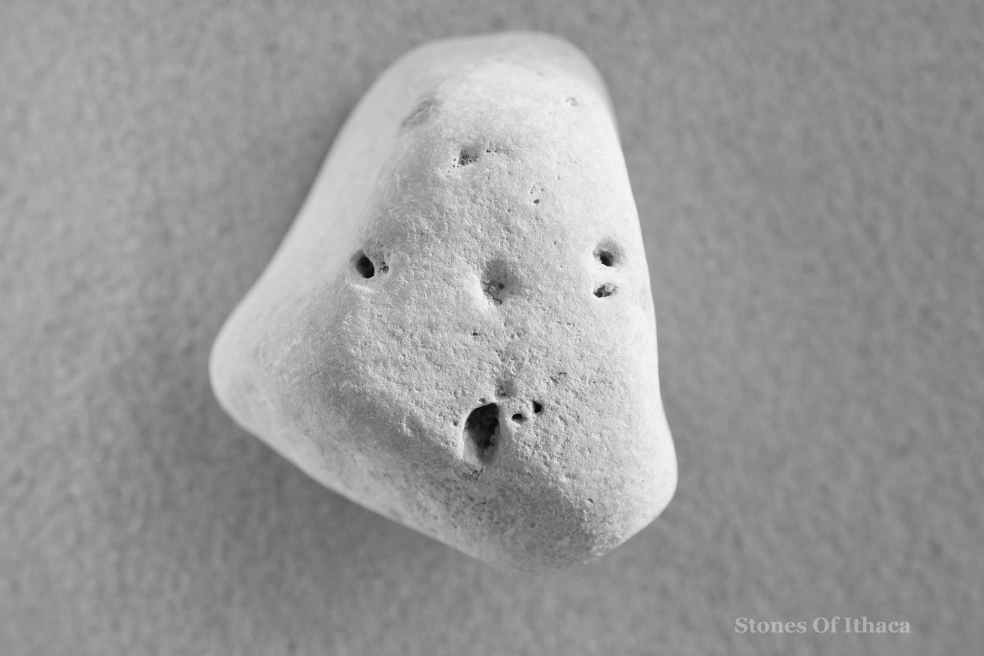
What is this face with its white border, furrowed lines and flared nostrils? Its mountain or triangle, with a spade propped against it, drawing us to the closed left eye, which gives a sense of peace or tiredness. The mouth is a ledge, somewhere to place the feet, the nose something to hold on to with the hands. And up we go, step by step, furrow by furrow, until we are on the smooth surface at the top, able to look around. The jagged line will take us down again, the triangle formed by a path, where people, to avoid the angle, have created a shortcut.


Meanwhile, in language, there is also eros. The word itself spells “sore” and “rose”, it is in “horse” and “shore”. “Penis” is in “pencil” or “spoon”, while “bowl” is “womb”. This step in the alphabet allows us to connect “womb” with “wound” or even “world” (b-d, addition of u/r). We are brought into the world through eros, and the world itself is a kind of womb (a template) that provides a growing process. “Semen” is in “cement” – it is made to prevent the egg from detaching. And “egg” is an unravelled “o” away from “ego” – a new being, one that will have to find its way and avoid the pitfalls of “ogre” or “yoke” (g-k, addition of r/y). Eros is the preserve of a loving and committed relationship; we must beware of what our mind can conceive and go beyond this to contemplation. And, last of all, “tired” is in “tender”, the closed eye, the scaled mountain, the gentle submission.

Swimming Cross

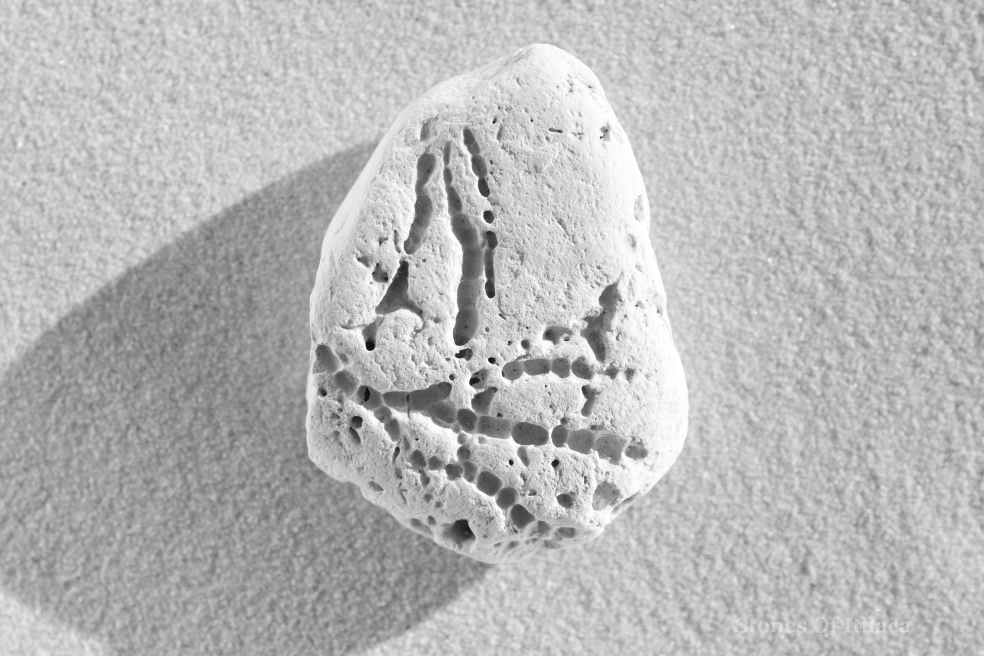
I call this stone a “swimming cross”. Next to the main cross, which has a road leading up to it, is a smaller cross that seems to be swimming through space, like a seed. We will notice that in order to progress through air or water, it is necessary to join one’s legs together. It is only on land that we walk by separating our legs. If you try to fly or swim with your legs apart, you will quickly flounder. They must be joined together, in one place. This is why the Cross is a superior figure, say, to the Vitruvian Man of Leonardo da Vinci, which has its legs apart. The Cross is stable, it will not break like a wall or a tower. The only other figure that shows similar resistance is the triangle – a pyramid. And a circle, though that may bounce or be pricked like a balloon. One detail I love in this depiction is the small bird that has alighted on the transverse beam of the main cross. On the other side of the transverse beam, there is a flag. Both bear witness.


Meanwhile, in language, we are sheep, and Christ is our shepherd. He is not a hired hand, he will not abandon his sheep when the going gets tough. The sound that a sheep makes is “Baa!” We will find here the same letters as in the Aramaic word for “father”, “Abba!”, a term Christ uses in the Gospel. As sheep, we are meant to call upon God the Father in this way. But there is another sound that we can make, if we add the ego to the end of “Baa!”, and that is “Baal!” Baal is the name of the false god in the Old Testament. As sheep, we must make up our mind which god we are going to call upon. The good thing, though, is that even if we make the mistake of calling upon “Baal”, by adding breath (h) and applying the phonetic pair b-p, we can return to “Alpha”. It is the same when we step from “AM” (another title of God) to “I’m”, we are still in a position, through the addition of breath, to go to “Him”, that is Christ. It is a question of repentance, of inviting Him in.

Tightrope Walker

Here we have a tightrope walker walking the line of life, the thread that connects our first breath and our last, which seems sometimes to cross a chasm. It is easy to lose our concentration, to panic, to flail our arms, even to fall. We do not want to look down. So what is it that enables us to stay upright, to continue on the line, to walk the rope? It is, of course, our outstretched arms, the balance of faith. Faith is like the metal pole that funambulists use to keep their balance. It can be heavy, a little awkward even, but when it finds the right position, when we find the right position for it, then our balance is maintained and we make it safely across to the other side.


Meanwhile, in language, let us take a word, any word. Dark, for example. Are words connected? Do they contain information that has been passed down through the centuries, put there by an unknown force, that of language? I think they do. If you know your phonetics, you will see (phonetic pair l-r) that “dark” is “cold” (forget the vowels, they are fluid). If you use the appearance of the letters and turn them around, then “dark” is also “black” (b-d). Opposites attract, and if we are competent, we might see “light” in “dark” (three phonetic pairs, d-t, g-k, l-r, with the addition of h). Turn it around, and we will find “create”. After all, wasn’t the world created in darkness? And here’s my favourite connection. We find the word “dark” in “cradle”. A baby is kept in the dark, so that it can sleep. “Baby” is a step away from the Aramaic word for “father”: “Abba”. In the act of giving birth, language has moved away from the A of creation to the I that signifies the ego in English. I talk about this progression in my books. We have to learn again how to call upon our father, God, who in the Old Testament is also known as El, the two remaining letters in “cradle”.

Round Tree in Square Field

I love this picture of a round tree in a square field. It even seems that there is a miniature replica of the tree to the left. Or the tree could represent a balloon on a string, or a planet suspended (by a string?) in space. The tree – the round crown and the straight trunk – reflect what I have written about the progression from I to O. I is O in profile or from above. Perhaps the I is hollow; after all, most of an atom is said to be empty, isn’t it? Are we mainly space? What do we choose to fill this space with? An I – like an eye – when it is opened becomes a circle: O. So O (live to love, sin to son) is an opened I. The field, however, is square. This responds to the indefinite article, a/an, which can only be applied to something that is individual. We are individuals, but how long can we remain so?


Meanwhile, in language, I am struck by how similar the words “will” and “evil” are. It is very easy to apply our will to do evil, but this isolates us, leaves us alone. We are not part of a community. “Will” is also the auxiliary to speak about the future, our plans, our intentions. If we combine “I” and “will”, we get “I’ll” (or “ill”); if we combine the plural, however, “we” and “will”, we get “we’ll”, that is “well”. An incentive to think in terms of the plural, just as “me” can become “we” if we upturn the first letter, or the plural of “you” is “us” (isn’t it?). Let us apply the progression from I to O to our “will”. We get “low” in reverse, we become humble.

Cattle Grazing

Ithaca is known, above all, for its goats and sheep, and is said in the Odyssey to be unsuitable for horses because it is a rugged island. Here, however, we see a cow that is grazing in an open field next to a stone wall, being observed by the figure of a girl. On the left side of the wall is a tree, and there may be another tree behind that, on the boundary between two fields. It was cattle that God created in chapter one of the Book of Genesis, together with creeping things and wild animals, on day six, before he created man in his own image, so I take this stone to refer to the story of creation, since most of the animals I have found on the beaches of Ithaca have been cattle and creepy-crawlies.


Meanwhile, in language, there is a strange correlation between “fear” and “heart” and indeed, if we breathe in a little too deeply, it is often fear that we feel deep in our hearts. “Fear” can turn to “rage” by a step in the alphabet (f-g), and “rage” can turn into “anger” (addition of n). This can easily lead us to nurture “hatred” in our “heart” (addition of d), but our hearts were meant for love – love of God and love of our neighbour. Hate is something that is associated with the past – “hated” gives “death”, just as “lived” gives “devil”. If we want to have a future, we must lay aside our hate and embrace the other. We will cultivate fear of God. This “fear” is “safe” (r-s) because it teaches us to be humble in God’s presence, not to want to place ourselves on a level with him. And then we may find that “fear”, this kind of fear, gives way to “grace”, whereby we work in conjunction with God and allow his love to pass through us.

Yacht on Sea of Branches

In this second image of a ship, I see a boat, a yacht perhaps, sailing across the waves. There are many of these in and around the bays of Ithaca, homing pigeons flitting across the sky, carrying messages from one shore to another, the white could refer to a scrap of paper caught by the wind, or it could be a cloth, a starched garment. The waves themselves look like a footprint, the footprint of a meat-eating dinosaur, the one that crashes out of the forest, where it has been lying in wait, and races towards you, who are miniature in comparison. And yet, turn the stone upside down, and the waves become the branches of a tree providing shade to a couple, one holding a stick, the other throwing back his head in laughter. Waves, footprint, branches, are all one in this composition.


Meanwhile, in language, I would like to look at love, what we get if we count down from the ego, I to O, and turn “live” not into its reverse, “evil”, but into “love” (sin-son, logic-Logos). What is in this word, “love”? Well, we might see “oval”, which is the shape I imagine love to be, that is humble, the shape made by two hands held close together, touching at the base and the fingertips. I don’t think love is so bold as to be round and certainly it wouldn’t want the sharp corners of a square or a rectangle. “Love” is also in “evolve”, where the letters are repeated, it teaches us, it helps us to grow, it is like soil with its nutrients to a flower. The word “love” also contains “I owe” (v-w is very close phonetically, they are also a step in the alphabet), but love, true love, casts out fear – with love, there is no debt, we can rip up the piece of paper, the IOU. “Love” is also in “vowel”, a sound made without the obstruction of flesh, an open sound (“open” is connected with “eros”, n-p-r-s, jumps in the alphabet). But my favourite connection with “love” is “word” – the phonetic pair l-r, plus jumps in the alphabet, d-e and v-w. If God is love, and love is the word, doesn’t that tell us something?

Chalice

The chalice, the cup of life. I have found a more elegant version, a cup beneath a tree, and one that is almost luminous. This is the cup that at the Orthodox liturgy contains the body and blood of Christ, which we receive – a fire in our belly – and then kiss the base. It is the cup of truth. There is no hiding behind this cup, it will reveal all things. Until we turn to Christ, it is as if we are living in the shadow of a scrap of metal. The world’s illusion is no more than that, a scrap of metal that goes rusty. Once it is removed, all our misconceptions are burned away by the light. I have chosen this cup because it is roughly made, ceramic or pewter, like the cup in Indiana Jones and the Last Crusade.


Meanwhile, in language, we can see that the system that prevails in our society, one of buying and selling, is a mere illusion, a scrap of metal that pollutes. The word “sell” gives “less” in reverse, and we have all experienced this. “Capital”, what we are supposed to gain and build up, gives “plastic”, the throw-away end product that threatens our oceans. “Economy”, that factor that is supposed to indicate the well-being of our countries and lives, simply spells “Money & Co.” And “money” in reverse reads “venom”. It can be a source of long-standing resentment. We are called to love our neighbours as ourselves, not to make money out of them. This is how society should work. And for all the importance that we should give to the environment, ultimately it is the health of our souls that should come first. “Soul” spells “lose” in reverse; it is also close to “soil”, as we have seen. Interestingly enough, there is a verb “soil”, the first definition of which is “to pollute with sin”, but it has a second meaning – to absolve from sin, to “loose”, not “lose”. We must be careful with our language.

Bow and Ship

This is one of only three Odysseus stones I have found on the beaches of Ithaca. They are not so easy to come by. Two of them appeared on Polis Beach, the beach below the town of Stavros, which is where the old polis or city was located and is only a stone’s throw from the Palace of Odysseus. I like to imagine that he came here to bathe. It is certainly more protected than the beaches on the north side of this promontory, though it may also have been used to protect the fleet. On this beach is the Cave of Loizos, where votive tablets to Odysseus left by sailors on their way to Italy have been discovered. I see here two facets of the Greek hero: the bow on the left, and the ship on the right. He seems to be holding the bow and is facing in that direction. It was his ability to string the bow on his return to the Palace that unleashed the slaughter of the suitors and his subsequent reunion with Penelope. The ship, on the other hand, is obvious. Odysseus was a good sailor and is famous for having wandered the seas for ten years in Homer’s book the Odyssey. I am struck by the figure holding the bow. The eye is like a map, a map of longing perhaps, and the clothes and hair could be those of a woman – Penelope herself perhaps?


Meanwhile, in language, we like to rely on our reason, what our minds can comprehend and preferably also what our eyes can see. Ever since the Enlightenment, we have become increasingly reliant on our capacity to reason and to rely only on what our senses can confirm to us. We forget that perhaps in order to see something we need to have our sight cleansed, and this only happens through faith. Also, certain things have to be taken on faith. I sometimes think one of the main arguments for the existence of God is that God is love and, as such, he would never lie to us. For me, therefore, “reason” is a “snare” (without the o), and so is our desire always to have the “answer” (without the w, which is the Greek letter for o). As with “live” and “love”, or “sin” and “son”, we again have to count down from the ego (I to O, 1 to 0) and to turn away from the “logic” of Aristotle to the “Logos”, the Word himself, Jesus Christ. We become enveloped by him and keep our eyes on him, at which point the scales fall from our Is.

Open-Mouthed

A face is essentially two eyes to see with, a mouth to breathe, eat and speak with, a nose to breathe and smell with. The ears for hearing are on the side. Or a face is essentially two eyes to be seen with, a mouth to kiss someone’s hand and a nose to breathe and smell with (though it is not much good at either). The organs are divided into two – eyes, ears, nostrils – only the mouth is one. One might say that one is enough. Children place their thumb in their mouth when they are little, and that is why the reverse of “mouth” is “thumb”. These four forward-facing circles form the letter Y.


Meanwhile, in language, we are subject to the passions and may lose our “temper”. For this, we should “repent”. “Anger” is a “gangrene” and eats away at us, like another illness, “cancer”. They share the same letters (phonetic pair g-k/c). When we “repent” of our sins, the idea is not to “repeat” them, so in a way “repent” and “repeat” are opposites; a-n is not a pair so much as a progression. But there is also a cycle in life in the seasons: “winter” spells “rewind”, “summer” is “resume”. Each individual is a line, but creation is cyclical as God waits for our repentance. The same can be said of the I/the eye. When the eye is closed, it is a straight line (I), but when it opens, it forms a circle (O) – it counts down (1 to 0). We saw this with “live” and “love”. The same is true of “sin” – when the eyes are opened, we repent and “sin” gives way to “son”.