Bow and Ship

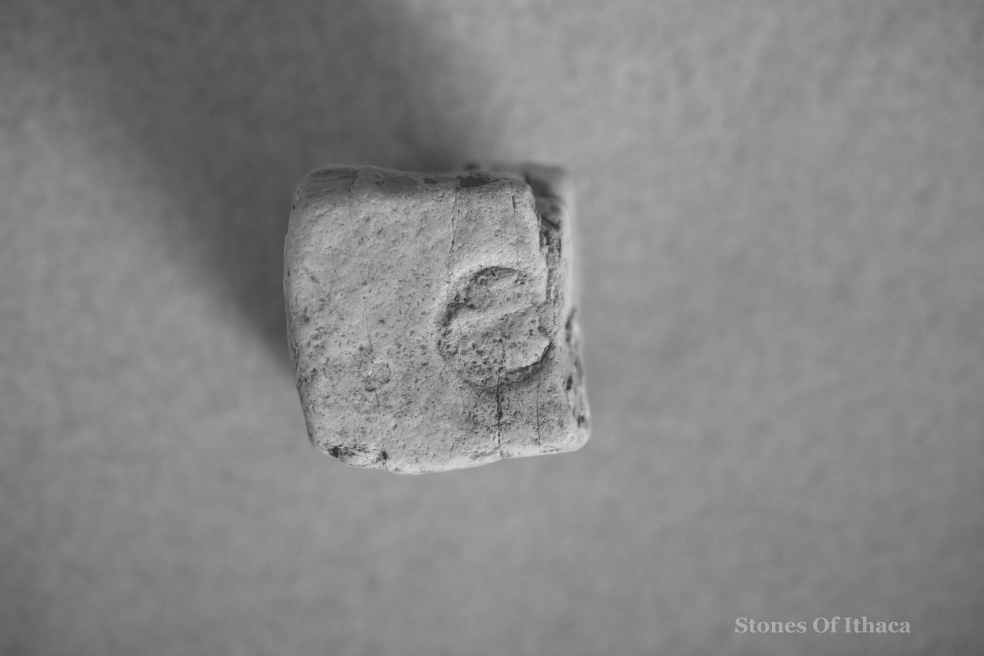
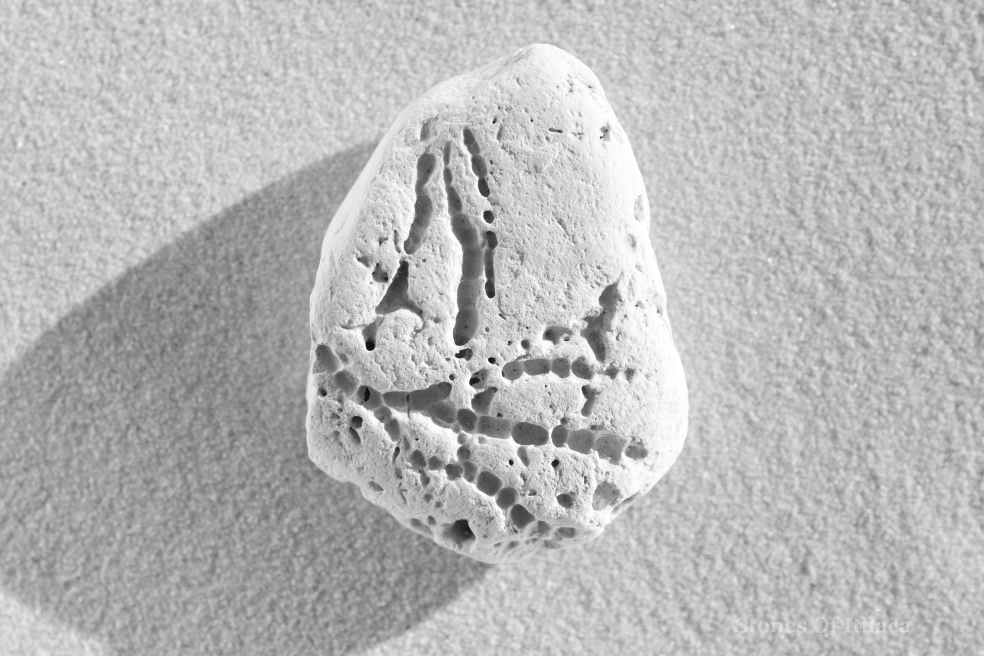
This is one of only three Odysseus stones I have found on the beaches of Ithaca. They are not so easy to come by. Two of them appeared on Polis Beach, the beach below the town of Stavros, which is where the old polis or city was located and is only a stone’s throw from the Palace of Odysseus. I like to imagine that he came here to bathe. It is certainly more protected than the beaches on the north side of this promontory, though it may also have been used to protect the fleet. On this beach is the Cave of Loizos, where votive tablets to Odysseus left by sailors on their way to Italy have been discovered. I see here two facets of the Greek hero: the bow on the left, and the ship on the right. He seems to be holding the bow and is facing in that direction. It was his ability to string the bow on his return to the Palace that unleashed the slaughter of the suitors and his subsequent reunion with Penelope. The ship, on the other hand, is obvious. Odysseus was a good sailor and is famous for having wandered the seas for ten years in Homer’s book the Odyssey. I am struck by the figure holding the bow. The eye is like a map, a map of longing perhaps, and the clothes and hair could be those of a woman – Penelope herself perhaps?


Meanwhile, in language, we like to rely on our reason, what our minds can comprehend and preferably also what our eyes can see. Ever since the Enlightenment, we have become increasingly reliant on our capacity to reason and to rely only on what our senses can confirm to us. We forget that perhaps in order to see something we need to have our sight cleansed, and this only happens through faith. Also, certain things have to be taken on faith. I sometimes think one of the main arguments for the existence of God is that God is love and, as such, he would never lie to us. For me, therefore, “reason” is a “snare” (without the o), and so is our desire always to have the “answer” (without the w, which is the Greek letter for o). As with “live” and “love”, or “sin” and “son”, we again have to count down from the ego (I to O, 1 to 0) and to turn away from the “logic” of Aristotle to the “Logos”, the Word himself, Jesus Christ. We become enveloped by him and keep our eyes on him, at which point the scales fall from our Is.

Open-Mouthed

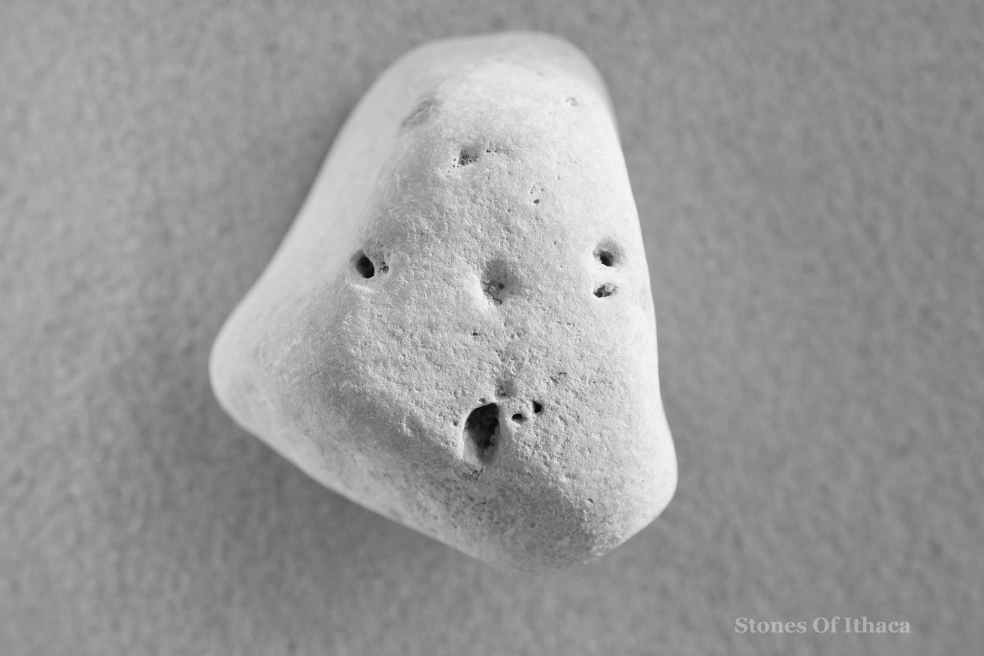
A face is essentially two eyes to see with, a mouth to breathe, eat and speak with, a nose to breathe and smell with. The ears for hearing are on the side. Or a face is essentially two eyes to be seen with, a mouth to kiss someone’s hand and a nose to breathe and smell with (though it is not much good at either). The organs are divided into two – eyes, ears, nostrils – only the mouth is one. One might say that one is enough. Children place their thumb in their mouth when they are little, and that is why the reverse of “mouth” is “thumb”. These four forward-facing circles form the letter Y.


Meanwhile, in language, we are subject to the passions and may lose our “temper”. For this, we should “repent”. “Anger” is a “gangrene” and eats away at us, like another illness, “cancer”. They share the same letters (phonetic pair g-k/c). When we “repent” of our sins, the idea is not to “repeat” them, so in a way “repent” and “repeat” are opposites; a-n is not a pair so much as a progression. But there is also a cycle in life in the seasons: “winter” spells “rewind”, “summer” is “resume”. Each individual is a line, but creation is cyclical as God waits for our repentance. The same can be said of the I/the eye. When the eye is closed, it is a straight line (I), but when it opens, it forms a circle (O) – it counts down (1 to 0). We saw this with “live” and “love”. The same is true of “sin” – when the eyes are opened, we repent and “sin” gives way to “son”.

Flowering Cross

This stone is one of many crosses. Crosses and faces are the most common drawings to appear on stones. Two lines that intersect; two dots and a mouth, sometimes even showing nostrils and teeth. I call this a “flowering cross” because it seems to me to have flowered. It also appears to be attached to a sac, like an embryo. The life of a Christian could be likened to this – having to plant a stick in the ground (the soil) and to wait for it to bear fruit (there are instances of this happening). This involves patience and faith. Also, to others (and to ourselves at times), it may appear as foolishness – waiting for a stick to blossom. But it does.


Meanwhile, in language, it can be seen that “fruit” is connected with “root” – there is no way to bear fruit without drawing on the soil’s nutrients; “root” gives “shoot” by a step in the alphabet (r-s) and the addition of breath (h). A “shoot”, as it appears above the ground, resembles a small “tooth”. But I like the connections with “flower”, which of course is meant to turn our heads (or the heads of insects). Doesn’t “flower” contain “lover” and, in reverse, read “revolve”? It is also connected with “grow” (step in the alphabet, f-g, and phonetic pair l-r). We are here, if for nothing else, to grow and bear fruit.

Pilgrim

I see here the figure of a pilgrim putting one foot in front of the other, heading westwards perhaps, a low-lying hill in the background, carrying a backpack, which may be protected by a waterproof. There is a paradox here: the only way we bear fruit is by staying in one place, literally or metaphorically. If we keep moving about, we will not achieve many things, we will flit from one place or activity to another. And yet, at the same time, as humans we are obliged to make progress, to learn from our mistakes, we cannot stay still or rest on our laurels, it seems the ups and downs of life, the blessings and temptations, force us ever onwards. So we work away at our surface. Perhaps this is where the two things meet: in the act of pilgrimage, we are wearing away the ground, polishing the surface, there is a constancy, one foot in front of the other. The journey is not so much about arriving – that will come later – as about finding company and fulfilment on the way.


Meanwhile, in language, the act of walking involves placing the heel on the ground and rolling forward on the sole. The sole is like a cradle or a blotter. We cannot walk without making this movement, heel-sole, and this may tell us something about the purpose of walking, of moving forward, of staying alive: to heal our soul.

Twin Peaks

On this stone found on the beaches of Ithaca, we can see twin peaks, perhaps with snow on them, and a path running in between, a path that seems to want to invite us to take it and to progress to the field beyond. There is a larger figure overshadowing the right of the peaks, swaying in the wind, perhaps unstable, bending to the contours of the landscape. We must remember that these drawings are done by stones or else planted on them by external forces.


Meanwhile, in language, there is a striking parallel between the words “planet” (which itself is a derivation of “plant”, which itself is a derivation of “land”, and so on) and “template”. A template is a model, something we can use to make our own creation, but it is not the finished version. Is there a chance that this planet spinning in space in a cul-de-sac of the universe is a template for us to learn to live our lives, to learn values, to learn cohabitation, to learn humility, certainly, and also joy? If this is so, planet-template, then that should make us re-evaluate our position on this planet and place it in a wider context. Because once the template has been saved and closed, the “Undo” function becomes unavailable. While the environment and protecting the environment are important, so is caring for our souls. The earth is like a heart, says my wife, with rock and fire, but around this, enclosing this, is a thin layer, a surface of soil that feeds us. Earth-heart, soil-soul.

Outline of Fish

In this drawing of a fish, the fish, whose eye is just visible, is surrounded by a marked line. This reminds me of the account of creation in chapter one of the Book of Genesis, when God created the dry land, scenery and vegetation, fish, birds, land animals and humans. He drew lines around individuals, so that we were one. In English, this is represented by the indefinite article, “a/an”. We use the indefinite article when it is something we can (literally or metaphorically) draw a line around. If it is something abstract, too large to be contained, such as love, then we don’t. Objects with a line around them are known as countable, and I often think that a lot of human life is about how things that are countable relate to each other.


Meanwhile, in language, I used to think the act of translation (which is everything we do) involved activity, doing things. There is the horizontal act of preparation over time, tending the ground, when we look up unknown words and references, consult the author and so on. But the act of translation itself should be vertical, a question of listening, a slit in time, from which we extract and pass on meaning. And to listen, to hear the voice of the translation, we must be silent. Listen-silent.

Shipwreck

Not all drawings are overtly religious in content. This seems to show a ship in the foreground with three masts that has been washed ashore, a shipwreck perhaps. You can see the curve of the bay behind it. It is quite common for stones to reflect the landscape of which they are a part, so there are sea views, boats, fishermen, vegetation… My wife says the stone has a face. All stones appear to have a face. Other objects too, though sometimes the face only becomes apparent after a while.


Meanwhile, in language, opposites are not always so different. Let us look at “east-west”. These two words may seem to be completely different until we take away the three letters they have in common, “est”, and are left with “a” and “w”, or Alpha and Omega. Alpha and Omega is a name of God, the beginning and the end. Yes, but surely this is just a coincidence? All things are coincidences, happening together. Let us look at “north-south”. Again, they are connected by an alphabetical pair (r-s) and by a physical pair, a pair of letters that resemble each other (n-u, one being an upturned version of the other). So things we think are far apart may not be so far apart, as the word indicates (a part).

Entry into Jerusalem

While sitting on the beaches of the Greek island of Ithaca, we came across stones that seemed to have drawings on them, like this one. Here I see a figure riding a donkey, next to a rocky outcrop, with a cross in the sky. It seems to me to be a representation of the Entry into Jerusalem, a feast celebrated a week before Easter, on Palm Sunday, to commemorate Christ’s entry into Jerusalem a few days before his crucifixion and resurrection, when the people hailed him as the Son of God and laid palms in front of his path. He was riding a donkey. Is it possible that creation might somehow wish to reflect its Creator? Are these drawings here by chance, is it my imagination, or do simple beach stones contain a kind of language, signs that would tell us the story of creation?


Meanwhile, in language, I am struck by the word LIVE. The reverse of LIVE is EVIL, and this is certainly one choice open to us in this life. But if we imagine that the letter I, which represents the ego in English, is a number, 1, we can count down from 1 to 0, and turn LIVE into LOVE. This is the other choice open to us. LIVE-EVIL-LOVE.