
I. Red Square
I suppose the place a Westerner visiting Moscow for the first time wants to see most is Red Square. This is probably the only image of Moscow I retained from my childhood. The military parade. Russia as a military threat. Victory Day. But when we left the Revolution Square metro station, my son took me past the statue of Karl Marx, somewhat blinded by the sun, to visit the Bolshoi Theatre. “Bolshoi”, such a resonant term for lovers of ballet, simply means “Big”. Next to it, unsurprisingly, is another theatre called “Small” and an operetta house we will go to a few days later (my son has a blind date, and I am there to chaperone him; actually he mistakenly bought an extra ticket). When I do finally make it into Red Square via the Resurrection Gate next to the History Museum, I find myself in a large, cobbled space with the Kremlin walls to my right, the emblematic St Basil’s Cathedral ahead of me, and a fancy mall on my left. Nestled beneath the Kremlin walls is Lenin’s mausoleum. One cannot help but be struck by the juxtaposition of Christianity and socialism, an impression that is reinforced later by a visit to Zaryadye Park, where on a walkway suspended above the Moscow River one can view the Kremlin (with the Archangel Cathedral clearly visible) and further down the north bank the Cathedral of Christ the Saviour. As if to make the visitor feel even dizzier, each tower of the Kremlin walls is topped by a red star. I learn my first history lesson: Russians commemorate all aspects of their past, they do not try to do away with them, as has happened in Bulgaria, for example, where socialist monuments are dismantled and Dimitrov’s mausoleum was (with some difficulty) razed to the ground.
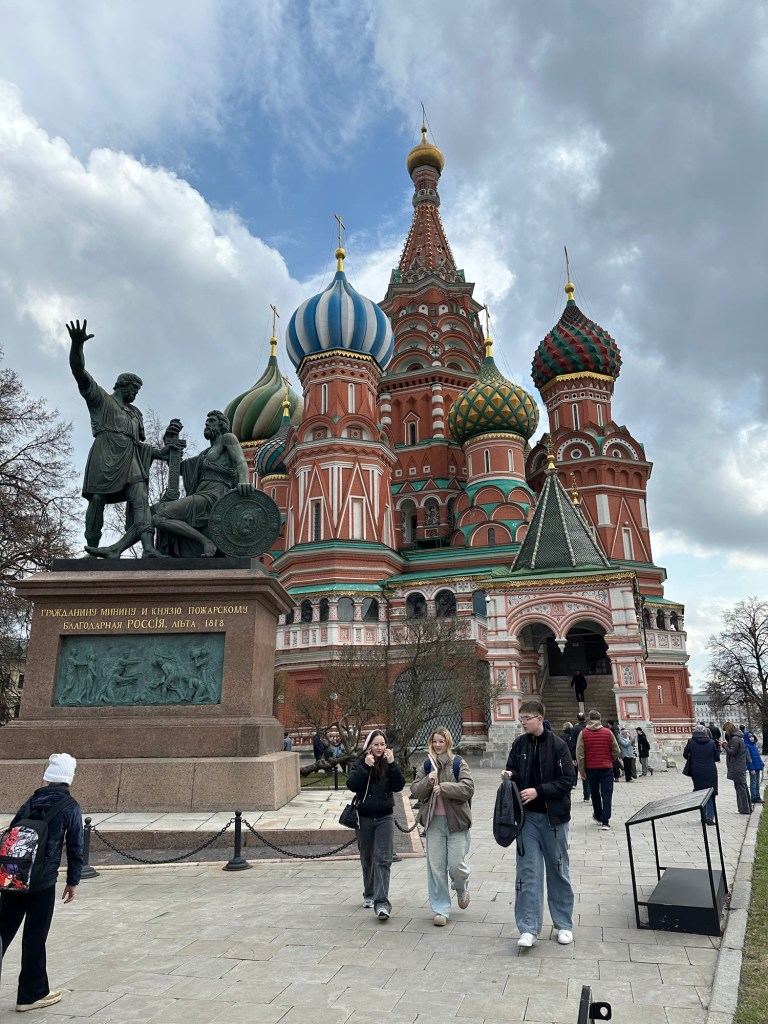
The walls are not so red, either. They are more russet. I gravitate towards St Basil’s Cathedral, known to the Russians as Pokrovsky Cathedral, a reference to the Virgin Mary’s veil (pokrov) and the protection Ivan the Terrible believed he had received in his successful military campaign against the Kazan Khanate in the sixteenth century, which was the reason for him to erect this church. The Basil in question is not the fourth-century theologian, but a contemporary holy fool who was later buried in the church. The familiar domes, looking like turbans, provide a splash of colour: blue and white, green and white, green and gold, red and green, gold. I pose in front of the church and the monument to Minin and Pozharsky, a butcher and a noble who organized resistance to the Polish invaders another fifty years later (in 1612). This would bring to an end the Time of Troubles and lead to the rise of the Romanov dynasty, which would rule over Russia for the next three hundred years, until the bloody revolution of 1917 and the rise of the Bolsheviks under Lenin.
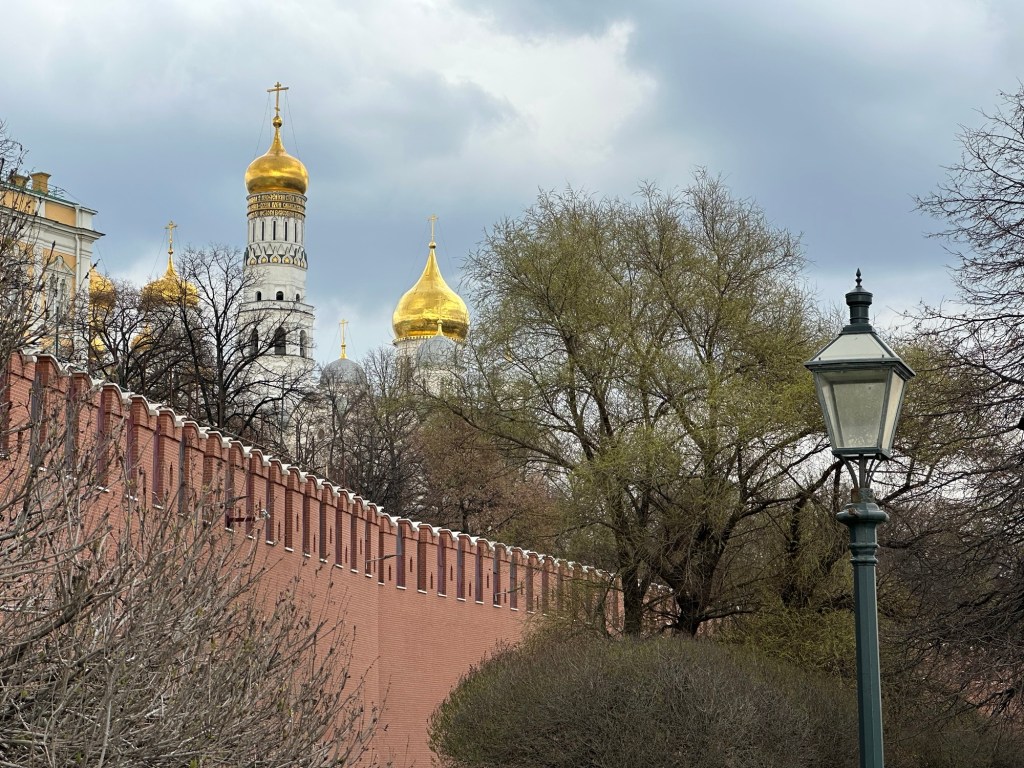
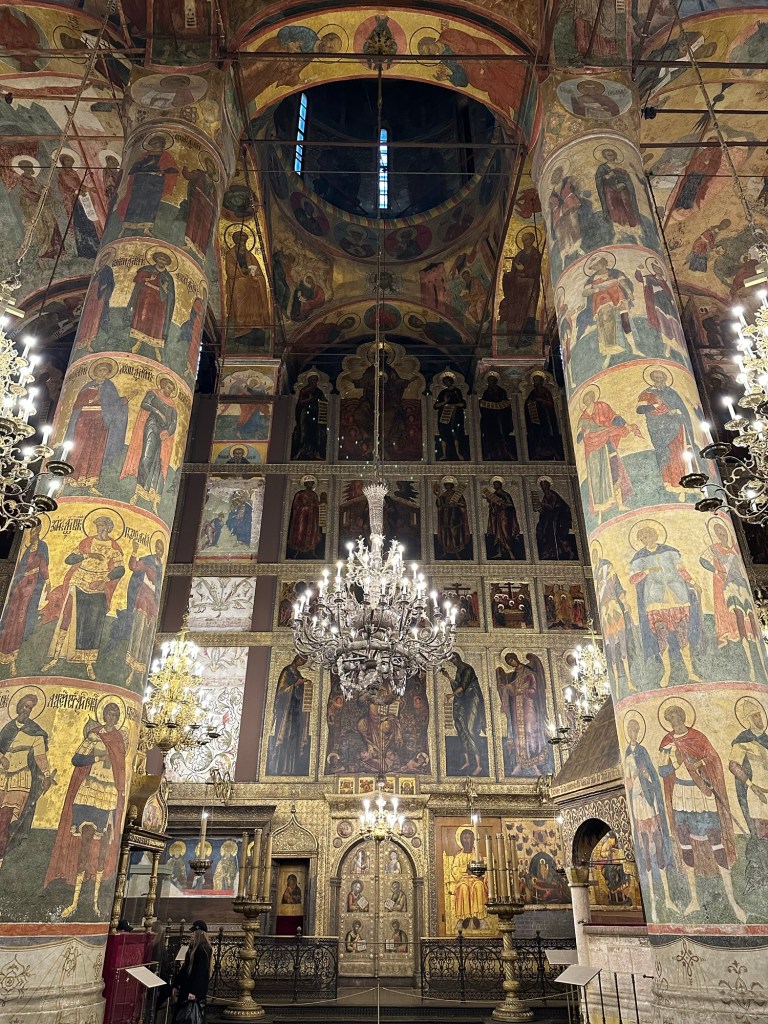
It is easy to lose one’s sense of direction because the Kremlin is not four-sided, but more of a triangle, so you have the south side facing the river, Red Square to the north-east, and Alexander Garden to the north-west. Inside the Kremlin are four ancient churches: the Assumption, Archangel, and Annunciation Cathedrals, and a smaller Church of Laying Our Lady’s Holy Robe. Here also is the Ivan the Great Bell Tower, a large bell sitting at its feet, a chunk missing – it is difficult to ascend to heaven when you are so heavy – and the Senate. The Kremlin, therefore, far from being military in character, is an enclosure that houses churches built (two by Italian architects) during the Grand Duchy of Moscow. My favourite is the Assumption Cathedral with its towering iconostasis (the icons that hide the altar from view, I notice how in some of the grander Russian churches the iconostasis consists of five levels and reaches all the way to the ceiling, the icons of the second level being particularly large, some of which I will see out of context in the Tretyakov Gallery) and frescoes adorning the columns, ceiling, and walls; the Archangel Cathedral, with its icon of St Michael, prince of the heavenly host, was used by royals to pray for military success, and many of them are buried here, while the Annunciation Cathedral was used as a private chapel.
In the Annunciation Cathedral, a Russian woman is enthusiastically explaining the icons to a group of Asian tourists. The tourists answer her questions with comparable enthusiasm, like excited schoolchildren. The Russian woman is indulgent with them and greets their correct answers with mild expressions of joy. I am waiting to take a photograph of the iconostasis, but the male tourist’s head obstructs my view of the holy doors at the centre of the iconostasis. As they move to the left, a woman comes in and stands in front of the icon of Christ. She leaves, but the Asian group automatically shuffles to the right, again making it impossible for me to gain a clear view. They then exit the church, and I think my moment has come, but just as I am about to press the shutter, they come back in – either they have forgotten something, or a point has to be made more forcefully. I rue having entered the church at the same time as them, if only I had been five or ten minutes later or earlier, but in the end they leave and I get my shot. The Russian woman flashes me a look; she is eyeing me as a prospective student.
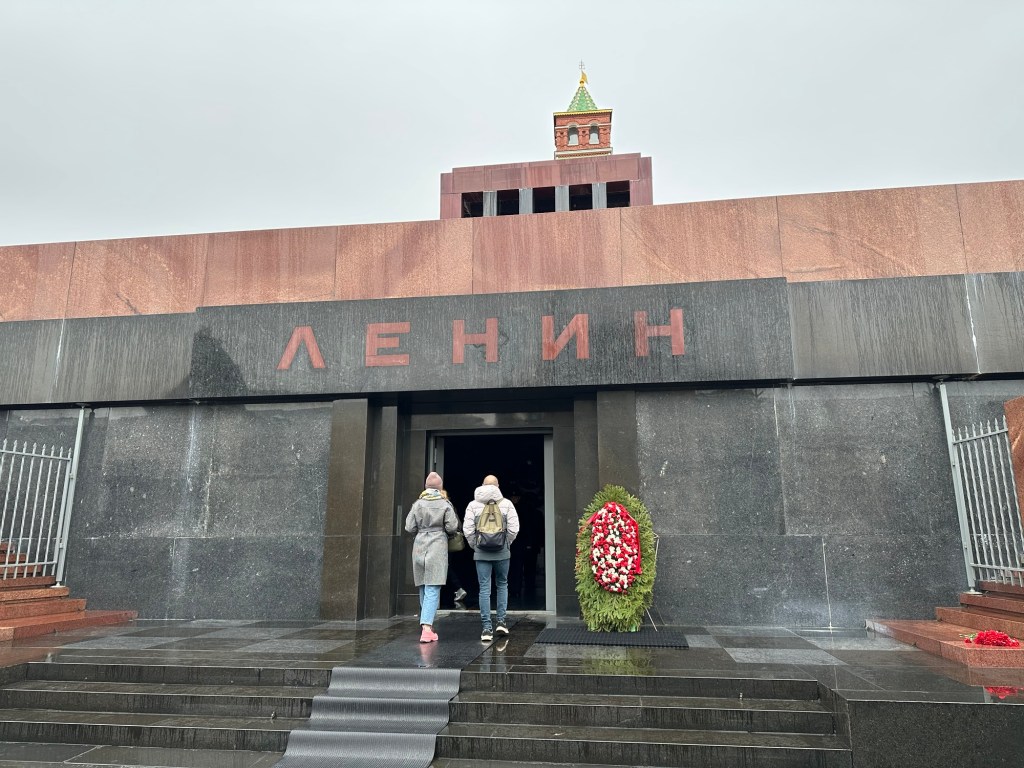
That morning, we visit Lenin’s Mausoleum. The queue is not long, and the constant drizzle helps to keep it down. We are not required to buy a ticket, entrance is free (entrance to the Kremlin is 11 euros; the History Museum and St Basil’s Cathedral both cost 20 euros, which I find a bit steep). We pass through security and along the wall, where the ashes of prominent socialists are interred, including the Scottish Arthur MacManus and the American Bill Haywood, before going down some steps and entering the mausoleum proper. A guard indicates that I should put my phone away and not take photographs. We descend some more steps, turn a corner, and there is Lenin in his casket, brightly lit in the surrounding darkness and surprisingly intact after a hundred years. Here is the architect of the 1917 Revolution, the one who promoted and was later pushed aside by Stalin. Stalin is buried outside, along with other leaders, while other prominent socialist-era politicians, such as Khrushchev, Gorbachev, and Yeltsin, are buried in the Novodevichy Cemetery in the south-west of the city. It is difficult to avoid a comparison between Lenin’s embalmed body and the relics of a saint in an Orthodox church, and the impact on Russians must have been similar. There is an aura about him. We pause for a moment before being encouraged by a disembodied voice somewhere in the shadows to move on. As we leave the area, the Spasskaya Tower strikes twelve and follows this up with a jaunty rendition of the Russian anthem. I am not sure what century I am in or what the dominant ideology is meant to be.
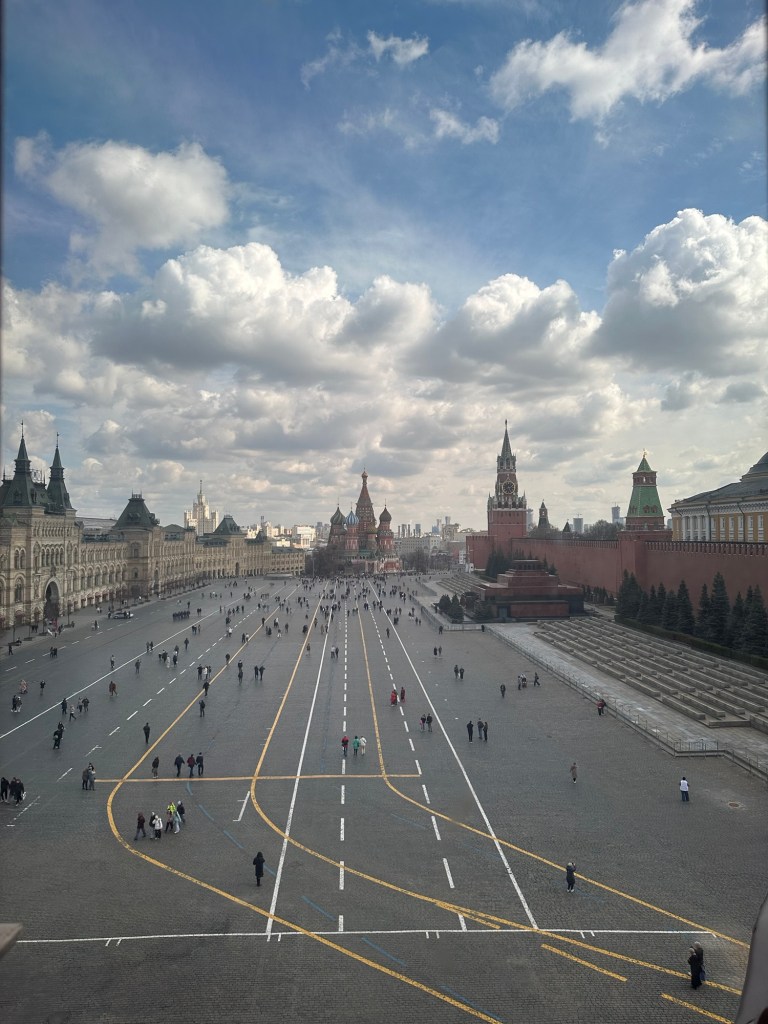
- Red Square (taken from the third floor of the History Museum).
- St Basil’s Cathedral with the monument to Minin and Pozharsky.
- The Kremlin walls and the domes inside the courtyard (Annunciation, Archangel, Bell Tower).
- The five-tiered iconostasis inside the Assumption Cathedral.
- The entrance to Lenin’s mausoleum.
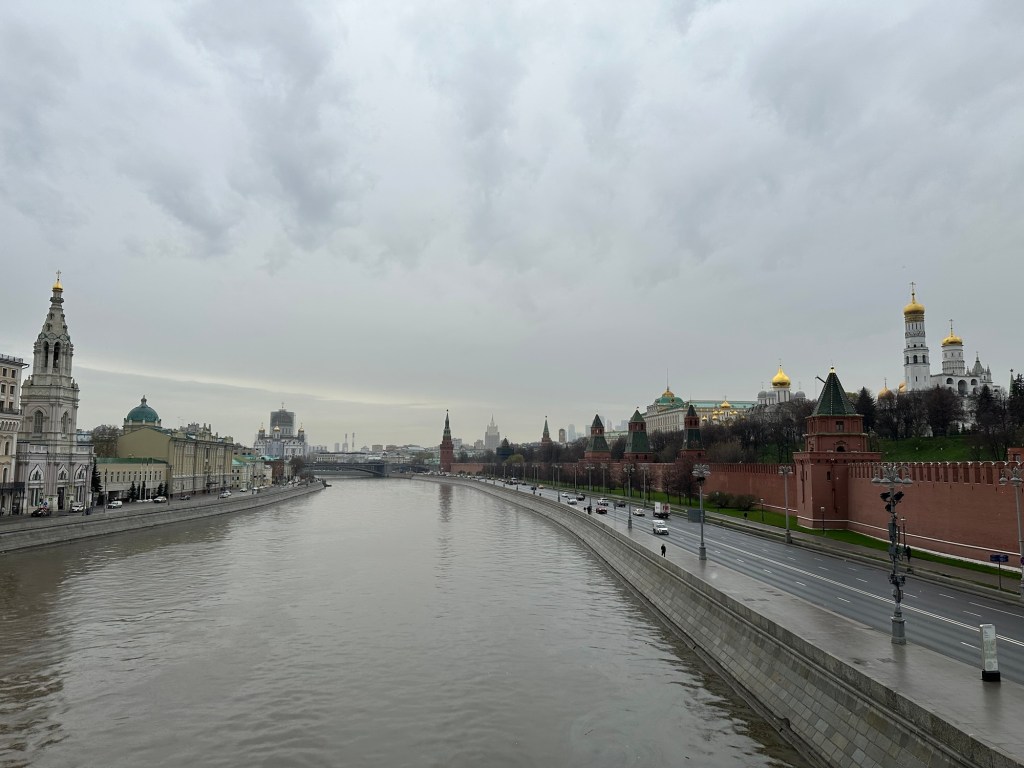
- The view along the Moscow River from the Bolshoy Moskvoretsky Bridge.
Jonathan Dunne
Next: The Tretyakov Gallery
 Stones Of Ithaca
Pingback: V. A Trip to Sergiyev Posad – Stones Of Ithaca