Word in Language (10): Father (0)

What do we know about the Father? Perhaps we know about him as much as our ability to love. He is generally portrayed as an old man with white hair and a white beard, next to his Son, with the Holy Spirit hovering above. We may associate him in particular with the act of creation and the Fall in chapters 1-3 of the Book of Genesis. According to Orthodox tradition, all appearances of God in the Old Testament are by the Logos, the Word of God, that is Jesus Christ. The New Testament is associated with the earthly life of Christ, his birth, teaching, crucifixion and resurrection. And the Holy Spirit is associated with Pentecost, the beginnings of the Church. The Father can remain in the background. Certainly, we cannot know his essence, and of God’s qualities St Maximos the Confessor says that it is only infinity that can be grasped fully by the intellect (see the end of his First Century on Love).


In an earlier article, I made the connection between TREE and THREE and put forward the analogy of the Father as the trunk and the Son and the Holy Spirit as two branches, as in a child’s drawing, the Son begotten and the Spirit proceeding. This is why in the Orthodox Creed it is said that the Spirit proceeds from the Father – not from the Father and the Son, as is erroneously stated in Western Churches – because otherwise the Spirit would have to be a sub-branch of the Son, making for a lopsided drawing. This doesn’t make sense.


Christianity is the only religion that professes God the Trinity: Father, Son and Holy Spirit. This is shared love, which crucially involves a third person, otherwise it could be construed as being exclusive. This love among the three persons is not jealous. It is like love in a monastic community – it professes love for the brethren, but also welcomes pilgrims, newcomers. The arrival of newcomers can be very unsettling, but somehow we have to find a place for them, to see that our reaction is immediately, naturally, spontaneously, one of love.


You cannot have the Father without having a Son. His first characteristic is that of being a Father, which immediately places emphasis on relationship. The Holy Spirit can be seen as a kind of conjunction – and – that welds the love together. I have already stated that this little conjunction, AND, contains the name Alpha and Omega (A ’N’ O) and spells DNA in reverse. It is a crucial word in language, and barely a sentence exists without it.


I would like to suggest that there is proof in language for the existence of the Father. This doesn’t surprise me, for from him all things come. The Son is begotten by the Father, the Spirit proceeds from the Father, and we are his creation. We saw in the previous article how the world is a kind of spiritual womb, from which the body of the Church is in the process of being born. We make the mistake of thinking that life in this world is all there is and our birth has already taken place, but I don’t think this is quite true – our physical birth has taken place, sure enough, but our collective spiritual birth is still happening, which is why for me St Paul writes, ‘We know that the whole creation has been groaning in labour pains until now’ (Rom 8:22).


The first indication that the Father is who we understand him to be – the source of all life – can be found in the alphabet. But we should sound a note of caution: if we can find proof for the existence of the Father in language, shouldn’t that point us in the direction of the Holy Trinity? Shouldn’t that suggest that the Father is truly behind and in his creation, just as we make him out to be? How else could he be in language, a set of words we ourselves have come up with in order to communicate, a set of letters which we use to write these words down? This should give us pause for thought – if we can find proof for him in language.


Language is made up of three elements. The first of these is breath. Breath forms the basis of all language. There can be no language without breath. Without breath, we are in effect dead, and we are not going to communicate by means of our bodies. Breath is represented in the alphabet by the letter h, a very important letter since it represents the basis of all speech, and yet (or because of this) it is dropped in dialects like Cockney and not pronounced in languages like Spanish. That for me is a sure sign of its importance.


If all we do is huff and puff, we are not going to make much sense, and so, as anyone who has been present at a childbirth knows, the next thing that comes along is voice, the vowels. We breathe out (the baby breathes out) and add voice (the baby bawls – loudly), and now we have sound. We also have words – words like a, I and o! We can even put a vowel before breath and exclaim, ‘Ah!’ We have the beginnings of speech.


If we hold a vowel for long enough, as when we visit the doctor’s, water will collect in our mouth, and this is because vowels are like a river – they flow. We can see that FLOW and VOWEL are connected by the phonetic pair f-v, addition of e. But the vowels do not emerge from our throat, where language originates, in the same order that they appear in the alphabet. Actually, they emerge in the following order, from the back of the mouth to the front:


u – o – a – e – i


forming a V-shape as they do so. This means that the first word the human apparatus is capable of pronouncing is breath (h) plus the first vowel to emerge from the throat (u): hu (I am assuming that breath on its own does not constitute a word, which I don’t think it does).


You might wonder, ‘So what?’ Well, this little word hu is from Sanskrit and means ‘invoke the gods’. So the first word a human is capable of pronouncing is an invocation of God. It is also the root of our word God, as any good dictionary will tell you. This is extremely interesting, but it doesn’t stop there.


Have you noticed that we are human? The science of etymology, which studies the evolution of language over time and, like all science, is limited in its vision (only faith is not limited, which is why we need it), will tell you that human derives from the Latin word for ‘man’, homo. Yes, maybe. But word connections – which are the study of language outside time, and hence far more interesting – will enable us to see that HUMAN is a combination of HU and MAN. It seems that God stamped us with his seal when he made us. We have already seen how MAN contains AM and AN.


But we still haven’t seen any proof for the Father. Let us continue. If all we had was breath and water, h and the vowels, we would do a lot of whining and exclaiming (some people do that, it is true). But to form words, real words, we need to obstruct the passage of air with our lips and tongue to form the consonants. Now we get proper chunky words. The consonants, as I have explained, can be divided into seven phonetic pairs:


b-p     d-t     f-v     g-k     l-r     m-n     s-z


depending on where in the mouth they are pronounced and which piece of flesh – the lips or tongue – is used to obstruct the passage of air when they are pronounced.


That accounts for twenty letters, but the English alphabet has twenty-six. Three of the remaining letters are semi-vowels – that is, the passage of air is only partially obstructed. The semi-vowels j and y correspond to the vowel i; the semi-vowel w corresponds to u (think of the name of the letter).


And the other three are what I call redundant letters. We don’t need them. They are c, q and x, all of which can be written using a combination of the letters k and s: the letter c is pronounced either k or s, q is pronounced k and x is pronounced ks. And yet they serve a purpose, because the double pronunciation of c as k/s enables me to make word connections through both these letters (we will see an example in a moment).


That accounts for the whole of the English alphabet: h, five vowels, seven pairs of consonants, three semi-vowels and three redundant letters. The letter h corresponds to breath, the vowels to water and the consonants to flesh.


What is very interesting is that the exact same three elements – breath, water and flesh – correspond to the act of creation in chapters 1 and 2 of Genesis. Remember that a wind (breath) swept over the face of the waters (Gen 1:2). Remember that to form the sky (air/breath) God separated the waters from the waters (water) (Gen 1:6-8). Remember that God then gathered the waters under the sky into one place and formed the land (flesh) (Gen 1:9-11). Remember that man was formed from the dust of the ground (flesh) (Gen 2:7) and God then breathed into his nostrils the breath of life (breath).


So the same three elements of breath, water and flesh are involved in the creation. But why should we be surprised, given that we know that God spoke the world into being? Doesn’t almost every paragraph in Genesis chapter 1 begin, ‘And God said’?


Do you remember how the letter c can be pronounced k or s? We might now see a connection between SPACE and SPEAK.


We might also see that WORLD contains LORD and WORD. The WORLD is a combination of LORD AND WORD:


world = lord + word


Hence those three words that are constantly repeated in Genesis: ‘And God said.’


But we still haven’t found proof for the existence of the Father in language. You need to know that there is an ‘eighth’ phonetic pair (and it isn’t even a pair): b-v-w. These letters are closely related. In Modern Greek, b is pronounced v; in Spanish, v is pronounced b. In Latin, v is pronounced w; in German, w is pronounced v. This enables me, through v, to connect b/w with f (the partner of v according to the phonetic pairs), and many word connections are made using this combination.


Now we will begin to see that the three elements of breath, water and flesh – the elements that make up speech, a daily occurrence, and also the creation of the world we inhabit – have one word in common. I am not making this up because I am obeying phonetic rules, so it is in language (not in my imagination!).


BREATH is clearly connected to FATHER by this combination I talked about, f-b/w.


WATER is clearly connected to FATHER by the same combination, f-b/w, addition of h (one of the two most commonly added letters).


FLESH is clearly connected to FATHER by the phonetic pair l-r, the alphabetical pair s-t, addition of a.


The elements of speech and creation have the word FATHER in common. That is remarkable and ought to make us bow our heads in worship. The next time we open our mouths to speak, we might be a little more respectful of what we are doing and remember how the Father is in the elements of speech, in our very human being.


Jonathan Dunne, http://www.stonesofithaca.com
Word in Language (9): The Fall

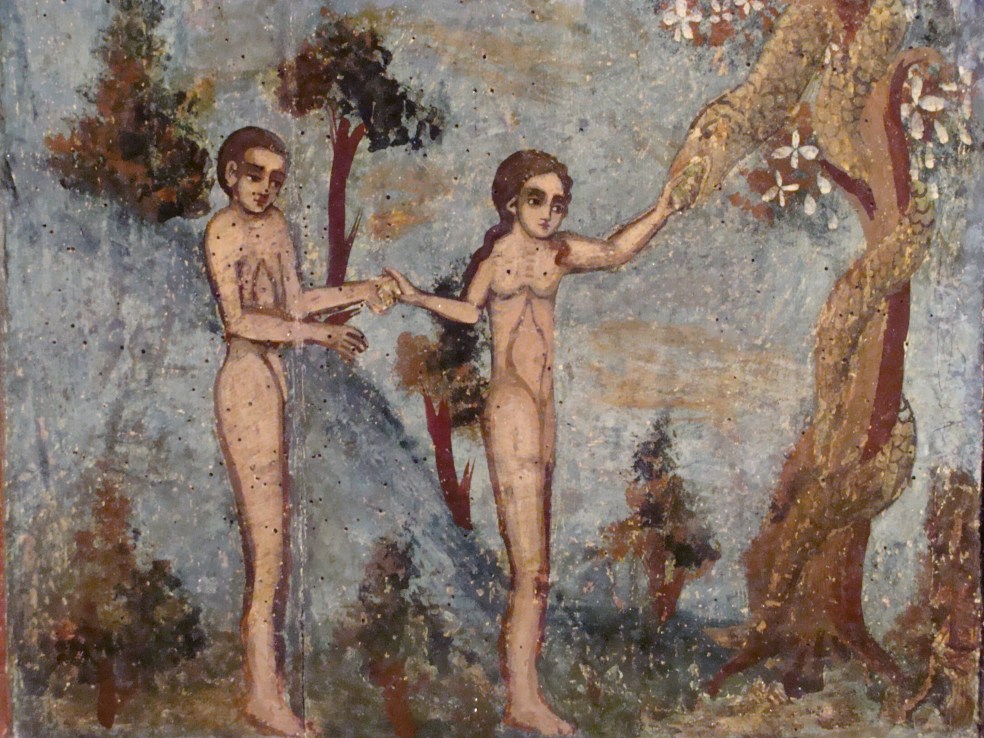
The story of the Fall of humankind is related in chapter 3 of the Book of Genesis. It is generally understood to mean that the woman, Eve, was tempted by the serpent and persuaded Adam to eat of the fruit of the tree of the knowledge of good and evil, which the Lord God had told the man not to eat from or else he would die. The serpent – a representation of evil, or the devil himself – tells Eve that they will not die, but their eyes will be opened and they will be like God, knowing good and evil. The man and the woman eat and then become aware of their nakedness, which causes them to hide when God comes visiting ‘at the time of the evening breeze’. The Lord God asks Adam how it is he knows that he is naked, and he replies that the woman gave him fruit from the tree to eat; she in turn blames the serpent. God pronounces their punishment, and the man and the woman are expelled from the Garden of Eden.


I should perhaps point out one of the most remarkable word connections you will ever find, and that is when we rearrange the letters of GARDEN OF EDEN. I used to do this, sitting down in the early morning (between 6 and 8) while the house martins screeched around on a level with my eighth-floor apartment in Sofia, Bulgaria – rearrange the letters and see what I could find.


GARDEN OF EDEN gives DANGER OF NEED. This is surely a coincidence, language telling us something.


Adam and Eve were in danger of need. But what exactly is wrong with having a knowledge of good and evil, and why should that cause them to die?


I would like to suggest an alternative interpretation, one I thought was unique to me until I discovered that it had been offered and accepted before. This interpretation – which is only that, an interpretation – gives rise to several conclusions, which I would like to list at the end of this article.


I imagine Adam and Eve playing in the Garden of Eden, in innocence, as children do, without a care in the world and with not much to do except to admire God’s handiwork in themselves and the animals and plants that surrounded and delighted them. They must soon have become friends. Life must have seemed like an ‘Eden’ to them – no great responsibilities, no great amount of work, no aches and pains to bother them. Just an eternity of today.


Except, as children do, they began to grow, to become sexually mature, and their curiosity must have been piqued. Eve began to have these bumps on her chest; Adam began to grow hair around his genitals and his long thing got longer. And they must have begun to experience the first sexual stirrings, perhaps in the night, when they were asleep, lying among last year’s fallen leaves. Perhaps they began to experience pleasure and to wonder what pleasure lay in the other.


There is an obvious correlation between the serpent and the man’s penis. The snake has traditionally been associated with the penis and sexuality. So perhaps it was the man who, feeling aroused, suggested they acquire carnal knowledge, knowledge of one another. Certainly carnal knowledge can be for good and evil – good in a loving, committed relationship and in the procreation of children; evil when it treats the other as an object and seeks only its own satisfaction. Undoubtedly, in the history of humankind, sex has been a force for good and evil – on the one hand, a demonstration of love, two people coming together in wonder and amazement; on the other, an abuse of the other person when it is not consensual or merely pleasure-seeking, seeking a meaning where none is to be found.


So we have identified the serpent with the man’s penis, but what of the fruit of the tree of the knowledge of good and evil, the apple? The apple can be related to the woman’s breast, that object that mystified the man and that he is now suggesting they eat of. After all, a fruit has flesh. It also has ‘the seed in it’, as we read in chapter 1 of the Book of Genesis, in the first creation account.


God had said that if they ate of the forbidden fruit – had sexual intercourse – they would surely die, and this is true, but bear in mind that the verb ‘die’ has two meanings: to expire at the end of our earthly lives, but also to expire in orgasm. This latter meaning is well documented.


What is the connection between these two meanings, and again why should the knowledge of good and evil be such a bad thing?


I think the answer is to be found in an article by a Greek bishop and theologian, Metropolitan John Zizioulas. In ‘The Consequences of Man’s Fall’, he writes, ‘In beings with organs – especially mammals – the ageing cycle begins from the moment that the organism reaches the point of reproductive maturity.’ So when we reach sexual maturity, we begin to die (in both senses of the word).


And this ties in with a teenager’s behaviour, because a child who reaches sexual maturity changes somewhat. They become more bashful, more private, they are no longer prepared to appear naked in front of their parents. Isn’t this exactly the behaviour of Adam and Eve when God comes looking for them ‘at the time of the evening breeze’? They hide themselves. They have become aware of their nakedness. And what is it they use to hide their nakedness that now causes them such shame? Fig leaves! Figs are another symbol of sexuality and the male organ.


So they have acquired carnal knowledge, they have slept together, and now they do not want God to see them because they are ashamed of their nakedness and they know that he will see it in their eyes. Their eyes have been opened.


But if sexual maturity coincides with the beginning of the ageing process, there is no other way to have children. So God – who so often is seen as inflicting punishment, as being vindictive, something that is as far away from his nature as it is possible to be – performs an act of charity, of love: he banishes them from the Garden of Eden in case they eat of the tree of life. He wants them to have children (I’m quite sure he knew perfectly well what was going to happen, just as any parent does), but he doesn’t want the ageing process that comes with sexual maturity to last for ever, that would be terrible, so he sends them out of the Garden of Eden to till the land they came from.


He does this in order that we might have children. In order to have children, we must die. This is the meaning of death – it is so that we can have the unparalleled blessing of procreating, of giving our life to another, who is then ‘the apple of our eye’.


This is a great thing – ‘Greater love hath no man than this that a man lay down his life for his friends’ (Jn 15:13) – but it also serves another purpose: it builds up the body of the Church. It prevents God from having to create all the creatures, all the men and women, himself. He involves us in the process (albeit our involvement is slightly different, because life passes through us, it does not begin with us – we are translators, not authors).


In this sense, the earth is a spiritual womb, it is a womb in which a spiritual body – the body of the Church – is being formed, just as we are formed in our mother’s womb. We have not realized this. Just as there is spiritual blindness as well as physical blindness, so there is spiritual birth as well as physical birth. We are still in the womb, but now it is not the body of an individual that is being formed, it is the collective body of the Church, a body made up of many members (in 1 Corinthians 12 and Romans 12, Paul compares us to the different members of the body, each performing his or her own unique function, with Christ as the head).


And this is where we get into the realm of Christian paradox: life passes through us when we receive life from our parents and pass it on to our children; but we also pass through life, in the sense that we are not here for ever and we move on. We form part of the body of Christ, the body of his Church, but in the sacrament of communion it is his body and blood that form part of us. We lose our life and find it. I begin to think the Christian message is true precisely because it is paradoxical.


Is there an indication of the world as a spiritual womb? I think there is, because if we read the first creation account in chapter 1 of Genesis, we find that God created the day on day one (already we have the progression AIO in the word DAY, remember the correlation between O and D and between i and y) and then, on day two, he created the dome of the sky by separating the waters from the waters. Doesn’t that sound like a baby in its mother’s womb, surrounded by water? Perhaps this is why SKY can be connected to KISS and SICK, because for procreation to occur there must be a kiss, but sexual maturity is also the beginning of the ageing process, of what makes us sick.


Is there anything in language to connect the serpent and the man’s penis, to connect the apple and the woman’s breast?


Well, if you allow fluidity to the vowels and change one front vowel for another, you will find that PENIS is in SERPENT, with the addition of r and t. And applying the phonetic pairs b-p and l-r, you will find that APPLE is in the first four letters of BREAST, with the addition of s and t.


This interpretation – and it is only an interpretation – has three consequences:


  1. The Fall was a good thing. Otherwise, we couldn’t have children and the body of the Church could not be formed.


  1. Perhaps the woman is not entirely to blame; in fact it would seem that Adam was the prime mover in response to his sexual desire. We could at least speak about shared responsibility.


  1. While in the Church great emphasis is placed on monasticism, on abstinence and asceticism, it would appear that the purpose of life on earth is to have children, and this would give the option of marriage far greater importance than it is sometimes credited with.


So Genesis, that most remarkable book, is not just the story of the creation of the world and the Fall of humankind, but also the story of each one of us, of human life. We are born, just as the world (the body of Christ) is. We reach sexual maturity in order that we might give that life to others. We then have to die (we have now fast-forwarded to the Crucifixion) because it is the only way to give life – to die, to expire. But there is a greater mystery here. This is not the last word.


The word ‘die’, if we apply the physical pair b-d (a pair of letters that look alike; in this case one is the mirror image of the other), clearly contains ‘I’ and ‘be’. It is a very life-affirming word. The word ‘live’, if we remember the closeness between b and v, contains two ‘I’s and ‘be’ – this may refer to our physical and spiritual selves, to our human and divine natures (the latter acquired by grace in a process known in Orthodoxy as theosis), or to our fallen and resurrected selves. Anyway, it is manifestly not the end.


If we could only see this world for what it is, a place of spiritual growth (not a place to make money!!) – a spiritual womb – we might realize our connectedness. Having been born from our mothers, we are now – all of us, outside the constraints of time – in the process of forming another, spiritual body, one that has Christ as its head and one that will last for all eternity. The world is a spiritual womb. We must die in order to have children, participating in this way in the formation of the Church. And having died, we have no choice but to be born again, but this time without the straitjacket of corruption, without the ageing process. We will be ‘like angels in heaven’ (Mt 22:30). With one great difference: we will not be alone.


Jonathan Dunne, http://www.stonesofithaca.com
Word in Language (3): Seed and New Life

In the Gospels, Christ is in the habit of saying, after a parable, ‘Let anyone with ears to hear listen!’ When he explains to his disciples that the mysteries of the kingdom are revealed to them and not to others, he quotes the fulfilment of the prophecy contained in Isaiah, ‘They may indeed look, but not perceive, and may indeed listen, but not understand.’ It is obvious that there are different forms of seeing and hearing, of looking and listening. It is not enough to open our physical eyes, we must open our spiritual eyes also.


This is the great problem facing humankind because a large majority think it is sufficient to open their physical eyes, this means they are not blind, but we are all blind to some extent and it is only faith that will cleanse our sight and unplug our ears, so that we can hear. It is remarkable that EAR is contained in HEAR, and EYES contains SEE in reverse.


It is also remarkable that ‘ear’ can refer to an ear of wheat. We find this in the Parable of the Tares (Matthew 13:24-30, 36-43), where wheat is taken to refer to the children of the kingdom, while weeds (or tares) refer to the children of the evil one. Again, we are saved through hearing because wheat has ears.


One of the phonetic pairs is d-t. A phonetic pair is a pair of consonants that are pronounced similarly in the mouth, often with voice and without voice, as in the case of d-t – they are pronounced in the same way, only d is voiced and t is voiceless, as you can see if you hold your throat while you pronounce them. If we apply this phonetic pair to SEE and HEAR, we get SEED and HEART. If we rearrange the letters of HEART, we get EARTH. So a seed is planted in the earth of a person’s heart and it depends on that person’s reaction, their receptiveness, whether they listen or not.


We might think this connection between EARTH and HEART is just a coincidence. Well, that’s exactly what it is. Coincidences are hidden roots that come to the surface. But we can confirm this coincidence by looking at another word connection, this time between SOIL and SOUL. Soil is a thin layer around the earth, but it provides untold riches, all the food that we can eat. In terms of economics, we focus on another kind of black stuff, OIL, but I would suggest that it is SOIL that provides the real riches and enables us to live.


A seed is planted in the earth. It sprouts roots, which in a child’s drawing always divide into two, and a shoot that breaks through the surface (rather as a tooth breaks through the gum) and divides into three – the trunk and branches of a tree. The branches put out leaves, which photosynthesize, and then flowers, which metamorphose into fruit. So the end result of a seed sprouting in the ground is the growth of a tree and the bearing of fruit.


This is the process of life and it takes place right in front of our eyes (though we may not see it). A SEED becomes a TREE. Have you seen the connection? Phonetic pair d-t, alphabetical pair r-s. ROOT and TREE are also connected (we only have to substitute one mid vowel for another). ROOT is also connected to SHOOT by the alphabetical pair r-s, addition of h. And SHOOT is connected to TOOTH by the alphabetical pair s-t.


This is because language, like nature, is interconnected.


I could go on (for example, how FRUIT contains ROOT, which is indeed the case, without roots there are no chances of the tree bearing fruit). But I would like to focus on two word connections.


The first is between TREE and THREE. A tree in a simple drawing has a trunk and two branches. There is an obvious correlation here with the Holy Trinity: Father, Son and Holy Spirit. Would it be surprising for creation to speak of the Holy Trinity, by whom it was created? For that matter, should we be surprised that language contains information about God and human life, when Christ himself is called the Word? Is it not possible that when we speak, we are handling sacred things, just as when we till the earth? Should this not encourage a sacred attitude to everything around us, inasmuch as it refers us to the Creator?


But there is another word connected with THREE, and that is EARTH (we only change one vowel). In fact, EARTH is THREE in reverse (if we keep the consonantal group, th, together). Again, we might see a connection with the Holy Trinity, but it also so happens that the Earth is the third planet in order of increasing distance from the Sun – and it was created on day three, according to the creation account in the first chapter of the Book of Genesis, together with ‘plants yielding seed, and fruit trees of every kind on earth that bear fruit with the seed in it’ (that is so that the whole process can begin again). Earth is intrinsically linked with the number three, and we see some of the other words we talked about – seed, fruit and tree.


Yes, but what about ‘plant’? That doesn’t fit your system, does it?


Well, actually it does. If we apply the phonetic pair d-t to PLANT and remove the first letter, we get LAND. If we remove the final letter of LAND and apply the alphabetical pair l-m, we get MAN. Language is telling us something – it is genetically encoded, just like plants. If we put it under the microscope, we will discover wonders, because these are not things a single human being in a single generation could have installed in language without our knowledge. We have adopted the kind of speech that reflects our Creator, just as we bear his image and draw our breath from his existence.


Why is this so hard for us to admit?


Some might also find it hard to admit of the possibility of a resurrection from the dead. How could a body laid in the ground ever possibly return to life? And yet, don’t we have an example of this in front of our very eyes? The seed that is planted in the ground – is it not an example of resurrection? To all intents and purposes, we cannot see it, it is not there. And yet it gives rise to towering trees, microcosms of life that support insects, that communicate in a way we are only beginning to decipher.


There is another connection with SEED, but we will see it better if we use lower-case letters: ‘seed’. Do you remember how we took the ego, I, from ‘gold’ and ‘slave’ and got ‘God’ and ‘save’? If we add the ego to ‘seed’ and rotate the letter d by 180 degrees, we get ‘sleep’. Isn’t that what the seed does in the ground? Sleep the big sleep before rising to new life.


Jonathan Dunne, http://www.stonesofithaca.com