Turner and the Desert

Turner’s painting Seascape with a Yacht (?), c. 1825-30, is somewhat cursorily dismissed on the Tate Gallery website. It doesn’t get a display caption, like most of the paintings. There is a catalogue entry, but it is short and rather scathing – “thinly and freely painted […] lack of drama and small size” – and ends: “There are some losses down the left-hand edge and particularly at the top corner. The picture has not yet been restored.” No wonder it wasn’t put on display.

There even seems to be uncertainty about the title (that question mark in brackets) and about the date (circa a period of five years). Everything points to a painting unworthy of our attention. And yet it is the gift of the poet to see something extraordinary in the ordinary, and in her book Turner and the Uncreated Light the Bulgarian poet Tsvetanka Elenkova does just this. Let us look at the painting:
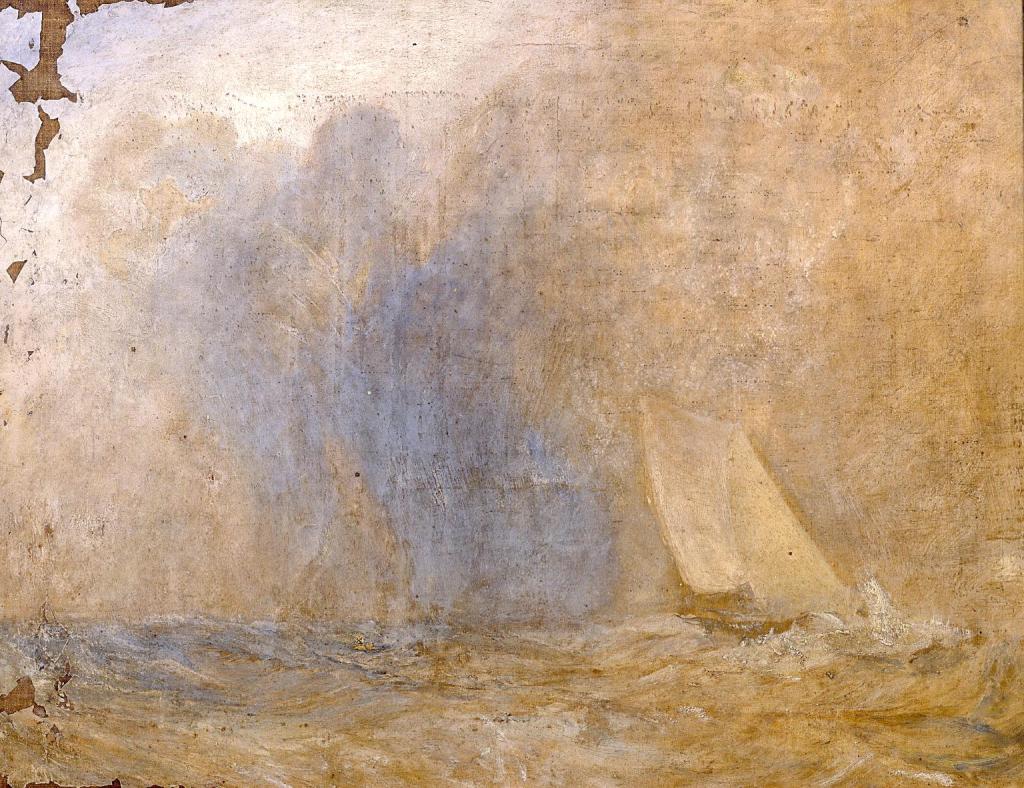
Seascape with a Yacht (?) by J. M. W. Turner (reproduced from https://www.tate.org.uk/art/artworks/turner-seascape-with-a-yacht-n05485)

Not much, right? A splodge which is falling to pieces. There appears to be a yacht (is it a yacht?) on the right, and some waves. But the poet has noticed the predominantly ochre colour of the painting. The sea looks less like a sea than a desert. The yacht she understands to represent the people of Israel crossing the desert. And that tall white wave at the bow of the yacht she takes to be the prophet Moses.

Then she draws our attention to the large blue area in the left half of the picture, standing, as it were, on the waves. She understands this to be Archangel Gabriel. We can see the fold of his tunic where it crosses on his chest, in a lighter colour. Out of the tunic appear his neck and head. He is looking towards the yacht, watching over the people of Israel as they make their way to the promised land. Behind him (again in a lighter colour) we can see the outline of his wings.

It may help at this point to reproduce a fresco of Archangel Gabriel found in the medieval Church of Sts Peter and Paul in the old Bulgarian capital Veliko Tarnovo (in central Bulgaria) because there is an obvious similarity between the two images:

Fresco of Archangel Gabriel in the Church of Sts Peter and Paul, Veliko Tarnovo, Bulgaria

Again, the tunic is folded over on his chest. The angel’s skin is darker than the cloth of the garment. And we can see the outline of his wings. He is writing on a scroll (“Wash yourselves and be clean learn to do good”) – perhaps that is the meaning of the dark blue patch to the right of the angel in Turner’s painting.

And in the painting she also sees a horse’s head in the ochre sky above the yacht and slightly to the right. It is possible to make out the horse’s eyes and nostrils. Admittedly we can always disbelieve. Then the magic of the painting begins to recede, and we are left with a tattered painting. But the poet’s vision is so much richer. Here we have a depiction of the Exodus – this is why the painting has not been restored, we haven’t got there yet. We are on the way, a prophet leading us, a guardian angel over our shoulder. As with the other paintings, not for a moment do I think Turner consciously painted these things. It’s just he received the same inspiration as the painter of the fresco in a church in central Bulgaria several hundred years earlier. It is the same Spirit working through him.

Jonathan Dunne, http://www.stonesofithaca.com
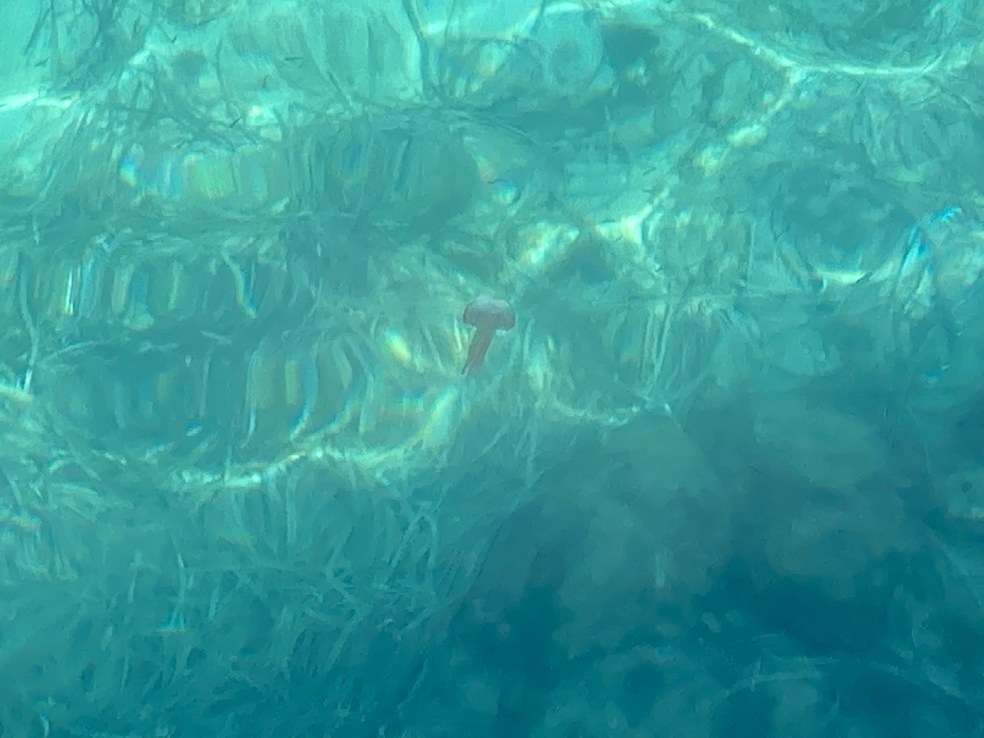
Jellyfish Sting

I swam

not with Tom Cruise,

not with Anthony Hopkins,

not with Kim Kardashian

but with a cormorant

fishing

in flips and furls

seemingly oblivious of me

as I cut silently

through the water

I start the day like this

– arms outstretched,

hands upturned,

palms white,

seeking the sun

and then I draw

a long arc

like Moses

watching the Israelites

fighting the Philistines

keeping God on their side

The sea is

an altar cloth

– an antimension –

which I open

and wipe with a sponge

I begin my prayer

above the water

“Lord Jesus Christ,

have mercy on me”

After a while

my prayer descends

I no longer enunciate

the words

as my mouth goes

below water

My mouth is now

the underside of the boat

(I have learned

something of

the spiritual life)

But when I turn

the sea changes

a dark cloak

has been cast over it

with coruscating

sequins

that prevent me

seeing

below the surface

A sudden

searing pain

wraps itself

around my wrist

I thought pain

was supposed to be

a knife

a spit

something driven in

not something wrapped around

an embrace

an arm around the shoulder

and what to do

when the threat

is your milieu

– you cannot get out

of it

except by swimming

to shore

you cannot stay still

Prayer is tossed

to the four winds

safety is the priority

now

and as I head

to the shore

another hidden enemy

still has time

to give me

a parting shot

On the beach

I accost some locals

unsure as yet

what has attacked me

Jellyfish,

they say

Then how do you swim?

I ask

The old Greek lady

gazes at me

through dark tinted

glasses

I can just make out

the pearls

of her eyes

We look,

she replies

Jonathan Dunne, 28 June 2022

Ownership

We have been placed on this earth, we’re not really sure how, except to say that we emerged from our mother’s womb after a gestation period of nine months. When we emerged, having survived in water, we took a breath of fresh air and thus became suitable for the environment we now inhabit. Once we had breathed in, we could breathe out and we joined all the other creatures in translating the environment around us.

It is important that we understand this concept of translating the environment around us. We generally look down on translation. It is second best to the original. It contains mistakes and isn’t as good as reading the original text. The translator’s name is hidden, eclipsed. When we need a translator, that person is essential, but we soon forget about them afterwards. Perhaps because the translator takes control away from us, we cannot access the original language ourselves and so we must rely on the other.

But translation goes further than this. The person who sits down and writes the original text is also translating – translating their experiences, the stories they have heard, the knowledge they have acquired, the words they have learned, their understanding of conversations. And they translate all of that on to a piece of paper. The way they write it one day will not be the same if they write it on another day, so the text is susceptible to their mood on that day and the environment around them (any disturbances). Creativity is a fragile thing.

And while they are doing this, they are translating the air by breathing, translating the food they had for breakfast that morning, translating (making sense of) any conversations they may overhear. Everything in this world is translation because nothing begins or ends with us.

The same might be said of our thoughts. Do they truly originate with us? Or are they placed in our minds to see what we will make of them, how we will react? I believe that the only thing that is ours, strictly speaking, is our reaction, how we choose to react – whether we choose in a given moment to show love or hatred. This also is translation because our reaction, our choice of words or deeds, is like choosing the words with which to represent a text in another language. Again, it will not be exactly the same on one day as the next.

Air passes through us. Food passes through us. Even life passes through us – the life we receive from our parents and pass on to our children, precisely because we are not the authors of life. Even trade, the desire to make money, involves things passing through our hands. They do not begin with us, we do not come up with the raw materials, more often than not it is the earth that does that. We change them in some way (a process that normally involves packaging) and pass them on, fixing a price as we do so.

But we would prefer to think of ourselves as authors. We lay claim. We say this piece of land, this object, this product is mine – because I paid for it, because I got here first. Once we draw the line and say something is mine, we open ourselves to conflict, because it is a false assumption. We don’t own the land we live on, someone else made it, and it wasn’t us. We don’t own what the earth produces, we certainly didn’t invent the seed that gave rise to the crop.

If you fail to recognize the other, then what the world contains, even other people, are fair game, you might think, a potential source of profit. But this is a corrupted way of thinking. We should use what is placed at our disposal for the good of others, not to make a profit.

This claiming ownership is really making ourselves out to be the source of what is around us, and only God can do that, the same God who appeared to Moses at the burning bush in Exodus, chapter 3, and sent him to free the Israelites from bondage to the Egyptians. When Moses asks, naturally enough, on whose authority he is to do this, who he is to say has sent him, God replies, ‘I AM WHO I AM.’ This is the name of the one who sent you.

In Greek, this phrase is translated ‘ἐγώ εἰμι ὁ ὤν’, literally ‘I am the being’, and the last part of this phrase – ‘ὁ ὤν’, ‘the being’ – is included in icons of Christ Pantocrator, since in Orthodox tradition it is the pre-incarnate Christ who appears in the Old Testament. The letters are written in capitals: O WN.

Not only do these three letters spell three words in English – own, won and now – not only do they spell a number if we rotate one of the letters – ONE – they make clear, as all of language does, who the author is, who is the one that can lay claim to ownership. The rest of us are just passing through.

Jonathan Dunne, http://www.stonesofithaca.com