Word in Language (20): Believe

I have always been confused whether we are supposed to receive a sign and then believe, or to believe and then receive a sign as a result of our belief, a confirmation, as it were. That is, does God open the doors of our senses to the other world, we perceive the other world and therefore believe, or does he open the doors of our senses as a result of our belief? Is it possible to believe something (or someone) you have never seen?

What set me on the journey of faith was an experience I had in 2001 on the island of Procida in the Bay of Naples, Italy. I asked for a sign and I got one. So in a way my belief was a result of the sign I received. But that sign came about because I asked for it, so I was predisposed, I had realized the limitations of my self, my need for the other, I had pulled down the walls of my self-sufficiency, thrown open the gates, invited God in. Is this, therefore, the procession of faith: an understanding of our own limitations leads to a call to God, which leads to a response on his part, which leads to faith on ours?

BELIEVE itself is a very interesting word. It spells VEILED in reverse (remember the physical pair, pair of letters that look alike, b-d, one of which is a mirror image of the other). Well, the mysteries are veiled, aren’t they? We don’t see them at once, but they reveal themselves to us gradually, in response to the level of our faith and repentance.

But BELIEVE contains another word: if we take a step in the alphabet (b-c) and apply the phonetic pair l-r, we get RECEIVE. Christ said to his disciples, ‘Truly I tell you, there is no one who has left house or brothers or sisters or mother or father or children or fields, for my sake and for the sake of the good news, who will not receive a hundredfold now in this age – houses, brothers and sisters, mothers and children, and fields, with persecutions – and in the age to come eternal life’ (Mk 10:29-30). So when we believe, when we follow Christ, we are to receive a hundredfold – the blessings of the spiritual life – with persecution – the world no longer recognizes us as one of its own because we have switched allegiance – and the ultimate goal is eternal life.

John the Evangelist has a lot to say about belief and eternal life in his Gospel. It is clear that the precondition for eternal life is that we believe. In fact, belief is the work of God – not to build mansions, not to perform impossible feats, not to exert ourselves strenuously, but simply to believe! The crowd has witnessed the feeding of the five thousand on the other side of the Sea of Galilee. Christ’s disciples have returned to Capernaum in the only boat available. Christ did not leave with them, and yet when they wake up, they see that he is not there. They take some boats that have come from Tiberias and travel to the other side, only to find that Christ is already there, having walked on the water. How has he got there? Christ says they have come looking for him because they had their fill of loaves the previous day and it is this that motivates them. He endeavours to redirect their aspirations and when they ask, ‘What must we do to perform the works of God?’, he comes out with a strikingly simple statement: ‘This is the work of God, that you believe in him whom he has sent’ (Jn 6:29) – that is, that you believe in me. Well, that’s not much to do, is it?

But the crowd immediately asks for a sign: ‘What sign are you going to give us then, so that we may see it and believe you?’ There we go again, the need for a sign to trigger our belief.

The first chapters of John’s Gospel are full of people like us looking for signs. In chapter 1, Nathanael believes because Christ saw him under the fig tree. In chapter 2, in Jerusalem, ‘many believed in his name because they saw the signs that he was doing’ (Jn 2:23). In chapter 4, Jesus says to the royal official whose son lay ill in Capernaum and to those with him, ‘Unless you see signs and wonders you will not believe’ (Jn 4:48), though to his credit the royal official believes before he has actually witnessed the miracle. When Christ says, ‘Go; your son will live’, crucially he believes the word that Christ has spoken, even though he has yet to receive confirmation of the healing. The Church Fathers are always telling us when we ask for something – from God or the saints – we must ask with faith in our hearts, in the belief that what we ask for, if it is for our salvation, will come to pass. It’s no use asking half-heartedly. Extreme circumstances call for extreme measures, and for the royal official whose son lay ill in Capernaum, this was an extreme situation. So he believed. With all his heart. This is all Christ asks of us. As a result of the healing (a sign or wonder), it then says that the royal official ‘himself believed, along with his whole household’ (Jn 4:53). Belief leads to healing, which in turn leads to more generalized belief.

In chapter 6, ‘a large crowd kept following him, because they saw the signs that he was doing for the sick’ (Jn 6:2). Again, a sign triggers belief. After the feeding of the five thousand, ‘when the people saw the sign that he had done, they began to say, “This is indeed the prophet who is to come into the world”’ (Jn 6:14). A sign leads to belief. Even Christ’s disciples, after the miracle of the transformation of water into wine at the wedding in Cana, then believed: ‘Jesus did this, the first of his signs, in Cana of Galilee, and revealed his glory; and his disciples believed in him’ (Jn 2:11).

So it seems that we are only persuaded as a result of signs, an accusation Christ was often levelling at the Pharisees. But what does he say we are to do? I think he understands our weakness and accepts that we need to see a sign in order to believe. But, when it comes down to it, what we are to do is to believe his testimony. He does not testify on his own behalf – this point is reiterated several times in the first chapters of John’s Gospel – but rather he testifies to his Father, and it is his Father – together with John the Baptist in chapter 1, the Samaritan woman in chapter 4 and the scriptures in chapter 5 – who testify to him. There is a wonderful altruism here. We are to believe him because he does not testify to himself, but to the other, and this we can take as a confirmation of what he is saying.

The point is heavily emphasised. Just perform a search of the words ‘testify’ and ‘testimony’ in the early chapters of John’s Gospel. You might also perform a search of the word ‘believe’. These are probably the most important words, together with ‘water’, ‘bread’ and ‘eternal life’.

It is belief that leads to eternal life:

And just as Moses lifted up the serpent in the wilderness, so must the Son of Man be lifted up, that whoever believes in him may have eternal life. (Jn 3:14)

Whoever believes in the Son has eternal life. (Jn 3:36)

Anyone who hears my word and believes him who sent me has eternal life. (Jn 5:24)

Those who hear will live. (Jn 5:25)

This is indeed the will of my Father, that all who see the Son and believe in him may have eternal life. (Jn 6:40)

Whoever believes has eternal life. (Jn 6:47)

It would be difficult to make the point more emphatically. But there are two other things that will lead us in the direction of eternal life: WATER and BREAD. These two words are, of course, connected if we apply the phonetic pairs d-t and b-v-w. BREAD is one of three words that refer to nourishment, all beginning with the same letters: BREAD, BREAST and BREATH. They are all connected by the phonetic pair d-t, addition of s or h. And WATER is a short step from WORD (phonetic pair d-t, change of vowels, all of which are open).

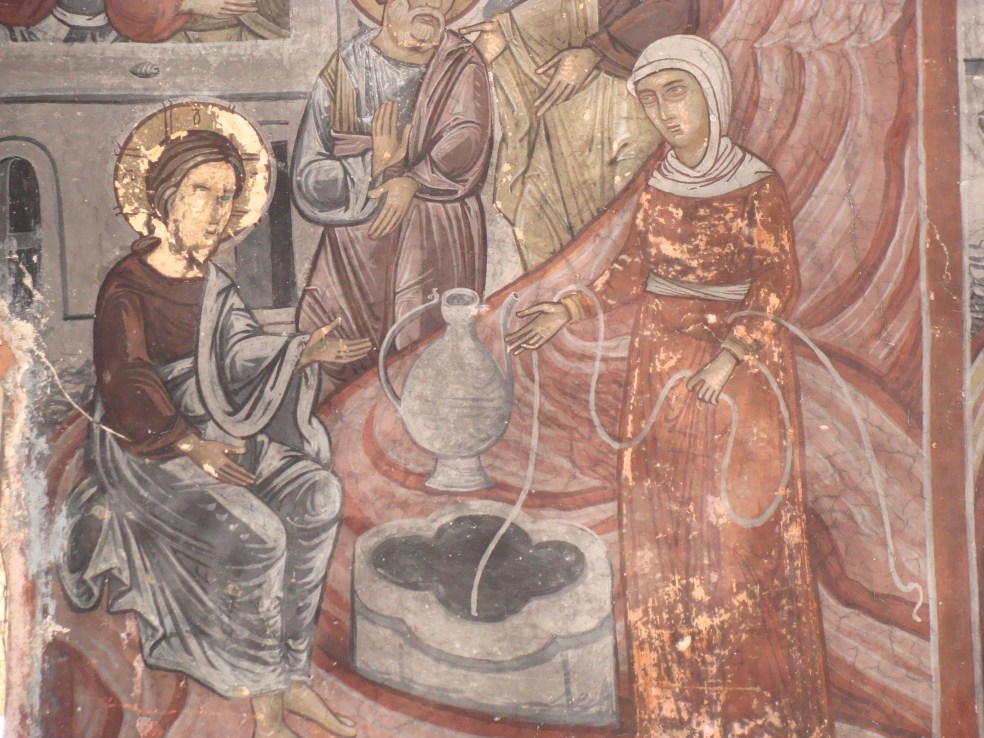
We come across the first in the wonderful story of the Samaritan woman at the well. This woman is very striking. She has had five husbands for a start. She also has a pithy way about her, asking Christ (the Creator of the universe!) how he thinks he is going to manage to pull up some water from the well where they meet near the city of Sychar if he doesn’t have a bucket! This is the man who created the universe, through whom the world was brought into being, and all she can do is affirm that he doesn’t have a bucket and he must think he is clever or something if he thinks he’ll get some water out of the hole without one.

Christ observes (as always), enjoys the humour (as always) and then comes straight to the point: ‘Everyone who drinks of this water will be thirsty again, but those who drink of the water that I will give them will never be thirsty. The water that I will give will become in them a spring of water gushing up to eternal life’ (Jn 4:13-4). He refers to this as ‘living water’ (Jn 4:10).

The ‘living bread’ comes in chapter 6. Remember that rousing hymn ‘Guide Me, O Thou Great Redeemer’, in which the words ‘bread of heaven’ are repeated? The crowd who witnessed the feeding of the five thousand and followed Jesus across the lake have made reference to the manna their ancestors ate in the wilderness. Now that was a pretty impressive sign, wasn’t it? How about something similar? They want a corresponding sign without realizing (like Pilate when he asked Christ, ‘What is truth?’) that the sign (truth) is standing in front of them. To which Christ replies, ‘I am the bread of life.’ That bread is his flesh, the sign is himself, the body of Christ that we receive in communion. He doesn’t magic manna out of thin air. No, this is different. We partake of his body and by ingesting his body, which thus becomes part of us, we become part of his body. He goes on, ‘I am the living bread that came down from heaven. Whoever eats of this bread will live for ever’ (Jn 6:51). There we have it once more – eternal life.

So eternal life is to believe in Christ. But it seems that not even his brothers believed in him, as John reports at the beginning of chapter 7. The time for the Festival of the Booths in Jerusalem is approaching, and they think he should make himself known. Jesus says his time has not yet come, but after they have gone to the festival, he goes anyway, in secret. He testifies to his Father. He performs signs. The chief priests and the Pharisees send the temple police to arrest him! The crowd is divided (as always). When he says he won’t be with them for much longer, they wonder if he is planning to travel among the Greeks – to go on an excursion! It gets to the last day of the festival, and by now (after seven chapters of signs and testimony), Christ is becoming weary.

And he does something uncharacteristic. He cries out. He shouts. He is at the end of his tether. He desperately wants them to get the point, to stop squabbling, to stop trying to kill or arrest him. And he cries out some of the most remarkable verses in the whole of the New Testament:

Let anyone who is thirsty come to me, and let the one who believes in me drink. As the scripture has said, ‘Out of the believer’s heart shall flow rivers of living water.’ (Jn 7:37-8)

The actual word in Greek for ‘heart’ is ‘belly’ (κοιλίας). And I wonder if the mention of ‘living’ reminds you of the creation story? After the Fall, what did Adam, the one who had been given the task of naming the creatures (that is, of translating), decide to call his wife? ‘Eve, because she was the mother of all who live’ (Gen 3:20). A footnote in the NRSV version of the Bible informs us that in Hebrew Eve resembles the word for living (Ḥawwāh/ḥāyâ).

And what do we get if we put ‘belly’ (translated as ‘heart’) and ‘Eve’ (which resembles the word for living) together? BELIEVE. The word BELIEVE confirms the truth of what Christ is saying.

I have already explained that, for me, the Fall happened so that we could have children, so that we could participate in the act of creation, and in this way form the body of the Church. I think God wanted us to participate in this action, even though he knew that sexual maturity would lead to our physical death, a barrier we must cross in order to enter eternal life (did I just see ENTER in ETERNAL?). This is where we are now, in the spiritual womb of the world, out of which the collective body of the Church is being born, in the same way as the body of an individual is born out of their mother’s womb. We are to be born twice, and this is the point we are missing. We are not there yet. We have been born physically (out of our mothers’ wombs), but now we must be born spiritually. That is the point of all the suffering, confusion, mistakes, misunderstandings – we are pointing in the wrong direction until we point towards Christ. There the needle will stop turning and become fixed.

BELIEVE contains other words: for example, I, BE and LIVE. It is also extremely close to BIBLE.

The message is there. All that we need to know is in the Bible, where Christ testifies to his Father.

And because he testifies to another – his Father – though he could equally testify to himself (Jn 8:14), we can accept that what he is saying is true. All we have to do is believe him.

Jonathan Dunne, http://www.stonesofithaca.com
Word in Language (19): The First and the Last

There is paradox in Christianity, and I begin to think that paradox is a sign of truth. Truth is paradoxical. The main tenet of the Christian faith is that Christ died and rose again. That is fairly paradoxical, and I believe it to be true. But I have always found his injunction to lose our life for his sake in order to find it rather paradoxical as well. How on earth can you lose your life and find it? It doesn’t make sense. And yet everything that Christ says or does makes sense in the long run, even if we don’t understand it at once. We saw that the way you lose your life is to deny the ego – that is, to draw a line through the I – which gives the sign of the cross: †. The cross, as I like to say, is a deleted I, an I with a line drawn through it. But it is also a plus-sign: +. So while we may seem to lose our life by denying our selfish impulses, we actually end up receiving a hundredfold in this world – our eyes are opened, our spiritual senses are honed – and eternal life. We lose our life for Christ’s sake and find it. What he offers us is true self-discovery, we become not a creature who is driven by his passions, who is in effect controlled by what he thought was the world’s pleasures, and through repentance we rediscover our true selves, we are freed of our addiction, our bodies and lives are infused with light, we are prepared to become gods – gods by grace, by adoption. This is what is meant by losing our life in order to find it.

We have seen how the ego in English, I, resembles the number 1 and how we teach our children to count up from the number 1, thereby putting the ego first. This is a mistake, we should teach them to count from 0, the eternal figure that represents God, because this will give them a base they can rely on, a rock on which they can build their lives rather than being swept along by whatever whim may take them. This is one of the ways of moving away from the ego – we make reference to a third point and create a triangle, which resembles the letter A; we draw a line through the ego, which makes a cross, but also a plus-sign; and we turn the ego into a number, 1, and count down to 0, the letter O. The three actions together give us A+O, or the name of God in the Book of Revelation, Alpha and Omega, and that name is present in the middle conjunction, ‘and’ or AND (A ’N’ O). That path is mapped out for us in the name of God. This is why Christ tells us that he is the way. He is literally the way, as the name Alpha and Omega indicates.

We make the progression from the A of Creation to the I of the Fall to the O of redemption: AIO.

We have seen how the Holy Trinity – Father, Son and Holy Spirit – is three in ONE. The Father is no one (O1) – except that in chemistry the subscript 1 is not written down – the Son is oxygen (O2) and the Holy Spirit is ozone (O3): three in ONE. The only number ONE does not contain is itself: 1. It contains 0, 2 (the N on its side) and 3 (the E back to front). And just as we count down from 1 to 0 – from I to O – so we can take a step back in the alphabet and ‘count down’ from the EGO to GOD (alphabetical pair d-e). The two processes are parallel. We turn away from the selfish demands of the ego, we repent of our selfish (actually self-destructive) impulses and embrace the source of life.

What we haven’t seen so far is the ordinal: ‘first’. What can FIRST tell us? I wonder if you can see anything. I am struck by the correlation between FIRST and FIGHT. You might say they have nothing in common, but that is not quite true. The words share three letters – f, i and t – while the other two letters – r and s, g and h – are alphabetical pairs.

But that is not the clearest connection. If we remove the r, we see that FIRST contains FIST. In reverse, it spells STRIFE with the addition of final e (very common in word connections). So when we put ourselves first, we encounter strife, we get involved in fisticuffs, on an individual level and on the world stage.

This is why Christ teaches us not to put ourselves first. He tells us he came ‘not to be served but to serve’ (Mt 20:28). And in reference to the kingdom of heaven – and the Parable of the Workers in the Vineyard, which immediately precedes this passage – he explains that ‘many who are first will be last, and the last will be first’ (Mt 19:30).

Another paradox. How is it possible for the first to be last, and the last first? Again, surely that doesn’t make sense. Either you’re first or you’re not. I would like to explain how I believe these two words to be connected, and also how the cycle of conflict and suffering has to be broken in order for us to enter eternal life.

FIRST is clearly connected to THIRST (physical pair f-t, addition of h). That which is first in this life – the young, the newborn – always has a strong thirst. A strong thirst for its mother’s milk, a strong thirst for discovery, a strong thirst to leave its mark. Youth and thirst are closely related, and if you don’t believe me, just go to a pub on a Friday night.

But there is something else that makes us thirst, and that is salt. If you eat salt, you become very thirsty. This should remind us of Christ telling his disciples that they are ‘the salt of the earth’ (Mt 5:13). They are what gives life its taste. But salt can be painful – in a wound, for example. It can also be curative – remember washing your mouth out with salt water in order to heal a sore? This is what we, Christ’s disciples, have to be in this world. We have to give taste, to resist falsehood, to heal wounds.

But salt is also used to preserve meat. It is used to make things last, to make them endure, and this is why SALT and LAST contain the same letters.

So we have gone from FIRST to THIRST to SALT to LAST. But having done this, having endured persecution in this world, having become the salt of the earth with all of life’s blessings, but also its problems, how do we avoid a return back to the beginning? This is very important. It is the same with the Garden of Eden. Our aim in life is not to return to the GARDEN OF EDEN, where we will simply be in DANGER OF NEED once again. We become like children in our innocence, purity and trust in order to prepare ourselves for the kingdom of heaven, but we do not become like children in our ignorance and adopt some kind of infantile stance, so that we are like helpless babies. Having acquired knowledge, having eaten of the fruit of the Tree of the Knowledge of Good and Evil, the whole point, I think, is to use that knowledge to grow, to become better people, not to fall into the same traps again. We are in this world – this spiritual nursery – to learn.

So how do we prevent this return to the ferocious thirst of youth? How do we avoid getting sucked up into the fight involved in competition, a concept that is exalted in the West, but always struck me as fundamentally absurd. I never saw Christ compete. I saw him heal, help, resurrect, teach, give hope. I never saw him compete, put himself first. And yet competition is the ethos of the way we school our children and, as a result, it forms the ethos of our Western society, that is how civilized we have become, despite the fact the race to be first causes us to damage the environment we live in and sometimes to harm other people. Wealth implies poverty only if you put a price on things. Wealth can be made available to everybody if you do not put a price on things – as God does (he gives us the air we breathe), as the earth does (it gives us the food we eat).

I will tell you how you break this cycle of conflict and suffering. Having become the salt of the earth, having endured persecution, you take the word ‘last’ and you make a simple adjustment. Can you see it? You take out the a, the beginning of all things, the Creation, the Garden of Eden, the going back to the beginning, you leave that all behind, you give your whole life up for God. This reminds me of a time I was in London, at the end of my tether, and I knelt down in front of my desk and offered God my life. I didn’t want it for myself anymore. I never actually thought he would hear me, but he did.

You take out the a. And what happens when you remove the a from ‘last’? You get ‘lst’. But ‘lst’ is not ‘first’, and this means that the connection to ‘thirst’ is broken. This is the difference that Christ wished to teach the Samaritan woman at the well (Jn 4:4-26). If you drink of the water of the well (this world), you will be thirsty again. It doesn’t last. But if you drink of the living water that Christ offers, you will never be thirsty because you are no longer ‘first’, but ‘lst’.

Everything the world gives you will tire you in the end, and you will have to go back for more. This is what the capitalist model is built on – the need to go back for more. You will never be replenished, or only for a couple of hours. That kind of life, with pit stops at every turn, is not going to be a very good fit for eternity. You need something that is going to last a little longer, that is going to sustain you, and Christ offers precisely that: ‘a spring of water gushing up to eternal life’ (Jn 4:14).

The first – those who have put themselves first – will be last in the age to come, and the last – the poor in spirit, those who have been persecuted – will be lst. This is why the description of his disciples as ‘the salt of the earth’ directly follows on from the Beatitudes in Matthew’s Gospel, because it is only through salt/last that the chain is broken and the kingdom of heaven becomes ours.

Jonathan Dunne, http://www.stonesofithaca.com

Word in Language (18): Mary, Mother of God

It is a remarkable thing that the name of God revealed to Moses at the burning bush in Exodus 3:14, I AM, contains the progression of human life, AIO, which is also the progression of the Greek alphabet, if we write the last letter, omega, in the Greek way: AIW. You may remember that the letter A refers to the act of Creation described in the first two chapters of Genesis; the letter I, which represents the ego in the English language, refers to the Fall, when we turned away from God and began to rely on ourselves; and the letter O is the letter of repentance, of recognition, when we turn the ego, I, into a number, 1, and count down to O.


All of this is contained in the simple statement/name I AM. Note that God does not say, ‘I am God. Thus you shall say to the Israelites…’ He does not use a predicate, something after the ‘I am’, in the way that you and I would. ‘Hello, I am Jonathan.’ If I stood in a room and said, ‘Hello, I am,’ people would think I was strange. They expect a name to follow the enunciation ‘I am’. But in God’s case, it is enough for him to say simply, ‘I am.’ He is in all, and all things come from him. He is the Author of all things, the origin, the source. We are translators, because things pass through us, nothing begins with us – life, food, oxygen, thoughts… What belongs to us is our reaction, our free will, how we choose to respond to the things, the people, we meet on our road. We give them meaning and take away meaning from our encounter. This is why we are translators, because this is the process of translation.


In the act of Creation, AM created a separate object, a countable noun, AN. The indefinite article, a/an, is used for things that can have a line drawn around them: a book, a room. It is used for things that we can visualize and, in order to visualize them, we have to be able to separate them from ourselves. We cannot do this with concepts such as love and righteousness, so when we talk about concepts we do not used the indefinite article. We use it only for things that are separate from ourselves. Why does the indefinite article, therefore, refer to the creature that God created in the beginning? Because he made that creature separate from himself – he endowed it with free will. It is not a machine, remotely controlled. It may make its own decisions. That is why it is a countable noun, because it is separate from God. God did not want hangers-on, he wanted true, living, breathing human beings who would love him of their own accord.


If we combine the name of God, AM, and the indefinite article, AN, we get A MAN, and the name of that man was ADAM (which contains the name of God, AM). So while we are separate, we do bear God’s imprint. After all, we are made in his image and likeness and, to quote St Augustine, ‘our hearts are restless until they rest in You’.


Christ came to fulfil the Old Testament law and prophets, to make the law personal, relevant to you and me, and there are numerous words that show this connection, but let us take the name of God in Exodus 3:14, I AM, and see how this relates to Christ. It relates in four ways. The first is that it gives us the words ‘law’ and ‘way’. For ‘law’, we apply the physical pairs, pairs of letters that look alike, i-l and m-w, that is we replace the capital I with a lower-case l and turn the M upside down. For ‘way’, we again turn the M upside down and replace the vowel i with its corresponding semi-vowel y.


Christ says as much in John 14:6: ‘I am the way, and the truth, and the life’ (my italics). Language confirms this because the two words – ‘I am’ and ‘way’ – are connected.


But we also find the name of God from Exodus 3:14 in a common appellation of Christ, first given to him by John the Baptist in John 1:29: Lamb. ‘I am’ is found in ‘lamb’. Again, language seems to confirm his provenance.


In Revelation 22:13, towards the end of the Bible, Christ cries, ‘I am the Alpha and the Omega, the first and the last, the beginning and the end.’ We will see how ‘first’ and ‘last’ might be connected in the next article, but the name Alpha and Omega, or A+O, contains the three ways of escaping the ego (I): to make reference to a third point and form a triangle (Δ), to delete the I and form a cross (†) or to treat the I as a number and count down (0). These three symbols, Δ†0, spell the name spoken in the Book of Revelation, Alpha and Omega (A+O), and are referenced already in the name of God in Exodus, I AM, which contains that same progression, AIW (only the I has not been deleted).


And finally this name of God in Exodus is translated into Greek as O WN, the three letters found in the halo of icons of Christ, because according to Orthodox tradition it is Christ who appears to Moses at the burning bush. O WN, if we rotate the second letter, gives us ONE, a reference to the Holy Trinity, because it contains the chemical symbols for all three persons: the Father (O1, no one), the Son (O2, oxygen) and the Holy Spirit (O3, ozone), only in chemistry the subscript 1 is not normally written down: ONE (the 2 has toppled over, the 3 is back to front).


So we see a strong connection between Christ – the way, the Lamb, the Alpha and the Omega, O WN – and the name of God in Exodus, I AM. We have also seen how AM and SON combine in the word RANSOM if we omit the initial r. The word RANSOM seems to confirm what Christ says in Matthew 20:28 about coming to serve and to give his life a ransom for many – that life was the life of the SON and it was given on the Cross, in accordance with the pre-eternal design of the Holy Trinity.


Now I would like to see if there is any indication in the English language not only to affirm that Christ is the Son of God, as we saw in the previous article, but also to point to Mary as his Mother. Perhaps you have already seen the link.


When we discussed the progression AIO inside words, we saw that it is contained in common appellations of the Virgin Mary: ‘lady’ and ‘maid’. It is also in the word AID, and in Orthodox prayers we often ask the Virgin Mary to ‘come to our AID’. But I would like to see if there is a connection between Mary and I AM, as there was between Christ and I AM.


It is remarkable that I AM is contained in MARY if we replace the vowel i with its corresponding semi-vowel y and add the letter r. The name MARY contains the name of God in Exodus 3:14, I AM, and that is surely a coincidence. Not only that, but if we again add the letter r, we get the word MARRY:


I AM – MARY – MARRY


Christ came into the world, became incarnate, as a result of the action of the Holy Spirit, sent from the Father, and through the wish and obedience of the Virgin Mary. She could have said no. God relied on her willing cooperation, the free will we talked about earlier in relation to countable nouns. But after the initial surprise (how is that to be if I have not known a man?), when it was explained to her by the Archangel Gabriel, she bowed to God’s will, she acquiesced, and the ‘marriage’ took place. This led to the Incarnation, Christ becoming fully human, and ultimately to our salvation (if Christ became fully human, it was so that we could become fully divine, a process known in Orthodoxy as theosis – we become gods by adoption).


All this connection, all this lineage, is contained in the name of the Virgin MARY: the name of God in Exodus 3:14, I AM, the human progression from A (Creation) to I (the Fall) to O or W (the act of repentance, the moment when our hearts comprehend that of ourselves we are not enough, on our own we can do nothing, we do not avail – we become aware of our own limitations, and it is curious for me that AWARE contains AM and the second person singular of the verb ‘to be’, ARE: AWARE conjugates the verb ‘to be’).


Language is a wonder. Whoever would have said that AWARE conjugates the verb ‘to be’? There is more on this, the different parts of the verb ‘to be’, perhaps I will write about it in the future.


So MARY contains the name of God in Exodus, I AM, and if we double the letter r, we get MARRY, which is how the Incarnation took place.


Is that all there is? Well, no. A very important word to describe Christ is the Messiah. He is the long-awaited Messiah, the one that would come to earth and atone for our sins, make everything right again, give us a way to return to God, but a different way, not the way we have come through sin, the Fall, this is not a return to the GARDEN OF EDEN, where once again we would be in DANGER OF NEED. We do not go back to the first letter of the alphabet, A, because what would be the point of that? It would only all start again – the Fall, repentance… No, we must break the circle, so we progress on to the letter O, not back to the letter A, we progress to the end of the alphabet.


Can you find the name of God in Exodus, I AM, inside the word MESSIAH? It is there. And what word can you spell with the remaining letters, bearing in mind that letters may be doubled?


M   E   S   S   I   A   H


The word is SHE.


MESSIAH is a combination of I AM and SHE. It is as if the Messiah would only come when God, I AM, combined with a certain woman, the Virgin Mary. This event took place in history, and Christ was born.


I will provide one more example. You remember at the end of the previous article we saw that, if we do some dance-steps in the alphabet, if we put our best foot forward, then JERUSALEM can be turned into JESUS AMEN. All we have to do is apply three alphabetical pairs: l-m, m-n and r-s. Something similar can be done with the word MOTHER, but this time we must take one step forward and one step back: m-n and s-t.


What two words can be found in MOTHER? To whom does the Mother point in icons of her with Christ? She points to HER SON. I would say that this is what the MOTHER achieved through her obedience: the life, death and resurrection of HER SON, which were not isolated incidents that have no bearing on us. They changed the course of history. By his life on earth and his descent into hell, Christ brought the possibility of salvation to all human persons, wherever they might be. But this was only possible by the consent, purity and experience of the Virgin Mary. Without her, there would be no salvation, and the road – the way to I AM – would be closed.


It’s amazing what you will find in three letters.


Jonathan Dunne, http://www.stonesofithaca.com
Word in Language (17): Christ the Son of God

After the bread that is destined to become the body of Christ during the Orthodox Liturgy has been cut from the loaves that have been baked for this purpose, the bread that is left over from the loaves is divided into small pieces, blessed by the priest and distributed to the people after the service. This bread is known as antidoron in Greek, meaning ‘instead of the gift’. It is used by those who have received communion to help wash down any remaining traces of the body and blood of Christ, so that they do not remain in the mouth, and is received by those who have not received communion as a substitute – ‘instead of the gift’. One of the subdeacon’s duties is to cut this bread into small pieces so that it can be distributed by the priest.


I serve as a subdeacon in the Orthodox Church, and I often think of this unconsecrated bread as being similar to words, cut from the body of Christ and waiting to be sanctified or not by their use. That is, the words we bandy about in conversation or in writing are small fragments of the Word of God and contain the potential to be used in a sanctifying way, if our intentions are good and our mind is set on God.


It is as if the priest is distributing words to the people, who will then leave the church and go out into the street and use those words in what is hopefully a beneficial way. It is only an image.


But I would like to suggest that words, just like the environment, bear the imprint of the Creator and refer to him. My book Stones Of Ithaca contains numerous examples of stones from the beaches of the Greek island of Ithaca that seem to depict Christian symbols and scenes. Language is the same, and why should we be surprised? Isn’t Christ the Word of God, the Logos? Isn’t it logical, therefore, that he should be present in words? Or that words should speak of him?


I would like to suggest that this is so and we can find proof in language that Christ is the Son of God (and that Mary is his Mother). God is one essence and three hypostases (that is, three persons) – three in ONE. I would like to show how language confirms Christ as the Son.


Let us start with the progression that we saw in the previous two articles, AIO, the progression of the Greek alphabet and of human life. A represents the Creation (described in the first two chapters of the Book of Genesis); I represents the Fall (described in the third chapter of Genesis), the era we live in; and O represents repentance, becoming aware of our sins and turning back to God, the aim of our life on earth.


In the Book of Revelation, at the other end of the Bible, Christ describes himself as ‘the Alpha and the Omega, the first and the last, the beginning and the end’ (Rev 22:13). This is one of his names – Alpha and Omega – and can be written A+O. Now it is curious that the three ways of escaping from the selfish demands of the ego, of moving away from the line that represents the ego in English (I), involve:


– making reference to a third point, God, and forming a triangle (Δ);

– deleting the I and forming a cross (†);

– treating the letter I as a number (1) in order to count down to zero (0).


That is, A+O. Christ’s own name, revealed in the Book of Revelation, indicates to us the path that we must follow. I don’t think any human could have invented this; it must be something contained in language itself.


We saw that A+O is found in the middle conjunction, ‘and’, because if we write ‘and’ using capital letters, we get AND or A ’N’ O. The reverse of AND is DNA, which implies that it is in our make-up to make this progression and to turn to God, away from the ego. Note how GOD and EGO are only a step apart in the alphabet (alphabetical pair d-e).


If we apply this progression AIO to the name of God revealed to Moses at the burning bush in Exodus 3:14, AM, we find that AM becomes I’M becomes OM. I take this last word to be a reference to the Holy Trinity: O3, or three in One. But one of the ways of making word connections is by the addition of letters, and one of the most commonly added letters is h. So another way of moving away from the self-centred demands of the ego that we find in I’M is, instead of making the progression AIO, simply to add h to I’M, which gives us HIM. I understand this to be a reference to Christ. He takes us out of ourselves – actually, in many ways it is the reverse movement: he returns us to ourselves. We turn to HIM and in the act of worship we sing a HYMN (the coincidence between these two homophones HIM and HYMN is found also in LORD and LAUD).


In Matthew 20:28, Christ says to his disciples that the Son of Man – Christ himself – came ‘not to be served but to serve, and to give his life a RANSOM for many’. Again, I think we can find proof for this in language, because if we ignore the first letter of RANSOM (r), we find that the rest of the word contains the name of God in Exodus, AM, and SON. Of course, the letters are jumbled up; spiritual knowledge is always hidden in some way. But it is not difficult to make out. I think the word RANSOM wishes to confirm what the Word is saying, and to confirm who he is: the Son of God.


We find another connection to the name of God in Exodus in John 14:6, where Christ says, ‘I am the way, and the truth, and the life.’ If we write the name of God in Exodus I AM and turn the letter M upside down, we will see a clear similarity between I AM and ‘law’ – the law of the Old Testament, which found its spiritual fulfilment in Christ – and between I AM and ‘way’ (y is the semi-vowel that corresponds to i): I AM – law – way. Language confirms what Christ is saying. This is why he goes on in the same verse to say, ‘No one comes to the Father except through me.’ He is the way to I AM.


We find further proof of this connection between the name of God in Exodus and Christ in the appellation that John the Baptist gives Christ when he sees him approach in John 1:29: Lamb. The word ‘lamb’ (and note that the final letter, b, is silent) contains ‘I am’.


So in ‘way’ and ‘lamb’ we find two clear indications that Christ is the Son of God. Again, I would point out that no human could have invented these words so that they would reproduce the name of God in Exodus, I AM. This has to have come from God, to be ingrained in language, just as we saw AM in the name given to the first human, ADAM (both words contain the first and last letters of the Greek alphabet: AO, or AW if we write omega according to Greek usage).


In Orthodox tradition, all appearances of God in the Old Testament are by the Logos, so it is Christ who interacts with Adam and Eve in the Garden of Eve and it is Christ who appears to Moses at the burning bush. For this reason, the Greek Septuagint translation of the name of God in Exodus – O WN – is included in icons of Christ, in the beams of the Cross inside the halo around his head. Search for an icon of Christ Pantocrator, and you will see what I mean.


O WN actually means ‘the being’. That is how the name of God, AM/I AM, is translated into Greek. O WN spells three words in English – OWN, WON and NOW – and it is easy to see the relevance of these words to Christ: he claims us as his own; he has won; he is with us now (Emmanuel).


By rotating the W, we can connect O WN to the number ONE, and I think this is because in his Incarnation, becoming visible to us, Christ represents – follows the will of – the Holy Trinity, three in ONE.


We have seen how these three letters O WN can be written O WH, which spells the question words WHO and HOW. Christ is the answer to both these questions, which we can only ask when we have made the progression AIO. That is, we have gone from asking WHAT in Creation (What is this creature? What should I call it?) to asking WHY (Why should I do this? Why should I believe you?) in the Fall to asking WHO/HOW in a state of repentance. We count down from the ego and realize that the answer we should be seeking is a person, and if you want a person to be the answer to the question you are asking, then the correct question is WHO? This was Pontius Pilate’s mistake when he was standing in front of that very person and asked him, ‘What is truth?’ Truth, he failed to understand, is not a thing, it is a person. The irony of this situation is staggering.


Now WHO sounds the same as HU, which is the root in Sanskrit of our word ‘God’. To show that Christ is the Son of God, the fulfilment of the Old Testament law and prophets, we see that WHO (O WH) is a progression from WHY, which contains the letters of the Hebrew Tetragrammaton: YHWH. And finally if we combine WHO with another name of God in the Old Testament, EL, we find that the two names together spell WHOLE. With the coming of Christ in human form, his birth, teaching, crucifixion, descent into hell and resurrection, we are made WHOLE. We are given that possibility, for our broken form, human nature, to receive wholeness, to return to God. That possibility was not available to us under the Old Law.


In the addition of letters, one of the most commonly added letters is h. Remembering the correlation in phonetics and in the alphabet between v and w, we will then see that WHOLE contains LOVE. It is love that makes us whole, that enables us to enter into relationship. Relationship is intrinsic to the Holy Trinity (there are three persons), and so it is intrinsic to us as well, because we are made in the image and likeness of God (Gen 1:26).


LOVE, by the addition of the same letter h, can be found in OTHER (phonetic pair l-r, alphabetical pair t-v). Love necessarily involves the other, unless all you are going to do is love yourself. I don’t think we are meant to do this. True love – true healing – involves relationship. I am healed by others, by letting them into my life and by revealing myself to them. I have a family, I was lost without them, but that same love – that same self-affirmation (as opposed to the self-destruction brought about by sin) – can be found with a complete stranger if our gaze is at once directed towards each other and towards him (the third point I talked about with reference to the triangle). OTHER is connected to the Greek word for ‘God’, THEOS (alphabetical pair r-s), and this is the meaning of Christ’s saying, ‘Just as you did it to one of the least of these who are members of my family, you did it to me’ (Mt 25:40), but we have lost this meaning. Very often we see our neighbour as a threat to our peace, we turn away from them or eyeball them with aggression. Our lives are separate – we have no common reference. It is a common reference that brings peace.


And LOVE is connected with another word in language, which again goes some way to proving that Christ is God. If we apply the phonetic pairs l-r and v-w and the alphabetical pair d-e to LOVE, we find WORD. We read in 1 John 4:8 that ‘God is love’ – Christ is the Word, and WORD is connected to LOVE, which seems to confirm this.


In the beginning, God the Father created the world through the Son on the basis of the Holy Spirit. Again, we will find confirmation in language because WORLD is a combination of LORD and WORD. We find WORD not only in LOVE, but in the WORLD we inhabit. We also find him in the SUN that illuminates our lives and enables us to grow crops, that is to survive, because there is a clear correlation between SON and SUN. It is the Son who enables us to eat. I am not saying that the Sun is Christ himself, but there is clearly a connection between the two words, which implies a scientific connection as well.


We find confirmation of this connection SON-SUN if we apply the phonetic pair b-p to LAMB, which gives us LAMP. Christ says as much in John 8:12: ‘I am the light of the world.’ Language confirms it. His name confirms it, because CHRIST contains LIGHT (phonetic pairs g-k and l-r, addition of s).


He also enables us to breathe. When we discussed the Trinity as three in ONE, we saw that God the Father is no one (O1), God the Son is oxygen (O2) and God the Holy Spirit is ozone (O3). The Holy Spirit is commonly likened to a wind (a word, by the way, that contains the first four numbers – 0, 1, 2 and 3 – if we rotate two of the letters in WIND) – that is, breath, which is represented in language by the letter h. If we combine this letter for the Holy Spirit, H, and the chemical symbol for oxygen, O2, we get water: H2O. Christ also enables us to drink.


The two chemical symbols combined, O2 and O3, can be found in MOON (again, we need to rotate the letters to get the numbers 2 and 3), so it seems that Christ reflects his own light and enables us to see at night.


Language, and the environment that surrounds us, are permeated by Christ. Look around you, and you will see a million crosses. The Cross is like a stile – it enables us to cross over to the other side, to escape our own isolation, to walk over the line, to make a bridge that will carry us where we want to go. Language will help us. Once we enlist its support, it will provide the content of our prayers – at least until we no longer need words. Language, in this sense, is repetitive. It can be boring, but we are rubbing away the hard outer casing of our hearts, so that we can enter there and find God’s kingdom.


In the end, perhaps the name alone will suffice, coupled with an expression of assent. There is one city in the world that is claimed by the Abrahamic religions: Jerusalem. It was here that Christ’s crucifixion and resurrection took place, and it was not far from here, in Bethlehem, that he was born. This is where Christ taught in the temple when he was only a child and sweated tears of blood in the Garden of Gethsemane prior to his ultimate sacrifice on the Cross.


Take the word JERUSALEM and apply the alphabetical pairs l-m, m-n and r-s. That is, take the letters l, m and r in JERUSALEM and advance one step in the alphabet. What two words do you get? This, for me, is proof that Christ is who he says he is.


Jonathan Dunne, http://www.stonesofithaca.com

Word in Language (16): AIO (1)

In the previous article, we looked at the progression of human life – which is also the progression of the Greek alphabet – from A to I to O. A represents the letter of Creation, when AM created AN, a countable noun, a separate being, one that can have free will – that is to say, A MAN – whose name was ADAM. I is the letter of the Fall, of the era we live in, in which we are subject to our selfish impulses and seem to view one another as a source of profit instead of someone we should serve. I am reminded of two monks who tried to have an argument. One said, ‘Let’s quarrel.’ The other replied, ‘OK then.’ The first took hold of an object and declared, ‘This object is mine. I am going to take it.’ The other rejoined, ‘Please do,’ and that was the end of the argument. When we cede our will to another’s, there is no cause for a quarrel. O is the letter of repentance – we count down from the ego, I, to God, O, or to put it another way we open our spiritual eyes (our spiritual Is) and see that we ourselves are limited, the world is not going to fill us (or it is only going to do so temporarily) and the source of true life is God. This change of vision can be the result of a spiritual experience. In my case, it was, but this was after I had got down on my knees and called to God (if he truly existed) for assistance. I had realized my limits, but God did not invade my privacy, he waited for me to call him. I do think we have to take the first step. This happened when I was thirty-three and, without my knowing, it was Maundy Thursday when I called, and Easter Sunday when God answered.


All the examples I gave in the previous article of the progression AIO were between words: for example, AM-I’M-OM (NO ONE) or AMEN-MINE-NEMO/OMEN. I would like now to look at examples of this progression inside words, but I would like first to sound a note of warning. In all my study of word connections, which has occupied the last sixteen years, this is where my knowledge is most limited. I only see ‘through a glass, darkly’. I perceive that this progression exists inside words in the English language, but it is much wider than I am able to comprehend, and I think there is more to it. I shall try simply to make my case, and the reader will come to their own conclusions.


First of all, we must consider the alternatives. Inside words, the I of AIO may be written in the form of the corresponding semi-vowels j and y, or as lower-case l (which to all intents and purposes is identical to capital I):


I: j, y, l


Secondly, we have already seen the close resemblance between the capital letters O, D and G (the word GOD can thus be said to comprise three circles). We have also replaced the O of AIO with the corresponding Greek letter W (which is how lower-case omega is written in Greek), so we could expect to find the letter O written using these other letters:


O: d, g, w


Starting with AIO, then, we see the progression AIO in words like AID and DAY. The former reminds me of Orthodox prayers to the Virgin Mary, in which we ask her to ‘come to our aid’. The latter reminds me of the creation of the Day in the first chapter of Genesis, when God said, ‘Let there be light’ (Gen 1:3-5). It was as if he laid down the progression AIO right at the very beginning.


But there is a very curious example, which is IAO, an early Greek form of the Hebrew Tetragrammaton, YHWH. This early Greek form of the name Yahweh clearly contains the progression AIO.


If we repeat one of the letters, we find it in GLAD. This reminds me of the first verse of Psalm 122, ‘I was glad when they said unto me’, set so wonderfully to music by Sir Hubert Parry. Again if we repeat a letter, we will find the progression in LADY and, with the Greek way of writing omega, in MAID, two common appellations for the Virgin Mary.


It is in OAK, that most majestic of trees, if we take a step in the alphabet (k-l), and might also be found in trees like ELM and WILLOW (in the first, the Greek letter W  has been rotated to produce E and M; all three letters closely resemble the number 3) without the presence of A.


We can find it in the name of key figures in the Old Testament such as King DAVID (addition of v), who wrote the psalms, and in the name of contemporary saints such as PAISIOS (addition of p and s), perhaps the most beloved contemporary Greek saint, who has been compared to St Anthony of Egypt (it is in ANTHONY as well, but we will get to that in a moment).


If I replace O with W (AIW), then the most obvious example is the name of God in Exodus 3:14, I AM. This name contains the progression from A to I to O (W), and so do the key words that are connected to it: LAW and WAY, the law being that of the Old Testament and ‘way’ referring to Christ, the law in person, who said, ‘I am the way, and the truth, and the life’ (Jn 14:6).


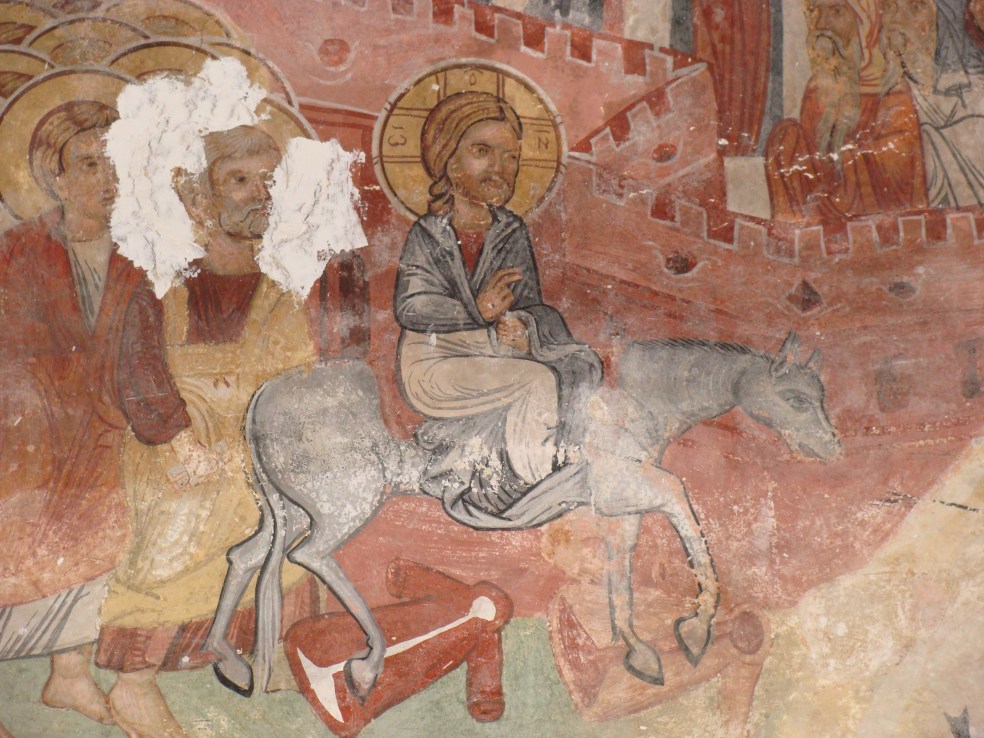
The name ‘I am’ is found in ‘lamb’ (John the Baptist famously called Christ the Lamb of God, and this is confirmed by language), but it is also found in words like ‘lame’ (what we are without God), ‘male’ (the creation of Adam) and ‘mammal’ (the creation of animals). The LAMB took upon himself the BLAME for our sins and acted like a BALM. He opened his PALM (phonetic pair b-p) in an act of self-giving, and I think this is why the crowds outside Jerusalem laid palms on the road when he came riding into Jerusalem on a donkey. PALM is in PSALM (addition of s), during the reciting of which we place ourselves in God’s hands.


Do you begin to see how AIO (AIW) is present everywhere? It is in another Sanskrit word, MAYA (derived from the Sanskrit word MA, meaning ‘create’), which is defined in the Shorter Oxford English Dictionary as ‘the power by which the universe becomes manifest’. It is in words that relate to other religions: DALAI LAMA, the Tibetan spiritual leader, or how about the Easter Island statues, which are known as MOAI and are erected on platforms called AHU (here we must take a step in the alphabet, h-i, and swap one back vowel for another, o-u)? It is also in Greek mythology – for example, the god APOLLO (addition of p) – and in Eastern practices such as YOGA and AIKIDO. What I have found is that it is much more prevalent than we might think, but I cannot say exactly why this is.


Let us now draw a line through the I and make a cross: †. The cross is best represented in the alphabet by the letter ‘t’ (also by ‘f’, ‘r’ and ‘x’):


†: t, f, r, x


If we delete the ego in the progression AIO, which is what we are called to do when we turn to God in repentance – Sophrony’s ‘love to the point of self-hatred’ – we now have A†O. This progression is clearly found in the word TAO, ‘the absolute being or principle underlying the universe; ultimate reality’ according to the SOED. It is also found in PLATO (addition of p), the most famous ancient philosopher, and also, I might say, in ARISTOTLE. These two thinkers are well known for their philosophical systems, and most modern philosophy is based on what they wrote. So again it seems to me that certain key names or words contain this progression.


Let us now keep the cross and substitute O with W: A†W. Now it becomes really interesting because these three symbols are clearly present in ATOM, once thought to be the ultimate particle of matter (oh, and MATTER clearly contains the same progression). ATOM is connected to ATONE (again the same progression, here we have applied the phonetic pair m-n with the addition of final e), so the atonement brought about by Christ’s voluntary sacrifice on the Cross was obviously meant to affect our very being. It is language that confirms this.


We find the same progression with the cross, A†W, in WAIT, which is connected to FAITH by the phonetic pair f-v/w, addition of h. There is a lesson here, and it seems to me to be saying we must wait and have faith, even when we are suffering, even when the odds appear to be stacked against us, even when we can scarcely breathe or cannot see the wood for the trees. Wait, have faith.


We have one more step to make. Having introduced the cross in place of the letter I, we must now complete the paradox and replace the cross with a plus-sign: A+O (the meaning of Christ’s injunction to lose our life for his sake in order to find it). A plus-sign is best represented in the alphabet by the letter ‘n’ (think of rock ’n’ roll) and we have seen that this letter is closely associated with ‘h’:


+: n, h


A+O represents the three ways of escaping the ego and spells Alpha and Omega. Indeed it is contained in the middle conjunction – AND (A ’N’ O) – the reverse of which is DNA, so as with ATOM this progression seems to form part of our make-up. Replacing O with W, we find it in AMINO ACID, the building block of protein. Just as these compounds were discovered by placing samples under microscopes, so we can place language under the microscope and unveil its make-up, its message to us.


I will give just a few more examples. How about the Hebrew name of God ADONAI? Or the only righteous man found on earth before the Flood, NOAH? They contain the same progression, A+O. It is also in HALO, an indication that someone has followed this blessed path of repentance (isn’t it also in PATH?). It is in SAINT – without the O, but with the plus-sign and the cross following the I in quick succession, as if the word SAINT was mapping out the path for us to follow.


It is in the names of two places intimately connected with Orthodoxy: ATHOS in Greece, the spiritual heartland of Orthodoxy, and IONA in Scotland, from where the Irish monk AIDAN set out to evangelize Northumbria under King OSWALD. All these names clearly contain the progression AIO.


And now we come to the last connection. We have taken the progression AIO, replaced the O with the Greek letter W – AIW – deleted the I and formed a cross – A†O (A†W) – and finally turned the cross into a plus-sign: A+O (A+W).


If we replace the plus-sign in this final progression with the corresponding letter in the alphabet, ‘n’ – A ’N’ W – what word do we get? To whom is this message in language addressed? For whom was the world created? Who is it that was made in the image and likeness of God? Who is it that is endowed with reason, so that he might observe the destruction wrought by the Fall, wrought by his own selfish impulses, his wish to accommodate himself? Who is it that is called – by Christ! – to restore his own image by the grace of God and to become a god by adoption (isn’t AIO in that word as well)?


It is MAN, the fruit of this progression, who contains the progression in himself.


Jonathan Dunne, http://www.stonesofithaca.com

Word in Language (15): AIO (0)

Ideally, human life, like the Greek alphabet, should be a progression from the letter A to the letter I to the letter O: AIO.


A represents the act of creation described in chapters 1-2 of the Book of Genesis, in the beginning, when God created the world. It is the first letter of both the Greek and Latin alphabets, so it represents the first act in the history of time, the first thing we have to write about.


We already saw that the name God reveals to Moses at the burning bush in Exodus 3:14 is AM (in this word we see both the A and the O – the latter written W, like the Greek letter omega – because God stands outside time, of which he is the beginning and the end). AM created AN, the indefinite article, the article that is used for countable nouns, for nouns that we can see and draw a line around, that we can separate from ourselves and give free will. AM and AN combine to give A MAN, whose name was Adam.


ADAM also contains the name of God in Exodus 3:14 – AM – as well as both ways of writing the final letter of the Greek alphabet: O/W (D closely resembles O, M is an upturned W). It is as if the new Adam is already present in the old. These two ways of writing the last letter of the Greek alphabet, O/W, can be used to describe the Holy Trinity: O3, or 3 in One. Adam is not a chance name assigned to the first human, it has the imprint of God stamped all over it.


ADAM in reverse reads MADE, just as EARTH in reverse reads THREE (because it was created on day three and is the third planet in order of increasing distance from the Sun). Adam was made by God, who shaped him from the dust of the ground and breathed the Holy Spirit, the Spirit of life, into him.


Adam’s task was not to create all the creatures, it was to name them – that is, to translate – and we see this purpose accorded to Adam in the reverse of MAN, which is NAME (with addition of final e, very common in word connections).


Now NAME, if we rearrange the letters, spells MEAN and AMEN. When we name someone or something, we give them meaning. We acquiesce in the process of God’s creation, we accept our role in the same, and say AMEN.


But, in chapter 3 of the Book of Genesis, Adam and Eve were tempted to eat of the fruit of the tree of the knowledge of good and evil. See how EVE is already taking us away from the letter A and towards the letter I. If we apply the physical pair (pair of letters that look alike) v-y to EVE, we get EYE, and EYE sounds the same as the letter I (which, if we rotate it by ninety degrees, represents a closed eye).


We can see this progression away from the letter A towards the letter I in the name of the garden where Adam and Eve lived, EDEN, which is connected to ADAM by the phonetic pair m-n and the pair of vowels a-e.


With the Fall, described in chapter 3 of Genesis, we have turned our attention away from God and towards ourselves. The Fall corresponds to time. It is the era we live in, the timeline drawn by a teacher of English on a whiteboard, the letter I, when despite being surrounded by all of God’s goodness – the earth and all it contains – we think we can do very well without him (despite the fact we could not even breathe without him).


So, instead of calling on God, AM, we start to say I’M. Instead of saying AMEN to God’s commandments, we lay claim to our surroundings and say MINE. We have made the progression from A to I. This means that, while our physical eyes may be open, our spiritual eyes are closed: I.


Put three of these Is together, and you get the word ‘ill’, a triple ego if you like. We are spiritually sick because we have detached ourselves from the source of all goodness, the Holy Trinity. If you don’t believe me, look at what happens if we make the progression from A to I to I: we get the word ‘ail’. But God in his ineffable mercy always offers us a way out, because if we add breath to the start of this word and slightly alter the vowels, ‘ail’ gives rise to ‘heal’.


We saw in the article Alpha and Omega that one of the ways to escape the ego, I, is to treat it as a number, 1, and to count down to 0. This can be likened to opening our spiritual eyes: I to O. We turn our hearts to God in repentance, we realize we cannot live without him, or at least our life is ultimately without meaning if we do not live in, for and with him. This is the purpose of human life – to realize our need. There is nothing wrong with this. We sink to the bottom of the overturned pyramid, to use St Sophrony of Essex’s image, we descend into the hell of uncertainty and emerge the other side, strengthened and joyful.


Now, instead of saying I’M, we say OM, but I do not mean the mantra, I mean the Holy Trinity: O3. We redirect our sight away from ourselves to the centre of all being.


We saw in the article Chemistry that God the Father can be written O1, or no one. OM is connected to NO by the phonetic pair m-n, and ONE is NO in reverse with the addition of final e. So when we turn away from the I with all its hereditary fears and selfish demands, instead of saying I’M, we call on NO ONE, as we were meant to do because we are human.


The name of God is spread throughout language – language is insisting, albeit unobtrusively, that salvation for ourselves lies in calling upon God, but it must be a question of free will, a freely taken decision. We are given all the time in the world to make this step.


Instead of saying MINE, we say NEMO, which is the Latin word for NO ONE, or OMEN, a sign for the future, perhaps.


We make the progression from A to I to O, the progression of human life, which involves committing a mistake (or many mistakes) and then owning up to it.


AM – I’M – OM/O3/NO ONE


AMEN/MEAN/NAME – MINE – NEMO/OMEN


Now perhaps I have just made this all up. Well, not exactly. We also saw this same progression from A to I to O (AIO) in the question words WHAT – WHY – WHO.


‘What?’ is the question word of Creation: what is this creature? What will you call it?


‘Why?’ is the mantra of modern society, of the Fall: why should I do this? Why should I believe you? (‘Why?’ simply indicates a lack of obedience.)


The real and only valid question is ‘Who?’ (or ‘How?’, it makes no difference), and the answer is Jesus Christ. We see this progression in the Hebrew Tetragrammaton, YHWH, which corresponds to WHY, and in the Greek Septuagint translation of the name of God in Exodus 3:14, O WN (or O WH), found in icons of Christ Pantocrator, which spells WHO and HOW. We have made the progression, we have gone from the letter of the law to the spirit of the law, to the law in human form.


WHAT – WHY – WHO/HOW


Another example. The name of God in Exodus 3:14 is I AM, which gives us ‘law’ if we apply the physical pairs i-l and m-w (one letter is an extension or a reversal of the other). We associate LAW with the Old Testament, a set of rules which must be blindly followed, even to the detriment of people (for example, not healing on the Sabbath). This LAW, as we all know, can be a WALL. It protects us, but it also stands as an obstacle, especially when it is the letter of the law – and not the spirit – that is being applied.


If we make the progression from A to I, from LAW we get WILL: we apply our own will. We don’t obey the commandments to love the Lord our God with all our being and to love our neighbour as ourself. We seek our own will, we place ourselves – our profit, our comfort, our status – above the other and pursue our own self-interest. We have gone from the PROPHETS of the Old Testament to an obsession with PROFITS, as if the purpose of human life was solely to make money. It is not. The purpose of human life is to turn to God and, in God’s love, to show concern for our neighbour. That is to restore God’s image in us, to become properly human. We see many examples of this transformation in our everyday lives.


The Church Fathers, including St Sophrony, are always talking about God’s self-emptying (or kenotic) love. We imitate this love, taking ourselves – the I – out of the equation, opening our arms, making space for the other. We humble ourselves (St Sophrony goes so far as to speak of self-hatred). And what is the position of humility? It is LOW. We give space to the other, we ALLOW them. Instead of saying WILL, we say WON’T.


LAW/WALL – WILL – LOW/ALLOW/WON’T


Language is clearly indicating to us the path of repentance for those who wish to follow the example of Christ. I don’t know how to make it any clearer than this, but I will give just a few more examples. Note that all these examples of the progression AIO are between words. There are also examples of the same progression inside words, and we will see some of those in the next article.


Here is one of my favourite examples. In the Garden of Eden, there was no competition: DRAW. The ethos of our modern society, with its competition and counting up from the number 1, is to WIN. But Christ came along and told us to LOSE our life for his sake in order to gain it (Mt 10:39). Look at the vowels, and you will see the progression of repentance.


DRAW – WIN – LOSE


Losing, as we have seen, can be a frightening experience because it looks as if we are condemning ourselves to self-extinction, but I have likened this to the process of translation, where in order for a text to appear in another language, it must first disappear in the mind of the translator. This, for me, is what death is. It is a matter of having faith in the Translator.


Another favourite example. The SWAN may be taken as a symbol of purity. Certainly, it is very white. On the contrary, SWINE are a symbol of filth, the filth the Prodigal Son found himself literally rolling in when he was reduced to feeding his neighbour’s swine after he had wasted his father’s inheritance. What word will take us to the O of repentance? It is said that no one flake is ever the same. It falls out of the sky and alights on our nose. When we step in it, it soon becomes slush, or it can become frozen and cause us to slip, but newly fallen it transforms the landscape, turning it white again, forming a blanket under which Nature has a chance to rewind. I am talking about SNOW, of course.


SWAN – SWINE – SNOW


And one last example. The creature I most associate with the depths of history is WHALE, this creature that swims the world’s oceans and seems to have been doing so ever since the beginning of time. It is a creature I associate with the Creation, primordial and wise. What word do I get if I make the progression from A to I? WHILE, which corresponds to the process of time, time which has been spread out like a carpet for us to walk on while we make up our minds. And if I count down from the ego and make the progression from I to O? I become WHOLE, a combination of the Old Testament name of God, El, and O WH.


WHALE – WHILE – WHOLE


We already saw other examples of the progression from the I of the Fall to the O of redemption: LIVE-LOVE, SIN-SON and CHRIST-CROSS.


Language is urging us not to count up, not to make out that we are the owners of everything in existence. We are not. We are here to act as vehicles of love, to become sons, children of God, to lose our life for Christ’s sake on the Cross in order that we might receive everlasting joy in the resurrection.


Language confirms this. The Greek alphabet does the same, it provides the example. We may associate this with Eastern spirituality (for me, that is Orthodoxy) or with kenotic love and spontaneity, which doesn’t count the cost. There is another example, however, and I’m afraid it is provided by the Latin alphabet, which may be taken to signify a greater reliance on reason. Reason always counts the cost.


And that is because the Latin alphabet, instead of counting down from I to O, as the Greek alphabet does, counts up: from I to Z. This means that you have taken everything that was created, A, and used it for yourself.


Jonathan Dunne, http://www.stonesofithaca.com

Word in Language (14): Auxiliary Verbs

We live in the white space of eternity, but we cling to the line of time. It is extraordinary that the word TIME contains DIE (phonetic pair d-t, addition of m), but if we take a couple of steps in the alphabet it also gives LIVE (alphabetical pairs l-m, t-v). We have seen how it also contains MEET and DENY – this life on earth is our chance to meet Christ or to deny him, it is as simple as that. This is the purpose of life – do we choose to count down from the ego, I, to God, O, or do we prefer to attend to our own self-interest and to amass possessions by counting up from the ego, I? Once you start counting up, there will be no end, and we have seen how the English alphabet does this – it goes from the letter A to I to Z (1 to 2), it starts to count up, which may be seen as signifying a Western rational way of thinking, counting the cost, whereas the Greek alphabet, which may be taken to signify a spiritual way of thinking, a spontaneous response, counts down, it goes from the letter A to I to O (1 to 0, or omega).


This is very telling. We somehow have to escape the line that is represented by the ego, I, or by the timeline. LINE is close to MINE (alphabetical pair l-m) – when we draw a line, we are limiting ourselves, laying claim to possession, fencing ourselves in. We may find that the LINE leaves us ALONE, whereas in fact we are ALL ONE, and the one we have in common is God.


We see our life on earth in terms of the tenses: present, past and future. How much time do we spend in the present? Perhaps not very much, we are always thinking about events in the past or worrying about the future.


An example of the present tense is ‘I live in London’ or ‘I like to visit Hyde Park on a Tuesday’. It is used to talk about routines, actions or states that we consider to be fixed.


If we want to ask a question or to make a negative in the present, we have to use what is called an auxiliary verb – a verb that ‘helps’ us to ask the question or to make the negative – and the auxiliary verb for the present is ‘do’: ‘Where do you live?’ ‘I don’t like going out in the dark.’ We cannot ask a question or make a negative without the auxiliary ‘do’, or we will sound a little foreign: ‘Where you live?’ ‘I not like going out in the dark.’


Auxiliaries are a feature of the English language. Other languages like Ancient Greek and Bulgarian have little particles that enable the hearer to understand that what is coming is not a statement of fact, but a question: ‘ara’ in Greek, ‘li’ in Bulgarian. Languages like Spanish use intonation. ‘You live in Madrid?’ with a rising intonation informs the hearer that this is a question. I’m not telling you, I’m asking. But English has need of auxiliaries.


So it is in the past, and the auxiliary is the same: ‘I went to school in Clapham.’ ‘Where did you go to school?’ ‘I didn’t like it very much.’


So ‘do’ is the first auxiliary. ‘What do you do for a living?’ ‘Do you often come here?’ ‘Don’t talk to me like that!’


The auxiliary for the future is ‘will’. This little word expresses intention or a prediction: ‘I will come and help you.’ ‘I think it will rain at the weekend.’ ‘Will you tell me what it is?’ Whereas the auxiliaries in the present and past – ‘do’ and ‘did’ – are only used to ask questions or to make the negative, in the future the auxiliary must also be used in positive statements – precisely to signify that it is the future: ‘I come to lunch on Tuesdays, but next week I will come on Wednesday.’


We have seen how language encourages us to think in terms of the collective, not in terms of the individual, and the future provides us with a wonderful example because if we contract ‘I’ and ‘will’ we get ‘I’ll’ – this is a way of talking about plans in the singular – whereas if we contract ‘we’ and ‘will’ and think about the future in terms of the plural, we get ‘we’ll’.


Language appears to be telling us something: ‘I’ll’ and ‘we’ll’. I’LL and WE’LL. Take away the apostrophe that indicates a contraction and you have ILL and WELL. Isn’t this language telling us to think in terms of the plural? We might also notice that ME becomes WE when we turn the letter M upside down (physical pair m-w). And what is the plural of ‘you’ (think not how the word is written, but how it sounds)? Why, ‘us’ of course!


There is an aspect – the perfect – that we can apply to the tenses we have talked about, the present, the past and the future. This perfect aspect has the amazing ability to connect the tenses, to join them together, but our emphasis is still very much on the line.


For example, imagine that I started to live in London in the year 2000. It is now 2020, and I still live in London. You have a past – I moved to London in 2000 – and a present – I live in London now. What if you want to join them together? You can only do this by using the perfect, the auxiliary for which is ‘have’: ‘I have lived in London for twenty years.’


Imagine a point in the future: when you get home. I want to say that between now and the point in time when you get home, that is between the present and the future, I am planning to finish baking a cake. I will say, ‘By the time you get home, I will have baked a cake.’ There is the perfect again, by means of the auxiliary ‘have’, and it connects two points along the line, the past and the present, the present and the future, even the past and a point further back in time: ‘When you came to visit me, I had already put the things away.’ Before that point in time when you turned up, I had performed this other action, between the past and a point further back in time (when I got home from the office, for example).


Well, after that short lesson in grammar, we are equipped to say that the auxiliaries that cover the timeline are ‘do’, ‘will’ and ‘have’.


But doesn’t this tell us something about how we approach time, our lives on earth? Because the first auxiliary, ‘do’, refers to activity – we must always be busy. The second auxiliary, ‘will’, refers to intention – what I want. And the third auxiliary, ‘have’, refers to possession – how much I have. Couldn’t this be said somehow to sum up our approach to life: what I do, what I will and what I have?


This is because we are clinging to the timeline. We are like vines on an arbour or shellfish on a submerged pillar. We cling to what we know. And what we know is what we can see in front of us, what we can lay our hands on. But there is so much more. There is the enormity of space, to start with. There is also the enormity of ourselves – isn’t the kingdom of heaven within us? There is the enormity of our hearts, of our reaching out to one another, of the many examples of endurance and selflessness that humanity has shown. There is the moment when, albeit we are busy or tired, we take time out to focus on the other’s need. We shift away from the timeline, we take a step over the abyss. We enter the white space of the whiteboard. We realize that the battle has already been won and we are picking up the pieces. We step outside of time and into the light. We cease – for a moment – to linger on the past or to harbour concerns about the future. They are always only moments – the past and future quickly reclaim their place, like a tide coming in. But there are moments when we can separate ourselves from the timeline and enter eternity. We are in eternity. Now.


And what is the fourth auxiliary that is used to represent the continuous aspect, to talk about the moment? It is ‘be’. ‘Where are you at the moment?’ ‘I am sitting in the garden.’ Enjoying life, focused on the here and now, amazed by the wonder of it all. Isn’t this life? Amazement at the other, amazement at ourselves. Little coins that jingle in our pockets. Coins that are like suns, shimmering in the light.


Faith is stepping off the line. I don’t have enough money, I don’t have enough time, I’m too busy, I can’t do it for you, otherwise…


Faith is being quiet. In the moment, when we prise the timeline open and expand it, blow a little air into the bag.


When we expand the moment, we use ‘be’ (a word that we have seen is connected to ‘we’ and is contained in both ‘die’ and ‘live’). ‘I was reading a book when you arrived’ (I was unaware of time). ‘We will be waiting for you when the train arrives’ (the train will pull up alongside the platform, but we will already be out of time – waiting for you). ‘Be’ takes us out of time – it is used for actions that may be temporary (‘I am living in London at the moment, but next month I may not be’), continuous (‘we were walking alongside the river when it happened’) or repeated (‘I have been trying to get hold of you for ages’). It takes us away from the apparent security of our own efforts (‘do’), our own wills (‘will’) and our own possessions (‘have’).


There is so much noise in the world, but the truth is that the silence is much greater. There are so many words on this page, but the truth is that the white space is far greater. There is so much substance to our bodies, but the truth is that we are peppered with holes and invaded by space.


So it is with time. Time – the cross (†), I and me – is in eternity. It is the only place it can be. At some point, the teacher of English will come along and rub out the timeline. And then our preoccupations, our money and possessions, our frustrated wills, will count for nothing. All that will count is who we have allowed ourselves to be.


Jonathan Dunne, http://www.stonesofithaca.com

Word in Language (13): Hate

Hate is the opposite of love, it is the dark side of love. All the shoots we have put out in order to communicate with our neighbour, in order to interlink our life to theirs, we begin to withdraw, to take away, to withdraw our favours. And at the same time, our sight, which was focused on those we love, begins to wander, we begin to entertain temptations, even though we know that they will destroy us, so hate engenders self-destruction.


If hate engenders self-destruction, it is a form of death. We are slowly but surely heading towards death, but not death as a portal of life, not DIE so that I can BE, as we saw in a previous article. This is death with no continuation. This is THE END of the film (these two words are beautifully connected: phonetic pair d-t, physical pair – pairs of letters that are an extension or a reversal of one another – h-n). This is the death of the popular imagination, where there is no continuation or, if there is, we don’t want to know about it.


So hate is a negation of God, because if we deny the existence of heaven, we deny the existence of God; if we deny the possibility of good (in ourselves quite apart from anyone else), we again deny the existence of the GOD who is GOOD. Do you see how language, the Word, wishes to teach us? GOD is GOOD, but the DEVIL is EVIL. If you look up these pairs of words in a dictionary and search for the etymology, you will find that their roots – horizontal, over time – are different. Not so in a vertical understanding of language. They are very close for a reason.


So hate makes us first withdraw into ourselves, reject contact with those who are close to us, and then seek to scatter ourselves further afield, to disintegrate, in what may be a call for attention or a means of revenge or a wish for self-annihilation.


But there is always the call of God, the call of our conscience, if we can only overcome the barrier of our ego, of our pride. PRIDE is in DESPAIR, and it is despair that robs us of our willingness and strength, as Saint Porphyrios points out in the book of his life and sayings Wounded by Love (p. 98).


Hate leads us to despair, while love gives us hope, hope of a better future. This is why HOPE is connected to OPEN (that same physical pair I talked about earlier, h-n). Hope keeps us open to the other, to their love, which is calling us, just as a dog hears the call of its owner. Hope keeps us open, but of course this means we can be wounded – the Wounded by Love of the book title.


Dark thoughts explore our mind. They can be a little frightening, these thoughts, even overwhelming. Where do they come from? Are they really ours? Well, given that the whole theme of my writing is that we are translators, not authors, and things pass through us, I am inclined to believe that thoughts also do not start with us. What belongs to us is our reaction, the choices we make, whether we choose to ignore these thoughts, to exercise self-control, to seek the good, or to enact the thoughts, to give free rein to our baser instincts. Does this really mean that no thoughts belong to us, only our reaction does? I am inclined to believe so, and thoughts are like language, roots travelling underground, in the subsoil of our minds.


In which case, we should be able to take a dark thought and simply make it good, turn it around, do the opposite, embrace the one we want to hate. This will hurt, though. It will hurt in that place we have opened up in order to embrace the other, in order to apologize, in order to see it from the other’s point of view, in order really to lessen our own importance in the grand scheme of things. Will anything really happen if I let go of my hatred? Will the world collapse if I forget to maintain my resentment? No, the world will carry on as normal, and I might even feel a little relieved – also a little sore perhaps – the hatred like a mole popping up its head from time to time, breaking the soil, trying to remind me of its existence, trying to draw me down again into the dirt of non-existence.


These thoughts, I let them go. They are nothing. Thoughts are insubstantial, a monk once told me. They have no substance. If they have no substance, they have no reality beyond the reality I choose to give them, even if it doesn’t feel that way when they assault me and seem to control me, not the other way around.


Perhaps I just stop thinking. THINK, after all, is connected to NIGHT by the phonetic pair g-k. It may be over-rated. It may be better just to WAIT. What word connections can I find for WAIT? Well, DAY is in there (phonetic pair d-t, addition of w). So is FAITH (f-v/w, addition of h). Isn’t the meaning of FAITH to WAIT? Maybe God doesn’t expect me to achieve something every day, to justify my existence all the time. After all, he has the bigger picture. He envelops time. Time is an envelope, and he sticks it down, says when it is finished. Perhaps he will put it in the post, send it to the outer reaches, open it later on, while we are all busy or asleep, and see what it is that everybody did with the time allotted to them. Take out the letter of our actions, intentions, good deeds. The desert fathers say that God always sees the intentions behind our actions, our motivations. What is it we are trying to achieve? Are we just trying to get his attention? To call him down, to force him to intersect with our lives because the horizontality of living got too much, too boring, too monotonous, the street, the cars, the coffee, the cake, get up, work, eat, sleep. So much going in and out of ourselves. Things passing by. Ourselves sometimes ineffectual, unprepared, unable to influence events. WAIT, whispered FAITH. Look at me. I am here.


Christ, I am in the night of hatred. Will you love me even down here? Will you see a speck of goodness in me that is worth saving? Is my breath anything to you? Of course, it is. You gave it to me. You are the Word. My breath is yours and the Holy Spirit’s. I beg of you, hold me. Deliver me. See how DELIVER contains DEVIL. Our Father, which art in the heavens…


DEVIL in reverse reads LIVED. Past tense.


DEATH with the letters rearranged spells HATED. Past tense.


There is no future in either of these. If we apply the phonetic pair d-t, we will see that HATE is connected to HEAD. DEATH contains both of them. Perhaps thinking, calculation, is not the way. But where does that leave us?


It leaves us in the moment. In the moment, there is no time. It is the only place where we can escape time. The moment is, in effect, the nullification of time. We are not controlled by past memories or future fears. We simply place ourselves in the O of repentance, the star in the night sky, the pinprick of existence.


A star is not light coming from a long way away. A star is a window, an invitation, a ladder of ascent. It is where the threads of our garments do not meet, where the air passes through, it is the interstice, it is the light, it is the way we slip through the net. It is a hole in the fabric.


Even the flame of a match banishes the night. ‘Flame’ contains ‘I am’, the name of God in Exodus 3:14. It enables us to make a hole in the line of time. We use the flame as a nib, a bubble, a leaf, and begin to write.


Jonathan Dunne, http://www.stonesofithaca.com
Word in Language (12): Love

Let us look at the word ‘love’. We have just received a Cavalier King Charles Spaniel puppy, and it is constantly looking for ways to express its love. Its whole attention is focused on this. What a wonder it would be if we were to approach life in the same way.


The first thing I see in the word ‘love’ is the progression from I to O, whereby we count down from the ego, I, to God, O, we count down from the number 1 to 0 – the opposite of what we teach our children to do, which is to count up from 1. If you count up from 1, you will constantly amass, what you have will never be enough, and there will be no end. It reminds me of our system of buying and selling, of production (whatever the cost to the environment and to our fellow human beings), whereas if you count down to 0, you have already reached your answer, there is no need to search anymore, you have, in effect, attained peace (and all without any damage to the environment or to your fellow human beings).


We saw how it is possible to apply this progression from I to O in pairs of words like LIVE-LOVE, SIN-SON and CHRIST-CROSS. Even Christ, God himself, who came down to earth to translate for us the meaning of life in a form of spiritual writing for the blind called the parable, was prepared to count down from the ego to God (despite being God himself) in order to show us how it was done. In this way, he also acquired a human nature – he became a translator, as well as an author – and in acquiring human nature he exalted it, that we in turn might go the other way and become gods. This process is known in Orthodoxy as theosis and it is the purpose of our existence, to acquire the virtues, to transform the passions, to exercise self-control and to become as we were made: in the image and likeness of God (Gen 1:26).


After this progression, this humbling of ourselves, we find the two letters ‘ve’, which as I have already pointed out can be connected to ‘be’ by the ‘eighth’ phonetic pair b-v-w. So ‘love’ seems to contain a turning to God in order that we might be. We go from the line to the circle, then we slip down into the valley of the v, in order to reach the e, which as a capital letter (E) is three-pronged, perhaps representing what the I can become when it worships the Holy Trinity.


There is a descent, therefore, a lesson in humility, a being brought low, in order to climb again. It is as if we deconstruct ourselves, our false image of what we are meant to be, in order to find our true selves, because if there is one thing I am sure of, it is that if we lose ourselves for Christ’s sake, it is then – and only then – that we will truly find ourselves, in that first and most telling of the paradoxes contained in Christianity (you must lose your life in order to find it).


In effect, we evolve. And EVOLVE can be seen to contain LOVE with the repetition of certain letters. If we again apply the pair b-v-w, we might say that EVOLVE reads WE LOVE or LOVE/BE. There is clearly a connection between communion with others – WE – and existence – BE.


We have different mathematical shapes, most of them filled out, bulging or with sharp edges – a circle, a square, a rectangle – but the shape I associate with love is not so full of itself as these, it is the oval, a clasping of the hands, a sheltering of the light, a timid prayer. LOVE and OVAL are connected by a slight shift in the vowels, from a to e. As if this weren’t enough, having recourse again to the ‘eighth’ phonetic pair, we see that the first three letters of LOVE give LOW. We do not exalt ourselves, place ourselves first – this is not love – we give way to the other, we make a gesture. This is love.


And we already saw how LOVE is connected with OTHER by the phonetic pair l-r, the alphabetical pair t-v, addition of h, in what for me is one of the most remarkable connections. LOVE and OTHER are central words in language. Love implies the other; without the other, there can be no love, or only self-love, which is not really love at all.


OTHER is connected to THEOS (alphabetical pair r-s), the Greek word for ‘God’. The other is God. We find (serve) God in the other. Christ says as much in Matthew 25:40: ‘Just as you did it to one of the least of these who are members of my family, you did it to me.’ We are called to practise our love on our neighbour, to go beyond our rational thinking, our thirst for revenge, and bestow love even on our enemies. How wonderfully illogical! How wonderfully nonsensical! Turn the other cheek? You must be joking!


And yet there it is. A minus leads to a plus when one I combines with another. The other – my wife, my son, my neighbour – gives me back my life. Isn’t it that simple? Whoever gave life to himself?


We also saw that LOVE makes us WHOLE (b-v-w again, addition of h), but it can be misdirected and turned into LOVE for MONEY (l-m-n in the alphabet, physical pair – pair of letters that look alike – v-y) or POWER (phonetic pairs l-r and v-w, addition of p). This is love with a view to the senses, the material world and our place in it.


I would like to finish with two astonishing word connections for LOVE.


If you remember no other word connection, remember this one: LOVE is connected to WORD by the phonetic pairs l-r and v-w and the alphabetical pair d-e. Now we know that God is love (1 Jn 4:8) and God is the Word, so there is confirmation for you because the two words are intimately connected. I would suggest that the connections LOVE-OTHER-THEOS and LOVE-WORD are central to the Gospel message and to our existence. God spoke the world into being – he did this through love. God sent his only-begotten Son, the Word, to redeem us from our sins, to call us back to the straight path – he did this through love. God can be found all around us when we act with love. You should have seen the look of this puppy when it came into my son’s arms – it was a look of pure love. And they had only just met!


Everything else falls away – the structures that we have invented, the scaffolding with which we have surrounded our lives, the lies we have been told ever since we were children. They are not important anymore. The only thing that matters now is love (those two words are surely connected).


And then we come to an extraordinary conclusion because, if I apply the ‘eighth’ phonetic pair b-v-w (again!) and the physical pair i-l, I find that ‘I owe’ is replaced by ‘love’. There is no debt. DEBT, as a word, is connected to DEATH (as it should be). Our debt melts away in a tide of love, and the promissory note – the IOU – becomes an exclamation of recognition: I, O You!


We recognize ourselves in the other. We caress them. And thank them for giving us back our life – our real life, this time.


Jonathan Dunne, http://www.stonesofithaca.com