J. M. W. Turner and the Bulgarian poet Tsvetanka Elenkova

We are in the habit of seeing the world as being full of objects. We view these objects externally to ourselves and consider that they may or may not come into our possession. If they do come into our possession, we may try to sell them and make a profit. This is more or less the stage our civilization has reached, which is not very far. Politicians, the ones responsible for governing us as a society, only ever talk about the state of the economy, this is the sine qua non of political discourse, they never inquire after our (or their own) spiritual well-being.

If we insist on viewing the world like this, as put there for our satisfaction, for trade, then we are in danger of missing out on a large part of what is before us. The world is not full of objects, it is full of subjects with which we have the opportunity to enter into a relationship of love, but this involves our regarding people and even things as subjects with their own purpose (which is not to satisfy me).

I could say even language fits into this way of seeing things. We consider language as a tool, a succession of words with which to convey our meaning, make ourselves understood, we never consider that the words may have their own meaning that they wish to convey, they may not be ‘ours’, so to speak, but have a deeper purpose. Let me give an example: ‘dogma’ is what the Church believes, but if you look at the word in reverse, if you turn it around, then you will see that the word itself spells ‘am God’. Perhaps this is the dogma that we need. To believe that God exists, to believe in him. I often think this is all Christ wanted – us to believe in him – hence his frustration on the last day of the Festival of Booths, when he cried out, quoting Scripture, ‘Out of the believer’s heart shall flow rivers of living water’ (John 7:38). Believe = belly + Eve (see my article ‘Word in Language (20): Believe’).

Words have a life of their own, but we are loath to see it, we are much keener to get to the core of the message we are trying to get across, so that we can be understood, so that we can get whatever it is we want. Words are fragments of the Word – that is Christ – they are put there for our benefit, for us to use in a good (read ‘loving’) way. If every word we spoke was spoken in love, placing the other before ourselves, what a different world this would be!

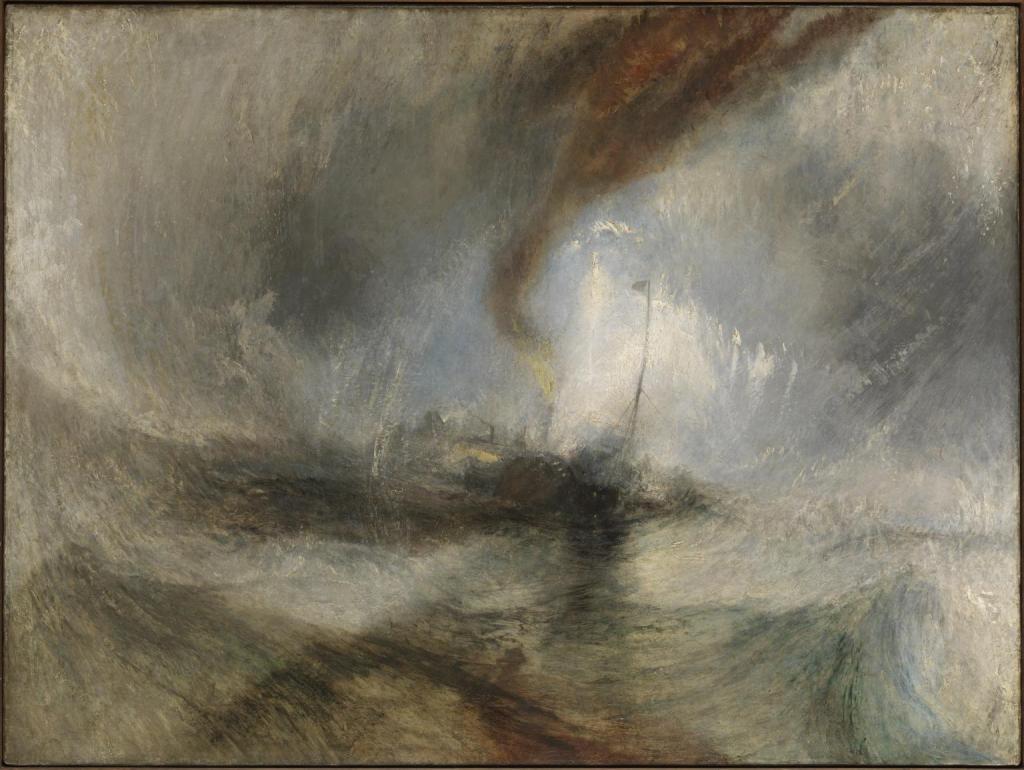
And yet we view the world as being full of objects. This is what happened to a lot of Turner’s paintings. Critics viewed them as objects. Take the example of the painting Snow Storm – Steam-Boat off a Harbour’s Mouth:

Snow Storm – Steam-Boat off a Harbour’s Mouth by J. M. W. Turner (reproduced from http://www.tate.org.uk/art/work/N00530)

The display caption from the Tate Gallery’s website reads simply, ‘The small ship, being overpowered by water and wind, can be seen as a symbol of human’s efforts to overcome the forces of nature.’ The catalogue entry says, ‘The picture may recall a particularly bad storm in January 1842 though it has not been possible to tie down the exact incident.’ There is then a lot of conjecture as to the name of the ship (possibly Ariel), whether Turner really had himself tied to a mast for four hours in order to be able to depict the storm more faithfully. One critic is not convinced and describes the storm as nothing but a mass of ‘soapsuds and whitewash’. Another seems to think Turner has thrown at the painting whatever he could find in the kitchen cupboard: cream, chocolate, egg yolk, currant jelly… It is possible to focus on the painting as an external object and to discuss its merits and failings, its historical circumstances, more or less endlessly.

But just as the word ‘dogma’ can be turned around to reveal its spiritual meaning, so the painting can be turned around to show another meaning:

Snow Storm – Steam-Boat off a Harbour’s Mouth by J. M. W. Turner (the same painting rotated anti-clockwise by ninety degrees)

This is the work being carried out by the Bulgarian poet Tsvetanka Elenkova, who is writing a series of poems that look at the spiritual meaning of Turner’s paintings. This meaning is important. It is right in front of our eyes, but more often than not we fail to see it.

So the poet discerns a face in the painting – the two eyes, the arched nose, the furrowed brow. And at the base of the nose, covering the mouth, a figure in black, arms outstretched – Christ on the Cross – with another figure in front, which she takes to be Christ holding a child. On either side of the Cross, the ginger hair of the man whose face we can see (God the Father), and where the white is, at the top, if we zoom in, the profile of a face with an open mouth and a long nose, wearing a cap (the captain who was reluctant to leave his ship).

If you rely on reason, you will not see these things. It is a question of faith, of believing, as Christ indicated to us at the Festival of Booths. Our world is lacking this spiritual vision. We continue to insist on counting what comes in and what goes out in order to make a profit from things we barely see. Even in cultural circles, such as literature and art, this spiritual vision is often not welcome. But it underlies everything before us, it expresses the essence of things. Not for a moment do I suppose that Turner was aware of this face in the painting when positioned vertically, this was the Spirit working through him. But ‘authors’ are translators, you see, they are prone to give meaning.

Jonathan Dunne, http://www.stonesofithaca.com

Ownership

We have been placed on this earth, we’re not really sure how, except to say that we emerged from our mother’s womb after a gestation period of nine months. When we emerged, having survived in water, we took a breath of fresh air and thus became suitable for the environment we now inhabit. Once we had breathed in, we could breathe out and we joined all the other creatures in translating the environment around us.

It is important that we understand this concept of translating the environment around us. We generally look down on translation. It is second best to the original. It contains mistakes and isn’t as good as reading the original text. The translator’s name is hidden, eclipsed. When we need a translator, that person is essential, but we soon forget about them afterwards. Perhaps because the translator takes control away from us, we cannot access the original language ourselves and so we must rely on the other.

But translation goes further than this. The person who sits down and writes the original text is also translating – translating their experiences, the stories they have heard, the knowledge they have acquired, the words they have learned, their understanding of conversations. And they translate all of that on to a piece of paper. The way they write it one day will not be the same if they write it on another day, so the text is susceptible to their mood on that day and the environment around them (any disturbances). Creativity is a fragile thing.

And while they are doing this, they are translating the air by breathing, translating the food they had for breakfast that morning, translating (making sense of) any conversations they may overhear. Everything in this world is translation because nothing begins or ends with us.

The same might be said of our thoughts. Do they truly originate with us? Or are they placed in our minds to see what we will make of them, how we will react? I believe that the only thing that is ours, strictly speaking, is our reaction, how we choose to react – whether we choose in a given moment to show love or hatred. This also is translation because our reaction, our choice of words or deeds, is like choosing the words with which to represent a text in another language. Again, it will not be exactly the same on one day as the next.

Air passes through us. Food passes through us. Even life passes through us – the life we receive from our parents and pass on to our children, precisely because we are not the authors of life. Even trade, the desire to make money, involves things passing through our hands. They do not begin with us, we do not come up with the raw materials, more often than not it is the earth that does that. We change them in some way (a process that normally involves packaging) and pass them on, fixing a price as we do so.

But we would prefer to think of ourselves as authors. We lay claim. We say this piece of land, this object, this product is mine – because I paid for it, because I got here first. Once we draw the line and say something is mine, we open ourselves to conflict, because it is a false assumption. We don’t own the land we live on, someone else made it, and it wasn’t us. We don’t own what the earth produces, we certainly didn’t invent the seed that gave rise to the crop.

If you fail to recognize the other, then what the world contains, even other people, are fair game, you might think, a potential source of profit. But this is a corrupted way of thinking. We should use what is placed at our disposal for the good of others, not to make a profit.

This claiming ownership is really making ourselves out to be the source of what is around us, and only God can do that, the same God who appeared to Moses at the burning bush in Exodus, chapter 3, and sent him to free the Israelites from bondage to the Egyptians. When Moses asks, naturally enough, on whose authority he is to do this, who he is to say has sent him, God replies, ‘I AM WHO I AM.’ This is the name of the one who sent you.

In Greek, this phrase is translated ‘ἐγώ εἰμι ὁ ὤν’, literally ‘I am the being’, and the last part of this phrase – ‘ὁ ὤν’, ‘the being’ – is included in icons of Christ Pantocrator, since in Orthodox tradition it is the pre-incarnate Christ who appears in the Old Testament. The letters are written in capitals: O WN.

Not only do these three letters spell three words in English – own, won and now – not only do they spell a number if we rotate one of the letters – ONE – they make clear, as all of language does, who the author is, who is the one that can lay claim to ownership. The rest of us are just passing through.

Jonathan Dunne, http://www.stonesofithaca.com
Meekness

‘Blessed are the meek, for they will inherit the earth.’ This is the third of the Beatitudes that Jesus teaches his disciples in Matthew, chapter 5. ‘Blessed are the meek, for they will inherit the earth.’

I have just been on the island of Thassos in the north of the Aegean in Greece. A rich and beautiful island with what is reputed to be the best marble in the world. There is an old Roman quarry in the settlement of Alyki in the south of the island. The land is fertile, pomegranates abound, as well as millenarian olive trees that produce an olive oil that is thick and tasty. Of course, being Greece, there is plenty of tourism, with attractive, isolated beaches catering to the needs of those who come here for a rest.

But what struck me this time was the abundance of animal life. On our first day, swimming off the beach of Trypiti round to a gap in the rock that leads to a small harbour, I spotted a flash of blue with a tawny underside. Could it be a kingfisher fishing by the sea? That is certainly what it seemed. I hadn’t seen one since I was a child and visited the RSPB reserve at Minsmere in Suffolk. Two days later, I saw the same flash of blue while swimming off the beach of Atspas – the same or another kingfisher. Off the same beach, we spotted dolphins, circumflex accents dipping in and out of the ocean. Cormorants stood like statues on the rocks, keeping an eye out for fish or simply gazing at the view. Others skimmed the waves in low flight, these ones certainly fishing, competing with the ferries that to and froed in the distance.

There were plenty of goats, some sheep, cats filling the gaps in balconies, dogs being taken out by their owners, there are no pavements, so they walk in the road. One night, we came across a hedgehog, all pins and needles, it curled into a ball. Later, when I went to search for it again, it had disappeared, motored off into the night at surprising speed.

One of our favourites was the donkey in the next-door garden, a beautiful animal with a grey-brown coat, a dark brown line marking the transition from its head to its body. It would serenade us in the morning and evening with a series of sharp inbreaths and loud outbursts. It had gentle eyes, oceans in themselves, ears that swivelled delightfully (and not always in the same direction) and yellow teeth it liked to bare in front of us. After several days, I got the impression it really was greeting us when we got up in the morning and returned from the beach in the late afternoon.

‘Blessed are the meek, for they will inherit the earth.’ I have the impression that animals know when you believe in God, they react differently, they see you no longer as a threat, but as a possible friend. They notice you, and you notice them. You view the world differently, it is no longer there for the taking, as it is so often treated, when we view ourselves as authors and draw lines. We are just passing through, after all, and we begin to delight in the simple things of life, which are the most important. It is as if the animals realize we have (finally!) come to our senses. They are waiting for us to realize. Perhaps they have never lost their spiritual sight, as we have, but they must endure whatever we might throw at them while waiting for us to repent, to change our attitude, to see things (to see them) in a different light. Then they come to us, they share with us, they communicate with us.

So, for me, ‘blessed are the meek, for they will inherit the earth’ is exactly true. When we are meek, we believe. When we are proud or stubborn, we refuse to believe and rely on science (which is only the study of God’s creation and what we have learned about it), on what we can prove. This is the problem with belief. Belief gives sight, belief changes the way you view things, but how can you believe if you haven’t seen God or had an experience? There’s the conundrum. Belief gives sight, but sight gives belief.

I always remember Apostle Peter walking on the water. While he believes, he walks towards Christ; only when he hesitates, when he doubts, does he begin to sink, to lose his equilibrium. God just wants us to believe. Nothing else. And to those who believe – to the meek – is given the whole world.

Jonathan Dunne, http://www.stonesofithaca.com
Thassos: Monastery of St Michael

There is a very famous Monastery of St Michael on the island of Thassos in Greece, to which there is a reference in a document of 1287. A monk, Luke, built a church where there was a sacred spring. When the Ottomans wished to defile the spring, it dried up, only to reappear in a cave down by the sea, a walk we did today. You head down a path marked by metal poles topped by red-painted bottles to a pebble beach. This part is fairly steep. Then you clamber over rocks by the sea, through narrow passes, rock archways and over a wooden bridge, always being directed by red arrows painted on the rocks and crosses in more difficult places. To your right, the green Aegean and Mt Athos in the distance, the only spectators a pair of goats and some slender birds. After an hour and a quarter, having climbed Golgotha and gone past Scylla and Charybdis, you reach your destination, a trickling spring and in a cave you can only enter by wriggling like a worm a quiet pool of water, where we prayed for those we know under the Archangel’s watchful and merciful gaze. To humble oneself before God, wriggling like a worm, is not only appropriate, it is strangely uplifting. Orthodoxy is smell and on the way back we kept getting wafts of fragrant candle wax. A blessed experience.

View of the Aegean from below the Monastery, with Athos in the distance.
The path with metal poles topped by red-painted bottles.
The pebble beach where the path meets the sea.
Steps built going down to the beach (thank God for the workers!).
A goat watches our progress.
A rock archway you must pass through.
A wooden bridge over a gap in the rocks.
Golgotha, a climb up the rocks.
Scylla and Charybdis (every time we passed this way, I made the sign of the Cross, and we always made it across without being touched by the waves).
The approach to the sacred spring.
Water trickling down beneath the cave.
The entrance to the cave.

This article was also published on the website Orthodox Christianity.

Time

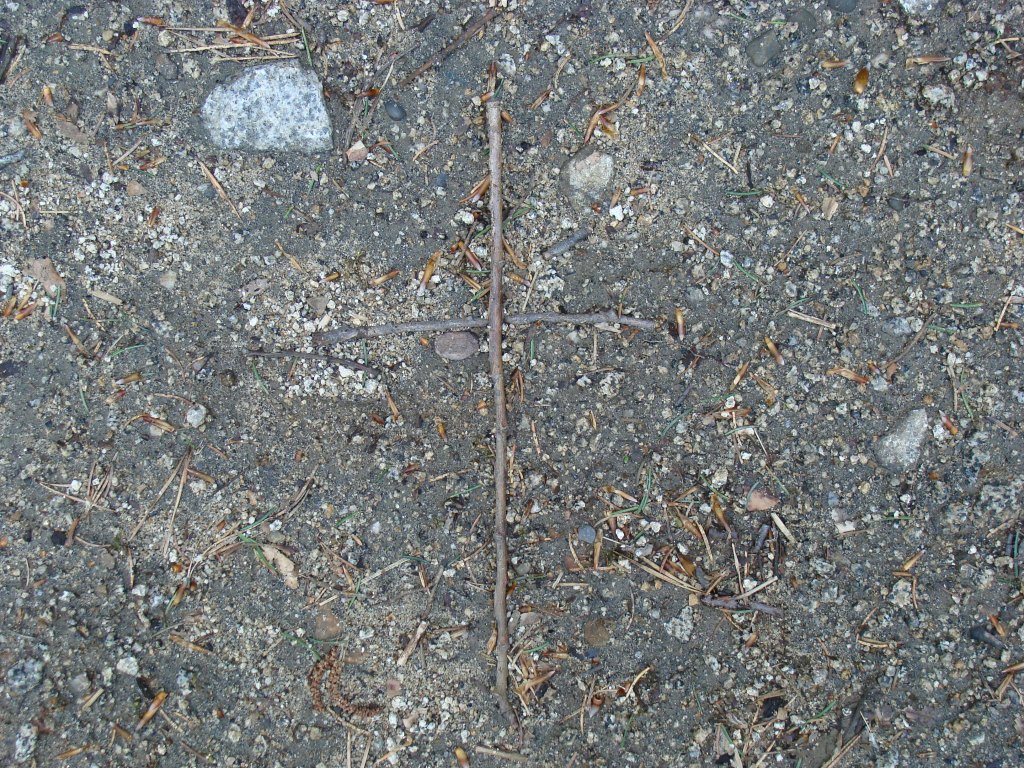
Time is a line drawn by teachers of English on a whiteboard, with the points past, present and future marked by crosses. It is a line in a vast expanse of white, which can only exist because of the whiteboard. If there is nowhere to draw the line, then time cannot exist. We cannot just draw it in the air. Or we can if we use a sparkler. But it won’t last very long.

Time is a kind of zip. An Orion’s Belt drawn in chalk on a blackboard that is expanding space. Three points: past, present and future. Have, do and will. I have lived in London for ten years. Do you like London? I will come with you. Three auxiliary verbs that reflect our attitude to this world: to have (possessions), to do (activity) and to will (what we want). The only way to enter the line, to burrow inside it, to live in the moment, without regret for the past (nostalgia, which spells lost again), without fear for the future, is be. What are you doing? I am listening to music.

Time is a window of opportunity opened for us to take part in creation. It is a soap bubble floating in the air. It cannot last for ever, at some point it will pop. We saw in the previous article that if we are to take part in creation, if we are to be co-creators with God, if we are to have our own children, then the reproductive maturity that enables us to do this comes with age. To be left to age for ever really would be a punishment, so when we acquired carnal knowledge of the other and were expelled from the Garden of Eden, a clock was set in motion. Now we had a ‘life’, a finite period of time, three score years and ten, enough to grow up, reach sexual maturity, have children, raise them and then grow old. We are not authors, so we cannot breathe the breath of life into an inanimate object. We can, however, translate life. We receive it from our parents and pass it on. We are translators in everything we do, from having children, to breathing, to eating, to communicating. Nothing begins with us. We arrive mid-conversation, take part in the conversation and then leave.

But in this process we acquire meaning. We learn things. This is what time gives us. And note that time is clearly connected to line, there is a jump in the alphabet (m-n) and an l with a line drawn through it to make a cross: t. So that is what a cross is – a line that has been deleted, an ego that has been rejected.

Because with time came sin, and again you will see that these words are connected. Imagine letters are like reels in a slot machine: s becomes t and m becomes n, with the addition of final e. Sin-time. In time, we have children. But we also abuse this ability. We do not care for the other as we should. We try to take possession. We remain in permanent activity. Our lives are considered useless if we do not produce. Have, do and will. These auxiliaries dictate our lives, tell us how we should lead them. And what about be?

When we push aside the demands of the ego (a word that is in stark opposition to God), it is as if we turned the ego, the line (I), into a number (1) and counted down to O. We take the I of sin and turn it into son. In a similar way, we turn live into love (and not into its reverse, which is evil). We do this by removing the ego and then we see that time contains a cross (), I and me.

So time († I me) is not just the chance to have children, something we can only do with another person and which will cause us to age, it is also the opportunity to grow spiritually, to realize our need, to meet God and not to deny him.

Church Fathers say that Jesus Christ is waiting in our heart. He calls to us and, when we have grown tired of the things of this world, external objects that can be classified and counted (which is what much of our activity is about), we heed his call. We turn away from our possessions, from the incentive to own, which is nothing less than the attempt to make ourselves the source of life, and approach the heart with our mind. After knocking for a long time – because we must learn to desist from the passions, what caused us to sin in the first place – we are allowed to go in. We call on him – ‘Lord Jesus Christ, have mercy on me’ – and enter. Our mind meets itself for the first time, and becomes aware of the presence of someone far greater.

So time is a bottomless pocket. A door handle. A bubble God blew in the air. Here today, gone tomorrow. A place where we can learn the true value of love, who is the only one that matters.

Jonathan Dunne, http://www.stonesofithaca.com

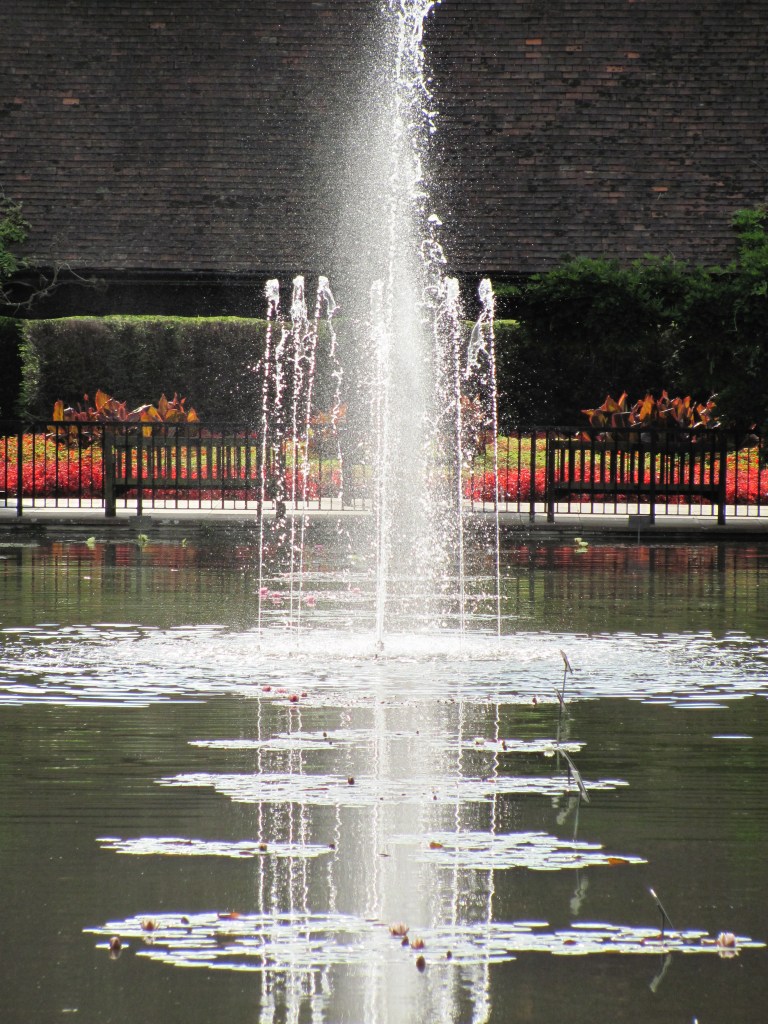
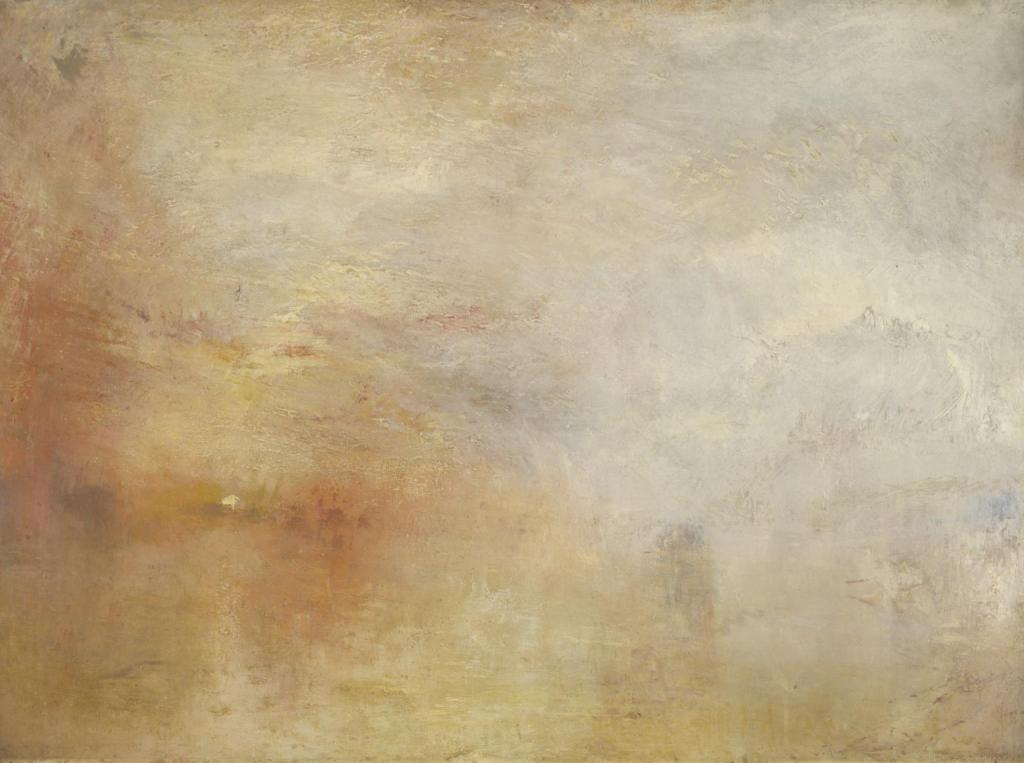
Monet’s lily pond

The Fall

For centuries now, the Church has been taking a dim view of the Fall, the moment in human history when Adam and Eve, the first man and his helpmate, created from one of his ribs, were expelled from the Garden of Eden for eating of the fruit of the tree of the knowledge of good and evil. It’s never quite clear what was so bad about eating of this fruit, only that God had forbidden it (although presumably he knew perfectly well what was going to happen, how the two partners would be tempted by the serpent – nothing bad will happen to you, it certainly looks tasty – and would eat anyway).

I say the moment in human history, although it could be said to be the moment that began human history, when the clock started ticking, because up until then the two partners enjoyed eternal life, whereas now, once expelled from Paradise, they would be subject to death and corruption. I always think we still enjoy eternal life, we are eternal still, it’s just that eternity is hidden behind time and we must pass through a gate to get there. But it doesn’t take away the fact our soul (and our body at the general resurrection) are already eternal. We die in order that I be.

Why does the Church take such a dim view of this moment? Yes, as human beings, we are subject to the passions. We get angry, we do unkind things, we are arrogant, lustful, greedy. We treat others as objects. We want things for ourselves, to acquire worldly wealth (I say worldly, because there is clearly no way we can take it with us when we die), property. We aspire to a comfortable life, everything just so, everything in its place, no demands on our attention, except to enjoy ourselves.

And yet it never quite works out like that. Things go wrong. There are provocations, lines that need to be crossed. The car or the dishwasher breaks down and has to be repaired. We get ill. Things are not perfect. They are not perfect in order to teach us a little humility.

But it could be said that the very quality that got us expelled from Paradise – our rebelliousness – is often what keeps us going, the refusal to give up, the insistence on our hopes and dreams, our resistance in the face of life’s disappointments. Rebelliousness isn’t entirely a bad quality.

I am a little tired of the Church’s interpretation of the Fall, to be honest. I would like to give another interpretation, which I go into in greater detail here. The Fall represents sexual knowledge, the serpent is the man’s penis and the apple is the woman’s breast. Adam and Eve acquired carnal knowledge (at the man’s instigation, note), and for this reason they had to be expelled from the Garden of Eden (whose letters rearranged spell danger of need). Because once you become sexually mature, the process of dying begins. In ‘The Consequences of Man’s Fall’, Metropolitan John Zizioulas puts it like this: ‘In beings with organs – especially mammals – the ageing cycle begins from the moment that the organism reaches the point of reproductive maturity.’

I don’t think God was being cruel. He wanted us to be co-creators, but we are not like him, we cannot create ex nihilo (out of nothing), we are translators, we use what already exists and make something out of it. We are not authors. Only God is this. So when we create another being, we cannot just mould a body out of clay and insert the breath of life into it. We are not the originators of life, as God is.

What we can do, however, is give of ourselves (as Adam did in the creation of Eve, when a rib was taken from him). And in this way we can have children. The difference is it is not a clone army, like in Star Wars, they are our very own children, with their own personalities and identities. And we can only have children with another person, we cannot produce children on our own.

The alternative would be a heaven containing only two people, Adam and Eve, or as many as God created from our ribs, without our conscious, active participation.

God gave us the opportunity to knowingly come together and fill the Church ourselves, one generation after another. That is exactly what we are doing. Filling the Church, giving life in the only way we can, through translation. The Fall – so long as it is followed by repentance, an acceptance of our need – may not turn out to be such a bad thing.

Jonathan Dunne, http://www.stonesofithaca.com

Mercy, And Not Sacrifice

The icons shine. When you give them even cursory attention, they shine. Icons are in the habit of gathering dust. They are bought in a moment of illumination and love, affixed to the wall, and there they stay for months and years on end, gathering dust. It is difficult to clean them all. Sometimes they are too many. Sometimes the edges are rough, you cannot run a cloth over them. Sometimes they are simply affixed to the wall too firmly or they are stuck.

And yet they respond to even a superficial dusting. Just a quick wipe, they seem to gleam, to appreciate the attention, to speak of another world where all is light. They beckon you onwards. ‘Keep going,’ they seem to say, ‘the race is not so long, it will be over soon.’ It is like when you have an illness, you feel terrible for a few days, but then when you get better, the life surges back into your veins, you are grateful simply to be alive, you almost cannot believe it. I wonder if this short cycle of illnesses like colds and flus isn’t a preparation for what death will be like, a feeling awful, followed by a rush of gladness and disbelief, of joy and gratitude when the weight is lifted. Having shed the stones of the illness that irked your feet, you will rise again, but this time your feet won’t touch the ground.

Simple things. The eye of the lamb on a mug. The resurrected cactus in its new ceramic pot. We ignore most of the things most of the time. Most of them become covered in dust for our sight. We see only what we want to see, or are capable of seeing, which isn’t much. How much do we notice the street we are walking along, when we are immersed in our thoughts? How much do we notice our neighbour’s need or put ourselves in their shoes, try to perceive the world as they do? I’m not sure we really see each other. We get glimpses, but most of the time it’s a cardboard cut-out, a presentation.

My father was just in a restaurant in Folkestone. He couldn’t position himself under the table properly, so that he could eat. An anonymous stranger sitting behind him got to his feet and slid my father’s chair closer to the table, carried out his purpose for him. My father was surprised, taken aback, mumbled thanks. Again, at the end of the meal, they exchanged a few words. He was so touched by this simple act of kindness that he felt the need to communicate it to me a few days later. An act of simple kindness.

I have been reading St Matthew’s Gospel in Greek. It is known that this Gospel was aimed primarily at the Jews (it is the only Gospel that was originally written in Hebrew and later translated into Greek) and it was concerned with presenting the life of Jesus as fulfilling the Old Testament prophecies, the words of prophets like Isaiah, Ezekiel, Jeremiah, who it seemed foretold the coming of the Messiah, the Spirit worked through them. There are many verses in St Matthew’s Gospel that are printed in bold, quotes from the Old Testament, but the only one that I am aware is repeated is when Christ says to those around him, ‘Go and learn what it means, “I want mercy and not sacrifice”’ (Mt 9:13, 12:7).

God wants mercy, not sacrifice. What does this mean? Is it possible that in this spiritual training ground that is the world God has his finger on the pulse of everything, he knows what we need and sends what is best for us, all he requires from us is not great sacrifice, but simple acts of kindness? We think we need to control events around us, we think only we will be able to find the resources that we need to enable ourselves and our families to survive, but is it possible that God has already arranged these things – the sacrifice – after all, he knows every blade of grass, every hair on your head, and what he needs from us is not the big picture, not the creation of the world (he brought the creatures to Adam to name, not to create), only that we open our eyes a little, that we notice our neighbour, that we blow away the dust?

Mercy, and not sacrifice. When you believe, the world catches fire.

Jonathan Dunne, http://www.stonesofithaca.com

Word in Language (24): English Course (3)

In the fourth and final part of this short course in English, we will look at word connections made by the addition of letters. Sometimes it is possible to make connections simply by adding a letter, and we have seen examples of these: SELF and FALSE or FLESH, for example, or GOD and GOLD. Here, I have simply added a letter (a, h, l) without making any other changes. But often it is necessary to apply the rules we have studied and make a change to the vowels, apply the seven phonetic pairs and b-v-w, change a letter according to the alphabet or its appearance. A good example is LAND and PLANT – we have added the letter p, but also applied the phonetic pair d-t. Or FLESH and FATHER – we have added the letter a, but also applied the alphabetical pair s-t. We may need to replace i and u with their corresponding semi-vowels j/y and w, c with the two ways it is pronounced, k or s, or to double a letter.

These are the words we are going to look at. See if by adding the letter in brackets and making any other necessary changes, by maintaining or changing the order of the letters, you can arrive at the connections:

FISH   LINE   (+ a)   AIR   CROWN   WORK   (+ d)

FLIRT   PLOT   (+ e)   LOVER   (+ f)   FIRE   (+ g)

GRIST   DIE   EGO   (+ h)   GREEN   (+ i)   FIRE   (+ l)

SNARE   (+ o)   FIEND   (+ r)   EXIT   (+ s)

FISH   SEMEN   (+ t)   IDLE   (+ v)

The two most commonly added letters are h and e. The first letter, h, is the way we represent breath in the alphabet, so it is not entirely surprising that we should often find this letter has been added – we are simply adding breath to the word. Think of the example of TREE, which has a single trunk, but when it sprouts branches turns into THREE, becoming three in one (a good analogy for the Holy Trinity). Nor is it entirely surprising that the other commonly added letter should be e, since this is the most common letter in the English language. What strikes me is that the two letters together spell he, and that points us to Christ.

The other commonly added letters are all grammatical. The first of them is s, which we use in English to make the plural (car, cars) and to make the third person singular of the present tense (learn, learns). Again, what I find striking is that if we add s to he, we get she, and that points us to Mary, his Mother.

The next four most commonly added letters are the two most common phonetic pairs I have already mentioned, d-t and l-r. Again, they are grammatical. D and t are the way we pronounce the past tense in English – think of the past of learn, which can be spelled learned or learnt (think of the past of spell, which can be written spelled or spelt!). These letters are appended to the end of verbs in English to indicate that the action was in the past. Meanwhile, l and r are suffixes used to turn nouns into adjectives – think of words like normal and regular.

The other most commonly added letter is n. Again, it is grammatical because n is used to make the past participle of irregular verbs (see, seen). So letters that are used in grammar to make derivatives, words that derive from others, are also commonly added in the formation of word connections. The other letters are vowels: e in first place (we often find this letter at the end of words in English, lengthening the previous vowel – think of shin and shine or man and mane), but also i and a. This completes the list of most commonly added letters: h, e, s, d-t, l-r, n, i and a.

Let us look now at the examples. If we add a to FISH (and apply the alphabetical pair s-t), we get FAITH. This is a remarkable connection because the fish is an early symbol of Christianity. The letters of the word for ‘fish’ in Greek, ichthys, form an acronym, again in Greek, for ‘Jesus Christ Son of God Saviour’. The symbol is made up of two overlapping lines – two hands in prayer. The fish may also remind us of pivotal moments in Christ’s ministry: the feeding of the five thousand; the feeding of his disciples on the beach by the Sea of Tiberias at the end of John’s Gospel, when Christ asks Peter to feed his sheep, a reference to the formation of the Church.

Meanwhile, LINE gives us ALIEN. We create an alien by drawing a line between them and us. We draw a line when we make ourselves out to be authors. The line is also the ego in English – the pronoun I. When we draw a line, we are claiming property, but this is hard to do given that nothing begins with us and things pass through us. We are translators, not authors, but our urge to be authors (and to deny the existence of the real author of all things) leads in our world to inequality, the haves and have-nots, to war and suffering. Christ asks us to embrace the other, because the OTHER is God (THEOS in Greek). We are not saved alone, but in community (we pray for each other, and the saints pray for us).

With the addition of the letter d, from AIR, we get BIRD (alphabetical pair a-b). Well, a bird is intimately linked with the air, so it is logical that the two words should be connected.

From CROWN, we get GROUND (u-w, phonetic pair g-k). This is to show that opposites are connected. To us, with our limited vision, they may seem far apart – certainly if you are perched in the crown of a tree, the ground will appear far off – but the truth is they are connected. It matters what happens on the other side of the fence – this is why translation is so important, so that cultures can understand one another and interact – but all too often we are concerned primarily or exclusively with what is going on in our own patch. We are saved as a body. We find this connection between distant points in similar word connections: ROOF-FLOOR (addition of l), TOP-BOTTOM (phonetic pair b-p, addition of m). Word connections are often confirmed like this.

From WORK, we get WORLD (alphabetical pair k-l). The world is a place of work – if we do not work, nothing will grow (and you will see that WORK and GROW are the reverse of one another, phonetic pair g-k). But this work is not in vain. It has its reward. If we read WORK back to front and add the letter n, we get CROWN. If we apply ourselves to the virtues, which is hard work, if we persevere in the face of doubts (our own as much as anybody else’s), we will receive the crown of righteousness. We will not achieve anything in the world without work.

The next is a wonderful example, because FLIRT, if we add the letter e, gives TRIFLE. I have to confess that, when I was young, my brother James used to make the most delicious trifles, with fruit and sponge cake, cream and custard. Once finished, it would sit there, on the side in the kitchen, attracting people’s attention, saying, ‘Here I am! Come and eat me!’ My brother’s trifle is not the only thing to do this – to flirt, I mean – fruit does it as well to attract the attention of animals that will spread the plant’s seeds far and wide. That is why FRUIT and FLIRT are also connected (phonetic pair l-r, addition of u). All Nature is attracting attention – or hiding!

And what is the purpose of a PLOT? The purpose of a PLOT is to TOPPLE someone. I give these last two examples to show that word connections aren’t necessarily theological – they can be mundane, or political.

By the addition of the letter f, we find LOVER in FLOWER. Well, just as fruit flirts, so a flower is a potential lover for an insect. Flowers are designed to turn heads, and we find that the reverse of FLOWER is REVOLVE for this reason (phonetic pairs f-v and b-v-w).

By the addition of g, we find FIRE in GRIEF. Grief is a purifying experience. It reduces us to our bare minimum, without the trimmings (which don’t matter anymore, or even make us sick). We are left only with ourselves, and it doesn’t amount to much. And yet this increases our dependence on God. Our pride is wiped away at a stroke. The clearest eyes I ever saw – together with those of a monk on Mt Athos – were those of a husband at his wife’s funeral. He was holding the pain inside. Isn’t this to be a disciple? To hold the pain, albeit for a while, rather than to toss it aside. To participate, to take up some of the slack, to bear witness.

Through the addition of h, we can connect GRIST with CHRIST (phonetic pair g-k). Grist is corn that is to be ground. Can you imagine two millstones whirling in a dance, rotating one on top of the other, with nothing in between? Their activity will, in the end, prove pointless. If we rotate in a dance, with nothing in between, what are we really doing? We need the grist of Christ in our lives – not just thin air, but matter that we can hold on to. God is not only spirit. He came down to earth and assumed our human nature. Every Sunday, we can consume his most holy body. This gives us grist for the mill. And what word is in MILL in reverse? I’M. Christ takes us away from the selfishness of our own desires, he provides a purpose, something we can grind. He is the bread of life.

I said before that Nature also likes to hide – especially when it dies. When an animal is about to die, it often disappears. We don’t see it anymore. This is why DIE and HIDE are connected. When we DIE, we SHED our outer coating (alphabetical pair h-i, addition of s). DIE is like the TIDE (addition of t), which comes in and goes out, just like our breathing.

Again, with the addition of h, we find EGO in ECHO (phonetic pair g-k). Isn’t our ego an echo? Isn’t it just telling us what we want to hear? But this is a kind of blindness. We will never learn anything if all we listen to is our own voice. We have to hear the voice of the other. We open ourselves to what is alien, take part in its joys and sufferings.

Through the addition of i (y), we find that GREEN is in ENERGY. This is an incentive perhaps to look for green sources of energy. After all, GREEN is CLEAN (phonetic pairs g-k, l-r).

By the addition of that other letter that represents the ego, l, we find FIRE in RIFLE. This, for me, is very interesting. What does a rifle, which bears a striking resemblance to the ego, since it is a straight line, do? It fires and then it takes a man’s life. Can you believe that, in our urge to be authors and to lay claim to property, we have created a representation of our ego – the line – for the purpose of taking another man’s life? RIFLE: FIRE – LIFE. There is language to tell us.

Our reason tells us we have the right. We listen to our reason, we rely on it, often to justify the actions of the ego. Well, why shouldn’t I? After all… And there is the voice of our conscience to provide a counter-argument. Well, it isn’t exactly fair, especially if you look at it from the other’s point of view. Reason is comforting. Reason tells us we can have what we want. But REASON contains SNARE (addition of o) and can be found in TREASON (addition of t). Perhaps it will do us a bad turn in the end and we should rely on faith instead. SNARE is also in ANSWER (addition of w). An answer is also comforting, it closes the chapter (but never for long).

Jesus must have thought he had a friend in Judas. Or this is what casual onlookers must have surmised when they saw them together. FRIEND is a complicated word, however. Without the r, it spells FIEND, and certainly the devil entered Judas when he decided to betray his master. Is that a coincidence? Yes, of course it is. Everything is coincidence, things happening together. But as I said before, there are other connections to confirm it. Look at the first four letters of FRIEND and apply the phonetic pairs f-v and l-r. What word do you find? EVIL. And in the last four letters of FRIEND? DENY. Language knew long before it happened what would come to pass.

‘All the world’s a stage,’ wrote Shakespeare in As You Like It. EARTH is in THEATRE. When our role is done, we exit stage left or right – perhaps left to join the goats and right to join the sheep (Mt 25:31-46). That is why EXIT is in EXIST. At some juncture, we exit and exist – in terms of the theatre – no longer. Life is but a dream. The ancient Greeks referred to the boundary between the earth and the underworld as the river STYX. This word is also in EXIST.

What is it that a FISH can do better than any other living creature? It can dart about, it can move from side to side, suddenly change direction. It can SHIFT (addition of t). I find this a very visual connection. I think of the fish in the water suddenly disappearing, parallel becoming perpendicular.

At the beginning of life is the seed and the egg. Only if an egg is fertilized will it remain in the mother’s womb, will it stick to the side of the womb and gestate. This is because SEMEN acts as a CEMENT (addition of t). Cement is a kind of past tense. The introduction of the seed cements the egg to the womb, where it can develop.

The DEVIL makes work for IDLE hands (addition of v). We have come across several connections with DEVIL: EVIL, LIVED, DIFFER, WICKED, DEFILE, YIELD…

We have now studied all the rules for making word connections. In all likelihood, we will have to rearrange the letters, not read them in the same order (though there are a few connections where it is not necessary to rearrange the letters). We may replace the vowels i and u with their corresponding semi-vowels j/y and w, c with the two ways it is pronounced (k/s). We may double a letter. We may change a vowelvowels flow – especially the front vowels a, e and i. We may change a consonant according to where it is pronounced in the mouth – the seven phonetic pairs, plus b-v-w. We may change a letter according to its position in the alphabet and its appearance (by turning it upside down, back to front, by extending it). And having done all of these things, we may add a letter, most commonly he, she.

Language is encoded. It wishes to tell us about human life, why we are here, where we come from (the act of creation in the Garden of Eden), our current situation (a result of the Fall, where the ego holds sway, the line that produces aliens) and what we can do about it (repentance). I have given numerous examples to show that word connections are not isolated events, but part of a greater fabric in history, a thread floating in eternity, time is a thread floating in eternity. It is up to us what we do with the thread. We can discard it. We can use it to sew up a wound. We can tie it into a knot to remind us of something. We can add it to the tapestry, our own particular flash of colour. Life is a thread, a series of events taking us ever onwards, in a direction that will benefit us if we allow it. A water snake propelling us forwards. A hair in the eye that we must remove. The eye of a needle.

Thread is the breath that connects birth and death. All these words are connected. Our timeline is our breath. Our breath is our ‘to be continued’.

The eye of the needle, depending on the angle, can be enormous. Like the sun in the trees.

Jonathan Dunne, http://www.stonesofithaca.com
Word in Language (23): English Course (2)

In the first two parts of this short course in English, we have seen how word connections – connections that reveal the hidden meaning inside the words we use every day – can be made by keeping the letters in the same order, by rearranging the letters, by replacing the vowels i and u with the corresponding semi-vowels j/y and w, by using the fact that the letter c can be pronounced either k or s, by making changes to the vowels according to where they are pronounced in the mouth (for example, a-e, e-i) and by making changes to the consonants, again according to where they are pronounced in the mouth (the seven phonetic pairs – especially d-t and l-r – and b-v-w).

We are now going to look at changes made to letters according to their position in the alphabet and according to their appearance. In the fourth and last part, we will look at the addition of letters. The important thing to remember is that we must continue to apply the rules we have learned – word connections often involve several changes, not just one, so we may have to change a vowel and take a step in the alphabet, or change a consonant and a letter according to its appearance. The most important changes are those made to the consonants – the seven phonetic pairs and b-v-w. Then come the changes made to letters according to the alphabet and their appearance. Vowels flow, they change easily (in some languages they are not even written down). We may need to double a letter. And we may understand i-j/y, u-w and c-k/s to be interchangeable.

Before we start looking at the alphabet and appearance, here are the words we are going to connect. I have put the changes you need to make in brackets, so have a go at making the word connections. You will need to shuffle the letters and to apply some of the rules we have already studied. There are ten words according to the alphabet:

BIRTH   (b-c)   COG   (c-d)   WORLD   (d-e)

LEFT   (f-g-h)   WICKED   (k-l)   LOSE   (l-m, r-s)   MUTUAL   (l-n)

GRAIN   (n-p-s)   ERROR   (r-s)   SHARE   (s-t)

and ten words according to appearance (which are written lowercase to make it easier to see the resemblance between the letters):

birth   (b-d)   cross (c-e)   free (f-t)

faith   hide   mouth   (h-n)   I’m sane (i-l)

alone   (l-t)   north   (n-u)   devil   (v-y)

The English alphabet has twenty-six letters. We have already looked at the letters that make up the alphabet. When we change letters according to their position in the alphabet, we take a step forwards or backwards, we turn the dial. It is as if the letters were on reels in a slot machine and they spin. We rotate them, sometimes one notch, sometimes more than one. We saw the examples of GOD and EGO (d-e), FATHER and GATHER (f-g), OTHER and THEOS (r-s). They are like the dates that appear in the little window of a watch. We may make several changes at once: JERUSALEM-JESUS AMEN (l-m, m-n, r-s). We may go in alternate directions, one letter forwards, the other back: MOTHER-HER SON (m-n, s-t). But it is clear to me that the letters in the alphabet are ordered in this way for a reason.

So if we apply the alphabetical pair b-c, we will find that BIRTH gives CHILD (also the phonetic pairs d-t, l-r). And this is true. Birth does give a child. I think of birth as an equation: 1 + 1 = 1. Two bodies come together to make one body. Three people in one. It’s quite a good analogy for the Holy Trinity, for how three can be one. If we apply the phonetic pair b-v-w and add final e, we will see that BIRTH is connected to THRIVE and WRITHE. It is also connected to BRIDE and TRIBE. The first three letters in reverse spell RIB, which is how the first woman was born. And RIB gives RIP (phonetic pair b-p) – the ability to give birth leads to our physical death, but it also gives us the opportunity to have children and to form the body of the Church.

If we apply the alphabetical pair c-d, we find that COG gives GOD. We are cogs in a machine designed by the Creator. Each one of us has his or her particular function. When we work together, everything goes smoothly. When we fight or think only of our own needs, the machine starts to malfunction. What is most remarkable for me, however, is how the Son of God, through whom the world was created – who was outside the world, therefore, as well as in it – deigned to become a cog in that machine so that we could find the way to salvation. God became a cog. He entered his own machine in order to fix it.
WORLD is connected to LOWER. This world is lower than heaven. According to the celestial hierarchy, there are another nine levels above us, rising to God and ending with the seraphim and the cherubim. So it is appropriate that WORLD is LOWER. This reminds me of another two word connections: HEATHEN-NETHER and HEAVEN-NEVER (you have to read the words in reverse). If we are pagan and do not believe in God, but only in the things of this world, we remain here below. Heaven is a kind of Never Never Land, outside time. There is a paradox here – the place it seems we are never going to reach lasts for ever.

We have seen other examples of paradox in Christianity. Opposites are connected. For example, LEFT and RIGHT (take two steps in the alphabet, f-g-h, change the vowel and apply the phonetic pair l-r). Everything is contained in God. Things that seem disconnected are not so far apart.

Remember the connections DIFFER-DEVIL and FATHER-GATHER? It is the devil who would make us differ, who would lead us into STRIFE (the contest to be FIRST). This is why GOD is GOOD and the DEVIL is EVIL (their etymological roots are different, but the words are practically the same). DEVIL is also connected to WICKED by the phonetic pair v-w and the alphabetical pair k-l (the c in wicked is just reinforcing the k).

And here’s another paradox. LOSE gives MORE (alphabetical pairs l-m, r-s). Christ enjoins us to lose our life for his sake, and we have seen how by denying the self and forming a cross – † (the I with a line drawn through it) – we also make a plus-sign. This is how we lose our life in order to find it.

MUTUAL gives AUTUMN. I find this a beautiful connection, but I cannot say quite why. There is something borrowed in autumn, something we must give back, a change taking place between the warmth of summer and the cold of winter. In autumn, the weather can be lovely, a kind of bonus summer – we call it an Indian summer. I have climbed to the Rila Lakes in Bulgaria with my wife and son in November! Autumn is like an extension that God offers us for free. It is also the season for harvesting, when we gather crops and fruit.

Crops are stored in the form of grain. We use GRAIN to make bread. We use the GRAPE to make wine (I have taken two steps in the alphabet, n-p, and changed the vowel, e-i). Bread and wine are the elements of the Eucharist, which are translated into the body and blood of Christ. How are they translated? By the descent of the Holy Spirit, by GRACE (another two steps in the alphabet, p-s; c corresponds to s). GRAIN-GRAPE-GRACE, the ‘materials’ we need to celebrate the Eucharist.

ERROR is connected to EROS (r-s). There is no doubt that eros can be used in error when it seeks to take pleasure at the cost of the other. This is one of the devil’s main strategies – to convince us that EXCESS in SEX, or alcohol, or drugs, is an affirmation of the self, an assertion of freedom, an act of independence, when all it is doing is destroying the self we are purporting to raise on a pedestal by linking it to the passions, by enslaving it, in short. Eros is when two people come together, openly, knowingly, in full possession of their faculties, and commit to each other. It is a private affair, in which God is present.

In SHARE we find HEART (s-t). We open ourselves to the other, share with them what we have. This is why both these words have HEAR in common. We hear the voice of the other, and not just our own selfish demands.

Let us turn now to word connections made by changing letters according to their appearance. For these connections, it is better to write the letters lowercase so their resemblance becomes more obvious. Letters can be turned upside down: f-t, m-w, n-u. Back to front: b-d. They can be continued: c-e, h-n, i-l, n-r, v-y. They can be crossed out: l-t. We have seen the examples ‘breath’ and ‘thread’ (b-d, breath is the thread that links birth and death), ‘hope’ and ‘open’ (h-n, hope keeps us open), ‘venom’ and ‘money’ (v-y, money acts as a poison).

We now find that ‘birth’ gives rise to a ‘third’ person (b-d). We have seen this is the case in the equation 1 + 1 = 1.

The word ‘cross’ can be likened to ‘eros’. This is not eros in error. This is the true meaning of eros, in which we are fully open, fully vulnerable before the other. Is there any way of being more open in a human body than on the cross, with your hands and feet nailed in place? Is this not what God asks of us, to become increasingly vulnerable, which paradoxically constitutes an ascent to heaven (Never Never Land). The answers (the certainties) seem to evaporate. They leave only one. That God is love. It is that LOVE that will make us WHOLE.

We want to be free and, in order to achieve this, we travel in all directions, we seek forms of entertainment, things that will occupy our attention, distract us from the futility of death, we search for ways to give our life meaning, to justify our existence. We think that ‘free’ means asserting our own will. This forms the basis of our modern society – the ability to do what we like (within reason). But freedom is not to do what we like, to go wherever we want. Freedom is to remain in one place. To go through the pain. To endure. And what better example of ‘free’ than a ‘tree’, which is rooted to the spot? We may pollute it, surround it with concrete, cut it down, but still it continues to give fruit, shade, warmth, oxygen! You may say that it has no choice, but I think that is exactly the point. It is our choice that kills us. Freedom is submission to God. Freedom is to bow our heads in worship. To reach down to the ground, so that God will lift us. This is why language – and life – are so paradoxical. The answers are not where we would find them. They are somewhere else (and not generally in our brains).

But ‘faith’ can grow ‘faint’ (h-n). Sometimes the journey seems long, unending, without purpose. This is where we must dig in and stay in one place. STAY provides YEAST (addition of e). STRAY doesn’t. Even the DEVOUT can DOUBT (b-v, addition of e). But when the wind blows and life seems most pointless, when we are at our most vulnerable (and the devil chooses that precise moment to attack us), we must stand firm. Like the tree.

Then we will find God. In the eye of the storm. The word ‘hide’ gives ‘find’ (h-n, alphabetical pair e-f). What is hidden comes to light. If we persevere. Word connections are often confirmed by other word connections. So it is with ‘hide’-‘find’. Compare SEEK and SEE (addition of k). Or SEARCH and REACH (addition of s). We find an answer, but it may not be immediate.

The ‘mouth’ is a ‘wound’ (two physical pairs, h-n and m-w, phonetic pair d-t). The mouth is like a wound in our body, a kind of gash. It can also wound others. As Christ says, ‘It is not what goes into the mouth that defiles a person, but it is what comes out of the mouth that defiles’ (Mt 15:11). Note the connection between DEVIL and DEFILE (phonetic pair f-v).

Here is one of my favourite connections. The world thinks it is sane. It puts other people who don’t agree with its point of view in hospital. But ‘mental’ spells ‘I’m sane’ if we apply the alphabetical pair s-t and the physical pair i-l. There is a corresponding connection: ‘normal’ reads ‘I am wrong’ in reverse (physical pair i-l, addition of g and w). What is considered normal – making money at the expense of the other – may not be right. The one who is marginalized because of his opinions may actually be saner than we are. As a translator who lives on the margins, I begin to think that holding fast to your beliefs inevitably leads you to the margins; it is compromising on your beliefs that takes you to the centre, to a place by the fire. Christ was the most marginalized figure of them all (Mt 8:20, Mk 6:4).

But alone we can do nothing (Jn 15:5). We need the Cross to make sense of our existence. Cross out the I in ‘alone’ and you get ‘atone’, which is what Christ did: lead us back to the Father, the source of life.

We have seen how opposites are connected: LEFT and RIGHT. Let us take another two directions: ‘north’ and ‘south’ (n-u, alphabetical pair r-s). They also are connected. God is everywhere; there is nowhere he is not. This is why his name, Alpha and Omega, is left over in the other two points of the compass: EAST and WEST. These two words share the letters est. What is left over is AW (the Greek letter omega is written w).

But the ‘devil’ would have us stray. Abandon our post. Succumb to the difficulties. Seek amusement, satisfaction, elsewhere. The devil does not want us to withstand the pressure. He wants us to fracture. He wants us to ‘yield’ (v-y).

We have now seen all the ways of changing letters:

i-j/y, u-w, c-k/s;

– vowels (u-o-a-e-i);

– consonants (seven phonetic pairs, especially d-t and l-r, plus b-v-w);

– alphabet (d-e, f-g, r-s, s-t);

– appearance (b-d, h-n, i-l, m-w).

But not all words that are connected contain the same number of letters. We now come to the richest source of word connections – the addition of letters. We continue to apply the rules we have studied (phonetics, alphabet, appearance), but also add letters.

Jonathan Dunne, http://www.stonesofithaca.com