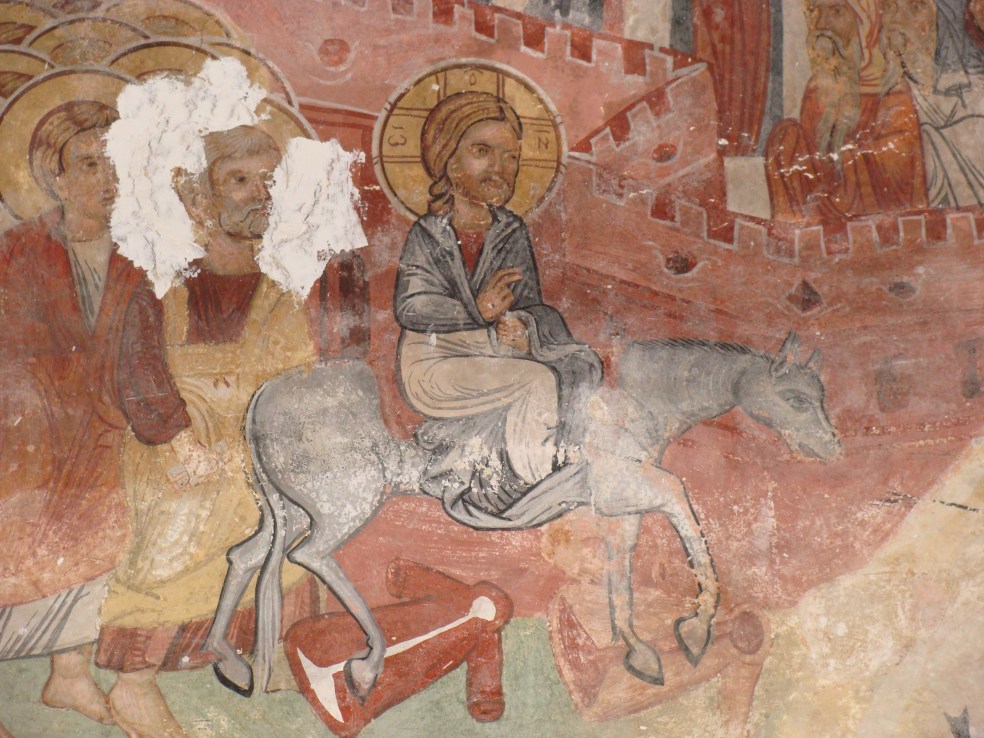
Baptism of Christ

Readings: Isaiah 43:1-7; Psalm 29; Acts 8:14-17; Luke 3:15-17, 21-22

We all speak. That is, we produce sounds with our mouths. After the service, we will gather around the coffee machine and do this. We will discuss the week’s events and thrash out the finer details of this sermon. We will express opinions and hopes and desires. We will enquire after friends. And we will leave, having shared fellowship.

How strange it would be if we all gathered in the entrance hall and didn’t say anything! If we stood in each other’s company with our mouths closed. We might raise our eyebrows or wiggle our ears, but no further communication would be permitted. Eventually someone would snort or yawn, and the spell would be broken. We would laugh and launch into a discussion.

We worship a God, Jesus Christ, whom we call the Word. This is how John the Evangelist refers to him at the start of his Gospel: “In the beginning was the Word, and the Word was with God, and the Word was God.” And we read in chapter 1 of the Book of Genesis that the world was spoken into being. Each paragraph begins, “And God said.” “Let there be light.” “Let there be a dome in the midst of the waters.” “Let the dry land appear.” Etc.

And yet we pay very little attention to speech. This is unusual since I would say that Christianity is a religion of the Word and its ritual is based on the action of speaking. The first thing we do when we speak is breathe out. It is impossible – I think! – to speak as you are breathing in. So, the first element of speech is BREATH. Breath is represented in the alphabet by my favourite letter, the letter “h”.

Then we add voice to our breath and produce the vowel sounds. Think of a baby. A baby is a student of phonetics. It opens its mouth (hopefully not at three in the morning) and adds voice to its breath, producing vowel sounds that may range from an “oo!” to a long, drawn-out “ah!”. But it will generally not produce consonants because consonants involve blocking the flow of air with the lips or tongue and this is more difficult.

A vowel sound is what the doctor asks you to make when they want to examine your throat: “ah!” “A” is the most open vowel there is, so it involves opening your mouth to its greatest extent. It is what we do when we sing. The longer you hold a vowel sound, the more saliva will collect in your mouth, and you will have to swallow. This is because vowels are like water. It is as if a river was flowing through the canyon of our mouths. So, the second element of speech is WATER.

When we obstruct the flow of air with the lips or the tongue, we produce the consonants. Perhaps the easiest consonant to pronounce is the letter “m”. This involves pressing the lips together. “M”. And this is often the first consonant a baby will produce, when it says, “Mama”.

Since the consonants are produced by blocking the flow of air with our lips or tongue, we might say that the third element of speech is FLESH. So, we have BREATH (the letter “h”), WATER (the vowels), and FLESH (the consonants). The three elements of speech, which we practise unknowingly, as when we change gears in a car.

This is how I would analyze the action of speaking: breath, water, and flesh. In chapter 2 of the Book of Genesis, there is a second creation account, which involves the creation of man. In verses 6-7, it reads as follows:

A stream would rise from the earth, and water the whole face of the ground – then the Lord God formed man from the dust of the ground, and breathed into his nostrils the breath of life; and the man became a living being.

Gen 2:6-7 (NRSV)

Most of us, I suspect, would regard speech as the agent of creation as a kind of metaphor, but I think this is exactly what happened. Nowhere in the first two chapters of Genesis does it say that God made the world with his hands, like a potter fashioning clay. It says that he spoke. All through the first two chapters, we read that God said. And the three elements of speech – breath, water, and flesh – are clearly present here: God “breathed into his nostrils the breath of life”, “a stream would rise from the earth, and water the whole face of the ground”, God “formed man from the dust of the ground”. We read later in Genesis 3:19, “You are dust, and to dust you shall return.” This refers to our material body.

We find the same emphasis on the power of speech in Psalm 29: “The voice of the Lord is powerful… The voice of the Lord breaks the cedars… The voice of the Lord strikes with flashes of lightning… The voice of the Lord twists the oaks and strips the forests bare…” That’s pretty impressive – to do all of that only with words. It doesn’t say that God did these things with his hands, and this is a constant in Christian texts and prayers.

We are not able to produce matter with our mouths, but with our words we can have a material effect on our surroundings. We can make someone happy by saying something nice to them. We can make someone cry by saying something hurtful. We can order someone to be killed. Or we can issue a pardon. Our words can be recorded and can influence future generations or even the course of history.

After the creation of man, man – the Hebrew word is “Adam” – is given a task. He is not asked to make the creatures – that is God’s undertaking. He is asked to name them. To apply a word to that particular creature. This occurs in Genesis 2:19-20. Most of us are not in the habit of adding words to the dictionary, of coming up with a name for a horse or a squirrel. But we do name our children, and names are important. They may not fix a child’s destiny, but they do, to some extent, determine their character. There is a Bulgarian name, Milen, which comes from the Bulgarian word for “kind”, mil, and I have noticed that many people called Milen are kind in person. It is as if they live up to their name.

A child is named at their baptism. The priest takes a bundle of flesh and douses their head with water three times, invoking the Holy Spirit. But hang on a minute! Aren’t those the three elements of speech – breath (the Holy Spirit), water (the water of the font), and flesh (the tiny baby)?

In effect, in the sacrament of Holy Baptism, a child is being made into a word of God – not the Word (that is Christ), but they are being called to be Christ-like, to reject the devil.

And what happens in the sacrament of Holy Communion? The priest takes the bread, the fruit of the earth, and the wine, which is a liquid like water, and consecrates them by the invocation of the Holy Spirit. Again, the three elements of breath, water, and flesh are present. We find all three elements in bread, which is made from a dough of flour and water and has air in it.

And what about the first creation account in Genesis, where we read that the waters were separated from the waters and the sky was created, then the waters under the sky were gathered together into one place and the dry land appeared. Aren’t these again the three elements of speech – breath (the sky), water, and flesh (the dry land)?

I would suggest that speech is central to an understanding of the world around us and our place in it. It can effect change, it can bring people to their senses. It can give meaning, as when we take our child and name him or her.

When we are baptized, as Jesus was by John the Baptist in the River Jordan, we have a choice. We can choose what kind of people we want to be. We can decide on the words we will use, on the actions we will take, whether to tell the truth or lie, whether to help others or steal.

We are a word of God. We can choose to be wheat or chaff. We can choose whether to please God or to turn away from him. According to our life, so our definition will be. And this is why we need to cling to the name of Jesus, to think only of him, so that in our earthly pilgrimage we become as much like him as possible. We are made in God’s image, now we must become like him.

Come, Lord Jesus! Amen.

Jonathan Dunne, www.stonesofithaca.com

Photo caption: Letters make good staging posts. Saints Cyril and Methodius, the brothers from Thessaloniki who wrote the Cyrillic alphabet, outside the National Library in Sofia, Bulgaria.
Video

Theological English (0): The Line

In this first video on “Theological English”, Jonathan Dunne looks at the line, which represents the ego in English (I) and the number 1. Countable nouns are nouns that can have a line drawn around them – a book, a car, a tree. They are accompanied by the indefinite article, a/an. When God made man, he in effect made a countable noun – he drew a line around us and gave us free will. We do the same with products of the earth – we draw a line around them in the form of packaging – but we do this not to give things free will, but to trade in them, to sell them to each other. We appropriate for ourselves the role of author (things begin with us), when in fact we are translators (things pass through us).

To access all the videos in this course, use the drop-down menu “Theological English (Video Course)” above. The videos can be watched on Vimeo and YouTube.

Turner: The Man and the Angel

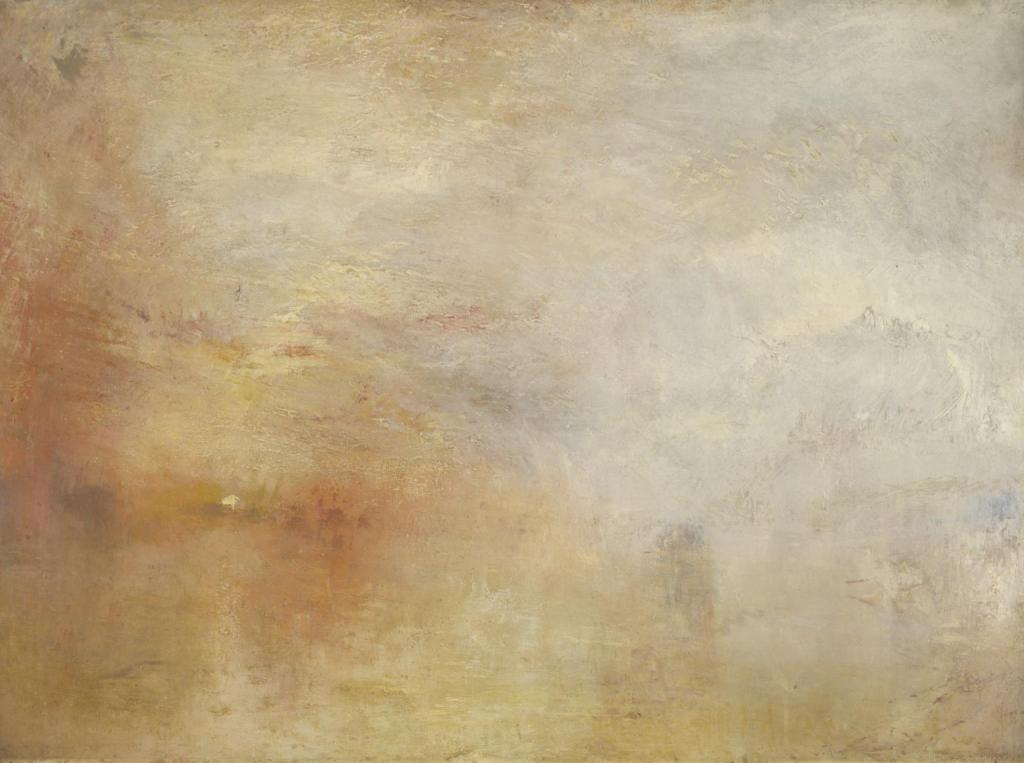
Turner’s painting Sun Setting over a Lake is one of a group of paintings, ‘Late Unfinished Sea Pieces’, whose dating and provenance are uncertain. They are generally dated to the period 1830-45, though some people disagree, and there is some suggestion that Turner’s assistant, Francis Sherrell, may have had a hand in them.

Then there is the subject matter. As always, what seems to concern the critics is the visual evidence. What can we see? Except that they always focus on the physical details. So regarding Sun Setting over a Lake, the display caption says, ‘The topographical details of this painting are hazy and indistinct […] passages of white paint may depict snowy Alpine mountains.’ And the catalogue entry ends, ‘Whether the picture shows the sun setting over a lake or the sea is difficult to determine, but the presence of what appear to be mountains on the right suggests the former.’

Which is to say we haven’t the foggiest and must make of the painting what we will. Turner’s impressionistic style (which is contrasted in the catalogue entry with an earlier more substantial, three-dimensional style) puts paid to objects. This is very interesting for me, because I think many of the world’s problems come from our obsession with objects. The fact that you define something as an object suggests that object doesn’t have its own will and you can do what you like with it. Trade is based on this premise, and trade is what drives the economy.

But this is to miss the inner vision of things, their true value. I have already written two articles about the Bulgarian poet Tsvetanka Elenkova’s inner vision of Turner’s paintings, which she has recorded in a book of poems entitled Turner and the Uncreated Light (forthcoming in both Bulgarian and English). These articles can be read here and here.

Let us focus on the painting in question, Sun Setting over a Lake:

Sun Setting over a Lake by J. M. W. Turner (reproduced from http://www.tate.org.uk/art/work/N04665)

What can we see? What is the visual evidence?

Well, I can make out a sun on the left, a bright dot, and a splodge of white paint on the right with a bluish patch. There is the suggestion that when a painting of Turner’s is impressionistic like this, it may just be unfinished, but as Elenkova points out in another poem, after Michelangelo the fact that something is unfinished doesn’t make it imperfect.

Impressionism allows us to enter the true value of things. It takes us away from our three-dimensional vision of the world by which we like to control the things around us. This painting is a case in point. Let us start, as we did with the painting Snow Storm – Steam-Boat off a Harbour’s Mouth, by rotating the painting by ninety degrees:

Now the vision becomes more interesting. There is the figure of a man. Where the sun is is just below the mouth, on the right cheek. Above this is the hazy outline of a nose, two eyes, and a dark patch of hair. Underneath the sun can be seen the man’s neck, and on either side the two shoulders. Not all the torso is visible, but what we can see very clearly is the windpipe. The torso is an upside-down triangle. Above the man’s left shoulder is what looks like the kind of handprint found in primitive cave paintings. This part of the painting relates to this world.

Now rotate the painting by ninety degrees the other way:

What we have now is an angel. Again, the torso is only partially visible, an upside-down triangle. The angel’s neck is stretched upwards, and the angel is in profile. We see a chin, the lips, a nose, a bright patch on the forehead. The angel’s vision is directed heavenwards, and over his right shoulder can be seen the bright patch of a wing.

Where the handprint was in the other half of the painting, above the angel’s left shoulder, there is a dove, which in the poet’s vision would represent the Holy Spirit, whispering words to the angel.

When we return the painting to where it was:

in the foreground, right of centre, we see the figure of an owl on what looks like a branch.

Was Turner aware of all these details in his painting? I’m sure he wasn’t, but they are there, if one chooses to see the spiritual side of things. And it is this spiritual vision that the world has need of, not to see things as bringing us profit (the world of politicians), but as having an intrinsic value in themselves.

Why are we not exposed to this kind of vision? And why do we not pass it on to our children? You can read as many academic books as you like about Turner’s painting, I am quite sure you will not find this kind of vision. They will limit themselves to what has been recorded by contemporaries, to what the author can see, to how one painting relates to another. This is all very interesting, but it doesn’t take us out of the physical world we live in.

And this spiritual vision is also important when it comes to saving the planet. We give great importance to the physical environment, as we should, we live in this environment, but we must also be able to see the essence of things, their inner meaning, otherwise we won’t make good stewards and our decisions may be skewed. It is not just the environment, but also what is behind or inside the environment, what inspires it.

I have no doubt that Elenkova’s poems will have a difficult reception in both the Bulgarian- and the English-language spheres. They may not even find a publisher all too easily. And yet I would say their vision is essential for our well-being.

Jonathan Dunne, http://www.stonesofithaca.com

Word in Language (17): Christ the Son of God

After the bread that is destined to become the body of Christ during the Orthodox Liturgy has been cut from the loaves that have been baked for this purpose, the bread that is left over from the loaves is divided into small pieces, blessed by the priest and distributed to the people after the service. This bread is known as antidoron in Greek, meaning ‘instead of the gift’. It is used by those who have received communion to help wash down any remaining traces of the body and blood of Christ, so that they do not remain in the mouth, and is received by those who have not received communion as a substitute – ‘instead of the gift’. One of the subdeacon’s duties is to cut this bread into small pieces so that it can be distributed by the priest.


I serve as a subdeacon in the Orthodox Church, and I often think of this unconsecrated bread as being similar to words, cut from the body of Christ and waiting to be sanctified or not by their use. That is, the words we bandy about in conversation or in writing are small fragments of the Word of God and contain the potential to be used in a sanctifying way, if our intentions are good and our mind is set on God.


It is as if the priest is distributing words to the people, who will then leave the church and go out into the street and use those words in what is hopefully a beneficial way. It is only an image.


But I would like to suggest that words, just like the environment, bear the imprint of the Creator and refer to him. My book Stones Of Ithaca contains numerous examples of stones from the beaches of the Greek island of Ithaca that seem to depict Christian symbols and scenes. Language is the same, and why should we be surprised? Isn’t Christ the Word of God, the Logos? Isn’t it logical, therefore, that he should be present in words? Or that words should speak of him?


I would like to suggest that this is so and we can find proof in language that Christ is the Son of God (and that Mary is his Mother). God is one essence and three hypostases (that is, three persons) – three in ONE. I would like to show how language confirms Christ as the Son.


Let us start with the progression that we saw in the previous two articles, AIO, the progression of the Greek alphabet and of human life. A represents the Creation (described in the first two chapters of the Book of Genesis); I represents the Fall (described in the third chapter of Genesis), the era we live in; and O represents repentance, becoming aware of our sins and turning back to God, the aim of our life on earth.


In the Book of Revelation, at the other end of the Bible, Christ describes himself as ‘the Alpha and the Omega, the first and the last, the beginning and the end’ (Rev 22:13). This is one of his names – Alpha and Omega – and can be written A+O. Now it is curious that the three ways of escaping from the selfish demands of the ego, of moving away from the line that represents the ego in English (I), involve:


– making reference to a third point, God, and forming a triangle (Δ);

– deleting the I and forming a cross (†);

– treating the letter I as a number (1) in order to count down to zero (0).


That is, A+O. Christ’s own name, revealed in the Book of Revelation, indicates to us the path that we must follow. I don’t think any human could have invented this; it must be something contained in language itself.


We saw that A+O is found in the middle conjunction, ‘and’, because if we write ‘and’ using capital letters, we get AND or A ’N’ O. The reverse of AND is DNA, which implies that it is in our make-up to make this progression and to turn to God, away from the ego. Note how GOD and EGO are only a step apart in the alphabet (alphabetical pair d-e).


If we apply this progression AIO to the name of God revealed to Moses at the burning bush in Exodus 3:14, AM, we find that AM becomes I’M becomes OM. I take this last word to be a reference to the Holy Trinity: O3, or three in One. But one of the ways of making word connections is by the addition of letters, and one of the most commonly added letters is h. So another way of moving away from the self-centred demands of the ego that we find in I’M is, instead of making the progression AIO, simply to add h to I’M, which gives us HIM. I understand this to be a reference to Christ. He takes us out of ourselves – actually, in many ways it is the reverse movement: he returns us to ourselves. We turn to HIM and in the act of worship we sing a HYMN (the coincidence between these two homophones HIM and HYMN is found also in LORD and LAUD).


In Matthew 20:28, Christ says to his disciples that the Son of Man – Christ himself – came ‘not to be served but to serve, and to give his life a RANSOM for many’. Again, I think we can find proof for this in language, because if we ignore the first letter of RANSOM (r), we find that the rest of the word contains the name of God in Exodus, AM, and SON. Of course, the letters are jumbled up; spiritual knowledge is always hidden in some way. But it is not difficult to make out. I think the word RANSOM wishes to confirm what the Word is saying, and to confirm who he is: the Son of God.


We find another connection to the name of God in Exodus in John 14:6, where Christ says, ‘I am the way, and the truth, and the life.’ If we write the name of God in Exodus I AM and turn the letter M upside down, we will see a clear similarity between I AM and ‘law’ – the law of the Old Testament, which found its spiritual fulfilment in Christ – and between I AM and ‘way’ (y is the semi-vowel that corresponds to i): I AM – law – way. Language confirms what Christ is saying. This is why he goes on in the same verse to say, ‘No one comes to the Father except through me.’ He is the way to I AM.


We find further proof of this connection between the name of God in Exodus and Christ in the appellation that John the Baptist gives Christ when he sees him approach in John 1:29: Lamb. The word ‘lamb’ (and note that the final letter, b, is silent) contains ‘I am’.


So in ‘way’ and ‘lamb’ we find two clear indications that Christ is the Son of God. Again, I would point out that no human could have invented these words so that they would reproduce the name of God in Exodus, I AM. This has to have come from God, to be ingrained in language, just as we saw AM in the name given to the first human, ADAM (both words contain the first and last letters of the Greek alphabet: AO, or AW if we write omega according to Greek usage).


In Orthodox tradition, all appearances of God in the Old Testament are by the Logos, so it is Christ who interacts with Adam and Eve in the Garden of Eve and it is Christ who appears to Moses at the burning bush. For this reason, the Greek Septuagint translation of the name of God in Exodus – O WN – is included in icons of Christ, in the beams of the Cross inside the halo around his head. Search for an icon of Christ Pantocrator, and you will see what I mean.


O WN actually means ‘the being’. That is how the name of God, AM/I AM, is translated into Greek. O WN spells three words in English – OWN, WON and NOW – and it is easy to see the relevance of these words to Christ: he claims us as his own; he has won; he is with us now (Emmanuel).


By rotating the W, we can connect O WN to the number ONE, and I think this is because in his Incarnation, becoming visible to us, Christ represents – follows the will of – the Holy Trinity, three in ONE.


We have seen how these three letters O WN can be written O WH, which spells the question words WHO and HOW. Christ is the answer to both these questions, which we can only ask when we have made the progression AIO. That is, we have gone from asking WHAT in Creation (What is this creature? What should I call it?) to asking WHY (Why should I do this? Why should I believe you?) in the Fall to asking WHO/HOW in a state of repentance. We count down from the ego and realize that the answer we should be seeking is a person, and if you want a person to be the answer to the question you are asking, then the correct question is WHO? This was Pontius Pilate’s mistake when he was standing in front of that very person and asked him, ‘What is truth?’ Truth, he failed to understand, is not a thing, it is a person. The irony of this situation is staggering.


Now WHO sounds the same as HU, which is the root in Sanskrit of our word ‘God’. To show that Christ is the Son of God, the fulfilment of the Old Testament law and prophets, we see that WHO (O WH) is a progression from WHY, which contains the letters of the Hebrew Tetragrammaton: YHWH. And finally if we combine WHO with another name of God in the Old Testament, EL, we find that the two names together spell WHOLE. With the coming of Christ in human form, his birth, teaching, crucifixion, descent into hell and resurrection, we are made WHOLE. We are given that possibility, for our broken form, human nature, to receive wholeness, to return to God. That possibility was not available to us under the Old Law.


In the addition of letters, one of the most commonly added letters is h. Remembering the correlation in phonetics and in the alphabet between v and w, we will then see that WHOLE contains LOVE. It is love that makes us whole, that enables us to enter into relationship. Relationship is intrinsic to the Holy Trinity (there are three persons), and so it is intrinsic to us as well, because we are made in the image and likeness of God (Gen 1:26).


LOVE, by the addition of the same letter h, can be found in OTHER (phonetic pair l-r, alphabetical pair t-v). Love necessarily involves the other, unless all you are going to do is love yourself. I don’t think we are meant to do this. True love – true healing – involves relationship. I am healed by others, by letting them into my life and by revealing myself to them. I have a family, I was lost without them, but that same love – that same self-affirmation (as opposed to the self-destruction brought about by sin) – can be found with a complete stranger if our gaze is at once directed towards each other and towards him (the third point I talked about with reference to the triangle). OTHER is connected to the Greek word for ‘God’, THEOS (alphabetical pair r-s), and this is the meaning of Christ’s saying, ‘Just as you did it to one of the least of these who are members of my family, you did it to me’ (Mt 25:40), but we have lost this meaning. Very often we see our neighbour as a threat to our peace, we turn away from them or eyeball them with aggression. Our lives are separate – we have no common reference. It is a common reference that brings peace.


And LOVE is connected with another word in language, which again goes some way to proving that Christ is God. If we apply the phonetic pairs l-r and v-w and the alphabetical pair d-e to LOVE, we find WORD. We read in 1 John 4:8 that ‘God is love’ – Christ is the Word, and WORD is connected to LOVE, which seems to confirm this.


In the beginning, God the Father created the world through the Son on the basis of the Holy Spirit. Again, we will find confirmation in language because WORLD is a combination of LORD and WORD. We find WORD not only in LOVE, but in the WORLD we inhabit. We also find him in the SUN that illuminates our lives and enables us to grow crops, that is to survive, because there is a clear correlation between SON and SUN. It is the Son who enables us to eat. I am not saying that the Sun is Christ himself, but there is clearly a connection between the two words, which implies a scientific connection as well.


We find confirmation of this connection SON-SUN if we apply the phonetic pair b-p to LAMB, which gives us LAMP. Christ says as much in John 8:12: ‘I am the light of the world.’ Language confirms it. His name confirms it, because CHRIST contains LIGHT (phonetic pairs g-k and l-r, addition of s).


He also enables us to breathe. When we discussed the Trinity as three in ONE, we saw that God the Father is no one (O1), God the Son is oxygen (O2) and God the Holy Spirit is ozone (O3). The Holy Spirit is commonly likened to a wind (a word, by the way, that contains the first four numbers – 0, 1, 2 and 3 – if we rotate two of the letters in WIND) – that is, breath, which is represented in language by the letter h. If we combine this letter for the Holy Spirit, H, and the chemical symbol for oxygen, O2, we get water: H2O. Christ also enables us to drink.


The two chemical symbols combined, O2 and O3, can be found in MOON (again, we need to rotate the letters to get the numbers 2 and 3), so it seems that Christ reflects his own light and enables us to see at night.


Language, and the environment that surrounds us, are permeated by Christ. Look around you, and you will see a million crosses. The Cross is like a stile – it enables us to cross over to the other side, to escape our own isolation, to walk over the line, to make a bridge that will carry us where we want to go. Language will help us. Once we enlist its support, it will provide the content of our prayers – at least until we no longer need words. Language, in this sense, is repetitive. It can be boring, but we are rubbing away the hard outer casing of our hearts, so that we can enter there and find God’s kingdom.


In the end, perhaps the name alone will suffice, coupled with an expression of assent. There is one city in the world that is claimed by the Abrahamic religions: Jerusalem. It was here that Christ’s crucifixion and resurrection took place, and it was not far from here, in Bethlehem, that he was born. This is where Christ taught in the temple when he was only a child and sweated tears of blood in the Garden of Gethsemane prior to his ultimate sacrifice on the Cross.


Take the word JERUSALEM and apply the alphabetical pairs l-m, m-n and r-s. That is, take the letters l, m and r in JERUSALEM and advance one step in the alphabet. What two words do you get? This, for me, is proof that Christ is who he says he is.


Jonathan Dunne, http://www.stonesofithaca.com