
The Nonduality of Christ

Readings: Isaiah 6:8-13; Psalm 138; 1 Corinthians 15:1-11; Luke 5:1-11

The Creed, which we will recite in a moment, the Church’s Symbol of Faith, was the result of two ecumenical councils in the fourth century, the first at Nicaea in modern Turkey, and the second at Constantinople, the capital of the Eastern Roman Empire. Right belief, what the Church believes, took more than three hundred years to be written down. It was not a given. That is, it had to be defended, fought for, and there were several viewpoints, later declared heresies when they were seen to be inaccurate, that threatened the integrity of the early Church.

One of these is that Christ didn’t really become human, didn’t really suffer on the Cross, he only had the appearance of being human. This heresy was known as Docetism, from the Greek dokeĩn, meaning “to seem”. He only seemed to be human. On the other side of the coin, there was the false belief that Jesus was just a man – a very good man, to be sure, a man who reached an unusual stage of spiritual enlightenment that made him appear more advanced than others and become so spiritually advanced that God adopted him. This heresy was known as Ebionism.

These heresies – and there were others – served to force the early Church to delineate its beliefs. It took seven ecumenical councils in all – the first and last of which were at Nicaea in 325 and 787 – to establish what the Church believed. It seems that certain people could just not accept the idea that Christ might be both fully divine and fully human. And even when they did, there were those who claimed that he was fully divine and fully human in one nature. This is the Christological doctrine known as Miaphysitism, which is held by the Oriental Orthodox Churches and is the root of the far earlier schism between Eastern Orthodox and Oriental Orthodox (six long centuries before the Great Schism between Catholic and Orthodox).

So, belief is not so easy. We find it hard to accept that Christ can be fully divine and fully human, and yet be one person. Either he isn’t really God or human, or his two natures must be subsumed into one. It seems we are unhappy with what we take to be some kind of contradiction – if he is fully divine, then he cannot also be human. He has to be one or the other.

I would suggest that this inability or unwillingness to marry seeming opposites is still very much alive and well today, in the twenty-first century. And this lack of ability to see unity in difference can be dangerous.

It is only two weeks since this year’s Week of Prayer for Christian Unity ended. Most of us have forgotten about it by now. It’s a nice idea, but impractical. Those people over there are never going to agree to it, and I’m certainly not going to change my position. There is some hope that Christians on both sides of the divide are going to be able to agree on a unified date for Easter, though most of us would be hard pushed to state simply how the two dates are arrived at (something about a spring moon).

Yes, but how does God see this? How does he see his followers, some saying the liturgy, others singing it, some with white walls, others with frescoes, some crossing themselves from left to right, others from right to left? Does he say, “You’re right, you’re in; you’re wrong, go back to the beginning”? Or does he weigh up the intentions of the heart, the faithfulness shown sometimes over years by ordinary Christians? I know what I would do in his position.

One of my favourite TV series is Battlestar Galactica, about a group of humans, reduced in number, who are attacked by the machines that they themselves have made, known as Cylons. After an attack on their capital, Caprica, the humans are almost wiped out. Only a few ships manage to escape the holocaust and they are then condemned to wander space, jumping from one set of coordinates to another, as they endeavour to dodge the Cylon menace. Their ultimate quest is for Earth, a planet – a dream, Admiral Bill Adama calls it – where they can finally settle down and breathe fresh air.

The humans regard Cylons as machines. They have a visceral hatred towards them. They refer to them as “it”, not “he” or “she”, and do not believe that they have any real feelings.

And yet it is apparent that they do. Even when they lose the ability to resurrect, something that set them apart from their human counterparts, they are still willing to sacrifice themselves for the greater good. And it is only in tandem with their now Cylon allies that the humans, what is left of them, finally make it down to Earth. One of the Cylons is Bill Adama’s closest friend and colleague, Colonel Tigh. But they overcome their differences, their different makeup, because their friendship is too strong.

I sometimes think in the Churches we see each other as humans and Cylons. We cannot accept that both black and white exist. Those on the other side, who do not believe the same as I do – or do not express their belief in the selfsame way – it is as if they are machines. We never attend each other’s services. It is the same with nationalities. When I am in England, I am shocked by how much people hate Russians – people who have never actually met a Russian or set foot in Moscow.

I am afraid that this continued entrenchment is good for business. I am also afraid that it is not good for our souls. How can we possibly be one body if we are constantly wanting to cut each other off?

There is a strand of Christianity known as Celtic Christianity, Christianity that spread to the north of England, in particular the Kingdom of Northumbria, from the small island of Iona in Scotland. It is linked very closely to the names of such saints as Aidan and Cuthbert (the latter’s bones were the reason for the founding of the city of Durham, the city was literally founded on his remains).

In an afterword to Michael Mitton’s book Restoring the Woven Cord: Strands of Celtic Christianity for the Church Today, Ray Simpson, the founding guardian of the Community of Aidan and Hilda, talks of “an act of unity with Jesus in various focal places”. He goes on to say:

I make an act of unity with Jesus in scripture (the Evangelical strand) and in Holy Communion (the Sacramental strand); in the poor (the Justice strand) and in the deep heart’s core (the Mystical strand); in the spiritual shepherds (the Catholic strand) and in the Living Tradition (the Orthodox strand); in nature (the Creation strand) and in the group process (the Community strand). These acts of unity do not require me to be unfaithful to anything I have learnt of Jesus.

This is a wonderful statement of faith. Different, yes, but I’m not your enemy. Before we condemn the others, should we not get to know them first? Should we not attend their services? My father liked to say, if it was left to the common people, there would be no wars. How much of human conflict could be settled by a bottle of brandy instead of a bullet? The truth must be defended. It is not subject to my whim. But there is room for all of us in heaven, and I do not believe that the Jesus who spoke so tenderly and fiercely to the Samaritan woman at the well, a double outcast (not only was she a Samaritan, but she had been married five times, she was an outcast to her own community), will reject the person who gets down on their knees, takes responsibility for their mistakes, and tries to do better.

Christ is one person, two natures. He became human so that we might become gods, not through our own efforts, but by the action of grace. He became human so that he could translate us into the language of eternity, a language we have yet to learn to speak.

Amen.

Jonathan Dunne, www.stonesofithaca.com
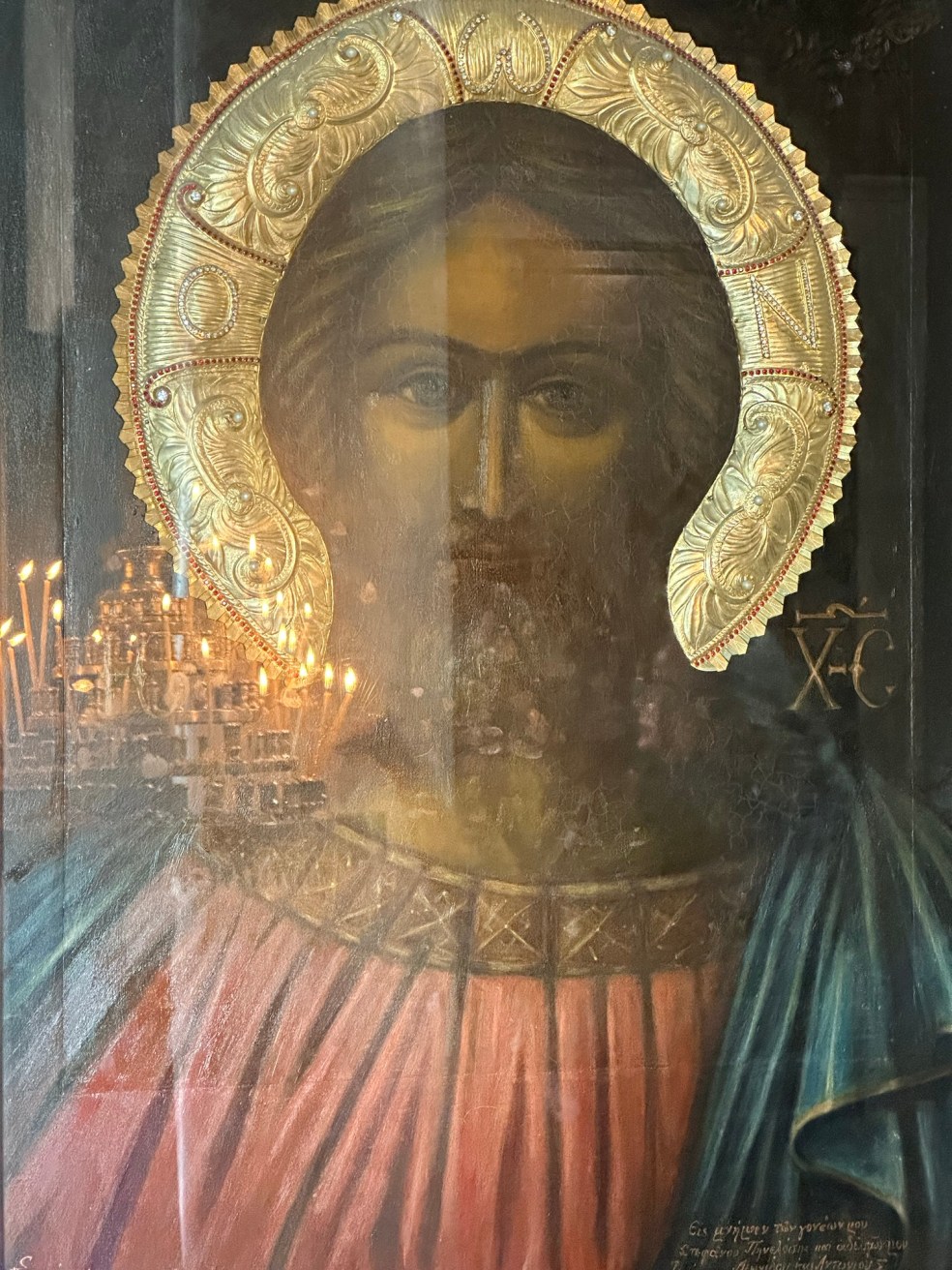
13. O WN

Language is thought made manifest. We are words in a dictionary, responsible for and dependent on others. Christ entered his creation, came through the eye of the needle, in order that we might have the courage and confidence to go in the other direction.

We have now seen a correlation between Christ and the environment we live in, but this should not surprise us if we accept that Christ is the Word and the world was spoken into being.

Christ is the Word. It says in the Christian Creed that all things were made by him, they were spoken into being. So physical matter would seem to be the result of language.

When we speak, we make things manifest in a similar way – our thoughts, our observations, our wishes. So we also turn something that did not exist into physical matter. We are using fragments of the Word to do this, as if the Word had been divided among us (like pieces of bread, or shards of a mirror). But the idea is the same – we make things manifest by using language.

So I would say that we speak Christ. Since there is a striking connection between the words son and sun (they are homophones, they sound the same), I would suggest that we see by him. After all, in John 8:12, he calls himself “the light of the world”. Perhaps this can be understood literally (just as the story of creation in the Book of Genesis is literally a description of speech, or the concept of the Trinity is literally three in ONE).

We speak him, we see by him. We also breathe him if we accept that Christ is the Second Person of the Trinity, O2, the chemical formula for oxygen. When we combine this symbol in reverse with the letter for breath, h, to refer to the Holy Spirit, we get H2O, the chemical formula for water. So we also drink him.

It would seem that our life is completely dependent on Christ, whether or not we believe in him. Enter an Orthodox church and you will most likely see an icon of Christ Pantocrator (“Ruler of All”). In this image, Christ is shown with the beams of the Cross behind him (only three are visible), and in these beams are written the letters O WN.

O WN is Greek for “the being”, which is the translation of the name that God reveals to Moses at the burning bush in Exodus 3:14: I AM. Again, we find here confirmation of the Trinity, because O WN is almost identical to ONE, it’s just that one of the letters has been rotated.

O WN also spells three words in English: own, won and now. Christ claims us as his own; the victory is his, he has won; he is here with us now (the meaning of the name Emmanuel).

I have seen this name written O WH. In Cyrillic, the letter H is pronounced N, and indeed the two letters are very similar (only the crossbar has become slanted). There is also a rough breathing in the original Greek, ὁ ὤν, the reverse apostrophe, which equates to the letter h in English.

If we write the name in this way, then we will see that it spells the words who and how, the result of making the progression AIO from what (A, the letter of creation: “What is this creature?”, “What shall I call it?”) through why (I, the letter of the Fall, an expression of distrust, of disobedience: “Why should I do this?”, “Why should I believe you?”).

Who and how are the questions that we should be asking. What is factual. Why is self-centred. We think that the purpose of life is to amass things and then to share them out, because we were taught at school to count up from 1, to do sums, multiplications and divisions. But actually the answer we are seeking is a person.

Christ gives us the answer to both question words when he says, “I am the way, and the truth, and the life” (Jn 14:6). I am and way are connected if we turn the m upside down and replace the vowel i with its semi-vowel equivalent, y. Both words contain the progression AIW (omega written as w).

We have also seen how when we flee the ego, the I, when we refuse to heed its selfish demands, we automatically create three symbols: A+O, the name of God Alpha and Omega. This can be written A ’N’ O and is found in the conjunction and, the reverse of which is DNA (it is in our DNA to do this). If we write this same progression with the Greek letter for omega, w, we get ANW, which with the w turned upside down gives man. So this denial of the ego, of our innate selfishness, is in the word that describes us (and woman is the same, only it has O3 at the beginning).

The automatic result of turning away from the ego, I, is to say the name of God Alpha and Omega: A+O. By turning away from the ego, we call on him. This is why God and ego are only a step apart in the alphabet (d-e). And him is just I’m with a little breath (h) before it.

This is what makes us human, a combination of hu (Sanskrit for “invoke the gods” and the root of our word “God”) and man – physical beings with the divine spark in them, the potential to become gods by grace if we attend to our true nature, which is not to grab whatever we see out there and to claim it as our own, making a mockery of the divine in us, but to see ourselves as part of the whole, a word in the dictionary, responsible for and dependent on the other. This most ancient way of calling on God – hu – sounds exactly the same as who, the letters we find in Christ’s icon, emphasizing what it is we should be asking.

In the Old Testament, there are two other names of God, apart from I AM. They are YHWH, the Hebrew Tetragrammaton (Yahweh), and El.

YHWH is extremely close to the question word why. So, if we make the progression from I to O, as we did with live-love, sin-son and Christ-cross, opening the line (opening our spiritual Is) to form not a barrier, a wall, but a tunnel that we can walk through, like the proverbial camel through the eye of the needle, just as why gives who, so the name of God in the Old Testament, YHWH, gives O WH, the letters found in Christ’s icon.

And if we place the other name of God from the Old Testament, El, in front of O WH, the two names together spell WHOLE in reverse (keeping the digraph wh together, as we did with earth-three).

This combination YHWH-O WH (why-who) and El-O WH (whole) goes a long way to confirming Christ as the fulfilment of the Old Testament law and prophets. This is why I would say that language is not only Trinitarian (three in ONE), but also Christological.

All physical appearances of God in the Old Testament are said to be by the Logos – that is, Christ – but we are not allowed to touch him. In the New Testament, when he walks among his disciples, eats with them and washes their feet, God himself has entered his creation. He has slipped through the hole – I become O – but in the other direction, so that we will have the courage and confidence to go the other way. This is an extraordinary act of condescension, of coming down to our level, and it was only possible because one of his creatures – namely Mary – acted as a conduit. How else in bodily form do you enter the creation that you have made, if not through one of your creatures?

Jonathan Dunne

Heart of Language 13/15

Next: Heart of Language 14/15

Back to: Contents

3. Human

The elements of speech – breath, water and flesh – are the same elements that are present in the act of creation in the Book of Genesis. The world was spoken into being, which means that we, and the world around us, are a form of language.

Language is made up of three elements: breath, water and flesh.

The first element is breath. Breath forms the basis of all speech. Without breath, you are dead. Breath is represented by the letter h, a letter that is dropped in colloquial speech and silent in some languages, but for me the most important letter in the alphabet:

h   (breath)

The second element is water. This is when we add voice to our breath and form the vowels. Hold a vowel sound for long enough, and water will collect in your mouth. The vowels are listed in the alphabet in the following order: a-e-i-o-u. But this is misleading because the vowel sounds are formed, from the back of the mouth (where language originates), in a different order:

u-o-a-e-i   (water)

Since breath on its own doesn’t make a word (it only expresses exasperation), the first word that the human apparatus is capable of producing is the combination of breath, h, and the first vowel sound to emerge from the throat, u: hu. You might think this is unremarkable, but, as we have seen, hu is Sanskrit for “invoke the gods” and the root of our word God.

So the first utterance we can make by our very nature is to call on God, just as when we move away from the ego and produce the symbols A+O, we say another name of God, Alpha and Omega. While the science of etymology stipulates that human derives from the Latin word for “man”, homo, I would suggest that really it is a combination of hu and man. We are spiritual beings.

The third element of language is flesh. We obstruct the passage of breath with our lips or tongue (our flesh) and produce the consonants, which can be voiced or voiceless. The consonants are divided into phonetic pairs according to where they are produced in the mouth. There are seven simple pairs:

b-p   d-t   f-v   g-k   l-r   m-n   s-z   (flesh)

We see all these elements – breath, water and flesh – in chapters 1 and 2 of the Book of Genesis. Take, for example, Genesis 1:1-2:

In the beginning when God created the heavens and the earth, the earth was a formless void and darkness covered the face of the deep, while a wind from God swept over the face of the waters.

I would suggest that this passage in Genesis is really a description of speech. Or the creation of man in Genesis 2:6-7:

But a stream would rise from the earth, and water the whole face of the ground – then the Lord God formed man from the dust of the ground, and breathed into his nostrils the breath of life; and the man became a living being.

Again, all three elements of language are present, which would suggest that the world was literally spoken into being. This would explain the proximity between space and speak (the letter c, a redundant letter in English, can be pronounced k or s), and also the presence in world of word and lord (the reiterative verse “And God said”).

What is also remarkable is the word these three elements have in common: father. We have seen the phonetic pair f-v, but v is also connected to b and w (think of languages such as modern Greek, Spanish, Latin and German), so through the intermediary of v, I can make the connection f-b/w.

In this way, we see that breath and father have the same letters, water is in father with the addition of h, and flesh is in father with the addition of a (phonetic pair l-r, step in the alphabet s-t).

Father contains speech.

Jonathan Dunne

Heart of Language 3/15

Next: Heart of Language 4/15

Back to: Contents

Theological English (3): The Alphabet

In this fourth video on “Theological English”, Jonathan Dunne looks at the twenty-six letters that make up the Latin alphabet as it is used in English – h, five vowels, three semi-vowels, fourteen consonants, and three “redundant” letters (c, q and x) – and sees how these letters are used to represent the three elements of speech which are also the three elements of creation: breath, water, and flesh.

To access all the videos in this course, use the drop-down menu “Theological English (Video Course)” above. The videos can be watched on Vimeo and YouTube.