Video

Theological English (5): Connections – Same Letters, Different Order

In this sixth video on “Theological English”, Jonathan Dunne continues looking at connections between words in the English language, again using the same letters, but this time changing their order, rearranging the letters. Once we rearrange the letters, sometimes reading the words back to front, we can no longer claim that the connection is because of etymology, the evolution of words over time, with us as the cause of their development. Spiritual meaning is hidden, so in order to discover this meaning we must be willing to make slight changes to the words – changes, however, that always follow a fixed set of rules (phonetics, alphabet, appearance).

To access all the videos in this course, use the drop-down menu “Theological English (Video Course)” above. The videos can be watched on Vimeo and YouTube.

Video

Theological English (4): Connections – Same Letters, Same Order

In this fifth video on “Theological English”, Jonathan Dunne begins to look at word connections in the English language – that is, the spiritual content of language, meaning inside words. Unlike etymology, which is the study of how words have evolved over time, the spiritual content of language hasn’t been put there by us – it is meaning the words themselves contain, whether we like it or not. Hence the spiritual content of language can be said to be “outside” or “behind” time. It is vertical rather than horizontal (“over” time). Here, Jonathan looks at the simplest word connections – connections between words that don’t involve making substantial changes to the letters or their order.

To access all the videos in this course, use the drop-down menu “Theological English (Video Course)” above. The videos can be watched on Vimeo and YouTube.

Theological English (3): The Alphabet

In this fourth video on “Theological English”, Jonathan Dunne looks at the twenty-six letters that make up the Latin alphabet as it is used in English – h, five vowels, three semi-vowels, fourteen consonants, and three “redundant” letters (c, q and x) – and sees how these letters are used to represent the three elements of speech which are also the three elements of creation: breath, water, and flesh.

To access all the videos in this course, use the drop-down menu “Theological English (Video Course)” above. The videos can be watched on Vimeo and YouTube.

Video

Theological English (2): The Holy Trinity

In this third video on “Theological English”, Jonathan Dunne looks at another Christian paradox, the concept of the Holy Trinity – God as “three in one”. How is it possible for God to be three and one? Surely he is one or the other. The answer can be found in language.

To access all the videos in this course, use the drop-down menu “Theological English (Video Course)” above. The videos can be watched on Vimeo and YouTube.

Video

Theological English (1): Away from the Line – AIO

Having looked at the line, which represents the ego in English (I) and the number 1, in this second video on “Theological English”, Jonathan Dunne looks at the three ways of moving away from the line – the triangle, the cross and the circle. Truth is paradoxical, so while a cross represents suffering, it is also a plus-sign. This is the meaning of Christ’s injunction to lose our life in order to find it.

To access all the videos in this course, use the drop-down menu “Theological English (Video Course)” above. The videos can be watched on Vimeo and YouTube.

Video

Theological English (0): The Line

In this first video on “Theological English”, Jonathan Dunne looks at the line, which represents the ego in English (I) and the number 1. Countable nouns are nouns that can have a line drawn around them – a book, a car, a tree. They are accompanied by the indefinite article, a/an. When God made man, he in effect made a countable noun – he drew a line around us and gave us free will. We do the same with products of the earth – we draw a line around them in the form of packaging – but we do this not to give things free will, but to trade in them, to sell them to each other. We appropriate for ourselves the role of author (things begin with us), when in fact we are translators (things pass through us).

To access all the videos in this course, use the drop-down menu “Theological English (Video Course)” above. The videos can be watched on Vimeo and YouTube.

Word in Language (17): Christ the Son of God

After the bread that is destined to become the body of Christ during the Orthodox Liturgy has been cut from the loaves that have been baked for this purpose, the bread that is left over from the loaves is divided into small pieces, blessed by the priest and distributed to the people after the service. This bread is known as antidoron in Greek, meaning ‘instead of the gift’. It is used by those who have received communion to help wash down any remaining traces of the body and blood of Christ, so that they do not remain in the mouth, and is received by those who have not received communion as a substitute – ‘instead of the gift’. One of the subdeacon’s duties is to cut this bread into small pieces so that it can be distributed by the priest.


I serve as a subdeacon in the Orthodox Church, and I often think of this unconsecrated bread as being similar to words, cut from the body of Christ and waiting to be sanctified or not by their use. That is, the words we bandy about in conversation or in writing are small fragments of the Word of God and contain the potential to be used in a sanctifying way, if our intentions are good and our mind is set on God.


It is as if the priest is distributing words to the people, who will then leave the church and go out into the street and use those words in what is hopefully a beneficial way. It is only an image.


But I would like to suggest that words, just like the environment, bear the imprint of the Creator and refer to him. My book Stones Of Ithaca contains numerous examples of stones from the beaches of the Greek island of Ithaca that seem to depict Christian symbols and scenes. Language is the same, and why should we be surprised? Isn’t Christ the Word of God, the Logos? Isn’t it logical, therefore, that he should be present in words? Or that words should speak of him?


I would like to suggest that this is so and we can find proof in language that Christ is the Son of God (and that Mary is his Mother). God is one essence and three hypostases (that is, three persons) – three in ONE. I would like to show how language confirms Christ as the Son.


Let us start with the progression that we saw in the previous two articles, AIO, the progression of the Greek alphabet and of human life. A represents the Creation (described in the first two chapters of the Book of Genesis); I represents the Fall (described in the third chapter of Genesis), the era we live in; and O represents repentance, becoming aware of our sins and turning back to God, the aim of our life on earth.


In the Book of Revelation, at the other end of the Bible, Christ describes himself as ‘the Alpha and the Omega, the first and the last, the beginning and the end’ (Rev 22:13). This is one of his names – Alpha and Omega – and can be written A+O. Now it is curious that the three ways of escaping from the selfish demands of the ego, of moving away from the line that represents the ego in English (I), involve:


– making reference to a third point, God, and forming a triangle (Δ);

– deleting the I and forming a cross (†);

– treating the letter I as a number (1) in order to count down to zero (0).


That is, A+O. Christ’s own name, revealed in the Book of Revelation, indicates to us the path that we must follow. I don’t think any human could have invented this; it must be something contained in language itself.


We saw that A+O is found in the middle conjunction, ‘and’, because if we write ‘and’ using capital letters, we get AND or A ’N’ O. The reverse of AND is DNA, which implies that it is in our make-up to make this progression and to turn to God, away from the ego. Note how GOD and EGO are only a step apart in the alphabet (alphabetical pair d-e).


If we apply this progression AIO to the name of God revealed to Moses at the burning bush in Exodus 3:14, AM, we find that AM becomes I’M becomes OM. I take this last word to be a reference to the Holy Trinity: O3, or three in One. But one of the ways of making word connections is by the addition of letters, and one of the most commonly added letters is h. So another way of moving away from the self-centred demands of the ego that we find in I’M is, instead of making the progression AIO, simply to add h to I’M, which gives us HIM. I understand this to be a reference to Christ. He takes us out of ourselves – actually, in many ways it is the reverse movement: he returns us to ourselves. We turn to HIM and in the act of worship we sing a HYMN (the coincidence between these two homophones HIM and HYMN is found also in LORD and LAUD).


In Matthew 20:28, Christ says to his disciples that the Son of Man – Christ himself – came ‘not to be served but to serve, and to give his life a RANSOM for many’. Again, I think we can find proof for this in language, because if we ignore the first letter of RANSOM (r), we find that the rest of the word contains the name of God in Exodus, AM, and SON. Of course, the letters are jumbled up; spiritual knowledge is always hidden in some way. But it is not difficult to make out. I think the word RANSOM wishes to confirm what the Word is saying, and to confirm who he is: the Son of God.


We find another connection to the name of God in Exodus in John 14:6, where Christ says, ‘I am the way, and the truth, and the life.’ If we write the name of God in Exodus I AM and turn the letter M upside down, we will see a clear similarity between I AM and ‘law’ – the law of the Old Testament, which found its spiritual fulfilment in Christ – and between I AM and ‘way’ (y is the semi-vowel that corresponds to i): I AM – law – way. Language confirms what Christ is saying. This is why he goes on in the same verse to say, ‘No one comes to the Father except through me.’ He is the way to I AM.


We find further proof of this connection between the name of God in Exodus and Christ in the appellation that John the Baptist gives Christ when he sees him approach in John 1:29: Lamb. The word ‘lamb’ (and note that the final letter, b, is silent) contains ‘I am’.


So in ‘way’ and ‘lamb’ we find two clear indications that Christ is the Son of God. Again, I would point out that no human could have invented these words so that they would reproduce the name of God in Exodus, I AM. This has to have come from God, to be ingrained in language, just as we saw AM in the name given to the first human, ADAM (both words contain the first and last letters of the Greek alphabet: AO, or AW if we write omega according to Greek usage).


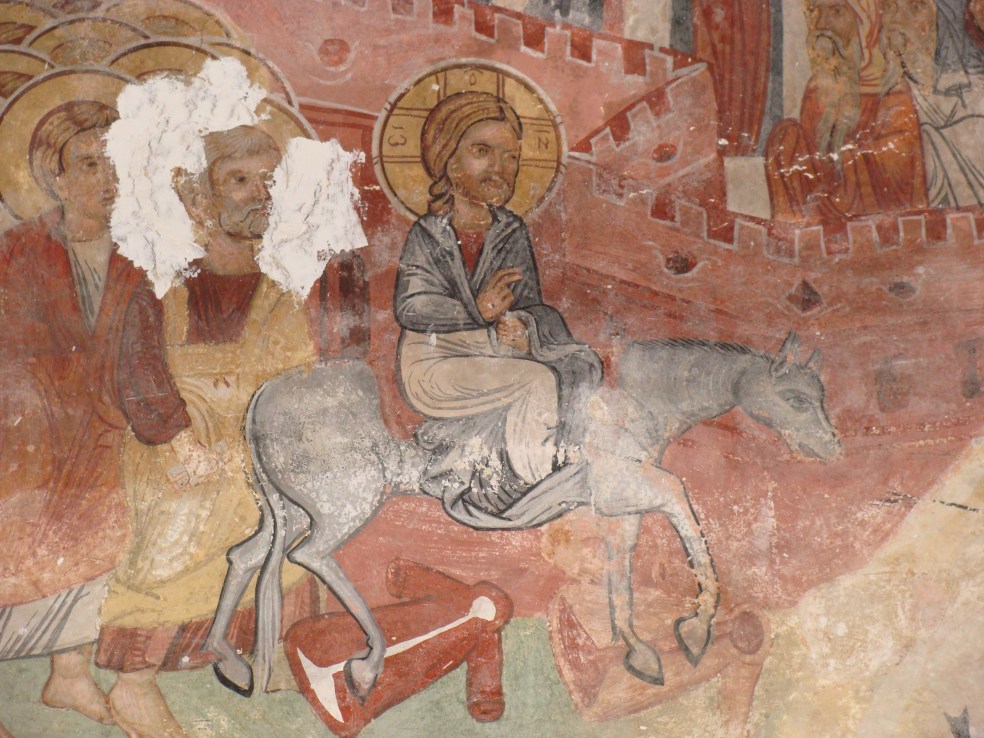
In Orthodox tradition, all appearances of God in the Old Testament are by the Logos, so it is Christ who interacts with Adam and Eve in the Garden of Eve and it is Christ who appears to Moses at the burning bush. For this reason, the Greek Septuagint translation of the name of God in Exodus – O WN – is included in icons of Christ, in the beams of the Cross inside the halo around his head. Search for an icon of Christ Pantocrator, and you will see what I mean.


O WN actually means ‘the being’. That is how the name of God, AM/I AM, is translated into Greek. O WN spells three words in English – OWN, WON and NOW – and it is easy to see the relevance of these words to Christ: he claims us as his own; he has won; he is with us now (Emmanuel).


By rotating the W, we can connect O WN to the number ONE, and I think this is because in his Incarnation, becoming visible to us, Christ represents – follows the will of – the Holy Trinity, three in ONE.


We have seen how these three letters O WN can be written O WH, which spells the question words WHO and HOW. Christ is the answer to both these questions, which we can only ask when we have made the progression AIO. That is, we have gone from asking WHAT in Creation (What is this creature? What should I call it?) to asking WHY (Why should I do this? Why should I believe you?) in the Fall to asking WHO/HOW in a state of repentance. We count down from the ego and realize that the answer we should be seeking is a person, and if you want a person to be the answer to the question you are asking, then the correct question is WHO? This was Pontius Pilate’s mistake when he was standing in front of that very person and asked him, ‘What is truth?’ Truth, he failed to understand, is not a thing, it is a person. The irony of this situation is staggering.


Now WHO sounds the same as HU, which is the root in Sanskrit of our word ‘God’. To show that Christ is the Son of God, the fulfilment of the Old Testament law and prophets, we see that WHO (O WH) is a progression from WHY, which contains the letters of the Hebrew Tetragrammaton: YHWH. And finally if we combine WHO with another name of God in the Old Testament, EL, we find that the two names together spell WHOLE. With the coming of Christ in human form, his birth, teaching, crucifixion, descent into hell and resurrection, we are made WHOLE. We are given that possibility, for our broken form, human nature, to receive wholeness, to return to God. That possibility was not available to us under the Old Law.


In the addition of letters, one of the most commonly added letters is h. Remembering the correlation in phonetics and in the alphabet between v and w, we will then see that WHOLE contains LOVE. It is love that makes us whole, that enables us to enter into relationship. Relationship is intrinsic to the Holy Trinity (there are three persons), and so it is intrinsic to us as well, because we are made in the image and likeness of God (Gen 1:26).


LOVE, by the addition of the same letter h, can be found in OTHER (phonetic pair l-r, alphabetical pair t-v). Love necessarily involves the other, unless all you are going to do is love yourself. I don’t think we are meant to do this. True love – true healing – involves relationship. I am healed by others, by letting them into my life and by revealing myself to them. I have a family, I was lost without them, but that same love – that same self-affirmation (as opposed to the self-destruction brought about by sin) – can be found with a complete stranger if our gaze is at once directed towards each other and towards him (the third point I talked about with reference to the triangle). OTHER is connected to the Greek word for ‘God’, THEOS (alphabetical pair r-s), and this is the meaning of Christ’s saying, ‘Just as you did it to one of the least of these who are members of my family, you did it to me’ (Mt 25:40), but we have lost this meaning. Very often we see our neighbour as a threat to our peace, we turn away from them or eyeball them with aggression. Our lives are separate – we have no common reference. It is a common reference that brings peace.


And LOVE is connected with another word in language, which again goes some way to proving that Christ is God. If we apply the phonetic pairs l-r and v-w and the alphabetical pair d-e to LOVE, we find WORD. We read in 1 John 4:8 that ‘God is love’ – Christ is the Word, and WORD is connected to LOVE, which seems to confirm this.


In the beginning, God the Father created the world through the Son on the basis of the Holy Spirit. Again, we will find confirmation in language because WORLD is a combination of LORD and WORD. We find WORD not only in LOVE, but in the WORLD we inhabit. We also find him in the SUN that illuminates our lives and enables us to grow crops, that is to survive, because there is a clear correlation between SON and SUN. It is the Son who enables us to eat. I am not saying that the Sun is Christ himself, but there is clearly a connection between the two words, which implies a scientific connection as well.


We find confirmation of this connection SON-SUN if we apply the phonetic pair b-p to LAMB, which gives us LAMP. Christ says as much in John 8:12: ‘I am the light of the world.’ Language confirms it. His name confirms it, because CHRIST contains LIGHT (phonetic pairs g-k and l-r, addition of s).


He also enables us to breathe. When we discussed the Trinity as three in ONE, we saw that God the Father is no one (O1), God the Son is oxygen (O2) and God the Holy Spirit is ozone (O3). The Holy Spirit is commonly likened to a wind (a word, by the way, that contains the first four numbers – 0, 1, 2 and 3 – if we rotate two of the letters in WIND) – that is, breath, which is represented in language by the letter h. If we combine this letter for the Holy Spirit, H, and the chemical symbol for oxygen, O2, we get water: H2O. Christ also enables us to drink.


The two chemical symbols combined, O2 and O3, can be found in MOON (again, we need to rotate the letters to get the numbers 2 and 3), so it seems that Christ reflects his own light and enables us to see at night.


Language, and the environment that surrounds us, are permeated by Christ. Look around you, and you will see a million crosses. The Cross is like a stile – it enables us to cross over to the other side, to escape our own isolation, to walk over the line, to make a bridge that will carry us where we want to go. Language will help us. Once we enlist its support, it will provide the content of our prayers – at least until we no longer need words. Language, in this sense, is repetitive. It can be boring, but we are rubbing away the hard outer casing of our hearts, so that we can enter there and find God’s kingdom.


In the end, perhaps the name alone will suffice, coupled with an expression of assent. There is one city in the world that is claimed by the Abrahamic religions: Jerusalem. It was here that Christ’s crucifixion and resurrection took place, and it was not far from here, in Bethlehem, that he was born. This is where Christ taught in the temple when he was only a child and sweated tears of blood in the Garden of Gethsemane prior to his ultimate sacrifice on the Cross.


Take the word JERUSALEM and apply the alphabetical pairs l-m, m-n and r-s. That is, take the letters l, m and r in JERUSALEM and advance one step in the alphabet. What two words do you get? This, for me, is proof that Christ is who he says he is.


Jonathan Dunne, http://www.stonesofithaca.com

Word in Language (11): Father (1)

So now we are diving down into the depths of language and discovering that language has a lot to tell us about the meaning of human life and about the world we live in. We are here to count down from the ego, I, to God, O, as we saw in words like LIVE and LOVE, SIN and SON, CHRIST and CROSS. Christ himself, who is God and has no need to count down, came down to earth so that he could show us how to do this. He came down and was incarnate in order to translate for us the meaning of life. He did this by means of parables, writing for the spiritually blind.


But we have also seen that the world is a spiritual womb in which the body of the Church is being formed until the end of time. Just as we have physical and spiritual blindness, so we have a physical and spiritual birth. Sadly, many of us in this life focus solely on the physical side of things, to the detriment of our spiritual growth. We must open not only our physical eyes, but also our spiritual eyes. This is why ‘I’ and ‘eye’ sound the same. Because an open I is O.


God does not let us dive for too long. We must come back to the surface for air. And just as God separated the waters from the waters in order to create the dome of the sky (Gen 1:6-8), so we see that air is extremely important to us. We started this series of articles by talking about the Coronavirus, which has currently got us practising social distancing, something that was foreign to our way of thinking just a few months ago and is now ‘the new normal’. Viruses make it difficult for us to breathe, they precisely attack our air supply, as if we were divers in the water and our air supply was getting low or the connection with the bottle was faulty. We cannot gulp air as we would like to, and we realize how tenuous our connection to life really is.


The ancients spelled ‘air’ like this: ‘aer’. This is how it is written in Latin and Greek, and I find this extraordinarily significant. Imagine yourself on the surface of the sea, this line in creation where so many creatures live, criss-crossing the line in their search for food or to escape predators. A gentle breeze is ruffling the surface of the water, creating an effect like a desert, like pimpled flesh or a crinkled crisp. Our breathing is shallow, barely noticeable, just enough. We are on the line between two frighteningly different elements. And yet for nine months in our mother’s womb the element of water was normal to us and we breathed.


We have already seen how oxygen is present in water, so they cannot be altogether so different. Indeed, if we apply the alphabetical pair r-s, we will see that AER in reverse reads SEA. Just a step in the alphabet, that line we were talking about, a murmur in the ear (oh, EAR is obviously connected as well).


And we may notice that AER is in WATER if we take away the w and the t, thus confirming what we said about oxygen being in water.


AER is also in BREATH, another of the elements of speech/creation, but where does it come from, this element that we breathe? Where does the wind arise? Where is it when we wait in the heat of the day and it seems to have disappeared? Only the other day, I stood in my room and a cold current of air came in through the window, just like the current you sometimes get in Greek seas (off the west coast of Corfu), chilling your feet, providing welcome refreshment.


I can only assume that air, breath, comes from the Father, who breathed into the newly created human being the breath of life. Isn’t he the source of life, the source of all creation? Wasn’t it the Father who separated the waters from the waters in Genesis chapter 1? Hang on a moment, though, at the beginning of that chapter I remember there was a wind that swept over the face of the waters. Can that wind somehow be connected to the Holy Spirit? On the day of Pentecost, didn’t the Holy Spirit descend ‘like the rush of a violent wind’ (Acts 2:2)? Didn’t Christ himself breathe the Holy Spirit on his disciples (Jn 20:22), not because the Spirit proceeds from him, but because they are both part of the Holy Trinity and their lives are intertwined? WIND contains the numbers 0, 1, 2, 3 – a reflection of the Holy Trinity, which can also be found in words like GOD, WOOD and ONE.


But AER is in other words as well, for example FEAR. When fear assails us, we find it difficult to breathe, our breathing becomes rapid, we hyperventilate. What is fear? Well, it can be unfounded when it relates to our predictions for the future. In fact, I would say it generally is unfounded. And yet it can have a profound effect on our behaviour and make us RAGE (alphabetical pair f-g). Another kind of FEAR is SAFE (alphabetical pair r-s), the fear that makes us cling to our Father, what Metropolitan Athanasios of Limassol describes as awe, love and reverence in our hearts.


And what is it that pumps the air, the oxygen, around our bodies? The organ called the HEART. AER is there also. If our heart stops, so does our air supply, just like divers in the water (though there is AER in WATER as well). We saw that HEART is connected with EARTH, and I would say that AER is the main characteristic that we associate with the earth – the ability to breathe.


We are beginning to see that AER is a crucial component of language. It is in SEA and WATER, it is in BREATH (which as the letter h is also in water or its chemical formula H2O), it is in FEAR and HEART (see how these two words are connected – isn’t this where we feel fear most keenly, when it strikes dread into our hearts?).


But interestingly enough we cannot only live by breathing. We must also eat: BREAD. When we are babies, we are reliant on our mother’s milk, which fills our bellies and provides us with protection: BREAST. BREATH-BREAD-BREAST. All three words contain AER and are sources of nourishment. How curious that they should be so similar!


BREAD is connected to WATER by the phonetic pair d-t and the ‘eighth’ phonetic pair, b-v-w, which we talked about at the end of the previous article.


And ‘breath’, if we apply the physical pair b-d, gives ‘thread’. Breath is like a thread, the thread that the Fates are waiting to snip. It is air – isn’t it? – that provides the continuum to our lives. We are alive inasmuch as we are breathing. This is why we can see that ‘breath’ is connected to ‘birth’ if I use the front vowels (a-e-i), but also to ‘death’ if I use the physical pair b-d and remove the r.


Breath is the thread that links birth and death. All this information is contained in language.


I open my mouth. Breath emerges from my mouth. God knows where it has come from. If I add voice, I can speak. I can imitate the Father in the act of creation (CREATE also contains AER). After all, I am made in his image and likeness (Gen 1:26).


There is the Father again, the source of all things, who begat the Son, who gives rise to the Spirit, who created us human beings and all that we can see (and cannot see).


He emerges from the shadows ‘at the time of the evening breeze’. There is AER in him as well. AER is in FATHER, just as BREATH is, EARTH and HEART, FEAR (FAITH) and WATER.


Air carries water; air is in water. We associate air with the letter h, but also with oxygen (O2). Perhaps that dividing line is thinner than we thought. Certainly creatures like gannets and flying fish think so.


Jonathan Dunne, http://www.stonesofithaca.com
Word in Language (10): Father (0)

What do we know about the Father? Perhaps we know about him as much as our ability to love. He is generally portrayed as an old man with white hair and a white beard, next to his Son, with the Holy Spirit hovering above. We may associate him in particular with the act of creation and the Fall in chapters 1-3 of the Book of Genesis. According to Orthodox tradition, all appearances of God in the Old Testament are by the Logos, the Word of God, that is Jesus Christ. The New Testament is associated with the earthly life of Christ, his birth, teaching, crucifixion and resurrection. And the Holy Spirit is associated with Pentecost, the beginnings of the Church. The Father can remain in the background. Certainly, we cannot know his essence, and of God’s qualities St Maximos the Confessor says that it is only infinity that can be grasped fully by the intellect (see the end of his First Century on Love).


In an earlier article, I made the connection between TREE and THREE and put forward the analogy of the Father as the trunk and the Son and the Holy Spirit as two branches, as in a child’s drawing, the Son begotten and the Spirit proceeding. This is why in the Orthodox Creed it is said that the Spirit proceeds from the Father – not from the Father and the Son, as is erroneously stated in Western Churches – because otherwise the Spirit would have to be a sub-branch of the Son, making for a lopsided drawing. This doesn’t make sense.


Christianity is the only religion that professes God the Trinity: Father, Son and Holy Spirit. This is shared love, which crucially involves a third person, otherwise it could be construed as being exclusive. This love among the three persons is not jealous. It is like love in a monastic community – it professes love for the brethren, but also welcomes pilgrims, newcomers. The arrival of newcomers can be very unsettling, but somehow we have to find a place for them, to see that our reaction is immediately, naturally, spontaneously, one of love.


You cannot have the Father without having a Son. His first characteristic is that of being a Father, which immediately places emphasis on relationship. The Holy Spirit can be seen as a kind of conjunction – and – that welds the love together. I have already stated that this little conjunction, AND, contains the name Alpha and Omega (A ’N’ O) and spells DNA in reverse. It is a crucial word in language, and barely a sentence exists without it.


I would like to suggest that there is proof in language for the existence of the Father. This doesn’t surprise me, for from him all things come. The Son is begotten by the Father, the Spirit proceeds from the Father, and we are his creation. We saw in the previous article how the world is a kind of spiritual womb, from which the body of the Church is in the process of being born. We make the mistake of thinking that life in this world is all there is and our birth has already taken place, but I don’t think this is quite true – our physical birth has taken place, sure enough, but our collective spiritual birth is still happening, which is why for me St Paul writes, ‘We know that the whole creation has been groaning in labour pains until now’ (Rom 8:22).


The first indication that the Father is who we understand him to be – the source of all life – can be found in the alphabet. But we should sound a note of caution: if we can find proof for the existence of the Father in language, shouldn’t that point us in the direction of the Holy Trinity? Shouldn’t that suggest that the Father is truly behind and in his creation, just as we make him out to be? How else could he be in language, a set of words we ourselves have come up with in order to communicate, a set of letters which we use to write these words down? This should give us pause for thought – if we can find proof for him in language.


Language is made up of three elements. The first of these is breath. Breath forms the basis of all language. There can be no language without breath. Without breath, we are in effect dead, and we are not going to communicate by means of our bodies. Breath is represented in the alphabet by the letter h, a very important letter since it represents the basis of all speech, and yet (or because of this) it is dropped in dialects like Cockney and not pronounced in languages like Spanish. That for me is a sure sign of its importance.


If all we do is huff and puff, we are not going to make much sense, and so, as anyone who has been present at a childbirth knows, the next thing that comes along is voice, the vowels. We breathe out (the baby breathes out) and add voice (the baby bawls – loudly), and now we have sound. We also have words – words like a, I and o! We can even put a vowel before breath and exclaim, ‘Ah!’ We have the beginnings of speech.


If we hold a vowel for long enough, as when we visit the doctor’s, water will collect in our mouth, and this is because vowels are like a river – they flow. We can see that FLOW and VOWEL are connected by the phonetic pair f-v, addition of e. But the vowels do not emerge from our throat, where language originates, in the same order that they appear in the alphabet. Actually, they emerge in the following order, from the back of the mouth to the front:


u – o – a – e – i


forming a V-shape as they do so. This means that the first word the human apparatus is capable of pronouncing is breath (h) plus the first vowel to emerge from the throat (u): hu (I am assuming that breath on its own does not constitute a word, which I don’t think it does).


You might wonder, ‘So what?’ Well, this little word hu is from Sanskrit and means ‘invoke the gods’. So the first word a human is capable of pronouncing is an invocation of God. It is also the root of our word God, as any good dictionary will tell you. This is extremely interesting, but it doesn’t stop there.


Have you noticed that we are human? The science of etymology, which studies the evolution of language over time and, like all science, is limited in its vision (only faith is not limited, which is why we need it), will tell you that human derives from the Latin word for ‘man’, homo. Yes, maybe. But word connections – which are the study of language outside time, and hence far more interesting – will enable us to see that HUMAN is a combination of HU and MAN. It seems that God stamped us with his seal when he made us. We have already seen how MAN contains AM and AN.


But we still haven’t seen any proof for the Father. Let us continue. If all we had was breath and water, h and the vowels, we would do a lot of whining and exclaiming (some people do that, it is true). But to form words, real words, we need to obstruct the passage of air with our lips and tongue to form the consonants. Now we get proper chunky words. The consonants, as I have explained, can be divided into seven phonetic pairs:


b-p     d-t     f-v     g-k     l-r     m-n     s-z


depending on where in the mouth they are pronounced and which piece of flesh – the lips or tongue – is used to obstruct the passage of air when they are pronounced.


That accounts for twenty letters, but the English alphabet has twenty-six. Three of the remaining letters are semi-vowels – that is, the passage of air is only partially obstructed. The semi-vowels j and y correspond to the vowel i; the semi-vowel w corresponds to u (think of the name of the letter).


And the other three are what I call redundant letters. We don’t need them. They are c, q and x, all of which can be written using a combination of the letters k and s: the letter c is pronounced either k or s, q is pronounced k and x is pronounced ks. And yet they serve a purpose, because the double pronunciation of c as k/s enables me to make word connections through both these letters (we will see an example in a moment).


That accounts for the whole of the English alphabet: h, five vowels, seven pairs of consonants, three semi-vowels and three redundant letters. The letter h corresponds to breath, the vowels to water and the consonants to flesh.


What is very interesting is that the exact same three elements – breath, water and flesh – correspond to the act of creation in chapters 1 and 2 of Genesis. Remember that a wind (breath) swept over the face of the waters (Gen 1:2). Remember that to form the sky (air/breath) God separated the waters from the waters (water) (Gen 1:6-8). Remember that God then gathered the waters under the sky into one place and formed the land (flesh) (Gen 1:9-11). Remember that man was formed from the dust of the ground (flesh) (Gen 2:7) and God then breathed into his nostrils the breath of life (breath).


So the same three elements of breath, water and flesh are involved in the creation. But why should we be surprised, given that we know that God spoke the world into being? Doesn’t almost every paragraph in Genesis chapter 1 begin, ‘And God said’?


Do you remember how the letter c can be pronounced k or s? We might now see a connection between SPACE and SPEAK.


We might also see that WORLD contains LORD and WORD. The WORLD is a combination of LORD AND WORD:


world = lord + word


Hence those three words that are constantly repeated in Genesis: ‘And God said.’


But we still haven’t found proof for the existence of the Father in language. You need to know that there is an ‘eighth’ phonetic pair (and it isn’t even a pair): b-v-w. These letters are closely related. In Modern Greek, b is pronounced v; in Spanish, v is pronounced b. In Latin, v is pronounced w; in German, w is pronounced v. This enables me, through v, to connect b/w with f (the partner of v according to the phonetic pairs), and many word connections are made using this combination.


Now we will begin to see that the three elements of breath, water and flesh – the elements that make up speech, a daily occurrence, and also the creation of the world we inhabit – have one word in common. I am not making this up because I am obeying phonetic rules, so it is in language (not in my imagination!).


BREATH is clearly connected to FATHER by this combination I talked about, f-b/w.


WATER is clearly connected to FATHER by the same combination, f-b/w, addition of h (one of the two most commonly added letters).


FLESH is clearly connected to FATHER by the phonetic pair l-r, the alphabetical pair s-t, addition of a.


The elements of speech and creation have the word FATHER in common. That is remarkable and ought to make us bow our heads in worship. The next time we open our mouths to speak, we might be a little more respectful of what we are doing and remember how the Father is in the elements of speech, in our very human being.


Jonathan Dunne, http://www.stonesofithaca.com