15. Atom

Christ became human so that he might translate for us the meaning of life through parables (Braille, writing for the spiritually blind), but also so that he might translate us when we die. The process of translation, when a word in one language disappears in the translator’s mind in order to reappear in another language, can be likened to death, when someone disappears and is spoken into the language of eternity.

Christ became man in order to show us the road to salvation. He entered his own creation through one of his creatures, Mary. He came to translate for us the meaning of life, because we were at a loss and it needed explaining. He did this by means of parables. We have seen examples. Parable is connected to Braille through the phonetic pair b-p – it is writing for the spiritually blind, for those whose spiritual eyes have not been opened.

But I believe that there is another reason for God to become human, to enter his creation. God is the Author, the source of all that is. We are not the Author, much as we would like to be, because we cannot create out of nothing. We need what already exists, and our purpose is to take this and to turn it into something better, to translate it, just as the translator of a text takes a text written in one language and converts it into another through an unseen, and highly spiritual, process that takes place in the person’s mind as they are translating.

When we are translating a text, there is a point, once we have understood the original (read it, looked up any words we do not know, consulted with the writer or an expert in their work, all the horizontal work of preparation), when the original disappears, it evaporates, the words dissipate, the letters fade away, and out of the translator’s mind, through their fingers as they type on the keyboard, appear new words, words written in another language.

That momentary disappearance, that disembodiment, can be likened to the process of human death. We also seem to disappear, our bodies are put in the ground, and we are no longer seen. We also evanesce, cease to be discernible by the five senses. But in whose mind are we?

I think that Christ became man not only to translate for us the meaning of life by means of parables and his example, but also literally so that he could translate us at our death. An author is the source. A translator acts as a conduit, just as the Virgin Mary did when she acquiesced to bear Jesus in her womb. By becoming human, Christ became the Translator.

We are a text being written. Everything we do in this life takes us in a certain direction. And when we reach the end of our lives, we will be spoken, having been taken up into the mind of the Translator. We will be freed of the constraints of time, and we will enter eternity, the white page on which words are written.

This is why eternal gives two connections. For the first, we must take a step in the alphabet, e-f, and use two pairs of letters that look alike, i-l and n-h (one is an extension of the other). In this way, eternal gives father and I:

eternal = father + I

I think this is because, once we have been spoken, we will have left the speaker’s mouth and be able to see him.

It also spells I am free (phonetic pair m-n, pairs of letters that look alike, i-l and f-t):

eternal = I am free

We will be free of corruption, of the bondage to sin, free to express ourselves without fear (free – the fine line between fear of God and the fire of purification, if we allow fluidity to the vowels; the good news is that it lasts for ever, f-v).

Language contains hidden meaning. The whole of human existence is contained within it. We haven’t realized this. We treat language like an external object, a tool. We use words to bash people on the heads and also to caress them. But we haven’t realized that we ourselves are language, words in the making, spoken into being – breath, water and flesh; h, vowels and consonants – just as we read in the first two chapters of Genesis.

Language tells us the road that we must follow. Christ is very clear about this when he says to his disciples, “If any want to become my followers, let them deny themselves and take up their cross and follow me” (Mt 16:24). This is the way to eternal life, but it passes through denying the ego, drawing a line through the I, which forms a cross, †, but also a plus-sign, + (the meaning of losing our life in order to find it).

We have seen the three ways of moving away from the line by forming a triangle, the letter A, by deleting the I, +, and by treating the line as a number and counting down to O: A+O. These three symbols spell the name of God Alpha and Omega. As soon as we turn our backs on the ego, we turn to God. They are also found in the middle conjunction, and, if we write it with capital letters: AND (A ’N’ O). The reverse of and is DNA – it is in our DNA to do this, to move away from the line, to follow the progression of the Greek alphabet, AIO or AIW.

And when we draw a line through the ego, when we make the sign of the cross (a cross is a deleted I), something extraordinary happens. The progression of the Greek alphabet, with the ego deleted, spells A+O/W (depending on which letter we use to depict omega, a long o or w).

We effect a change at molecular level – the “living water” Christ was talking about, a change of heart, literally, at a level we cannot normally see – because this progression is contained in the word atom, traditionally the smallest particle of matter.

There is a clear connection between language and the environment: seed-root-tree-fruit. A tree that branches out is like a flowering ego, it is no longer a straight line. There is a clear connection between language and the history of the world, from the creation in the Book of Genesis to the Last Judgement, when angels will come to glean the field. And just as we plant a seed outside (as the Samaritan woman fetches water from the well in a bucket), so we must hear the Word of God and plant a seed in our heart.

The one will feed our stomach. The other will give us wings, and change our perception for ever.

Jonathan Dunne

Heart of Language 15/15

Back to: Contents

See also: Theological English (video course); Word in Language (series of articles)

14. Mary

The Virgin Mary is often referred to as the New Eve because of her role in the economy of salvation. We learn in Genesis that Adam called his wife Eve “because she was the mother of all who live”, since in Hebrew the name Eve resembles the word for “living”; if we apply the phonetic pair l-r, we will see that there is a connection between “living” and “Virgin”, which confirms the link between them.

I have the utmost veneration for Mary, the Mother of God. There is no one else through whom I would rather be saved. As part of God’s creation, she also responds to language in the most extraordinary way.

The rules that I have expounded in these short texts for unearthing spiritual meaning are very simple. We may rearrange the letters. We may change the vowels, which are water, by allowing them to flow (a-e, earth-three). We may replace the vowel i with its semi-vowel equivalent, y (think of try and tried). When we get to the flesh of language, the consonants, we must be familiar with the seven simple pairs, pairs of consonants such as f-v and l-r that are pronounced in the same part of the mouth (often one is voiced, the other is voiceless). We may replace the redundant letter c with either of the ways it is pronounced, k and s (think of a word like Pacific).We may take a step in the alphabet (d-e, God-ego; f-g, father-gather), turn a letter upside down (m-w, I am-way) or back to front (b-d, birth-third), or lengthen it (v-y, Eve-eye). And this is the way we will enter the spiritual edifice of the language we speak.

Look at Mary. Replace the y with i, and tell me what you can see.

Mary contains the name that God reveals to Moses at the burning bush in Exodus 3:14, I AM, in reverse, with the addition of the letter r. So it is clear that she has the divine in her.

And what if we double the r? We get marry. For her to give birth to the Son of God, was it not necessary for there to be a marriage of wills, as well as the overshadowing of the Holy Spirit that made the incarnation possible?

I AM-Mary-marry

She is the Mother of God. If we treat letters like reels in a slot machine and press the button, allowing the letters to spin according to their order in the alphabet, we will see that mother spells her son (m-n, s-t). The archetypal Mother, the Mother of us all, gave birth to her son in the flesh, Jesus Christ.

mother-her son

Jesus Christ was the Messiah, the long-awaited one, the one who would come to free us from bondage, except that he didn’t do this with physical weapons (remember the well and the bucket). The change he effects takes place within us, but it is no less visible for that. It’s just that if you’re expecting fireworks, flashing lights and earth tremors, you might not get them. Or you will, but not in the way you expect, and over a longer period.

Messiah. Can the word tell us anything? Does the word Messiah not contain I AM and she? Is this not confirmation of Mary’s role in the incarnation?

Messiah = I AM + she

We refer to her as “maid” and “lady”, two words that clearly contain the progression of the Greek alphabet, AIO (AIW).

But she is best known as the Virgin Mary.

Do you remember what Jesus said to the Samaritan woman in John, chapter 4, about asking him and receiving “living water” – not visible water that can only be retrieved by means of a physical bucket, but water that will flow “out of the believer’s heart” (Jn 7:38), becoming “a spring of water gushing up to eternal life”? This “living water” is not one that satisfies our physical needs momentarily, it restores us to ourselves, reminding us that we are eternal beings in physical bodies. If we believe – and when did anyone achieve anything without believing in what they were doing? – we will inherit eternal life. The word we have been in this earthly life, the sum of our acts and intentions, will be spoken.

Living water. Virgin Mary (l-r). The two words are connected, and this is because the Virgin Mary is the second Eve. Being a virgin and giving birth is what sets her apart from God’s other creatures; virgin harks back to the name of Eve in Genesis 3:20, “because she was the mother of all who live”, resembling as it does the Hebrew word for living.

Language, it seems, is also Marian.

Jonathan Dunne

Heart of Language 14/15

Next: Heart of Language 15/15

Back to: Contents

11. Believe

Belief activates the spiritual senses and enables us to see. St Paul talks in his Letter to the Romans about justification by faith. Grace is freely given, we cannot earn it. All that Jesus requires of us is that we believe in him.

What we do not see, we have to believe. And paradoxically, it is the act of believing that then enables us to see, when our spiritual understanding is unlocked and our spiritual senses are awakened. Believe in order to see. What the Pharisees (Pharisee = far I see, or so they think!) wanted was to see in order to believe. In Matthew 16:4, when asked to show them a sign from heaven, Jesus gave them short shrift: “An evil and adulterous generation asks for a sign, but no sign will be given to it except the sign of Jonah” (see how closely the word sign is connected to sin, addition of g).

Belief activates our spiritual senses and enables us to see beyond the mere appearance of things. This is why, I think, the word believe so obviously contains be and live. We become fully alive when our vision is not limited to seeing what will satisfy our physical needs.

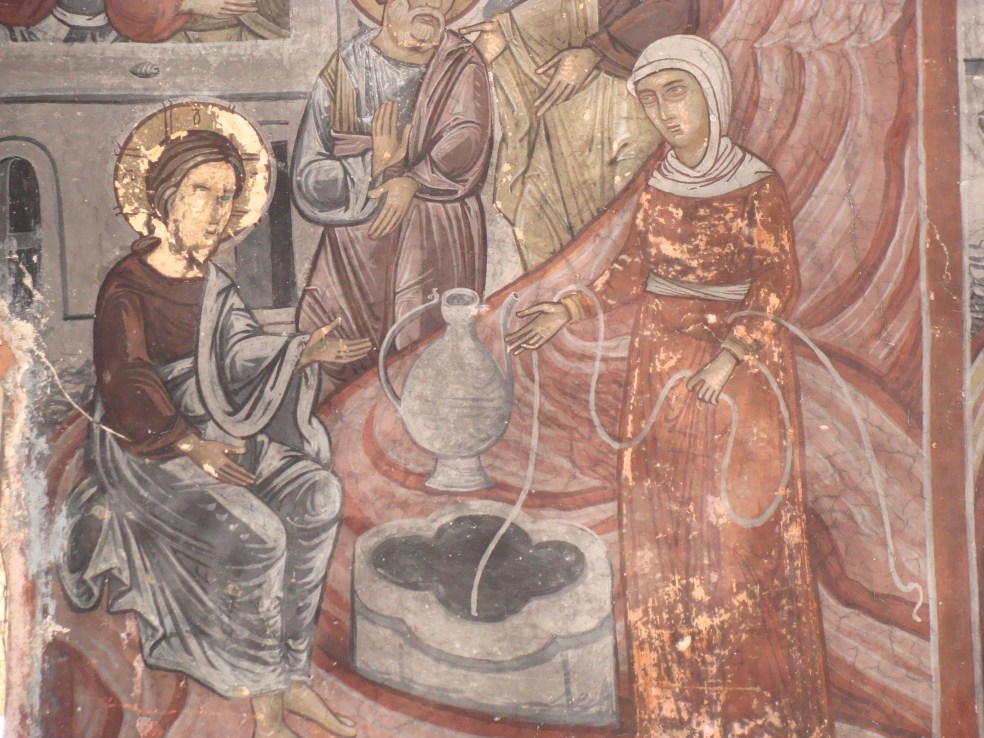
This is the reason for the break-down in communication during the wonderful encounter between Jesus and the Samaritan woman at the well in John, chapter 4. When Jesus says if she knew who she was talking to, she would ask him and he would give her “living water”, the woman is perplexed. She doesn’t realize that Jesus is talking about spiritual sustenance – not physical sustenance, which always requires us to come back for more (something the system knows and relies on for its continued existence).

He doesn’t even have a bucket (again, this reliance on external objects, objects we can pick up and use), how is he going to give her this living water? Jesus replies, “Everyone who drinks of this water will be thirsty again, but those who drink of the water that I will give them [what he means is those who put their trust in him] will never be thirsty. The water that I will give will become in them a spring of water gushing up to eternal life.”

These are extremely important verses. “A spring of water gushing up to eternal life.” Now, that is surely something worth having. We know that when we drink water from the well, we will be thirsty again, and so we are tied to it, to something external. But what Jesus is talking about appears to be something that comes from within us: “The water that I will give will become in them a spring of water gushing up to eternal life.” It is something whose provenance we cannot perceive.

I think he is talking about belief. The bucket that will enable us to receive this living water is belief. It is all that Jesus requires of us – that we believe in him (even though we do not see him with our physical senses). He wants us to see/hear the message that he is transmitting and to plant the seed of that message in the earth of our heart (the soil of our soul). We are to become like the seed of an apple, which falls into the ground and sleeps for a while before bursting forth anew as a shoot that, in time and with proper care, will grow into a tree, as language tells us.

And so it is that three chapters later – in John, chapter 7 – Jesus decides to attend the Festival of Booths in Jerusalem. The message – about doing the will of God, about doing good and healing people, even if it is on the Sabbath – doesn’t seem to be getting across. When he says that he won’t be with them for long (because he is going to be crucified!!!), they understand he is planning a visit to Greece. It comes to the last day of the festival, and Jesus is feeling pretty frustrated. He cries out, “Let anyone who is thirsty come to me, and let the one who believes in me drink. As the scripture has said, ‘Out of the believer’s heart shall flow rivers of living water’” (Jn 7:37-8).

There it is again – that phrase “living water”. It means that when we believe in him, our life will take on new meaning, we will no longer be limited by the parameters of time, we will be working on a different timescale, or actually on no timescale at all. We will be diving into the white spaces between and behind the words on a page and finding new meaning. We will be entering the words themselves, admiring their structure, as if a word was a church and we could enter it, light a candle, look up into the dome, and even walk around the church three times on Easter Eve, before the light of the resurrection has dawned. We will begin to bear spiritual fruit, not just physical fruit we can eat, touch and confirm, but the fruit of obedience, which is not to put ourselves first in a world of competing egos, but to seek the common good, which might even involve some kind of personal sacrifice, but is incomparably richer and leads to true wealth (the wheat in the Parable of the Tares, which has ears and can hear). This “living water” can only come out of a believer’s heart, of a heart that is open, of a heart that is alive and beating, not one that is closed and withered, that only thinks about itself.

Jesus quotes scripture: “Out of the believer’s heart shall flow rivers of living water.” Except that the word in Greek is not “heart”, it is “belly” (κοιλία). In Genesis 3:20, we learn that Adam named his wife Eve “because she was the mother of all who live”. This is explained by a footnote in the NRSV Bible: “In Heb Eve resembles the word for living.”

So, the verse Jesus quotes could be reduced to belly (“Out of the believer’s heart”) and Eve (“shall flow rivers of living water”). And what do belly and Eve give us? Believe.

Jesus’ message – that all we need to do is believe to become fully alive, to be and live – is contained in the words he speaks. Language is pure theology, a vade mecum for the human who seeks a higher meaning. We just have to have the eyes to see it.

Jonathan Dunne

Heart of Language 11/15

Next: Heart of Language 12/15

Back to: Contents

Word in Language (20): Believe

I have always been confused whether we are supposed to receive a sign and then believe, or to believe and then receive a sign as a result of our belief, a confirmation, as it were. That is, does God open the doors of our senses to the other world, we perceive the other world and therefore believe, or does he open the doors of our senses as a result of our belief? Is it possible to believe something (or someone) you have never seen?

What set me on the journey of faith was an experience I had in 2001 on the island of Procida in the Bay of Naples, Italy. I asked for a sign and I got one. So in a way my belief was a result of the sign I received. But that sign came about because I asked for it, so I was predisposed, I had realized the limitations of my self, my need for the other, I had pulled down the walls of my self-sufficiency, thrown open the gates, invited God in. Is this, therefore, the procession of faith: an understanding of our own limitations leads to a call to God, which leads to a response on his part, which leads to faith on ours?

BELIEVE itself is a very interesting word. It spells VEILED in reverse (remember the physical pair, pair of letters that look alike, b-d, one of which is a mirror image of the other). Well, the mysteries are veiled, aren’t they? We don’t see them at once, but they reveal themselves to us gradually, in response to the level of our faith and repentance.

But BELIEVE contains another word: if we take a step in the alphabet (b-c) and apply the phonetic pair l-r, we get RECEIVE. Christ said to his disciples, ‘Truly I tell you, there is no one who has left house or brothers or sisters or mother or father or children or fields, for my sake and for the sake of the good news, who will not receive a hundredfold now in this age – houses, brothers and sisters, mothers and children, and fields, with persecutions – and in the age to come eternal life’ (Mk 10:29-30). So when we believe, when we follow Christ, we are to receive a hundredfold – the blessings of the spiritual life – with persecution – the world no longer recognizes us as one of its own because we have switched allegiance – and the ultimate goal is eternal life.

John the Evangelist has a lot to say about belief and eternal life in his Gospel. It is clear that the precondition for eternal life is that we believe. In fact, belief is the work of God – not to build mansions, not to perform impossible feats, not to exert ourselves strenuously, but simply to believe! The crowd has witnessed the feeding of the five thousand on the other side of the Sea of Galilee. Christ’s disciples have returned to Capernaum in the only boat available. Christ did not leave with them, and yet when they wake up, they see that he is not there. They take some boats that have come from Tiberias and travel to the other side, only to find that Christ is already there, having walked on the water. How has he got there? Christ says they have come looking for him because they had their fill of loaves the previous day and it is this that motivates them. He endeavours to redirect their aspirations and when they ask, ‘What must we do to perform the works of God?’, he comes out with a strikingly simple statement: ‘This is the work of God, that you believe in him whom he has sent’ (Jn 6:29) – that is, that you believe in me. Well, that’s not much to do, is it?

But the crowd immediately asks for a sign: ‘What sign are you going to give us then, so that we may see it and believe you?’ There we go again, the need for a sign to trigger our belief.

The first chapters of John’s Gospel are full of people like us looking for signs. In chapter 1, Nathanael believes because Christ saw him under the fig tree. In chapter 2, in Jerusalem, ‘many believed in his name because they saw the signs that he was doing’ (Jn 2:23). In chapter 4, Jesus says to the royal official whose son lay ill in Capernaum and to those with him, ‘Unless you see signs and wonders you will not believe’ (Jn 4:48), though to his credit the royal official believes before he has actually witnessed the miracle. When Christ says, ‘Go; your son will live’, crucially he believes the word that Christ has spoken, even though he has yet to receive confirmation of the healing. The Church Fathers are always telling us when we ask for something – from God or the saints – we must ask with faith in our hearts, in the belief that what we ask for, if it is for our salvation, will come to pass. It’s no use asking half-heartedly. Extreme circumstances call for extreme measures, and for the royal official whose son lay ill in Capernaum, this was an extreme situation. So he believed. With all his heart. This is all Christ asks of us. As a result of the healing (a sign or wonder), it then says that the royal official ‘himself believed, along with his whole household’ (Jn 4:53). Belief leads to healing, which in turn leads to more generalized belief.

In chapter 6, ‘a large crowd kept following him, because they saw the signs that he was doing for the sick’ (Jn 6:2). Again, a sign triggers belief. After the feeding of the five thousand, ‘when the people saw the sign that he had done, they began to say, “This is indeed the prophet who is to come into the world”’ (Jn 6:14). A sign leads to belief. Even Christ’s disciples, after the miracle of the transformation of water into wine at the wedding in Cana, then believed: ‘Jesus did this, the first of his signs, in Cana of Galilee, and revealed his glory; and his disciples believed in him’ (Jn 2:11).

So it seems that we are only persuaded as a result of signs, an accusation Christ was often levelling at the Pharisees. But what does he say we are to do? I think he understands our weakness and accepts that we need to see a sign in order to believe. But, when it comes down to it, what we are to do is to believe his testimony. He does not testify on his own behalf – this point is reiterated several times in the first chapters of John’s Gospel – but rather he testifies to his Father, and it is his Father – together with John the Baptist in chapter 1, the Samaritan woman in chapter 4 and the scriptures in chapter 5 – who testify to him. There is a wonderful altruism here. We are to believe him because he does not testify to himself, but to the other, and this we can take as a confirmation of what he is saying.

The point is heavily emphasised. Just perform a search of the words ‘testify’ and ‘testimony’ in the early chapters of John’s Gospel. You might also perform a search of the word ‘believe’. These are probably the most important words, together with ‘water’, ‘bread’ and ‘eternal life’.

It is belief that leads to eternal life:

And just as Moses lifted up the serpent in the wilderness, so must the Son of Man be lifted up, that whoever believes in him may have eternal life. (Jn 3:14)

Whoever believes in the Son has eternal life. (Jn 3:36)

Anyone who hears my word and believes him who sent me has eternal life. (Jn 5:24)

Those who hear will live. (Jn 5:25)

This is indeed the will of my Father, that all who see the Son and believe in him may have eternal life. (Jn 6:40)

Whoever believes has eternal life. (Jn 6:47)

It would be difficult to make the point more emphatically. But there are two other things that will lead us in the direction of eternal life: WATER and BREAD. These two words are, of course, connected if we apply the phonetic pairs d-t and b-v-w. BREAD is one of three words that refer to nourishment, all beginning with the same letters: BREAD, BREAST and BREATH. They are all connected by the phonetic pair d-t, addition of s or h. And WATER is a short step from WORD (phonetic pair d-t, change of vowels, all of which are open).

We come across the first in the wonderful story of the Samaritan woman at the well. This woman is very striking. She has had five husbands for a start. She also has a pithy way about her, asking Christ (the Creator of the universe!) how he thinks he is going to manage to pull up some water from the well where they meet near the city of Sychar if he doesn’t have a bucket! This is the man who created the universe, through whom the world was brought into being, and all she can do is affirm that he doesn’t have a bucket and he must think he is clever or something if he thinks he’ll get some water out of the hole without one.

Christ observes (as always), enjoys the humour (as always) and then comes straight to the point: ‘Everyone who drinks of this water will be thirsty again, but those who drink of the water that I will give them will never be thirsty. The water that I will give will become in them a spring of water gushing up to eternal life’ (Jn 4:13-4). He refers to this as ‘living water’ (Jn 4:10).

The ‘living bread’ comes in chapter 6. Remember that rousing hymn ‘Guide Me, O Thou Great Redeemer’, in which the words ‘bread of heaven’ are repeated? The crowd who witnessed the feeding of the five thousand and followed Jesus across the lake have made reference to the manna their ancestors ate in the wilderness. Now that was a pretty impressive sign, wasn’t it? How about something similar? They want a corresponding sign without realizing (like Pilate when he asked Christ, ‘What is truth?’) that the sign (truth) is standing in front of them. To which Christ replies, ‘I am the bread of life.’ That bread is his flesh, the sign is himself, the body of Christ that we receive in communion. He doesn’t magic manna out of thin air. No, this is different. We partake of his body and by ingesting his body, which thus becomes part of us, we become part of his body. He goes on, ‘I am the living bread that came down from heaven. Whoever eats of this bread will live for ever’ (Jn 6:51). There we have it once more – eternal life.

So eternal life is to believe in Christ. But it seems that not even his brothers believed in him, as John reports at the beginning of chapter 7. The time for the Festival of the Booths in Jerusalem is approaching, and they think he should make himself known. Jesus says his time has not yet come, but after they have gone to the festival, he goes anyway, in secret. He testifies to his Father. He performs signs. The chief priests and the Pharisees send the temple police to arrest him! The crowd is divided (as always). When he says he won’t be with them for much longer, they wonder if he is planning to travel among the Greeks – to go on an excursion! It gets to the last day of the festival, and by now (after seven chapters of signs and testimony), Christ is becoming weary.

And he does something uncharacteristic. He cries out. He shouts. He is at the end of his tether. He desperately wants them to get the point, to stop squabbling, to stop trying to kill or arrest him. And he cries out some of the most remarkable verses in the whole of the New Testament:

Let anyone who is thirsty come to me, and let the one who believes in me drink. As the scripture has said, ‘Out of the believer’s heart shall flow rivers of living water.’ (Jn 7:37-8)

The actual word in Greek for ‘heart’ is ‘belly’ (κοιλίας). And I wonder if the mention of ‘living’ reminds you of the creation story? After the Fall, what did Adam, the one who had been given the task of naming the creatures (that is, of translating), decide to call his wife? ‘Eve, because she was the mother of all who live’ (Gen 3:20). A footnote in the NRSV version of the Bible informs us that in Hebrew Eve resembles the word for living (Ḥawwāh/ḥāyâ).

And what do we get if we put ‘belly’ (translated as ‘heart’) and ‘Eve’ (which resembles the word for living) together? BELIEVE. The word BELIEVE confirms the truth of what Christ is saying.

I have already explained that, for me, the Fall happened so that we could have children, so that we could participate in the act of creation, and in this way form the body of the Church. I think God wanted us to participate in this action, even though he knew that sexual maturity would lead to our physical death, a barrier we must cross in order to enter eternal life (did I just see ENTER in ETERNAL?). This is where we are now, in the spiritual womb of the world, out of which the collective body of the Church is being born, in the same way as the body of an individual is born out of their mother’s womb. We are to be born twice, and this is the point we are missing. We are not there yet. We have been born physically (out of our mothers’ wombs), but now we must be born spiritually. That is the point of all the suffering, confusion, mistakes, misunderstandings – we are pointing in the wrong direction until we point towards Christ. There the needle will stop turning and become fixed.

BELIEVE contains other words: for example, I, BE and LIVE. It is also extremely close to BIBLE.

The message is there. All that we need to know is in the Bible, where Christ testifies to his Father.

And because he testifies to another – his Father – though he could equally testify to himself (Jn 8:14), we can accept that what he is saying is true. All we have to do is believe him.

Jonathan Dunne, http://www.stonesofithaca.com

Word in Language (19): The First and the Last

There is paradox in Christianity, and I begin to think that paradox is a sign of truth. Truth is paradoxical. The main tenet of the Christian faith is that Christ died and rose again. That is fairly paradoxical, and I believe it to be true. But I have always found his injunction to lose our life for his sake in order to find it rather paradoxical as well. How on earth can you lose your life and find it? It doesn’t make sense. And yet everything that Christ says or does makes sense in the long run, even if we don’t understand it at once. We saw that the way you lose your life is to deny the ego – that is, to draw a line through the I – which gives the sign of the cross: †. The cross, as I like to say, is a deleted I, an I with a line drawn through it. But it is also a plus-sign: +. So while we may seem to lose our life by denying our selfish impulses, we actually end up receiving a hundredfold in this world – our eyes are opened, our spiritual senses are honed – and eternal life. We lose our life for Christ’s sake and find it. What he offers us is true self-discovery, we become not a creature who is driven by his passions, who is in effect controlled by what he thought was the world’s pleasures, and through repentance we rediscover our true selves, we are freed of our addiction, our bodies and lives are infused with light, we are prepared to become gods – gods by grace, by adoption. This is what is meant by losing our life in order to find it.

We have seen how the ego in English, I, resembles the number 1 and how we teach our children to count up from the number 1, thereby putting the ego first. This is a mistake, we should teach them to count from 0, the eternal figure that represents God, because this will give them a base they can rely on, a rock on which they can build their lives rather than being swept along by whatever whim may take them. This is one of the ways of moving away from the ego – we make reference to a third point and create a triangle, which resembles the letter A; we draw a line through the ego, which makes a cross, but also a plus-sign; and we turn the ego into a number, 1, and count down to 0, the letter O. The three actions together give us A+O, or the name of God in the Book of Revelation, Alpha and Omega, and that name is present in the middle conjunction, ‘and’ or AND (A ’N’ O). That path is mapped out for us in the name of God. This is why Christ tells us that he is the way. He is literally the way, as the name Alpha and Omega indicates.

We make the progression from the A of Creation to the I of the Fall to the O of redemption: AIO.

We have seen how the Holy Trinity – Father, Son and Holy Spirit – is three in ONE. The Father is no one (O1) – except that in chemistry the subscript 1 is not written down – the Son is oxygen (O2) and the Holy Spirit is ozone (O3): three in ONE. The only number ONE does not contain is itself: 1. It contains 0, 2 (the N on its side) and 3 (the E back to front). And just as we count down from 1 to 0 – from I to O – so we can take a step back in the alphabet and ‘count down’ from the EGO to GOD (alphabetical pair d-e). The two processes are parallel. We turn away from the selfish demands of the ego, we repent of our selfish (actually self-destructive) impulses and embrace the source of life.

What we haven’t seen so far is the ordinal: ‘first’. What can FIRST tell us? I wonder if you can see anything. I am struck by the correlation between FIRST and FIGHT. You might say they have nothing in common, but that is not quite true. The words share three letters – f, i and t – while the other two letters – r and s, g and h – are alphabetical pairs.

But that is not the clearest connection. If we remove the r, we see that FIRST contains FIST. In reverse, it spells STRIFE with the addition of final e (very common in word connections). So when we put ourselves first, we encounter strife, we get involved in fisticuffs, on an individual level and on the world stage.

This is why Christ teaches us not to put ourselves first. He tells us he came ‘not to be served but to serve’ (Mt 20:28). And in reference to the kingdom of heaven – and the Parable of the Workers in the Vineyard, which immediately precedes this passage – he explains that ‘many who are first will be last, and the last will be first’ (Mt 19:30).

Another paradox. How is it possible for the first to be last, and the last first? Again, surely that doesn’t make sense. Either you’re first or you’re not. I would like to explain how I believe these two words to be connected, and also how the cycle of conflict and suffering has to be broken in order for us to enter eternal life.

FIRST is clearly connected to THIRST (physical pair f-t, addition of h). That which is first in this life – the young, the newborn – always has a strong thirst. A strong thirst for its mother’s milk, a strong thirst for discovery, a strong thirst to leave its mark. Youth and thirst are closely related, and if you don’t believe me, just go to a pub on a Friday night.

But there is something else that makes us thirst, and that is salt. If you eat salt, you become very thirsty. This should remind us of Christ telling his disciples that they are ‘the salt of the earth’ (Mt 5:13). They are what gives life its taste. But salt can be painful – in a wound, for example. It can also be curative – remember washing your mouth out with salt water in order to heal a sore? This is what we, Christ’s disciples, have to be in this world. We have to give taste, to resist falsehood, to heal wounds.

But salt is also used to preserve meat. It is used to make things last, to make them endure, and this is why SALT and LAST contain the same letters.

So we have gone from FIRST to THIRST to SALT to LAST. But having done this, having endured persecution in this world, having become the salt of the earth with all of life’s blessings, but also its problems, how do we avoid a return back to the beginning? This is very important. It is the same with the Garden of Eden. Our aim in life is not to return to the GARDEN OF EDEN, where we will simply be in DANGER OF NEED once again. We become like children in our innocence, purity and trust in order to prepare ourselves for the kingdom of heaven, but we do not become like children in our ignorance and adopt some kind of infantile stance, so that we are like helpless babies. Having acquired knowledge, having eaten of the fruit of the Tree of the Knowledge of Good and Evil, the whole point, I think, is to use that knowledge to grow, to become better people, not to fall into the same traps again. We are in this world – this spiritual nursery – to learn.

So how do we prevent this return to the ferocious thirst of youth? How do we avoid getting sucked up into the fight involved in competition, a concept that is exalted in the West, but always struck me as fundamentally absurd. I never saw Christ compete. I saw him heal, help, resurrect, teach, give hope. I never saw him compete, put himself first. And yet competition is the ethos of the way we school our children and, as a result, it forms the ethos of our Western society, that is how civilized we have become, despite the fact the race to be first causes us to damage the environment we live in and sometimes to harm other people. Wealth implies poverty only if you put a price on things. Wealth can be made available to everybody if you do not put a price on things – as God does (he gives us the air we breathe), as the earth does (it gives us the food we eat).

I will tell you how you break this cycle of conflict and suffering. Having become the salt of the earth, having endured persecution, you take the word ‘last’ and you make a simple adjustment. Can you see it? You take out the a, the beginning of all things, the Creation, the Garden of Eden, the going back to the beginning, you leave that all behind, you give your whole life up for God. This reminds me of a time I was in London, at the end of my tether, and I knelt down in front of my desk and offered God my life. I didn’t want it for myself anymore. I never actually thought he would hear me, but he did.

You take out the a. And what happens when you remove the a from ‘last’? You get ‘lst’. But ‘lst’ is not ‘first’, and this means that the connection to ‘thirst’ is broken. This is the difference that Christ wished to teach the Samaritan woman at the well (Jn 4:4-26). If you drink of the water of the well (this world), you will be thirsty again. It doesn’t last. But if you drink of the living water that Christ offers, you will never be thirsty because you are no longer ‘first’, but ‘lst’.

Everything the world gives you will tire you in the end, and you will have to go back for more. This is what the capitalist model is built on – the need to go back for more. You will never be replenished, or only for a couple of hours. That kind of life, with pit stops at every turn, is not going to be a very good fit for eternity. You need something that is going to last a little longer, that is going to sustain you, and Christ offers precisely that: ‘a spring of water gushing up to eternal life’ (Jn 4:14).

The first – those who have put themselves first – will be last in the age to come, and the last – the poor in spirit, those who have been persecuted – will be lst. This is why the description of his disciples as ‘the salt of the earth’ directly follows on from the Beatitudes in Matthew’s Gospel, because it is only through salt/last that the chain is broken and the kingdom of heaven becomes ours.

Jonathan Dunne, http://www.stonesofithaca.com