Turner and the Desert

Turner’s painting Seascape with a Yacht (?), c. 1825-30, is somewhat cursorily dismissed on the Tate Gallery website. It doesn’t get a display caption, like most of the paintings. There is a catalogue entry, but it is short and rather scathing – “thinly and freely painted […] lack of drama and small size” – and ends: “There are some losses down the left-hand edge and particularly at the top corner. The picture has not yet been restored.” No wonder it wasn’t put on display.

There even seems to be uncertainty about the title (that question mark in brackets) and about the date (circa a period of five years). Everything points to a painting unworthy of our attention. And yet it is the gift of the poet to see something extraordinary in the ordinary, and in her book Turner and the Uncreated Light the Bulgarian poet Tsvetanka Elenkova does just this. Let us look at the painting:
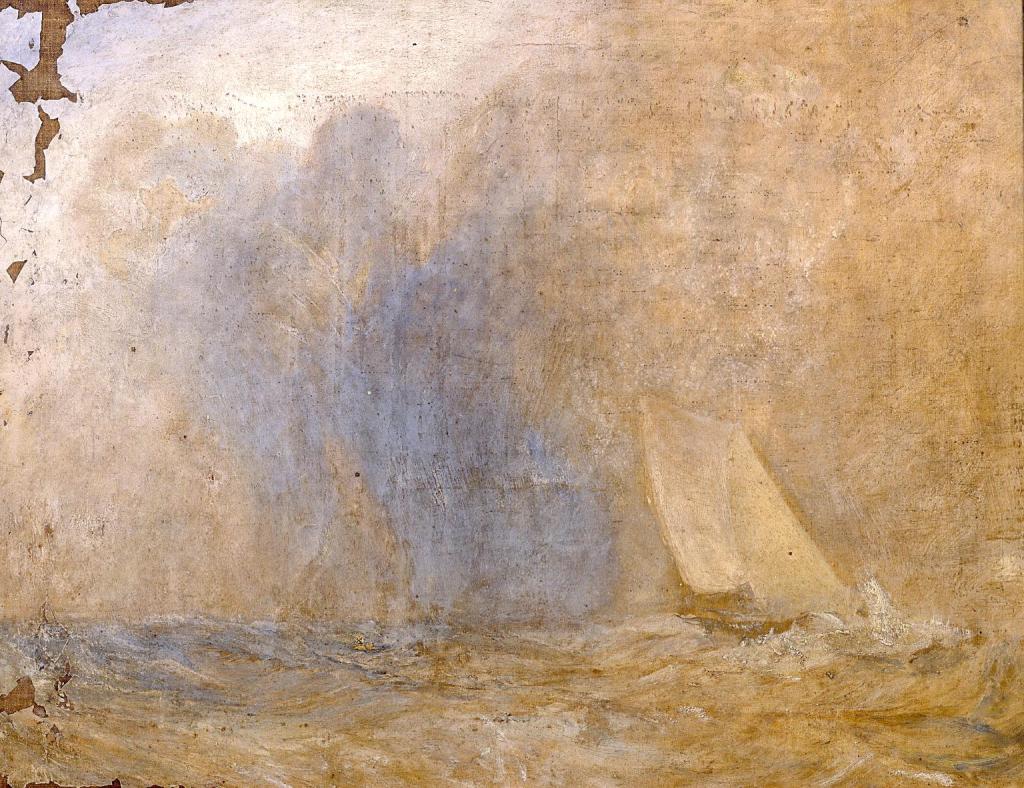
Seascape with a Yacht (?) by J. M. W. Turner (reproduced from https://www.tate.org.uk/art/artworks/turner-seascape-with-a-yacht-n05485)

Not much, right? A splodge which is falling to pieces. There appears to be a yacht (is it a yacht?) on the right, and some waves. But the poet has noticed the predominantly ochre colour of the painting. The sea looks less like a sea than a desert. The yacht she understands to represent the people of Israel crossing the desert. And that tall white wave at the bow of the yacht she takes to be the prophet Moses.

Then she draws our attention to the large blue area in the left half of the picture, standing, as it were, on the waves. She understands this to be Archangel Gabriel. We can see the fold of his tunic where it crosses on his chest, in a lighter colour. Out of the tunic appear his neck and head. He is looking towards the yacht, watching over the people of Israel as they make their way to the promised land. Behind him (again in a lighter colour) we can see the outline of his wings.

It may help at this point to reproduce a fresco of Archangel Gabriel found in the medieval Church of Sts Peter and Paul in the old Bulgarian capital Veliko Tarnovo (in central Bulgaria) because there is an obvious similarity between the two images:

Fresco of Archangel Gabriel in the Church of Sts Peter and Paul, Veliko Tarnovo, Bulgaria

Again, the tunic is folded over on his chest. The angel’s skin is darker than the cloth of the garment. And we can see the outline of his wings. He is writing on a scroll (“Wash yourselves and be clean learn to do good”) – perhaps that is the meaning of the dark blue patch to the right of the angel in Turner’s painting.

And in the painting she also sees a horse’s head in the ochre sky above the yacht and slightly to the right. It is possible to make out the horse’s eyes and nostrils. Admittedly we can always disbelieve. Then the magic of the painting begins to recede, and we are left with a tattered painting. But the poet’s vision is so much richer. Here we have a depiction of the Exodus – this is why the painting has not been restored, we haven’t got there yet. We are on the way, a prophet leading us, a guardian angel over our shoulder. As with the other paintings, not for a moment do I think Turner consciously painted these things. It’s just he received the same inspiration as the painter of the fresco in a church in central Bulgaria several hundred years earlier. It is the same Spirit working through him.

Jonathan Dunne, http://www.stonesofithaca.com

Hotnitsa

There are three waterfalls north-west of Veliko Tarnovo – near the villages of Hotnitsa, Emen and Vishovgrad. Hotnitsa (‘Kaya Bunar’) is the closest. The journey takes about forty minutes, and on the way back you have the chance to visit one of the most beautiful monasteries in Bulgaria, Preobrazhenski (‘Transfiguration’) Monastery.

The waterfall is where you park the car and is undoubtedly one of the most magical and mystical waterfalls we have visited. To get there from Veliko Tarnovo, follow the brown signs for Preobrazhenski Monastery and for the ancient Roman town Nicopolis ad Istrum. These signs will take you north of Veliko Tarnovo, from where you join the E85 and head in the direction of Samovodene. This main arterial road that joins the towns of Haskovo in the south and Ruse in the north passes along the gorge formed by the river Yantra. After a short while, you will pass the turning for Preobrazhenski Monastery on your left. Keep going straight. In Samovodene, the road divides – the right fork is signposted for Ruse, the left for Resen. You take the left fork and, about a kilometre after leaving Samovodene, take the turning left signposted for the villages of Hotnitsa (5 km) and Pavlikeni.

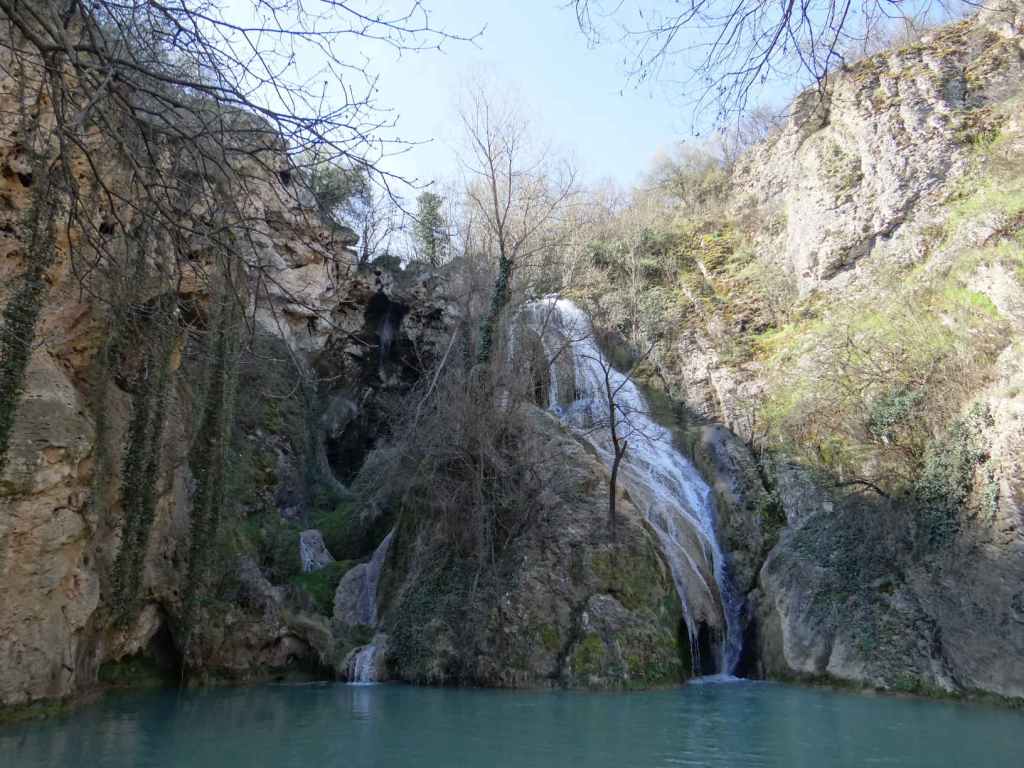
When you arrive in the centre of Hotnitsa, the waterfall is clearly signposted on your left. The distance from the centre of Hotnitsa to the waterfall is 3 km, and it is clearly signposted all the way. The road ends at the waterfall, where you can park the car. This astonishing waterfall is on your left. The colour of the water is turquoise blue because of the karst spring and limestone rocks.

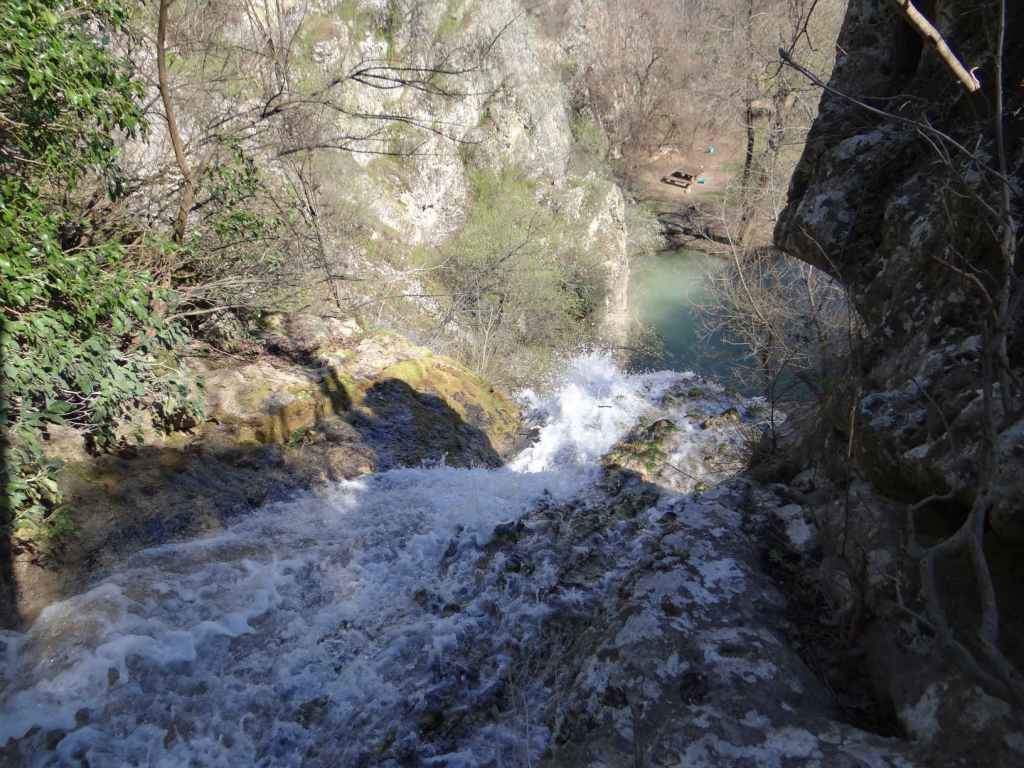
There is an ecopath (1.5 km) that takes you up the left-hand side of the waterfall, a little up the gorge above the main waterfall and back along the top of the gorge on the right. This ecopath is not for the faint-hearted! I did it carrying our dog, but there are places where you have to climb or descend steep wooden ladders and clamber over the rocks. There are several wooden bridges that take you from side to side of the river Bohot. You can literally stand at the top of the main waterfall. There are smaller waterfalls further upstream. Once you have reached the top of the gorge on the right, the path descends slowly back to the café at the bottom.

On your return to Veliko Tarnovo, don’t miss the chance to visit Preobrazhenski Monastery, which overlooks the Yantra gorge and offers views back to Veliko Tarnovo. The church was built by noted Bulgarian National Revival architect Kolyu Ficheto and painted by another nineteenth-century Bulgarian artist, Zahari Zograf (who also painted Rila and Troyan Monasteries). It has some of the most beautiful frescoes in Bulgaria, including the famous fresco ‘The Circle of Life’ on the outside of the building. Behind the church is a very large rock that missed the church by inches and has been left there to remind us of God’s providence! On the opposite side of the gorge can be seen another important monastery, the Patriarchal Monastery of the Holy Trinity.

The road from the village of Hotnitsa ends at the waterfall.
An overview of Hotnitsa Waterfall.
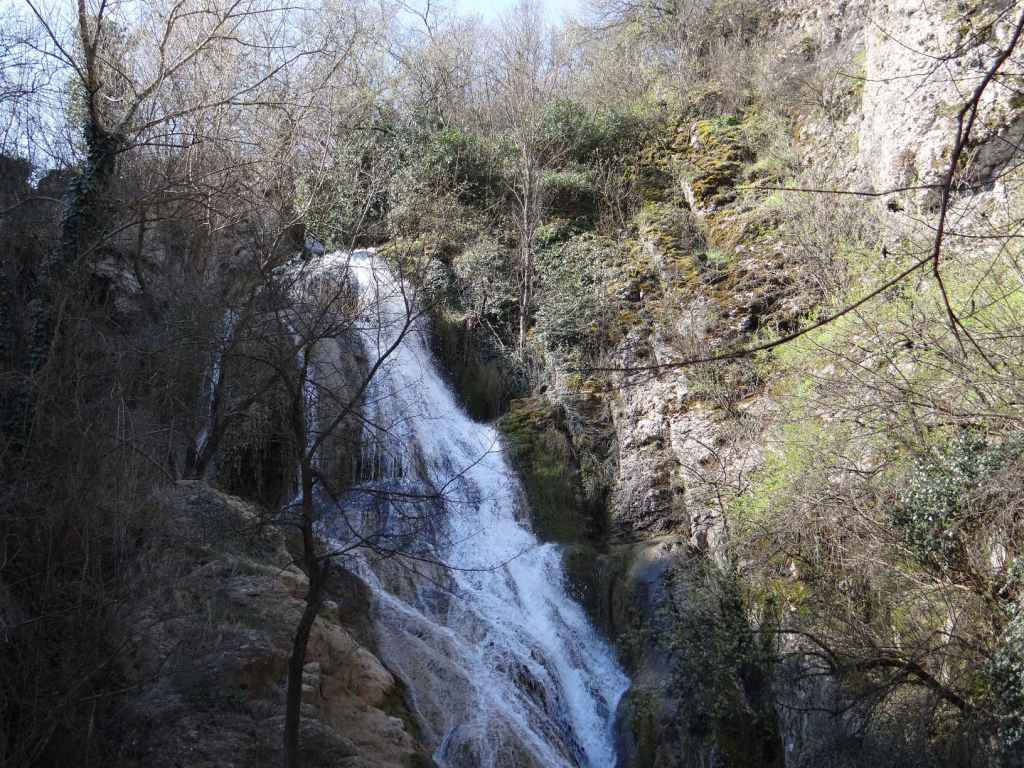
The upper part of the waterfall.
A view from the side.
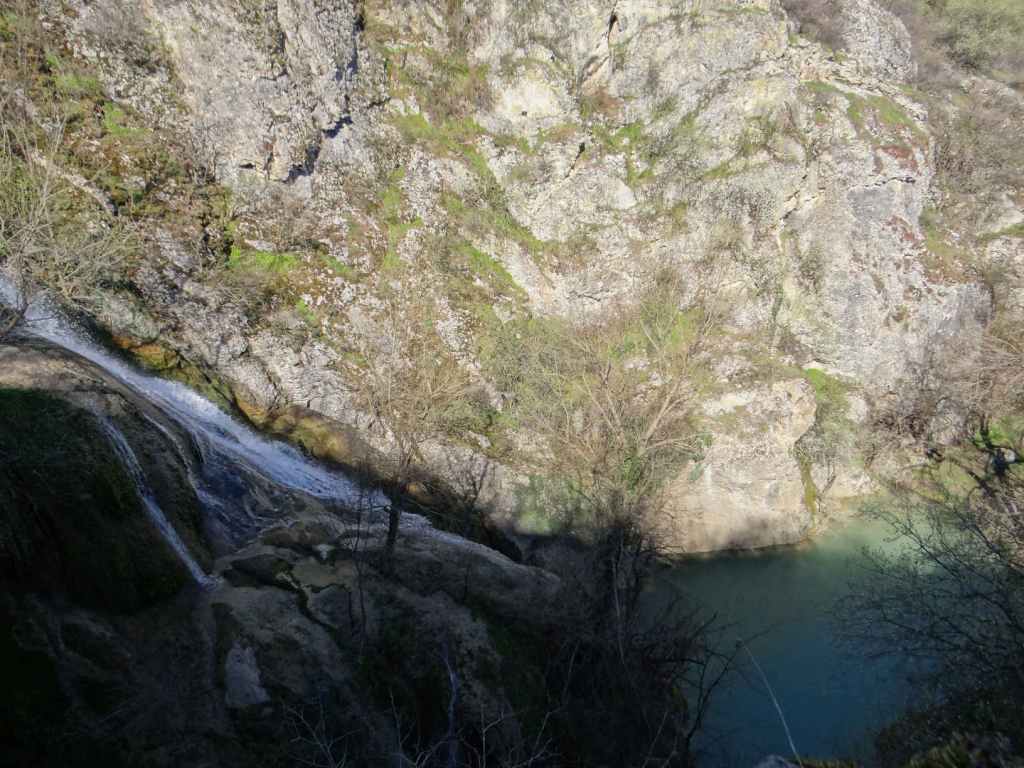
A view from the ecopath above – note the turquoise blue water!
The ecopath (no, it’s not a dungeon!).
A view back to the pool below the waterfall.
Standing at the top of the waterfall – be careful!
A smaller waterfall further upstream.
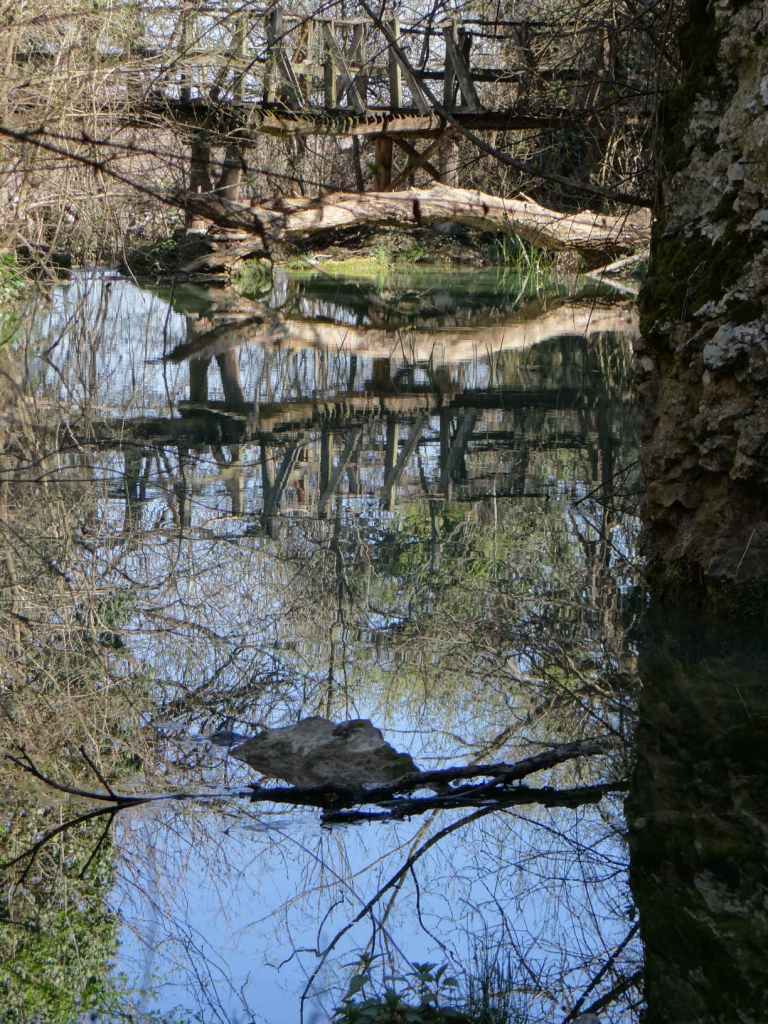
One of the wooden bridges crossing the river Bohot.
One of the steep wooden ladders.
The sun captured in the river.
A view from the top of the gorge back to the car park.
The fresco ‘The Circle of Life’ at Transfiguration Monastery.
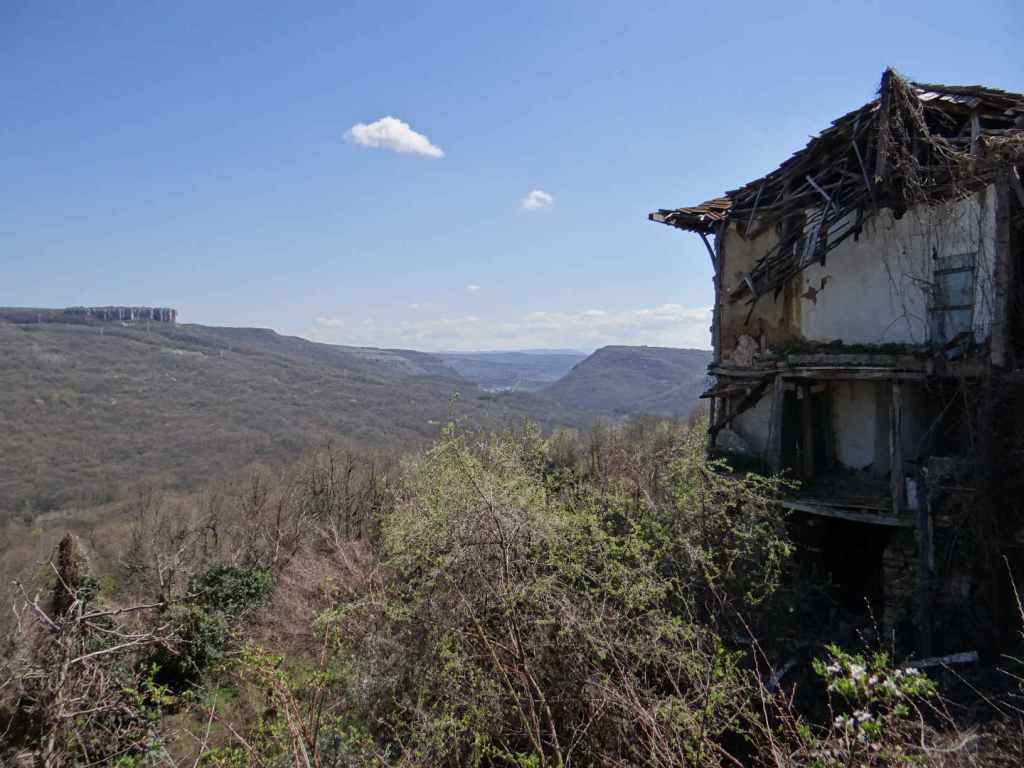
View from Transfiguration Monastery to Veliko Tarnovo – note the plateau on the left, above the gorge, where the village of Arbanasi with its famous churches is situated.