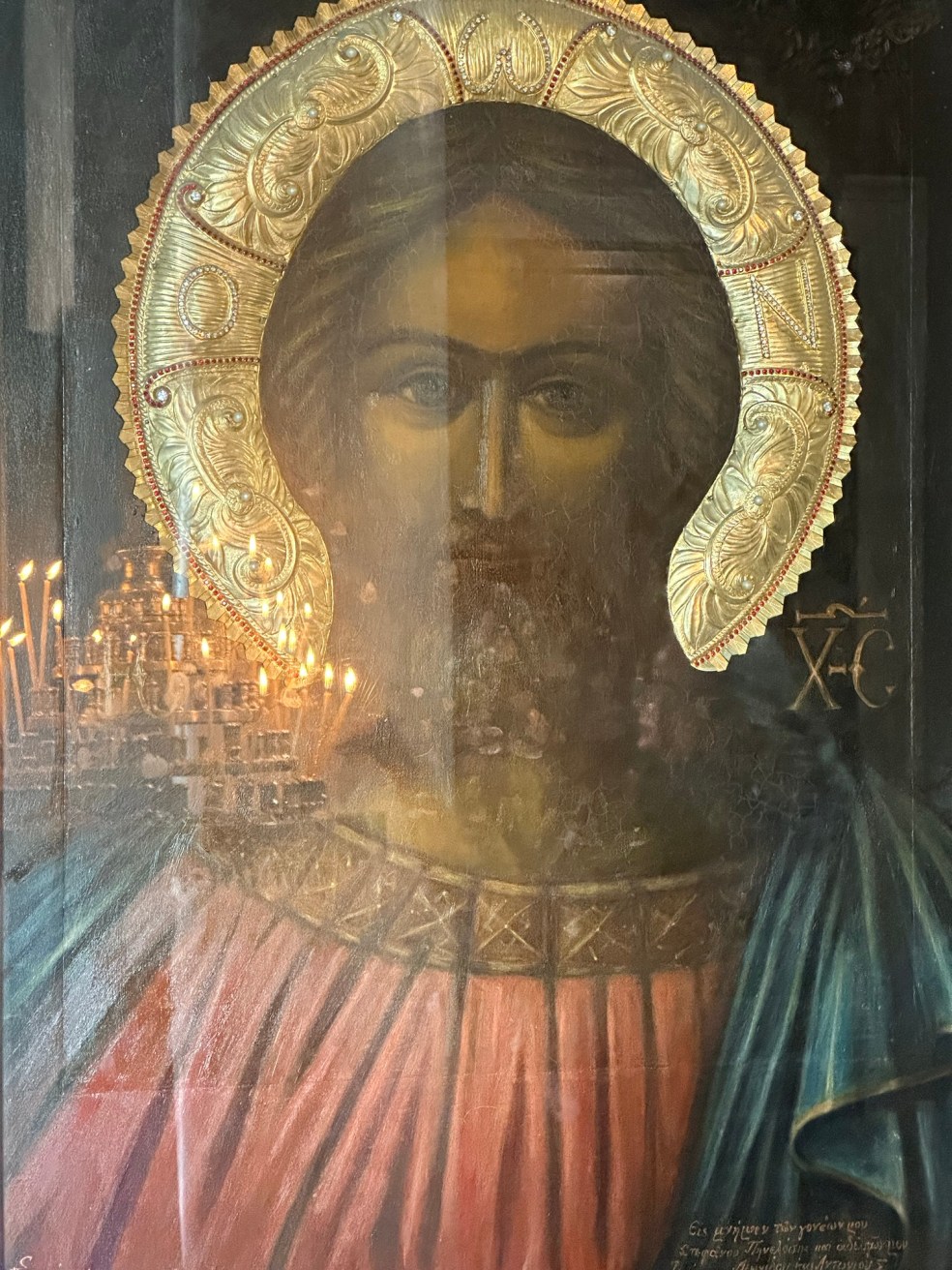
13. O WN

Language is thought made manifest. We are words in a dictionary, responsible for and dependent on others. Christ entered his creation, came through the eye of the needle, in order that we might have the courage and confidence to go in the other direction.

We have now seen a correlation between Christ and the environment we live in, but this should not surprise us if we accept that Christ is the Word and the world was spoken into being.

Christ is the Word. It says in the Christian Creed that all things were made by him, they were spoken into being. So physical matter would seem to be the result of language.

When we speak, we make things manifest in a similar way – our thoughts, our observations, our wishes. So we also turn something that did not exist into physical matter. We are using fragments of the Word to do this, as if the Word had been divided among us (like pieces of bread, or shards of a mirror). But the idea is the same – we make things manifest by using language.

So I would say that we speak Christ. Since there is a striking connection between the words son and sun (they are homophones, they sound the same), I would suggest that we see by him. After all, in John 8:12, he calls himself “the light of the world”. Perhaps this can be understood literally (just as the story of creation in the Book of Genesis is literally a description of speech, or the concept of the Trinity is literally three in ONE).

We speak him, we see by him. We also breathe him if we accept that Christ is the Second Person of the Trinity, O2, the chemical formula for oxygen. When we combine this symbol in reverse with the letter for breath, h, to refer to the Holy Spirit, we get H2O, the chemical formula for water. So we also drink him.

It would seem that our life is completely dependent on Christ, whether or not we believe in him. Enter an Orthodox church and you will most likely see an icon of Christ Pantocrator (“Ruler of All”). In this image, Christ is shown with the beams of the Cross behind him (only three are visible), and in these beams are written the letters O WN.

O WN is Greek for “the being”, which is the translation of the name that God reveals to Moses at the burning bush in Exodus 3:14: I AM. Again, we find here confirmation of the Trinity, because O WN is almost identical to ONE, it’s just that one of the letters has been rotated.

O WN also spells three words in English: own, won and now. Christ claims us as his own; the victory is his, he has won; he is here with us now (the meaning of the name Emmanuel).

I have seen this name written O WH. In Cyrillic, the letter H is pronounced N, and indeed the two letters are very similar (only the crossbar has become slanted). There is also a rough breathing in the original Greek, ὁ ὤν, the reverse apostrophe, which equates to the letter h in English.

If we write the name in this way, then we will see that it spells the words who and how, the result of making the progression AIO from what (A, the letter of creation: “What is this creature?”, “What shall I call it?”) through why (I, the letter of the Fall, an expression of distrust, of disobedience: “Why should I do this?”, “Why should I believe you?”).

Who and how are the questions that we should be asking. What is factual. Why is self-centred. We think that the purpose of life is to amass things and then to share them out, because we were taught at school to count up from 1, to do sums, multiplications and divisions. But actually the answer we are seeking is a person.

Christ gives us the answer to both question words when he says, “I am the way, and the truth, and the life” (Jn 14:6). I am and way are connected if we turn the m upside down and replace the vowel i with its semi-vowel equivalent, y. Both words contain the progression AIW (omega written as w).

We have also seen how when we flee the ego, the I, when we refuse to heed its selfish demands, we automatically create three symbols: A+O, the name of God Alpha and Omega. This can be written A ’N’ O and is found in the conjunction and, the reverse of which is DNA (it is in our DNA to do this). If we write this same progression with the Greek letter for omega, w, we get ANW, which with the w turned upside down gives man. So this denial of the ego, of our innate selfishness, is in the word that describes us (and woman is the same, only it has O3 at the beginning).

The automatic result of turning away from the ego, I, is to say the name of God Alpha and Omega: A+O. By turning away from the ego, we call on him. This is why God and ego are only a step apart in the alphabet (d-e). And him is just I’m with a little breath (h) before it.

This is what makes us human, a combination of hu (Sanskrit for “invoke the gods” and the root of our word “God”) and man – physical beings with the divine spark in them, the potential to become gods by grace if we attend to our true nature, which is not to grab whatever we see out there and to claim it as our own, making a mockery of the divine in us, but to see ourselves as part of the whole, a word in the dictionary, responsible for and dependent on the other. This most ancient way of calling on God – hu – sounds exactly the same as who, the letters we find in Christ’s icon, emphasizing what it is we should be asking.

In the Old Testament, there are two other names of God, apart from I AM. They are YHWH, the Hebrew Tetragrammaton (Yahweh), and El.

YHWH is extremely close to the question word why. So, if we make the progression from I to O, as we did with live-love, sin-son and Christ-cross, opening the line (opening our spiritual Is) to form not a barrier, a wall, but a tunnel that we can walk through, like the proverbial camel through the eye of the needle, just as why gives who, so the name of God in the Old Testament, YHWH, gives O WH, the letters found in Christ’s icon.

And if we place the other name of God from the Old Testament, El, in front of O WH, the two names together spell WHOLE in reverse (keeping the digraph wh together, as we did with earth-three).

This combination YHWH-O WH (why-who) and El-O WH (whole) goes a long way to confirming Christ as the fulfilment of the Old Testament law and prophets. This is why I would say that language is not only Trinitarian (three in ONE), but also Christological.

All physical appearances of God in the Old Testament are said to be by the Logos – that is, Christ – but we are not allowed to touch him. In the New Testament, when he walks among his disciples, eats with them and washes their feet, God himself has entered his creation. He has slipped through the hole – I become O – but in the other direction, so that we will have the courage and confidence to go the other way. This is an extraordinary act of condescension, of coming down to our level, and it was only possible because one of his creatures – namely Mary – acted as a conduit. How else in bodily form do you enter the creation that you have made, if not through one of your creatures?

Jonathan Dunne

Heart of Language 13/15

Next: Heart of Language 14/15

Back to: Contents
Word in Language (5): WHOLE

We saw in the previous article that the letters O WN in icons of Christ Pantocrator refer to the verse Exodus 3:14, in which God meets Moses at the burning bush and reveals his name to him:


God said to Moses, ‘I am who I am.’ He said further, ‘Thus you shall say to the Israelites, “I am has sent me to you.”’ (NRSV)


O WN is the Greek Septuagint translation. It literally means ‘the being’, but in English translations of the Bible the name of God is rendered I AM.


I live in Bulgaria. Here, I have seen these Greek letters, O WN, written O WH, possibly because the letter N is written H in Cyrillic. These two letters are closely connected – in effect, the crossbar between the two parallel lines has simply been straightened, H could be a stylized version of N. If we make them lower case, h is simply an extension of n. We find this a lot in word connections – letters that have been extended: h-n, i-l, v-y.


But there is another reason for introducing the letter H, and that is because ‘the being’ in Greek has a rough breathing: ὁ ὢν. Do you see that little c atop the letter o (which is the definite article, ‘the’)? This little cup or cap atop the letter o represents the sound h in Greek (though it is ignored in modern Greek pronunciation, which I think is a shame). So actually the correct transcription would be HO WN.


Let us look at the alternative spelling, O WH. It is remarkable that as O WN spelled OWN, WON and NOW, so these three letters spell WHO and HOW.


The answer to both questions is Christ.


WHO? The answer is I AM (the English translation of the name of God in Exodus 3:14).


HOW? Christ gives us the answer to this question when in John 14:6 he says, ‘I am the way, and the truth, and the life.’ WAY is I AM written with the semi-vowel y (and the m turned upside down).


So the answer to life’s most important question is contained in language. WHO and HOW. In the act of creation (related in the first two chapters of the Book of Genesis), the question word was WHAT: what is this creature, what will you call it? Today we are in the habit of selfishly asking WHY. WHY corresponds to the demands of the ego, that is I. In WHAT to WHY, there has been a progression from the first letter of the alphabet – A – to I.


But it is the wrong question. The right question, the only one that will give us an answer, is WHO. When we ask this question, we get the answer: I AM.


In this way, we make the progression from the letter of creation – A – to the ego – I – to O. We count down. The Greek alphabet makes this progression because the last letter in the Greek alphabet is Omega. The Latin alphabet, which we might equate with a more rationalistic, legalistic way of thinking, does not make this progression. It counts up – from I to Z (or 1 to 2).


If we write the correct progression AIO but replace the final letter o with the Greek way of writing Omega, w, that is AIW, we find we are back to I AM. AIO (AIW) is the progression of human life, but the Latin alphabet makes the fatal mistake of counting up: AIZ. Once you start counting up, there is no end. You will never reach an answer (and all the time the answer was right behind you, but you have to have humility, you have to turn around, you have to count down, from I to O).


AIZ is an act of hubris, AIO is an act of humility. But what do we teach our children in school? We teach them to count from 1, not 0 – starting with the ego, I, not with God, O.


I do not think it is an exaggeration to say that this then affects our whole way of thinking: we see everything from our own point of view, in terms of ownership, instead of seeing things as God would have us see them, in terms of service. It is a real wrench to change our way of thinking, but this is what we should be teaching our children. To take a step back, not to affirm the ego (don’t worry, as soon as we lose ourselves, Christ has promised us we will find ourselves again, just as in the act of translation, where the text must disappear momentarily before it reappears in another language).


So we make the progression from WHY to WHO. This progression from I to O is found in other word connections. We make the progression from I to O in LIVE to LOVE, for example, instead of turning LIVE around, perverting it, and getting EVIL. That is the choice that is open to us in this life. Another example of the progression from I to O is SIN to SON. We stop sinning, or at least we try to, and become children of God. Even CHRIST made this progression when he submitted to death on the CROSS for our sakes. He counted down (look at the vowels), albeit he is God already, to show us the way. He deleted the I and turned it into a Cross, †, which is also a plus-sign, +. We saw this in the article Alpha and Omega.


But the answer only became available with the Incarnation of Christ, that is with the New Testament. The New Testament fulfils the Old. The Old is not enough – it contains the law and the prophets, that is it looks forward to the coming of Christ in human form. We know this because perhaps the most famous name of God in the Old Testament is the Tetragrammaton, YHWH (which is normally transcribed Yahweh). YHWH corresponds to the question word WHY. It has not made the progression to O WH (WHO).


Another name of God in the Old Testament is EL. We find this name at the end of the names of archangels, such as Michael and Gabriel. And what happens when we combine this name of God in the Old Testament, EL, with the name of Christ, O WH. What word do we get?


EL + O WH = WHOLE.


Christ makes us whole.


We like to think of ourselves as isolated beings, with parapets around us protecting us from unwanted intrusions, but the fact is we are peppered with holes. They are called pores. Actually they are what permits our skin to breathe, they are necessary.


But on a metaphysical level, we feel we have a hole when we are not fulfilled and we might try all kinds of ways, all kinds of substances, to block up this hole – we might seek comfort in drink, in drugs, in anything that takes our mind off the gaping hole at the centre of our lives.


Only the Holy Trinity will do this, will supply the answer. The Holy Trinity can be linked with the number 3. When we add the number 3 to HOLE (and rotate the number 3 so that it becomes the letter W), we get WHOLE. WHOLE is HOLE with God (3) at the beginning.


And once we have made that change, once we have repented, a miracle takes place. Because what word is contained in WHOLE that is not in HOLE?


Word connections sometimes involve the addition of a letter, most commonly h (the letter that represents breath). The letters v and w are closely connected – they are next to each other in the alphabet, and their pronunciation can be confused (think of Latin and German).


If we make these changes – v-w, addition of h – to WHOLE, what word do we get? LOVE.


WHOLE is a combination of EL and O WH – the New Testament fulfils the Old.


It is a combination of our HOLE and the Holy Trinity, represented by the number 3 (or the letter W).


And it contains LOVE, which is what happens when we take the ego, I, and count down to O.


All of this – all this message – is contained in language, in the words we use every day, but we have no idea. We study language horizontally, in terms of history. We don’t study language spiritually, apart from time. That is why I compare language to the environment. We look on them both two-dimensionally, as put there for our own use, but they reflect their Maker. The environment reflects the Creator, who created it in the first two chapters of Genesis, and gave us the creatures to translate (that is, to name). Language reflects the Word, the Son of God, Jesus Christ. For all we know, the words we use are fragments of him – breadcrumbs.


But to perceive this, we need God at the centre of our lives, not ourselves. We need to open our spiritual Is so that they become Os.


O is simply an I that has been opened. An eye that sees for the first time, a progression we all need to make in this life.


Jonathan Dunne, http://www.stonesofithaca.com