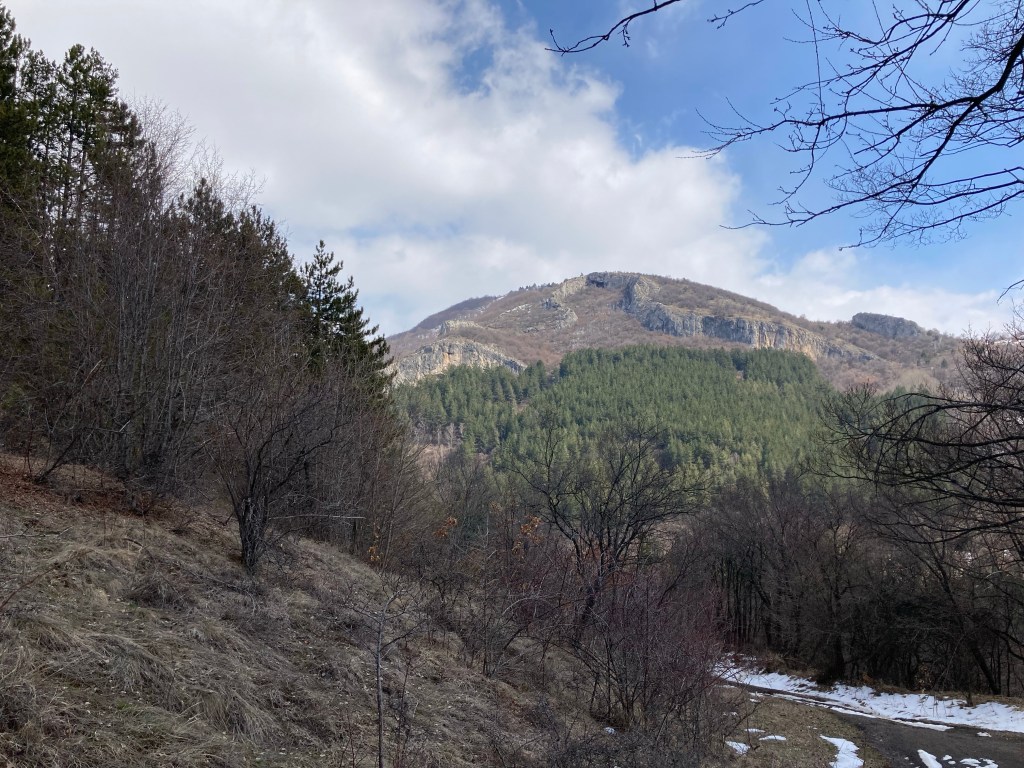
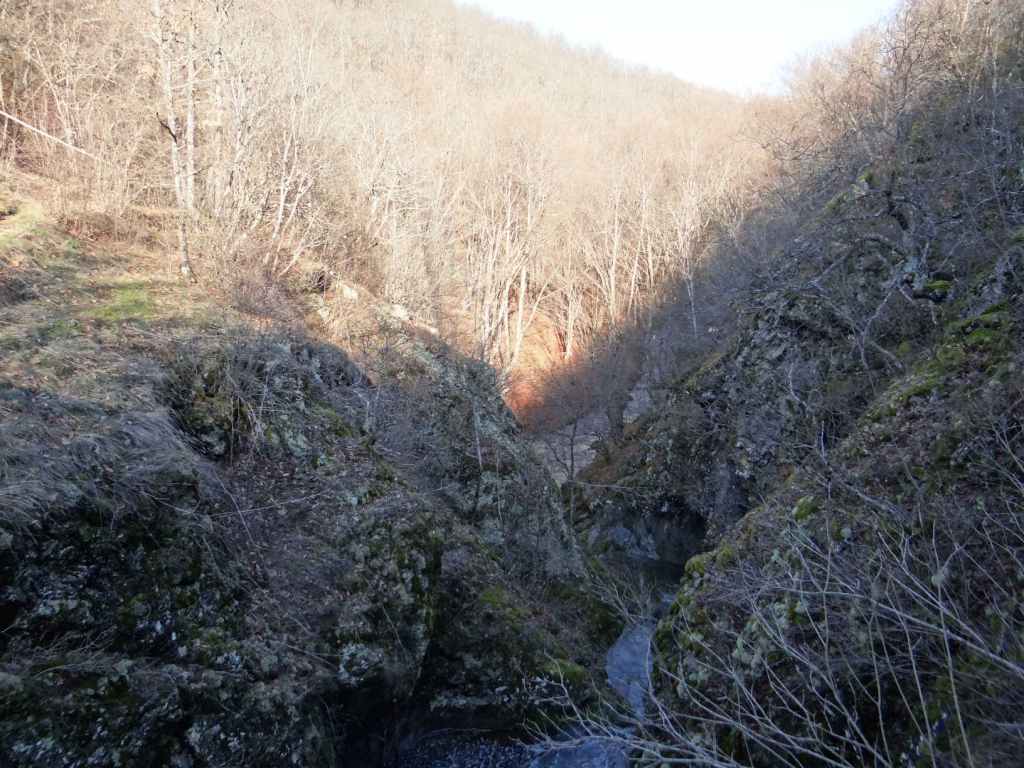
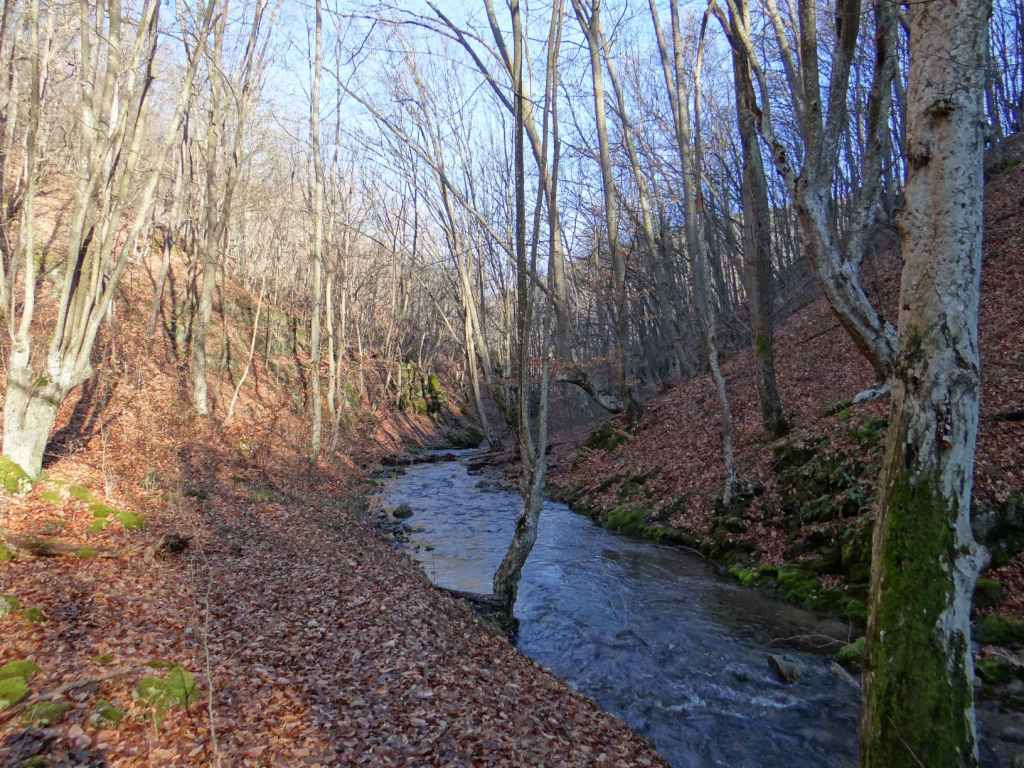
There are two waterfalls on the outskirts of Sofia, on the lower slopes of the mountain that overlooks Sofia from the south, Vitosha. They are Aleko and Boyana. Aleko is the name of the last stop on the cabin lift that climbs the mountain from the Simeonovo district of Sofia and finishes a few hundred metres shy of the summit, Cherni Vrah (‘Black Peak’). Aleko Waterfall, however, is much lower down the mountain, between the districts of Dragalevtsi and Simeonovo.
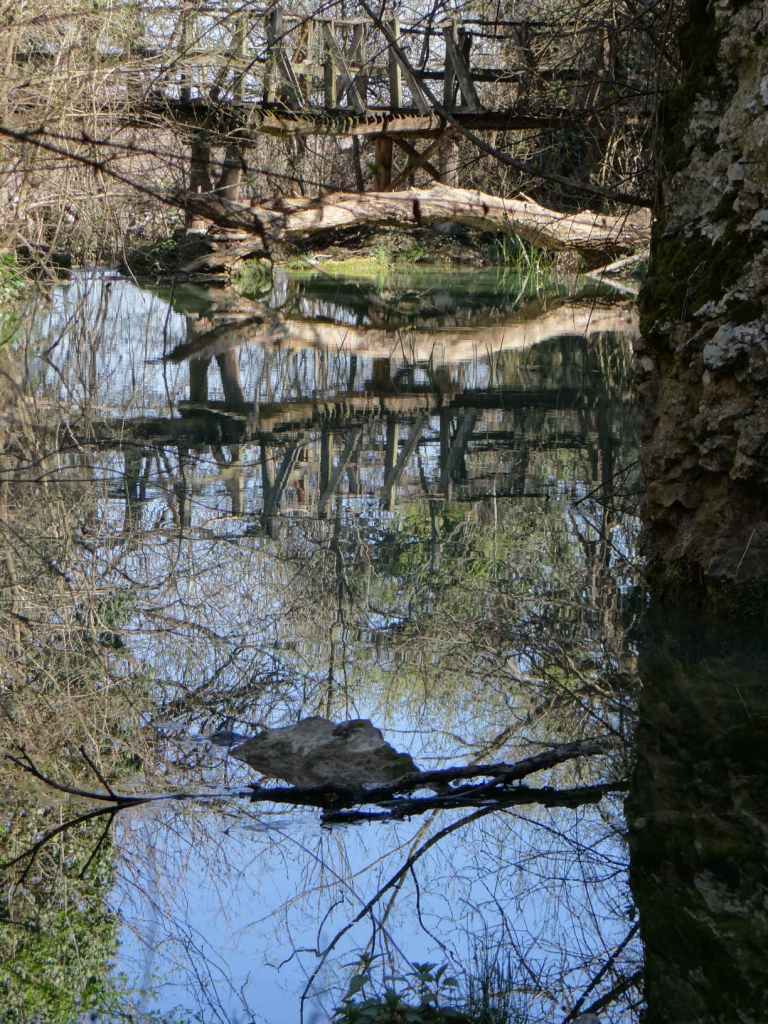
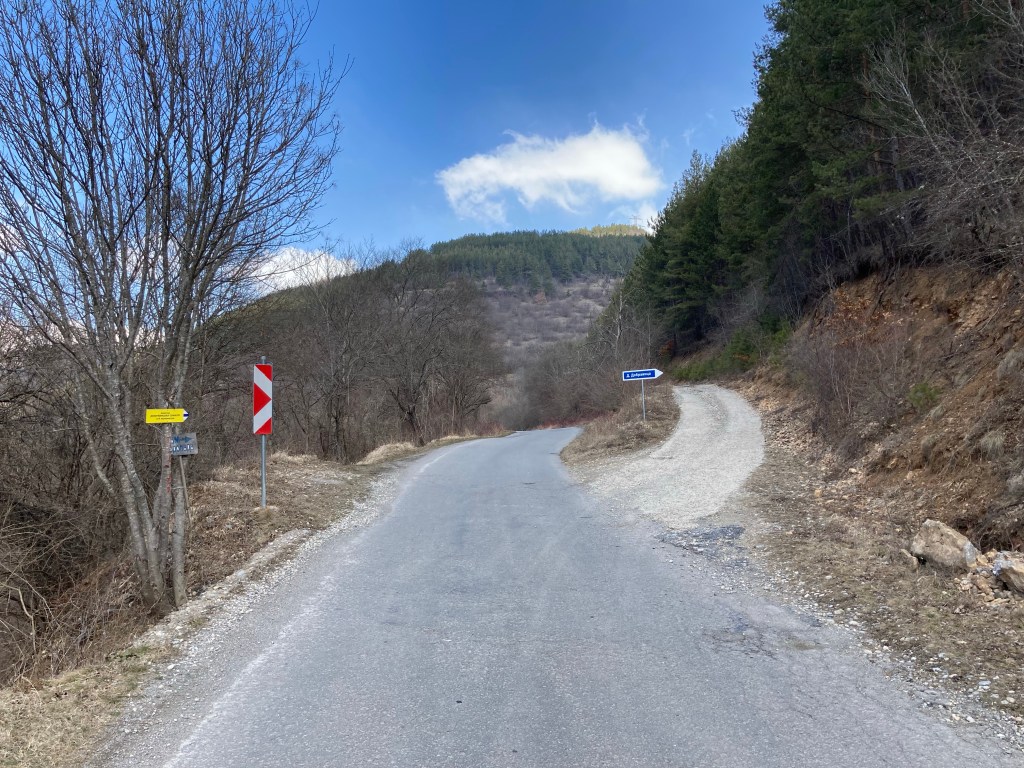
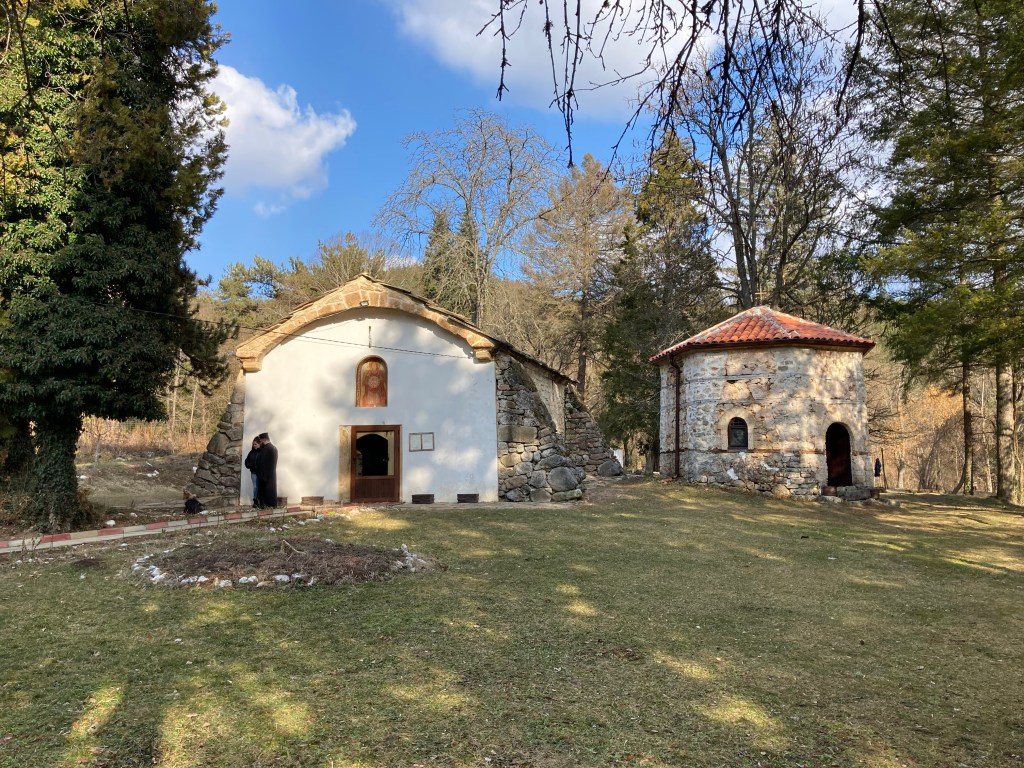
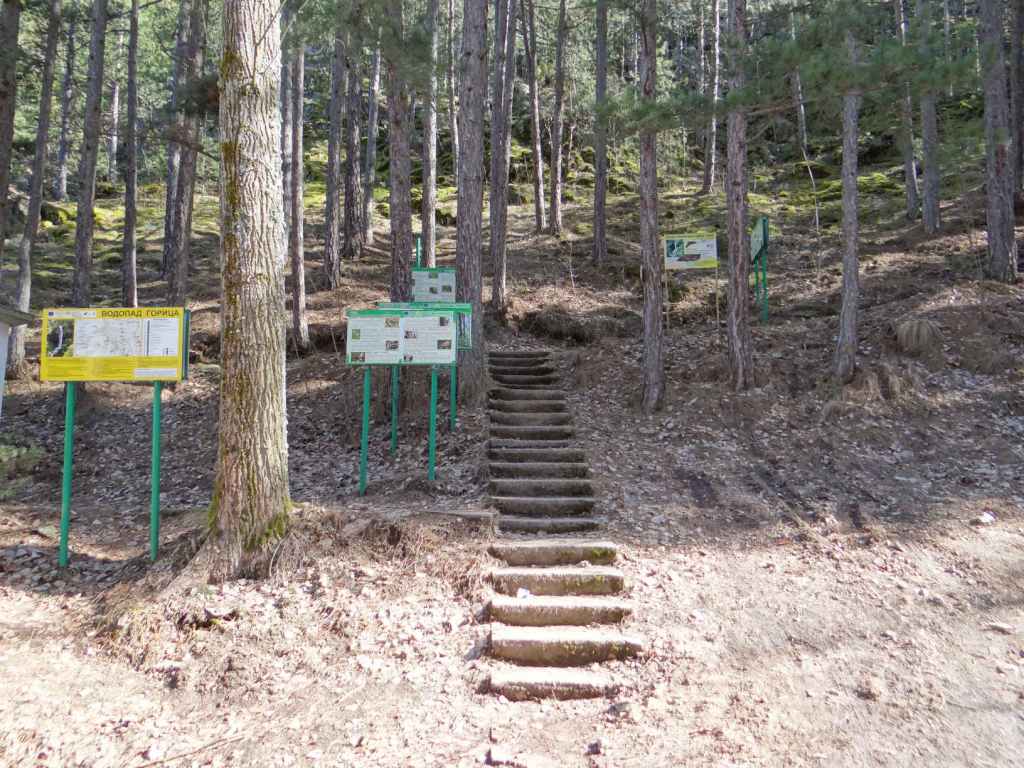
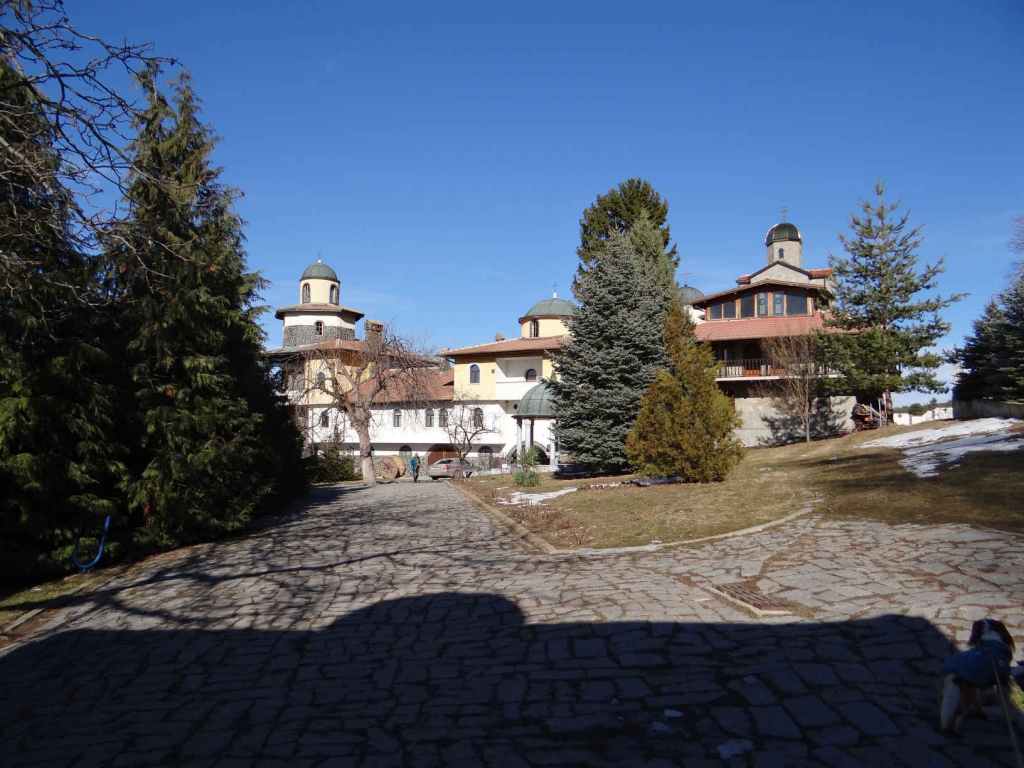
To reach Aleko Waterfall, the best way is to head to Dragalevtsi Monastery, one of the oldest monasteries in Sofia, which has an old church with valuable frescoes. Above the monastery is a car park. From the far corner of the car park a path leads directly up the mountain, with the monastery residential building on the left, but you don’t have to go any higher up the mountain. Instead you take a path that forks immediately left (with the monastery behind you and on your left) and then you stay more or less at the same height and wind your way around the mountain. Within a few minutes, the path forks again. Do not be tempted to start to climb the mountain; take the left fork and continue until you reach two wooden bridges crossing the Dragalevska River. This is a charming spot, with the river threading through the forest, and there is a wooden walkway between the bridges to help you keep your feet dry!
Continue at the same height. The path winds through a wonderful beech and pine forest. After a short time, you reach the disused Dragalevtsi-Goli Vrah chairlift, my first experience of taking a lift on Vitosha Mountain. It was like sitting on a park bench suspended in mid-air and for me, a novice at the time, it was a terrifying experience. I gradually became used to it, but sadly the lift has been discontinued. This is a shame since it offered a very useful way for walkers and mountain bikers to head up the mountain.
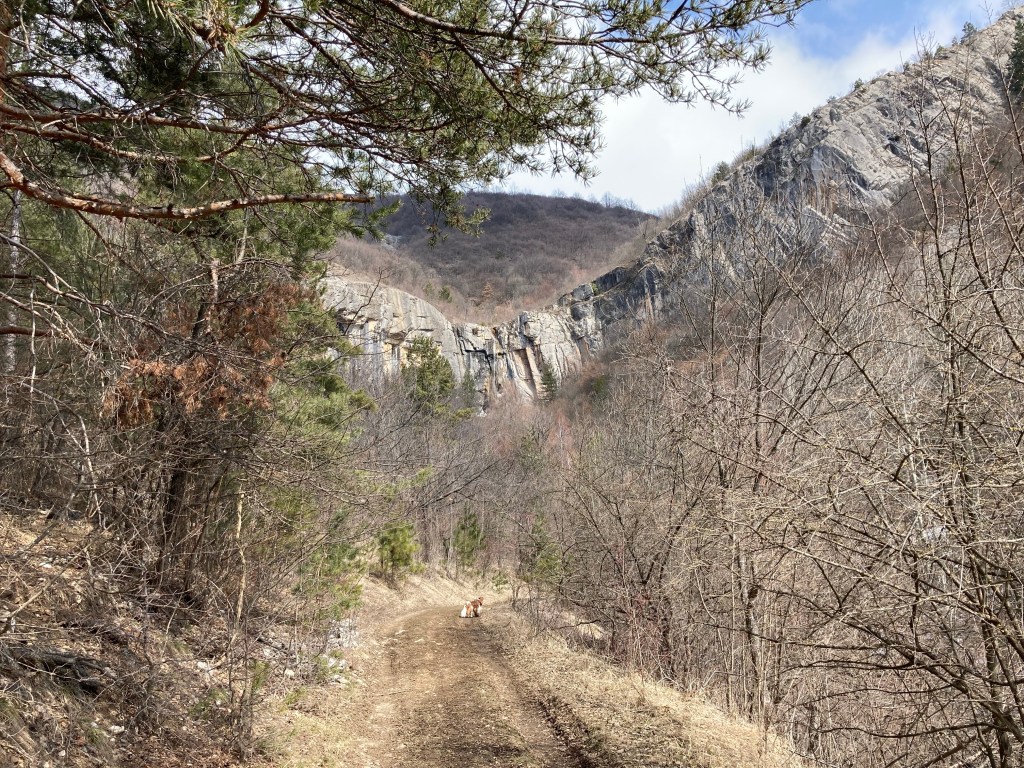
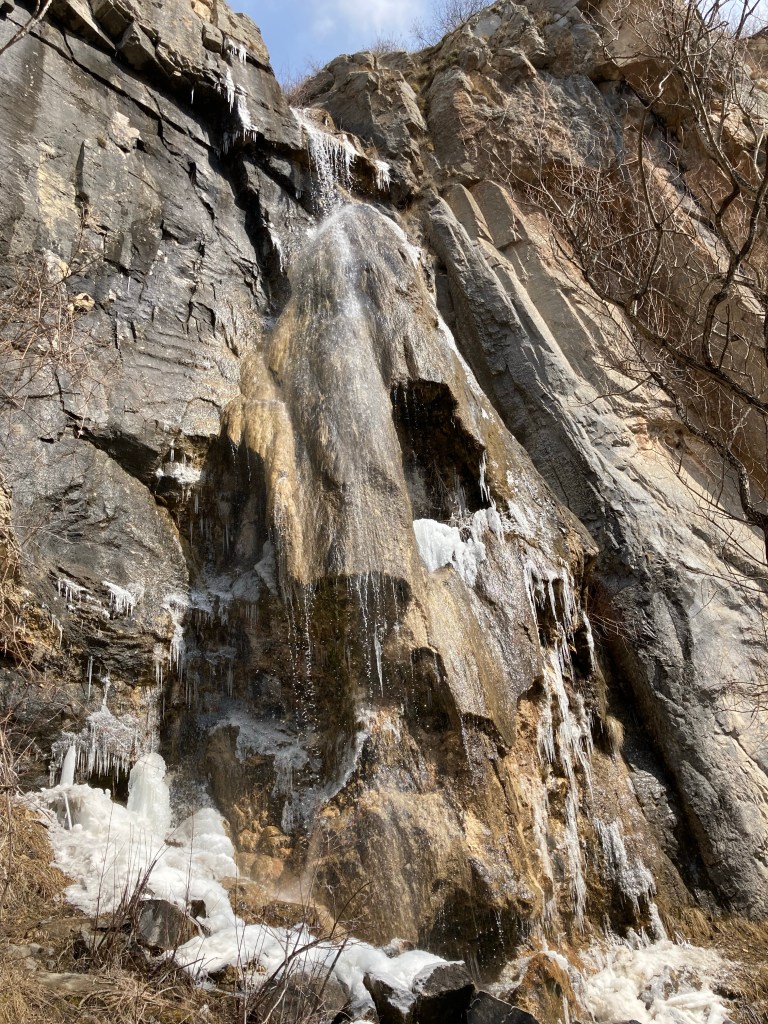
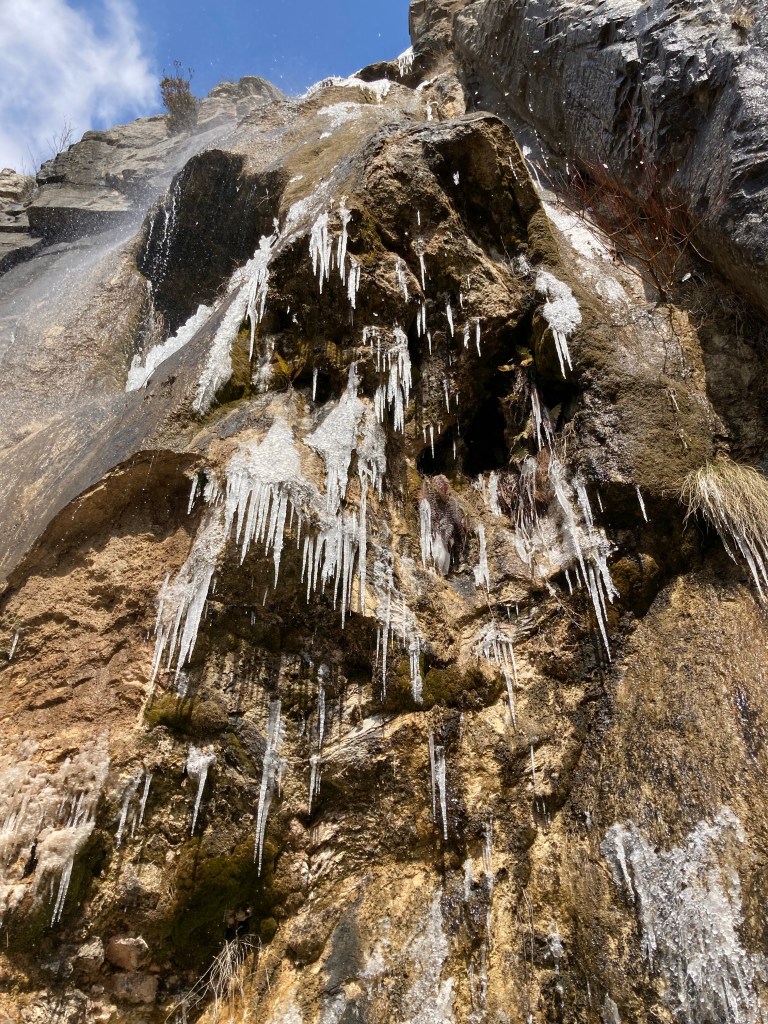
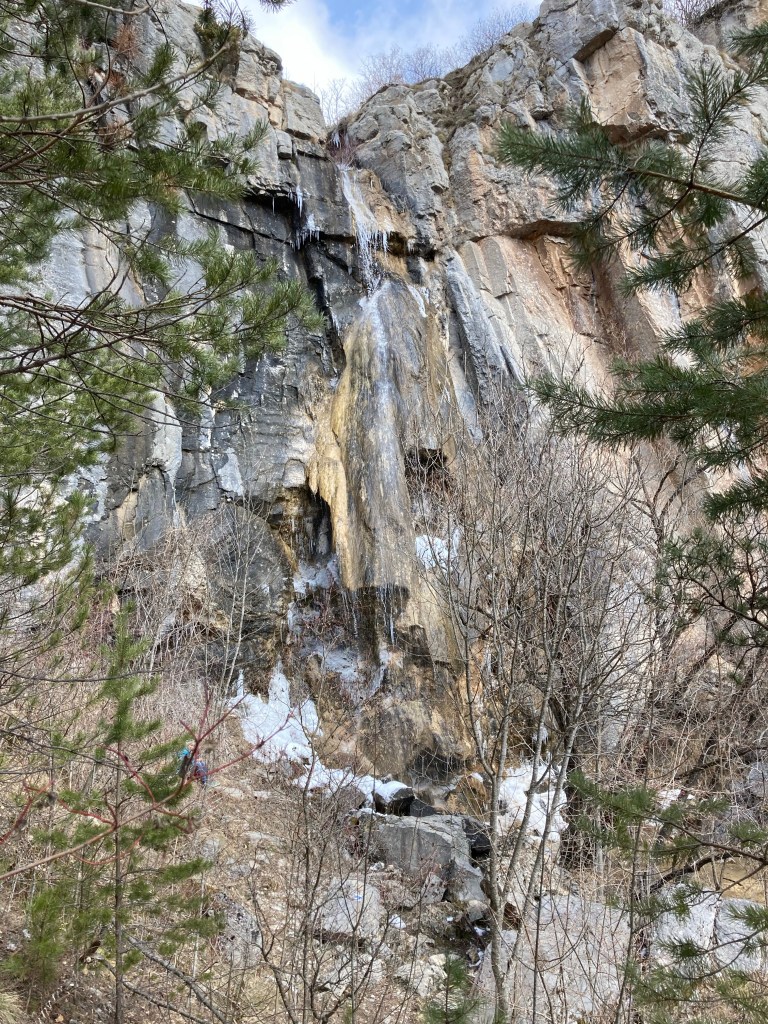
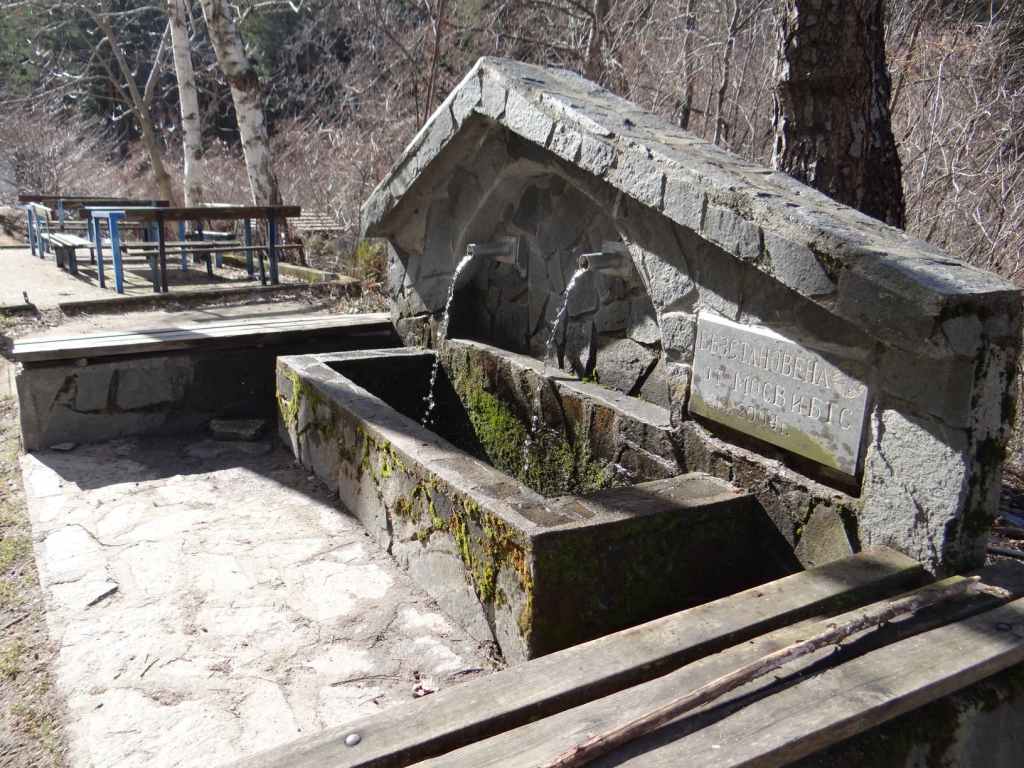
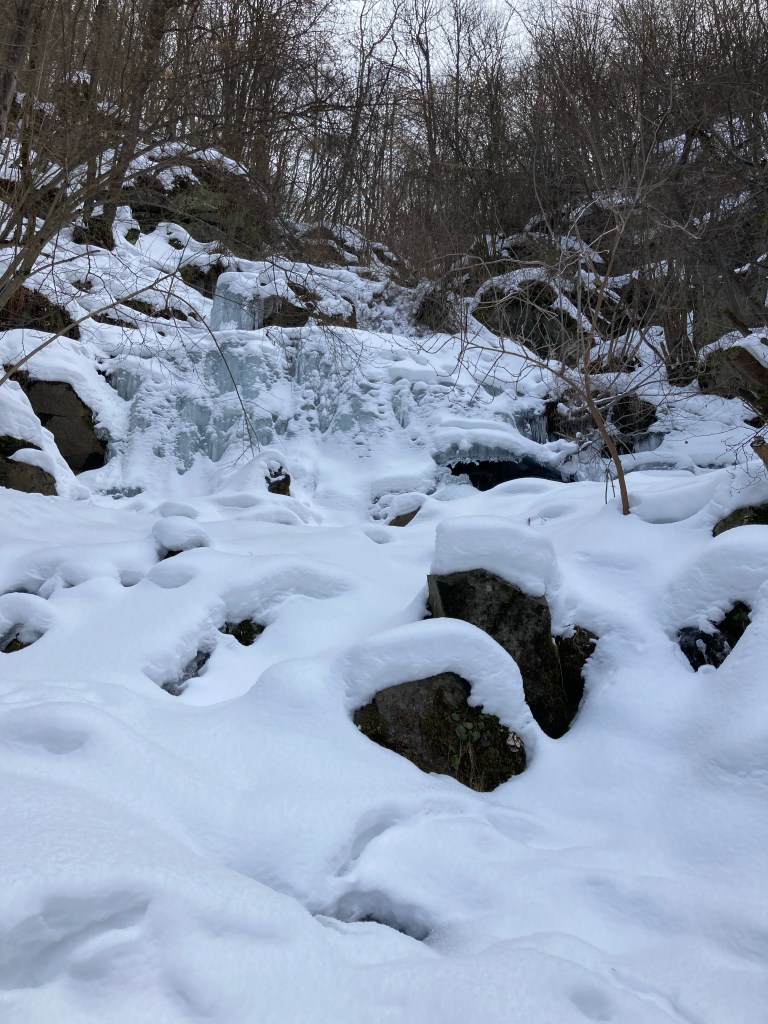
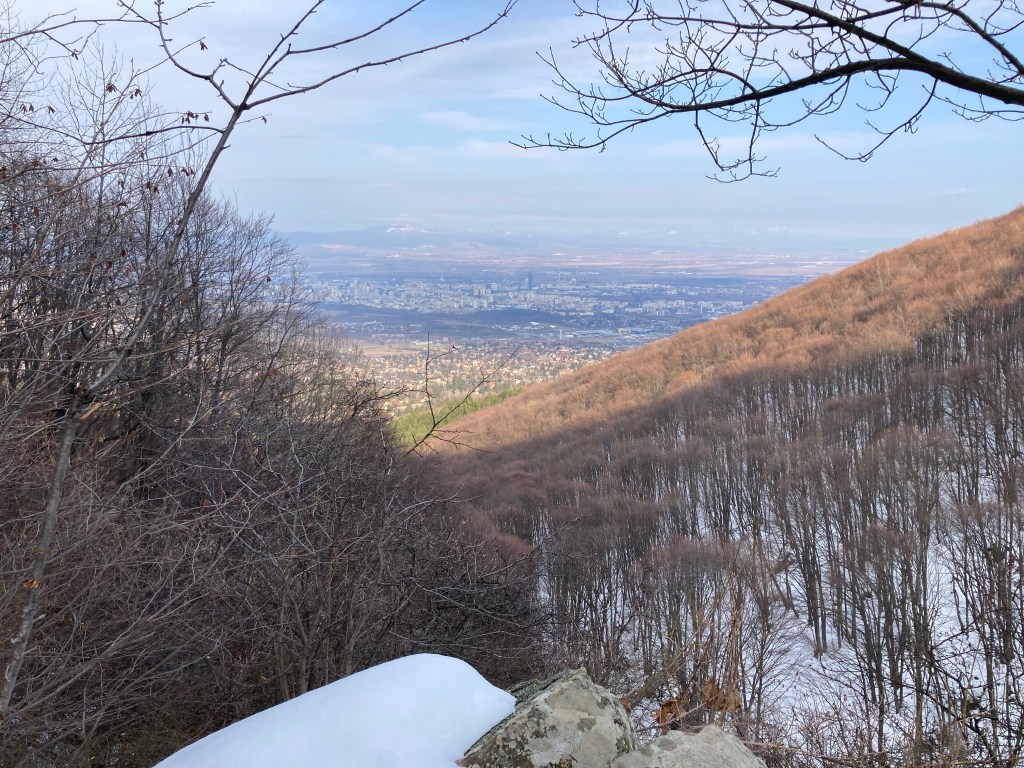
At a later stage, you will come across a fountain with a bench and a small icon of the Mother of God. All the time, paths continue up the mountain or drop down, but there is no need to change your height. After about an hour, there is a rocky outcrop with one of the most beautiful views of Sofia down below. Be careful not to go too close to the edge! This is an ideal place to stop and take some refreshments. You are now two minutes away from the waterfall. Continue along the path, and you will come to the waterfall, which when I visited in February was partially frozen and made for a wonderful sight.
The waterfall is formed by the river Skakavitsa, and I understand there is a second, smaller waterfall further down. You now have a choice to retrace your footsteps (if you have left the car in the car park) or to continue to Simeonovo and the Simeonovo Lakes, a set of small, artificial pools, which takes another half an hour. Buses go to and from the districts of Dragalevtsi and Simeonovo, so whether you retrace your footsteps or continue to Simeonovo, you should be able to take a bus from there back to the centre of Sofia.
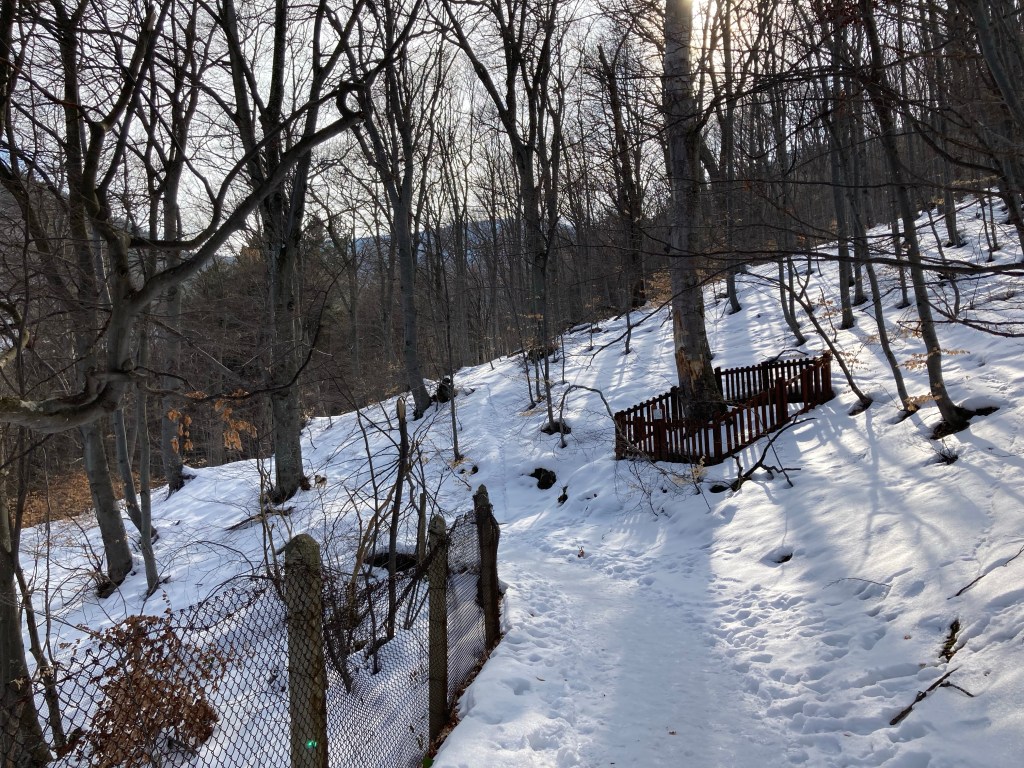
A tree has been protected by a fence. On the left is the wire fence surrounding Dragalevtsi Monastery.
The monastery buildings through the trees.
The path forks almost immediately. Keep left.
A wooden bridge over the Dragalevska River.
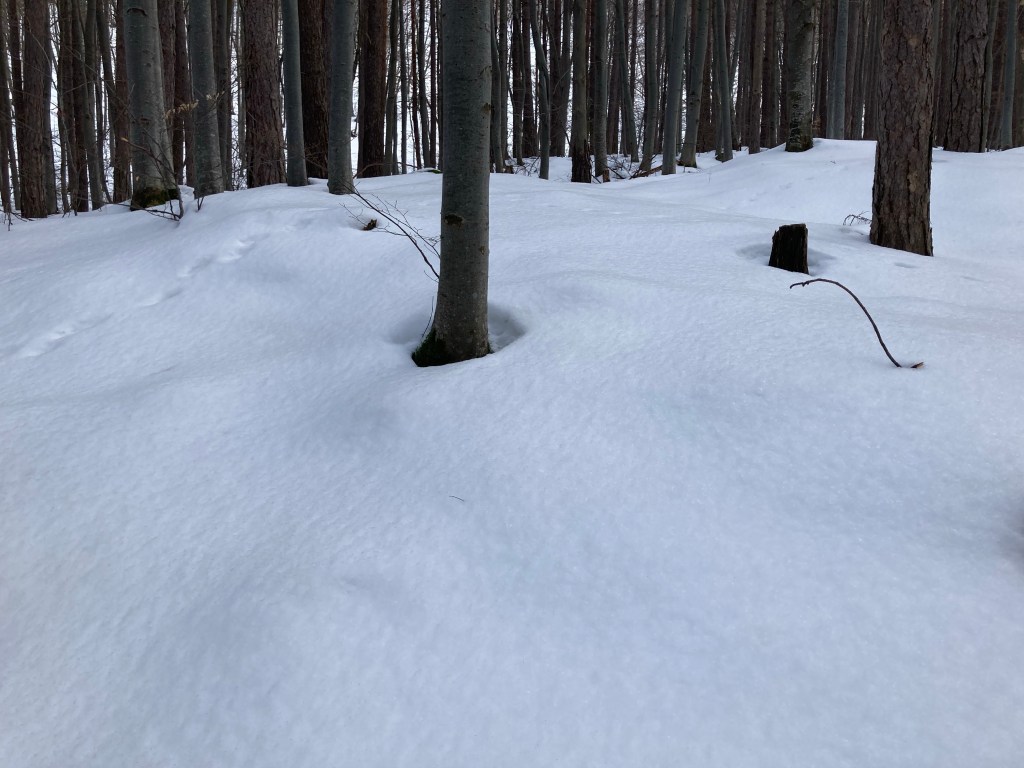
Snow and beeches!
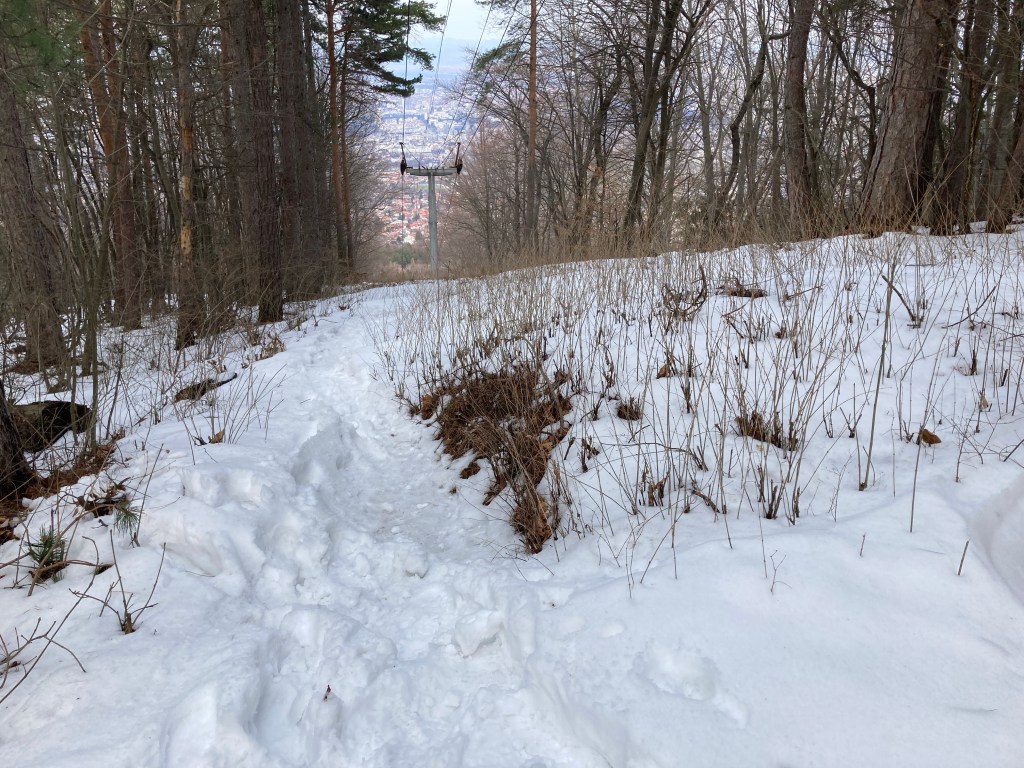
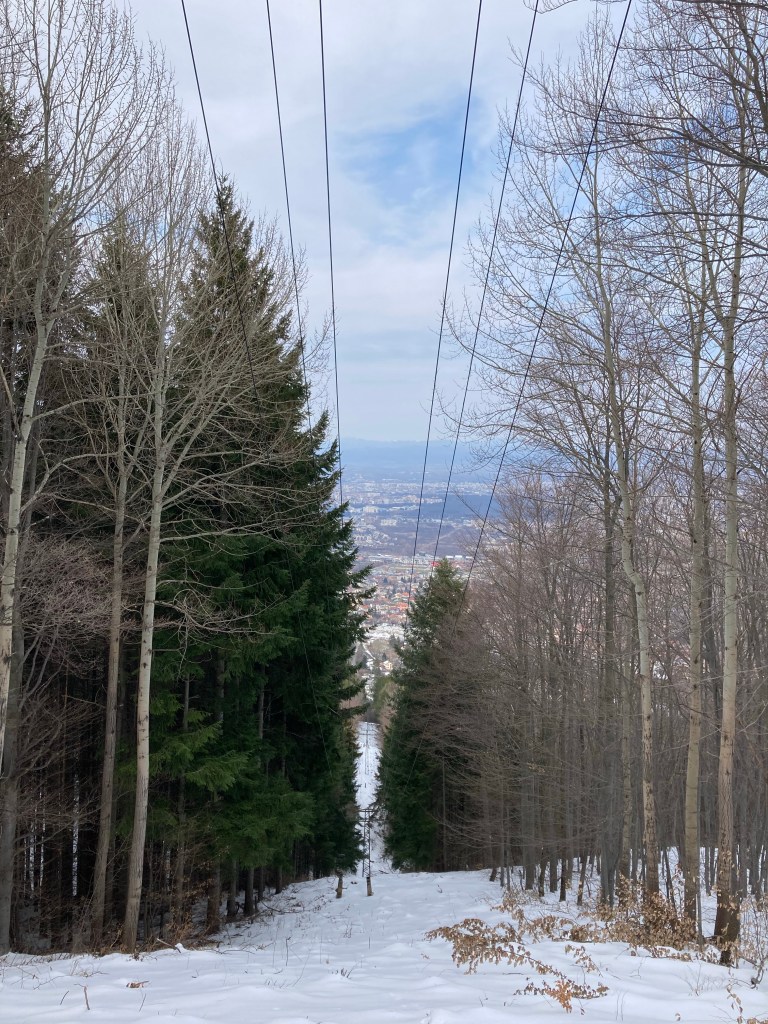
The disused Dragalevtsi chairlift, with Sofia in the background.
More cables cut through the forest, offering another view of Sofia.
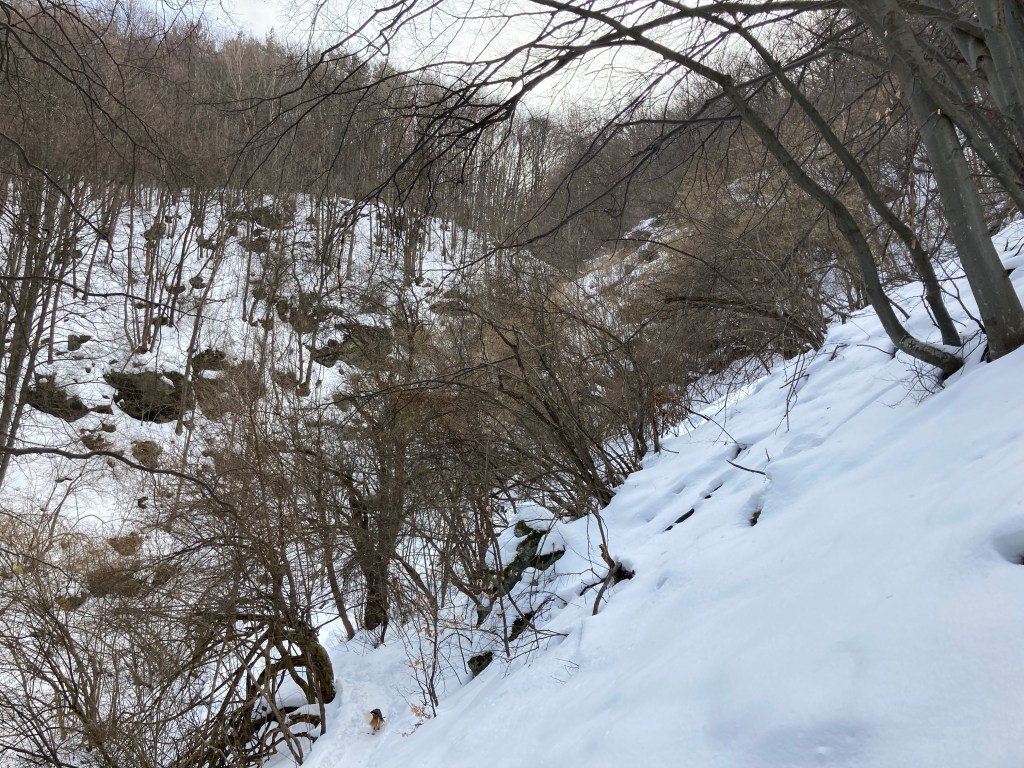
Beneath the snow is one of many moraines – rocks left by glaciers – on Vitosha Mountain.
Small trees pushing against the odds.
Rock formations.
The rocky outcrop just before the waterfall.
From here you are within touching distance of the waterfall.
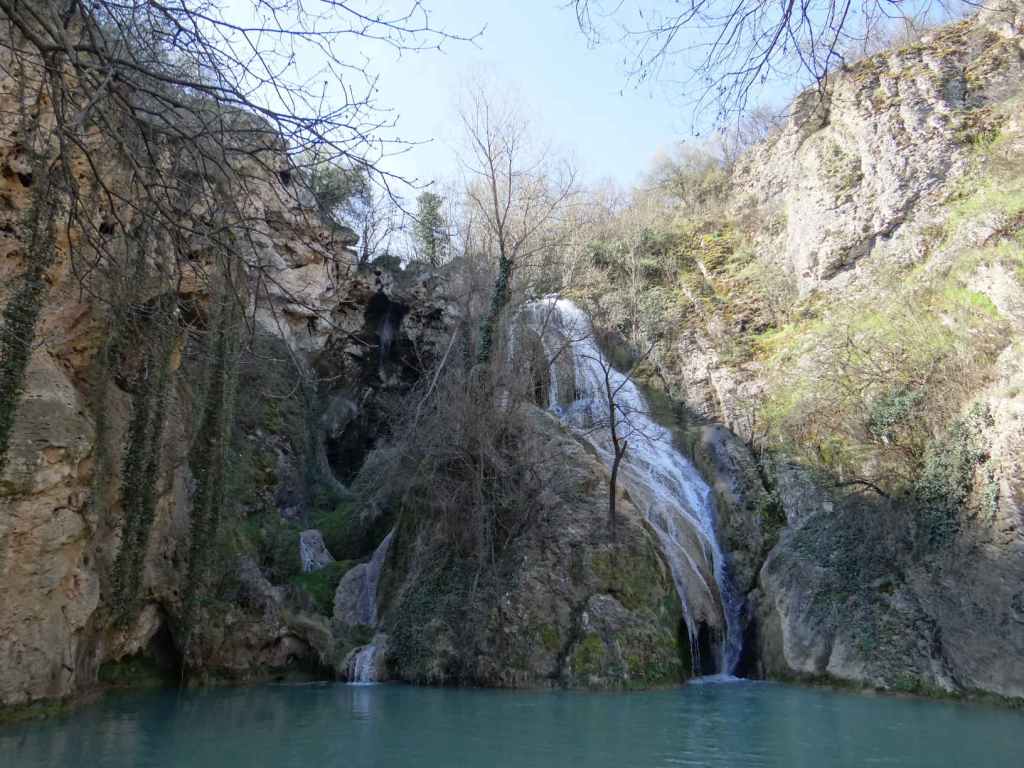
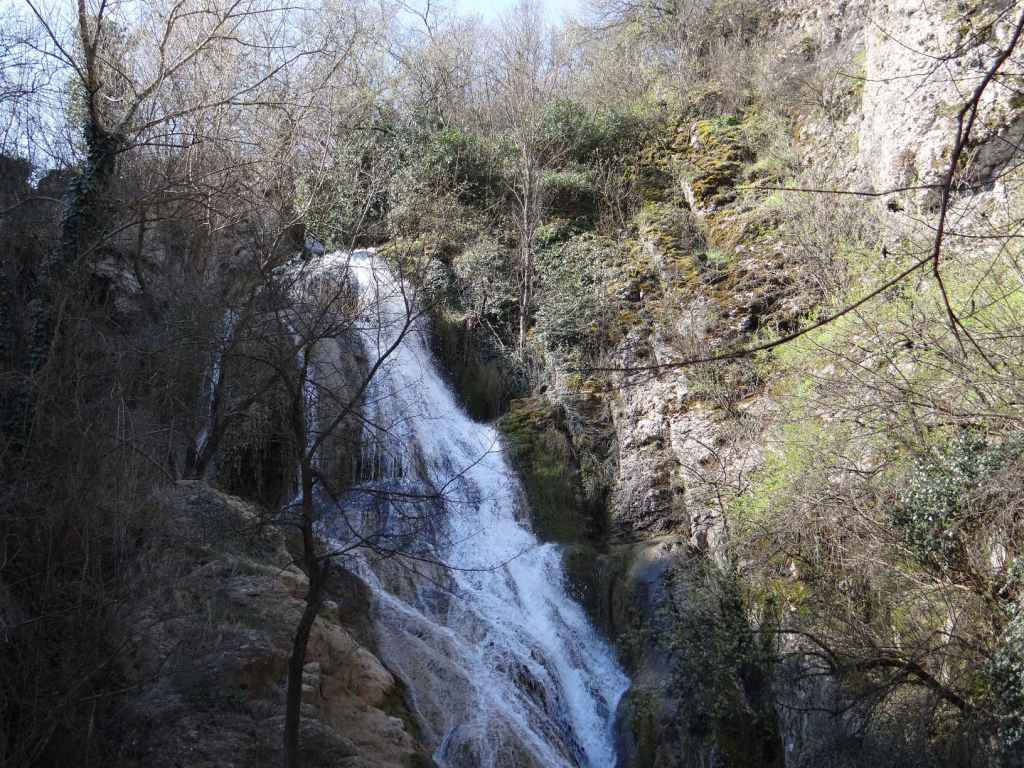
The waterfall, which in February was partially frozen.
A more general view of the waterfall.
The rocky outcrop offers one of the best views of Sofia.
Chavdar is a pretty village about seventy kilometres due east of Sofia, a little south of the main road, the E871, that connects Sofia with Burgas on the Black Sea coast. This road runs alongside the Balkan mountain to the north, so from Chavdar and the walk to the nearby waterfall of Kazanite you get wonderful views of the Balkan itself. To the east, you also get a glimpse of the industrial town of Pirdop.
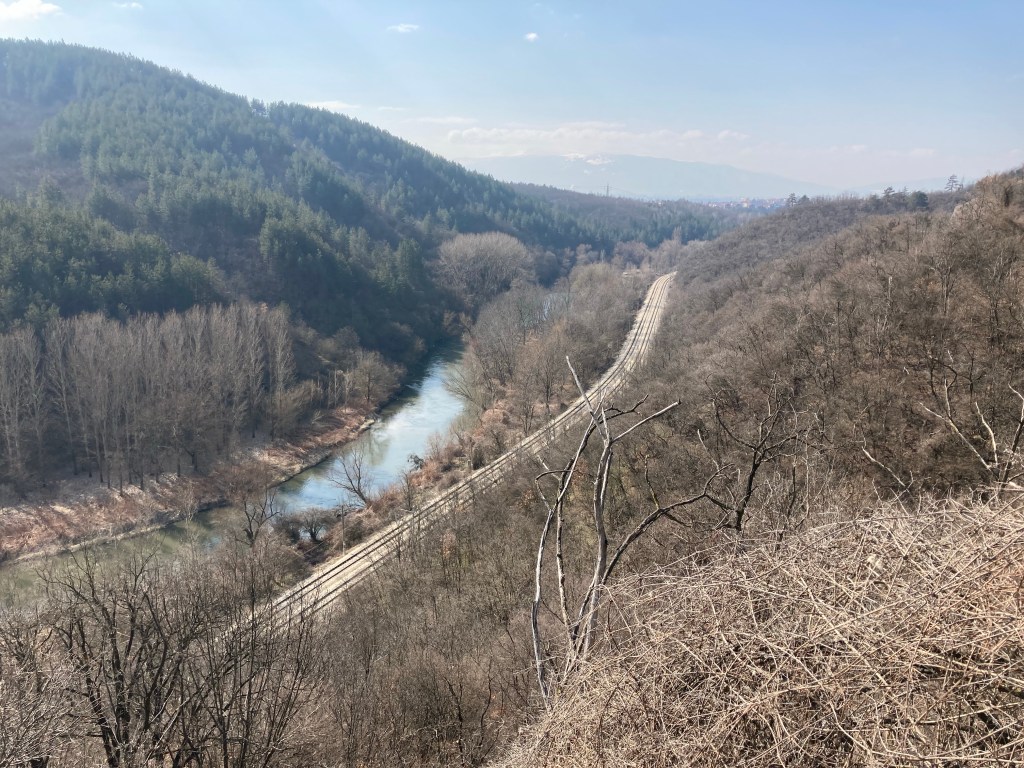
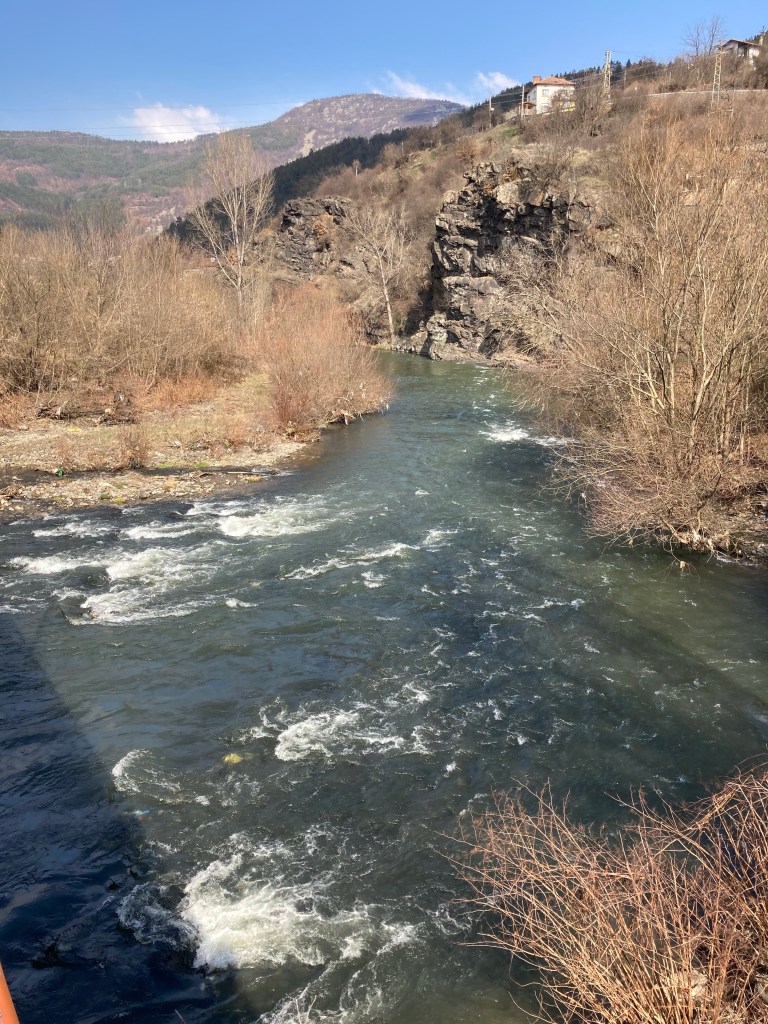
You drive straight through the village and continue for another three kilometres along the asphalt road until you reach the river Topolnitsa, a beautiful river that looks like elephant hide. Here the asphalt road becomes a dirt track. We went in January and decided to park the car on the verge just before the bridge. You then walk about 700 metres along the dirt track in front of you before cutting through the forest on your right (there is a signpost), again along a rutted track that climbs the side of the hill, offering wonderful views of the Balkan and Pirdop behind you.
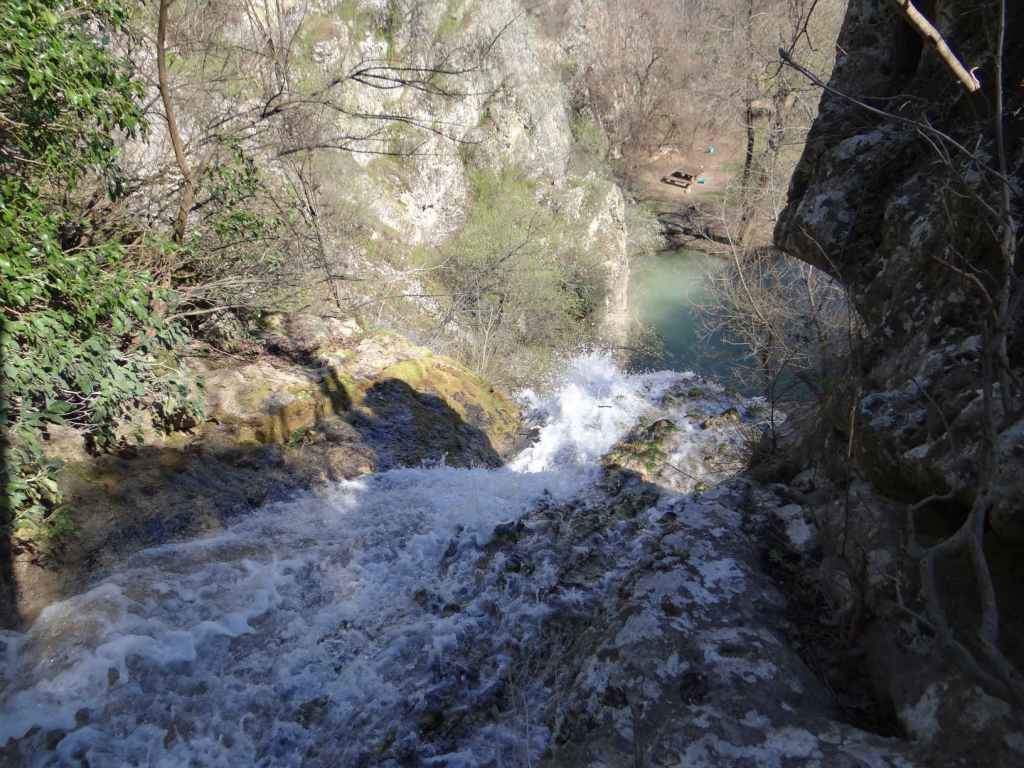
You reach the top of the hill, and the track begins to descend. Shortly afterwards, there is a steep path going directly down to the waterfall. Again, this is signposted. The path leads to a metal bridge over the waterfall and to a picnic table on the other side, next to the stream (a tributary of the Topolnitsa). From here, you can see the top of the waterfall, but the only way to get a general view of the waterfall like the one in the photos is to backtrack a little and then edge your way along the side of the stream until you can see the waterfall in front of you. The ledge you walk along is narrow, so this is not for the fainthearted! You can also walk off the path down to the stream below the waterfall and again look upstream to the waterfall, though from here you will only see the lower part of the waterfall.
The waterfall is called ‘Kazanite’, meaning ‘The Cauldrons’ in Bulgarian. The various pools look like cauldrons, the running water is the ingredients being stirred. In the photos below, you can see the walk to the waterfall, which takes about an hour and a half, and the waterfall itself. A perfect day out from Sofia. On the way back, you can stop in the village of Chavdar and have a drink in the centre.
The river Topolnitsa, where we left the car.
A view alongside the Topolnitsa.
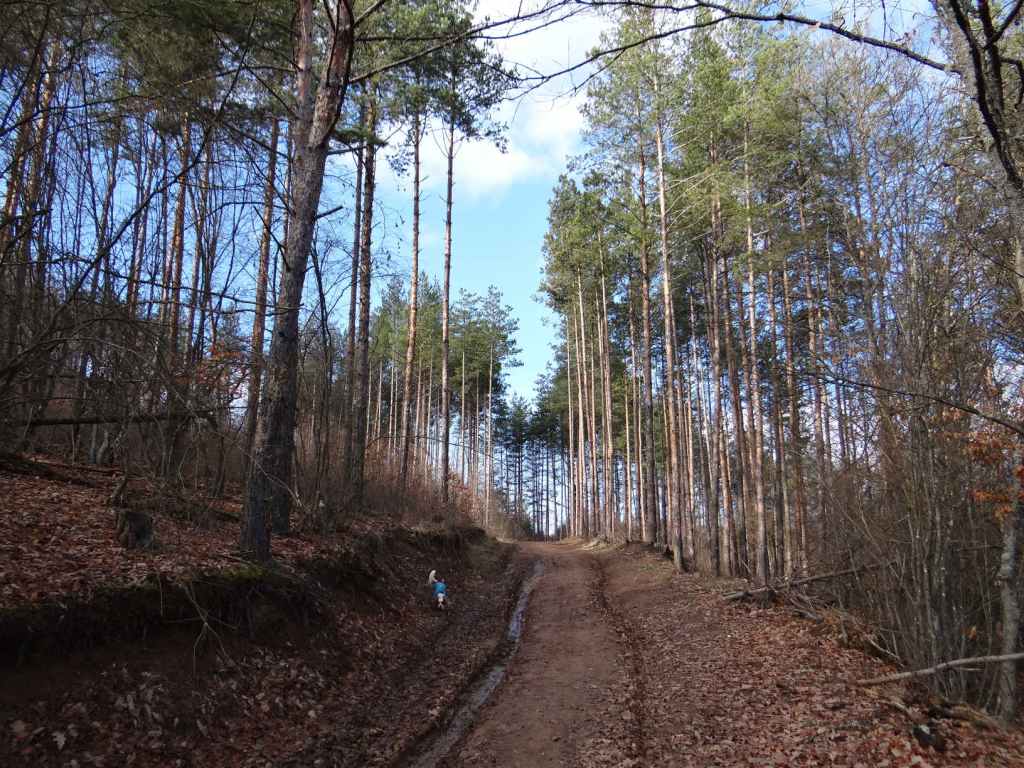
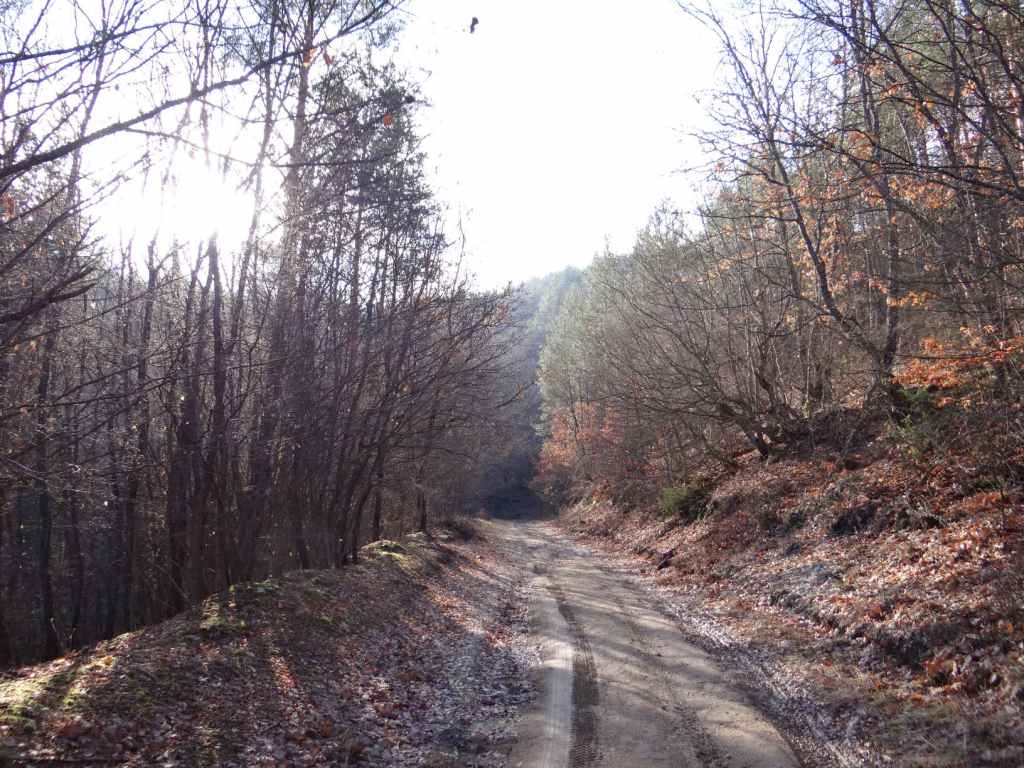
The rutted track running through the forest.
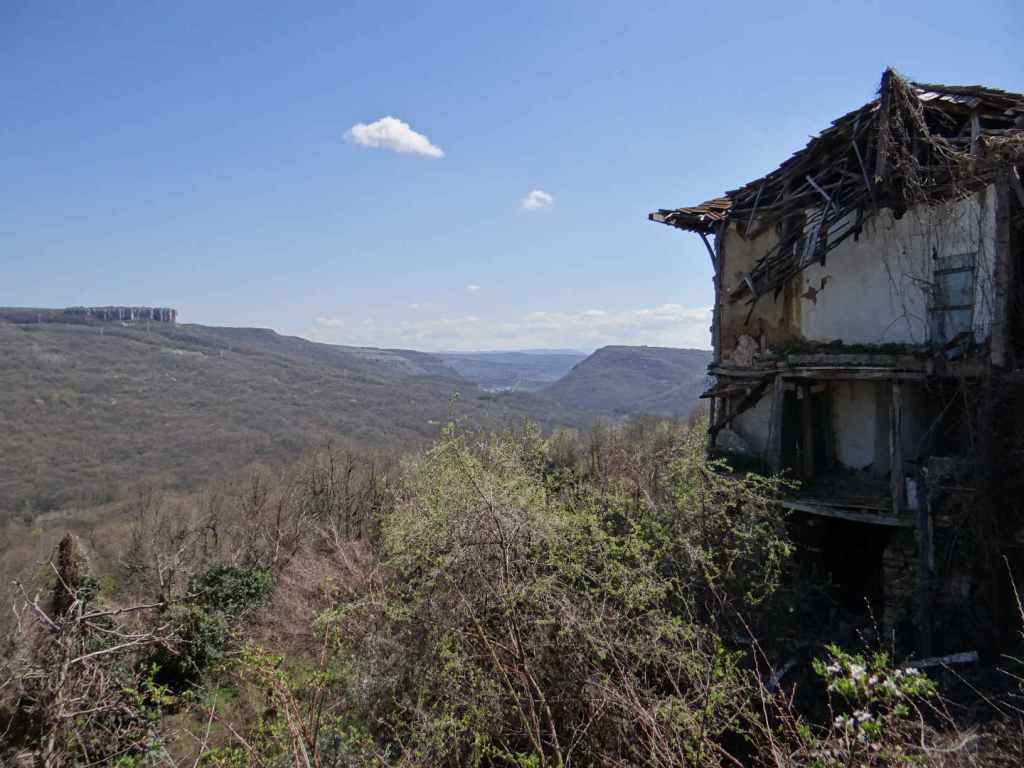
A view west (the side of the hill is being mined for something).
Beautiful white winter blossom.
Looking back – the Balkan mountain to the north of Chavdar and the E871.
The road ahead!
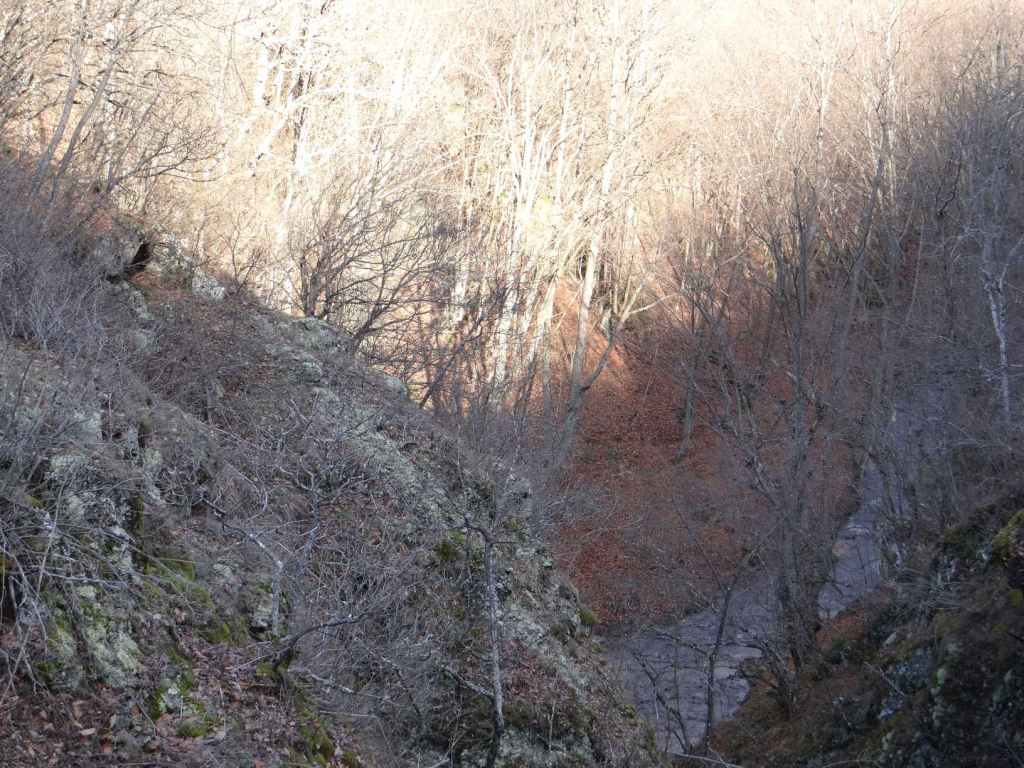
The bare forest – down below is the stream that creates the waterfall. We are nearly there!
The short path leading down to the bridge over the waterfall.
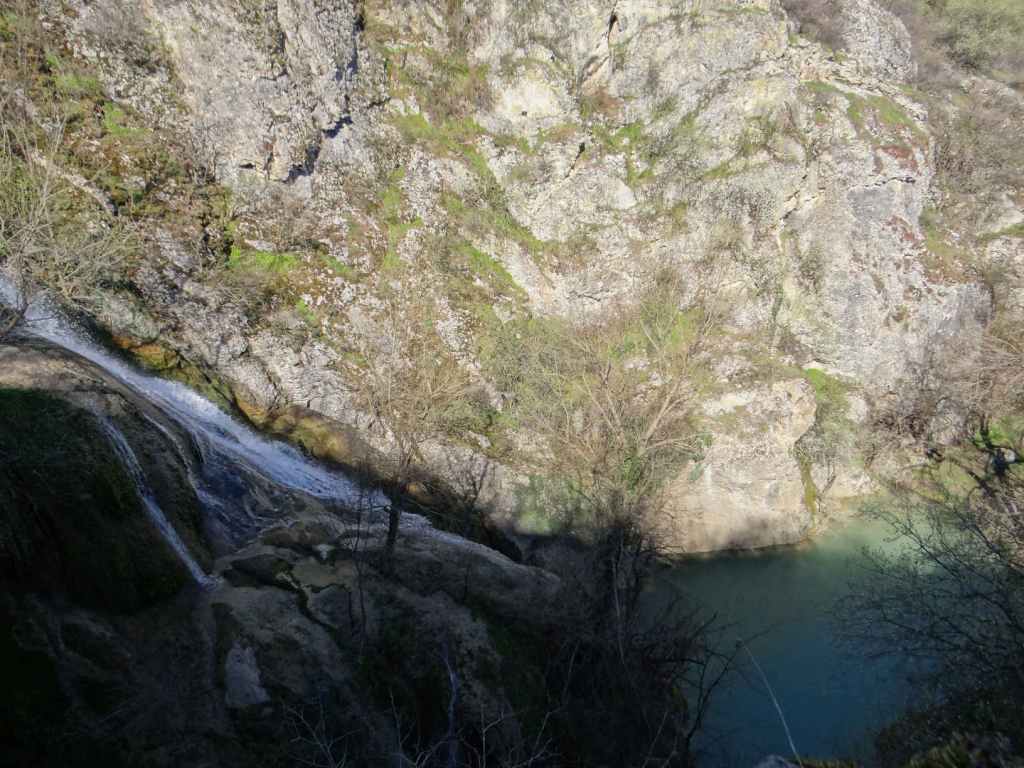
A general view of Chavdar Waterfall (I am standing on a ledge!).
A close-up of the waterfall. Note a waterfall comprises two things: the water and the rock around it.
A fiery heart in the forest. You can see the stream below the waterfall and an open area to the left.
Ditto. You can see the path on the left, which has a wooden handrail.
The open area next to the stream below the waterfall. You have to leave the path to get here.
Looking back up to the lower part of Chavdar Waterfall, with a January sunset.
Today I revisited Izgrev, meaning ‘Sunrise’ in Bulgarian, the old artists’ and writers’ quarter of Sofia, where I lived when I first arrived in Bulgaria seventeen years ago. It’s obvious my wife, a poet, is the one who found me the flat. I used to enjoy living in this quarter, it was quiet, relatively small, there were one or two embassies, a disused railway track and, on the other side of the track, a very cold swimming pool. You could even catch a bus to go to Vitosha, the mountain that overlooks Sofia from the south (in those days I didn’t drive, that would come later). I lived in a flat on the eighth floor of a high-rise, perhaps twenty floors in all, six apartments per floor. I remember people being friendly and cultured. There was a family whose daughter was a professional pianist and she used to practise at dizzying pace in the afternoons. There was a lovely old couple that lived upstairs, but unfortunately their son (perhaps to forge an identity of his own) used to be up and about at night, and his bedroom was on top of mine. This is one of the reasons I left the apartment after little more than a year. The other was a drunk who lived downstairs and who would get inebriated on vodka on a Friday night, come home, put his music on loud and throw up in the toilet (I was still able to make this out over the loud music). It wasn’t a bed of roses, but I was experiencing my first taste of Eastern Europe, a culture shock for someone who had lived in England and Spain before that, but one that has served me well. The flat was comfortable and cosy, and the icing on the cake was a house martins’ nest just outside my bedroom window. I used to watch the adults flying at exactly the height of my apartment over breakfast. Unadulterated joy. I also did a lot of work there, and translated my first and only Catalan novel, In the Last Blue by Carme Riera, winner of the Spanish National Book Award, about the persecution of Jews on the island of Mallorca in the seventeenth century.
I grew up in a village in Surrey and one of my first memories is visiting the local woods. To my good fortune, it turns out Izgrev has a wood and I used to immerse myself in this wood, going for walks every day, leaving behind the slightly grey high-rise blocks (and the car alarms) and seemingly entering another world. The forest took me in. I think it understood I had recently left my familiar surroundings, so it took me under its wing, so to speak. It accepted me. I spent many hours circumambulating the forest, walking around its furthest extent, then diving into the interior, criss-crossing the wood, until I reached the very centre, where there stood a tall sequoia tree. Some days were better than others, but I grew to love this wood, and I think this wood loved me. There was one particular gentleman, a fellow walker, who used to be there as much as me. He would walk around with his head in the air, looking upwards, his gaze distracted, as if he had entered another dimension. I’m not even sure if he noticed me. Or perhaps it was just the thick glasses that gave him this otherworldly look, as if he had climbed further up the ladder of divine ascent. I wondered what he could see, what it was I wasn’t seeing. The world can seem so two-dimensional from transport (a car or a train), even three-dimensional when we are in it, but it is difficult to reach further in, to enter the code, to strain our eyes. We must wait for the vision to come to us.
The sequoia tree at the heart of Izgrev Forest.
I took solace in this forest. I remember a Romanian-Nigerian couple coming to stay for a night, and I religiously took them on my daily outing, a swift walk around the forest’s outer border. We couldn’t walk next to each other, the path wasn’t wide enough, and it was getting dark, so we walked in single file, with me leading the way. Goodness knows what they made of this quasi-nocturnal outing, but they never said anything and smiled all the way.
Today I went back to the forest, the path that leads away from the high-rise buildings, up into the woods. A short ascent, and then you are on the level. I started by following the main path all around the forest, busy roads limiting its extent on every side where there are not buildings. Then I cut in along a path I knew in order to get back where I had started. It seemed to take much less time than I had anticipated. Perhaps twenty minutes in all. And I had been expecting a single circuit of the forest to be enough. I was a little disappointed. Had the forest become smaller in my absence? No, it seemed the same. Was it because it was winter, and I could see through the trees, which therefore gave the impression the forest had shrunk? Or is it that, in order to package our memories, we make the places we have been to smaller? They expand when we are there, when we live in a place on a daily basis, but when we leave, they contract in order not to occupy too much memory on the hard disk of our minds. It felt like revisiting an old girlfriend. You wondered what all the fuss had been about. The world – what am I saying, the universe – you had shared now seemed small and provincial. Your life lay elsewhere. In the intervening period, I had got married, had a child, learned to drive, been through a wealth of experiences. And that little pocket I had explored so much now seemed just that – a little pocket.
Sometimes I wonder if the world is all flat. When we visit a place, we blow it up, like a balloon, and it expands in order to contain our life, our loves and experiences, and when we leave, it deflates again, like a balloon after a party.
I didn’t go there to revisit my past. I went because it’s New Year’s Day and I wanted to give Simi, our dog, a run-around. We were a bit late to go all the way to the mountain, Vitosha, so I took him there instead. He was happy, charging ahead, choosing a path when there was a fork in the expectation that I would go the same way and then charging back when I chose another (which I invariably did), his nose close to the ground. I wondered what it seemed like to him. After all, he’s only about half a foot tall (a foot, if I include his tail). The trees must seem enormous. They must multiply him about sixty times. Did he realize when I was retracing my steps, taking a path for the second time or in the opposite direction? Or was it all new to him, virgin territory to explore? (Does virgin territory even exist for dogs, can’t they always smell who’s been there before?)
Izgrev Forest.
We reached the end of our walk, Simi didn’t seem too unhappy to leave. He’s very accommodating. We passed the Korean restaurant on the ground floor of a house (so that was still working – why hadn’t I ever gone there to eat?), went past my old block with its bench out the front, seemingly inviting neighbourly conversation, past the supermarket where I did my first shopping (did Bulgarians even eat the same food as we did?), and back to the car. We hopped in, I did a three-point turn and drove back the way we had come, past the Russian Embassy compound and the garden dedicated to Peter Deunov. I left behind this remnant of my past and returned to the world I am in.
Turner paid a visit to the Schöllenen Gorge in 1802. This gorge is formed by the upper Reuss, a river in Switzerland, and provides access to the St Gotthard Pass. Turner made several drawings of this scene, like the one I would like to talk about, The Devil’s Bridge and Schöllenen Gorge, some of which he later turned into paintings.
The bridge, called the Devil’s Bridge, had recently been destroyed during fighting between the French and Russians in 1799 (the War of the Second Coalition, part of the French Revolutionary Wars) and had just been rebuilt when Turner visited. The figures in white on the left of the bridge are thought to be Russian soldiers, and on the right can be seen some pack-mules on the track as it leaves the bridge.
This is how far a physical description of this drawing would go, but the Bulgarian poet Tsvetanka Elenkova in her poetry collection Turner and the Uncreated Light offers a spiritual vision of this drawing, as she does of numerous paintings by Turner, so that we, the viewer, might go further than the physical vision and discover something new, something that critics have overlooked (among them John Ruskin, who described this drawing as ‘curiously bad’).
The first thing we note, as I myself noted some fifteen years ago, at the beginning of my spiritual journey, are the faces in the rock. Look at the rock behind the bridge, above the Reuss Falls. These faces are often recumbent, gazing upwards (not at us), as if towards the other world (or something that we cannot see). There is one in the lighter (brown) patch on the right. You can clearly see the hair, the thick eyebrows, the eyes, the nose, the fleshy lips. There is another on the left, where the Falls begin, looking slightly perturbed. I have walked on the mountain near Sofia, where I live, and often come across such faces. They seem frozen in time, as if awaiting reanimation. They do not communicate, they simply look (beyond you). I think Turner here has faithfully drawn the landscape, and this landscape contains faces (as we often find in clouds, for example, or other aspects of nature).
But what the poet pays attention to is the shape of the gorge, which from the top of the mountains down to the arch of the bridge forms a chalice. The Falls would be inside this chalice, and the thin stream of water that falls down in a vertical line would be the stem of the chalice. I think once you see this chalice, it is difficult to look at the drawing without seeing it (this is typical, in my experience, of spiritual vision, it is like a security door at the airport, once you go through it, you cannot go back and unsee what you have seen).
Particularly remarkable is the cliff face on the right, beneath the track with the pack-mules, because here there seem to be two or three figures of saints. The one in the middle is very clear. We see their upper half, the vestments, the darker skin and hair, and a very distinct halo. Anyone who is familiar with an Orthodox church will know that in the altar at the far eastern end of the church, the frescoes in the first row often depict Church Fathers (Basil the Great, John Chrysostom, Gregory the Theologian). These figures are often very tall (in comparison, for example, with the figures in the next row up, which shows the Communion of the Holy Apostles). So Elenkova concludes that we are in a kind of stone church, the centre of which is the chalice (in the Orthodox liturgy people commune from the chalice, the body and blood of Christ are given together directly from the chalice in a spoon).
Elenkova understands the Russian soldiers on the left to be priests (dressed in white). They are bringing the gifts in order to offer them to the people and from the people to God. And we see that the figure or pack next to the mule on the right (it is difficult to make out clearly) has a red cross.
But perhaps most important for the poet is the figure of a child wrapped in swaddling clothes that can be seen inside the chalice (top left). It is as if we have a depiction of the whole life of Christ on this earth, from his nativity to his bloody crucifixion (the red cross). There would be no crucifixion – and resurrection – without the nativity, no less remarkable in itself, that God should become human. As the poet says, in a way it is to be expected that God can resurrect, he is after all eternal, but to take on human form, to contain himself in his mother’s womb and to be born into his creation, is unusual.
From this nativity comes all the teaching, the miracles, and then Christ’s crucifixion and resurrection, leading to the celebration of the Orthodox liturgy and the communion of the people.
So again, the poet offers us a spiritual vision of Turner’s paintings and drawings, and this vision is very important for us to begin to see the world we live in. If we don’t see the world we live in, then we are walking in darkness and we are liable to make the wrong decisions. We are, in effect, the blind leading the blind because our spiritual eyes haven’t been opened. The problem with spiritual sight is that we don’t realize we don’t have it. Once our physical eyes are opened when we are babies, we think that we can see – ourselves in a mirror, the world around us (which we generally think has been put there for us to do with what we like). But we are still missing an essential element – the intrinsic worth of things. And this spiritual sight is only given to us when we believe, when we turn our hearts to God and begin to participate in the sacraments of the Church. Christ healed the man born blind in John, chapter 9. We are all the man born blind, in need of having our spiritual eyes opened so that we can see, which is the journey of the mind into the heart, the purpose of all Orthodox asceticism.
There is a very important distinction in grammar between countable and uncountable nouns. Uncountable nouns are generally concepts, things that have no boundaries, that cannot be circumscribed (a line cannot be drawn around them). Examples would be ‘love’ and ‘righteousness’. Countable nouns are nouns that can have a line drawn around them, they can be separated in our imagination from the rest of the environment. These nouns – and this is very important – are preceded by the indefinite article a or an. Examples would be ‘a house’, ‘a car’, ‘a person’. Compare the concept of ‘light’ with the countable noun ‘a light’. ‘Light’ is what fills the sky. ‘A light’ would be a single bulb – that is, it can have a line drawn around it and be contained.
When God created man in chapter 2 of the Book of Genesis, what he did was create a countable noun – a being separate from him (with its own free will). Of course, ‘man’ (here it is uncountable, it is not preceded by the indefinite article) is contained within God, he can never be quite separate, but ‘a man’ is allowed his own free will to make decisions, to believe in God or not, to love or hate, to react with kindness or anger…
The name that God reveals to Moses at the burning bush in Exodus 3:14, for me the most important verse in the Old Testament, is ‘I AM WHO I AM’ or simply ‘I AM’. Most of us would say ‘I am Jonathan’, ‘I am Rebecca’, etc. But God says only, ‘I AM’. There is no need for him to add a name because he is everything. Now in the study of speech sounds (called phonetics, the study of where speech sounds are produced in the mouth), the consonants, the hard sounds, so to speak, are divided into seven pairs, one of which is m-n. These two sounds are produced close to each other in the mouth.
If we apply this pair to the name of God without the personal pronoun, AM, we get an, the indefinite article. We can understand that from God came an individual human being, a countable noun. And if we put these two words one after the other, we get AM an – which is to say that God created a man.
The letter a is the first letter in the alphabet, it comes at the beginning, and so it is the letter I most associate with the act of creation (described in chapters 1 and 2 of the Book of Genesis). What was the name of the first man? Adam. If we turn Adam around, we see that he was made (I have allowed fluidity to the final vowel so that a becomes e).
Adam’s partner was Eve. Here the dominant vowel is e. We are progressing in the alphabet. Eve resembles another word very closely: eye. Now we are drawing close to the vowel i because eye and i sound the same.
When Adam and Eve ate of the fruit of the tree of knowledge, they didn’t heed God’s command, they turned away from AM and said I’m, they made this progression from the vowel a to i.
The reverse of man is name, and that indeed was man’s purpose in Genesis, chapter 2, when God brought him the creatures to name (not to make). Name, with the letters rearranged, spells mean (by naming the creatures, he gave them meaning) and amen (Adam agreed with God’s plan for him). In the Fall, however, together with Eve, he took the fruit and said not amen anymore, but mine. Again, he replaced the vowel a with the vowel i.
We live now in the era of the i. This is the vowel that is used to represent the ego in English: I. In the system we have at the moment, it is every man for himself. Yes, we may receive some help, but basically every person has his or her own money, his or her own address, and has to struggle, more or less successfully, to make ends meet.
Where do we go now that we have succumbed to the wishes of the ego, of the I? Well, if we treat the ego (I) as a number (1), there are two ways we can go – upwards (2) or downwards (0). We can start to count (the objects around us, all of which are countable nouns – this is how we package and sell them) or we can make the much shorter journey to zero (a word, by the way, that is very close to eros).
The Latin alphabet, the alphabet we use in English, counts up. The last letter of the Latin alphabet is Z, so in effect it counts from I to Z (1 to 2). This would reflect a more rational, self-reliant way of thinking, a view that treats the world as a way of making money.
As an aside here, I would like to ask why it is we teach our children the basic skills of writing and counting. Is it not in a sense to record what is in the world by writing down what there is and counting it? Are we not instilling this rationalistic way of thinking in our children from the very start (not to mention the huge emphasis placed in school on marks)?
The Greek alphabet, on the contrary, counts down. The last letter of the Greek alphabet is omega, which we can write O (it is a long o; there is also a short o in Greek, omicron). Greek is the language of the Gospel, so this would reflect a God-oriented way of thinking.
The other way of writing omega is W (this is how it is written lower case in Greek). If we put the three vowels I have talked about – the A of creation, the I of the Fall and the O of spiritual enlightenment/repentance/recognition – together, we get AIO. If we use the Greek way of writing omega, we get AIW.
Now what is very interesting is that this progression of spiritual growth that puts God (0) at the centre of the picture is found in the name of God himself: I AM. All I have to do is turn the W upside down. God is indicating to us the path that we should follow – we should turn to him.
What is the most famous aspect of the Old Testament, of the Jewish Bible? It is the law – Moses received the Ten Commandments when he met with God on Mt Sinai; the Jews are famous for their rules and regulations (Jesus is often criticized for healing on the Sabbath); and indeed Christ, in the New Testament, says that he has come to fulfil, not to abolish, the Old Testament law (‘not one letter, not one stroke of a letter, will pass from the law until all is accomplished’, Matthew 5:18).
The word law contains the same progression, AIW, and is clearly related to the name of God in Exodus, I AM.
What of the New Testament then? Is there any indication in language to support the belief that Jesus Christ is the Son of God (who he says he is)?
In John 14:6, Jesus says to Thomas, who has asked how they are to find the way to heaven, ‘I am the way, and the truth, and the life. No one comes to the Father except through me.’
Here we find the third word that is related to the progression AIW: I AM – law – way. The letter y is the semi-vowel that corresponds to i, they are often interchangeable. Note that Jesus says, ‘No one comes to the Father except through me.’ We could rewrite this, ‘No I comes to the Father except through me.’ That is, each individual I must pass through him.
And so we find that the whole purpose of the spiritual journey in this life (AIW) is found in the name of God revealed to Moses in Exodus 3:14 (I AM), is found in the law that Jesus came not to abolish, but to fulfil, and is found in Jesus himself, who is the way.
There are many other confirmations in language that Jesus is the Son of God. Let us take the word Messiah, which is a combination of the name of God, I AM, and she (the Virgin Mary). I have written about these confirmations in my book Stones Of Ithaca.
But there is one other confirmation that Jesus is who he says he is that I would like to include here. At the beginning of John’s Gospel, John the Baptist sees Jesus coming towards him and declares, ‘Here is the Lamb of God who takes away the sin of the world!’ Jesus is the sacrificial lamb who will be sacrificed on the Cross to atone for our sins. He will take our sins upon his sinless self. He will take the blame for our sins (lamb and blame are clearly connected, as are words like balm and psalm).
But let us look a little more closely at the word lamb (the last letter of which is silent). Again we see the name of God, I AM, in the first three letters.
The whole of the Bible can be reduced schematically to: I AM – law – way/lamb. Here we find a spiritual map, so to speak, an indication of the road we must take, which passes not through counting the objects around us and dealing in them (often to the detriment of the environment and of our fellow man), but in placing God at the centre of our lives and acknowledging him.
Turner’s painting Sun Setting over a Lake is one of a group of paintings, ‘Late Unfinished Sea Pieces’, whose dating and provenance are uncertain. They are generally dated to the period 1830-45, though some people disagree, and there is some suggestion that Turner’s assistant, Francis Sherrell, may have had a hand in them.
Then there is the subject matter. As always, what seems to concern the critics is the visual evidence. What can we see? Except that they always focus on the physical details. So regarding Sun Setting over a Lake, the display caption says, ‘The topographical details of this painting are hazy and indistinct […] passages of white paint may depict snowy Alpine mountains.’ And the catalogue entry ends, ‘Whether the picture shows the sun setting over a lake or the sea is difficult to determine, but the presence of what appear to be mountains on the right suggests the former.’
Which is to say we haven’t the foggiest and must make of the painting what we will. Turner’s impressionistic style (which is contrasted in the catalogue entry with an earlier more substantial, three-dimensional style) puts paid to objects. This is very interesting for me, because I think many of the world’s problems come from our obsession with objects. The fact that you define something as an object suggests that object doesn’t have its own will and you can do what you like with it. Trade is based on this premise, and trade is what drives the economy.
But this is to miss the inner vision of things, their true value. I have already written two articles about the Bulgarian poet Tsvetanka Elenkova’s inner vision of Turner’s paintings, which she has recorded in a book of poems entitled Turner and the Uncreated Light (forthcoming in both Bulgarian and English). These articles can be read here and here.
Let us focus on the painting in question, Sun Setting over a Lake:
Well, I can make out a sun on the left, a bright dot, and a splodge of white paint on the right with a bluish patch. There is the suggestion that when a painting of Turner’s is impressionistic like this, it may just be unfinished, but as Elenkova points out in another poem, after Michelangelo the fact that something is unfinished doesn’t make it imperfect.
Impressionism allows us to enter the true value of things. It takes us away from our three-dimensional vision of the world by which we like to control the things around us. This painting is a case in point. Let us start, as we did with the painting Snow Storm – Steam-Boat off a Harbour’s Mouth, by rotating the painting by ninety degrees:
Now the vision becomes more interesting. There is the figure of a man. Where the sun is is just below the mouth, on the right cheek. Above this is the hazy outline of a nose, two eyes, and a dark patch of hair. Underneath the sun can be seen the man’s neck, and on either side the two shoulders. Not all the torso is visible, but what we can see very clearly is the windpipe. The torso is an upside-down triangle. Above the man’s left shoulder is what looks like the kind of handprint found in primitive cave paintings. This part of the painting relates to this world.
Now rotate the painting by ninety degrees the other way:
What we have now is an angel. Again, the torso is only partially visible, an upside-down triangle. The angel’s neck is stretched upwards, and the angel is in profile. We see a chin, the lips, a nose, a bright patch on the forehead. The angel’s vision is directed heavenwards, and over his right shoulder can be seen the bright patch of a wing.
Where the handprint was in the other half of the painting, above the angel’s left shoulder, there is a dove, which in the poet’s vision would represent the Holy Spirit, whispering words to the angel.
When we return the painting to where it was:
in the foreground, right of centre, we see the figure of an owl on what looks like a branch.
Was Turner aware of all these details in his painting? I’m sure he wasn’t, but they are there, if one chooses to see the spiritual side of things. And it is this spiritual vision that the world has need of, not to see things as bringing us profit (the world of politicians), but as having an intrinsic value in themselves.
Why are we not exposed to this kind of vision? And why do we not pass it on to our children? You can read as many academic books as you like about Turner’s painting, I am quite sure you will not find this kind of vision. They will limit themselves to what has been recorded by contemporaries, to what the author can see, to how one painting relates to another. This is all very interesting, but it doesn’t take us out of the physical world we live in.
And this spiritual vision is also important when it comes to saving the planet. We give great importance to the physical environment, as we should, we live in this environment, but we must also be able to see the essence of things, their inner meaning, otherwise we won’t make good stewards and our decisions may be skewed. It is not just the environment, but also what is behind or inside the environment, what inspires it.
I have no doubt that Elenkova’s poems will have a difficult reception in both the Bulgarian- and the English-language spheres. They may not even find a publisher all too easily. And yet I would say their vision is essential for our well-being.
It is remarkable that the number 1 is a straight line. We teach our children to count from the number 1 upwards, and when we learn a foreign language, we do the same. But the line separates, it forms a barrier. It is also unstable. A wall can come crashing down, a tower topples.
What is also remarkable is that the ego in English – I – is also a straight line and very similar in appearance to the number 1. So when we teach our children to count from 1 upwards, we are in effect teaching them to start with the ego. This conditions all our thinking. We start with ourselves, instead of starting with the other.
We should actually start with the number 0. 0 stands for the Other. It also stands for God, since 0 represents infinity and is unending (it goes round and round). We might even see that the word G O D is made up of three zeros, one after the other, and this will be important when it comes to understanding the word ONE.
Christianity is full of paradox. Christ says, for example, that we must lose our life in order to find it. This is paradoxical – how can you possibly lose your life and find it? I have discussed this in another article. Another paradox is that the first will be last, and the last first. Again, it seems paradoxical, and I have talked about this paradox here.
Well, one of the biggest paradoxes in Christianity is the concept of the Holy Trinity – that God is three in one. How can that be? Surely, he is either three or one. How can he be both?
Again, language will give us the answer, because language contains information about the meaning of life, about God, ourselves, existence, the world, the creation, the Fall, etc.
It will be easier to understand if we write it in the following way: three in ONE. The Holy Trinity is made up of the Father, the Son and the Holy Spirit. Three persons, but one essence. The Son is begotten of the Father before all ages. The Spirit proceeds from the Father (and not from the Son, as is recited in the Creed in Western Churches, a later addition).
Three in ONE. Three distinct persons, but one essence. Let us imagine that God the Father is 1, God the Son is 2 and God the Holy Spirit is 3.
We will add these numbers as subscripts to the number 0 or O. So God the Father is O1, which means that he is ‘no one’. The only thing here is that in chemistry the subscript 1 is not normally written down, so we would say simply that God the Father is O.
There is confirmation for this in the Greek language, where the word for ‘God’ is theos. If we omit the final s (as happens in the vocative and is very common in spoken Greek), this can be read the O.
God the Son is O2, which happens to be the chemical formula for oxygen (the air we breathe). And God the Holy Spirit is O3, the chemical formula for ozone, the protective layer that surrounds the planet on which we live.
Now all this information – God the Father as O, God the Son as O2 and God the Holy Spirit as O3 – can be found in the number ONE, because the one number that the number ONE does not contain is itself (1). ONE contains the numbers O, 2 (on its side) and 3 (back to front). It does not contain 1 because in chemistry the subscript 1 is not written down and because there is no selfish impulse in God, there is only love.
Three in ONE. It turns out that this concept of the Holy Trinity is literally true. That is the information about the Father, Son and Holy Spirit is contained in the word itself.
There are other connections. For example, if we combine the Son (O2) and the Holy Spirit (O3), we find that they are present in MOON (the 2 is on its side again, the 3 is on its front). This reminds us of the obvious similarity in sound between Son and Sun, so it would seem that God is the air we breathe, he is the light we see by during the day and he is the reflection of that light in the night, so that we even see in the darkness.
And if we remember that the word for ‘Spirit’ in Greek is pneuma – that is ‘wind’ – and that the letter that represents breath in the alphabet is h, then if we combine the Son (O2) and the Holy Spirit (this time written as H), we find that they make up the chemical formula for water: H2O. This means that we drink God as well.
God is all around us. He is ‘everywhere present’. He is even in the language we speak. Since we are translators, there is nothing in this world that is of our own making. All the materials we use were here when we arrived – we transform them into something else, we translate them, just as we translate the air we breathe and the food we eat.
But we have to open our eyes to see him. Eye sounds the same as I. We breathe life into the line and make a circle: O. We open our spiritual eye. When we teach our children to count from 1, we are making life much more difficult for them, because once you start counting from 1, there is no end, you will never reach the answer, when all you had to do was count down to 0.
The Uncreated Light is a very important doctrine in Eastern Orthodoxy that was first formulated by St Gregory Palamas in the fourteenth century, but is intimately connected with the writings of earlier figures such as Gregory of Nyssa (The Life of Moses) and Pseudo-Dionysius the Areopagite (The Celestial Hierarchy). It is defined on Wikipedia as ‘the light revealed on Mount Tabor at the Transfiguration of Jesus, identified with the light seen by Paul at his conversion’. The Wikipedia article goes on, ‘a completely purified saint who has attained divine union experiences the vision of divine radiance that is the same “light” that was manifested to Jesus’ disciples on Mount Tabor at the Transfiguration’.
So Orthodox theology has it that, through a process of purification, a person can experience this light of God in this present life. There was a controversy about this in the fourteenth century, involving Gregory Palamas and Barlaam of Calabria. The latter contended that it was not possible to know God in this way, God is unknowable, but Gregory Palamas made an important distinction between the essence and the energies of God. That is, the essence of God cannot be known by his creatures, even in the next life, but we can participate in his energies, he is communicable to us through his energies, which we can experience in this life.
To experience this divine light, we have to leave behind the world of concepts. We tend to view the world as being full of objects – that is, we rely on our physical sight – and we rely also on our powers of reasoning. We observe and draw conclusions. But at some point we must leave the world of concepts behind in order to progress on our spiritual journey. The website The Ascetic Experience explains it like this: ‘When the intellect has transcended intelligible realities and the concepts mixed with images that pertain to them, and in a godly and devout manner has rejected all things, then it will stand before God deaf and speechless.’ The website goes on to describe the intellect’s proper state in very beautiful terms:
The intellect’s proper state is a noetic height, somewhat resembling the sky’s hue, which is filled with the light of the Holy Trinity during the time of prayer. If you wish to see the intellect’s proper state, rid yourself of all concepts, and then you will see it like sapphire or the sky’s hue. But you cannot do this unless you have attained a state of dispassion, for God has to cooperate with you and to imbue you with His own-natural light.
What exactly is dispassion? I always understand it as not giving in to our natural impulse to, say, get angry or lust after someone or covet property (which is a strange concept, anyway, since in the long run nothing belongs to us but the destiny of our soul). For me, it is as simple as curbing the impulses that cause unhappiness and arguments and disintegration, fragmentation of families and societies. But we cannot do this on our own. We need God’s help and simultaneously we must purify ourselves of the passions by participation in the Sacraments of the Church.
Some people (see the site Sacramental Living) connect the Uncreated Light with the light revealed at the beginning of the Book of Genesis, the light that made Day (as opposed to the sun, the moon and the stars that were not created until the fourth day). Others connect it with the light in the Burning Bush, when God met Moses in the Book of Exodus (the fire that burns, but doesn’t scorch). A similar light is said to descend on the Holy Sepulchre on the night before Easter, from which Orthodox faithful light their Easter candles (known as ‘Holy Fire’). This is the light by which we will see in the heavenly Jerusalem, described in the Book of Revelation (21:23, 22:5).
The Bulgarian poet Tsvetanka Elenkova, whose work I have described in a previous article, connects the Uncreated Light with the bright white light so often found in J. M. W. Turner’s paintings. I would like to look in particular at the painting Undine Giving the Ring to Masaniello, Fisherman of Naples. The display caption for this painting says that Undine is a character in German fairytale written by Friedrich de la Motte Fouqué and published in 1811. Masaniello (real name Tommaso Aniello) was an Italian fisherman who led a revolt against the rule of Habsburg Spain in Naples in 1647. So the caption – and, needless to say, all critics – focus on this background to the painting and how Turner might have got the idea from an opera, La Muette de Portici, or a ballet, Ondine, he had seen in London before carrying out the painting.
What both the display caption and the catalogue entry emphasize, however, is the ‘otherworldly light’, ‘that favourite white light of Turner’s’. Elenkova goes further and decides to give all her attention to the spiritual content of the painting rather than its historical context (which we are so prone to focus on and to pass on to our children). Let us look at the painting:
In the middle of the painting, we see a ball of light. In her poem on the painting, Elenkova connects this ball of light with the Uncreated Light that was revealed to Jesus’ disciples on Mount Tabor, and the figure of Undine to the right she connects with the Virgin Mary. Beneath the ball of light can be seen a hand reaching up out of the sea (we see very clearly the tops of two fingers with their nails), to the right of which (said to be a fish Turner added later on) is what looks like a face (the fish would be the left eye, above it there is some hair, below it the nose and lips), which the poet links to the hand of God and the first Adam respectively. This part of the painting would refer to the creation of the world, and we all know how Adam and Eve ate of the fruit of the Tree of Knowledge and got expelled from Paradise, becoming subject to death and corruption.
On the other side of the ball of light, in the top left-hand corner, against a background of darkness, can be seen the figure of Christ on the Cross, arms outstretched, head slumped. Christ is the second Adam, the one who came to redeem us from our sins, to show us the way back to eternity, but this will be an eternity with knowledge, not a naive eternity in which we are prone to make the same mistake. We will have learned something from the experience of living on this earth for three score years and ten. That is why I always say you cannot go back to the Garden of Eden, to a state of blissful ignorance – our progress must be onwards.
So the ball of light in the middle of the painting is the fruit that the Virgin Mary accepts not out of disobedience, as in the Garden of Eden, but out of obedience, the seed that is implanted in her womb when she is overshadowed by the power of the Most High (Luke 1:35), the fruit that will repair the damage that was done and reopen the way to heaven.
On the left of the ball of light, we see what looks like a meteorite crashing into the earth (said by scientists to be one possible way that life arrived on earth), but look at the reflection of the meteorite in the black waters. It makes what looks like a cross.
Turner, as so often, was lampooned for this painting. Perhaps the critics even thought they could see the signs of approaching senility, since this painting, exhibited in 1846, is one of the last that Turner will paint. There is the suggestion that Turner’s choice of Undine and Masaniello as a subject may have embodied an attack on the Reverend John Eagles, one of Turner’s sharpest critics. Masaniello may have been chosen because of his rumoured friendship with the poet-painter Salvator Rosa. Masaniello’s real name being Tommaso Aniello, Turner may have been playing with the association of his own name with ‘ring’, of which ‘aniello’ is the Italian translation. Finley suggests that there is also an allusion to the French king Louis Philippe I, the object of a number of assassination attempts, while Wallace sees a parallel between Masaniello and Christ with the painting a reflection of Turner’s pessimism over the possibility of Christian salvation.
But what the painting contains is precisely a depiction of Christian salvation, from the first to the second Adam, from creation to redemption! It also provides a link between a scientific explanation of the arrival of life on earth and the Cross. When we focus only on external things, on the historical context, we are in grave danger of missing the point. Elenkova in her poems attempts to correct this physical vision, to offer a more spiritual vision of the paintings and their depth.
The most remarkable part comes at the end of the catalogue entry associated with this painting. When paintings were displayed at the Royal Academy in London, the artists were in the habit of spending a couple of days adding the final touches. The painter W. P. Frith describes how Turner and his neighbour, David Roberts, continued work on their paintings:
Both he and Roberts stood upon boxes, and worked silently at their respective pictures… ‘Masaniello’ was rapidly undergoing a treatment which was very damaging to its neighbour without a compensating improvement to itself. The gray sky had become an intense blue, and was every instant becoming so blue that even Italy could scarcely be credited with it. To this hour ‘Masaniello’ remains… with the bluest sky ever seen in a picture, and never seen out of one [my italics, note the heavy irony].
Could Frith unwittingly have cottoned on to the very essence of the painting, that it contained a depiction of the Uncreated Light (remember the description of the intellect’s proper state as being ‘like sapphire or the sky’s hue’)? If we want to go through this life without being spiritually blind, it is imperative that we open our eyes to the kind of spiritual vision being offered by the Bulgarian poet Tsvetanka Elenkova in her forthcoming book Turner and the Uncreated Light and at least entertain such possibilities.
This photo was taken in Alanya, Turkey. A double cross like this is quite unusual.
This photo was taken at Cherepish Monastery, north of Sofia. I love the way the light has cast a shadow of the window on the first row of saints.
Kladnitsa Monastery, near Sofia. Eaves also form a cross.
Vakarel Monastery, just east of Sofia. A cross in the sky is similar to a face (a brow, mouth and two eyes).
Gabra, east of Sofia. Bent grasses draw crosses all over the place.
This is one of my favourite Bulgarian monasteries – Seslavtsi, near Sofia, with its remarkable and rarely seen early seventeenth-century frescoes. The metal bars of the window have cast their own cross on the wall.
Nedelishte Monastery. This was not an easy monastery to get to, in the west of Bulgaria, near the border with Serbia. I love the way the cobweb has formed a cross with the window. To the right, the unmercenary physician Saint Panteleimon.
Gorni Pasarel Monastery, Sofia. This monastery is just a shell. The cross is like a key. Of course, the two leaves of the door also form a cross.
Dolni Pasarel Monastery, Sofia. Here the plaster has fallen away to reveal the beams.
This is a magical place – the Seven Rila Lakes. I was struck by the vein in the rock and the crack. Note the little stones that have become lodged there.
A photo from Wisley Gardens in Surrey, England. The fountain has formed a cross.
The shadow from a bridge has cast a rather dramatic cross on the waters of the Douro River in Porto, Portugal.
The intersection of an oar and a rowlock have created a rather beautiful cross in the fishing town of Bueu, Galicia (north-west Spain). Note the strange writing, which actually says “lagoas” (“lagoons”), reflected in the water.
Mooring ropes in Bueu have the same effect.
This for me is a remarkable photo because the fishing boat’s winch in Rianxo, west Galicia, really does resemble a Crucifix.
During a walk on Vitosha, the mountain south of Sofia, I came across two twigs perfectly positioned to resemble a cross.
This photo was taken at Kadamliya Waterfall in central Bulgaria. The tree and the rock form a cross with the grass. How the tree remains rooted to the spot, I do not know!
This pink evening primrose in Velingrad, Bulgaria, forms a perfect cross.
A brown insect that bears an uncanny resemblance to the Crucifix.
This is a different kind of winch – for lifting pilgrims in baskets to the aerial monasteries of Meteora in Greece. They don’t work anymore, and pilgrims have to climb stone steps instead.
Again, two twigs on Vitosha, the mountain south of Sofia, have formed a cross, but here the cross has a chain.
When we disembarked at Fiskardo on the Greek island of Cephalonia, I was struck by the cross revealed by plaster on the wall.
I tried many times to capture this cross, a reflection that appeared in the morning on a house in Sofia.
The classic cross – two contrails in Berlin.
A dislodged paving stone on a street in Sofia.
Poppies have clear crosses. This particularly luxurious specimen is to be found on the premises of the Georgian Patriarchate in Tbilisi.
Not all crosses are pretty! This iron cross is found in the village of Exogi, Ithaca.
On a walk on Ithaca, I came across this rather remarkable cross formed by the vegetation.
I love this cross, which has almost been obliterated by the footsteps of pilgrims on the Mount of Temptation outside the city of Jericho.
These girders in a basement in Metsovo, Greece, seem to represent Christ with the two thieves.
The Cross is a universal symbol. It is to be found everywhere, even in the constellations. It is in effect two intersecting lines, people interlacing arms in order to gee someone up – that is, a Cross provides support, it is a foundation, unlike a single line (a wall, a tower), which can easily be broken. A Cross was used in Roman times as a shameful means of putting someone to death. I imagine it is agonizing. The person on the Cross is at their most vulnerable, all parts exposed, arms outstretched. There is nowhere to hide. For God made man, it is the ultimate act of giving, nothing held back. For us, it is the denial of the ego, of our selfish impulses, because the Cross represents the ego (I) with a line drawn through it: †. It also represents, however, a plus-sign: +. This is what Christ meant by his seemingly paradoxical statement: “Those who find their life will lose it, and those who lose their life for my sake will find it” (Matthew 10:39). Jesus tells us to “deny ourselves, take up our Cross and follow him” (Matthew 16:24). We curb our passions, don’t give in to anger or lust, don’t try to avoid suffering. We endure, albeit only for a moment, and find our sight has been cleansed, our spiritual eye (I) has been opened (O). We count down, from 1 to 0. The Cross is a doorway, a signal of intent. Push a little, and it opens. Reveals the light. Like a child’s fist.
These are Crosses I have come across in my everyday life, in Bulgaria and other countries, on holiday or while performing an errand. I hope these photographs will serve to remind us of the presence of God in our daily lives.