The Gift of the Church

Readings: Acts 5:27-32; Psalm 150; Revelation 1:4-8; John 20:19-31

The Sanhedrin! Even the name sounds intimidating. One can imagine a row of austere, displeased faces, probably seated on thrones or a podium, certainly higher up, in ornate clothing, with ornate headdresses, peering down at these upstarts, Peter and his gang.

This was the Jewish legislative and judicial assembly. It met in the Temple in Jerusalem, in the Hall of Hewn Stones. It wasn’t disbanded until 425. It wasn’t so long ago that Peter and the other apostles had been beholden to such people, had owed them allegiance.

But now the situation seems decidedly unfriendly. The apostles “were brought in”. They were “made to appear”, in order to “be questioned”. They were informed in no uncertain terms that they had not being doing what they had been told. This small community was challenging the established order!

I wonder how Peter felt as he confronted them. Was he trembling at the knees? Was there a quaver in his voice? Did he feel belittled? Or was he so full of the recent experiences that he had cast all caution to the wind?

He says some things that must have sounded truly shocking. We must obey God over human beings (i.e. not you). He refers to Jesus, this man from Nazareth who had just been raised from the dead, they couldn’t find his body – “whom you killed by hanging him on a cross”. That’s a pretty direct accusation. He has been exalted so that he might bring Israel to repentance. The great House of Israel, of whom I’m sure the Sanhedrin felt like the legitimate representatives, the only ones qualified to discuss such matters. Not only that, but also to forgive their sins. They must have been reminded of the paralyzed man who was let down through the roof, so that Jesus could heal him (Lk 5:17-26). When Jesus told the man his sins were forgiven, there were murmurings among the Pharisees and teachers of the law sitting nearby. To indicate his authority, Jesus then told the paralyzed man to stand up and walk, which he promptly did, shocking them even further.

Peter ends with a reference to the Holy Spirit, “whom God has given to those who obey him”. That doesn’t sound as if it includes the Sanhedrin.

The whole of their world has been shaken, just as the foundations of the earth were shaken at the Crucifixion. Don’t we need something like that to waken us spiritually? I didn’t learn to drive until I was 48. My grandmother didn’t learn to drive until she was fifty, and I wanted to follow in her footsteps. So, I cadged lifts or walked everywhere for thirty years! I was the fourth child, and I think my father was a little exhausted of taking his children out for driving lessons. Anyway, I was more interested in books.

It took me until I came to Bulgaria to learn to drive, and I’m very glad I waited. My instructor, Mr Gujev, really woke me up. He made me realize that I wasn’t in an armchair, watching a film with popcorn, but I was in control of a machine that could kill people. He made me into a very responsible driver. One time, we were on Tsarigradsko Shose in the east of Sofia, driving towards the centre, and he told me to go up to fifty. I was quite happy going at 35, thank you very much, so he pushed his hand down on my right knee and forced the car to go faster. I was petrified initially, but then I began to enjoy it.

Isn’t that how it is with new experiences? To begin with, we’re reluctant, but then, with a guiding hand, we realize there are lessons to be learnt, boundaries to be pushed, and we’re often grateful afterwards. We realize that we have grown.

These men and women have certainly grown as a result of their allegiance to the Nazarene, the one who calls himself “the Alpha and the Omega” in John’s Book of Revelation. The appellation appears three times (also in 21:6 and 22:13), though it’s never quite clear if it refers to God the Trinity or to Jesus Christ.

The name “Alpha and Omega” refers to the first and last letters of the Greek alphabet. He is the beginning and the end. He is the white space behind the language of matter. There is not a time when he was not, to refute the Arian view that Jesus was created.

In our culture, we are very keen on straight lines. We use them to package things. We use them to parcel out land, to create borders. The ego in English is a straight line: I. As is the number we teach our children to count from: 1. The line separates. It is a wall or a tower and liable to fall down.

I can see three ways to escape the line. We can make reference to a third point and form a triangle (a pyramid, which is much more stable). We can delete the line, draw another line through it. This forms a cross, but a cross is also a plus-sign (the meaning of losing your life in order to find it – Mt 16:25). And we can breathe air into the line, open it out – as when you breathe air into a plastic bag or inflate a balloon – and form a circle, in effect counting down from 1 to 0. The triangle, the cross/plus-sign, and the circle.

These three symbols, if you can picture them, spell the name of God in Revelation, Alpha and Omega (A+O). The triangle closely resembles a capital A. Then you have the plus-sign and the letter O. This is the spiritual meaning of the name – it is a call to escape our individuality, our selfishness, and to place ourselves in God’s service, which is the fullness of life.

It is a way of believing, and when we believe, we receive. The Holy Spirit, in the reading from Acts, “whom God has given to those who obey him”. “Life in his name”, in the reading from John. “Eternal life”, in the post-Communion prayer we will hear in a moment.

Jesus says to Thomas, “Blessed are those who have not seen and yet have believed.” He is referring to us, the Church across the ages. He breathed on them and said, “Receive the Holy Spirit.” This verse might be taken to support the inclusion of the filioque clause in the Creed, to say that the Holy Spirit proceeds from the Father and from the Son. But this is not the Orthodox view. This clause was included after the Creed was composed in the fourth century, and it was included unilaterally, at the Third Council of Toledo in 589, not by the Church as a whole.

I believe that Jesus here is offering the disciples the Holy Spirit (“whom God has given to those who obey him”), so that they can forgive others their sins, just as a priest does in the absolution. This doesn’t mean that the Holy Spirit proceeds from him, simply that the Holy Spirit is in his gift, and I think we would be very wrong to go against the authority of such an important theologian as Gregory of Nazianzus, who contributed to the writing of the Creed at the Council of Constantinople in 381.

Christ is the Word. The Holy Spirit is breath. Breath is in the Word, but it comes from the lungs of the speaker.

Do you see how Peter and the other apostles have filled Jerusalem with their teaching? This, despite the fear they felt of the Jewish leaders, which caused them to lock the doors. It is the Holy Spirit that releases us from our fear, that delivers us from the death of sin and enables us to put away the leaven of malice and wickedness. That, and participation in Communion, where we receive the body of Christ and his blood – “him who loves us and has freed us from our sins by his blood”, as it says in Revelation.

Along with Thomas, the doubting one (and who hasn’t doubted? It is a part of faith), we should count ourselves blessed for these gifts – the body and blood of Christ in the Eucharist, the institution of which we celebrated only ten days ago, and the reception of the Holy Spirit, which the Church marks at Pentecost. This is a time of giving, like the air we breathe, the food we eat, the blossoming of spring, not a time to count the cost. Christ has already done that for us when he went to the Cross.

We are language – breath, water, and flesh. Our purpose is to have meaning. We are words on a page, living in eternity. Our job is to believe, so that the Holy Spirit can work through us and we can be imbued with meaning.

Jonathan Dunne, www.stonesofithaca.com
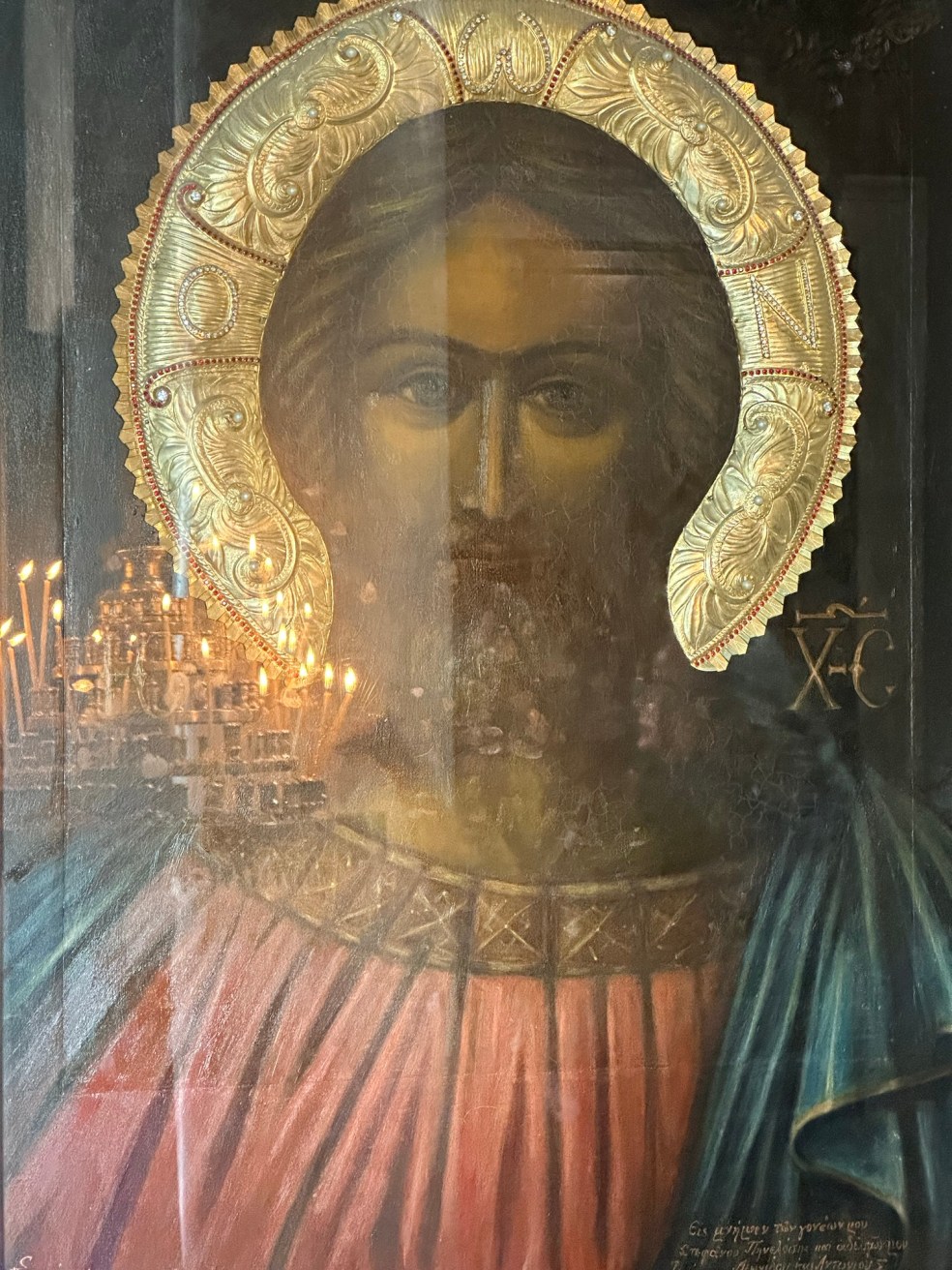
13. O WN

Language is thought made manifest. We are words in a dictionary, responsible for and dependent on others. Christ entered his creation, came through the eye of the needle, in order that we might have the courage and confidence to go in the other direction.

We have now seen a correlation between Christ and the environment we live in, but this should not surprise us if we accept that Christ is the Word and the world was spoken into being.

Christ is the Word. It says in the Christian Creed that all things were made by him, they were spoken into being. So physical matter would seem to be the result of language.

When we speak, we make things manifest in a similar way – our thoughts, our observations, our wishes. So we also turn something that did not exist into physical matter. We are using fragments of the Word to do this, as if the Word had been divided among us (like pieces of bread, or shards of a mirror). But the idea is the same – we make things manifest by using language.

So I would say that we speak Christ. Since there is a striking connection between the words son and sun (they are homophones, they sound the same), I would suggest that we see by him. After all, in John 8:12, he calls himself “the light of the world”. Perhaps this can be understood literally (just as the story of creation in the Book of Genesis is literally a description of speech, or the concept of the Trinity is literally three in ONE).

We speak him, we see by him. We also breathe him if we accept that Christ is the Second Person of the Trinity, O2, the chemical formula for oxygen. When we combine this symbol in reverse with the letter for breath, h, to refer to the Holy Spirit, we get H2O, the chemical formula for water. So we also drink him.

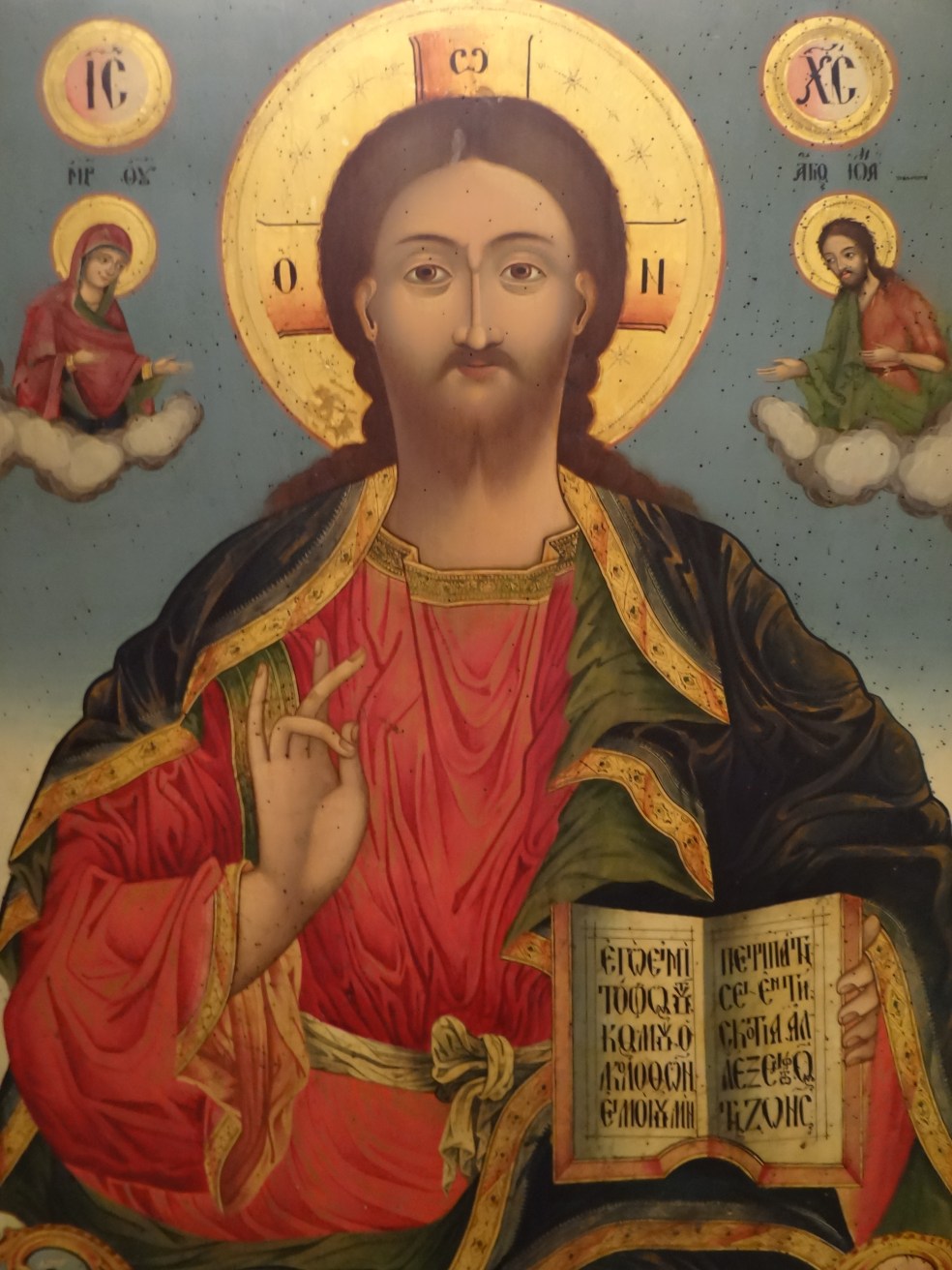
It would seem that our life is completely dependent on Christ, whether or not we believe in him. Enter an Orthodox church and you will most likely see an icon of Christ Pantocrator (“Ruler of All”). In this image, Christ is shown with the beams of the Cross behind him (only three are visible), and in these beams are written the letters O WN.

O WN is Greek for “the being”, which is the translation of the name that God reveals to Moses at the burning bush in Exodus 3:14: I AM. Again, we find here confirmation of the Trinity, because O WN is almost identical to ONE, it’s just that one of the letters has been rotated.

O WN also spells three words in English: own, won and now. Christ claims us as his own; the victory is his, he has won; he is here with us now (the meaning of the name Emmanuel).

I have seen this name written O WH. In Cyrillic, the letter H is pronounced N, and indeed the two letters are very similar (only the crossbar has become slanted). There is also a rough breathing in the original Greek, ὁ ὤν, the reverse apostrophe, which equates to the letter h in English.

If we write the name in this way, then we will see that it spells the words who and how, the result of making the progression AIO from what (A, the letter of creation: “What is this creature?”, “What shall I call it?”) through why (I, the letter of the Fall, an expression of distrust, of disobedience: “Why should I do this?”, “Why should I believe you?”).

Who and how are the questions that we should be asking. What is factual. Why is self-centred. We think that the purpose of life is to amass things and then to share them out, because we were taught at school to count up from 1, to do sums, multiplications and divisions. But actually the answer we are seeking is a person.

Christ gives us the answer to both question words when he says, “I am the way, and the truth, and the life” (Jn 14:6). I am and way are connected if we turn the m upside down and replace the vowel i with its semi-vowel equivalent, y. Both words contain the progression AIW (omega written as w).

We have also seen how when we flee the ego, the I, when we refuse to heed its selfish demands, we automatically create three symbols: A+O, the name of God Alpha and Omega. This can be written A ’N’ O and is found in the conjunction and, the reverse of which is DNA (it is in our DNA to do this). If we write this same progression with the Greek letter for omega, w, we get ANW, which with the w turned upside down gives man. So this denial of the ego, of our innate selfishness, is in the word that describes us (and woman is the same, only it has O3 at the beginning).

The automatic result of turning away from the ego, I, is to say the name of God Alpha and Omega: A+O. By turning away from the ego, we call on him. This is why God and ego are only a step apart in the alphabet (d-e). And him is just I’m with a little breath (h) before it.

This is what makes us human, a combination of hu (Sanskrit for “invoke the gods” and the root of our word “God”) and man – physical beings with the divine spark in them, the potential to become gods by grace if we attend to our true nature, which is not to grab whatever we see out there and to claim it as our own, making a mockery of the divine in us, but to see ourselves as part of the whole, a word in the dictionary, responsible for and dependent on the other. This most ancient way of calling on God – hu – sounds exactly the same as who, the letters we find in Christ’s icon, emphasizing what it is we should be asking.

In the Old Testament, there are two other names of God, apart from I AM. They are YHWH, the Hebrew Tetragrammaton (Yahweh), and El.

YHWH is extremely close to the question word why. So, if we make the progression from I to O, as we did with live-love, sin-son and Christ-cross, opening the line (opening our spiritual Is) to form not a barrier, a wall, but a tunnel that we can walk through, like the proverbial camel through the eye of the needle, just as why gives who, so the name of God in the Old Testament, YHWH, gives O WH, the letters found in Christ’s icon.

And if we place the other name of God from the Old Testament, El, in front of O WH, the two names together spell WHOLE in reverse (keeping the digraph wh together, as we did with earth-three).

This combination YHWH-O WH (why-who) and El-O WH (whole) goes a long way to confirming Christ as the fulfilment of the Old Testament law and prophets. This is why I would say that language is not only Trinitarian (three in ONE), but also Christological.

All physical appearances of God in the Old Testament are said to be by the Logos – that is, Christ – but we are not allowed to touch him. In the New Testament, when he walks among his disciples, eats with them and washes their feet, God himself has entered his creation. He has slipped through the hole – I become O – but in the other direction, so that we will have the courage and confidence to go the other way. This is an extraordinary act of condescension, of coming down to our level, and it was only possible because one of his creatures – namely Mary – acted as a conduit. How else in bodily form do you enter the creation that you have made, if not through one of your creatures?

Jonathan Dunne

Heart of Language 13/15

Next: Heart of Language 14/15

Back to: Contents

9. AIO

After the creation of the world (in the beginning, the letter A), we find ourselves in the era of the Fall, which centres around the ego, I. We have to take this line that separates us and open it, count down, perhaps just turn it around, so that we get O.

The correct progression of human life is that represented by the Greek alphabet, AIO (sometimes written AIW). The Greeks are known for their interest in philosophy and theology. Having made the progression from the A of creation to the I of the Fall – the period we find ourselves in – we have a choice: to count up (as the Latin alphabet does, AIZ) or to humble ourselves and count down, AIO.

Language favours the second option. We have seen the examples AM-I’m-om, no one and amen, mean, name-mine-nemo, omen. We go from the name of God in Exodus, AM, through personal importance and gain (I’m, mine) to calling on God again in the Holy Trinity (om) or on God the Father, no one (nemo in Latin).

In the Garden of Eden, between Adam and Eve, there was no competition. So, we have a draw. In today’s world with its competing egos, we set out to win. The vowel in these verbs has changed from A to I. But Christ comes with a different message. He encourages us to turn the other cheek, to lose our life for the sake of the other (in order to find it). So, he encourages us to lose:

draw-win-lose

Here again, we find the progression of the Greek alphabet, AIO (with a silent final e, very common in English, ignore the consonants).

We have seen that we are made to call on God. The first word the human apparatus is capable of producing is a combination of breath, h, and the first vowel to emerge from the throat, u: hu, which is Sanskrit for “invoke the gods” and the root of our word God. We are made to call on God. Similarly, if we turn away from the selfish demands of the ego, represented in English by a straight line, I, we make three symbols, A+O, which spell another name of God, Alpha and Omega. So, again, when we turn away from our selfish desires and embrace the other, we call on God.

In the Judgement of the Nations, Christ goes so far as to tell us that the other is God: “Just as you did it to one of the least of these who are members of my family, you did it to me” (Mt 25:40). If we remember that the Greek word for “God” is theos, we might see a close similarity between other and theos (step in the alphabet r-s). Language confirms what Christ is saying.

It is ironic, therefore, that after Adam and Eve have eaten of the fruit of the tree of knowledge in Genesis, chapter 3, it is God who calls to Adam, “Where are you?” (Gen 3:9). Of course, he knows where Adam is, and he knows what has happened. But by asking this question, which is the question Adam should have been asking, he is somehow indicating to us what our approach should be.

Make the progression from A to I, and from call you have like (in reverse, addition of e). Like is what we do on Facebook. We indicate our preferences. It also gives kill, and there has been plenty of killing in the history of humankind.

Now, count down from I to O, and you get look, which is the message Christ is trying to get across in the New Testament, the importance of opening our spiritual eyes (our egos or Is) and bearing spiritual fruit. We have seen the relevance of this in the Parables of the Sower and the Tares. So, we have:

call-kill, like-look

And then there are the examples that relate to the animal kingdom. Let us start with swan – a white bird, and white is a symbol of purity. Progress towards the ego, and you get swine – pigs in the mire, we have dirtied God’s image by rolling in the mud (just as the prodigal son does in Luke 15, a metaphor for dissolute living). When we come to our senses and realize that the things of this world will not satisfy us for long, we set out to purify ourselves once more, to return to our father, as the prodigal son does, which is not a return to the way things were before (swan), but a movement onwards, to something new: snow. So, we have:

swan-swine-snow

And finally, what is that most ancient mammal if not a whale that continues to patrol our oceans, despite our best efforts to wipe it out? Make the progression from A to I, and you have while, an indication of time. Time started after the Fall, this is when Adam and Eve became mortal, when they were expelled from paradise. Time will end for us individually when we die (the past tense of I) and for the human race when Christ comes again to judge the living and the dead. Now, count down from I to O, and in a while you become whole again. Whole is a remarkable word, and we will see more of it. So, we have:

whale-while-whole

All are examples of the progression made in the Greek alphabet, where we count down from the ego, which is represented in English by the letter I, and turn to God, the eternal symbol O.

Jonathan Dunne

Heart of Language 9/15

Next: Heart of Language 10/15

Back to: Contents

2. And

The different ways of moving away from the line that represents the ego in English (I), and how the three shapes that result spell a name of God – and a conjunction.

The ego in English is a line: I. It separates us from one another. It has a beginning and an end, like time (a word that is closely related to line, we cross out the l and apply the phonetic pair m-n).

How do we move away from the line that is represented in English by the pronoun I? I can see three ways to do this.

The first is to make reference to a third point, to bring God into the conversation, as if when crossing a river we remember the source of that river in the mountain. From a line, I, we make a triangle, Δ, which closely resembles the letter A (a triangle on stilts):

A

The second is to delete the ego, to draw a line through it (to deny oneself). We have seen that this makes a cross, †, which is also a plus-sign, + (the meaning of losing your life in order to find it):

+

The third is to treat the ego as a number, 1, and instead of counting up, as we teach our children, which has no end, we count down to 0. Again, we make reference to God (0 is an eternal symbol, it has no beginning or end) – we remember him:

O

The three symbols that result when we move away from the line are A+O. These three symbols spell the name of God Alpha and Omega, the first and last letters of the Greek alphabet. That is, when we turn away from the ego’s selfish demands and seek to do good, we necessarily call on God – there is no other way to do this.

And what’s curious is that this name of God, Alpha and Omega, is contained in the middle conjunction, and, if we write it with capital letters:

A ’N’ O (AND)

The reverse of and is DNA. We might say that it is in our DNA to do this. All human life is about understanding that the pursuit of our own desires, to the exclusion of others, will lead ultimately to dissatisfaction. It is when we embrace the other – not simply seek our own ends – that our life acquires meaning.

So, and, that little word that crops up so much in conversation, is like an instruction to turn away from the ego and to embrace the other, their needs, their points of view. It is a plus (our life is enriched), as the word itself indicates.

Jonathan Dunne

Heart of Language 2/15

Next: Heart of Language 3/15

Back to: Contents

Video

Theological English (1): Away from the Line – AIO

Having looked at the line, which represents the ego in English (I) and the number 1, in this second video on “Theological English”, Jonathan Dunne looks at the three ways of moving away from the line – the triangle, the cross and the circle. Truth is paradoxical, so while a cross represents suffering, it is also a plus-sign. This is the meaning of Christ’s injunction to lose our life in order to find it.

To access all the videos in this course, use the drop-down menu “Theological English (Video Course)” above. The videos can be watched on Vimeo and YouTube.

Word in Language (18): Mary, Mother of God

It is a remarkable thing that the name of God revealed to Moses at the burning bush in Exodus 3:14, I AM, contains the progression of human life, AIO, which is also the progression of the Greek alphabet, if we write the last letter, omega, in the Greek way: AIW. You may remember that the letter A refers to the act of Creation described in the first two chapters of Genesis; the letter I, which represents the ego in the English language, refers to the Fall, when we turned away from God and began to rely on ourselves; and the letter O is the letter of repentance, of recognition, when we turn the ego, I, into a number, 1, and count down to O.


All of this is contained in the simple statement/name I AM. Note that God does not say, ‘I am God. Thus you shall say to the Israelites…’ He does not use a predicate, something after the ‘I am’, in the way that you and I would. ‘Hello, I am Jonathan.’ If I stood in a room and said, ‘Hello, I am,’ people would think I was strange. They expect a name to follow the enunciation ‘I am’. But in God’s case, it is enough for him to say simply, ‘I am.’ He is in all, and all things come from him. He is the Author of all things, the origin, the source. We are translators, because things pass through us, nothing begins with us – life, food, oxygen, thoughts… What belongs to us is our reaction, our free will, how we choose to respond to the things, the people, we meet on our road. We give them meaning and take away meaning from our encounter. This is why we are translators, because this is the process of translation.


In the act of Creation, AM created a separate object, a countable noun, AN. The indefinite article, a/an, is used for things that can have a line drawn around them: a book, a room. It is used for things that we can visualize and, in order to visualize them, we have to be able to separate them from ourselves. We cannot do this with concepts such as love and righteousness, so when we talk about concepts we do not used the indefinite article. We use it only for things that are separate from ourselves. Why does the indefinite article, therefore, refer to the creature that God created in the beginning? Because he made that creature separate from himself – he endowed it with free will. It is not a machine, remotely controlled. It may make its own decisions. That is why it is a countable noun, because it is separate from God. God did not want hangers-on, he wanted true, living, breathing human beings who would love him of their own accord.


If we combine the name of God, AM, and the indefinite article, AN, we get A MAN, and the name of that man was ADAM (which contains the name of God, AM). So while we are separate, we do bear God’s imprint. After all, we are made in his image and likeness and, to quote St Augustine, ‘our hearts are restless until they rest in You’.


Christ came to fulfil the Old Testament law and prophets, to make the law personal, relevant to you and me, and there are numerous words that show this connection, but let us take the name of God in Exodus 3:14, I AM, and see how this relates to Christ. It relates in four ways. The first is that it gives us the words ‘law’ and ‘way’. For ‘law’, we apply the physical pairs, pairs of letters that look alike, i-l and m-w, that is we replace the capital I with a lower-case l and turn the M upside down. For ‘way’, we again turn the M upside down and replace the vowel i with its corresponding semi-vowel y.


Christ says as much in John 14:6: ‘I am the way, and the truth, and the life’ (my italics). Language confirms this because the two words – ‘I am’ and ‘way’ – are connected.


But we also find the name of God from Exodus 3:14 in a common appellation of Christ, first given to him by John the Baptist in John 1:29: Lamb. ‘I am’ is found in ‘lamb’. Again, language seems to confirm his provenance.


In Revelation 22:13, towards the end of the Bible, Christ cries, ‘I am the Alpha and the Omega, the first and the last, the beginning and the end.’ We will see how ‘first’ and ‘last’ might be connected in the next article, but the name Alpha and Omega, or A+O, contains the three ways of escaping the ego (I): to make reference to a third point and form a triangle (Δ), to delete the I and form a cross (†) or to treat the I as a number and count down (0). These three symbols, Δ†0, spell the name spoken in the Book of Revelation, Alpha and Omega (A+O), and are referenced already in the name of God in Exodus, I AM, which contains that same progression, AIW (only the I has not been deleted).


And finally this name of God in Exodus is translated into Greek as O WN, the three letters found in the halo of icons of Christ, because according to Orthodox tradition it is Christ who appears to Moses at the burning bush. O WN, if we rotate the second letter, gives us ONE, a reference to the Holy Trinity, because it contains the chemical symbols for all three persons: the Father (O1, no one), the Son (O2, oxygen) and the Holy Spirit (O3, ozone), only in chemistry the subscript 1 is not normally written down: ONE (the 2 has toppled over, the 3 is back to front).


So we see a strong connection between Christ – the way, the Lamb, the Alpha and the Omega, O WN – and the name of God in Exodus, I AM. We have also seen how AM and SON combine in the word RANSOM if we omit the initial r. The word RANSOM seems to confirm what Christ says in Matthew 20:28 about coming to serve and to give his life a ransom for many – that life was the life of the SON and it was given on the Cross, in accordance with the pre-eternal design of the Holy Trinity.


Now I would like to see if there is any indication in the English language not only to affirm that Christ is the Son of God, as we saw in the previous article, but also to point to Mary as his Mother. Perhaps you have already seen the link.


When we discussed the progression AIO inside words, we saw that it is contained in common appellations of the Virgin Mary: ‘lady’ and ‘maid’. It is also in the word AID, and in Orthodox prayers we often ask the Virgin Mary to ‘come to our AID’. But I would like to see if there is a connection between Mary and I AM, as there was between Christ and I AM.


It is remarkable that I AM is contained in MARY if we replace the vowel i with its corresponding semi-vowel y and add the letter r. The name MARY contains the name of God in Exodus 3:14, I AM, and that is surely a coincidence. Not only that, but if we again add the letter r, we get the word MARRY:


I AM – MARY – MARRY


Christ came into the world, became incarnate, as a result of the action of the Holy Spirit, sent from the Father, and through the wish and obedience of the Virgin Mary. She could have said no. God relied on her willing cooperation, the free will we talked about earlier in relation to countable nouns. But after the initial surprise (how is that to be if I have not known a man?), when it was explained to her by the Archangel Gabriel, she bowed to God’s will, she acquiesced, and the ‘marriage’ took place. This led to the Incarnation, Christ becoming fully human, and ultimately to our salvation (if Christ became fully human, it was so that we could become fully divine, a process known in Orthodoxy as theosis – we become gods by adoption).


All this connection, all this lineage, is contained in the name of the Virgin MARY: the name of God in Exodus 3:14, I AM, the human progression from A (Creation) to I (the Fall) to O or W (the act of repentance, the moment when our hearts comprehend that of ourselves we are not enough, on our own we can do nothing, we do not avail – we become aware of our own limitations, and it is curious for me that AWARE contains AM and the second person singular of the verb ‘to be’, ARE: AWARE conjugates the verb ‘to be’).


Language is a wonder. Whoever would have said that AWARE conjugates the verb ‘to be’? There is more on this, the different parts of the verb ‘to be’, perhaps I will write about it in the future.


So MARY contains the name of God in Exodus, I AM, and if we double the letter r, we get MARRY, which is how the Incarnation took place.


Is that all there is? Well, no. A very important word to describe Christ is the Messiah. He is the long-awaited Messiah, the one that would come to earth and atone for our sins, make everything right again, give us a way to return to God, but a different way, not the way we have come through sin, the Fall, this is not a return to the GARDEN OF EDEN, where once again we would be in DANGER OF NEED. We do not go back to the first letter of the alphabet, A, because what would be the point of that? It would only all start again – the Fall, repentance… No, we must break the circle, so we progress on to the letter O, not back to the letter A, we progress to the end of the alphabet.


Can you find the name of God in Exodus, I AM, inside the word MESSIAH? It is there. And what word can you spell with the remaining letters, bearing in mind that letters may be doubled?


M   E   S   S   I   A   H


The word is SHE.


MESSIAH is a combination of I AM and SHE. It is as if the Messiah would only come when God, I AM, combined with a certain woman, the Virgin Mary. This event took place in history, and Christ was born.


I will provide one more example. You remember at the end of the previous article we saw that, if we do some dance-steps in the alphabet, if we put our best foot forward, then JERUSALEM can be turned into JESUS AMEN. All we have to do is apply three alphabetical pairs: l-m, m-n and r-s. Something similar can be done with the word MOTHER, but this time we must take one step forward and one step back: m-n and s-t.


What two words can be found in MOTHER? To whom does the Mother point in icons of her with Christ? She points to HER SON. I would say that this is what the MOTHER achieved through her obedience: the life, death and resurrection of HER SON, which were not isolated incidents that have no bearing on us. They changed the course of history. By his life on earth and his descent into hell, Christ brought the possibility of salvation to all human persons, wherever they might be. But this was only possible by the consent, purity and experience of the Virgin Mary. Without her, there would be no salvation, and the road – the way to I AM – would be closed.


It’s amazing what you will find in three letters.


Jonathan Dunne, http://www.stonesofithaca.com

Word in Language (17): Christ the Son of God

After the bread that is destined to become the body of Christ during the Orthodox Liturgy has been cut from the loaves that have been baked for this purpose, the bread that is left over from the loaves is divided into small pieces, blessed by the priest and distributed to the people after the service. This bread is known as antidoron in Greek, meaning ‘instead of the gift’. It is used by those who have received communion to help wash down any remaining traces of the body and blood of Christ, so that they do not remain in the mouth, and is received by those who have not received communion as a substitute – ‘instead of the gift’. One of the subdeacon’s duties is to cut this bread into small pieces so that it can be distributed by the priest.


I serve as a subdeacon in the Orthodox Church, and I often think of this unconsecrated bread as being similar to words, cut from the body of Christ and waiting to be sanctified or not by their use. That is, the words we bandy about in conversation or in writing are small fragments of the Word of God and contain the potential to be used in a sanctifying way, if our intentions are good and our mind is set on God.


It is as if the priest is distributing words to the people, who will then leave the church and go out into the street and use those words in what is hopefully a beneficial way. It is only an image.


But I would like to suggest that words, just like the environment, bear the imprint of the Creator and refer to him. My book Stones Of Ithaca contains numerous examples of stones from the beaches of the Greek island of Ithaca that seem to depict Christian symbols and scenes. Language is the same, and why should we be surprised? Isn’t Christ the Word of God, the Logos? Isn’t it logical, therefore, that he should be present in words? Or that words should speak of him?


I would like to suggest that this is so and we can find proof in language that Christ is the Son of God (and that Mary is his Mother). God is one essence and three hypostases (that is, three persons) – three in ONE. I would like to show how language confirms Christ as the Son.


Let us start with the progression that we saw in the previous two articles, AIO, the progression of the Greek alphabet and of human life. A represents the Creation (described in the first two chapters of the Book of Genesis); I represents the Fall (described in the third chapter of Genesis), the era we live in; and O represents repentance, becoming aware of our sins and turning back to God, the aim of our life on earth.


In the Book of Revelation, at the other end of the Bible, Christ describes himself as ‘the Alpha and the Omega, the first and the last, the beginning and the end’ (Rev 22:13). This is one of his names – Alpha and Omega – and can be written A+O. Now it is curious that the three ways of escaping from the selfish demands of the ego, of moving away from the line that represents the ego in English (I), involve:


– making reference to a third point, God, and forming a triangle (Δ);

– deleting the I and forming a cross (†);

– treating the letter I as a number (1) in order to count down to zero (0).


That is, A+O. Christ’s own name, revealed in the Book of Revelation, indicates to us the path that we must follow. I don’t think any human could have invented this; it must be something contained in language itself.


We saw that A+O is found in the middle conjunction, ‘and’, because if we write ‘and’ using capital letters, we get AND or A ’N’ O. The reverse of AND is DNA, which implies that it is in our make-up to make this progression and to turn to God, away from the ego. Note how GOD and EGO are only a step apart in the alphabet (alphabetical pair d-e).


If we apply this progression AIO to the name of God revealed to Moses at the burning bush in Exodus 3:14, AM, we find that AM becomes I’M becomes OM. I take this last word to be a reference to the Holy Trinity: O3, or three in One. But one of the ways of making word connections is by the addition of letters, and one of the most commonly added letters is h. So another way of moving away from the self-centred demands of the ego that we find in I’M is, instead of making the progression AIO, simply to add h to I’M, which gives us HIM. I understand this to be a reference to Christ. He takes us out of ourselves – actually, in many ways it is the reverse movement: he returns us to ourselves. We turn to HIM and in the act of worship we sing a HYMN (the coincidence between these two homophones HIM and HYMN is found also in LORD and LAUD).


In Matthew 20:28, Christ says to his disciples that the Son of Man – Christ himself – came ‘not to be served but to serve, and to give his life a RANSOM for many’. Again, I think we can find proof for this in language, because if we ignore the first letter of RANSOM (r), we find that the rest of the word contains the name of God in Exodus, AM, and SON. Of course, the letters are jumbled up; spiritual knowledge is always hidden in some way. But it is not difficult to make out. I think the word RANSOM wishes to confirm what the Word is saying, and to confirm who he is: the Son of God.


We find another connection to the name of God in Exodus in John 14:6, where Christ says, ‘I am the way, and the truth, and the life.’ If we write the name of God in Exodus I AM and turn the letter M upside down, we will see a clear similarity between I AM and ‘law’ – the law of the Old Testament, which found its spiritual fulfilment in Christ – and between I AM and ‘way’ (y is the semi-vowel that corresponds to i): I AM – law – way. Language confirms what Christ is saying. This is why he goes on in the same verse to say, ‘No one comes to the Father except through me.’ He is the way to I AM.


We find further proof of this connection between the name of God in Exodus and Christ in the appellation that John the Baptist gives Christ when he sees him approach in John 1:29: Lamb. The word ‘lamb’ (and note that the final letter, b, is silent) contains ‘I am’.


So in ‘way’ and ‘lamb’ we find two clear indications that Christ is the Son of God. Again, I would point out that no human could have invented these words so that they would reproduce the name of God in Exodus, I AM. This has to have come from God, to be ingrained in language, just as we saw AM in the name given to the first human, ADAM (both words contain the first and last letters of the Greek alphabet: AO, or AW if we write omega according to Greek usage).


In Orthodox tradition, all appearances of God in the Old Testament are by the Logos, so it is Christ who interacts with Adam and Eve in the Garden of Eve and it is Christ who appears to Moses at the burning bush. For this reason, the Greek Septuagint translation of the name of God in Exodus – O WN – is included in icons of Christ, in the beams of the Cross inside the halo around his head. Search for an icon of Christ Pantocrator, and you will see what I mean.


O WN actually means ‘the being’. That is how the name of God, AM/I AM, is translated into Greek. O WN spells three words in English – OWN, WON and NOW – and it is easy to see the relevance of these words to Christ: he claims us as his own; he has won; he is with us now (Emmanuel).


By rotating the W, we can connect O WN to the number ONE, and I think this is because in his Incarnation, becoming visible to us, Christ represents – follows the will of – the Holy Trinity, three in ONE.


We have seen how these three letters O WN can be written O WH, which spells the question words WHO and HOW. Christ is the answer to both these questions, which we can only ask when we have made the progression AIO. That is, we have gone from asking WHAT in Creation (What is this creature? What should I call it?) to asking WHY (Why should I do this? Why should I believe you?) in the Fall to asking WHO/HOW in a state of repentance. We count down from the ego and realize that the answer we should be seeking is a person, and if you want a person to be the answer to the question you are asking, then the correct question is WHO? This was Pontius Pilate’s mistake when he was standing in front of that very person and asked him, ‘What is truth?’ Truth, he failed to understand, is not a thing, it is a person. The irony of this situation is staggering.


Now WHO sounds the same as HU, which is the root in Sanskrit of our word ‘God’. To show that Christ is the Son of God, the fulfilment of the Old Testament law and prophets, we see that WHO (O WH) is a progression from WHY, which contains the letters of the Hebrew Tetragrammaton: YHWH. And finally if we combine WHO with another name of God in the Old Testament, EL, we find that the two names together spell WHOLE. With the coming of Christ in human form, his birth, teaching, crucifixion, descent into hell and resurrection, we are made WHOLE. We are given that possibility, for our broken form, human nature, to receive wholeness, to return to God. That possibility was not available to us under the Old Law.


In the addition of letters, one of the most commonly added letters is h. Remembering the correlation in phonetics and in the alphabet between v and w, we will then see that WHOLE contains LOVE. It is love that makes us whole, that enables us to enter into relationship. Relationship is intrinsic to the Holy Trinity (there are three persons), and so it is intrinsic to us as well, because we are made in the image and likeness of God (Gen 1:26).


LOVE, by the addition of the same letter h, can be found in OTHER (phonetic pair l-r, alphabetical pair t-v). Love necessarily involves the other, unless all you are going to do is love yourself. I don’t think we are meant to do this. True love – true healing – involves relationship. I am healed by others, by letting them into my life and by revealing myself to them. I have a family, I was lost without them, but that same love – that same self-affirmation (as opposed to the self-destruction brought about by sin) – can be found with a complete stranger if our gaze is at once directed towards each other and towards him (the third point I talked about with reference to the triangle). OTHER is connected to the Greek word for ‘God’, THEOS (alphabetical pair r-s), and this is the meaning of Christ’s saying, ‘Just as you did it to one of the least of these who are members of my family, you did it to me’ (Mt 25:40), but we have lost this meaning. Very often we see our neighbour as a threat to our peace, we turn away from them or eyeball them with aggression. Our lives are separate – we have no common reference. It is a common reference that brings peace.


And LOVE is connected with another word in language, which again goes some way to proving that Christ is God. If we apply the phonetic pairs l-r and v-w and the alphabetical pair d-e to LOVE, we find WORD. We read in 1 John 4:8 that ‘God is love’ – Christ is the Word, and WORD is connected to LOVE, which seems to confirm this.


In the beginning, God the Father created the world through the Son on the basis of the Holy Spirit. Again, we will find confirmation in language because WORLD is a combination of LORD and WORD. We find WORD not only in LOVE, but in the WORLD we inhabit. We also find him in the SUN that illuminates our lives and enables us to grow crops, that is to survive, because there is a clear correlation between SON and SUN. It is the Son who enables us to eat. I am not saying that the Sun is Christ himself, but there is clearly a connection between the two words, which implies a scientific connection as well.


We find confirmation of this connection SON-SUN if we apply the phonetic pair b-p to LAMB, which gives us LAMP. Christ says as much in John 8:12: ‘I am the light of the world.’ Language confirms it. His name confirms it, because CHRIST contains LIGHT (phonetic pairs g-k and l-r, addition of s).


He also enables us to breathe. When we discussed the Trinity as three in ONE, we saw that God the Father is no one (O1), God the Son is oxygen (O2) and God the Holy Spirit is ozone (O3). The Holy Spirit is commonly likened to a wind (a word, by the way, that contains the first four numbers – 0, 1, 2 and 3 – if we rotate two of the letters in WIND) – that is, breath, which is represented in language by the letter h. If we combine this letter for the Holy Spirit, H, and the chemical symbol for oxygen, O2, we get water: H2O. Christ also enables us to drink.


The two chemical symbols combined, O2 and O3, can be found in MOON (again, we need to rotate the letters to get the numbers 2 and 3), so it seems that Christ reflects his own light and enables us to see at night.


Language, and the environment that surrounds us, are permeated by Christ. Look around you, and you will see a million crosses. The Cross is like a stile – it enables us to cross over to the other side, to escape our own isolation, to walk over the line, to make a bridge that will carry us where we want to go. Language will help us. Once we enlist its support, it will provide the content of our prayers – at least until we no longer need words. Language, in this sense, is repetitive. It can be boring, but we are rubbing away the hard outer casing of our hearts, so that we can enter there and find God’s kingdom.


In the end, perhaps the name alone will suffice, coupled with an expression of assent. There is one city in the world that is claimed by the Abrahamic religions: Jerusalem. It was here that Christ’s crucifixion and resurrection took place, and it was not far from here, in Bethlehem, that he was born. This is where Christ taught in the temple when he was only a child and sweated tears of blood in the Garden of Gethsemane prior to his ultimate sacrifice on the Cross.


Take the word JERUSALEM and apply the alphabetical pairs l-m, m-n and r-s. That is, take the letters l, m and r in JERUSALEM and advance one step in the alphabet. What two words do you get? This, for me, is proof that Christ is who he says he is.


Jonathan Dunne, http://www.stonesofithaca.com

Word in Language (4): Christ the Translator

But we prefer to own things. We prefer to draw a line and say ‘this is mine’. We are authors. And yet this is not true. Things pass through us, they do not begin with us. Air, food, words, experiences, even the gift of life, pass through us. We take what we need (meaning) and in the process we give meaning.


We are translators. Just as a translator allows the text to pass through him in order to translate it into another language, so the things of this world pass through us. But meaning is a two-way process. It is not only the text that passes through the translator, but the translator who passes through the text. He also is changed by the experience. He acquires meaning himself.


So it is with the things of this world – they pass through us, but we also pass through them. Money passes through our hands, for example, but we also pass through a house. Neither of them remains with us, we will leave them both behind. So neither truly belongs to us. What belongs to us, I think, is our reaction, how we use the things with which we are entrusted, how we react to situations. Our reaction – the destiny of our souls – is our belonging.


So is there nothing else we can truly be said to OWN? Well, I think there is, but it is not a thing, he is a person. And the process of meaning is the same.


If you have ever seen an icon of Christ Pantocrator, you might have noticed that inside the halo, in the beams of the Cross, are three letters: O WN. These are Greek letters and represent the Greek Septuagint translation of a verse from the Old Testament (perhaps the most important verse in the whole of the Old Testament, in my opinion): Exodus 3:14.


In Exodus 3:14, God meets Moses at the burning bush and replies to Moses’ question who he should say has sent him to the people of Israel to free them from the Egyptian overlords:


God said to Moses, ‘I am who I am.’ He said further, ‘Thus you shall say to the Israelites, “I am has sent me to you.”’ (NRSV)


In Greek, this text reads:


καὶ εἶπεν ὁ Θεὸς πρὸς Μωυσῆν λέγων· ἐγώ εἰμι ὁ ὤν. καὶ εἶπεν· οὕτως ἐρεῖς τοῖς υἱοῖς ᾿Ισραήλ· ὁ ὢν ἀπέσταλκέ με πρὸς ὑμᾶς. (LXX)


I have underlined the names of God in the Greek text: ‘I am who I am’ (ἐγώ εἰμι ὁ ὤν) and ‘I am’ (ὁ ὢν).


O WN (ὁ ὢν) literally means ‘the being’. It is sometimes translated ‘the One Who is’. In reference to this appearance of God before Moses, when he revealed to him his name, these three letters are included in icons of Christ, because according to Orthodox tradition all appearances of God in the Old Testament are by the Logos, the Word of God, that is Christ.


But this has meaning in English because those same three letters spell OWN. We could be said to ‘own’ Christ inasmuch as we form part of his body in the Church. He is ours. But ownership in Christian terms is not about exerting control, it is about expressing love. In the same way, he could be said to ‘own’ us. He gives himself to us in the Eucharist; we give ourselves to him unconditionally. It is a two-way process.


OWN in English spells another two words: WON and NOW. Christ’s is the victory; with his Resurrection he has conquered death. The end of the world has yet to come (this is for another reason), but the victory is assured, even if it seems at certain points in our lives that the opposite is true. NOW because Christ is with us now. How does the illuminating Gospel of Matthew end? ‘I am with you always, to the end of the age.’ His presence with us is permanent.


This, for me, is the meaning of ownership: to own Christ and to be owned by him. It is not to fight over portions of the earth. It is not to draw lines (supine egos) on the ground, around our property (which one day will not be ours). It is to give ourselves unconditionally. The giving the other way round (by Christ) has already been done, and that is the meaning of time: to turn meaning into a two-way process, to make it mutual.


The destiny of our souls depends on our reaction, our acceptance or not of Christ, our clinging to the letter of the law or its spirit, its deeper meaning, its greater good. This is ownership: to react with love or anger, to claim for ourselves or for the other, to cling to self-preservation (a futile task) or to lose our life in order to find it. This is why, having found the pearl, the merchant went and sold all that he had in order to buy it.


But there is something else – something that points to Christ as the Messiah, the fulfilment of the Old Testament prophets. The name of God in Exodus 3:14 is translated into English as ‘I am’. I think the whole of existence is contained in these three letters. First of all, we should note that ‘am’ contains the first and last letters of the Greek alphabet, Alpha and Omega (AW, do not worry that the m has been turned upside down). This name is found for the first time in Revelation 1:8:


‘I am the Alpha and the Omega’, says the Lord God, who is and who was and who is to come, the Almighty. (NRSV)


The expression ‘Alpha and Omega’ is contained in the verb ‘am’ – God could have just said ‘am’, and it would have been sufficient.


Also interesting is the fact that ‘am’ in reverse gives us the Sanskrit word ma, which means ‘create’. This is because God is the Creator, it is with him that things begin (not with us).


And finally the name revealed to Moses in Exodus 3:14 and reproduced in icons of Christ, ‘I am’, gives us two other words in English. The first of these is ‘law’. I think you can see this – a capital I and a lower-case l are practically identical; again, I have turned the m upside down (this is very common in language). ‘Law’ refers to the Old Testament – the law that Moses brought down from Mt Sinai on the tablets, the Ten Commandments, about worshipping the Lord your God and honouring your father and mother.


But this law is only a preparation for the law in person, that is Jesus Christ. Of itself, it does not give life, it does not conquer death – only Christ can do this.


And we see this when we make the progression from ‘I am’ to ‘law’ to another word in English: ‘way’ (y is the semi-vowel that corresponds to i).


In John 14:6, Christ says to Thomas:


I am the way, and the truth, and the life. No one comes to the Father except through me. (NRSV)


Note how both ‘way’ and ‘Alpha and Omega’ are preceded by the pronoun and verb ‘I am’. It is as if Christ is extrapolating them, is drawing out their meaning. He is, in effect, teaching us to be translators.


Christ came down to earth for two reasons: one is to translate for us the meaning of life, and he does this using Braille (writing for the spiritually blind, that is us). His form of BRAILLE is the PARABLE (another phonetic pair is b-p).


The other reason has to do with the second part of that verse from the Gospel of John, ‘No one comes to the Father except through me’, because not only did Christ come to translate for us the meaning of life (which is to believe in him), he also assumed our human nature (we are translators) so that he could later translate us into eternal life. You cannot do this if you are only an author. You must be a translator as well (the two natures of Christ, as defined at the Council of Chalcedon).


At the end of our lives, when we reach the end of our translation, of acquiring and giving meaning, we will become the word that best defines us, and that word will be spoken by Christ into eternal life. He will translate us. This is why translation is not inferior, it is not second-rate, it is not dog-eared like a book from the library, it is the essence of human life.


The fact that we see translation in a negative way is a reflection on ourselves, not on translation. Our wish to be authors – superior, first-rate and brand-new – reflects our desire to hold on to our lives at all costs. It responds to the instinct of self-preservation. But in the end we will be required to let the Word pass through us – and to pass through him – if we want to inherit eternal life.


Jonathan Dunne, http://www.stonesofithaca.com

Word in Language (2): Alpha and Omega

There is the story of a desert monk who was told by his elder to plant a stick in the ground and to water it until it grew leaves. This is an example of monastic obedience (obedience means you do not ask the question ‘why?’), and this is what we must do to our ego – water it until it grows leaves.


We live in the era of the ego, after the Fall (when we acquired carnal knowledge in order to have children, in order to give birth to the body of the Church). That is, in the era of the I. It is remarkable that in English the ego is a line: I. LINE, by a step in the alphabet (l-m), is connected to MINE – we like to lay claim to things in this world, to draw a line and say ‘this is mine’.


I think we are in this life to learn to move away from the ego (which paradoxically enough leads us to affirm the self, who we really are – this is one of many paradoxes in Christianity). How do you move away from the I?


As I see it, there are three ways of moving away from the I. The first is to make reference to a third point, to understand that in our relations with others it is never a two-way process, there is always a third person present. This is why the best kind of conversation is prayer, because instead of two people talking to each other, two people turn to face in the same direction and address themselves in communion to that third person, whom we name God. Prayer is conversation with a common purpose – it doesn’t have to be in church.


When you make reference to a third point, as if when crossing a river you remember the source, then you have a triangle: Δ. And a triangle is close to the letter A (in effect, the letter A is a triangle on stilts).


So that is one way of moving away from the I: Δ > A.


The second way is to draw a line through the I, to delete it. This is the meaning of the Gospel message to lose our life in order to find it. It is the opposite of what this world tells us to do – to keep our life, to prolong it as long as possible and to make it as comfortable as possible. It is not that we seek our death, far from it, but we lay down our life for the other, we make sacrifices for the other, we actually gain salvation through the other. When we draw a line through the I, of course the symbol we get is the Cross: †. The Cross is an I with a line drawn through it.


So how can we lose our life in order to find it? Surely this doesn’t make sense. Is Christ telling me to throw my life away and then to go and find it again? Well, in a way, yes, because as a desert father, Abba Alonius, once said, ‘If I had not destroyed myself completely, I should not have been able to rebuild and shape myself again’ (The Sayings of the Desert Fathers, trans. Benedicta Ward, Cistercian Publications, 1984, p. 35).


But I think the true meaning of the Gospel message is this: a Cross is also a plus-sign, +. So when we lose our life (the Cross, †), we actually find it (the plus-sign, +). I would go so far as to say we only find it when we lose it.


This is the second way of moving away from the I: † > +.


And the third way of moving away from the I is to see it as a number – 1 – and then to count down to 0. The ego, the I, is actually a spiritual eye that is closed. You will see this if you cock your head like a bird. It is an eye on its side, and it is closed. This is why ‘I’ and ‘eye’ sound the same.


We must open our spiritual eyes (our spiritual Is), and then, when we open the letter I, we get O.


This is the third way of moving away from the I: 0 > O.


If we put these three ways of moving away from the I together, we get:


A + O


Now this is a remarkable fact, because when we move away from the ego, we are actually calling on God, Alpha and Omega. This is our purpose in life: to shift our focus of attention from ourselves to God, and language wishes to confirm this.


But what is truly remarkable for me is that the name Alpha and Omega is contained in the middle conjunction: ‘and’. We will see it better if we write it with capital letters: AND. AND is A ’N’ O (we have the shortened form of the conjunction, ’n’, as in rock ’n’ roll), and in reverse it reads DNA. It is in our DNA to turn to God – it is he who will make us whole.


We see this same choice between following our own inclinations and bowing down before another in the connection between EGO and GOD. They are only a step in the alphabet (d-e) apart. It reminds me of Christ’s injunction that we cannot serve God and mammon (or, in word-connection terms, we cannot serve GOD and GOLD – what letter does GOLD contain that GOD does not? The letter l, which equates to the ego).


So it seems that the SELF must go the way of all FLESH (SELF in reverse, with the addition of h). The SELF in terms of self-seeking, privately harboured ambitions, is FALSE (addition of a), it makes us a SLAVE (phonetic pair f-v). When we enter the world, when we respond to its call, I think we find at some point that what we had taken to be freedom – the ability to do whatever we liked – has in fact enslaved us, has turned us into a slave. Like the Prodigal Son, we come to our senses and seek another path, one that will truly free us and bring us to fulfilment. It is a common misconception that freedom equates to the ability to do what we like (within reason). This is the tenet of democracy. But the Church is not democratic – it is not ruled by people, although it may consist of them. It is hierarchical, and the head of the Church is Christ.


What do we do with the SELF when we come to this realization? There is a simple answer in terms of language, but again you must know your phonetic pairs: f-v and l-r. Then you can turn SELF into SERVE (repetition of e).


Or, as with the connection between GOD and GOLD, you remove the ego from SLAVE. Again, we will see this better if we use lower-case letters – ‘slave’. What happens when you remove the I from ‘slave’? What word do you get?


Language, like the desert elder who sent his disciple off to plant a stick in the ground, or Abba Alonius, who realized that you have to break the ego down in order to rebuild it, is clearly showing us in these examples that we have a choice between becoming enslaved to the impulses of the ego (and there are plenty of substances lying in wait to help us with this task) and turning to God.


It is all a question of opening our spiritual Is – or having them opened for us.


The semi-vowel y corresponds to the vowel i (that is the line, I). When we turn to God in repentance, when we lay our ego on the altar of obedience, we OBEY. I think we reach a point, having made our choice, where we actually decide we don’t really want our free will (there is a parallel here with marriage, where we become one body – and see what fruit that bears).


I am not talking about subjection to a tyrant. I am talking about Christ. With Christ (yes, it is difficult sometimes), I want what he wants, not what I want, because I know it will lead to better things. It will lead to life in all its fullness. And at that point I am capable of declaring, not OBEY, but O, BE I! (the exclamation mark shows that I have opened my eyes; a question mark does the same, it just takes longer to get there).


Jonathan Dunne, http://www.stonesofithaca.com