
Language is thought made manifest. We are words in a dictionary, responsible for and dependent on others. Christ entered his creation, came through the eye of the needle, in order that we might have the courage and confidence to go in the other direction.
We have now seen a correlation between Christ and the environment we live in, but this should not surprise us if we accept that Christ is the Word and the world was spoken into being.
Christ is the Word. It says in the Christian Creed that all things were made by him, they were spoken into being. So physical matter would seem to be the result of language.
When we speak, we make things manifest in a similar way – our thoughts, our observations, our wishes. So we also turn something that did not exist into physical matter. We are using fragments of the Word to do this, as if the Word had been divided among us (like pieces of bread, or shards of a mirror). But the idea is the same – we make things manifest by using language.
So I would say that we speak Christ. Since there is a striking connection between the words son and sun (they are homophones, they sound the same), I would suggest that we see by him. After all, in John 8:12, he calls himself “the light of the world”. Perhaps this can be understood literally (just as the story of creation in the Book of Genesis is literally a description of speech, or the concept of the Trinity is literally three in ONE).
We speak him, we see by him. We also breathe him if we accept that Christ is the Second Person of the Trinity, O2, the chemical formula for oxygen. When we combine this symbol in reverse with the letter for breath, h, to refer to the Holy Spirit, we get H2O, the chemical formula for water. So we also drink him.
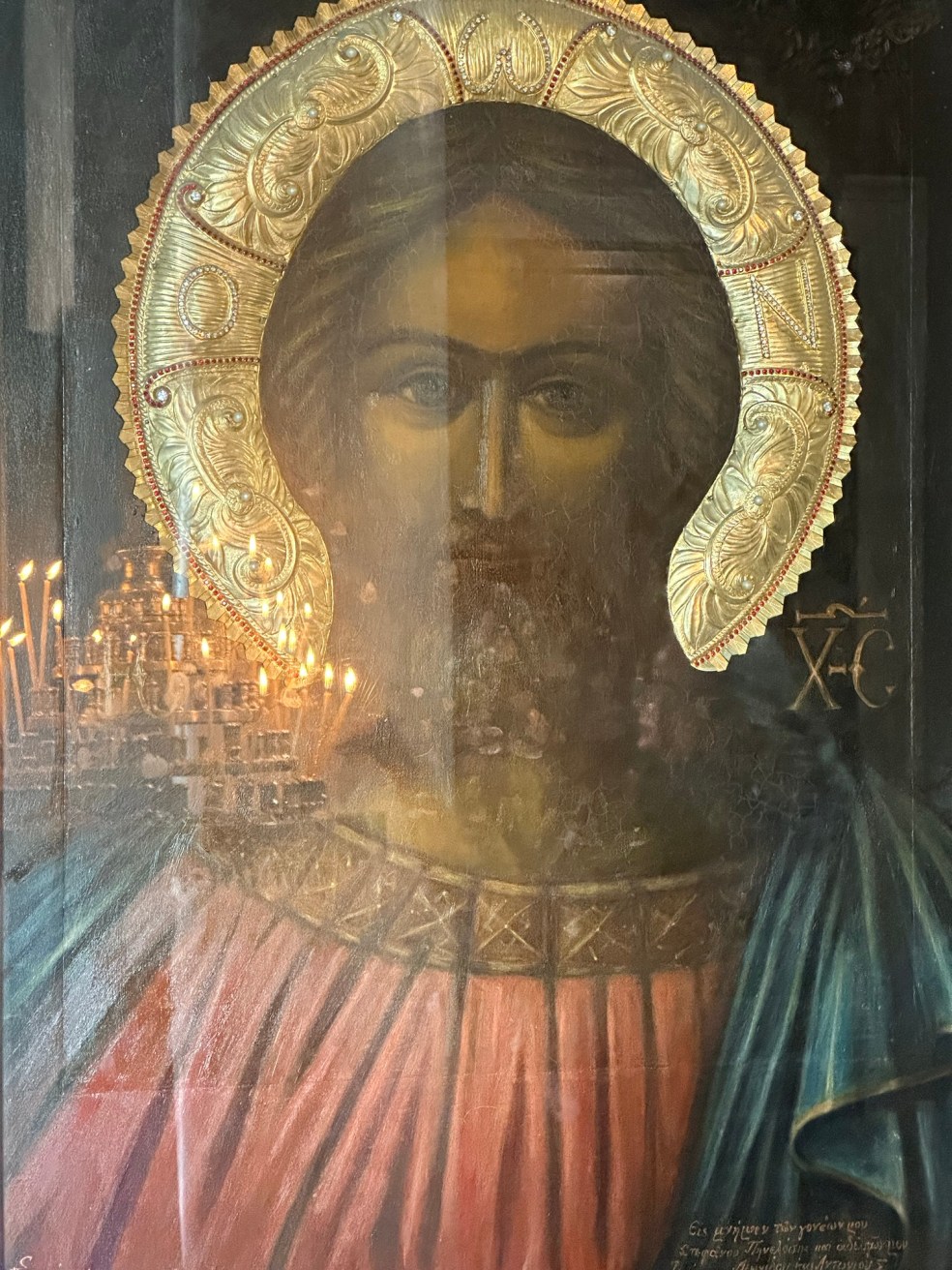
It would seem that our life is completely dependent on Christ, whether or not we believe in him. Enter an Orthodox church and you will most likely see an icon of Christ Pantocrator (“Ruler of All”). In this image, Christ is shown with the beams of the Cross behind him (only three are visible), and in these beams are written the letters O WN.
O WN is Greek for “the being”, which is the translation of the name that God reveals to Moses at the burning bush in Exodus 3:14: I AM. Again, we find here confirmation of the Trinity, because O WN is almost identical to ONE, it’s just that one of the letters has been rotated.
O WN also spells three words in English: own, won and now. Christ claims us as his own; the victory is his, he has won; he is here with us now (the meaning of the name Emmanuel).
I have seen this name written O WH. In Cyrillic, the letter H is pronounced N, and indeed the two letters are very similar (only the crossbar has become slanted). There is also a rough breathing in the original Greek, ὁ ὤν, the reverse apostrophe, which equates to the letter h in English.
If we write the name in this way, then we will see that it spells the words who and how, the result of making the progression AIO from what (A, the letter of creation: “What is this creature?”, “What shall I call it?”) through why (I, the letter of the Fall, an expression of distrust, of disobedience: “Why should I do this?”, “Why should I believe you?”).
Who and how are the questions that we should be asking. What is factual. Why is self-centred. We think that the purpose of life is to amass things and then to share them out, because we were taught at school to count up from 1, to do sums, multiplications and divisions. But actually the answer we are seeking is a person.
Christ gives us the answer to both question words when he says, “I am the way, and the truth, and the life” (Jn 14:6). I am and way are connected if we turn the m upside down and replace the vowel i with its semi-vowel equivalent, y. Both words contain the progression AIW (omega written as w).
We have also seen how when we flee the ego, the I, when we refuse to heed its selfish demands, we automatically create three symbols: A+O, the name of God Alpha and Omega. This can be written A ’N’ O and is found in the conjunction and, the reverse of which is DNA (it is in our DNA to do this). If we write this same progression with the Greek letter for omega, w, we get ANW, which with the w turned upside down gives man. So this denial of the ego, of our innate selfishness, is in the word that describes us (and woman is the same, only it has O3 at the beginning).
The automatic result of turning away from the ego, I, is to say the name of God Alpha and Omega: A+O. By turning away from the ego, we call on him. This is why God and ego are only a step apart in the alphabet (d-e). And him is just I’m with a little breath (h) before it.
This is what makes us human, a combination of hu (Sanskrit for “invoke the gods” and the root of our word “God”) and man – physical beings with the divine spark in them, the potential to become gods by grace if we attend to our true nature, which is not to grab whatever we see out there and to claim it as our own, making a mockery of the divine in us, but to see ourselves as part of the whole, a word in the dictionary, responsible for and dependent on the other. This most ancient way of calling on God – hu – sounds exactly the same as who, the letters we find in Christ’s icon, emphasizing what it is we should be asking.
In the Old Testament, there are two other names of God, apart from I AM. They are YHWH, the Hebrew Tetragrammaton (Yahweh), and El.
YHWH is extremely close to the question word why. So, if we make the progression from I to O, as we did with live-love, sin-son and Christ-cross, opening the line (opening our spiritual Is) to form not a barrier, a wall, but a tunnel that we can walk through, like the proverbial camel through the eye of the needle, just as why gives who, so the name of God in the Old Testament, YHWH, gives O WH, the letters found in Christ’s icon.
And if we place the other name of God from the Old Testament, El, in front of O WH, the two names together spell WHOLE in reverse (keeping the digraph wh together, as we did with earth-three).
This combination YHWH-O WH (why-who) and El-O WH (whole) goes a long way to confirming Christ as the fulfilment of the Old Testament law and prophets. This is why I would say that language is not only Trinitarian (three in ONE), but also Christological.
All physical appearances of God in the Old Testament are said to be by the Logos – that is, Christ – but we are not allowed to touch him. In the New Testament, when he walks among his disciples, eats with them and washes their feet, God himself has entered his creation. He has slipped through the hole – I become O – but in the other direction, so that we will have the courage and confidence to go the other way. This is an extraordinary act of condescension, of coming down to our level, and it was only possible because one of his creatures – namely Mary – acted as a conduit. How else in bodily form do you enter the creation that you have made, if not through one of your creatures?
Jonathan Dunne
Heart of Language 13/15
Next: Heart of Language 14/15
Back to: Contents
 Stones Of Ithaca