Ash Wednesday

Readings: Joel 2:1-2, 12-17; Psalm 51:1-18; 2 Corinthians 5:20-6:10; Matthew 6:1-6, 16-21

Sometimes, when I take my dog for a walk, he lingers behind, locating scents that only he can smell, and I wander ahead. He likes to come running after me and, like a good rugby player, to make a feint and dodge me just as he reaches me. It is a joy to see his ears flapping in the wind. But there are times when I turn around that he has disappeared, and I call to him. Has he followed some female? A golden retriever, perhaps? I stand, wondering whether I should retrace my steps, go looking for him. And then I realize, as I face forwards, that he is only five feet away, not behind me anymore, but by my side, discovering a new scent. I don’t know what the locals must make of me, this strange Englishman calling out to a dog that is right beside him. When I look back at the landscape behind me, it is as if he is invisible. He is unseen.

This is how we are to perform acts of charity, according to today’s reading from Matthew. When we give to the needy, when we pray, when we fast, we are to do it in secret and our Father, who sees what is done in secret, will reward us. We are not to seek the praise of those around us. We are to do it for our Father, who is unseen.

Lent is a strange journey from glory to glory. Let us not forget the previous Sunday’s reading was about Jesus’ transfiguration on Mount Tabor, when he appeared alongside Moses and Elijah, the Old Testament law and prophets, and shone dazzlingly white. But as we are reminded, this is not a moment you can hold onto. Peter was mistaken, Luke tells us (Lk 9:33), when he suggested building shelters for the three of them. They had to go on from there – Jesus to the Cross, but ultimately to the Resurrection and Emmaus, where he accompanies us on the road; Peter to Rome; James and John to their places, not the least of which was for John to write his Gospel. If they had stayed behind to witness to one event, to try to grasp water, none of this would have happened.

We also are on this journey. Joel tells us that “the day of the Lord is coming”, but it is not a day full of wonder, as we might expect, it is “a day of darkness and gloom, a day of clouds and blackness”. We are to “rend our heart”. As the Psalmist says in Psalm 51, “a broken and contrite heart, you, God, will not despise”.

We express our repentance. We are sorry that things are not how they should be. People suffer, are ill, are exploited. Others lord it over them. The journey as expressed in Psalm 51, a very important psalm which is part of Orthodox Morning Prayer (except that there it is numbered Psalm 50), goes from being “sinful at birth” to purity of heart.

Celtic Christianity would have a problem with the phrase “sinful at birth”. In their view, we are intrinsically good, just as the creation around us is good, and what we have to do is rediscover the sacredness within. But the journey is the same. To “be reconciled to God”.

I like to think of it in terms of language. The I, the ego, is a straight line, a kind of barrier. This word, I, sounds the same as the organ of sight, eye, and if we rotate the line by ninety degrees, indeed it looks like a closed eye.

So, we breathe air into the line and make a circle, the letter O. We open it out. “O” can be an expression of realization – “Oh!”. We become aware of God’s presence in our lives. It can also be an exclamation of repentance – “Oh!”

This realization, and repentance, is what opens our spiritual eyes and enables us to reach spiritual maturity. “God made him who had no sin to be sin for us, so that in him we might become the righteousness of God.” This is the doctrine of theosis, deification. St Athanasius of Alexandria wrote in his work “On the Incarnation” that “God became man so that man might become God”. He wrote this in 318, as a young deacon, before going on to help draft the first version of the Creed at Nicaea in 325. He also came up with the first listing of canonical New Testament books.

God became man so that we might become gods – gods by grace, not by nature – so that we might inherit eternal life, enter the land of paradox where truth resides. We are “genuine, yet regarded as impostors; known, yet regarded as unknown; dying, and yet we live on; beaten, and yet not killed; sorrowful, yet always rejoicing; poor, yet making many rich; having nothing, and yet possessing everything”.

It is this recognition – realization, repentance, return, it doesn’t matter – that enables us to fix our eyes, open now, on heaven. And this, for me, is the most important line in today’s readings, the line that we can take with us through Lent: “Where your treasure is, there your heart will be also.” We have rediscovered God, come to a realization, but there is a change in us. We do not return to the Garden of Eden, we do not try to hold onto the moment of the Transfiguration, to store it in a shelter or on film. We return to a state of innocence – a lack of willingness to do harm – but this time with knowledge. We must pass through the stage of physical knowledge in order to reach spiritual maturity, not only because it enables us to have children and so to be co-participants in the creation of man, but also because it teaches us what it is to hurt and not to want to inflict hurt on others.

Lent is a journey of endurance – troubles and hardships, yes, but also truthful speech and sincere love. We are poor, yet making many rich; having nothing, and yet possessing everything. Deep inside us is a flame that, like the disciples of St Brigid or the inhabitants of the Hebrides, we must keep burning through the long winter’s night in the expectation that it will blaze up in the morning.

Jonathan Dunne, www.stonesofithaca.com

9. AIO

After the creation of the world (in the beginning, the letter A), we find ourselves in the era of the Fall, which centres around the ego, I. We have to take this line that separates us and open it, count down, perhaps just turn it around, so that we get O.

The correct progression of human life is that represented by the Greek alphabet, AIO (sometimes written AIW). The Greeks are known for their interest in philosophy and theology. Having made the progression from the A of creation to the I of the Fall – the period we find ourselves in – we have a choice: to count up (as the Latin alphabet does, AIZ) or to humble ourselves and count down, AIO.

Language favours the second option. We have seen the examples AM-I’m-om, no one and amen, mean, name-mine-nemo, omen. We go from the name of God in Exodus, AM, through personal importance and gain (I’m, mine) to calling on God again in the Holy Trinity (om) or on God the Father, no one (nemo in Latin).

In the Garden of Eden, between Adam and Eve, there was no competition. So, we have a draw. In today’s world with its competing egos, we set out to win. The vowel in these verbs has changed from A to I. But Christ comes with a different message. He encourages us to turn the other cheek, to lose our life for the sake of the other (in order to find it). So, he encourages us to lose:

draw-win-lose

Here again, we find the progression of the Greek alphabet, AIO (with a silent final e, very common in English, ignore the consonants).

We have seen that we are made to call on God. The first word the human apparatus is capable of producing is a combination of breath, h, and the first vowel to emerge from the throat, u: hu, which is Sanskrit for “invoke the gods” and the root of our word God. We are made to call on God. Similarly, if we turn away from the selfish demands of the ego, represented in English by a straight line, I, we make three symbols, A+O, which spell another name of God, Alpha and Omega. So, again, when we turn away from our selfish desires and embrace the other, we call on God.

In the Judgement of the Nations, Christ goes so far as to tell us that the other is God: “Just as you did it to one of the least of these who are members of my family, you did it to me” (Mt 25:40). If we remember that the Greek word for “God” is theos, we might see a close similarity between other and theos (step in the alphabet r-s). Language confirms what Christ is saying.

It is ironic, therefore, that after Adam and Eve have eaten of the fruit of the tree of knowledge in Genesis, chapter 3, it is God who calls to Adam, “Where are you?” (Gen 3:9). Of course, he knows where Adam is, and he knows what has happened. But by asking this question, which is the question Adam should have been asking, he is somehow indicating to us what our approach should be.

Make the progression from A to I, and from call you have like (in reverse, addition of e). Like is what we do on Facebook. We indicate our preferences. It also gives kill, and there has been plenty of killing in the history of humankind.

Now, count down from I to O, and you get look, which is the message Christ is trying to get across in the New Testament, the importance of opening our spiritual eyes (our egos or Is) and bearing spiritual fruit. We have seen the relevance of this in the Parables of the Sower and the Tares. So, we have:

call-kill, like-look

And then there are the examples that relate to the animal kingdom. Let us start with swan – a white bird, and white is a symbol of purity. Progress towards the ego, and you get swine – pigs in the mire, we have dirtied God’s image by rolling in the mud (just as the prodigal son does in Luke 15, a metaphor for dissolute living). When we come to our senses and realize that the things of this world will not satisfy us for long, we set out to purify ourselves once more, to return to our father, as the prodigal son does, which is not a return to the way things were before (swan), but a movement onwards, to something new: snow. So, we have:

swan-swine-snow

And finally, what is that most ancient mammal if not a whale that continues to patrol our oceans, despite our best efforts to wipe it out? Make the progression from A to I, and you have while, an indication of time. Time started after the Fall, this is when Adam and Eve became mortal, when they were expelled from paradise. Time will end for us individually when we die (the past tense of I) and for the human race when Christ comes again to judge the living and the dead. Now, count down from I to O, and in a while you become whole again. Whole is a remarkable word, and we will see more of it. So, we have:

whale-while-whole

All are examples of the progression made in the Greek alphabet, where we count down from the ego, which is represented in English by the letter I, and turn to God, the eternal symbol O.

Jonathan Dunne

Heart of Language 9/15

Next: Heart of Language 10/15

Back to: Contents

7. AM

A refers to creation. I refers to the Fall (or time). O is the symbol of recognition, repentance. This is the progression of human life, contained in the Greek alphabet: AIO. That is, the Greek alphabet counts down from the Fall (from I to O). The Latin alphabet used in English counts up (from I to Z).

The Greek alphabet makes the progression from A (which represents creation, “In the beginning…”) to I (which represents the Fall, or time) to O (a long o, called omega, the last letter). AIO. We tend to associate Greek culture with drama, philosophy and theology.

We tend to associate Latin culture with making laws and building roads. It’s the Latin alphabet that we use in English, 26 letters. But the Latin alphabet, which might be taken to convey rationalism, thinking, doesn’t make the same progression as the Greek one. It goes from A to I to Z. That is, it counts up: from 1 to 2.

It does exactly what we teach our children to do in school. To amass. To count up from the line that represents the ego, I, without taking into account the source, O (the eternal symbol that represents God). A fatal mistake. This contrast in styles, between a more humble East and a more hegemonic West, with its colonies and empires, is very telling.

Let us start by looking more closely at the A of creation. We have seen that the name of God revealed to Moses at the burning bush in Exodus 3:14, perhaps the most important verse in the Old Testament, is AM. This name actually contains the letter A and also the Greek letter omega, w, turned upside down. In God is both the beginning and the end. He is the empty space on which we draw the timeline (there can be no time without eternity).

If we apply the phonetic pair m-n to AM, we get an. This is the indefinite article, the article we use to refer to countable nouns, nouns that can be counted. You can only count if you separate off, if you draw a line around, so God did this – but he didn’t create man in order to trade in him, which is the reason we draw lines around things (barrels, bottles, containers, any kind of packaging, for the purpose of trade). He drew a line around man in order to grant him free will, to make him separate (while, obviously, man’s life is contained in God, without whom he cannot breathe). This is the difference in intention between God and man: one gives freedom, the other thinks about profit.

If we combine the name of God, AM, and the indefinite article, an, we get a man:

AM + an = a man

And the name of that man was Adam. Again, the letter A. But because he is God’s creation, made in his image, he also has the divine spark in him, which is why the letter omega, written o or w, is in his name when written with capital letters: ADAM. His name is a duplicate of God’s in Exodus, AM, using the two ways of writing a long o or omega.

If we read the name Adam in reverse, we find made (I have allowed the second vowel to shift slightly towards the front of the mouth). That is because we are made, not begotten. Only Christ is the Son of God, only he is begotten of the Father before all ages (outside the timeline).

In chapter 2 of Genesis, after the creation of man, God then creates the animals and birds, and asks Adam to name them. Do you see how name is man in reverse, with the addition of final e?

If we shuffle the letters of name, we find mean and amen. By naming the creatures, Adam gave them meaning, and he said amen to God’s will. So, man: name-mean-amen.

God asked Adam what he wanted to call them. What is the primordial question. What is this creature? What will you call it? But, in the Fall, we make the progression from A to I, and instead of what, we ask why. Why should I do this? Why should I believe you? Why signifies distrust (y is the semi-vowel that corresponds to i).

Now that we find ourselves in the time of the Fall (as soon as Adam and Eve are ejected from paradise, the clock starts ticking, this is why the Fall and the ego are represented by a line), we really only have one choice: to go forward. So, we do not attempt a return to paradise, to the world of childish ignorance. We have our knowledge and must use it.

We make the progression of the Greek alphabet, and turn why into who (or how, it’s the same answer). The biggest shift in someone’s thinking is when they make this change from why to who. Pilate, when he asked Christ, “What is truth?” (Jn 18:38), had not made this progression. He had to ask the one by whom all things were made (because he is the Word, and the world was spoken into being) not “What is truth?”, but “Who is truth?” And then Christ might have answered, “I am,” in which is contained the progression of human life: AIO (AIW).

AIO, or AIW (depending on which letter we use for omega, o or w), restores us to ourself. The crucial difference – and the reason we should not want to return to Eden (Garden of Eden spells danger of need) – is that now we have knowledge, knowledge we must put to good use.

Jonathan Dunne

Heart of Language 7/15

Next: Heart of Language 8/15

Back to: Contents

Video

Theological English (5): Connections – Same Letters, Different Order

In this sixth video on “Theological English”, Jonathan Dunne continues looking at connections between words in the English language, again using the same letters, but this time changing their order, rearranging the letters. Once we rearrange the letters, sometimes reading the words back to front, we can no longer claim that the connection is because of etymology, the evolution of words over time, with us as the cause of their development. Spiritual meaning is hidden, so in order to discover this meaning we must be willing to make slight changes to the words – changes, however, that always follow a fixed set of rules (phonetics, alphabet, appearance).

To access all the videos in this course, use the drop-down menu “Theological English (Video Course)” above. The videos can be watched on Vimeo and YouTube.

Word in Language (9): The Fall

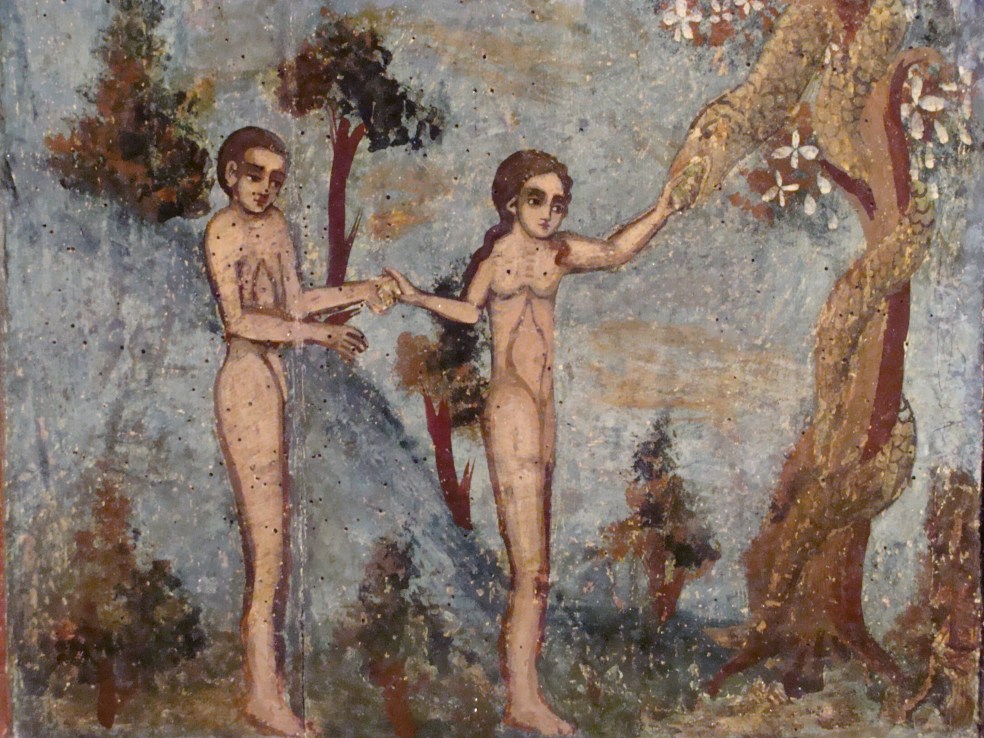
The story of the Fall of humankind is related in chapter 3 of the Book of Genesis. It is generally understood to mean that the woman, Eve, was tempted by the serpent and persuaded Adam to eat of the fruit of the tree of the knowledge of good and evil, which the Lord God had told the man not to eat from or else he would die. The serpent – a representation of evil, or the devil himself – tells Eve that they will not die, but their eyes will be opened and they will be like God, knowing good and evil. The man and the woman eat and then become aware of their nakedness, which causes them to hide when God comes visiting ‘at the time of the evening breeze’. The Lord God asks Adam how it is he knows that he is naked, and he replies that the woman gave him fruit from the tree to eat; she in turn blames the serpent. God pronounces their punishment, and the man and the woman are expelled from the Garden of Eden.


I should perhaps point out one of the most remarkable word connections you will ever find, and that is when we rearrange the letters of GARDEN OF EDEN. I used to do this, sitting down in the early morning (between 6 and 8) while the house martins screeched around on a level with my eighth-floor apartment in Sofia, Bulgaria – rearrange the letters and see what I could find.


GARDEN OF EDEN gives DANGER OF NEED. This is surely a coincidence, language telling us something.


Adam and Eve were in danger of need. But what exactly is wrong with having a knowledge of good and evil, and why should that cause them to die?


I would like to suggest an alternative interpretation, one I thought was unique to me until I discovered that it had been offered and accepted before. This interpretation – which is only that, an interpretation – gives rise to several conclusions, which I would like to list at the end of this article.


I imagine Adam and Eve playing in the Garden of Eden, in innocence, as children do, without a care in the world and with not much to do except to admire God’s handiwork in themselves and the animals and plants that surrounded and delighted them. They must soon have become friends. Life must have seemed like an ‘Eden’ to them – no great responsibilities, no great amount of work, no aches and pains to bother them. Just an eternity of today.


Except, as children do, they began to grow, to become sexually mature, and their curiosity must have been piqued. Eve began to have these bumps on her chest; Adam began to grow hair around his genitals and his long thing got longer. And they must have begun to experience the first sexual stirrings, perhaps in the night, when they were asleep, lying among last year’s fallen leaves. Perhaps they began to experience pleasure and to wonder what pleasure lay in the other.


There is an obvious correlation between the serpent and the man’s penis. The snake has traditionally been associated with the penis and sexuality. So perhaps it was the man who, feeling aroused, suggested they acquire carnal knowledge, knowledge of one another. Certainly carnal knowledge can be for good and evil – good in a loving, committed relationship and in the procreation of children; evil when it treats the other as an object and seeks only its own satisfaction. Undoubtedly, in the history of humankind, sex has been a force for good and evil – on the one hand, a demonstration of love, two people coming together in wonder and amazement; on the other, an abuse of the other person when it is not consensual or merely pleasure-seeking, seeking a meaning where none is to be found.


So we have identified the serpent with the man’s penis, but what of the fruit of the tree of the knowledge of good and evil, the apple? The apple can be related to the woman’s breast, that object that mystified the man and that he is now suggesting they eat of. After all, a fruit has flesh. It also has ‘the seed in it’, as we read in chapter 1 of the Book of Genesis, in the first creation account.


God had said that if they ate of the forbidden fruit – had sexual intercourse – they would surely die, and this is true, but bear in mind that the verb ‘die’ has two meanings: to expire at the end of our earthly lives, but also to expire in orgasm. This latter meaning is well documented.


What is the connection between these two meanings, and again why should the knowledge of good and evil be such a bad thing?


I think the answer is to be found in an article by a Greek bishop and theologian, Metropolitan John Zizioulas. In ‘The Consequences of Man’s Fall’, he writes, ‘In beings with organs – especially mammals – the ageing cycle begins from the moment that the organism reaches the point of reproductive maturity.’ So when we reach sexual maturity, we begin to die (in both senses of the word).


And this ties in with a teenager’s behaviour, because a child who reaches sexual maturity changes somewhat. They become more bashful, more private, they are no longer prepared to appear naked in front of their parents. Isn’t this exactly the behaviour of Adam and Eve when God comes looking for them ‘at the time of the evening breeze’? They hide themselves. They have become aware of their nakedness. And what is it they use to hide their nakedness that now causes them such shame? Fig leaves! Figs are another symbol of sexuality and the male organ.


So they have acquired carnal knowledge, they have slept together, and now they do not want God to see them because they are ashamed of their nakedness and they know that he will see it in their eyes. Their eyes have been opened.


But if sexual maturity coincides with the beginning of the ageing process, there is no other way to have children. So God – who so often is seen as inflicting punishment, as being vindictive, something that is as far away from his nature as it is possible to be – performs an act of charity, of love: he banishes them from the Garden of Eden in case they eat of the tree of life. He wants them to have children (I’m quite sure he knew perfectly well what was going to happen, just as any parent does), but he doesn’t want the ageing process that comes with sexual maturity to last for ever, that would be terrible, so he sends them out of the Garden of Eden to till the land they came from.


He does this in order that we might have children. In order to have children, we must die. This is the meaning of death – it is so that we can have the unparalleled blessing of procreating, of giving our life to another, who is then ‘the apple of our eye’.


This is a great thing – ‘Greater love hath no man than this that a man lay down his life for his friends’ (Jn 15:13) – but it also serves another purpose: it builds up the body of the Church. It prevents God from having to create all the creatures, all the men and women, himself. He involves us in the process (albeit our involvement is slightly different, because life passes through us, it does not begin with us – we are translators, not authors).


In this sense, the earth is a spiritual womb, it is a womb in which a spiritual body – the body of the Church – is being formed, just as we are formed in our mother’s womb. We have not realized this. Just as there is spiritual blindness as well as physical blindness, so there is spiritual birth as well as physical birth. We are still in the womb, but now it is not the body of an individual that is being formed, it is the collective body of the Church, a body made up of many members (in 1 Corinthians 12 and Romans 12, Paul compares us to the different members of the body, each performing his or her own unique function, with Christ as the head).


And this is where we get into the realm of Christian paradox: life passes through us when we receive life from our parents and pass it on to our children; but we also pass through life, in the sense that we are not here for ever and we move on. We form part of the body of Christ, the body of his Church, but in the sacrament of communion it is his body and blood that form part of us. We lose our life and find it. I begin to think the Christian message is true precisely because it is paradoxical.


Is there an indication of the world as a spiritual womb? I think there is, because if we read the first creation account in chapter 1 of Genesis, we find that God created the day on day one (already we have the progression AIO in the word DAY, remember the correlation between O and D and between i and y) and then, on day two, he created the dome of the sky by separating the waters from the waters. Doesn’t that sound like a baby in its mother’s womb, surrounded by water? Perhaps this is why SKY can be connected to KISS and SICK, because for procreation to occur there must be a kiss, but sexual maturity is also the beginning of the ageing process, of what makes us sick.


Is there anything in language to connect the serpent and the man’s penis, to connect the apple and the woman’s breast?


Well, if you allow fluidity to the vowels and change one front vowel for another, you will find that PENIS is in SERPENT, with the addition of r and t. And applying the phonetic pairs b-p and l-r, you will find that APPLE is in the first four letters of BREAST, with the addition of s and t.


This interpretation – and it is only an interpretation – has three consequences:


  1. The Fall was a good thing. Otherwise, we couldn’t have children and the body of the Church could not be formed.


  1. Perhaps the woman is not entirely to blame; in fact it would seem that Adam was the prime mover in response to his sexual desire. We could at least speak about shared responsibility.


  1. While in the Church great emphasis is placed on monasticism, on abstinence and asceticism, it would appear that the purpose of life on earth is to have children, and this would give the option of marriage far greater importance than it is sometimes credited with.


So Genesis, that most remarkable book, is not just the story of the creation of the world and the Fall of humankind, but also the story of each one of us, of human life. We are born, just as the world (the body of Christ) is. We reach sexual maturity in order that we might give that life to others. We then have to die (we have now fast-forwarded to the Crucifixion) because it is the only way to give life – to die, to expire. But there is a greater mystery here. This is not the last word.


The word ‘die’, if we apply the physical pair b-d (a pair of letters that look alike; in this case one is the mirror image of the other), clearly contains ‘I’ and ‘be’. It is a very life-affirming word. The word ‘live’, if we remember the closeness between b and v, contains two ‘I’s and ‘be’ – this may refer to our physical and spiritual selves, to our human and divine natures (the latter acquired by grace in a process known in Orthodoxy as theosis), or to our fallen and resurrected selves. Anyway, it is manifestly not the end.


If we could only see this world for what it is, a place of spiritual growth (not a place to make money!!) – a spiritual womb – we might realize our connectedness. Having been born from our mothers, we are now – all of us, outside the constraints of time – in the process of forming another, spiritual body, one that has Christ as its head and one that will last for all eternity. The world is a spiritual womb. We must die in order to have children, participating in this way in the formation of the Church. And having died, we have no choice but to be born again, but this time without the straitjacket of corruption, without the ageing process. We will be ‘like angels in heaven’ (Mt 22:30). With one great difference: we will not be alone.


Jonathan Dunne, http://www.stonesofithaca.com