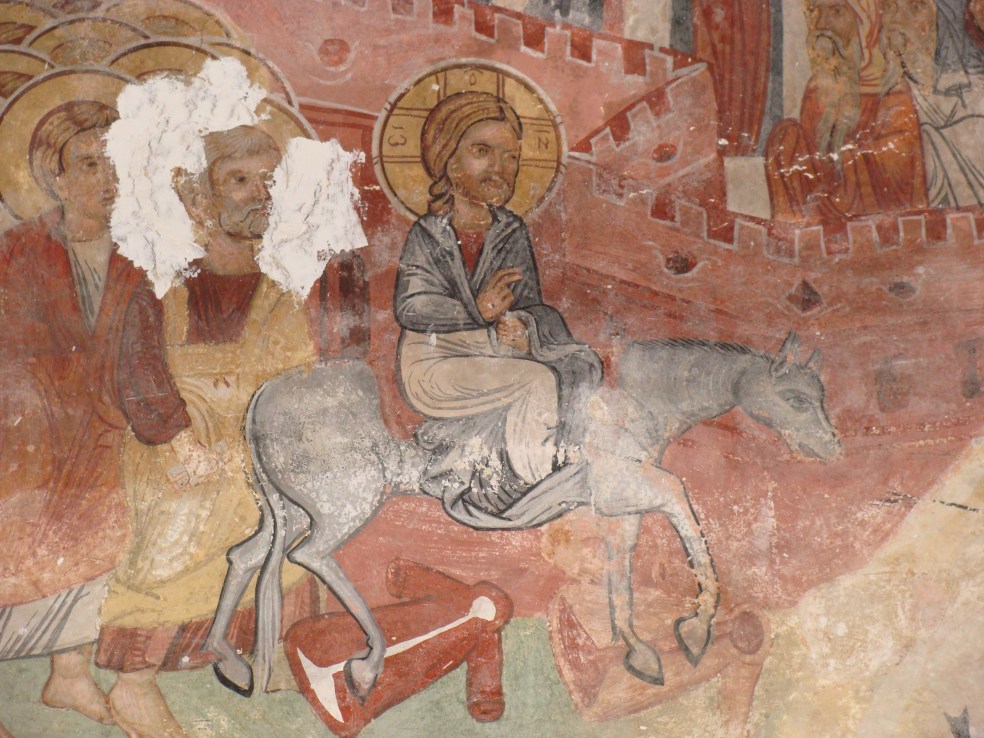
Baptism of Christ

Readings: Isaiah 43:1-7; Psalm 29; Acts 8:14-17; Luke 3:15-17, 21-22

We all speak. That is, we produce sounds with our mouths. After the service, we will gather around the coffee machine and do this. We will discuss the week’s events and thrash out the finer details of this sermon. We will express opinions and hopes and desires. We will enquire after friends. And we will leave, having shared fellowship.

How strange it would be if we all gathered in the entrance hall and didn’t say anything! If we stood in each other’s company with our mouths closed. We might raise our eyebrows or wiggle our ears, but no further communication would be permitted. Eventually someone would snort or yawn, and the spell would be broken. We would laugh and launch into a discussion.

We worship a God, Jesus Christ, whom we call the Word. This is how John the Evangelist refers to him at the start of his Gospel: “In the beginning was the Word, and the Word was with God, and the Word was God.” And we read in chapter 1 of the Book of Genesis that the world was spoken into being. Each paragraph begins, “And God said.” “Let there be light.” “Let there be a dome in the midst of the waters.” “Let the dry land appear.” Etc.

And yet we pay very little attention to speech. This is unusual since I would say that Christianity is a religion of the Word and its ritual is based on the action of speaking. The first thing we do when we speak is breathe out. It is impossible – I think! – to speak as you are breathing in. So, the first element of speech is BREATH. Breath is represented in the alphabet by my favourite letter, the letter “h”.

Then we add voice to our breath and produce the vowel sounds. Think of a baby. A baby is a student of phonetics. It opens its mouth (hopefully not at three in the morning) and adds voice to its breath, producing vowel sounds that may range from an “oo!” to a long, drawn-out “ah!”. But it will generally not produce consonants because consonants involve blocking the flow of air with the lips or tongue and this is more difficult.

A vowel sound is what the doctor asks you to make when they want to examine your throat: “ah!” “A” is the most open vowel there is, so it involves opening your mouth to its greatest extent. It is what we do when we sing. The longer you hold a vowel sound, the more saliva will collect in your mouth, and you will have to swallow. This is because vowels are like water. It is as if a river was flowing through the canyon of our mouths. So, the second element of speech is WATER.

When we obstruct the flow of air with the lips or the tongue, we produce the consonants. Perhaps the easiest consonant to pronounce is the letter “m”. This involves pressing the lips together. “M”. And this is often the first consonant a baby will produce, when it says, “Mama”.

Since the consonants are produced by blocking the flow of air with our lips or tongue, we might say that the third element of speech is FLESH. So, we have BREATH (the letter “h”), WATER (the vowels), and FLESH (the consonants). The three elements of speech, which we practise unknowingly, as when we change gears in a car.

This is how I would analyze the action of speaking: breath, water, and flesh. In chapter 2 of the Book of Genesis, there is a second creation account, which involves the creation of man. In verses 6-7, it reads as follows:

A stream would rise from the earth, and water the whole face of the ground – then the Lord God formed man from the dust of the ground, and breathed into his nostrils the breath of life; and the man became a living being.

Gen 2:6-7 (NRSV)

Most of us, I suspect, would regard speech as the agent of creation as a kind of metaphor, but I think this is exactly what happened. Nowhere in the first two chapters of Genesis does it say that God made the world with his hands, like a potter fashioning clay. It says that he spoke. All through the first two chapters, we read that God said. And the three elements of speech – breath, water, and flesh – are clearly present here: God “breathed into his nostrils the breath of life”, “a stream would rise from the earth, and water the whole face of the ground”, God “formed man from the dust of the ground”. We read later in Genesis 3:19, “You are dust, and to dust you shall return.” This refers to our material body.

We find the same emphasis on the power of speech in Psalm 29: “The voice of the Lord is powerful… The voice of the Lord breaks the cedars… The voice of the Lord strikes with flashes of lightning… The voice of the Lord twists the oaks and strips the forests bare…” That’s pretty impressive – to do all of that only with words. It doesn’t say that God did these things with his hands, and this is a constant in Christian texts and prayers.

We are not able to produce matter with our mouths, but with our words we can have a material effect on our surroundings. We can make someone happy by saying something nice to them. We can make someone cry by saying something hurtful. We can order someone to be killed. Or we can issue a pardon. Our words can be recorded and can influence future generations or even the course of history.

After the creation of man, man – the Hebrew word is “Adam” – is given a task. He is not asked to make the creatures – that is God’s undertaking. He is asked to name them. To apply a word to that particular creature. This occurs in Genesis 2:19-20. Most of us are not in the habit of adding words to the dictionary, of coming up with a name for a horse or a squirrel. But we do name our children, and names are important. They may not fix a child’s destiny, but they do, to some extent, determine their character. There is a Bulgarian name, Milen, which comes from the Bulgarian word for “kind”, mil, and I have noticed that many people called Milen are kind in person. It is as if they live up to their name.

A child is named at their baptism. The priest takes a bundle of flesh and douses their head with water three times, invoking the Holy Spirit. But hang on a minute! Aren’t those the three elements of speech – breath (the Holy Spirit), water (the water of the font), and flesh (the tiny baby)?

In effect, in the sacrament of Holy Baptism, a child is being made into a word of God – not the Word (that is Christ), but they are being called to be Christ-like, to reject the devil.

And what happens in the sacrament of Holy Communion? The priest takes the bread, the fruit of the earth, and the wine, which is a liquid like water, and consecrates them by the invocation of the Holy Spirit. Again, the three elements of breath, water, and flesh are present. We find all three elements in bread, which is made from a dough of flour and water and has air in it.

And what about the first creation account in Genesis, where we read that the waters were separated from the waters and the sky was created, then the waters under the sky were gathered together into one place and the dry land appeared. Aren’t these again the three elements of speech – breath (the sky), water, and flesh (the dry land)?

I would suggest that speech is central to an understanding of the world around us and our place in it. It can effect change, it can bring people to their senses. It can give meaning, as when we take our child and name him or her.

When we are baptized, as Jesus was by John the Baptist in the River Jordan, we have a choice. We can choose what kind of people we want to be. We can decide on the words we will use, on the actions we will take, whether to tell the truth or lie, whether to help others or steal.

We are a word of God. We can choose to be wheat or chaff. We can choose whether to please God or to turn away from him. According to our life, so our definition will be. And this is why we need to cling to the name of Jesus, to think only of him, so that in our earthly pilgrimage we become as much like him as possible. We are made in God’s image, now we must become like him.

Come, Lord Jesus! Amen.

Jonathan Dunne, www.stonesofithaca.com

Photo caption: Letters make good staging posts. Saints Cyril and Methodius, the brothers from Thessaloniki who wrote the Cyrillic alphabet, outside the National Library in Sofia, Bulgaria.

15. Atom

Christ became human so that he might translate for us the meaning of life through parables (Braille, writing for the spiritually blind), but also so that he might translate us when we die. The process of translation, when a word in one language disappears in the translator’s mind in order to reappear in another language, can be likened to death, when someone disappears and is spoken into the language of eternity.

Christ became man in order to show us the road to salvation. He entered his own creation through one of his creatures, Mary. He came to translate for us the meaning of life, because we were at a loss and it needed explaining. He did this by means of parables. We have seen examples. Parable is connected to Braille through the phonetic pair b-p – it is writing for the spiritually blind, for those whose spiritual eyes have not been opened.

But I believe that there is another reason for God to become human, to enter his creation. God is the Author, the source of all that is. We are not the Author, much as we would like to be, because we cannot create out of nothing. We need what already exists, and our purpose is to take this and to turn it into something better, to translate it, just as the translator of a text takes a text written in one language and converts it into another through an unseen, and highly spiritual, process that takes place in the person’s mind as they are translating.

When we are translating a text, there is a point, once we have understood the original (read it, looked up any words we do not know, consulted with the writer or an expert in their work, all the horizontal work of preparation), when the original disappears, it evaporates, the words dissipate, the letters fade away, and out of the translator’s mind, through their fingers as they type on the keyboard, appear new words, words written in another language.

That momentary disappearance, that disembodiment, can be likened to the process of human death. We also seem to disappear, our bodies are put in the ground, and we are no longer seen. We also evanesce, cease to be discernible by the five senses. But in whose mind are we?

I think that Christ became man not only to translate for us the meaning of life by means of parables and his example, but also literally so that he could translate us at our death. An author is the source. A translator acts as a conduit, just as the Virgin Mary did when she acquiesced to bear Jesus in her womb. By becoming human, Christ became the Translator.

We are a text being written. Everything we do in this life takes us in a certain direction. And when we reach the end of our lives, we will be spoken, having been taken up into the mind of the Translator. We will be freed of the constraints of time, and we will enter eternity, the white page on which words are written.

This is why eternal gives two connections. For the first, we must take a step in the alphabet, e-f, and use two pairs of letters that look alike, i-l and n-h (one is an extension of the other). In this way, eternal gives father and I:

eternal = father + I

I think this is because, once we have been spoken, we will have left the speaker’s mouth and be able to see him.

It also spells I am free (phonetic pair m-n, pairs of letters that look alike, i-l and f-t):

eternal = I am free

We will be free of corruption, of the bondage to sin, free to express ourselves without fear (free – the fine line between fear of God and the fire of purification, if we allow fluidity to the vowels; the good news is that it lasts for ever, f-v).

Language contains hidden meaning. The whole of human existence is contained within it. We haven’t realized this. We treat language like an external object, a tool. We use words to bash people on the heads and also to caress them. But we haven’t realized that we ourselves are language, words in the making, spoken into being – breath, water and flesh; h, vowels and consonants – just as we read in the first two chapters of Genesis.

Language tells us the road that we must follow. Christ is very clear about this when he says to his disciples, “If any want to become my followers, let them deny themselves and take up their cross and follow me” (Mt 16:24). This is the way to eternal life, but it passes through denying the ego, drawing a line through the I, which forms a cross, †, but also a plus-sign, + (the meaning of losing our life in order to find it).

We have seen the three ways of moving away from the line by forming a triangle, the letter A, by deleting the I, +, and by treating the line as a number and counting down to O: A+O. These three symbols spell the name of God Alpha and Omega. As soon as we turn our backs on the ego, we turn to God. They are also found in the middle conjunction, and, if we write it with capital letters: AND (A ’N’ O). The reverse of and is DNA – it is in our DNA to do this, to move away from the line, to follow the progression of the Greek alphabet, AIO or AIW.

And when we draw a line through the ego, when we make the sign of the cross (a cross is a deleted I), something extraordinary happens. The progression of the Greek alphabet, with the ego deleted, spells A+O/W (depending on which letter we use to depict omega, a long o or w).

We effect a change at molecular level – the “living water” Christ was talking about, a change of heart, literally, at a level we cannot normally see – because this progression is contained in the word atom, traditionally the smallest particle of matter.

There is a clear connection between language and the environment: seed-root-tree-fruit. A tree that branches out is like a flowering ego, it is no longer a straight line. There is a clear connection between language and the history of the world, from the creation in the Book of Genesis to the Last Judgement, when angels will come to glean the field. And just as we plant a seed outside (as the Samaritan woman fetches water from the well in a bucket), so we must hear the Word of God and plant a seed in our heart.

The one will feed our stomach. The other will give us wings, and change our perception for ever.

Jonathan Dunne

Heart of Language 15/15

Back to: Contents

See also: Theological English (video course); Word in Language (series of articles)

Video

Theological English (10): Connections – Addition of Letters (0)

In this eleventh video on “Theological English”, Jonathan Dunne starts to look at word connections between words that do not have the same number of letters, where it is necessary to add one or two letters. If we do not want to be like Narcissus and only to hear our own voice, we must open our spiritual eyes and ears. This will lead to a seed being planted in our heart. The two greatest commandments are to love God and to love our neighbour: love – other – theos. It is “love” that makes us “whole” (without the initial “w”, a letter that resembles the number “3” and can be taken to refer to the Holy Trinity, all we have is a “hole”). There is a second video on this theme: “Addition of Letters (1)”.

To access all the videos in this course, use the drop-down menu “Theological English (Video Course)” above. The videos can be watched on Vimeo and YouTube.

Video

Theological English (0): The Line

In this first video on “Theological English”, Jonathan Dunne looks at the line, which represents the ego in English (I) and the number 1. Countable nouns are nouns that can have a line drawn around them – a book, a car, a tree. They are accompanied by the indefinite article, a/an. When God made man, he in effect made a countable noun – he drew a line around us and gave us free will. We do the same with products of the earth – we draw a line around them in the form of packaging – but we do this not to give things free will, but to trade in them, to sell them to each other. We appropriate for ourselves the role of author (things begin with us), when in fact we are translators (things pass through us).

To access all the videos in this course, use the drop-down menu “Theological English (Video Course)” above. The videos can be watched on Vimeo and YouTube.

Turner and the Uncreated Light

The Uncreated Light is a very important doctrine in Eastern Orthodoxy that was first formulated by St Gregory Palamas in the fourteenth century, but is intimately connected with the writings of earlier figures such as Gregory of Nyssa (The Life of Moses) and Pseudo-Dionysius the Areopagite (The Celestial Hierarchy). It is defined on Wikipedia as ‘the light revealed on Mount Tabor at the Transfiguration of Jesus, identified with the light seen by Paul at his conversion’. The Wikipedia article goes on, ‘a completely purified saint who has attained divine union experiences the vision of divine radiance that is the same “light” that was manifested to Jesus’ disciples on Mount Tabor at the Transfiguration’.

So Orthodox theology has it that, through a process of purification, a person can experience this light of God in this present life. There was a controversy about this in the fourteenth century, involving Gregory Palamas and Barlaam of Calabria. The latter contended that it was not possible to know God in this way, God is unknowable, but Gregory Palamas made an important distinction between the essence and the energies of God. That is, the essence of God cannot be known by his creatures, even in the next life, but we can participate in his energies, he is communicable to us through his energies, which we can experience in this life.

To experience this divine light, we have to leave behind the world of concepts. We tend to view the world as being full of objects – that is, we rely on our physical sight – and we rely also on our powers of reasoning. We observe and draw conclusions. But at some point we must leave the world of concepts behind in order to progress on our spiritual journey. The website The Ascetic Experience explains it like this: ‘When the intellect has transcended intelligible realities and the concepts mixed with images that pertain to them, and in a godly and devout manner has rejected all things, then it will stand before God deaf and speechless.’ The website goes on to describe the intellect’s proper state in very beautiful terms:

The intellect’s proper state is a noetic height, somewhat resembling the sky’s hue, which is filled with the light of the Holy Trinity during the time of prayer. If you wish to see the intellect’s proper state, rid yourself of all concepts, and then you will see it like sapphire or the sky’s hue. But you cannot do this unless you have attained a state of dispassion, for God has to cooperate with you and to imbue you with His own-natural light.

What exactly is dispassion? I always understand it as not giving in to our natural impulse to, say, get angry or lust after someone or covet property (which is a strange concept, anyway, since in the long run nothing belongs to us but the destiny of our soul). For me, it is as simple as curbing the impulses that cause unhappiness and arguments and disintegration, fragmentation of families and societies. But we cannot do this on our own. We need God’s help and simultaneously we must purify ourselves of the passions by participation in the Sacraments of the Church.

Some people (see the site Sacramental Living) connect the Uncreated Light with the light revealed at the beginning of the Book of Genesis, the light that made Day (as opposed to the sun, the moon and the stars that were not created until the fourth day). Others connect it with the light in the Burning Bush, when God met Moses in the Book of Exodus (the fire that burns, but doesn’t scorch). A similar light is said to descend on the Holy Sepulchre on the night before Easter, from which Orthodox faithful light their Easter candles (known as ‘Holy Fire’). This is the light by which we will see in the heavenly Jerusalem, described in the Book of Revelation (21:23, 22:5).

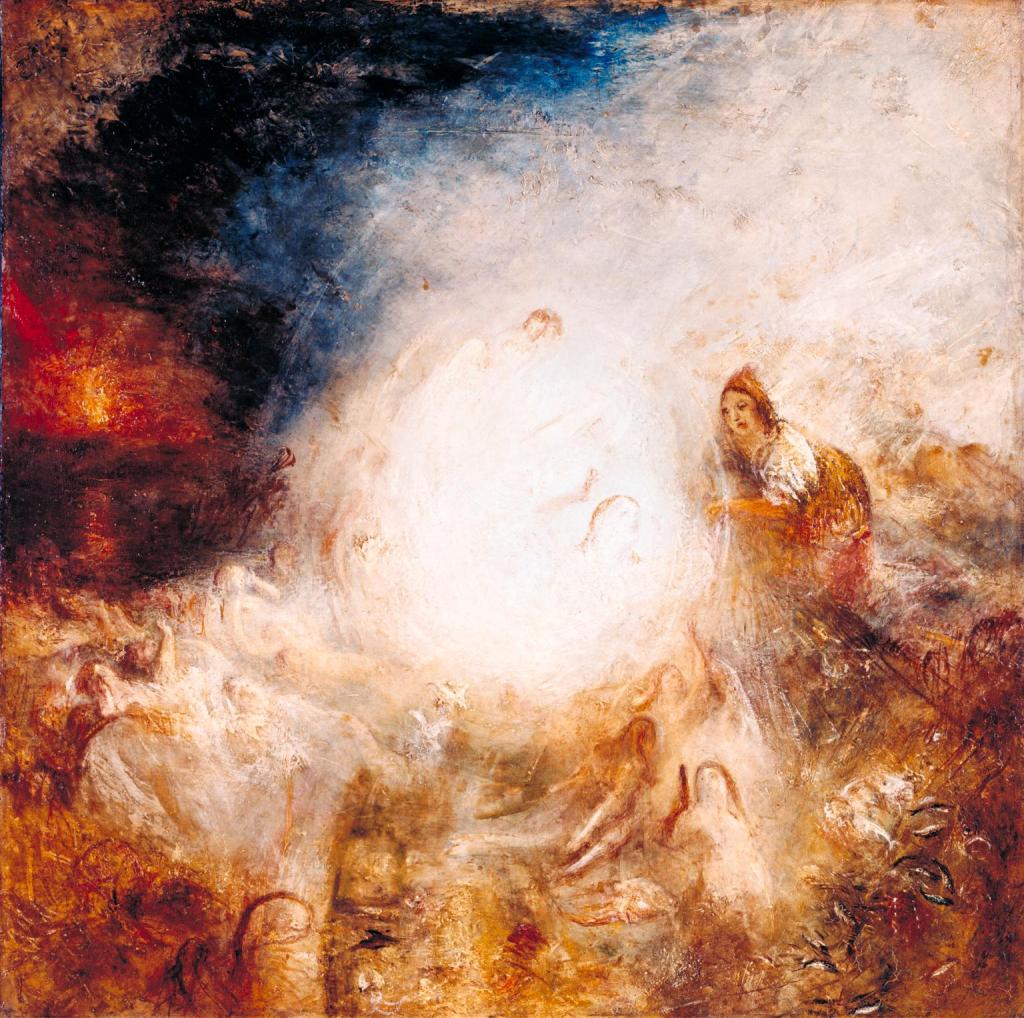
The Bulgarian poet Tsvetanka Elenkova, whose work I have described in a previous article, connects the Uncreated Light with the bright white light so often found in J. M. W. Turner’s paintings. I would like to look in particular at the painting Undine Giving the Ring to Masaniello, Fisherman of Naples. The display caption for this painting says that Undine is a character in German fairytale written by Friedrich de la Motte Fouqué and published in 1811. Masaniello (real name Tommaso Aniello) was an Italian fisherman who led a revolt against the rule of Habsburg Spain in Naples in 1647. So the caption – and, needless to say, all critics – focus on this background to the painting and how Turner might have got the idea from an opera, La Muette de Portici, or a ballet, Ondine, he had seen in London before carrying out the painting.

What both the display caption and the catalogue entry emphasize, however, is the ‘otherworldly light’, ‘that favourite white light of Turner’s’. Elenkova goes further and decides to give all her attention to the spiritual content of the painting rather than its historical context (which we are so prone to focus on and to pass on to our children). Let us look at the painting:

Undine Giving the Ring to Massaniello, Fisherman of Naples by J. M. W. Turner (reproduced from http://www.tate.org.uk/art/work/N00549)

In the middle of the painting, we see a ball of light. In her poem on the painting, Elenkova connects this ball of light with the Uncreated Light that was revealed to Jesus’ disciples on Mount Tabor, and the figure of Undine to the right she connects with the Virgin Mary. Beneath the ball of light can be seen a hand reaching up out of the sea (we see very clearly the tops of two fingers with their nails), to the right of which (said to be a fish Turner added later on) is what looks like a face (the fish would be the left eye, above it there is some hair, below it the nose and lips), which the poet links to the hand of God and the first Adam respectively. This part of the painting would refer to the creation of the world, and we all know how Adam and Eve ate of the fruit of the Tree of Knowledge and got expelled from Paradise, becoming subject to death and corruption.

On the other side of the ball of light, in the top left-hand corner, against a background of darkness, can be seen the figure of Christ on the Cross, arms outstretched, head slumped. Christ is the second Adam, the one who came to redeem us from our sins, to show us the way back to eternity, but this will be an eternity with knowledge, not a naive eternity in which we are prone to make the same mistake. We will have learned something from the experience of living on this earth for three score years and ten. That is why I always say you cannot go back to the Garden of Eden, to a state of blissful ignorance – our progress must be onwards.

So the ball of light in the middle of the painting is the fruit that the Virgin Mary accepts not out of disobedience, as in the Garden of Eden, but out of obedience, the seed that is implanted in her womb when she is overshadowed by the power of the Most High (Luke 1:35), the fruit that will repair the damage that was done and reopen the way to heaven.

On the left of the ball of light, we see what looks like a meteorite crashing into the earth (said by scientists to be one possible way that life arrived on earth), but look at the reflection of the meteorite in the black waters. It makes what looks like a cross.

Turner, as so often, was lampooned for this painting. Perhaps the critics even thought they could see the signs of approaching senility, since this painting, exhibited in 1846, is one of the last that Turner will paint. There is the suggestion that Turner’s choice of Undine and Masaniello as a subject may have embodied an attack on the Reverend John Eagles, one of Turner’s sharpest critics. Masaniello may have been chosen because of his rumoured friendship with the poet-painter Salvator Rosa. Masaniello’s real name being Tommaso Aniello, Turner may have been playing with the association of his own name with ‘ring’, of which ‘aniello’ is the Italian translation. Finley suggests that there is also an allusion to the French king Louis Philippe I, the object of a number of assassination attempts, while Wallace sees a parallel between Masaniello and Christ with the painting a reflection of Turner’s pessimism over the possibility of Christian salvation.

But what the painting contains is precisely a depiction of Christian salvation, from the first to the second Adam, from creation to redemption! It also provides a link between a scientific explanation of the arrival of life on earth and the Cross. When we focus only on external things, on the historical context, we are in grave danger of missing the point. Elenkova in her poems attempts to correct this physical vision, to offer a more spiritual vision of the paintings and their depth.

The most remarkable part comes at the end of the catalogue entry associated with this painting. When paintings were displayed at the Royal Academy in London, the artists were in the habit of spending a couple of days adding the final touches. The painter W. P. Frith describes how Turner and his neighbour, David Roberts, continued work on their paintings:

Both he and Roberts stood upon boxes, and worked silently at their respective pictures… ‘Masaniello’ was rapidly undergoing a treatment which was very damaging to its neighbour without a compensating improvement to itself. The gray sky had become an intense blue, and was every instant becoming so blue that even Italy could scarcely be credited with it. To this hour ‘Masaniello’ remains… with the bluest sky ever seen in a picture, and never seen out of one [my italics, note the heavy irony].

Could Frith unwittingly have cottoned on to the very essence of the painting, that it contained a depiction of the Uncreated Light (remember the description of the intellect’s proper state as being ‘like sapphire or the sky’s hue’)? If we want to go through this life without being spiritually blind, it is imperative that we open our eyes to the kind of spiritual vision being offered by the Bulgarian poet Tsvetanka Elenkova in her forthcoming book Turner and the Uncreated Light and at least entertain such possibilities.

Jonathan Dunne, http://www.stonesofithaca.com

Word in Language (17): Christ the Son of God

After the bread that is destined to become the body of Christ during the Orthodox Liturgy has been cut from the loaves that have been baked for this purpose, the bread that is left over from the loaves is divided into small pieces, blessed by the priest and distributed to the people after the service. This bread is known as antidoron in Greek, meaning ‘instead of the gift’. It is used by those who have received communion to help wash down any remaining traces of the body and blood of Christ, so that they do not remain in the mouth, and is received by those who have not received communion as a substitute – ‘instead of the gift’. One of the subdeacon’s duties is to cut this bread into small pieces so that it can be distributed by the priest.


I serve as a subdeacon in the Orthodox Church, and I often think of this unconsecrated bread as being similar to words, cut from the body of Christ and waiting to be sanctified or not by their use. That is, the words we bandy about in conversation or in writing are small fragments of the Word of God and contain the potential to be used in a sanctifying way, if our intentions are good and our mind is set on God.


It is as if the priest is distributing words to the people, who will then leave the church and go out into the street and use those words in what is hopefully a beneficial way. It is only an image.


But I would like to suggest that words, just like the environment, bear the imprint of the Creator and refer to him. My book Stones Of Ithaca contains numerous examples of stones from the beaches of the Greek island of Ithaca that seem to depict Christian symbols and scenes. Language is the same, and why should we be surprised? Isn’t Christ the Word of God, the Logos? Isn’t it logical, therefore, that he should be present in words? Or that words should speak of him?


I would like to suggest that this is so and we can find proof in language that Christ is the Son of God (and that Mary is his Mother). God is one essence and three hypostases (that is, three persons) – three in ONE. I would like to show how language confirms Christ as the Son.


Let us start with the progression that we saw in the previous two articles, AIO, the progression of the Greek alphabet and of human life. A represents the Creation (described in the first two chapters of the Book of Genesis); I represents the Fall (described in the third chapter of Genesis), the era we live in; and O represents repentance, becoming aware of our sins and turning back to God, the aim of our life on earth.


In the Book of Revelation, at the other end of the Bible, Christ describes himself as ‘the Alpha and the Omega, the first and the last, the beginning and the end’ (Rev 22:13). This is one of his names – Alpha and Omega – and can be written A+O. Now it is curious that the three ways of escaping from the selfish demands of the ego, of moving away from the line that represents the ego in English (I), involve:


– making reference to a third point, God, and forming a triangle (Δ);

– deleting the I and forming a cross (†);

– treating the letter I as a number (1) in order to count down to zero (0).


That is, A+O. Christ’s own name, revealed in the Book of Revelation, indicates to us the path that we must follow. I don’t think any human could have invented this; it must be something contained in language itself.


We saw that A+O is found in the middle conjunction, ‘and’, because if we write ‘and’ using capital letters, we get AND or A ’N’ O. The reverse of AND is DNA, which implies that it is in our make-up to make this progression and to turn to God, away from the ego. Note how GOD and EGO are only a step apart in the alphabet (alphabetical pair d-e).


If we apply this progression AIO to the name of God revealed to Moses at the burning bush in Exodus 3:14, AM, we find that AM becomes I’M becomes OM. I take this last word to be a reference to the Holy Trinity: O3, or three in One. But one of the ways of making word connections is by the addition of letters, and one of the most commonly added letters is h. So another way of moving away from the self-centred demands of the ego that we find in I’M is, instead of making the progression AIO, simply to add h to I’M, which gives us HIM. I understand this to be a reference to Christ. He takes us out of ourselves – actually, in many ways it is the reverse movement: he returns us to ourselves. We turn to HIM and in the act of worship we sing a HYMN (the coincidence between these two homophones HIM and HYMN is found also in LORD and LAUD).


In Matthew 20:28, Christ says to his disciples that the Son of Man – Christ himself – came ‘not to be served but to serve, and to give his life a RANSOM for many’. Again, I think we can find proof for this in language, because if we ignore the first letter of RANSOM (r), we find that the rest of the word contains the name of God in Exodus, AM, and SON. Of course, the letters are jumbled up; spiritual knowledge is always hidden in some way. But it is not difficult to make out. I think the word RANSOM wishes to confirm what the Word is saying, and to confirm who he is: the Son of God.


We find another connection to the name of God in Exodus in John 14:6, where Christ says, ‘I am the way, and the truth, and the life.’ If we write the name of God in Exodus I AM and turn the letter M upside down, we will see a clear similarity between I AM and ‘law’ – the law of the Old Testament, which found its spiritual fulfilment in Christ – and between I AM and ‘way’ (y is the semi-vowel that corresponds to i): I AM – law – way. Language confirms what Christ is saying. This is why he goes on in the same verse to say, ‘No one comes to the Father except through me.’ He is the way to I AM.


We find further proof of this connection between the name of God in Exodus and Christ in the appellation that John the Baptist gives Christ when he sees him approach in John 1:29: Lamb. The word ‘lamb’ (and note that the final letter, b, is silent) contains ‘I am’.


So in ‘way’ and ‘lamb’ we find two clear indications that Christ is the Son of God. Again, I would point out that no human could have invented these words so that they would reproduce the name of God in Exodus, I AM. This has to have come from God, to be ingrained in language, just as we saw AM in the name given to the first human, ADAM (both words contain the first and last letters of the Greek alphabet: AO, or AW if we write omega according to Greek usage).


In Orthodox tradition, all appearances of God in the Old Testament are by the Logos, so it is Christ who interacts with Adam and Eve in the Garden of Eve and it is Christ who appears to Moses at the burning bush. For this reason, the Greek Septuagint translation of the name of God in Exodus – O WN – is included in icons of Christ, in the beams of the Cross inside the halo around his head. Search for an icon of Christ Pantocrator, and you will see what I mean.


O WN actually means ‘the being’. That is how the name of God, AM/I AM, is translated into Greek. O WN spells three words in English – OWN, WON and NOW – and it is easy to see the relevance of these words to Christ: he claims us as his own; he has won; he is with us now (Emmanuel).


By rotating the W, we can connect O WN to the number ONE, and I think this is because in his Incarnation, becoming visible to us, Christ represents – follows the will of – the Holy Trinity, three in ONE.


We have seen how these three letters O WN can be written O WH, which spells the question words WHO and HOW. Christ is the answer to both these questions, which we can only ask when we have made the progression AIO. That is, we have gone from asking WHAT in Creation (What is this creature? What should I call it?) to asking WHY (Why should I do this? Why should I believe you?) in the Fall to asking WHO/HOW in a state of repentance. We count down from the ego and realize that the answer we should be seeking is a person, and if you want a person to be the answer to the question you are asking, then the correct question is WHO? This was Pontius Pilate’s mistake when he was standing in front of that very person and asked him, ‘What is truth?’ Truth, he failed to understand, is not a thing, it is a person. The irony of this situation is staggering.


Now WHO sounds the same as HU, which is the root in Sanskrit of our word ‘God’. To show that Christ is the Son of God, the fulfilment of the Old Testament law and prophets, we see that WHO (O WH) is a progression from WHY, which contains the letters of the Hebrew Tetragrammaton: YHWH. And finally if we combine WHO with another name of God in the Old Testament, EL, we find that the two names together spell WHOLE. With the coming of Christ in human form, his birth, teaching, crucifixion, descent into hell and resurrection, we are made WHOLE. We are given that possibility, for our broken form, human nature, to receive wholeness, to return to God. That possibility was not available to us under the Old Law.


In the addition of letters, one of the most commonly added letters is h. Remembering the correlation in phonetics and in the alphabet between v and w, we will then see that WHOLE contains LOVE. It is love that makes us whole, that enables us to enter into relationship. Relationship is intrinsic to the Holy Trinity (there are three persons), and so it is intrinsic to us as well, because we are made in the image and likeness of God (Gen 1:26).


LOVE, by the addition of the same letter h, can be found in OTHER (phonetic pair l-r, alphabetical pair t-v). Love necessarily involves the other, unless all you are going to do is love yourself. I don’t think we are meant to do this. True love – true healing – involves relationship. I am healed by others, by letting them into my life and by revealing myself to them. I have a family, I was lost without them, but that same love – that same self-affirmation (as opposed to the self-destruction brought about by sin) – can be found with a complete stranger if our gaze is at once directed towards each other and towards him (the third point I talked about with reference to the triangle). OTHER is connected to the Greek word for ‘God’, THEOS (alphabetical pair r-s), and this is the meaning of Christ’s saying, ‘Just as you did it to one of the least of these who are members of my family, you did it to me’ (Mt 25:40), but we have lost this meaning. Very often we see our neighbour as a threat to our peace, we turn away from them or eyeball them with aggression. Our lives are separate – we have no common reference. It is a common reference that brings peace.


And LOVE is connected with another word in language, which again goes some way to proving that Christ is God. If we apply the phonetic pairs l-r and v-w and the alphabetical pair d-e to LOVE, we find WORD. We read in 1 John 4:8 that ‘God is love’ – Christ is the Word, and WORD is connected to LOVE, which seems to confirm this.


In the beginning, God the Father created the world through the Son on the basis of the Holy Spirit. Again, we will find confirmation in language because WORLD is a combination of LORD and WORD. We find WORD not only in LOVE, but in the WORLD we inhabit. We also find him in the SUN that illuminates our lives and enables us to grow crops, that is to survive, because there is a clear correlation between SON and SUN. It is the Son who enables us to eat. I am not saying that the Sun is Christ himself, but there is clearly a connection between the two words, which implies a scientific connection as well.


We find confirmation of this connection SON-SUN if we apply the phonetic pair b-p to LAMB, which gives us LAMP. Christ says as much in John 8:12: ‘I am the light of the world.’ Language confirms it. His name confirms it, because CHRIST contains LIGHT (phonetic pairs g-k and l-r, addition of s).


He also enables us to breathe. When we discussed the Trinity as three in ONE, we saw that God the Father is no one (O1), God the Son is oxygen (O2) and God the Holy Spirit is ozone (O3). The Holy Spirit is commonly likened to a wind (a word, by the way, that contains the first four numbers – 0, 1, 2 and 3 – if we rotate two of the letters in WIND) – that is, breath, which is represented in language by the letter h. If we combine this letter for the Holy Spirit, H, and the chemical symbol for oxygen, O2, we get water: H2O. Christ also enables us to drink.


The two chemical symbols combined, O2 and O3, can be found in MOON (again, we need to rotate the letters to get the numbers 2 and 3), so it seems that Christ reflects his own light and enables us to see at night.


Language, and the environment that surrounds us, are permeated by Christ. Look around you, and you will see a million crosses. The Cross is like a stile – it enables us to cross over to the other side, to escape our own isolation, to walk over the line, to make a bridge that will carry us where we want to go. Language will help us. Once we enlist its support, it will provide the content of our prayers – at least until we no longer need words. Language, in this sense, is repetitive. It can be boring, but we are rubbing away the hard outer casing of our hearts, so that we can enter there and find God’s kingdom.


In the end, perhaps the name alone will suffice, coupled with an expression of assent. There is one city in the world that is claimed by the Abrahamic religions: Jerusalem. It was here that Christ’s crucifixion and resurrection took place, and it was not far from here, in Bethlehem, that he was born. This is where Christ taught in the temple when he was only a child and sweated tears of blood in the Garden of Gethsemane prior to his ultimate sacrifice on the Cross.


Take the word JERUSALEM and apply the alphabetical pairs l-m, m-n and r-s. That is, take the letters l, m and r in JERUSALEM and advance one step in the alphabet. What two words do you get? This, for me, is proof that Christ is who he says he is.


Jonathan Dunne, http://www.stonesofithaca.com

Word in Language (16): AIO (1)

In the previous article, we looked at the progression of human life – which is also the progression of the Greek alphabet – from A to I to O. A represents the letter of Creation, when AM created AN, a countable noun, a separate being, one that can have free will – that is to say, A MAN – whose name was ADAM. I is the letter of the Fall, of the era we live in, in which we are subject to our selfish impulses and seem to view one another as a source of profit instead of someone we should serve. I am reminded of two monks who tried to have an argument. One said, ‘Let’s quarrel.’ The other replied, ‘OK then.’ The first took hold of an object and declared, ‘This object is mine. I am going to take it.’ The other rejoined, ‘Please do,’ and that was the end of the argument. When we cede our will to another’s, there is no cause for a quarrel. O is the letter of repentance – we count down from the ego, I, to God, O, or to put it another way we open our spiritual eyes (our spiritual Is) and see that we ourselves are limited, the world is not going to fill us (or it is only going to do so temporarily) and the source of true life is God. This change of vision can be the result of a spiritual experience. In my case, it was, but this was after I had got down on my knees and called to God (if he truly existed) for assistance. I had realized my limits, but God did not invade my privacy, he waited for me to call him. I do think we have to take the first step. This happened when I was thirty-three and, without my knowing, it was Maundy Thursday when I called, and Easter Sunday when God answered.


All the examples I gave in the previous article of the progression AIO were between words: for example, AM-I’M-OM (NO ONE) or AMEN-MINE-NEMO/OMEN. I would like now to look at examples of this progression inside words, but I would like first to sound a note of warning. In all my study of word connections, which has occupied the last sixteen years, this is where my knowledge is most limited. I only see ‘through a glass, darkly’. I perceive that this progression exists inside words in the English language, but it is much wider than I am able to comprehend, and I think there is more to it. I shall try simply to make my case, and the reader will come to their own conclusions.


First of all, we must consider the alternatives. Inside words, the I of AIO may be written in the form of the corresponding semi-vowels j and y, or as lower-case l (which to all intents and purposes is identical to capital I):


I: j, y, l


Secondly, we have already seen the close resemblance between the capital letters O, D and G (the word GOD can thus be said to comprise three circles). We have also replaced the O of AIO with the corresponding Greek letter W (which is how lower-case omega is written in Greek), so we could expect to find the letter O written using these other letters:


O: d, g, w


Starting with AIO, then, we see the progression AIO in words like AID and DAY. The former reminds me of Orthodox prayers to the Virgin Mary, in which we ask her to ‘come to our aid’. The latter reminds me of the creation of the Day in the first chapter of Genesis, when God said, ‘Let there be light’ (Gen 1:3-5). It was as if he laid down the progression AIO right at the very beginning.


But there is a very curious example, which is IAO, an early Greek form of the Hebrew Tetragrammaton, YHWH. This early Greek form of the name Yahweh clearly contains the progression AIO.


If we repeat one of the letters, we find it in GLAD. This reminds me of the first verse of Psalm 122, ‘I was glad when they said unto me’, set so wonderfully to music by Sir Hubert Parry. Again if we repeat a letter, we will find the progression in LADY and, with the Greek way of writing omega, in MAID, two common appellations for the Virgin Mary.


It is in OAK, that most majestic of trees, if we take a step in the alphabet (k-l), and might also be found in trees like ELM and WILLOW (in the first, the Greek letter W  has been rotated to produce E and M; all three letters closely resemble the number 3) without the presence of A.


We can find it in the name of key figures in the Old Testament such as King DAVID (addition of v), who wrote the psalms, and in the name of contemporary saints such as PAISIOS (addition of p and s), perhaps the most beloved contemporary Greek saint, who has been compared to St Anthony of Egypt (it is in ANTHONY as well, but we will get to that in a moment).


If I replace O with W (AIW), then the most obvious example is the name of God in Exodus 3:14, I AM. This name contains the progression from A to I to O (W), and so do the key words that are connected to it: LAW and WAY, the law being that of the Old Testament and ‘way’ referring to Christ, the law in person, who said, ‘I am the way, and the truth, and the life’ (Jn 14:6).


The name ‘I am’ is found in ‘lamb’ (John the Baptist famously called Christ the Lamb of God, and this is confirmed by language), but it is also found in words like ‘lame’ (what we are without God), ‘male’ (the creation of Adam) and ‘mammal’ (the creation of animals). The LAMB took upon himself the BLAME for our sins and acted like a BALM. He opened his PALM (phonetic pair b-p) in an act of self-giving, and I think this is why the crowds outside Jerusalem laid palms on the road when he came riding into Jerusalem on a donkey. PALM is in PSALM (addition of s), during the reciting of which we place ourselves in God’s hands.


Do you begin to see how AIO (AIW) is present everywhere? It is in another Sanskrit word, MAYA (derived from the Sanskrit word MA, meaning ‘create’), which is defined in the Shorter Oxford English Dictionary as ‘the power by which the universe becomes manifest’. It is in words that relate to other religions: DALAI LAMA, the Tibetan spiritual leader, or how about the Easter Island statues, which are known as MOAI and are erected on platforms called AHU (here we must take a step in the alphabet, h-i, and swap one back vowel for another, o-u)? It is also in Greek mythology – for example, the god APOLLO (addition of p) – and in Eastern practices such as YOGA and AIKIDO. What I have found is that it is much more prevalent than we might think, but I cannot say exactly why this is.


Let us now draw a line through the I and make a cross: †. The cross is best represented in the alphabet by the letter ‘t’ (also by ‘f’, ‘r’ and ‘x’):


†: t, f, r, x


If we delete the ego in the progression AIO, which is what we are called to do when we turn to God in repentance – Sophrony’s ‘love to the point of self-hatred’ – we now have A†O. This progression is clearly found in the word TAO, ‘the absolute being or principle underlying the universe; ultimate reality’ according to the SOED. It is also found in PLATO (addition of p), the most famous ancient philosopher, and also, I might say, in ARISTOTLE. These two thinkers are well known for their philosophical systems, and most modern philosophy is based on what they wrote. So again it seems to me that certain key names or words contain this progression.


Let us now keep the cross and substitute O with W: A†W. Now it becomes really interesting because these three symbols are clearly present in ATOM, once thought to be the ultimate particle of matter (oh, and MATTER clearly contains the same progression). ATOM is connected to ATONE (again the same progression, here we have applied the phonetic pair m-n with the addition of final e), so the atonement brought about by Christ’s voluntary sacrifice on the Cross was obviously meant to affect our very being. It is language that confirms this.


We find the same progression with the cross, A†W, in WAIT, which is connected to FAITH by the phonetic pair f-v/w, addition of h. There is a lesson here, and it seems to me to be saying we must wait and have faith, even when we are suffering, even when the odds appear to be stacked against us, even when we can scarcely breathe or cannot see the wood for the trees. Wait, have faith.


We have one more step to make. Having introduced the cross in place of the letter I, we must now complete the paradox and replace the cross with a plus-sign: A+O (the meaning of Christ’s injunction to lose our life for his sake in order to find it). A plus-sign is best represented in the alphabet by the letter ‘n’ (think of rock ’n’ roll) and we have seen that this letter is closely associated with ‘h’:


+: n, h


A+O represents the three ways of escaping the ego and spells Alpha and Omega. Indeed it is contained in the middle conjunction – AND (A ’N’ O) – the reverse of which is DNA, so as with ATOM this progression seems to form part of our make-up. Replacing O with W, we find it in AMINO ACID, the building block of protein. Just as these compounds were discovered by placing samples under microscopes, so we can place language under the microscope and unveil its make-up, its message to us.


I will give just a few more examples. How about the Hebrew name of God ADONAI? Or the only righteous man found on earth before the Flood, NOAH? They contain the same progression, A+O. It is also in HALO, an indication that someone has followed this blessed path of repentance (isn’t it also in PATH?). It is in SAINT – without the O, but with the plus-sign and the cross following the I in quick succession, as if the word SAINT was mapping out the path for us to follow.


It is in the names of two places intimately connected with Orthodoxy: ATHOS in Greece, the spiritual heartland of Orthodoxy, and IONA in Scotland, from where the Irish monk AIDAN set out to evangelize Northumbria under King OSWALD. All these names clearly contain the progression AIO.


And now we come to the last connection. We have taken the progression AIO, replaced the O with the Greek letter W – AIW – deleted the I and formed a cross – A†O (A†W) – and finally turned the cross into a plus-sign: A+O (A+W).


If we replace the plus-sign in this final progression with the corresponding letter in the alphabet, ‘n’ – A ’N’ W – what word do we get? To whom is this message in language addressed? For whom was the world created? Who is it that was made in the image and likeness of God? Who is it that is endowed with reason, so that he might observe the destruction wrought by the Fall, wrought by his own selfish impulses, his wish to accommodate himself? Who is it that is called – by Christ! – to restore his own image by the grace of God and to become a god by adoption (isn’t AIO in that word as well)?


It is MAN, the fruit of this progression, who contains the progression in himself.


Jonathan Dunne, http://www.stonesofithaca.com

Word in Language (15): AIO (0)

Ideally, human life, like the Greek alphabet, should be a progression from the letter A to the letter I to the letter O: AIO.


A represents the act of creation described in chapters 1-2 of the Book of Genesis, in the beginning, when God created the world. It is the first letter of both the Greek and Latin alphabets, so it represents the first act in the history of time, the first thing we have to write about.


We already saw that the name God reveals to Moses at the burning bush in Exodus 3:14 is AM (in this word we see both the A and the O – the latter written W, like the Greek letter omega – because God stands outside time, of which he is the beginning and the end). AM created AN, the indefinite article, the article that is used for countable nouns, for nouns that we can see and draw a line around, that we can separate from ourselves and give free will. AM and AN combine to give A MAN, whose name was Adam.


ADAM also contains the name of God in Exodus 3:14 – AM – as well as both ways of writing the final letter of the Greek alphabet: O/W (D closely resembles O, M is an upturned W). It is as if the new Adam is already present in the old. These two ways of writing the last letter of the Greek alphabet, O/W, can be used to describe the Holy Trinity: O3, or 3 in One. Adam is not a chance name assigned to the first human, it has the imprint of God stamped all over it.


ADAM in reverse reads MADE, just as EARTH in reverse reads THREE (because it was created on day three and is the third planet in order of increasing distance from the Sun). Adam was made by God, who shaped him from the dust of the ground and breathed the Holy Spirit, the Spirit of life, into him.


Adam’s task was not to create all the creatures, it was to name them – that is, to translate – and we see this purpose accorded to Adam in the reverse of MAN, which is NAME (with addition of final e, very common in word connections).


Now NAME, if we rearrange the letters, spells MEAN and AMEN. When we name someone or something, we give them meaning. We acquiesce in the process of God’s creation, we accept our role in the same, and say AMEN.


But, in chapter 3 of the Book of Genesis, Adam and Eve were tempted to eat of the fruit of the tree of the knowledge of good and evil. See how EVE is already taking us away from the letter A and towards the letter I. If we apply the physical pair (pair of letters that look alike) v-y to EVE, we get EYE, and EYE sounds the same as the letter I (which, if we rotate it by ninety degrees, represents a closed eye).


We can see this progression away from the letter A towards the letter I in the name of the garden where Adam and Eve lived, EDEN, which is connected to ADAM by the phonetic pair m-n and the pair of vowels a-e.


With the Fall, described in chapter 3 of Genesis, we have turned our attention away from God and towards ourselves. The Fall corresponds to time. It is the era we live in, the timeline drawn by a teacher of English on a whiteboard, the letter I, when despite being surrounded by all of God’s goodness – the earth and all it contains – we think we can do very well without him (despite the fact we could not even breathe without him).


So, instead of calling on God, AM, we start to say I’M. Instead of saying AMEN to God’s commandments, we lay claim to our surroundings and say MINE. We have made the progression from A to I. This means that, while our physical eyes may be open, our spiritual eyes are closed: I.


Put three of these Is together, and you get the word ‘ill’, a triple ego if you like. We are spiritually sick because we have detached ourselves from the source of all goodness, the Holy Trinity. If you don’t believe me, look at what happens if we make the progression from A to I to I: we get the word ‘ail’. But God in his ineffable mercy always offers us a way out, because if we add breath to the start of this word and slightly alter the vowels, ‘ail’ gives rise to ‘heal’.


We saw in the article Alpha and Omega that one of the ways to escape the ego, I, is to treat it as a number, 1, and to count down to 0. This can be likened to opening our spiritual eyes: I to O. We turn our hearts to God in repentance, we realize we cannot live without him, or at least our life is ultimately without meaning if we do not live in, for and with him. This is the purpose of human life – to realize our need. There is nothing wrong with this. We sink to the bottom of the overturned pyramid, to use St Sophrony of Essex’s image, we descend into the hell of uncertainty and emerge the other side, strengthened and joyful.


Now, instead of saying I’M, we say OM, but I do not mean the mantra, I mean the Holy Trinity: O3. We redirect our sight away from ourselves to the centre of all being.


We saw in the article Chemistry that God the Father can be written O1, or no one. OM is connected to NO by the phonetic pair m-n, and ONE is NO in reverse with the addition of final e. So when we turn away from the I with all its hereditary fears and selfish demands, instead of saying I’M, we call on NO ONE, as we were meant to do because we are human.


The name of God is spread throughout language – language is insisting, albeit unobtrusively, that salvation for ourselves lies in calling upon God, but it must be a question of free will, a freely taken decision. We are given all the time in the world to make this step.


Instead of saying MINE, we say NEMO, which is the Latin word for NO ONE, or OMEN, a sign for the future, perhaps.


We make the progression from A to I to O, the progression of human life, which involves committing a mistake (or many mistakes) and then owning up to it.


AM – I’M – OM/O3/NO ONE


AMEN/MEAN/NAME – MINE – NEMO/OMEN


Now perhaps I have just made this all up. Well, not exactly. We also saw this same progression from A to I to O (AIO) in the question words WHAT – WHY – WHO.


‘What?’ is the question word of Creation: what is this creature? What will you call it?


‘Why?’ is the mantra of modern society, of the Fall: why should I do this? Why should I believe you? (‘Why?’ simply indicates a lack of obedience.)


The real and only valid question is ‘Who?’ (or ‘How?’, it makes no difference), and the answer is Jesus Christ. We see this progression in the Hebrew Tetragrammaton, YHWH, which corresponds to WHY, and in the Greek Septuagint translation of the name of God in Exodus 3:14, O WN (or O WH), found in icons of Christ Pantocrator, which spells WHO and HOW. We have made the progression, we have gone from the letter of the law to the spirit of the law, to the law in human form.


WHAT – WHY – WHO/HOW


Another example. The name of God in Exodus 3:14 is I AM, which gives us ‘law’ if we apply the physical pairs i-l and m-w (one letter is an extension or a reversal of the other). We associate LAW with the Old Testament, a set of rules which must be blindly followed, even to the detriment of people (for example, not healing on the Sabbath). This LAW, as we all know, can be a WALL. It protects us, but it also stands as an obstacle, especially when it is the letter of the law – and not the spirit – that is being applied.


If we make the progression from A to I, from LAW we get WILL: we apply our own will. We don’t obey the commandments to love the Lord our God with all our being and to love our neighbour as ourself. We seek our own will, we place ourselves – our profit, our comfort, our status – above the other and pursue our own self-interest. We have gone from the PROPHETS of the Old Testament to an obsession with PROFITS, as if the purpose of human life was solely to make money. It is not. The purpose of human life is to turn to God and, in God’s love, to show concern for our neighbour. That is to restore God’s image in us, to become properly human. We see many examples of this transformation in our everyday lives.


The Church Fathers, including St Sophrony, are always talking about God’s self-emptying (or kenotic) love. We imitate this love, taking ourselves – the I – out of the equation, opening our arms, making space for the other. We humble ourselves (St Sophrony goes so far as to speak of self-hatred). And what is the position of humility? It is LOW. We give space to the other, we ALLOW them. Instead of saying WILL, we say WON’T.


LAW/WALL – WILL – LOW/ALLOW/WON’T


Language is clearly indicating to us the path of repentance for those who wish to follow the example of Christ. I don’t know how to make it any clearer than this, but I will give just a few more examples. Note that all these examples of the progression AIO are between words. There are also examples of the same progression inside words, and we will see some of those in the next article.


Here is one of my favourite examples. In the Garden of Eden, there was no competition: DRAW. The ethos of our modern society, with its competition and counting up from the number 1, is to WIN. But Christ came along and told us to LOSE our life for his sake in order to gain it (Mt 10:39). Look at the vowels, and you will see the progression of repentance.


DRAW – WIN – LOSE


Losing, as we have seen, can be a frightening experience because it looks as if we are condemning ourselves to self-extinction, but I have likened this to the process of translation, where in order for a text to appear in another language, it must first disappear in the mind of the translator. This, for me, is what death is. It is a matter of having faith in the Translator.


Another favourite example. The SWAN may be taken as a symbol of purity. Certainly, it is very white. On the contrary, SWINE are a symbol of filth, the filth the Prodigal Son found himself literally rolling in when he was reduced to feeding his neighbour’s swine after he had wasted his father’s inheritance. What word will take us to the O of repentance? It is said that no one flake is ever the same. It falls out of the sky and alights on our nose. When we step in it, it soon becomes slush, or it can become frozen and cause us to slip, but newly fallen it transforms the landscape, turning it white again, forming a blanket under which Nature has a chance to rewind. I am talking about SNOW, of course.


SWAN – SWINE – SNOW


And one last example. The creature I most associate with the depths of history is WHALE, this creature that swims the world’s oceans and seems to have been doing so ever since the beginning of time. It is a creature I associate with the Creation, primordial and wise. What word do I get if I make the progression from A to I? WHILE, which corresponds to the process of time, time which has been spread out like a carpet for us to walk on while we make up our minds. And if I count down from the ego and make the progression from I to O? I become WHOLE, a combination of the Old Testament name of God, El, and O WH.


WHALE – WHILE – WHOLE


We already saw other examples of the progression from the I of the Fall to the O of redemption: LIVE-LOVE, SIN-SON and CHRIST-CROSS.


Language is urging us not to count up, not to make out that we are the owners of everything in existence. We are not. We are here to act as vehicles of love, to become sons, children of God, to lose our life for Christ’s sake on the Cross in order that we might receive everlasting joy in the resurrection.


Language confirms this. The Greek alphabet does the same, it provides the example. We may associate this with Eastern spirituality (for me, that is Orthodoxy) or with kenotic love and spontaneity, which doesn’t count the cost. There is another example, however, and I’m afraid it is provided by the Latin alphabet, which may be taken to signify a greater reliance on reason. Reason always counts the cost.


And that is because the Latin alphabet, instead of counting down from I to O, as the Greek alphabet does, counts up: from I to Z. This means that you have taken everything that was created, A, and used it for yourself.


Jonathan Dunne, http://www.stonesofithaca.com

Word in Language (11): Father (1)

So now we are diving down into the depths of language and discovering that language has a lot to tell us about the meaning of human life and about the world we live in. We are here to count down from the ego, I, to God, O, as we saw in words like LIVE and LOVE, SIN and SON, CHRIST and CROSS. Christ himself, who is God and has no need to count down, came down to earth so that he could show us how to do this. He came down and was incarnate in order to translate for us the meaning of life. He did this by means of parables, writing for the spiritually blind.


But we have also seen that the world is a spiritual womb in which the body of the Church is being formed until the end of time. Just as we have physical and spiritual blindness, so we have a physical and spiritual birth. Sadly, many of us in this life focus solely on the physical side of things, to the detriment of our spiritual growth. We must open not only our physical eyes, but also our spiritual eyes. This is why ‘I’ and ‘eye’ sound the same. Because an open I is O.


God does not let us dive for too long. We must come back to the surface for air. And just as God separated the waters from the waters in order to create the dome of the sky (Gen 1:6-8), so we see that air is extremely important to us. We started this series of articles by talking about the Coronavirus, which has currently got us practising social distancing, something that was foreign to our way of thinking just a few months ago and is now ‘the new normal’. Viruses make it difficult for us to breathe, they precisely attack our air supply, as if we were divers in the water and our air supply was getting low or the connection with the bottle was faulty. We cannot gulp air as we would like to, and we realize how tenuous our connection to life really is.


The ancients spelled ‘air’ like this: ‘aer’. This is how it is written in Latin and Greek, and I find this extraordinarily significant. Imagine yourself on the surface of the sea, this line in creation where so many creatures live, criss-crossing the line in their search for food or to escape predators. A gentle breeze is ruffling the surface of the water, creating an effect like a desert, like pimpled flesh or a crinkled crisp. Our breathing is shallow, barely noticeable, just enough. We are on the line between two frighteningly different elements. And yet for nine months in our mother’s womb the element of water was normal to us and we breathed.


We have already seen how oxygen is present in water, so they cannot be altogether so different. Indeed, if we apply the alphabetical pair r-s, we will see that AER in reverse reads SEA. Just a step in the alphabet, that line we were talking about, a murmur in the ear (oh, EAR is obviously connected as well).


And we may notice that AER is in WATER if we take away the w and the t, thus confirming what we said about oxygen being in water.


AER is also in BREATH, another of the elements of speech/creation, but where does it come from, this element that we breathe? Where does the wind arise? Where is it when we wait in the heat of the day and it seems to have disappeared? Only the other day, I stood in my room and a cold current of air came in through the window, just like the current you sometimes get in Greek seas (off the west coast of Corfu), chilling your feet, providing welcome refreshment.


I can only assume that air, breath, comes from the Father, who breathed into the newly created human being the breath of life. Isn’t he the source of life, the source of all creation? Wasn’t it the Father who separated the waters from the waters in Genesis chapter 1? Hang on a moment, though, at the beginning of that chapter I remember there was a wind that swept over the face of the waters. Can that wind somehow be connected to the Holy Spirit? On the day of Pentecost, didn’t the Holy Spirit descend ‘like the rush of a violent wind’ (Acts 2:2)? Didn’t Christ himself breathe the Holy Spirit on his disciples (Jn 20:22), not because the Spirit proceeds from him, but because they are both part of the Holy Trinity and their lives are intertwined? WIND contains the numbers 0, 1, 2, 3 – a reflection of the Holy Trinity, which can also be found in words like GOD, WOOD and ONE.


But AER is in other words as well, for example FEAR. When fear assails us, we find it difficult to breathe, our breathing becomes rapid, we hyperventilate. What is fear? Well, it can be unfounded when it relates to our predictions for the future. In fact, I would say it generally is unfounded. And yet it can have a profound effect on our behaviour and make us RAGE (alphabetical pair f-g). Another kind of FEAR is SAFE (alphabetical pair r-s), the fear that makes us cling to our Father, what Metropolitan Athanasios of Limassol describes as awe, love and reverence in our hearts.


And what is it that pumps the air, the oxygen, around our bodies? The organ called the HEART. AER is there also. If our heart stops, so does our air supply, just like divers in the water (though there is AER in WATER as well). We saw that HEART is connected with EARTH, and I would say that AER is the main characteristic that we associate with the earth – the ability to breathe.


We are beginning to see that AER is a crucial component of language. It is in SEA and WATER, it is in BREATH (which as the letter h is also in water or its chemical formula H2O), it is in FEAR and HEART (see how these two words are connected – isn’t this where we feel fear most keenly, when it strikes dread into our hearts?).


But interestingly enough we cannot only live by breathing. We must also eat: BREAD. When we are babies, we are reliant on our mother’s milk, which fills our bellies and provides us with protection: BREAST. BREATH-BREAD-BREAST. All three words contain AER and are sources of nourishment. How curious that they should be so similar!


BREAD is connected to WATER by the phonetic pair d-t and the ‘eighth’ phonetic pair, b-v-w, which we talked about at the end of the previous article.


And ‘breath’, if we apply the physical pair b-d, gives ‘thread’. Breath is like a thread, the thread that the Fates are waiting to snip. It is air – isn’t it? – that provides the continuum to our lives. We are alive inasmuch as we are breathing. This is why we can see that ‘breath’ is connected to ‘birth’ if I use the front vowels (a-e-i), but also to ‘death’ if I use the physical pair b-d and remove the r.


Breath is the thread that links birth and death. All this information is contained in language.


I open my mouth. Breath emerges from my mouth. God knows where it has come from. If I add voice, I can speak. I can imitate the Father in the act of creation (CREATE also contains AER). After all, I am made in his image and likeness (Gen 1:26).


There is the Father again, the source of all things, who begat the Son, who gives rise to the Spirit, who created us human beings and all that we can see (and cannot see).


He emerges from the shadows ‘at the time of the evening breeze’. There is AER in him as well. AER is in FATHER, just as BREATH is, EARTH and HEART, FEAR (FAITH) and WATER.


Air carries water; air is in water. We associate air with the letter h, but also with oxygen (O2). Perhaps that dividing line is thinner than we thought. Certainly creatures like gannets and flying fish think so.


Jonathan Dunne, http://www.stonesofithaca.com