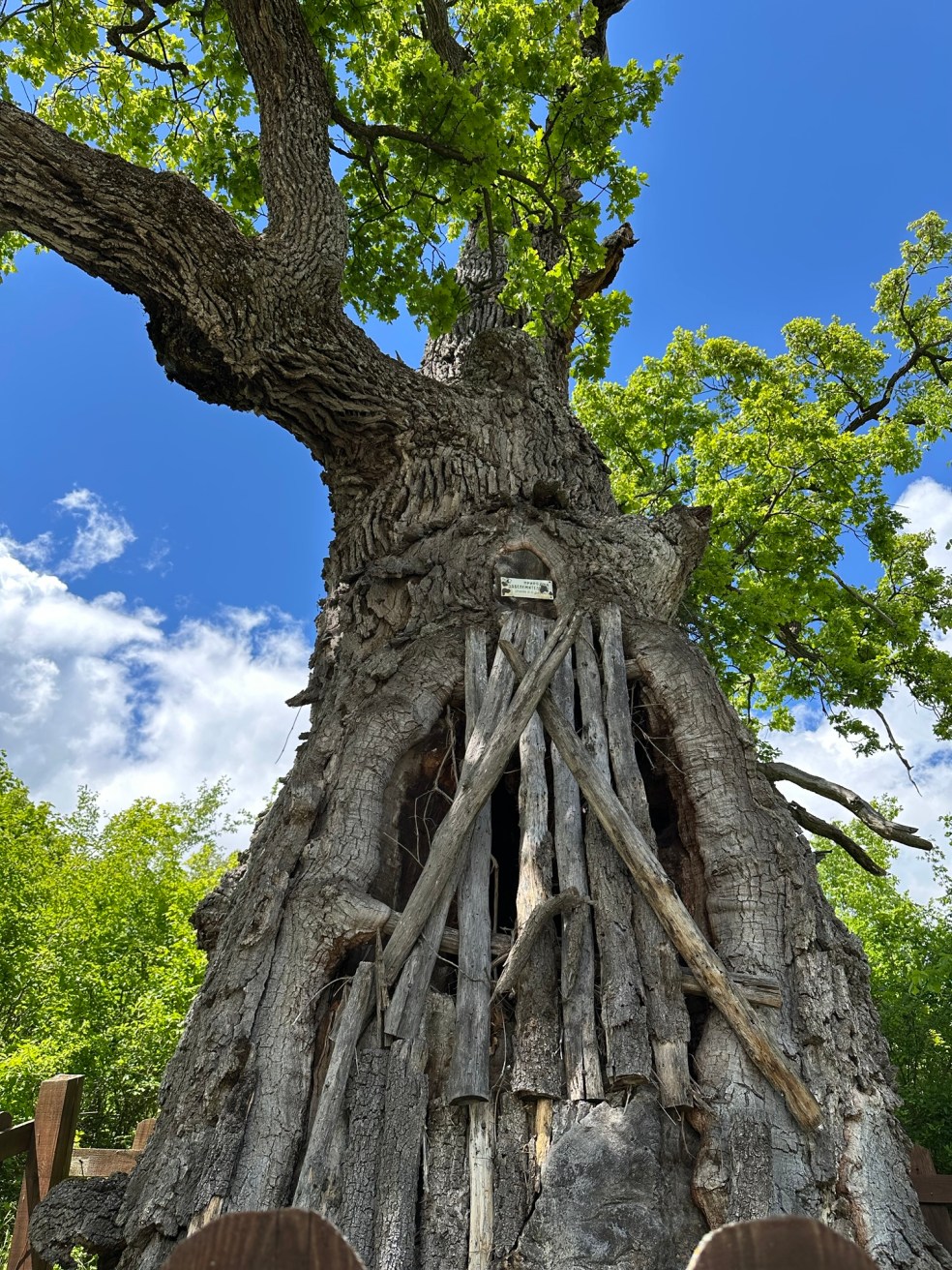
One of my favourite Old English poems, and my first translation from Old English! The translation is accompanied by a photo of a six-hundred-year-old downy oak at the entrance to Bosnek village, on the south side of Mt Vitosha in Bulgaria, which has resisted the twists and turns of life.
DEOR
Weland himself among worms experienced misery,
The single-minded nobleman endured hardships,
Had for himself as companions sorrow and longing,
Winter-cold pain, often found woe,
After Niðhad laid fetters on him,
Supple sinew-bonds on the better man.
That passed, so may this.
To Beadohild was not her brothers’ death
In mind so grievous as her own thing,
That she had readily perceived
That she was pregnant, could never
With courage have considered how that should be.
That passed, so may this.
We have heard that Mæðhild’s lamentations
Were endless, Geat’s wife,
That sorrowful love deprived her of all sleep.
That passed, so may this.
Theodric had for thirty winters
The Mærings’ burgh; that was known to many.
That passed, so may this.
We have heard about Ermanaric’s
Wolfish thought; he had widely the people
Of the Gothic kingdom; that was a grim king.
Many a warrior sat bound by sorrows,
Woe in expectation, wished constantly
That his kingdom would be overcome.
That passed, so may this.
Sits a sorrowful person, deprived of joy,
Grows dark in mind, it seems to him
His share of hardships may be endless.
He may then consider that throughout the world
The wise Lord turns constantly,
On many nobles bestows honour,
Certain fame, on others a share of woes.
As for myself, I should like to say this:
I was for a time the Heodenings’ bard,
Dear to my lord; Deor was my name.
I had for many winters a profitable position,
A loyal master, until Heorrenda now,
A song-skilled man, received the right to lands
The protector of nobles had previously afforded me.
That passed, so may this.
An Old English poem of consolation found in the tenth-century Exeter Book, translated by Jonathan Dunne. It is possible to view the manuscript of the Exeter Book online. The poem is on folios 100r and 100v. I first read the poem with the help of my tutor at City Lit, Stephen Pollington.
I started translating Galician literature in 1993, three years after graduating from Oxford in Classics. I have since translated 69 Galician books by a total of 33 writers, as well as three anthologies. But I had three masters. The first was Rosalía de Castro, the first author I translated professionally (meaning I was paid). I was asked by the Secretariat for Language Policy in 1993 to translate the opening section of her book New Leaves, “Vaguedás”. I was then hired by the Ramón Piñeiro Centre to translate both her major works of Galician poetry, Galician Songs and New Leaves, between 1994 and 1996, which I did, continuing (unpaid) until 1997. When friends in Lugo used to ask where I was, the answer would often be, “Ah, he’s with Rosalía.” This translation is where I cut my teeth. It was never published, but it did enable me to be the editor of Canadian writer Erín Moure’s translation of the same two books for my publishing house, Small Stations Press, in 2013 and 2016. I am still influenced by Rosalía’s metres in my writing today.
My second master was Rafael Dieste. I felt a strong affinity to this writer, his elegant style and cavernous asides. His book of short stories From the Imp’s Archives is the only book I have translated more than once. In fact I have translated it four times. I played the role of the author in a production put on by my friend and teacher Camilo F. Valdehorras with the theatre group AUGATEBA in Barcelona in 1995. I entered the auditorium in Barcelona University dressed as an English gentleman, with a newspaper under my arm, reciting (in Galician) the story “The Light in Silence”. I still remember the silence that hung in the air when I finished. We even recorded “The Knight’s Drama” for radio – I played the role of the White Knight, a dreamer.
My third master was Manuel Rivas. The translation of his novel The Carpenter’s Pencil was my first contract with a publishing house in London, The Harvill Press (I received a letter in the post asking me to translate it from the unfailingly polite editor, Euan Cameron). I would go on to translate nine titles by Manuel Rivas, six for The Harvill Press (which became Harvill Secker and then Penguin Random House). These included six novels, two collections of short stories and one book of poetry. The one that required the greatest stamina was Books Burn Badly. I had to maintain the tension, to live with the book, for ten months. This is why I always say it’s harder translating fiction than poetry, because you have to keep the tension going for that much longer (a poem is normally over in a matter of pages; the English-language edition of Books Burn Badly is 560 pages). I have a soft spot for The Potato Eaters, but the one I would take to a desert island is the last I translated, The Low Voices, an autobiographical novel that is incredibly moving.
These are my three masters, the ones I learnt most from. Well, now my (fourth) translation of eight of the twenty stories in From the Imp’s Archives has seen the light for the first time as part of the project “Seara”, housed and funded by the Consello da Cultura Galega, described as “an open project for an international community of readers” and aimed, like my publishing house, at making Galician literature more widely available. This project is the brainchild of that great lover of all things Galician Kathleen March.
It is amazing how often I catch myself hearing echoes of Dieste’s stories in everyday speech or in my thoughts. A turn of phrase, a strange situation, a jolt that brings you back to reality or transports you far away… These are eight of my favourite stories by one of my top five writers. The stories are magical, funny, and they do not fade with time.
They can be read here in both Galician and English.
Christ became human so that he might translate for us the meaning of life through parables (Braille, writing for the spiritually blind), but also so that he might translate us when we die. The process of translation, when a word in one language disappears in the translator’s mind in order to reappear in another language, can be likened to death, when someone disappears and is spoken into the language of eternity.
Christ became man in order to show us the road to salvation. He entered his own creation through one of his creatures, Mary. He came to translate for us the meaning of life, because we were at a loss and it needed explaining. He did this by means of parables. We have seen examples. Parable is connected to Braille through the phonetic pair b-p – it is writing for the spiritually blind, for those whose spiritual eyes have not been opened.
But I believe that there is another reason for God to become human, to enter his creation. God is the Author, the source of all that is. We are not the Author, much as we would like to be, because we cannot create out of nothing. We need what already exists, and our purpose is to take this and to turn it into something better, to translate it, just as the translator of a text takes a text written in one language and converts it into another through an unseen, and highly spiritual, process that takes place in the person’s mind as they are translating.
When we are translating a text, there is a point, once we have understood the original (read it, looked up any words we do not know, consulted with the writer or an expert in their work, all the horizontal work of preparation), when the original disappears, it evaporates, the words dissipate, the letters fade away, and out of the translator’s mind, through their fingers as they type on the keyboard, appear new words, words written in another language.
That momentary disappearance, that disembodiment, can be likened to the process of human death. We also seem to disappear, our bodies are put in the ground, and we are no longer seen. We also evanesce, cease to be discernible by the five senses. But in whose mind are we?
I think that Christ became man not only to translate for us the meaning of life by means of parables and his example, but also literally so that he could translate us at our death. An author is the source. A translator acts as a conduit, just as the Virgin Mary did when she acquiesced to bear Jesus in her womb. By becoming human, Christ became the Translator.
We are a text being written. Everything we do in this life takes us in a certain direction. And when we reach the end of our lives, we will be spoken, having been taken up into the mind of the Translator. We will be freed of the constraints of time, and we will enter eternity, the white page on which words are written.
This is why eternal gives two connections. For the first, we must take a step in the alphabet, e-f, and use two pairs of letters that look alike, i-l and n-h (one is an extension of the other). In this way, eternal gives father and I:
eternal = father + I
I think this is because, once we have been spoken, we will have left the speaker’s mouth and be able to see him.
It also spells I am free (phonetic pair m-n, pairs of letters that look alike, i-l and f-t):
eternal = I am free
We will be free of corruption, of the bondage to sin, free to express ourselves without fear (free – the fine line between fear of God and the fire of purification, if we allow fluidity to the vowels; the good news is that it lasts for ever, f-v).
Language contains hidden meaning. The whole of human existence is contained within it. We haven’t realized this. We treat language like an external object, a tool. We use words to bash people on the heads and also to caress them. But we haven’t realized that we ourselves are language, words in the making, spoken into being – breath, water and flesh; h, vowels and consonants – just as we read in the first two chapters of Genesis.
Language tells us the road that we must follow. Christ is very clear about this when he says to his disciples, “If any want to become my followers, let them deny themselves and take up their cross and follow me” (Mt 16:24). This is the way to eternal life, but it passes through denying the ego, drawing a line through the I, which forms a cross, †, but also a plus-sign, + (the meaning of losing our life in order to find it).
We have seen the three ways of moving away from the line by forming a triangle, the letter A, by deleting the I, +, and by treating the line as a number and counting down to O: A+O. These three symbols spell the name of God Alpha and Omega. As soon as we turn our backs on the ego, we turn to God. They are also found in the middle conjunction, and, if we write it with capital letters: AND (A ’N’ O). The reverse of and is DNA – it is in our DNA to do this, to move away from the line, to follow the progression of the Greek alphabet, AIO or AIW.
And when we draw a line through the ego, when we make the sign of the cross (a cross is a deleted I), something extraordinary happens. The progression of the Greek alphabet, with the ego deleted, spells A+O/W (depending on which letter we use to depict omega, a long o or w).
We effect a change at molecular level – the “living water” Christ was talking about, a change of heart, literally, at a level we cannot normally see – because this progression is contained in the word atom, traditionally the smallest particle of matter.
There is a clear connection between language and the environment: seed-root-tree-fruit. A tree that branches out is like a flowering ego, it is no longer a straight line. There is a clear connection between language and the history of the world, from the creation in the Book of Genesis to the Last Judgement, when angels will come to glean the field. And just as we plant a seed outside (as the Samaritan woman fetches water from the well in a bucket), so we must hear the Word of God and plant a seed in our heart.
The one will feed our stomach. The other will give us wings, and change our perception for ever.
The Virgin Mary is often referred to as the New Eve because of her role in the economy of salvation. We learn in Genesis that Adam called his wife Eve “because she was the mother of all who live”, since in Hebrew the name Eve resembles the word for “living”; if we apply the phonetic pair l-r, we will see that there is a connection between “living” and “Virgin”, which confirms the link between them.
I have the utmost veneration for Mary, the Mother of God. There is no one else through whom I would rather be saved. As part of God’s creation, she also responds to language in the most extraordinary way.
The rules that I have expounded in these short texts for unearthing spiritual meaning are very simple. We may rearrange the letters. We may change the vowels, which are water, by allowing them to flow (a-e, earth-three). We may replace the vowel i with its semi-vowel equivalent, y (think of try and tried). When we get to the flesh of language, the consonants, we must be familiar with the seven simple pairs, pairs of consonants such as f-v and l-r that are pronounced in the same part of the mouth (often one is voiced, the other is voiceless). We may replace the redundant letter c with either of the ways it is pronounced, k and s (think of a word like Pacific).We may take a step in the alphabet (d-e, God-ego; f-g, father-gather), turn a letter upside down (m-w, I am-way) or back to front (b-d, birth-third), or lengthen it (v-y, Eve-eye). And this is the way we will enter the spiritual edifice of the language we speak.
Look at Mary. Replace the y with i, and tell me what you can see.
Mary contains the name that God reveals to Moses at the burning bush in Exodus 3:14, I AM, in reverse, with the addition of the letter r. So it is clear that she has the divine in her.
And what if we double the r? We get marry. For her to give birth to the Son of God, was it not necessary for there to be a marriage of wills, as well as the overshadowing of the Holy Spirit that made the incarnation possible?
I AM-Mary-marry
She is the Mother of God. If we treat letters like reels in a slot machine and press the button, allowing the letters to spin according to their order in the alphabet, we will see that mother spells her son (m-n, s-t). The archetypal Mother, the Mother of us all, gave birth to her son in the flesh, Jesus Christ.
mother-her son
Jesus Christ was the Messiah, the long-awaited one, the one who would come to free us from bondage, except that he didn’t do this with physical weapons (remember the well and the bucket). The change he effects takes place within us, but it is no less visible for that. It’s just that if you’re expecting fireworks, flashing lights and earth tremors, you might not get them. Or you will, but not in the way you expect, and over a longer period.
Messiah. Can the word tell us anything? Does the word Messiah not contain I AM and she? Is this not confirmation of Mary’s role in the incarnation?
Messiah = I AM + she
We refer to her as “maid” and “lady”, two words that clearly contain the progression of the Greek alphabet, AIO (AIW).
But she is best known as the Virgin Mary.
Do you remember what Jesus said to the Samaritan woman in John, chapter 4, about asking him and receiving “living water” – not visible water that can only be retrieved by means of a physical bucket, but water that will flow “out of the believer’s heart” (Jn 7:38), becoming “a spring of water gushing up to eternal life”? This “living water” is not one that satisfies our physical needs momentarily, it restores us to ourselves, reminding us that we are eternal beings in physical bodies. If we believe – and when did anyone achieve anything without believing in what they were doing? – we will inherit eternal life. The word we have been in this earthly life, the sum of our acts and intentions, will be spoken.
Living water. Virgin Mary (l-r). The two words are connected, and this is because the Virgin Mary is the second Eve. Being a virgin and giving birth is what sets her apart from God’s other creatures; virgin harks back to the name of Eve in Genesis 3:20, “because she was the mother of all who live”, resembling as it does the Hebrew word for living.
Language is thought made manifest. We are words in a dictionary, responsible for and dependent on others. Christ entered his creation, came through the eye of the needle, in order that we might have the courage and confidence to go in the other direction.
We have now seen a correlation between Christ and the environment we live in, but this should not surprise us if we accept that Christ is the Word and the world was spoken into being.
Christ is the Word. It says in the Christian Creed that all things were made by him, they were spoken into being. So physical matter would seem to be the result of language.
When we speak, we make things manifest in a similar way – our thoughts, our observations, our wishes. So we also turn something that did not exist into physical matter. We are using fragments of the Word to do this, as if the Word had been divided among us (like pieces of bread, or shards of a mirror). But the idea is the same – we make things manifest by using language.
So I would say that we speak Christ. Since there is a striking connection between the words son and sun (they are homophones, they sound the same), I would suggest that we see by him. After all, in John 8:12, he calls himself “the light of the world”. Perhaps this can be understood literally (just as the story of creation in the Book of Genesis is literally a description of speech, or the concept of the Trinity is literally three in ONE).
We speak him, we see by him. We also breathe him if we accept that Christ is the Second Person of the Trinity, O2, the chemical formula for oxygen. When we combine this symbol in reverse with the letter for breath, h, to refer to the Holy Spirit, we get H2O, the chemical formula for water. So we also drink him.
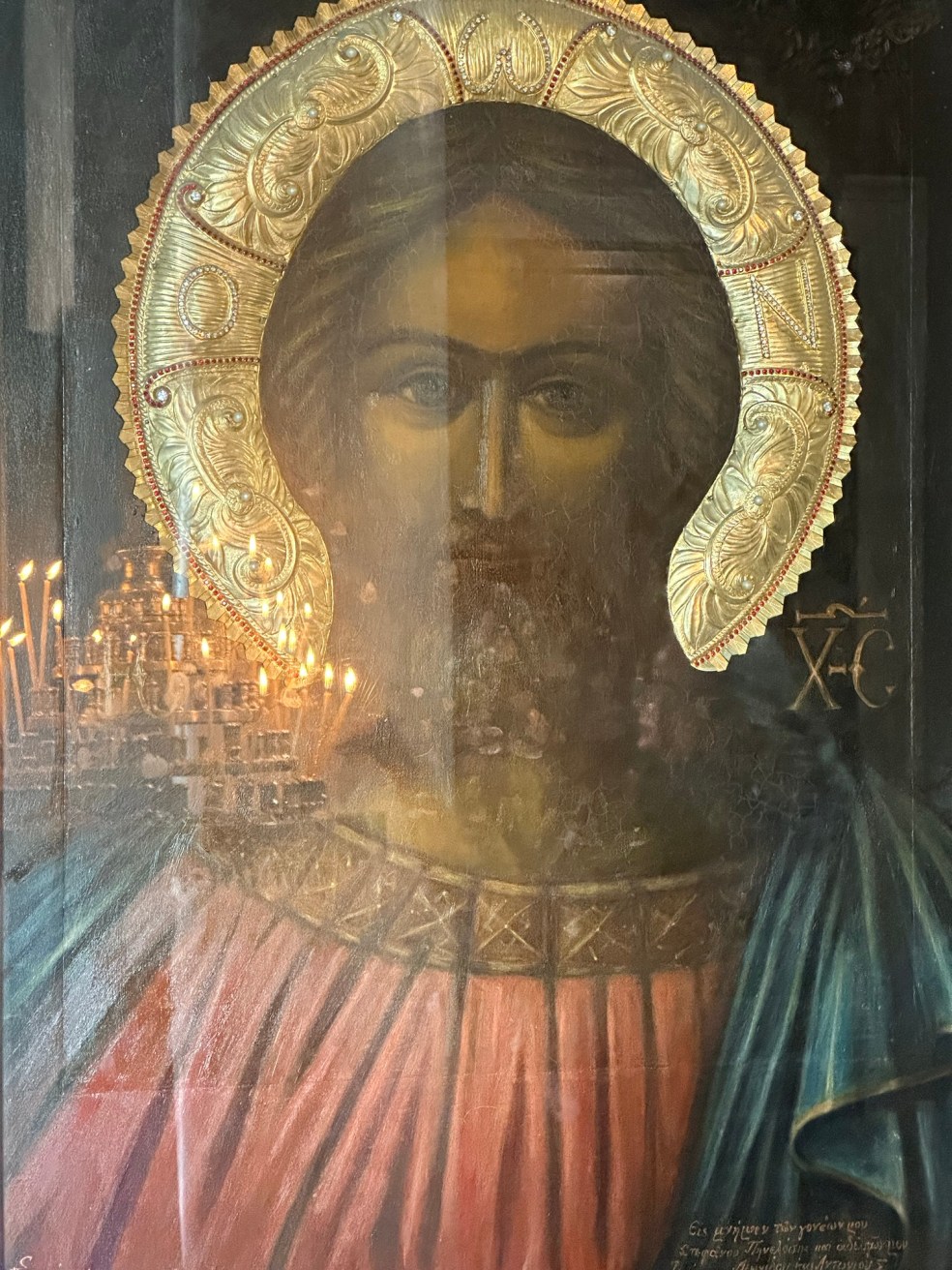
It would seem that our life is completely dependent on Christ, whether or not we believe in him. Enter an Orthodox church and you will most likely see an icon of Christ Pantocrator (“Ruler of All”). In this image, Christ is shown with the beams of the Cross behind him (only three are visible), and in these beams are written the letters O WN.
O WN is Greek for “the being”, which is the translation of the name that God reveals to Moses at the burning bush in Exodus 3:14: I AM. Again, we find here confirmation of the Trinity, because O WN is almost identical to ONE, it’s just that one of the letters has been rotated.
O WN also spells three words in English: own, won and now. Christ claims us as his own; the victory is his, he has won; he is here with us now (the meaning of the name Emmanuel).
I have seen this name written O WH. In Cyrillic, the letter H is pronounced N, and indeed the two letters are very similar (only the crossbar has become slanted). There is also a rough breathing in the original Greek, ὁ ὤν, the reverse apostrophe, which equates to the letter h in English.
If we write the name in this way, then we will see that it spells the words who and how, the result of making the progression AIO from what (A, the letter of creation: “What is this creature?”, “What shall I call it?”) through why (I, the letter of the Fall, an expression of distrust, of disobedience: “Why should I do this?”, “Why should I believe you?”).
Who and how are the questions that we should be asking. What is factual. Why is self-centred. We think that the purpose of life is to amass things and then to share them out, because we were taught at school to count up from 1, to do sums, multiplications and divisions. But actually the answer we are seeking is a person.
Christ gives us the answer to both question words when he says, “I am the way, and the truth, and the life” (Jn 14:6). I am and way are connected if we turn the m upside down and replace the vowel i with its semi-vowel equivalent, y. Both words contain the progression AIW (omega written as w).
We have also seen how when we flee the ego, the I, when we refuse to heed its selfish demands, we automatically create three symbols: A+O, the name of God Alpha and Omega. This can be written A ’N’ O and is found in the conjunction and, the reverse of which is DNA (it is in our DNA to do this). If we write this same progression with the Greek letter for omega, w, we get ANW, which with the w turned upside down gives man. So this denial of the ego, of our innate selfishness, is in the word that describes us (and woman is the same, only it has O3 at the beginning).
The automatic result of turning away from the ego, I, is to say the name of God Alpha and Omega: A+O. By turning away from the ego, we call on him. This is why God and ego are only a step apart in the alphabet (d-e). And him is just I’m with a little breath (h) before it.
This is what makes us human, a combination of hu (Sanskrit for “invoke the gods” and the root of our word “God”) and man – physical beings with the divine spark in them, the potential to become gods by grace if we attend to our true nature, which is not to grab whatever we see out there and to claim it as our own, making a mockery of the divine in us, but to see ourselves as part of the whole, a word in the dictionary, responsible for and dependent on the other. This most ancient way of calling on God – hu – sounds exactly the same as who, the letters we find in Christ’s icon, emphasizing what it is we should be asking.
In the Old Testament, there are two other names of God, apart from I AM. They are YHWH, the Hebrew Tetragrammaton (Yahweh), and El.
YHWH is extremely close to the question word why. So, if we make the progression from I to O, as we did with live-love, sin-son and Christ-cross, opening the line (opening our spiritual Is) to form not a barrier, a wall, but a tunnel that we can walk through, like the proverbial camel through the eye of the needle, just as why gives who, so the name of God in the Old Testament, YHWH, gives O WH, the letters found in Christ’s icon.
And if we place the other name of God from the Old Testament, El, in front of O WH, the two names together spell WHOLE in reverse (keeping the digraph wh together, as we did with earth-three).
This combination YHWH-O WH (why-who) and El-O WH (whole) goes a long way to confirming Christ as the fulfilment of the Old Testament law and prophets. This is why I would say that language is not only Trinitarian (three in ONE), but also Christological.
All physical appearances of God in the Old Testament are said to be by the Logos – that is, Christ – but we are not allowed to touch him. In the New Testament, when he walks among his disciples, eats with them and washes their feet, God himself has entered his creation. He has slipped through the hole – I become O – but in the other direction, so that we will have the courage and confidence to go the other way. This is an extraordinary act of condescension, of coming down to our level, and it was only possible because one of his creatures – namely Mary – acted as a conduit. How else in bodily form do you enter the creation that you have made, if not through one of your creatures?
The concept of the Trinity has flummoxed theologians for centuries. We might liken it to the birth of a child (a third person), or the branching out of a tree (a tree needs branches and leaves to bear fruit). In terms of language, we might identify three persons in the number one when written with capital letters: ONE.
And what is it we must believe? We must believe in God the Holy Trinity, Father, Son and Holy Spirit. It’s as simple as that. The rest will take care of itself.
The Christian concept of the Trinity – three persons, one God – has perplexed even theologians over the centuries, but we might think of our own birth to understand it (two people come together in order to create a third, which is why birth and third are connected, pair of letters that look alike b-d). We might also think of the shoot that branches out – the tree that becomes three – in order to grow and bear fruit.
But as language has taught us about the creation of the world, about the importance of belief, about our final destination and the Last Judgement (when an angel will enter the field to glean the wheat), so I think we can turn to language for an understanding of the Trinity.
Three in one. This doesn’t help us. Let us try writing one with capital letters: ONE. Now we can begin to see.
The word ONE comprises three numbers: 0, 2 (on its side) and 3 (back to front). The one number that ONE does not contain is itself: 1.
This is because in chemistry the subscript 1 is not written down. So if we take the first letter, O, to represent God (it has no beginning or end) and decide to write the three persons of the Trinity as chemical formulae, then God the Father would O(1), God the Son would be O2 and God the Holy Spirit would be O3. Three in ONE, literally.
For God the Father, we can read the formula O1 as no one, the end of the progression from the name of God in Exodus, AM, and from the purpose of Adam in the Book of Genesis to name the creatures, so that they mean something, to which he says amen. When we apply the progression of the Greek alphabet, AIO, to these words, from AM we get I’m and om, which with the phonetic pair m-n and addition of final e gives no one, God the Father. We are back to the beginning. From amen-mean-name, we get mine and nemo, the Latin word for “no one”, and omen. Again, we find ourselves back at God the Father, O1, the first person of the Holy Trinity.
Why would God the Father be “no one”? Because it’s the only way he can be everyone. We individual humans are someone – that is, as distinct from someone else, countable nouns, each with a line around them. The closest we can get to “no one” is the figure of the translator, that person who lives on the line, ferrying cultures across, enabling communication and understanding, and enriching people’s lives with what is other. The translator is “no man” – he lives inside the line, in no man’s land. He almost doesn’t exist – he is largely ignored, his name is sometimes omitted, he barely has enough to live on, and yet he believes in the value of the work he is doing… and so he continues beyond the bounds of what should be possible. He starts to push the boundaries of possibility, to test them, to see whether in fact they are real, whether the illusion will kill him or he will live to fight another day.
The translator, in human parlance, is no man. He doesn’t exist. He finds himself in the firing line between two opposite sides (sides that only exist because of the line), without a gun. He raises his arms in a semblance of crucifixion and implores an end to this madness of viewing people and things as external to ourselves. He doesn’t win, he loses, but he speaks the truth.
This is the closest we can come to the divine – “no one” – in this life. There are two indicators of truth: one is coincidence (things that happen together), the other is paradox (an apparent contradiction that turns out to be true). Language is full of paradox. God, who is in fact all that is, is no one. He is nowhere to be seen (which means he can be everywhere), but nowhere is also now here.
God the Son is O2, the chemical formula for oxygen – we breathe him, just as we speak him (because he is the Word) and see by him (because he is the Son/sun). And God the Holy Spirit is O3, the chemical formula for ozone, the layer that protects us from the sun’s rays (which we might understand as the Son’s wrath, existence in a precarious balance).
But let us remember that the letter in the alphabet that represents breath, wind (a word, by the way, comprised of the numbers 0, 1, 2 and 3: WIND), is h, so we can choose to represent the Holy Spirit (pneuma in Greek) as H. Combine H and the chemical formula for oxygen, O2, in reverse (common in word connections) – that is, combine God the Son and God the Holy Spirit – and you have H20, the chemical formula for water. We breathe him, we speak him, we see by him, and we drink him in water.
God is three in ONE. The last symbol, O3, can refer to God the Holy Spirit – the third person of the Trinity – or to the Trinity itself: 3 in One (the mantra om).
We have seen how three Os together spell GOD (just as three egos, three Is, spell ill). And we will find these three Os again in the word WOOD, with a lopsided 3 at the beginning. WOOD, of course, is the ultimate symbol of Christianity: the Cross, which is nothing more than a deleted I.
Language is clearly Trinitarian. It is also Christological.
Belief activates the spiritual senses and enables us to see. St Paul talks in his Letter to the Romans about justification by faith. Grace is freely given, we cannot earn it. All that Jesus requires of us is that we believe in him.
What we do not see, we have to believe. And paradoxically, it is the act of believing that then enables us to see, when our spiritual understanding is unlocked and our spiritual senses are awakened. Believe in order to see. What the Pharisees (Pharisee = far I see, or so they think!) wanted was to see in order to believe. In Matthew 16:4, when asked to show them a sign from heaven, Jesus gave them short shrift: “An evil and adulterous generation asks for a sign, but no sign will be given to it except the sign of Jonah” (see how closely the word sign is connected to sin, addition of g).
Belief activates our spiritual senses and enables us to see beyond the mere appearance of things. This is why, I think, the word believe so obviously contains be and live. We become fully alive when our vision is not limited to seeing what will satisfy our physical needs.
This is the reason for the break-down in communication during the wonderful encounter between Jesus and the Samaritan woman at the well in John, chapter 4. When Jesus says if she knew who she was talking to, she would ask him and he would give her “living water”, the woman is perplexed. She doesn’t realize that Jesus is talking about spiritual sustenance – not physical sustenance, which always requires us to come back for more (something the system knows and relies on for its continued existence).
He doesn’t even have a bucket (again, this reliance on external objects, objects we can pick up and use), how is he going to give her this living water? Jesus replies, “Everyone who drinks of this water will be thirsty again, but those who drink of the water that I will give them [what he means is those who put their trust in him] will never be thirsty. The water that I will give will become in them a spring of water gushing up to eternal life.”
These are extremely important verses. “A spring of water gushing up to eternal life.” Now, that is surely something worth having. We know that when we drink water from the well, we will be thirsty again, and so we are tied to it, to something external. But what Jesus is talking about appears to be something that comes from within us: “The water that I will give will become in them a spring of water gushing up to eternal life.” It is something whose provenance we cannot perceive.
I think he is talking about belief. The bucket that will enable us to receive this living water is belief. It is all that Jesus requires of us – that we believe in him (even though we do not see him with our physical senses). He wants us to see/hear the message that he is transmitting and to plant the seed of that message in the earth of our heart (the soil of our soul). We are to become like the seed of an apple, which falls into the ground and sleeps for a while before bursting forth anew as a shoot that, in time and with proper care, will grow into a tree, as language tells us.
And so it is that three chapters later – in John, chapter 7 – Jesus decides to attend the Festival of Booths in Jerusalem. The message – about doing the will of God, about doing good and healing people, even if it is on the Sabbath – doesn’t seem to be getting across. When he says that he won’t be with them for long (because he is going to be crucified!!!), they understand he is planning a visit to Greece. It comes to the last day of the festival, and Jesus is feeling pretty frustrated. He cries out, “Let anyone who is thirsty come to me, and let the one who believes in me drink. As the scripture has said, ‘Out of the believer’s heart shall flow rivers of living water’” (Jn 7:37-8).
There it is again – that phrase “living water”. It means that when we believe in him, our life will take on new meaning, we will no longer be limited by the parameters of time, we will be working on a different timescale, or actually on no timescale at all. We will be diving into the white spaces between and behind the words on a page and finding new meaning. We will be entering the words themselves, admiring their structure, as if a word was a church and we could enter it, light a candle, look up into the dome, and even walk around the church three times on Easter Eve, before the light of the resurrection has dawned. We will begin to bear spiritual fruit, not just physical fruit we can eat, touch and confirm, but the fruit of obedience, which is not to put ourselves first in a world of competing egos, but to seek the common good, which might even involve some kind of personal sacrifice, but is incomparably richer and leads to true wealth (the wheat in the Parable of the Tares, which has ears and can hear). This “living water” can only come out of a believer’s heart, of a heart that is open, of a heart that is alive and beating, not one that is closed and withered, that only thinks about itself.
Jesus quotes scripture: “Out of the believer’s heart shall flow rivers of living water.” Except that the word in Greek is not “heart”, it is “belly” (κοιλία). In Genesis 3:20, we learn that Adam named his wife Eve “because she was the mother of all who live”. This is explained by a footnote in the NRSV Bible: “In Heb Eve resembles the word for living.”
So, the verse Jesus quotes could be reduced to belly (“Out of the believer’s heart”) and Eve (“shall flow rivers of living water”). And what do belly and Eve give us? Believe.
Jesus’ message – that all we need to do is believe to become fully alive, to be and live – is contained in the words he speaks. Language is pure theology, a vade mecum for the human who seeks a higher meaning. We just have to have the eyes to see it.
If, in the Book of Genesis, the world was spoken into being (and the description of creation in chapters 1 and 2 contains the elements of speech: breath, water and flesh), it means that we ourselves are language, words in the making.
We have seen how the ego in English, I, is a straight line. It resembles the number 1. It could be taken to represent the line that isolates us as individuals, the line that we have used to carve up the earth and divide it into properties, the line that we fight over, the line that needs defending, the line that we use to package the products of the earth and trade in them, the line that we use to build roads and transport them. When we separate ourselves off from others, we lose our shared vision (we can’t see over the fence). We view other people, and the products of the earth, as commodities we can profit from, rather than as God’s creatures for whose spiritual well-being we are responsible. The line – I or 1 – isolates. It creates an illusion of self-dependency.
At some point, this self-reliance crumbles, and we realize that we depend on others. Our spiritual eyes are opened, and we begin to see the world not as “us and them”, but as one shared humanity whose needs (and fears) are more or less the same. We are not so different, our time on earth is limited, but we seem to think that if we keep busy (packaging and transporting goods with the line that alone enables us to count things), we can safely ignore our own mortality, or at least by the time it reaches us, we will be too exhausted to care too much about it.
And so we step onto the line, a moving walkway at the airport that takes us to our gate (which might be 2 or 41, we don’t know). That time (connected with line if we cross out the l and apply the phonetic pair m-n) enables us to safely view the landscape, the runways and planes, with the illusion that it will go on forever and what goes on out there won’t affect us.
But it doesn’t go on forever, which means that our own resources as individuals are limited. Instead of counting up and amassing wealth or memories, we learn to do what the Greek alphabet does and we breathe life into the line, turning it from I to O, omega, a long o, the last letter of the Greek alphabet (compare the Latin alphabet, which counts up from I to Z, or 2).
When the line is opened in this way, it is as if we reach a realization of something deeper at play, we tap into the hidden root system, the root system that was there the whole time, only it was not visible to our eyes, just as there are colours on the spectrum of light – infrared and ultraviolet – that are not visible to our eyes, it doesn’t mean they don’t exist.
And since, as we have seen, the world was spoken into being – the opening two chapters of the Book of Genesis can be understood as a description of speech, with the three elements of breath (h), water (vowels, voice added to breath) and flesh (consonants, breath obstructed by the lips or tongue, with or without voice) – this means that we are surrounded by language, we ourselves are somehow language, words in the making (I believe that this is what death is – to be spoken into eternity). And language can teach us.
So, count down from I to O, from the limitations of the ego to the eternity of God, and instead of live being read in reverse, being somehow distorted, and giving evil, it gives love – love for the other, love for God.
Perhaps you do not believe me, but love and other are connected, you just need to know where in the mouth consonants are produced, forming seven simple pairs, one of which is l-r. Then take a step in the alphabet (t-v, omitting the intervening vowel) and add breath (h). Love-other. The vowels are the same.
We have seen that if we take another step in the alphabet, r-s, other is connected to the Greek word for “God”, theos, and so the two great commandments Christ gives his disciples in Matthew 22 – to love the Lord our God and to love our neighbour as ourself – which together form the core of Christian teaching, are themselves confirmed by language:
love-other-theos
The ego has been taken out of them.
Similarly, we turn from the sin that may have characterized our youth and, having acquired spiritual knowledge, we become children of God, children of the light – son. Again, we achieve this by making the progression in language from I to O.
Even Christ did this by willingly going to the Cross. He counted down from I to O, even though there was no sin in him. He did it to show us the way, the answer to the questions we should be asking: who and how.
So, we have live (evil)-love, sin-son, Christ-cross, all examples of the path we must follow from the selfish demands of the ego to that wonderful moment of realization (and repentance) when we understand that there is more to life than we can see with our physical eyes. Our physical eyes can be used solely for the purpose of identifying and taking in the (external) objects of our desire. When we are subject to our desires, we become disconnected. Fragmented.
When we make the progression from I to O, we become whole again (in our brokenness), because while love is connected to other and theos (the two great commandments), it is also in whole (v-w, addition of breath). Love-other-theos, love-whole.
There is one other word where you will find love, and not surprisingly it is a word connected with language, because a word spoken in anger can destroy, but a word spoken with love builds up.
Again, we have to apply the pair v-w, the phonetic pair l-r and a step in the alphabet, d-e.
Then love gives word. It makes us whole (addition of breath). We are meant to love the other, who as Christ tells us in the Judgement of Nations is God (theos). This is the meaning of love in the English language. It’s the word itself that tells us. Unfortunately, we see language as a way of getting our message across – as something external (a tool) – and don’t realize it is bursting with meaning, like a bud in spring.
After the creation of the world (in the beginning, the letter A), we find ourselves in the era of the Fall, which centres around the ego, I. We have to take this line that separates us and open it, count down, perhaps just turn it around, so that we get O.
The correct progression of human life is that represented by the Greek alphabet, AIO (sometimes written AIW). The Greeks are known for their interest in philosophy and theology. Having made the progression from the A of creation to the I of the Fall – the period we find ourselves in – we have a choice: to count up (as the Latin alphabet does, AIZ) or to humble ourselves and count down, AIO.
Language favours the second option. We have seen the examples AM-I’m-om, no one and amen, mean, name-mine-nemo, omen. We go from the name of God in Exodus, AM, through personal importance and gain (I’m, mine) to calling on God again in the Holy Trinity (om) or on God the Father, no one (nemo in Latin).
In the Garden of Eden, between Adam and Eve, there was no competition. So, we have a draw. In today’s world with its competing egos, we set out to win. The vowel in these verbs has changed from A to I. But Christ comes with a different message. He encourages us to turn the other cheek, to lose our life for the sake of the other (in order to find it). So, he encourages us to lose:
draw-win-lose
Here again, we find the progression of the Greek alphabet, AIO (with a silent final e, very common in English, ignore the consonants).
We have seen that we are made to call on God. The first word the human apparatus is capable of producing is a combination of breath, h, and the first vowel to emerge from the throat, u: hu, which is Sanskrit for “invoke the gods” and the root of our word God. We are made to call on God. Similarly, if we turn away from the selfish demands of the ego, represented in English by a straight line, I, we make three symbols, A+O, which spell another name of God, Alpha and Omega. So, again, when we turn away from our selfish desires and embrace the other, we call on God.
In the Judgement of the Nations, Christ goes so far as to tell us that the other is God: “Just as you did it to one of the least of these who are members of my family, you did it to me” (Mt 25:40). If we remember that the Greek word for “God” is theos, we might see a close similarity between other and theos (step in the alphabet r-s). Language confirms what Christ is saying.
It is ironic, therefore, that after Adam and Eve have eaten of the fruit of the tree of knowledge in Genesis, chapter 3, it is God who calls to Adam, “Where are you?” (Gen 3:9). Of course, he knows where Adam is, and he knows what has happened. But by asking this question, which is the question Adam should have been asking, he is somehow indicating to us what our approach should be.
Make the progression from A to I, and from call you have like (in reverse, addition of e). Like is what we do on Facebook. We indicate our preferences. It also gives kill, and there has been plenty of killing in the history of humankind.
Now, count down from I to O, and you get look, which is the message Christ is trying to get across in the New Testament, the importance of opening our spiritual eyes (our egos or Is) and bearing spiritual fruit. We have seen the relevance of this in the Parables of the Sower and the Tares. So, we have:
call-kill, like-look
And then there are the examples that relate to the animal kingdom. Let us start with swan – a white bird, and white is a symbol of purity. Progress towards the ego, and you get swine – pigs in the mire, we have dirtied God’s image by rolling in the mud (just as the prodigal son does in Luke 15, a metaphor for dissolute living). When we come to our senses and realize that the things of this world will not satisfy us for long, we set out to purify ourselves once more, to return to our father, as the prodigal son does, which is not a return to the way things were before (swan), but a movement onwards, to something new: snow. So, we have:
swan-swine-snow
And finally, what is that most ancient mammal if not a whale that continues to patrol our oceans, despite our best efforts to wipe it out? Make the progression from A to I, and you have while, an indication of time. Time started after the Fall, this is when Adam and Eve became mortal, when they were expelled from paradise. Time will end for us individually when we die (the past tense of I) and for the human race when Christ comes again to judge the living and the dead. Now, count down from I to O, and in a while you become whole again. Whole is a remarkable word, and we will see more of it. So, we have:
whale-while-whole
All are examples of the progression made in the Greek alphabet, where we count down from the ego, which is represented in English by the letter I, and turn to God, the eternal symbol O.