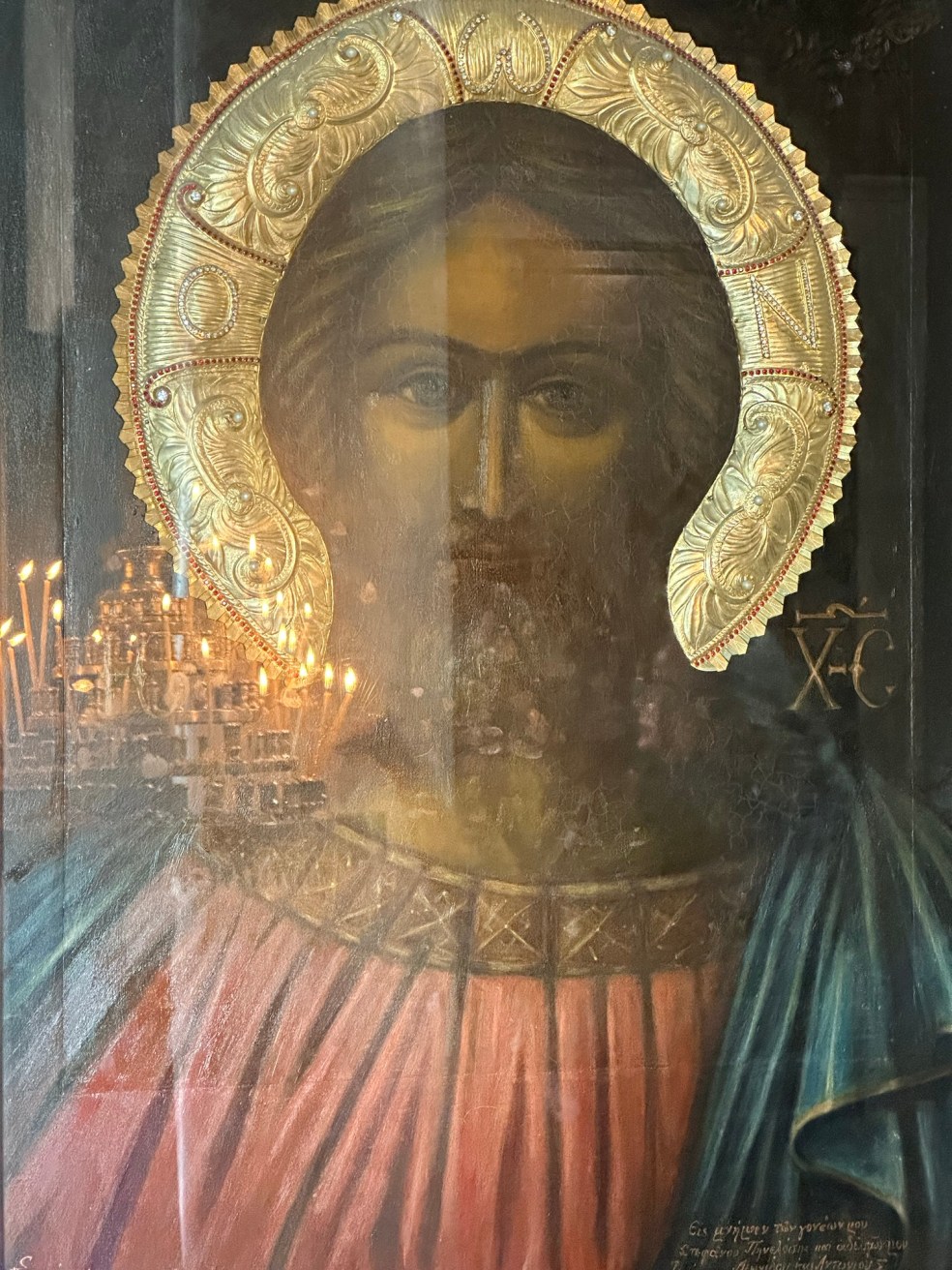
13. O WN

Language is thought made manifest. We are words in a dictionary, responsible for and dependent on others. Christ entered his creation, came through the eye of the needle, in order that we might have the courage and confidence to go in the other direction.

We have now seen a correlation between Christ and the environment we live in, but this should not surprise us if we accept that Christ is the Word and the world was spoken into being.

Christ is the Word. It says in the Christian Creed that all things were made by him, they were spoken into being. So physical matter would seem to be the result of language.

When we speak, we make things manifest in a similar way – our thoughts, our observations, our wishes. So we also turn something that did not exist into physical matter. We are using fragments of the Word to do this, as if the Word had been divided among us (like pieces of bread, or shards of a mirror). But the idea is the same – we make things manifest by using language.

So I would say that we speak Christ. Since there is a striking connection between the words son and sun (they are homophones, they sound the same), I would suggest that we see by him. After all, in John 8:12, he calls himself “the light of the world”. Perhaps this can be understood literally (just as the story of creation in the Book of Genesis is literally a description of speech, or the concept of the Trinity is literally three in ONE).

We speak him, we see by him. We also breathe him if we accept that Christ is the Second Person of the Trinity, O2, the chemical formula for oxygen. When we combine this symbol in reverse with the letter for breath, h, to refer to the Holy Spirit, we get H2O, the chemical formula for water. So we also drink him.

It would seem that our life is completely dependent on Christ, whether or not we believe in him. Enter an Orthodox church and you will most likely see an icon of Christ Pantocrator (“Ruler of All”). In this image, Christ is shown with the beams of the Cross behind him (only three are visible), and in these beams are written the letters O WN.

O WN is Greek for “the being”, which is the translation of the name that God reveals to Moses at the burning bush in Exodus 3:14: I AM. Again, we find here confirmation of the Trinity, because O WN is almost identical to ONE, it’s just that one of the letters has been rotated.

O WN also spells three words in English: own, won and now. Christ claims us as his own; the victory is his, he has won; he is here with us now (the meaning of the name Emmanuel).

I have seen this name written O WH. In Cyrillic, the letter H is pronounced N, and indeed the two letters are very similar (only the crossbar has become slanted). There is also a rough breathing in the original Greek, ὁ ὤν, the reverse apostrophe, which equates to the letter h in English.

If we write the name in this way, then we will see that it spells the words who and how, the result of making the progression AIO from what (A, the letter of creation: “What is this creature?”, “What shall I call it?”) through why (I, the letter of the Fall, an expression of distrust, of disobedience: “Why should I do this?”, “Why should I believe you?”).

Who and how are the questions that we should be asking. What is factual. Why is self-centred. We think that the purpose of life is to amass things and then to share them out, because we were taught at school to count up from 1, to do sums, multiplications and divisions. But actually the answer we are seeking is a person.

Christ gives us the answer to both question words when he says, “I am the way, and the truth, and the life” (Jn 14:6). I am and way are connected if we turn the m upside down and replace the vowel i with its semi-vowel equivalent, y. Both words contain the progression AIW (omega written as w).

We have also seen how when we flee the ego, the I, when we refuse to heed its selfish demands, we automatically create three symbols: A+O, the name of God Alpha and Omega. This can be written A ’N’ O and is found in the conjunction and, the reverse of which is DNA (it is in our DNA to do this). If we write this same progression with the Greek letter for omega, w, we get ANW, which with the w turned upside down gives man. So this denial of the ego, of our innate selfishness, is in the word that describes us (and woman is the same, only it has O3 at the beginning).

The automatic result of turning away from the ego, I, is to say the name of God Alpha and Omega: A+O. By turning away from the ego, we call on him. This is why God and ego are only a step apart in the alphabet (d-e). And him is just I’m with a little breath (h) before it.

This is what makes us human, a combination of hu (Sanskrit for “invoke the gods” and the root of our word “God”) and man – physical beings with the divine spark in them, the potential to become gods by grace if we attend to our true nature, which is not to grab whatever we see out there and to claim it as our own, making a mockery of the divine in us, but to see ourselves as part of the whole, a word in the dictionary, responsible for and dependent on the other. This most ancient way of calling on God – hu – sounds exactly the same as who, the letters we find in Christ’s icon, emphasizing what it is we should be asking.

In the Old Testament, there are two other names of God, apart from I AM. They are YHWH, the Hebrew Tetragrammaton (Yahweh), and El.

YHWH is extremely close to the question word why. So, if we make the progression from I to O, as we did with live-love, sin-son and Christ-cross, opening the line (opening our spiritual Is) to form not a barrier, a wall, but a tunnel that we can walk through, like the proverbial camel through the eye of the needle, just as why gives who, so the name of God in the Old Testament, YHWH, gives O WH, the letters found in Christ’s icon.

And if we place the other name of God from the Old Testament, El, in front of O WH, the two names together spell WHOLE in reverse (keeping the digraph wh together, as we did with earth-three).

This combination YHWH-O WH (why-who) and El-O WH (whole) goes a long way to confirming Christ as the fulfilment of the Old Testament law and prophets. This is why I would say that language is not only Trinitarian (three in ONE), but also Christological.

All physical appearances of God in the Old Testament are said to be by the Logos – that is, Christ – but we are not allowed to touch him. In the New Testament, when he walks among his disciples, eats with them and washes their feet, God himself has entered his creation. He has slipped through the hole – I become O – but in the other direction, so that we will have the courage and confidence to go the other way. This is an extraordinary act of condescension, of coming down to our level, and it was only possible because one of his creatures – namely Mary – acted as a conduit. How else in bodily form do you enter the creation that you have made, if not through one of your creatures?

Jonathan Dunne

Heart of Language 13/15

Next: Heart of Language 14/15

Back to: Contents

12. One

The concept of the Trinity has flummoxed theologians for centuries. We might liken it to the birth of a child (a third person), or the branching out of a tree (a tree needs branches and leaves to bear fruit). In terms of language, we might identify three persons in the number one when written with capital letters: ONE.

And what is it we must believe? We must believe in God the Holy Trinity, Father, Son and Holy Spirit. It’s as simple as that. The rest will take care of itself.

The Christian concept of the Trinity – three persons, one God – has perplexed even theologians over the centuries, but we might think of our own birth to understand it (two people come together in order to create a third, which is why birth and third are connected, pair of letters that look alike b-d). We might also think of the shoot that branches out – the tree that becomes three – in order to grow and bear fruit.

But as language has taught us about the creation of the world, about the importance of belief, about our final destination and the Last Judgement (when an angel will enter the field to glean the wheat), so I think we can turn to language for an understanding of the Trinity.

Three in one. This doesn’t help us. Let us try writing one with capital letters: ONE. Now we can begin to see.

The word ONE comprises three numbers: 0, 2 (on its side) and 3 (back to front). The one number that ONE does not contain is itself: 1.

This is because in chemistry the subscript 1 is not written down. So if we take the first letter, O, to represent God (it has no beginning or end) and decide to write the three persons of the Trinity as chemical formulae, then God the Father would O(1), God the Son would be O2 and God the Holy Spirit would be O3. Three in ONE, literally.

For God the Father, we can read the formula O1 as no one, the end of the progression from the name of God in Exodus, AM, and from the purpose of Adam in the Book of Genesis to name the creatures, so that they mean something, to which he says amen. When we apply the progression of the Greek alphabet, AIO, to these words, from AM we get I’m and om, which with the phonetic pair m-n and addition of final e gives no one, God the Father. We are back to the beginning. From amen-mean-name, we get mine and nemo, the Latin word for “no one”, and omen. Again, we find ourselves back at God the Father, O1, the first person of the Holy Trinity.

Why would God the Father be “no one”? Because it’s the only way he can be everyone. We individual humans are someone – that is, as distinct from someone else, countable nouns, each with a line around them. The closest we can get to “no one” is the figure of the translator, that person who lives on the line, ferrying cultures across, enabling communication and understanding, and enriching people’s lives with what is other. The translator is “no man” – he lives inside the line, in no man’s land. He almost doesn’t exist – he is largely ignored, his name is sometimes omitted, he barely has enough to live on, and yet he believes in the value of the work he is doing… and so he continues beyond the bounds of what should be possible. He starts to push the boundaries of possibility, to test them, to see whether in fact they are real, whether the illusion will kill him or he will live to fight another day.

The translator, in human parlance, is no man. He doesn’t exist. He finds himself in the firing line between two opposite sides (sides that only exist because of the line), without a gun. He raises his arms in a semblance of crucifixion and implores an end to this madness of viewing people and things as external to ourselves. He doesn’t win, he loses, but he speaks the truth.

This is the closest we can come to the divine – “no one” – in this life. There are two indicators of truth: one is coincidence (things that happen together), the other is paradox (an apparent contradiction that turns out to be true). Language is full of paradox. God, who is in fact all that is, is no one. He is nowhere to be seen (which means he can be everywhere), but nowhere is also now here.

God the Son is O2, the chemical formula for oxygen – we breathe him, just as we speak him (because he is the Word) and see by him (because he is the Son/sun). And God the Holy Spirit is O3, the chemical formula for ozone, the layer that protects us from the sun’s rays (which we might understand as the Son’s wrath, existence in a precarious balance).

But let us remember that the letter in the alphabet that represents breath, wind (a word, by the way, comprised of the numbers 0, 1, 2 and 3: WIND), is h, so we can choose to represent the Holy Spirit (pneuma in Greek) as H. Combine H and the chemical formula for oxygen, O2, in reverse (common in word connections) – that is, combine God the Son and God the Holy Spirit – and you have H20, the chemical formula for water. We breathe him, we speak him, we see by him, and we drink him in water.

God is three in ONE. The last symbol, O3, can refer to God the Holy Spirit – the third person of the Trinity – or to the Trinity itself: 3 in One (the mantra om).

We have seen how three Os together spell GOD (just as three egos, three Is, spell ill). And we will find these three Os again in the word WOOD, with a lopsided 3 at the beginning. WOOD, of course, is the ultimate symbol of Christianity: the Cross, which is nothing more than a deleted I.

Language is clearly Trinitarian. It is also Christological.

Jonathan Dunne

Heart of Language 12/15

Next: Heart of Language 13/15

Back to: Contents

Video

Theological English (2): The Holy Trinity

In this third video on “Theological English”, Jonathan Dunne looks at another Christian paradox, the concept of the Holy Trinity – God as “three in one”. How is it possible for God to be three and one? Surely he is one or the other. The answer can be found in language.

To access all the videos in this course, use the drop-down menu “Theological English (Video Course)” above. The videos can be watched on Vimeo and YouTube.

ONE

It is remarkable that the number 1 is a straight line. We teach our children to count from the number 1 upwards, and when we learn a foreign language, we do the same. But the line separates, it forms a barrier. It is also unstable. A wall can come crashing down, a tower topples.

What is also remarkable is that the ego in English – I – is also a straight line and very similar in appearance to the number 1. So when we teach our children to count from 1 upwards, we are in effect teaching them to start with the ego. This conditions all our thinking. We start with ourselves, instead of starting with the other.

We should actually start with the number 0. 0 stands for the Other. It also stands for God, since 0 represents infinity and is unending (it goes round and round). We might even see that the word G O D is made up of three zeros, one after the other, and this will be important when it comes to understanding the word ONE.

Christianity is full of paradox. Christ says, for example, that we must lose our life in order to find it. This is paradoxical – how can you possibly lose your life and find it? I have discussed this in another article. Another paradox is that the first will be last, and the last first. Again, it seems paradoxical, and I have talked about this paradox here.

Well, one of the biggest paradoxes in Christianity is the concept of the Holy Trinity – that God is three in one. How can that be? Surely, he is either three or one. How can he be both?

Again, language will give us the answer, because language contains information about the meaning of life, about God, ourselves, existence, the world, the creation, the Fall, etc.

It will be easier to understand if we write it in the following way: three in ONE. The Holy Trinity is made up of the Father, the Son and the Holy Spirit. Three persons, but one essence. The Son is begotten of the Father before all ages. The Spirit proceeds from the Father (and not from the Son, as is recited in the Creed in Western Churches, a later addition).

Three in ONE. Three distinct persons, but one essence. Let us imagine that God the Father is 1, God the Son is 2 and God the Holy Spirit is 3.

We will add these numbers as subscripts to the number 0 or O. So God the Father is O1, which means that he is ‘no one’. The only thing here is that in chemistry the subscript 1 is not normally written down, so we would say simply that God the Father is O.

There is confirmation for this in the Greek language, where the word for ‘God’ is theos. If we omit the final s (as happens in the vocative and is very common in spoken Greek), this can be read the O.

God the Son is O2, which happens to be the chemical formula for oxygen (the air we breathe). And God the Holy Spirit is O3, the chemical formula for ozone, the protective layer that surrounds the planet on which we live.

Now all this information – God the Father as O, God the Son as O2 and God the Holy Spirit as O3 – can be found in the number ONE, because the one number that the number ONE does not contain is itself (1). ONE contains the numbers O, 2 (on its side) and 3 (back to front). It does not contain 1 because in chemistry the subscript 1 is not written down and because there is no selfish impulse in God, there is only love.

Three in ONE. It turns out that this concept of the Holy Trinity is literally true. That is the information about the Father, Son and Holy Spirit is contained in the word itself.

There are other connections. For example, if we combine the Son (O2) and the Holy Spirit (O3), we find that they are present in MOON (the 2 is on its side again, the 3 is on its front). This reminds us of the obvious similarity in sound between Son and Sun, so it would seem that God is the air we breathe, he is the light we see by during the day and he is the reflection of that light in the night, so that we even see in the darkness.

And if we remember that the word for ‘Spirit’ in Greek is pneuma – that is ‘wind’ – and that the letter that represents breath in the alphabet is h, then if we combine the Son (O2) and the Holy Spirit (this time written as H), we find that they make up the chemical formula for water: H2O. This means that we drink God as well.

God is all around us. He is ‘everywhere present’. He is even in the language we speak. Since we are translators, there is nothing in this world that is of our own making. All the materials we use were here when we arrived – we transform them into something else, we translate them, just as we translate the air we breathe and the food we eat.

But we have to open our eyes to see him. Eye sounds the same as I. We breathe life into the line and make a circle: O. We open our spiritual eye. When we teach our children to count from 1, we are making life much more difficult for them, because once you start counting from 1, there is no end, you will never reach the answer, when all you had to do was count down to 0.

Jonathan Dunne, http://www.stonesofithaca.com