Baptism of Christ

Readings: Isaiah 43:1-7; Psalm 29; Acts 8:14-17; Luke 3:15-17, 21-22

We all speak. That is, we produce sounds with our mouths. After the service, we will gather around the coffee machine and do this. We will discuss the week’s events and thrash out the finer details of this sermon. We will express opinions and hopes and desires. We will enquire after friends. And we will leave, having shared fellowship.

How strange it would be if we all gathered in the entrance hall and didn’t say anything! If we stood in each other’s company with our mouths closed. We might raise our eyebrows or wiggle our ears, but no further communication would be permitted. Eventually someone would snort or yawn, and the spell would be broken. We would laugh and launch into a discussion.

We worship a God, Jesus Christ, whom we call the Word. This is how John the Evangelist refers to him at the start of his Gospel: “In the beginning was the Word, and the Word was with God, and the Word was God.” And we read in chapter 1 of the Book of Genesis that the world was spoken into being. Each paragraph begins, “And God said.” “Let there be light.” “Let there be a dome in the midst of the waters.” “Let the dry land appear.” Etc.

And yet we pay very little attention to speech. This is unusual since I would say that Christianity is a religion of the Word and its ritual is based on the action of speaking. The first thing we do when we speak is breathe out. It is impossible – I think! – to speak as you are breathing in. So, the first element of speech is BREATH. Breath is represented in the alphabet by my favourite letter, the letter “h”.

Then we add voice to our breath and produce the vowel sounds. Think of a baby. A baby is a student of phonetics. It opens its mouth (hopefully not at three in the morning) and adds voice to its breath, producing vowel sounds that may range from an “oo!” to a long, drawn-out “ah!”. But it will generally not produce consonants because consonants involve blocking the flow of air with the lips or tongue and this is more difficult.

A vowel sound is what the doctor asks you to make when they want to examine your throat: “ah!” “A” is the most open vowel there is, so it involves opening your mouth to its greatest extent. It is what we do when we sing. The longer you hold a vowel sound, the more saliva will collect in your mouth, and you will have to swallow. This is because vowels are like water. It is as if a river was flowing through the canyon of our mouths. So, the second element of speech is WATER.

When we obstruct the flow of air with the lips or the tongue, we produce the consonants. Perhaps the easiest consonant to pronounce is the letter “m”. This involves pressing the lips together. “M”. And this is often the first consonant a baby will produce, when it says, “Mama”.

Since the consonants are produced by blocking the flow of air with our lips or tongue, we might say that the third element of speech is FLESH. So, we have BREATH (the letter “h”), WATER (the vowels), and FLESH (the consonants). The three elements of speech, which we practise unknowingly, as when we change gears in a car.

This is how I would analyze the action of speaking: breath, water, and flesh. In chapter 2 of the Book of Genesis, there is a second creation account, which involves the creation of man. In verses 6-7, it reads as follows:

A stream would rise from the earth, and water the whole face of the ground – then the Lord God formed man from the dust of the ground, and breathed into his nostrils the breath of life; and the man became a living being.

Gen 2:6-7 (NRSV)

Most of us, I suspect, would regard speech as the agent of creation as a kind of metaphor, but I think this is exactly what happened. Nowhere in the first two chapters of Genesis does it say that God made the world with his hands, like a potter fashioning clay. It says that he spoke. All through the first two chapters, we read that God said. And the three elements of speech – breath, water, and flesh – are clearly present here: God “breathed into his nostrils the breath of life”, “a stream would rise from the earth, and water the whole face of the ground”, God “formed man from the dust of the ground”. We read later in Genesis 3:19, “You are dust, and to dust you shall return.” This refers to our material body.

We find the same emphasis on the power of speech in Psalm 29: “The voice of the Lord is powerful… The voice of the Lord breaks the cedars… The voice of the Lord strikes with flashes of lightning… The voice of the Lord twists the oaks and strips the forests bare…” That’s pretty impressive – to do all of that only with words. It doesn’t say that God did these things with his hands, and this is a constant in Christian texts and prayers.

We are not able to produce matter with our mouths, but with our words we can have a material effect on our surroundings. We can make someone happy by saying something nice to them. We can make someone cry by saying something hurtful. We can order someone to be killed. Or we can issue a pardon. Our words can be recorded and can influence future generations or even the course of history.

After the creation of man, man – the Hebrew word is “Adam” – is given a task. He is not asked to make the creatures – that is God’s undertaking. He is asked to name them. To apply a word to that particular creature. This occurs in Genesis 2:19-20. Most of us are not in the habit of adding words to the dictionary, of coming up with a name for a horse or a squirrel. But we do name our children, and names are important. They may not fix a child’s destiny, but they do, to some extent, determine their character. There is a Bulgarian name, Milen, which comes from the Bulgarian word for “kind”, mil, and I have noticed that many people called Milen are kind in person. It is as if they live up to their name.

A child is named at their baptism. The priest takes a bundle of flesh and douses their head with water three times, invoking the Holy Spirit. But hang on a minute! Aren’t those the three elements of speech – breath (the Holy Spirit), water (the water of the font), and flesh (the tiny baby)?

In effect, in the sacrament of Holy Baptism, a child is being made into a word of God – not the Word (that is Christ), but they are being called to be Christ-like, to reject the devil.

And what happens in the sacrament of Holy Communion? The priest takes the bread, the fruit of the earth, and the wine, which is a liquid like water, and consecrates them by the invocation of the Holy Spirit. Again, the three elements of breath, water, and flesh are present. We find all three elements in bread, which is made from a dough of flour and water and has air in it.

And what about the first creation account in Genesis, where we read that the waters were separated from the waters and the sky was created, then the waters under the sky were gathered together into one place and the dry land appeared. Aren’t these again the three elements of speech – breath (the sky), water, and flesh (the dry land)?

I would suggest that speech is central to an understanding of the world around us and our place in it. It can effect change, it can bring people to their senses. It can give meaning, as when we take our child and name him or her.

When we are baptized, as Jesus was by John the Baptist in the River Jordan, we have a choice. We can choose what kind of people we want to be. We can decide on the words we will use, on the actions we will take, whether to tell the truth or lie, whether to help others or steal.

We are a word of God. We can choose to be wheat or chaff. We can choose whether to please God or to turn away from him. According to our life, so our definition will be. And this is why we need to cling to the name of Jesus, to think only of him, so that in our earthly pilgrimage we become as much like him as possible. We are made in God’s image, now we must become like him.

Come, Lord Jesus! Amen.

Jonathan Dunne, www.stonesofithaca.com

Photo caption: Letters make good staging posts. Saints Cyril and Methodius, the brothers from Thessaloniki who wrote the Cyrillic alphabet, outside the National Library in Sofia, Bulgaria.

Presopta Place

I am not in a hurry

I am not going anywhere

I am being

as the Celts would say

The rocks smile at me

as they have done

for some time now

I cannot be sure

they are where I left them

They might have moved

an inch or two

a couple of miles

reassembled at first light

when shapes take form

struck a pose

usually smiling

They are old parchments

containing a language we do not speak

we haven’t bothered to learn

of light and shade

cracks and splodges

The universe is language being formed

We ourselves are words in the making

waiting to be pronounced

our definition fixed for the dictionary

what we will be

breath water and flesh

the sound of creation

a hum

lips crashing together

like waves mid-ocean

or mountain goats

as matter

­– flesh, the consonants –

comes into being

the oceans and rivers are vowels

and air God’s breath

the letter h

the beginning of language

We are waiting to be expelled

from this cavernous mouth

that is space

spoken

Black holes are nothing more than throats

and stars are light-bearing larvae

grubs clinging to the palate

As God opens his mouth

(he hasn’t spoken yet

– speech is the general resurrection

the waves that never meet

finally landing on the shore)

space expands

winds rage across the cosmos

carrying particles

– up and off

at and into –

smoke

I am a word

perhaps to form part of a sentence

with you

together we will give meaning

or diverge

like paths in the forest

– Golden Bridges, White Birches –

only to meet

further down the page

or in another chapter

I am breath (h)

vowels (saliva)

flesh (substance)

I am lost

in the Magic Forest

sun-dappled and quiet

waiting to be remembered

Memory is not something that has happened

It is something waiting to happen

the only way

we can be translated

into another reality

is to leave behind

the form we have taken

to all intents and purposes

to disappear

to cover the Translator’s hiatus

until he remembers us

and names us

(a template no longer)

The two conditions for translation

are faith and memory

to leave behind our form

to cease to exist

so we can be expressed

once more

A word dies and is reborn

In that transition

the Translator’s memory

(our speck of faith)

is all.

Jonathan Dunne

Presopta Place (Mount Vitosha), August 2024

13. O WN

Language is thought made manifest. We are words in a dictionary, responsible for and dependent on others. Christ entered his creation, came through the eye of the needle, in order that we might have the courage and confidence to go in the other direction.

We have now seen a correlation between Christ and the environment we live in, but this should not surprise us if we accept that Christ is the Word and the world was spoken into being.

Christ is the Word. It says in the Christian Creed that all things were made by him, they were spoken into being. So physical matter would seem to be the result of language.

When we speak, we make things manifest in a similar way – our thoughts, our observations, our wishes. So we also turn something that did not exist into physical matter. We are using fragments of the Word to do this, as if the Word had been divided among us (like pieces of bread, or shards of a mirror). But the idea is the same – we make things manifest by using language.

So I would say that we speak Christ. Since there is a striking connection between the words son and sun (they are homophones, they sound the same), I would suggest that we see by him. After all, in John 8:12, he calls himself “the light of the world”. Perhaps this can be understood literally (just as the story of creation in the Book of Genesis is literally a description of speech, or the concept of the Trinity is literally three in ONE).

We speak him, we see by him. We also breathe him if we accept that Christ is the Second Person of the Trinity, O2, the chemical formula for oxygen. When we combine this symbol in reverse with the letter for breath, h, to refer to the Holy Spirit, we get H2O, the chemical formula for water. So we also drink him.

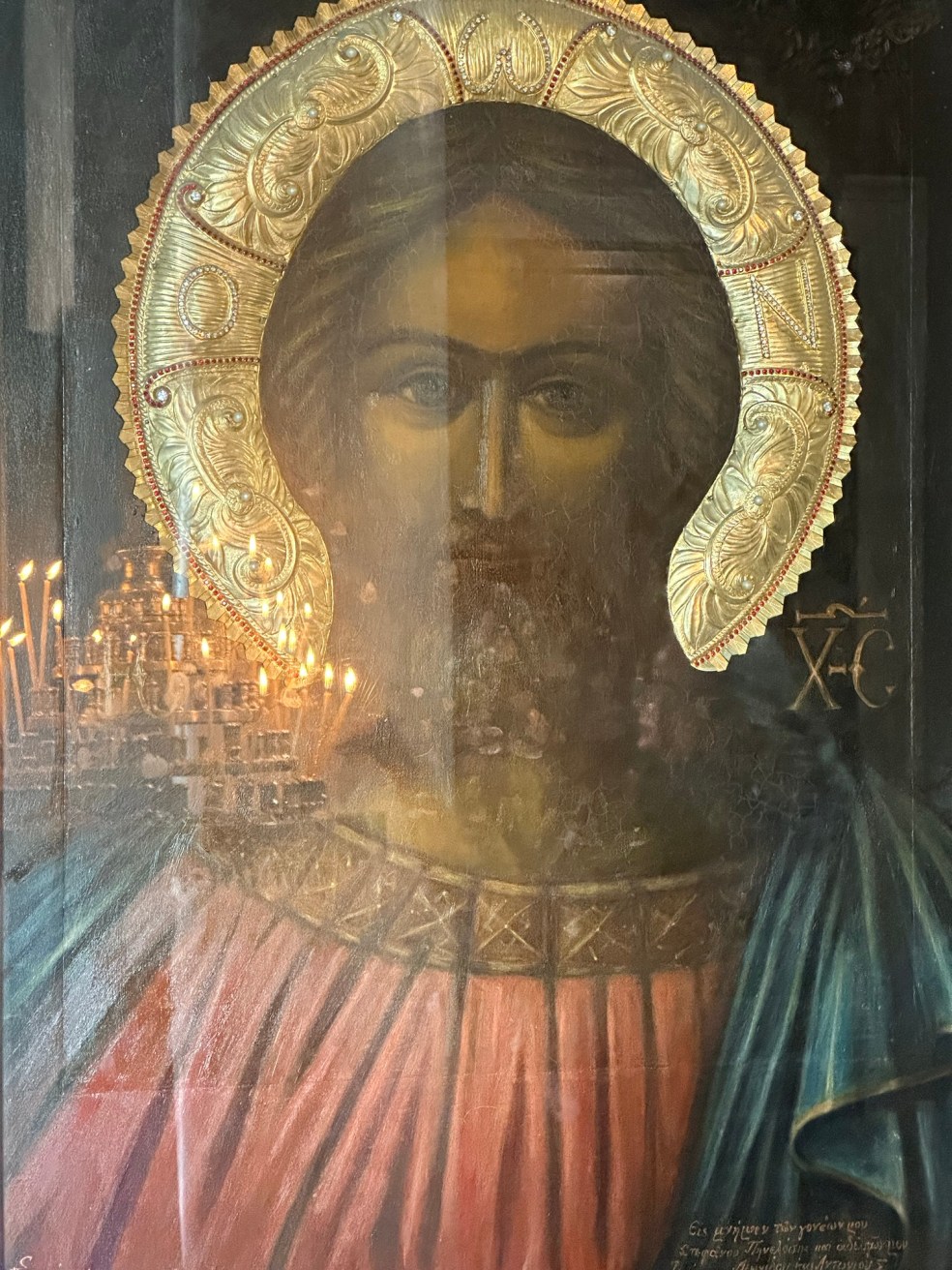
It would seem that our life is completely dependent on Christ, whether or not we believe in him. Enter an Orthodox church and you will most likely see an icon of Christ Pantocrator (“Ruler of All”). In this image, Christ is shown with the beams of the Cross behind him (only three are visible), and in these beams are written the letters O WN.

O WN is Greek for “the being”, which is the translation of the name that God reveals to Moses at the burning bush in Exodus 3:14: I AM. Again, we find here confirmation of the Trinity, because O WN is almost identical to ONE, it’s just that one of the letters has been rotated.

O WN also spells three words in English: own, won and now. Christ claims us as his own; the victory is his, he has won; he is here with us now (the meaning of the name Emmanuel).

I have seen this name written O WH. In Cyrillic, the letter H is pronounced N, and indeed the two letters are very similar (only the crossbar has become slanted). There is also a rough breathing in the original Greek, ὁ ὤν, the reverse apostrophe, which equates to the letter h in English.

If we write the name in this way, then we will see that it spells the words who and how, the result of making the progression AIO from what (A, the letter of creation: “What is this creature?”, “What shall I call it?”) through why (I, the letter of the Fall, an expression of distrust, of disobedience: “Why should I do this?”, “Why should I believe you?”).

Who and how are the questions that we should be asking. What is factual. Why is self-centred. We think that the purpose of life is to amass things and then to share them out, because we were taught at school to count up from 1, to do sums, multiplications and divisions. But actually the answer we are seeking is a person.

Christ gives us the answer to both question words when he says, “I am the way, and the truth, and the life” (Jn 14:6). I am and way are connected if we turn the m upside down and replace the vowel i with its semi-vowel equivalent, y. Both words contain the progression AIW (omega written as w).

We have also seen how when we flee the ego, the I, when we refuse to heed its selfish demands, we automatically create three symbols: A+O, the name of God Alpha and Omega. This can be written A ’N’ O and is found in the conjunction and, the reverse of which is DNA (it is in our DNA to do this). If we write this same progression with the Greek letter for omega, w, we get ANW, which with the w turned upside down gives man. So this denial of the ego, of our innate selfishness, is in the word that describes us (and woman is the same, only it has O3 at the beginning).

The automatic result of turning away from the ego, I, is to say the name of God Alpha and Omega: A+O. By turning away from the ego, we call on him. This is why God and ego are only a step apart in the alphabet (d-e). And him is just I’m with a little breath (h) before it.

This is what makes us human, a combination of hu (Sanskrit for “invoke the gods” and the root of our word “God”) and man – physical beings with the divine spark in them, the potential to become gods by grace if we attend to our true nature, which is not to grab whatever we see out there and to claim it as our own, making a mockery of the divine in us, but to see ourselves as part of the whole, a word in the dictionary, responsible for and dependent on the other. This most ancient way of calling on God – hu – sounds exactly the same as who, the letters we find in Christ’s icon, emphasizing what it is we should be asking.

In the Old Testament, there are two other names of God, apart from I AM. They are YHWH, the Hebrew Tetragrammaton (Yahweh), and El.

YHWH is extremely close to the question word why. So, if we make the progression from I to O, as we did with live-love, sin-son and Christ-cross, opening the line (opening our spiritual Is) to form not a barrier, a wall, but a tunnel that we can walk through, like the proverbial camel through the eye of the needle, just as why gives who, so the name of God in the Old Testament, YHWH, gives O WH, the letters found in Christ’s icon.

And if we place the other name of God from the Old Testament, El, in front of O WH, the two names together spell WHOLE in reverse (keeping the digraph wh together, as we did with earth-three).

This combination YHWH-O WH (why-who) and El-O WH (whole) goes a long way to confirming Christ as the fulfilment of the Old Testament law and prophets. This is why I would say that language is not only Trinitarian (three in ONE), but also Christological.

All physical appearances of God in the Old Testament are said to be by the Logos – that is, Christ – but we are not allowed to touch him. In the New Testament, when he walks among his disciples, eats with them and washes their feet, God himself has entered his creation. He has slipped through the hole – I become O – but in the other direction, so that we will have the courage and confidence to go the other way. This is an extraordinary act of condescension, of coming down to our level, and it was only possible because one of his creatures – namely Mary – acted as a conduit. How else in bodily form do you enter the creation that you have made, if not through one of your creatures?

Jonathan Dunne

Heart of Language 13/15

Next: Heart of Language 14/15

Back to: Contents

3. Human

The elements of speech – breath, water and flesh – are the same elements that are present in the act of creation in the Book of Genesis. The world was spoken into being, which means that we, and the world around us, are a form of language.

Language is made up of three elements: breath, water and flesh.

The first element is breath. Breath forms the basis of all speech. Without breath, you are dead. Breath is represented by the letter h, a letter that is dropped in colloquial speech and silent in some languages, but for me the most important letter in the alphabet:

h   (breath)

The second element is water. This is when we add voice to our breath and form the vowels. Hold a vowel sound for long enough, and water will collect in your mouth. The vowels are listed in the alphabet in the following order: a-e-i-o-u. But this is misleading because the vowel sounds are formed, from the back of the mouth (where language originates), in a different order:

u-o-a-e-i   (water)

Since breath on its own doesn’t make a word (it only expresses exasperation), the first word that the human apparatus is capable of producing is the combination of breath, h, and the first vowel sound to emerge from the throat, u: hu. You might think this is unremarkable, but, as we have seen, hu is Sanskrit for “invoke the gods” and the root of our word God.

So the first utterance we can make by our very nature is to call on God, just as when we move away from the ego and produce the symbols A+O, we say another name of God, Alpha and Omega. While the science of etymology stipulates that human derives from the Latin word for “man”, homo, I would suggest that really it is a combination of hu and man. We are spiritual beings.

The third element of language is flesh. We obstruct the passage of breath with our lips or tongue (our flesh) and produce the consonants, which can be voiced or voiceless. The consonants are divided into phonetic pairs according to where they are produced in the mouth. There are seven simple pairs:

b-p   d-t   f-v   g-k   l-r   m-n   s-z   (flesh)

We see all these elements – breath, water and flesh – in chapters 1 and 2 of the Book of Genesis. Take, for example, Genesis 1:1-2:

In the beginning when God created the heavens and the earth, the earth was a formless void and darkness covered the face of the deep, while a wind from God swept over the face of the waters.

I would suggest that this passage in Genesis is really a description of speech. Or the creation of man in Genesis 2:6-7:

But a stream would rise from the earth, and water the whole face of the ground – then the Lord God formed man from the dust of the ground, and breathed into his nostrils the breath of life; and the man became a living being.

Again, all three elements of language are present, which would suggest that the world was literally spoken into being. This would explain the proximity between space and speak (the letter c, a redundant letter in English, can be pronounced k or s), and also the presence in world of word and lord (the reiterative verse “And God said”).

What is also remarkable is the word these three elements have in common: father. We have seen the phonetic pair f-v, but v is also connected to b and w (think of languages such as modern Greek, Spanish, Latin and German), so through the intermediary of v, I can make the connection f-b/w.

In this way, we see that breath and father have the same letters, water is in father with the addition of h, and flesh is in father with the addition of a (phonetic pair l-r, step in the alphabet s-t).

Father contains speech.

Jonathan Dunne

Heart of Language 3/15

Next: Heart of Language 4/15

Back to: Contents

Theological English (3): The Alphabet

In this fourth video on “Theological English”, Jonathan Dunne looks at the twenty-six letters that make up the Latin alphabet as it is used in English – h, five vowels, three semi-vowels, fourteen consonants, and three “redundant” letters (c, q and x) – and sees how these letters are used to represent the three elements of speech which are also the three elements of creation: breath, water, and flesh.

To access all the videos in this course, use the drop-down menu “Theological English (Video Course)” above. The videos can be watched on Vimeo and YouTube.

Word in Language (10): Father (0)

What do we know about the Father? Perhaps we know about him as much as our ability to love. He is generally portrayed as an old man with white hair and a white beard, next to his Son, with the Holy Spirit hovering above. We may associate him in particular with the act of creation and the Fall in chapters 1-3 of the Book of Genesis. According to Orthodox tradition, all appearances of God in the Old Testament are by the Logos, the Word of God, that is Jesus Christ. The New Testament is associated with the earthly life of Christ, his birth, teaching, crucifixion and resurrection. And the Holy Spirit is associated with Pentecost, the beginnings of the Church. The Father can remain in the background. Certainly, we cannot know his essence, and of God’s qualities St Maximos the Confessor says that it is only infinity that can be grasped fully by the intellect (see the end of his First Century on Love).


In an earlier article, I made the connection between TREE and THREE and put forward the analogy of the Father as the trunk and the Son and the Holy Spirit as two branches, as in a child’s drawing, the Son begotten and the Spirit proceeding. This is why in the Orthodox Creed it is said that the Spirit proceeds from the Father – not from the Father and the Son, as is erroneously stated in Western Churches – because otherwise the Spirit would have to be a sub-branch of the Son, making for a lopsided drawing. This doesn’t make sense.


Christianity is the only religion that professes God the Trinity: Father, Son and Holy Spirit. This is shared love, which crucially involves a third person, otherwise it could be construed as being exclusive. This love among the three persons is not jealous. It is like love in a monastic community – it professes love for the brethren, but also welcomes pilgrims, newcomers. The arrival of newcomers can be very unsettling, but somehow we have to find a place for them, to see that our reaction is immediately, naturally, spontaneously, one of love.


You cannot have the Father without having a Son. His first characteristic is that of being a Father, which immediately places emphasis on relationship. The Holy Spirit can be seen as a kind of conjunction – and – that welds the love together. I have already stated that this little conjunction, AND, contains the name Alpha and Omega (A ’N’ O) and spells DNA in reverse. It is a crucial word in language, and barely a sentence exists without it.


I would like to suggest that there is proof in language for the existence of the Father. This doesn’t surprise me, for from him all things come. The Son is begotten by the Father, the Spirit proceeds from the Father, and we are his creation. We saw in the previous article how the world is a kind of spiritual womb, from which the body of the Church is in the process of being born. We make the mistake of thinking that life in this world is all there is and our birth has already taken place, but I don’t think this is quite true – our physical birth has taken place, sure enough, but our collective spiritual birth is still happening, which is why for me St Paul writes, ‘We know that the whole creation has been groaning in labour pains until now’ (Rom 8:22).


The first indication that the Father is who we understand him to be – the source of all life – can be found in the alphabet. But we should sound a note of caution: if we can find proof for the existence of the Father in language, shouldn’t that point us in the direction of the Holy Trinity? Shouldn’t that suggest that the Father is truly behind and in his creation, just as we make him out to be? How else could he be in language, a set of words we ourselves have come up with in order to communicate, a set of letters which we use to write these words down? This should give us pause for thought – if we can find proof for him in language.


Language is made up of three elements. The first of these is breath. Breath forms the basis of all language. There can be no language without breath. Without breath, we are in effect dead, and we are not going to communicate by means of our bodies. Breath is represented in the alphabet by the letter h, a very important letter since it represents the basis of all speech, and yet (or because of this) it is dropped in dialects like Cockney and not pronounced in languages like Spanish. That for me is a sure sign of its importance.


If all we do is huff and puff, we are not going to make much sense, and so, as anyone who has been present at a childbirth knows, the next thing that comes along is voice, the vowels. We breathe out (the baby breathes out) and add voice (the baby bawls – loudly), and now we have sound. We also have words – words like a, I and o! We can even put a vowel before breath and exclaim, ‘Ah!’ We have the beginnings of speech.


If we hold a vowel for long enough, as when we visit the doctor’s, water will collect in our mouth, and this is because vowels are like a river – they flow. We can see that FLOW and VOWEL are connected by the phonetic pair f-v, addition of e. But the vowels do not emerge from our throat, where language originates, in the same order that they appear in the alphabet. Actually, they emerge in the following order, from the back of the mouth to the front:


u – o – a – e – i


forming a V-shape as they do so. This means that the first word the human apparatus is capable of pronouncing is breath (h) plus the first vowel to emerge from the throat (u): hu (I am assuming that breath on its own does not constitute a word, which I don’t think it does).


You might wonder, ‘So what?’ Well, this little word hu is from Sanskrit and means ‘invoke the gods’. So the first word a human is capable of pronouncing is an invocation of God. It is also the root of our word God, as any good dictionary will tell you. This is extremely interesting, but it doesn’t stop there.


Have you noticed that we are human? The science of etymology, which studies the evolution of language over time and, like all science, is limited in its vision (only faith is not limited, which is why we need it), will tell you that human derives from the Latin word for ‘man’, homo. Yes, maybe. But word connections – which are the study of language outside time, and hence far more interesting – will enable us to see that HUMAN is a combination of HU and MAN. It seems that God stamped us with his seal when he made us. We have already seen how MAN contains AM and AN.


But we still haven’t seen any proof for the Father. Let us continue. If all we had was breath and water, h and the vowels, we would do a lot of whining and exclaiming (some people do that, it is true). But to form words, real words, we need to obstruct the passage of air with our lips and tongue to form the consonants. Now we get proper chunky words. The consonants, as I have explained, can be divided into seven phonetic pairs:


b-p     d-t     f-v     g-k     l-r     m-n     s-z


depending on where in the mouth they are pronounced and which piece of flesh – the lips or tongue – is used to obstruct the passage of air when they are pronounced.


That accounts for twenty letters, but the English alphabet has twenty-six. Three of the remaining letters are semi-vowels – that is, the passage of air is only partially obstructed. The semi-vowels j and y correspond to the vowel i; the semi-vowel w corresponds to u (think of the name of the letter).


And the other three are what I call redundant letters. We don’t need them. They are c, q and x, all of which can be written using a combination of the letters k and s: the letter c is pronounced either k or s, q is pronounced k and x is pronounced ks. And yet they serve a purpose, because the double pronunciation of c as k/s enables me to make word connections through both these letters (we will see an example in a moment).


That accounts for the whole of the English alphabet: h, five vowels, seven pairs of consonants, three semi-vowels and three redundant letters. The letter h corresponds to breath, the vowels to water and the consonants to flesh.


What is very interesting is that the exact same three elements – breath, water and flesh – correspond to the act of creation in chapters 1 and 2 of Genesis. Remember that a wind (breath) swept over the face of the waters (Gen 1:2). Remember that to form the sky (air/breath) God separated the waters from the waters (water) (Gen 1:6-8). Remember that God then gathered the waters under the sky into one place and formed the land (flesh) (Gen 1:9-11). Remember that man was formed from the dust of the ground (flesh) (Gen 2:7) and God then breathed into his nostrils the breath of life (breath).


So the same three elements of breath, water and flesh are involved in the creation. But why should we be surprised, given that we know that God spoke the world into being? Doesn’t almost every paragraph in Genesis chapter 1 begin, ‘And God said’?


Do you remember how the letter c can be pronounced k or s? We might now see a connection between SPACE and SPEAK.


We might also see that WORLD contains LORD and WORD. The WORLD is a combination of LORD AND WORD:


world = lord + word


Hence those three words that are constantly repeated in Genesis: ‘And God said.’


But we still haven’t found proof for the existence of the Father in language. You need to know that there is an ‘eighth’ phonetic pair (and it isn’t even a pair): b-v-w. These letters are closely related. In Modern Greek, b is pronounced v; in Spanish, v is pronounced b. In Latin, v is pronounced w; in German, w is pronounced v. This enables me, through v, to connect b/w with f (the partner of v according to the phonetic pairs), and many word connections are made using this combination.


Now we will begin to see that the three elements of breath, water and flesh – the elements that make up speech, a daily occurrence, and also the creation of the world we inhabit – have one word in common. I am not making this up because I am obeying phonetic rules, so it is in language (not in my imagination!).


BREATH is clearly connected to FATHER by this combination I talked about, f-b/w.


WATER is clearly connected to FATHER by the same combination, f-b/w, addition of h (one of the two most commonly added letters).


FLESH is clearly connected to FATHER by the phonetic pair l-r, the alphabetical pair s-t, addition of a.


The elements of speech and creation have the word FATHER in common. That is remarkable and ought to make us bow our heads in worship. The next time we open our mouths to speak, we might be a little more respectful of what we are doing and remember how the Father is in the elements of speech, in our very human being.


Jonathan Dunne, http://www.stonesofithaca.com