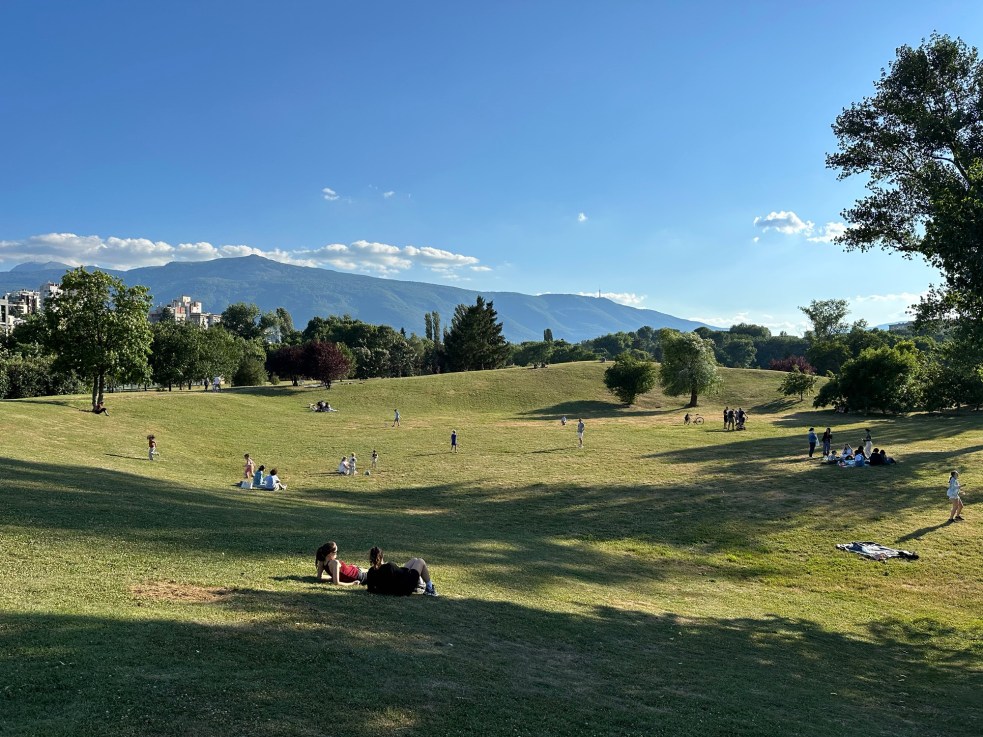
Kladnitsa – Selimitsa – Ostritsa – Kladnitsa

Starting Coordinates: 42.5685, 23.19619

Distance: 8.2 km

Elevation Gain: 475 m

Time: 3¼ hours

Difficulty: moderate-hard

Transport: by car, or by minibus
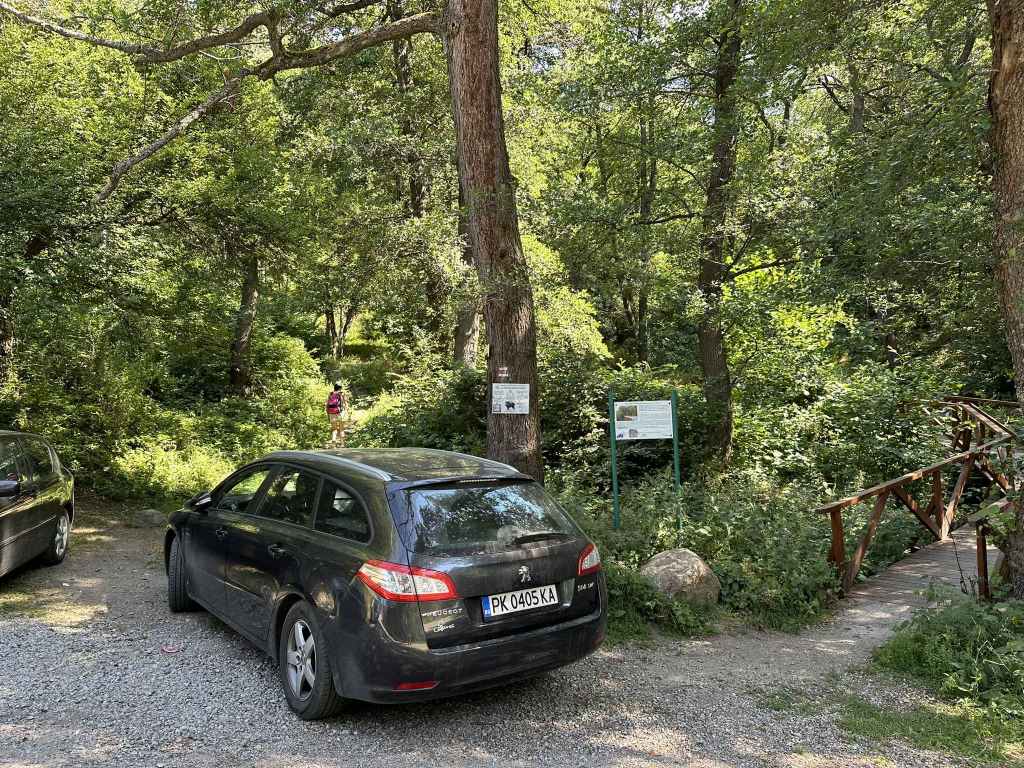

Kladnitsa, with a population of little more than a thousand, is the highest village on the west side of Vitosha. To get there by car, you must take the road from Sofia to Pernik, which passes through Knyazhevo and Vladaya before arriving at the crest of the hill and descending on the other side. As it reaches the bottom, in a village called Dragichevo, there is a set of traffic lights. Turn left here (it is signposted for Rudartsi, 4 km, and Kladnitsa, 9 km). If you continue straight, you will reach the motorway for Greece, the A3, and then Pernik.

In 1.5 kilometres, you enter Rudartsi. Stay on the same road. In another 4 kilometres, you enter Kladnitsa. 400 metres after entering Kladnitsa, the road veers left, signposted for Kladnitsa Monastery and Selimitsa Hut, and takes you uphill. After one kilometre, you leave the village of Kladnitsa and immediately enter Vitosha Nature Park. Keep going for another 500 metres. As the road turns left, you will see the start of the ecopath. 200 metres after the start of the ecopath is the slip road that leads to Kladnitsa Monastery. There is a very small area to park your car just after the start of the ecopath, otherwise people tend to park on the verge. It can be quite busy at weekends in summer.

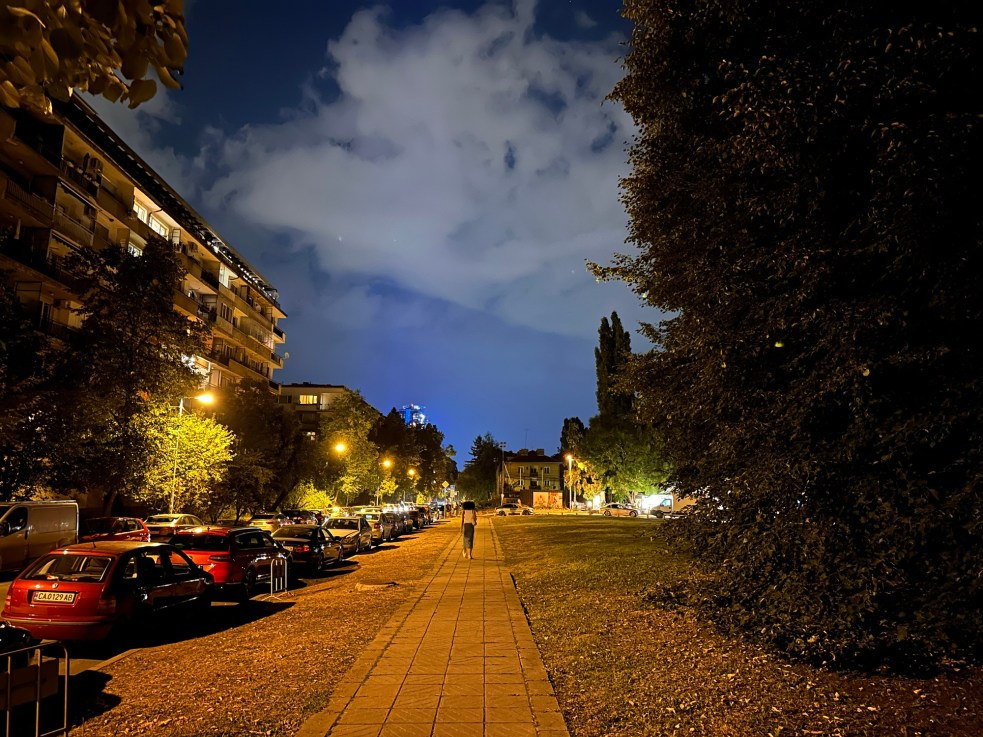
There is a minibus that goes to Kladnitsa from the Russian Monument in Sofia once an hour, during the daytime. The 21 bus also goes there from Pernik. The buses stop in the main square in Kladnitsa, where the chitalishte (community centre) is. From here, you need to head eastwards, and soon the road will take you out of Kladnitsa and into Vitosha Nature Park.

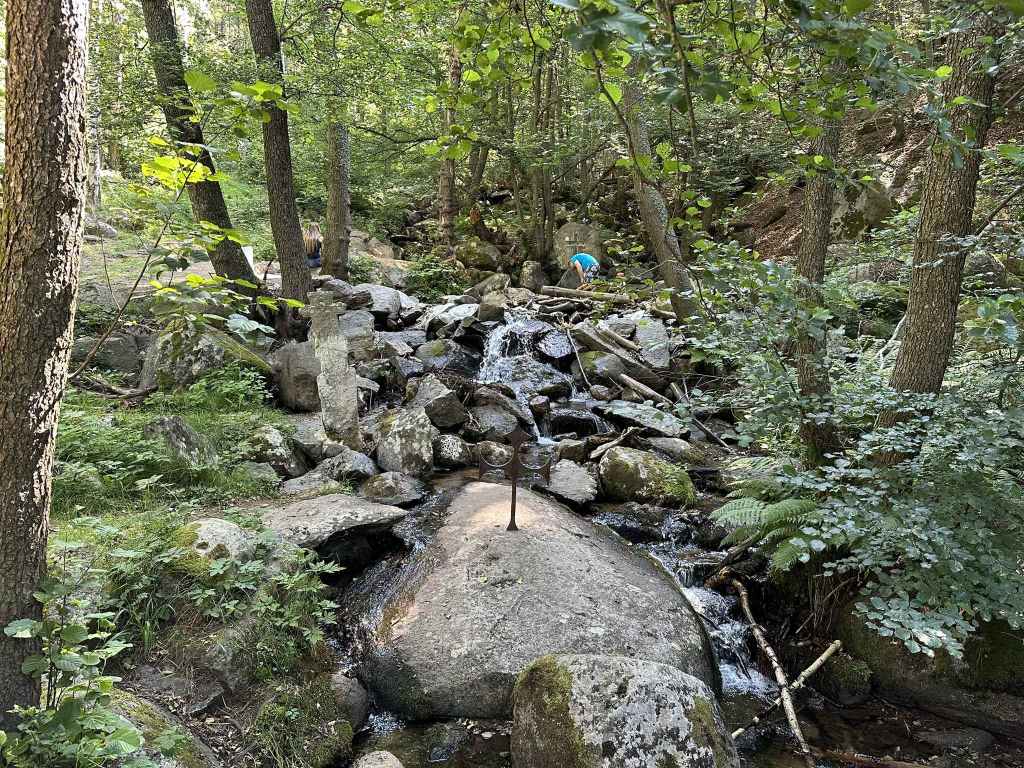
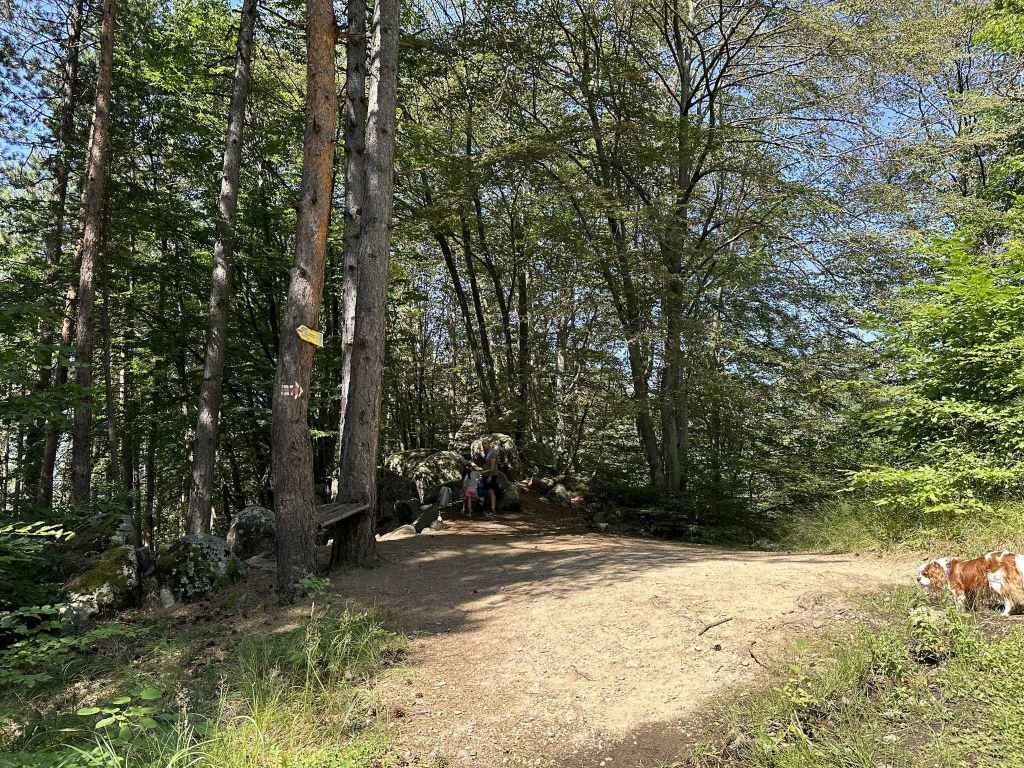
The ecopath is known as the “path of health”. It leads straight up from the road. The river should be on your right. In 200 metres, you cross the river on three separate bridges and continue on the other side. In another 200 metres, you again cross the river, but this time the path leaves the river behind and soon reaches a clearing with a bench between two tree trunks. You continue straight here (signposted for Cherni Vrah and Selimitsa Hut). In 200 metres, a small bridge takes you over a stream, and you become aware of the road you were on up on your left. The path crosses the same stream again, and 1.1 kilometres after the start of the ecopath you rejoin the road at Selimitsa Hut. There is a car park further down on your left.

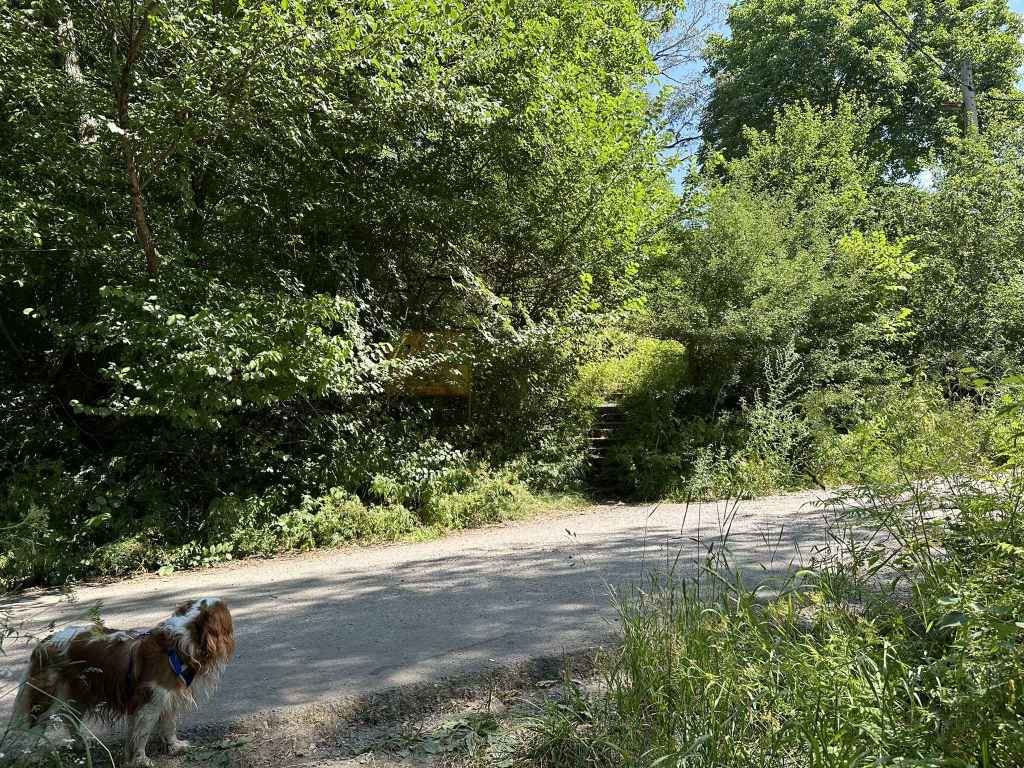
The path continues on the other side of the road, up some steps, and in a couple of minutes you arrive at Selimitsa Hut, which is a popular place for eating. If you don’t have food with you, you want to bear in mind that Ostritsa Hut is not working, so this is your only chance to grab a bite to eat on the route.

The path heads behind the hut (where the kitchens are) and joins a track. At the track, turn left and continue climbing past some wonderfully located houses. 300 metres after the hut, the track veers right and enters the forest. This track will now take you to Ostritsa Hut, the highest point on this walk.

I have marked the walk as “moderate-hard” not because of the distance, but because of the elevation gain (475 metres over 4.2 kilometres). You are constantly climbing. I always think it’s a question of not being anxious to arrive somewhere, but simply going at your own pace, putting one foot in front of the other. That’s all anyone does, isn’t it? And humans have achieved great things by putting one foot in front of the other and being patient.

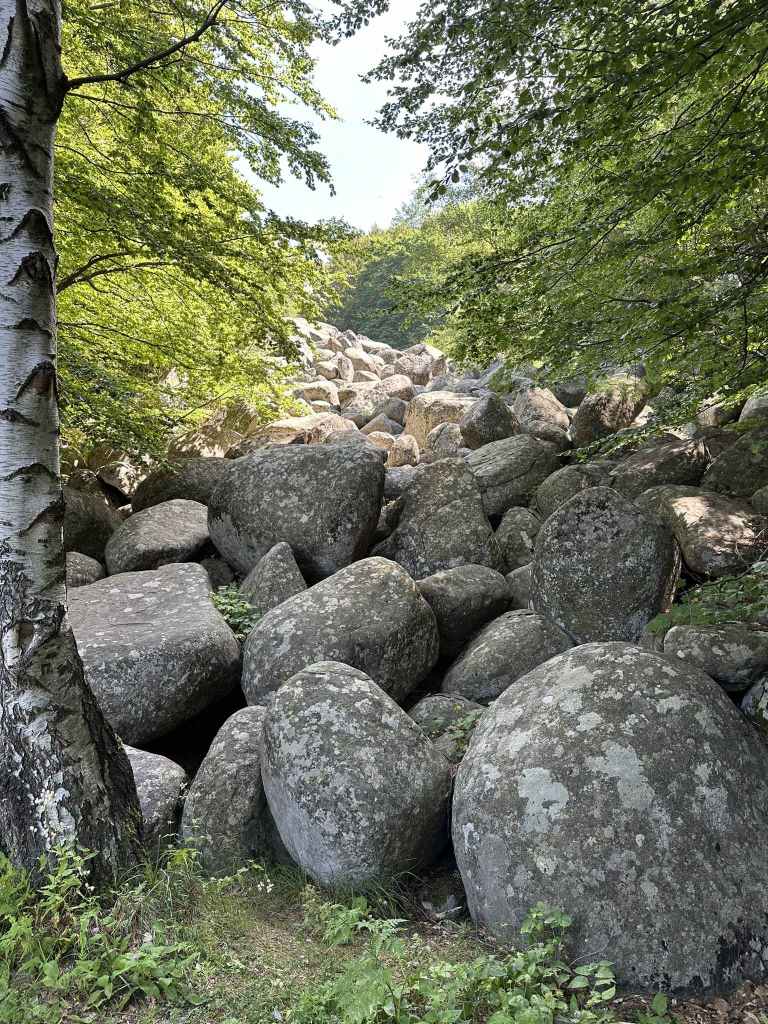
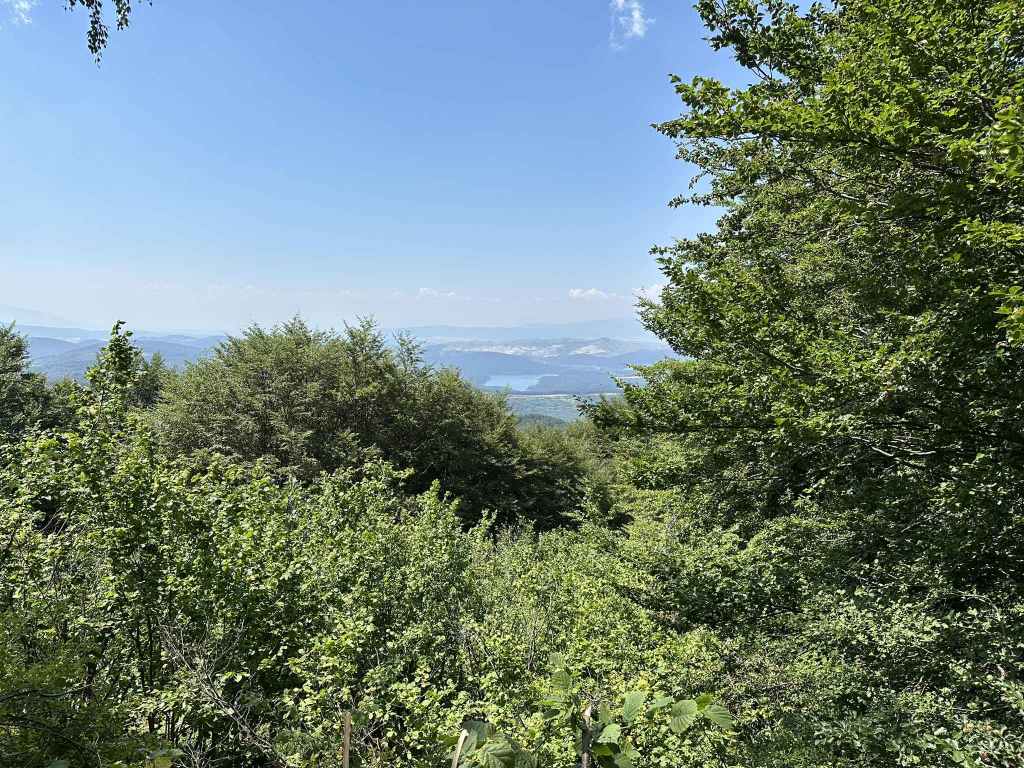
Very soon on the left is a picnic hut, with a small fountain behind it (only trickling water). Fifteen minutes after the picnic hut, there is a stone run, one of those moraine rivers that are so characteristic of Vitosha (and of the Falklands, apparently). Another 200 metres, and there is a wonderful view to the south-west of Studena Reservoir. Another ten minutes, and there is another small fountain on the right, this one without any water. One more kilometre, and you reach the top, with Ostritsa Hut on your right. You are now not far from the walk that begins at Ofeliite.

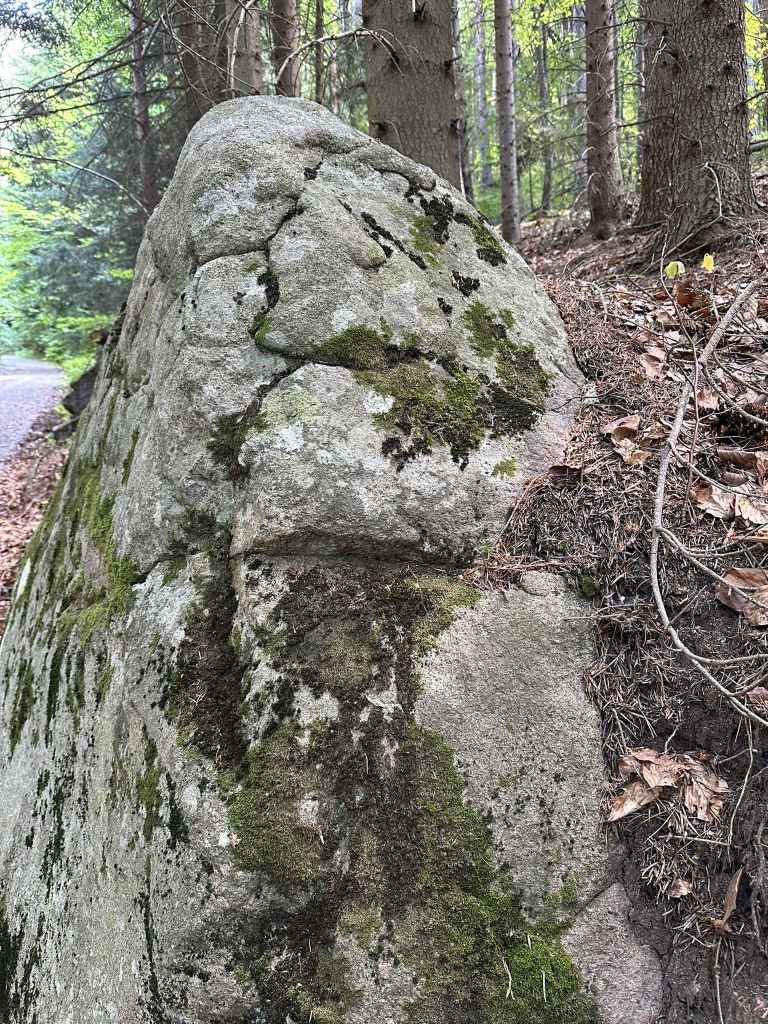
Unfortunately, Ostritsa Hut doesn’t work, but I still ate my lunch, sitting by the hut and the grassy slope that leads to Ostritsa Peak. I then headed back down the way I had come. What makes this path so worthwhile is the beauty of the path itself, which is mostly shaded, the views to the south-west, and the numerous boulders that line the route. You are also on a less frequented part of the mountain.

Back at the bottom, do make time to visit Kladnitsa Monastery, dedicated to St Nicholas, which is only 200 metres further up the road and has a very distinctive depiction of the Trinity on the ceiling of the nave.

12. One

The concept of the Trinity has flummoxed theologians for centuries. We might liken it to the birth of a child (a third person), or the branching out of a tree (a tree needs branches and leaves to bear fruit). In terms of language, we might identify three persons in the number one when written with capital letters: ONE.

And what is it we must believe? We must believe in God the Holy Trinity, Father, Son and Holy Spirit. It’s as simple as that. The rest will take care of itself.

The Christian concept of the Trinity – three persons, one God – has perplexed even theologians over the centuries, but we might think of our own birth to understand it (two people come together in order to create a third, which is why birth and third are connected, pair of letters that look alike b-d). We might also think of the shoot that branches out – the tree that becomes three – in order to grow and bear fruit.

But as language has taught us about the creation of the world, about the importance of belief, about our final destination and the Last Judgement (when an angel will enter the field to glean the wheat), so I think we can turn to language for an understanding of the Trinity.

Three in one. This doesn’t help us. Let us try writing one with capital letters: ONE. Now we can begin to see.

The word ONE comprises three numbers: 0, 2 (on its side) and 3 (back to front). The one number that ONE does not contain is itself: 1.

This is because in chemistry the subscript 1 is not written down. So if we take the first letter, O, to represent God (it has no beginning or end) and decide to write the three persons of the Trinity as chemical formulae, then God the Father would O(1), God the Son would be O2 and God the Holy Spirit would be O3. Three in ONE, literally.

For God the Father, we can read the formula O1 as no one, the end of the progression from the name of God in Exodus, AM, and from the purpose of Adam in the Book of Genesis to name the creatures, so that they mean something, to which he says amen. When we apply the progression of the Greek alphabet, AIO, to these words, from AM we get I’m and om, which with the phonetic pair m-n and addition of final e gives no one, God the Father. We are back to the beginning. From amen-mean-name, we get mine and nemo, the Latin word for “no one”, and omen. Again, we find ourselves back at God the Father, O1, the first person of the Holy Trinity.

Why would God the Father be “no one”? Because it’s the only way he can be everyone. We individual humans are someone – that is, as distinct from someone else, countable nouns, each with a line around them. The closest we can get to “no one” is the figure of the translator, that person who lives on the line, ferrying cultures across, enabling communication and understanding, and enriching people’s lives with what is other. The translator is “no man” – he lives inside the line, in no man’s land. He almost doesn’t exist – he is largely ignored, his name is sometimes omitted, he barely has enough to live on, and yet he believes in the value of the work he is doing… and so he continues beyond the bounds of what should be possible. He starts to push the boundaries of possibility, to test them, to see whether in fact they are real, whether the illusion will kill him or he will live to fight another day.

The translator, in human parlance, is no man. He doesn’t exist. He finds himself in the firing line between two opposite sides (sides that only exist because of the line), without a gun. He raises his arms in a semblance of crucifixion and implores an end to this madness of viewing people and things as external to ourselves. He doesn’t win, he loses, but he speaks the truth.

This is the closest we can come to the divine – “no one” – in this life. There are two indicators of truth: one is coincidence (things that happen together), the other is paradox (an apparent contradiction that turns out to be true). Language is full of paradox. God, who is in fact all that is, is no one. He is nowhere to be seen (which means he can be everywhere), but nowhere is also now here.

God the Son is O2, the chemical formula for oxygen – we breathe him, just as we speak him (because he is the Word) and see by him (because he is the Son/sun). And God the Holy Spirit is O3, the chemical formula for ozone, the layer that protects us from the sun’s rays (which we might understand as the Son’s wrath, existence in a precarious balance).

But let us remember that the letter in the alphabet that represents breath, wind (a word, by the way, comprised of the numbers 0, 1, 2 and 3: WIND), is h, so we can choose to represent the Holy Spirit (pneuma in Greek) as H. Combine H and the chemical formula for oxygen, O2, in reverse (common in word connections) – that is, combine God the Son and God the Holy Spirit – and you have H20, the chemical formula for water. We breathe him, we speak him, we see by him, and we drink him in water.

God is three in ONE. The last symbol, O3, can refer to God the Holy Spirit – the third person of the Trinity – or to the Trinity itself: 3 in One (the mantra om).

We have seen how three Os together spell GOD (just as three egos, three Is, spell ill). And we will find these three Os again in the word WOOD, with a lopsided 3 at the beginning. WOOD, of course, is the ultimate symbol of Christianity: the Cross, which is nothing more than a deleted I.

Language is clearly Trinitarian. It is also Christological.

Jonathan Dunne

Heart of Language 12/15

Next: Heart of Language 13/15

Back to: Contents

9. AIO

After the creation of the world (in the beginning, the letter A), we find ourselves in the era of the Fall, which centres around the ego, I. We have to take this line that separates us and open it, count down, perhaps just turn it around, so that we get O.

The correct progression of human life is that represented by the Greek alphabet, AIO (sometimes written AIW). The Greeks are known for their interest in philosophy and theology. Having made the progression from the A of creation to the I of the Fall – the period we find ourselves in – we have a choice: to count up (as the Latin alphabet does, AIZ) or to humble ourselves and count down, AIO.

Language favours the second option. We have seen the examples AM-I’m-om, no one and amen, mean, name-mine-nemo, omen. We go from the name of God in Exodus, AM, through personal importance and gain (I’m, mine) to calling on God again in the Holy Trinity (om) or on God the Father, no one (nemo in Latin).

In the Garden of Eden, between Adam and Eve, there was no competition. So, we have a draw. In today’s world with its competing egos, we set out to win. The vowel in these verbs has changed from A to I. But Christ comes with a different message. He encourages us to turn the other cheek, to lose our life for the sake of the other (in order to find it). So, he encourages us to lose:

draw-win-lose

Here again, we find the progression of the Greek alphabet, AIO (with a silent final e, very common in English, ignore the consonants).

We have seen that we are made to call on God. The first word the human apparatus is capable of producing is a combination of breath, h, and the first vowel to emerge from the throat, u: hu, which is Sanskrit for “invoke the gods” and the root of our word God. We are made to call on God. Similarly, if we turn away from the selfish demands of the ego, represented in English by a straight line, I, we make three symbols, A+O, which spell another name of God, Alpha and Omega. So, again, when we turn away from our selfish desires and embrace the other, we call on God.

In the Judgement of the Nations, Christ goes so far as to tell us that the other is God: “Just as you did it to one of the least of these who are members of my family, you did it to me” (Mt 25:40). If we remember that the Greek word for “God” is theos, we might see a close similarity between other and theos (step in the alphabet r-s). Language confirms what Christ is saying.

It is ironic, therefore, that after Adam and Eve have eaten of the fruit of the tree of knowledge in Genesis, chapter 3, it is God who calls to Adam, “Where are you?” (Gen 3:9). Of course, he knows where Adam is, and he knows what has happened. But by asking this question, which is the question Adam should have been asking, he is somehow indicating to us what our approach should be.

Make the progression from A to I, and from call you have like (in reverse, addition of e). Like is what we do on Facebook. We indicate our preferences. It also gives kill, and there has been plenty of killing in the history of humankind.

Now, count down from I to O, and you get look, which is the message Christ is trying to get across in the New Testament, the importance of opening our spiritual eyes (our egos or Is) and bearing spiritual fruit. We have seen the relevance of this in the Parables of the Sower and the Tares. So, we have:

call-kill, like-look

And then there are the examples that relate to the animal kingdom. Let us start with swan – a white bird, and white is a symbol of purity. Progress towards the ego, and you get swine – pigs in the mire, we have dirtied God’s image by rolling in the mud (just as the prodigal son does in Luke 15, a metaphor for dissolute living). When we come to our senses and realize that the things of this world will not satisfy us for long, we set out to purify ourselves once more, to return to our father, as the prodigal son does, which is not a return to the way things were before (swan), but a movement onwards, to something new: snow. So, we have:

swan-swine-snow

And finally, what is that most ancient mammal if not a whale that continues to patrol our oceans, despite our best efforts to wipe it out? Make the progression from A to I, and you have while, an indication of time. Time started after the Fall, this is when Adam and Eve became mortal, when they were expelled from paradise. Time will end for us individually when we die (the past tense of I) and for the human race when Christ comes again to judge the living and the dead. Now, count down from I to O, and in a while you become whole again. Whole is a remarkable word, and we will see more of it. So, we have:

whale-while-whole

All are examples of the progression made in the Greek alphabet, where we count down from the ego, which is represented in English by the letter I, and turn to God, the eternal symbol O.

Jonathan Dunne

Heart of Language 9/15

Next: Heart of Language 10/15

Back to: Contents

8. Om

The Fall – carnal knowledge – enabled us to have our own children, but it also brought about spiritual blindness, which is represented by the ego in English (I, a closed eye when rotated by ninety degrees). We must make the progression to O, an open eye, if we are to see the people and things around us.

In between the vowels a and i in the alphabet is the vowel e. The name of Adam’s partner in Genesis is Eve, “because she was the mother of all who live” (Gen 3:20).

Now there are two coincidences, and coincidences are indicators of truth. The first is the correlation between Eve and eye (v-y is a pair of letters that look alike, one is an extension of the other). The second is the way the words eye and I sound exactly the same.

Eve is taking us in the direction of the Fall (I), but I don’t see this as a bad thing. Without carnal knowledge, without a fall into bed, we could not have children. We had to make this progression in order for the world – and then heaven – to be comprised of our own creations. The alternative was for God to create a clone army, to keep on removing ribs from Adam in order to make more humans. God knew perfectly well what would happen in Genesis, chapter 3. But it was necessary for us to co-partake in creation – after all, we are divine creatures, we bear God’s name (AM is in ADAM). And there is no doubt that children give great joy and make life worth living.

So, the Fall made it possible for us to marry and have children. But with carnal knowledge came spiritual blindness. And this is something we don’t realize. We think when our eyes are opened shortly after birth, we can see. But our physical sight is extremely limited. We see things as objects. We label them. We move them about. We trade in them. We build lines around them (walls, fences) to protect them from others. This is not sight.

And this is why the ego, I, if we rotate the word by ninety degrees, represents a closed eye: —. This explains the correlation between eye and I. The ego is a closed eye, because it is spiritually blind. And we are in this life (apart from to have children) to open our spiritual eyes and to form the letter O. O is eternity. O is an open tunnel. O is a cry of recognition. O is a sigh of repentance. It represents restoration, redemption. Do you see how all these words begin with the prefix re-? It is a return – we are restored to ourselves – but it is a return with knowledge.

We have seen how this progression from the A of creation to the I of the Fall and the O of redemption can be discerned in the question words what, why and who (how).

Let us take the name of God in Exodus, AM, and apply the same progression. AM gives I’m (self-importance). We no longer call on God, we rely on our own resources (only to discover, later on, that they are limited). When we reach the end of our tether, we make the further progression from I’m (the ego gets to be pretty boring with its repetitiveness) to om, a mantra in Hinduism and Tibetan Buddhism. But I don’t mean that. For me, om represents the Holy Trinity: O3 (three in One).

And if we apply the phonetic pair m-n and add final e (which is extremely common in English), we find that om gives no one. Amen-mean-name do the same – they pass through mine (acquisitiveness) to nemo (Latin for “no one”) and omen.

No one – O1 – is God the Father, as we will see in a later chapter. So, again we call on him, just as we did by being human (the first word the human apparatus is capable of pronouncing, a combination of breath and the first vowel to emerge from the throat, the root of our word God). Or by moving away from the line and producing three symbols, A+O, that spell another name of God, Alpha and Omega.

This progression, AIO (sometimes written AIW), is inherent in language. We will see more examples.

Jonathan Dunne

Heart of Language 8/15

Next: Heart of Language 9/15

Back to: Contents

5. Seed

The life cycle is reflected in language; all the words connected with creation, fertility, reproduction, have aer (air) in them, the same aer that forms the basis of speech.

In order to grow and bear fruit, a seed must be planted in the earth. Yes, but how is this process reflected in language?

A seed must be planted in the ground in order to bear fruit. It must be buried. That is, it must disintegrate (not remain whole) in order to give rise to new life. This is surely a metaphor for our own resurrection.

So, a seed dies, and that is why the two words are connected in reverse if we interchange the front vowels e and i. We cannot bring forth new life except by being put in the ground (our ego, that is). We become dead to our selfish demands. And out of that deadness comes a new, unrestricted potential.

Alternatively, we can add the letter l to seed and get sleep (by rotating the letters d and p). Seeds have been known to sleep in the ground for hundreds of years before sprouting and giving forth new life. In the ancient world, early Christians referred to burial sites not as “graves”, but as “resting places”, because the people buried there were not dead, but asleep.

The seed dies and puts forth first a root and then a shoot. Do you see how these words are connected – seed with root (phonetic pair d-t, step in the alphabet r-s), root with shoot (step in the alphabet r-s, addition of h)?

A shoot appears above ground (reminding us of the seed’s existence), and as it does so, it closely resembles a tooth (step in the alphabet s-t) emerging from the gum. Language is often graphic like this.

As the root divides into two (too, addition of r), so the shoot divides into three and becomes a tree (addition of h). It cannot become a tree except by dividing, by putting out branches, as cells divide in the human body. This division, paradoxically, leads to increase.

One is three, as in the case of the Holy Trinity. The tree harnesses the power of the sun (Son) through each leaf (phonetic pair l-r, pair of letters that look alike f-t). It produces a flower, which wilts, giving way to a fruit (froot) with the seed in it. And the whole process begins anew.

So, we have: seed (dies/sleep)-root (two)-shoot (tooth)-tree (three)-leaf-fruit (root), all perfectly reproduced by language.

It is the earth that enables this, and perhaps it is time we notice the presence of air (written aer in Latin and Greek) in so many words that have to do with creation, fertility, reproduction: aer-earth-water-breath, bread, breast (all three sources of nourishment that share the same first four letters with the phonetic pair d-t, addition of h/s)-create-father.

They all have aer in them, just as language is impossible without breath (we add voice to our breath to form the vowels; we obstruct our breath, with or without voice, to form the consonants). This again provides a link between the physical world (we cannot live without breathing) and language (aer is in many words connected with creation).

And by taking a step in the alphabet, r-s, as we did with God-ego (d-e) and father-gather (f-g), we find aer in sea (imagine a sea without aer in it, it would be dead).

This brings us back to the account of creation in the Book of Genesis. On day three, the earth was created (spoken into being), together with the sea, plants yielding seed and the fruit tree.

All reflected in the words we speak.

Jonathan Dunne

Heart of Language 5/15

Next: Heart of Language 6/15

Back to: Contents

4. Earth

Our bodies mimic the physical environment – our heart is the earth, our soul the soil, where spiritual seeds can be planted.

Father also contains earth. And heart.

In Genesis 1:9-13, we read that the earth was created on day three, together with the sea, seed and tree (words with which it is connected).

We have seen that the vowels emerge from the throat, where language originates, in a different order from that in the alphabet. The back vowels are u and o, the central vowel is a, and the front vowels are e and i; u and i are close vowels, o and e are mid vowels, while a is an open vowel (this is why a doctor asks you to pronounce this vowel when she wants to look down your throat, because it is the most open vowel there is). So the vowels as they proceed from the throat form an inverted pyramid, according to where in the mouth they are produced:

u                                             i

o                      e

a

Now, vowels are fluid. I have already explained that they equate to water (water forms in the mouth when you hold one for long enough). This is why a vowel can be said to flow (phonetic pair f-v, addition of e). Languages like Arabic and Hebrew don’t even write them down, they only list the consonants. This means it is fairly easy to change a vowel in a word connection, especially if they are pronounced next to each other, such as a and e.

If we maintain the digraph th, then we can see that earth in reverse gives three, the day on which it was created. It also happens to be the third planet in order of increasing distance from the sun. And, in Christian theology, it was created by the Trinity (God in three persons) – the Father (the origin of breath, from whom the Holy Spirit proceeds), the Son (Christ the Word, begotten of the Father) and the Holy Spirit (breath or wind, pneuma in Greek, the basis of all speech). So we can understand why the number three might be so important for earth.

While a seed is planted in the earth in order for it to grow, a spiritual seed has to be planted in another kind of earth – our heart. This is why the two words are connected. It is not enough for us to hear a spiritual message, we have to take the message on board, to let it into our hearts, where the seed of an idea can grow and bear fruit.

We might then remember the layer of something that surrounds the earth like a shell or a circumference: soil. We cannot place the seed on a rock or among thorns if we want it to grow. We must place it in the soil.

Again, when it is a question of a spiritual seed, there is another kind of soil where we must plant it – our soul. This is where the spiritual seed will bear fruit.

So, earth-heart, soil-soul (containing the close vowels, u and i).

Language is drawing a comparison between the physical environment and our own bodies, in which the heart takes precedence (and where the soul is perhaps a layer around it, as soil is a layer around the earth).

Jonathan Dunne

Heart of Language 4/15

Next: Heart of Language 5/15

Back to: Contents

1. God

How the spiritual meaning of words can bring them close together, and how removing the ego, a line in English (I), from a word can lead to salvation.

The word GOD, when written with capital letters, closely resembles three zeros (000). This is because God is Father, Son and Spirit, three persons in One.

It is curious that the words God and good are so similar, you would think that they share a common root. And yet their etymological roots are quite different: God derives from the Sanskrit hu, meaning “invoke the gods”, and good derives from the Gothic goþs, meaning “bring together, unite”. Their roots are different, but God is good – the words can’t help revealing this.

If God is good, then the devil is evil. Again, you might think that these two words share a common root, but they don’t. The word devil derives from the Greek diabolos, “accuser, slanderer”, while evil is from the Gothic ubils. Their meaning has brought them close.

If we remember that, in the study of phonetics, one pair of consonants pronounced in the same part of the mouth is l-r, and another is f-v, we will see that quite easily devil gives differ. All I have to do is change two of the consonants according to where in the mouth the sounds are produced. If I take a step in the alphabet – from f to gfather gives gather. This would seem to confirm what we saw just now about God being good (goþs – “bring together, unite”). The devil would separate us, make us disagree. The Father would unite us, make us one in him.

Take an earlier step in the alphabet – from d to e – and God gives ego (represented in English by the letter/line I). These are really the two masters we can choose to serve in this life: God (to love him and to love our neighbour) or the ego (to follow our own desires, even at the expense of others).

One makes us a slave to our passions: the ego. The other sets us free. In effect, what he does is save us, and we can see that when we remove the ego, I, from slave (what the ego turns us into), we get save.

In Matthew 6:24, we read that we cannot serve God and wealth (or Mammon). Another word for “wealth” is gold. Again, we see that when we remove the ego, I, from a word, it takes us in the right direction.

The ego in English, I, closely resembles a line. It separates us. It also resembles the number 1, the number we use to start counting. Three zeros make GOD. What happens when we put together three egos, three Is? We become ill.

Jonathan Dunne

Heart of Language 1/15

Next: Heart of Language 2/15

Back to: Contents

I and Me

The line divides. The line is a wall or a tower. It defines. We use it to mark the borders between countries. To cross the line, you need permission, although nature will cross the line at will. This is a human invention. We use it to indicate private property and enact laws that will punish anyone who trespasses the line without permission. We use it in a sense to make ourselves out to be authors, as if the land, the products of the land, somehow belonged to us. We have misunderstood our role as translators. Our role is to take what is there and to transform it, hopefully for the better, to make it useful (to ourselves and others). But we cannot do anything without the earth and its gifts, as we cannot cook without ingredients. We are recipients.

But we do not like this idea, because it takes away our sense of control. We like to pretend that things begin with us, when they don’t, they pass through us. We cling to the line, because without the line there is a hole, we feel empty.

The ego in English is a line: I. And so is the number 1. We count up from 1 when we do business. We teach our children to do the same. We forget to count from 0. Once you start counting from 1, there is no end, there is no knowing where you will get to, so it produces a sense of uncertainty, not control. We feel the need to produce things (despite the obvious harm to the environment), to make a profit. We put ourselves in control, in the driver’s seat. We make ourselves the subject: I think, I do, I decide. But this is an illusion, or at least it doesn’t last.

A verb has a subject and an object. The subject carries out the action of the verb, the subject is in the driver’s seat (where we want to be). The object is acted on, the object is the recipient of the action. As we grow in the spiritual life (as we grow older), we begin to realize that perhaps our role is more to receive than to do. We receive help, we receive healing, we learn (we receive knowledge). We embrace that hole we avoided earlier, the circle (0), and find it actually makes us whole. Where is the difference between “hole” and “whole”? It is in the letter “w” at the beginning of the second word.

Language, like nature, wishes to tell us something. It is full of spiritual knowledge waiting to be seen, deciphered, harvested. A tree when it begins life is like the ego: a straight line (I). But it does not remain a straight line, otherwise it will be fruitless. So it branches out. It blossoms. And bears fruit. The tree is a lesson in what we have to do with the line, the ego, in our lives. It is an ego turning to God. The line (1) acquires branches and becomes 3 (think of a child’s drawing). This is why “tree” is in “three” (the only difference is breath, the letter “h”), because if it doesn’t branch out, it is not a tree, it is just a stick.

Nature and language wish to tell us something, but we are completely blind to this aspect. We think of nature and language as a tool to be used to our advantage (in short, to make money). But we are not here to make money, we are here to grow spiritually, so that we can prepare ourselves for the life to come. We are here to gain experience. Experience teaches us, it makes us more humble, it make us realize that not everything depends on us.

“I” is a subject. But God does not want us to remain as a straight line (we will not be able to bear fruit if we do). What is the object of “I”? If “I” is the nominative, then what is the accusative, the one who is acted upon, the one who receives? It is “me”.

I-ME. This is the same process undergone earlier by the tree. If we turn these words into numbers, we will see that “I” closely resembles 1, a straight line, but “ME” (written with capital letters) closely resembles two 3s (all I have to do is rotate the letters). When we cede control, when we accept that control was never really with us, when we allow ourselves to be acted upon, when we embrace the hole, the uncertainty, that is at the centre of human existence, then the process of spiritual growth can begin. Then we open ourselves to healing.

We become like the tree. We branch out.

This can be seen in other ways, too. What word sounds like “I”? “Eye”. An eye when it is closed is a straight line. What happens when we open our eyes? The eye becomes a circle. We count down. I-O. This process of opening the line is what God requires of us. We open our eyes and begin to see (“see” is in “eyes”). We open our ears and begin to hear (“ear” is in “hear”).

And it can be seen in language. Take the word “live”. In reverse, this word gives “evil”. That is what happens when we distort the purpose of human life and act selfishly. But if we count down and replace the “I” with “O”, we get “love”. It is the same with “sin” and “son”. Again, the line has been breached, we have accepted that not everything is under our control and have made ourselves receptive to healing (note that this takes an act of will on our part, it is not the response of an automaton, we have free will).

Now, in language, the consonants, the flesh of language, are divided into phonetic pairs according to where and how they are produced in the mouth. One such pair is “d-t”. These two consonants are produced in the same way, with the tongue against the front of the roof of the mouth. The only difference is that “d” is produced with voice, while “t” is voiceless. So they are a phonetic pair.

And what happens when we add this phonetic pair to “see” and “hear”, the result of opening our eyes and ears? We get “seed” and “heart”. So a seed is planted in the earth of our heart, in the soil of our soul.

On this Good Friday in the Orthodox calendar, when Christ himself counted down (I-O) by going to the Cross, I would like to suggest that while we think of language and nature as being at our service (which they are, but not to be exploited), their real purpose is to teach us. They are not tools to make money, they are tools for learning. We become like the tree and branch out (1-3). Away from the line that divides us. Or we count down (I-O). Proof of this can be seen in the landscape that surrounds us, in the language we use every day and in the Christian understanding of the Trinity (3 in One).

Jonathan Dunne, http://www.stonesofithaca.com

Theological English (3): The Alphabet

In this fourth video on “Theological English”, Jonathan Dunne looks at the twenty-six letters that make up the Latin alphabet as it is used in English – h, five vowels, three semi-vowels, fourteen consonants, and three “redundant” letters (c, q and x) – and sees how these letters are used to represent the three elements of speech which are also the three elements of creation: breath, water, and flesh.

To access all the videos in this course, use the drop-down menu “Theological English (Video Course)” above. The videos can be watched on Vimeo and YouTube.