14th Sunday after Trinity

Readings: Song of Solomon 2.8-13; Psalm 45.1-2, 6-9; James 1.17-27;Mark 7.1-8, 14-15, 21-23

“Lattice” is a funny word. It sounds like “lettuce”. It is fitted to a window to stop people breaking and entering, but to let the wind pass. It is there to stop people seeing too much. A lattice is what is used by the women of the house in Nobel prize winner Naguib Mahfouz’s Cairo Trilogy, so that they can see without being seen, observe what is happening in the street without being observed themselves.

And yet in today’s passage from the Song of Solomon it is God, the beloved, who “stands behind our wall, gazes through the windows, peers through the lattice”. Isn’t a lattice precisely what we use to be seen by God – that is, we allow him a qualified view, the best parts of ourselves, the ones we’re prepared to share? We are much more reluctant to let him see us all, to let him see us in our nakedness, as a lover would, warts and all.

We compartmentalize and are happy to show him the good stuff – the house we have constructed, the nicely pruned roses, the smartly trimmed lawn. We are even happier if our neighbours make complimentary remarks and this enhances our reputation. A wonderful neighbour, a worthy neighbour, a reputable neighbour. We might even have dropped a few coins in the tray of the beggar on the corner of our street.

Yes, but what about some of the darker stuff that is hidden behind the latticework which allows only a partial view (the way we would like to be seen)? James, in his letter, describes it as “all moral filth and the evil that is so prevalent”. Mark’s list, unfortunately, is longer: “sexual immorality, theft, murder, adultery, greed, malice, deceit, lewdness, envy, slander, arrogance and folly”. Mark describes these as evil thoughts that come from within, and he warns us that it is they that defile a person. Note that it is thoughts he cites, not words or actions.

I am in the habit of taking my dog for a walk two or three times a day. That is, he goes for three walks – I do two of them, three if my son is away. Most of the streets and parks around where we live I have become overly familiar with, and as Simi potters along, sniffing and pulling in certain directions, there is a limit to how much I can observe the scene and I fall to thinking. How many of my thoughts are “sexual immorality, theft, murder, adultery, greed, malice, deceit, lewdness, envy, slander, arrogance and folly”? Well, it depends what kind of day I’ve had. And what do we do about these thoughts that, if we are not careful, can lead to words and actions?

The first point to make is that we all have them. No human mind is as pure as the ivory that adorns kings’ palaces or as gleaming as gold from Ophir, a place from which gold was imported to the Middle East and which is said to have existed, though its location is uncertain.

I would say that the first way to counter thoughts that might lead to immoral behaviour or acts of revenge is to accept that they exist and then to ignore them.

Another way is to speak them aloud to a confessor. I am sorry that the sacrament of confession is so little used because I think it can be very helpful in the process of cleansing our souls. Perhaps we associate it too much with feeling guilty, with penance and punishment, but it needn’t be like this, if, as I said before, we accept that evil thoughts are common to us all and it is done in a spirit of communal love and non-judgementalism.

We can pray to God, cry out to the Lord for help, but in the heat of the moment, when lust or anger or hatred blinds our vision, this might not bring us the calm we seek.

We can surround ourselves with other believers. As it says in Psalm 133, “How very good and pleasant it is when kindred live together in unity!” We can look for a change of scene, avoid people or places that trigger temptation.

We can be grateful. It is very difficult to have evil thoughts when you are grateful. Thankfulness and hatred do not go hand in hand. We can respond with gentleness, adopt an attitude of lowliness in the light of Christ’s sacrifice and rejoice in the things that he has done.

It says in Proverbs, “The way of the wicked is an abomination to the Lord, but he loves the one who pursues righteousness.” We find the same message in today’s readings. In Psalm 45, “You love righteousness and hate wickedness.” In James, “human anger does not produce the righteousness that God desires.” This letter is traditionally attributed not to James the Apostle, the brother of John and son of Zebedee, but to James the Just, the brother of Jesus, who became leader of the Church in Jerusalem. James goes on to tell us that vanity is not the answer – looking at ourselves in the mirror – but piety, “looking intently into the perfect law that gives freedom”.

“Looking intently into the perfect law that gives freedom.” That is, a righteous way of life will free us from our passions. We think of freedom as getting what we want, as indulging the ego, but this will lead to frustration, isolation and a lack of bearing fruit. It is when we glimpse something greater than our own needs – which will be met anyway – that we can lay down the hatchet and begin to find peace.

So, we embrace righteousness. We make a conscious choice. We say to ourselves that this is the life that I choose in order to become the best version of myself, the best that I can be. True freedom is submission. The last will be first, and the first will be last. We must lose our life in order to find it. Christianity is full of paradox, which I take to be an indicator of truth.

That latticework is what hides our innermost thoughts. We try to prevent God from entering, or at least from seeing too much. It is as if a guest arrives unannounced and we rush around stuffing dirty clothes under the bed, dirty plates in the oven. We don’t have to do this. We can let him in. And when we do this, we will see that:

The winter is past;

the rains are over and gone.

Flowers appear on the earth;

the season of singing has come,

the cooing of doves

is heard in our land.

I would like to stress that this is a conscious choice “to keep oneself from being polluted by the world”. Of course, it’s not always possible. I normally find that my good intentions are thwarted after five minutes. But I also have the impression that if we declare this intention, God, who knows our weaknesses, will keep us from falling – if he sees a commitment on our part, a willingness to steer our lives in the right direction.

Let us pray:

God of constant mercy,

who sent your Son to save us:

remind us of your goodness,

increase your grace within us,

that our thankfulness may grow,

through Jesus Christ our Lord.

Amen.

Jonathan Dunne, www.stonesofithaca.com

15. Atom

Christ became human so that he might translate for us the meaning of life through parables (Braille, writing for the spiritually blind), but also so that he might translate us when we die. The process of translation, when a word in one language disappears in the translator’s mind in order to reappear in another language, can be likened to death, when someone disappears and is spoken into the language of eternity.

Christ became man in order to show us the road to salvation. He entered his own creation through one of his creatures, Mary. He came to translate for us the meaning of life, because we were at a loss and it needed explaining. He did this by means of parables. We have seen examples. Parable is connected to Braille through the phonetic pair b-p – it is writing for the spiritually blind, for those whose spiritual eyes have not been opened.

But I believe that there is another reason for God to become human, to enter his creation. God is the Author, the source of all that is. We are not the Author, much as we would like to be, because we cannot create out of nothing. We need what already exists, and our purpose is to take this and to turn it into something better, to translate it, just as the translator of a text takes a text written in one language and converts it into another through an unseen, and highly spiritual, process that takes place in the person’s mind as they are translating.

When we are translating a text, there is a point, once we have understood the original (read it, looked up any words we do not know, consulted with the writer or an expert in their work, all the horizontal work of preparation), when the original disappears, it evaporates, the words dissipate, the letters fade away, and out of the translator’s mind, through their fingers as they type on the keyboard, appear new words, words written in another language.

That momentary disappearance, that disembodiment, can be likened to the process of human death. We also seem to disappear, our bodies are put in the ground, and we are no longer seen. We also evanesce, cease to be discernible by the five senses. But in whose mind are we?

I think that Christ became man not only to translate for us the meaning of life by means of parables and his example, but also literally so that he could translate us at our death. An author is the source. A translator acts as a conduit, just as the Virgin Mary did when she acquiesced to bear Jesus in her womb. By becoming human, Christ became the Translator.

We are a text being written. Everything we do in this life takes us in a certain direction. And when we reach the end of our lives, we will be spoken, having been taken up into the mind of the Translator. We will be freed of the constraints of time, and we will enter eternity, the white page on which words are written.

This is why eternal gives two connections. For the first, we must take a step in the alphabet, e-f, and use two pairs of letters that look alike, i-l and n-h (one is an extension of the other). In this way, eternal gives father and I:

eternal = father + I

I think this is because, once we have been spoken, we will have left the speaker’s mouth and be able to see him.

It also spells I am free (phonetic pair m-n, pairs of letters that look alike, i-l and f-t):

eternal = I am free

We will be free of corruption, of the bondage to sin, free to express ourselves without fear (free – the fine line between fear of God and the fire of purification, if we allow fluidity to the vowels; the good news is that it lasts for ever, f-v).

Language contains hidden meaning. The whole of human existence is contained within it. We haven’t realized this. We treat language like an external object, a tool. We use words to bash people on the heads and also to caress them. But we haven’t realized that we ourselves are language, words in the making, spoken into being – breath, water and flesh; h, vowels and consonants – just as we read in the first two chapters of Genesis.

Language tells us the road that we must follow. Christ is very clear about this when he says to his disciples, “If any want to become my followers, let them deny themselves and take up their cross and follow me” (Mt 16:24). This is the way to eternal life, but it passes through denying the ego, drawing a line through the I, which forms a cross, †, but also a plus-sign, + (the meaning of losing our life in order to find it).

We have seen the three ways of moving away from the line by forming a triangle, the letter A, by deleting the I, +, and by treating the line as a number and counting down to O: A+O. These three symbols spell the name of God Alpha and Omega. As soon as we turn our backs on the ego, we turn to God. They are also found in the middle conjunction, and, if we write it with capital letters: AND (A ’N’ O). The reverse of and is DNA – it is in our DNA to do this, to move away from the line, to follow the progression of the Greek alphabet, AIO or AIW.

And when we draw a line through the ego, when we make the sign of the cross (a cross is a deleted I), something extraordinary happens. The progression of the Greek alphabet, with the ego deleted, spells A+O/W (depending on which letter we use to depict omega, a long o or w).

We effect a change at molecular level – the “living water” Christ was talking about, a change of heart, literally, at a level we cannot normally see – because this progression is contained in the word atom, traditionally the smallest particle of matter.

There is a clear connection between language and the environment: seed-root-tree-fruit. A tree that branches out is like a flowering ego, it is no longer a straight line. There is a clear connection between language and the history of the world, from the creation in the Book of Genesis to the Last Judgement, when angels will come to glean the field. And just as we plant a seed outside (as the Samaritan woman fetches water from the well in a bucket), so we must hear the Word of God and plant a seed in our heart.

The one will feed our stomach. The other will give us wings, and change our perception for ever.

Jonathan Dunne

Heart of Language 15/15

Back to: Contents

See also: Theological English (video course); Word in Language (series of articles)

Presopta Place

I am not in a hurry

I am not going anywhere

I am being

as the Celts would say

The rocks smile at me

as they have done

for some time now

I cannot be sure

they are where I left them

They might have moved

an inch or two

a couple of miles

reassembled at first light

when shapes take form

struck a pose

usually smiling

They are old parchments

containing a language we do not speak

we haven’t bothered to learn

of light and shade

cracks and splodges

The universe is language being formed

We ourselves are words in the making

waiting to be pronounced

our definition fixed for the dictionary

what we will be

breath water and flesh

the sound of creation

a hum

lips crashing together

like waves mid-ocean

or mountain goats

as matter

­– flesh, the consonants –

comes into being

the oceans and rivers are vowels

and air God’s breath

the letter h

the beginning of language

We are waiting to be expelled

from this cavernous mouth

that is space

spoken

Black holes are nothing more than throats

and stars are light-bearing larvae

grubs clinging to the palate

As God opens his mouth

(he hasn’t spoken yet

– speech is the general resurrection

the waves that never meet

finally landing on the shore)

space expands

winds rage across the cosmos

carrying particles

– up and off

at and into –

smoke

I am a word

perhaps to form part of a sentence

with you

together we will give meaning

or diverge

like paths in the forest

– Golden Bridges, White Birches –

only to meet

further down the page

or in another chapter

I am breath (h)

vowels (saliva)

flesh (substance)

I am lost

in the Magic Forest

sun-dappled and quiet

waiting to be remembered

Memory is not something that has happened

It is something waiting to happen

the only way

we can be translated

into another reality

is to leave behind

the form we have taken

to all intents and purposes

to disappear

to cover the Translator’s hiatus

until he remembers us

and names us

(a template no longer)

The two conditions for translation

are faith and memory

to leave behind our form

to cease to exist

so we can be expressed

once more

A word dies and is reborn

In that transition

the Translator’s memory

(our speck of faith)

is all.

Jonathan Dunne

Presopta Place (Mount Vitosha), August 2024

14. Mary

The Virgin Mary is often referred to as the New Eve because of her role in the economy of salvation. We learn in Genesis that Adam called his wife Eve “because she was the mother of all who live”, since in Hebrew the name Eve resembles the word for “living”; if we apply the phonetic pair l-r, we will see that there is a connection between “living” and “Virgin”, which confirms the link between them.

I have the utmost veneration for Mary, the Mother of God. There is no one else through whom I would rather be saved. As part of God’s creation, she also responds to language in the most extraordinary way.

The rules that I have expounded in these short texts for unearthing spiritual meaning are very simple. We may rearrange the letters. We may change the vowels, which are water, by allowing them to flow (a-e, earth-three). We may replace the vowel i with its semi-vowel equivalent, y (think of try and tried). When we get to the flesh of language, the consonants, we must be familiar with the seven simple pairs, pairs of consonants such as f-v and l-r that are pronounced in the same part of the mouth (often one is voiced, the other is voiceless). We may replace the redundant letter c with either of the ways it is pronounced, k and s (think of a word like Pacific).We may take a step in the alphabet (d-e, God-ego; f-g, father-gather), turn a letter upside down (m-w, I am-way) or back to front (b-d, birth-third), or lengthen it (v-y, Eve-eye). And this is the way we will enter the spiritual edifice of the language we speak.

Look at Mary. Replace the y with i, and tell me what you can see.

Mary contains the name that God reveals to Moses at the burning bush in Exodus 3:14, I AM, in reverse, with the addition of the letter r. So it is clear that she has the divine in her.

And what if we double the r? We get marry. For her to give birth to the Son of God, was it not necessary for there to be a marriage of wills, as well as the overshadowing of the Holy Spirit that made the incarnation possible?

I AM-Mary-marry

She is the Mother of God. If we treat letters like reels in a slot machine and press the button, allowing the letters to spin according to their order in the alphabet, we will see that mother spells her son (m-n, s-t). The archetypal Mother, the Mother of us all, gave birth to her son in the flesh, Jesus Christ.

mother-her son

Jesus Christ was the Messiah, the long-awaited one, the one who would come to free us from bondage, except that he didn’t do this with physical weapons (remember the well and the bucket). The change he effects takes place within us, but it is no less visible for that. It’s just that if you’re expecting fireworks, flashing lights and earth tremors, you might not get them. Or you will, but not in the way you expect, and over a longer period.

Messiah. Can the word tell us anything? Does the word Messiah not contain I AM and she? Is this not confirmation of Mary’s role in the incarnation?

Messiah = I AM + she

We refer to her as “maid” and “lady”, two words that clearly contain the progression of the Greek alphabet, AIO (AIW).

But she is best known as the Virgin Mary.

Do you remember what Jesus said to the Samaritan woman in John, chapter 4, about asking him and receiving “living water” – not visible water that can only be retrieved by means of a physical bucket, but water that will flow “out of the believer’s heart” (Jn 7:38), becoming “a spring of water gushing up to eternal life”? This “living water” is not one that satisfies our physical needs momentarily, it restores us to ourselves, reminding us that we are eternal beings in physical bodies. If we believe – and when did anyone achieve anything without believing in what they were doing? – we will inherit eternal life. The word we have been in this earthly life, the sum of our acts and intentions, will be spoken.

Living water. Virgin Mary (l-r). The two words are connected, and this is because the Virgin Mary is the second Eve. Being a virgin and giving birth is what sets her apart from God’s other creatures; virgin harks back to the name of Eve in Genesis 3:20, “because she was the mother of all who live”, resembling as it does the Hebrew word for living.

Language, it seems, is also Marian.

Jonathan Dunne

Heart of Language 14/15

Next: Heart of Language 15/15

Back to: Contents

13. O WN

Language is thought made manifest. We are words in a dictionary, responsible for and dependent on others. Christ entered his creation, came through the eye of the needle, in order that we might have the courage and confidence to go in the other direction.

We have now seen a correlation between Christ and the environment we live in, but this should not surprise us if we accept that Christ is the Word and the world was spoken into being.

Christ is the Word. It says in the Christian Creed that all things were made by him, they were spoken into being. So physical matter would seem to be the result of language.

When we speak, we make things manifest in a similar way – our thoughts, our observations, our wishes. So we also turn something that did not exist into physical matter. We are using fragments of the Word to do this, as if the Word had been divided among us (like pieces of bread, or shards of a mirror). But the idea is the same – we make things manifest by using language.

So I would say that we speak Christ. Since there is a striking connection between the words son and sun (they are homophones, they sound the same), I would suggest that we see by him. After all, in John 8:12, he calls himself “the light of the world”. Perhaps this can be understood literally (just as the story of creation in the Book of Genesis is literally a description of speech, or the concept of the Trinity is literally three in ONE).

We speak him, we see by him. We also breathe him if we accept that Christ is the Second Person of the Trinity, O2, the chemical formula for oxygen. When we combine this symbol in reverse with the letter for breath, h, to refer to the Holy Spirit, we get H2O, the chemical formula for water. So we also drink him.

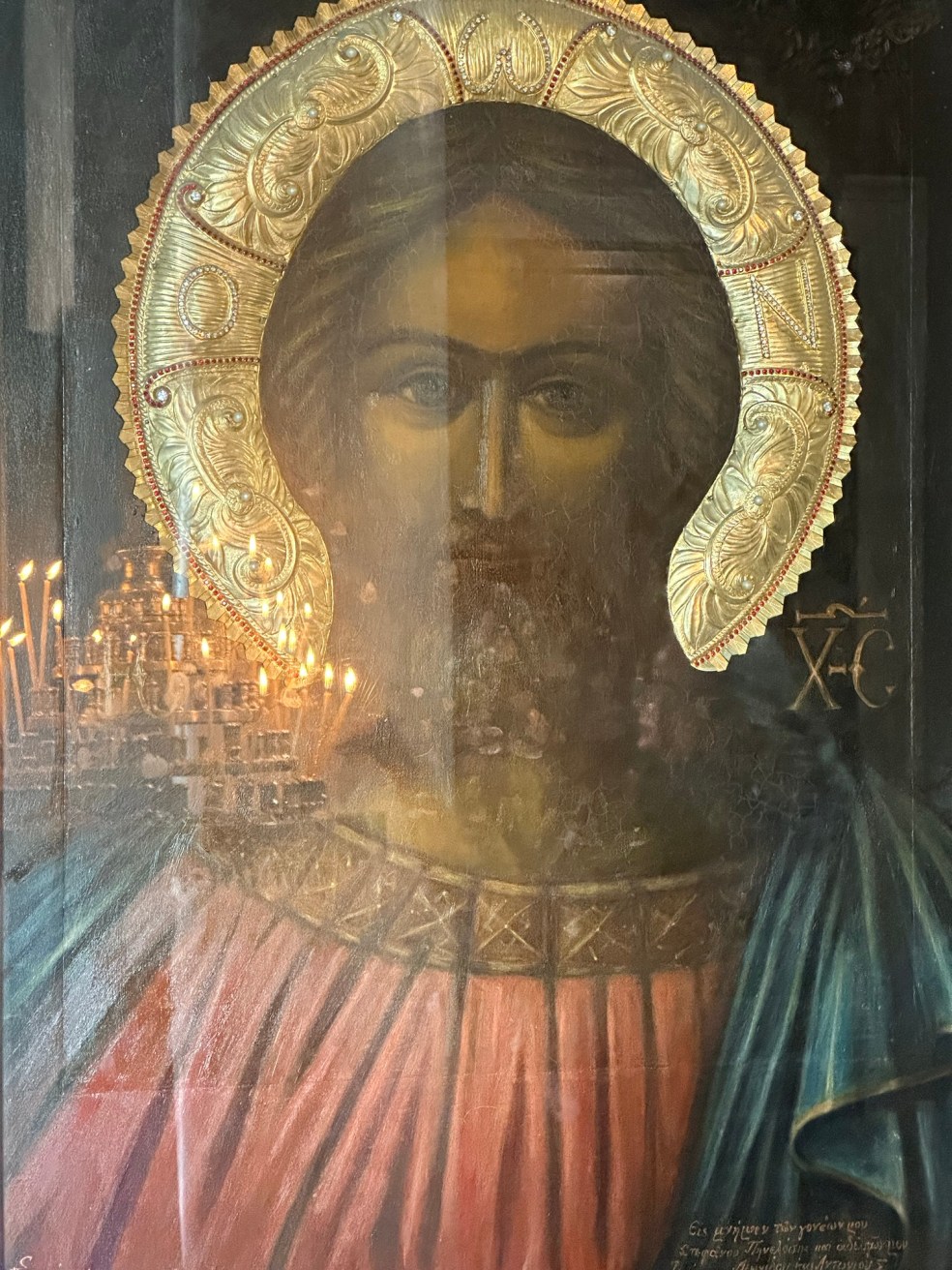
It would seem that our life is completely dependent on Christ, whether or not we believe in him. Enter an Orthodox church and you will most likely see an icon of Christ Pantocrator (“Ruler of All”). In this image, Christ is shown with the beams of the Cross behind him (only three are visible), and in these beams are written the letters O WN.

O WN is Greek for “the being”, which is the translation of the name that God reveals to Moses at the burning bush in Exodus 3:14: I AM. Again, we find here confirmation of the Trinity, because O WN is almost identical to ONE, it’s just that one of the letters has been rotated.

O WN also spells three words in English: own, won and now. Christ claims us as his own; the victory is his, he has won; he is here with us now (the meaning of the name Emmanuel).

I have seen this name written O WH. In Cyrillic, the letter H is pronounced N, and indeed the two letters are very similar (only the crossbar has become slanted). There is also a rough breathing in the original Greek, ὁ ὤν, the reverse apostrophe, which equates to the letter h in English.

If we write the name in this way, then we will see that it spells the words who and how, the result of making the progression AIO from what (A, the letter of creation: “What is this creature?”, “What shall I call it?”) through why (I, the letter of the Fall, an expression of distrust, of disobedience: “Why should I do this?”, “Why should I believe you?”).

Who and how are the questions that we should be asking. What is factual. Why is self-centred. We think that the purpose of life is to amass things and then to share them out, because we were taught at school to count up from 1, to do sums, multiplications and divisions. But actually the answer we are seeking is a person.

Christ gives us the answer to both question words when he says, “I am the way, and the truth, and the life” (Jn 14:6). I am and way are connected if we turn the m upside down and replace the vowel i with its semi-vowel equivalent, y. Both words contain the progression AIW (omega written as w).

We have also seen how when we flee the ego, the I, when we refuse to heed its selfish demands, we automatically create three symbols: A+O, the name of God Alpha and Omega. This can be written A ’N’ O and is found in the conjunction and, the reverse of which is DNA (it is in our DNA to do this). If we write this same progression with the Greek letter for omega, w, we get ANW, which with the w turned upside down gives man. So this denial of the ego, of our innate selfishness, is in the word that describes us (and woman is the same, only it has O3 at the beginning).

The automatic result of turning away from the ego, I, is to say the name of God Alpha and Omega: A+O. By turning away from the ego, we call on him. This is why God and ego are only a step apart in the alphabet (d-e). And him is just I’m with a little breath (h) before it.

This is what makes us human, a combination of hu (Sanskrit for “invoke the gods” and the root of our word “God”) and man – physical beings with the divine spark in them, the potential to become gods by grace if we attend to our true nature, which is not to grab whatever we see out there and to claim it as our own, making a mockery of the divine in us, but to see ourselves as part of the whole, a word in the dictionary, responsible for and dependent on the other. This most ancient way of calling on God – hu – sounds exactly the same as who, the letters we find in Christ’s icon, emphasizing what it is we should be asking.

In the Old Testament, there are two other names of God, apart from I AM. They are YHWH, the Hebrew Tetragrammaton (Yahweh), and El.

YHWH is extremely close to the question word why. So, if we make the progression from I to O, as we did with live-love, sin-son and Christ-cross, opening the line (opening our spiritual Is) to form not a barrier, a wall, but a tunnel that we can walk through, like the proverbial camel through the eye of the needle, just as why gives who, so the name of God in the Old Testament, YHWH, gives O WH, the letters found in Christ’s icon.

And if we place the other name of God from the Old Testament, El, in front of O WH, the two names together spell WHOLE in reverse (keeping the digraph wh together, as we did with earth-three).

This combination YHWH-O WH (why-who) and El-O WH (whole) goes a long way to confirming Christ as the fulfilment of the Old Testament law and prophets. This is why I would say that language is not only Trinitarian (three in ONE), but also Christological.

All physical appearances of God in the Old Testament are said to be by the Logos – that is, Christ – but we are not allowed to touch him. In the New Testament, when he walks among his disciples, eats with them and washes their feet, God himself has entered his creation. He has slipped through the hole – I become O – but in the other direction, so that we will have the courage and confidence to go the other way. This is an extraordinary act of condescension, of coming down to our level, and it was only possible because one of his creatures – namely Mary – acted as a conduit. How else in bodily form do you enter the creation that you have made, if not through one of your creatures?

Jonathan Dunne

Heart of Language 13/15

Next: Heart of Language 14/15

Back to: Contents

Kladnitsa – Selimitsa – Ostritsa – Kladnitsa

Starting Coordinates: 42.5685, 23.19619

Distance: 8.2 km

Elevation Gain: 475 m

Time: 3¼ hours

Difficulty: moderate-hard

Transport: by car, or by minibus


Kladnitsa, with a population of little more than a thousand, is the highest village on the west side of Vitosha. To get there by car, you must take the road from Sofia to Pernik, which passes through Knyazhevo and Vladaya before arriving at the crest of the hill and descending on the other side. As it reaches the bottom, in a village called Dragichevo, there is a set of traffic lights. Turn left here (it is signposted for Rudartsi, 4 km, and Kladnitsa, 9 km). If you continue straight, you will reach the motorway for Greece, the A3, and then Pernik.

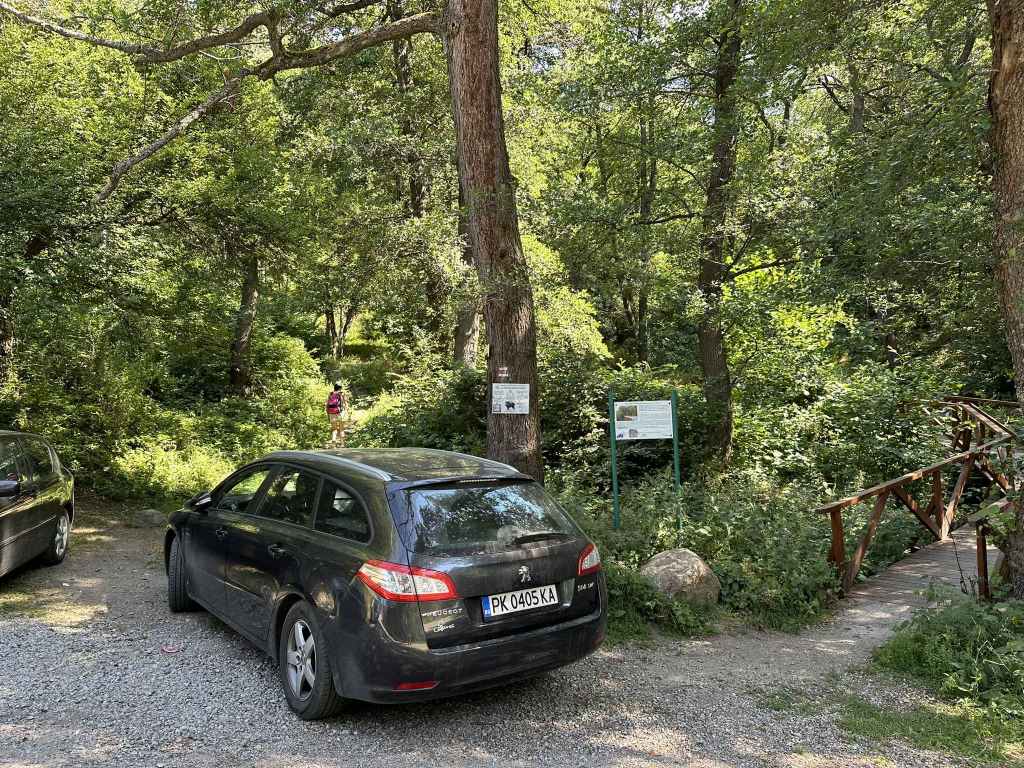
In 1.5 kilometres, you enter Rudartsi. Stay on the same road. In another 4 kilometres, you enter Kladnitsa. 400 metres after entering Kladnitsa, the road veers left, signposted for Kladnitsa Monastery and Selimitsa Hut, and takes you uphill. After one kilometre, you leave the village of Kladnitsa and immediately enter Vitosha Nature Park. Keep going for another 500 metres. As the road turns left, you will see the start of the ecopath. 200 metres after the start of the ecopath is the slip road that leads to Kladnitsa Monastery. There is a very small area to park your car just after the start of the ecopath, otherwise people tend to park on the verge. It can be quite busy at weekends in summer.

There is a minibus that goes to Kladnitsa from the Russian Monument in Sofia once an hour, during the daytime. The 21 bus also goes there from Pernik. The buses stop in the main square in Kladnitsa, where the chitalishte (community centre) is. From here, you need to head eastwards, and soon the road will take you out of Kladnitsa and into Vitosha Nature Park.

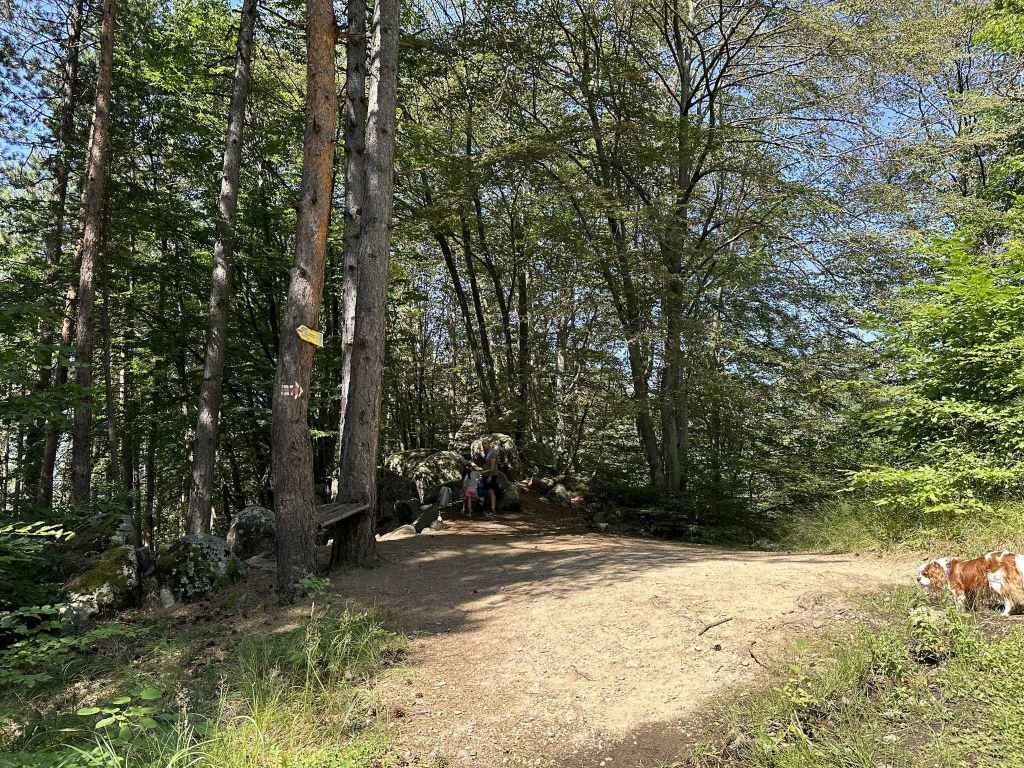
The ecopath is known as the “path of health”. It leads straight up from the road. The river should be on your right. In 200 metres, you cross the river on three separate bridges and continue on the other side. In another 200 metres, you again cross the river, but this time the path leaves the river behind and soon reaches a clearing with a bench between two tree trunks. You continue straight here (signposted for Cherni Vrah and Selimitsa Hut). In 200 metres, a small bridge takes you over a stream, and you become aware of the road you were on up on your left. The path crosses the same stream again, and 1.1 kilometres after the start of the ecopath you rejoin the road at Selimitsa Hut. There is a car park further down on your left.

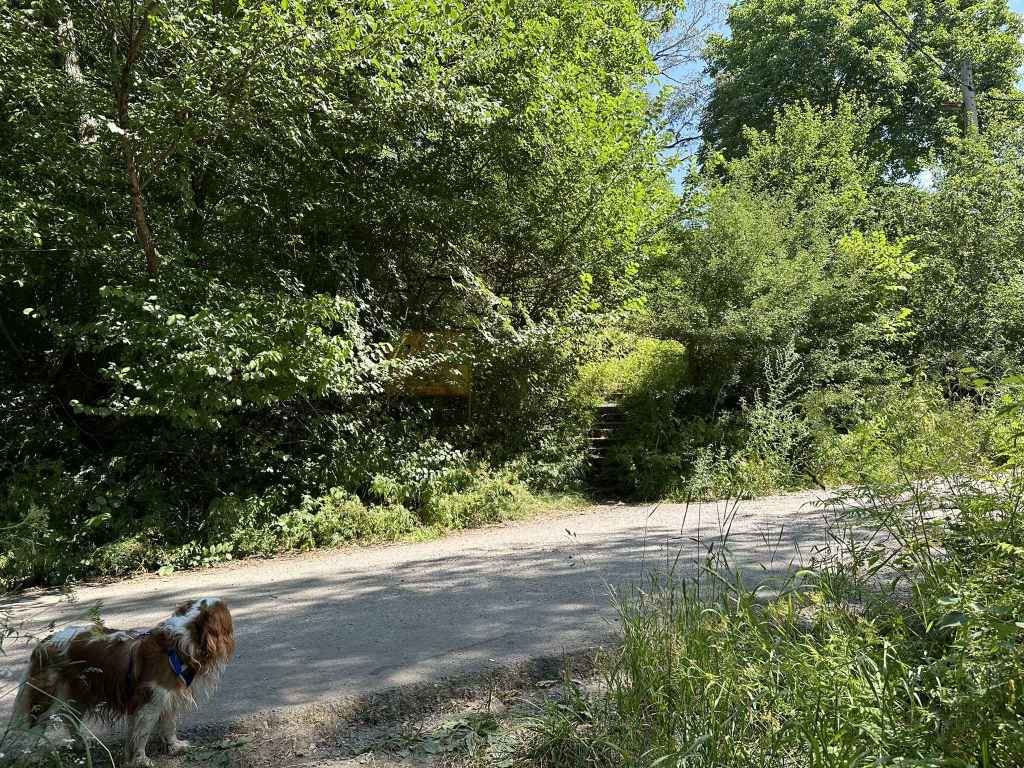
The path continues on the other side of the road, up some steps, and in a couple of minutes you arrive at Selimitsa Hut, which is a popular place for eating. If you don’t have food with you, you want to bear in mind that Ostritsa Hut is not working, so this is your only chance to grab a bite to eat on the route.

The path heads behind the hut (where the kitchens are) and joins a track. At the track, turn left and continue climbing past some wonderfully located houses. 300 metres after the hut, the track veers right and enters the forest. This track will now take you to Ostritsa Hut, the highest point on this walk.

I have marked the walk as “moderate-hard” not because of the distance, but because of the elevation gain (475 metres over 4.2 kilometres). You are constantly climbing. I always think it’s a question of not being anxious to arrive somewhere, but simply going at your own pace, putting one foot in front of the other. That’s all anyone does, isn’t it? And humans have achieved great things by putting one foot in front of the other and being patient.

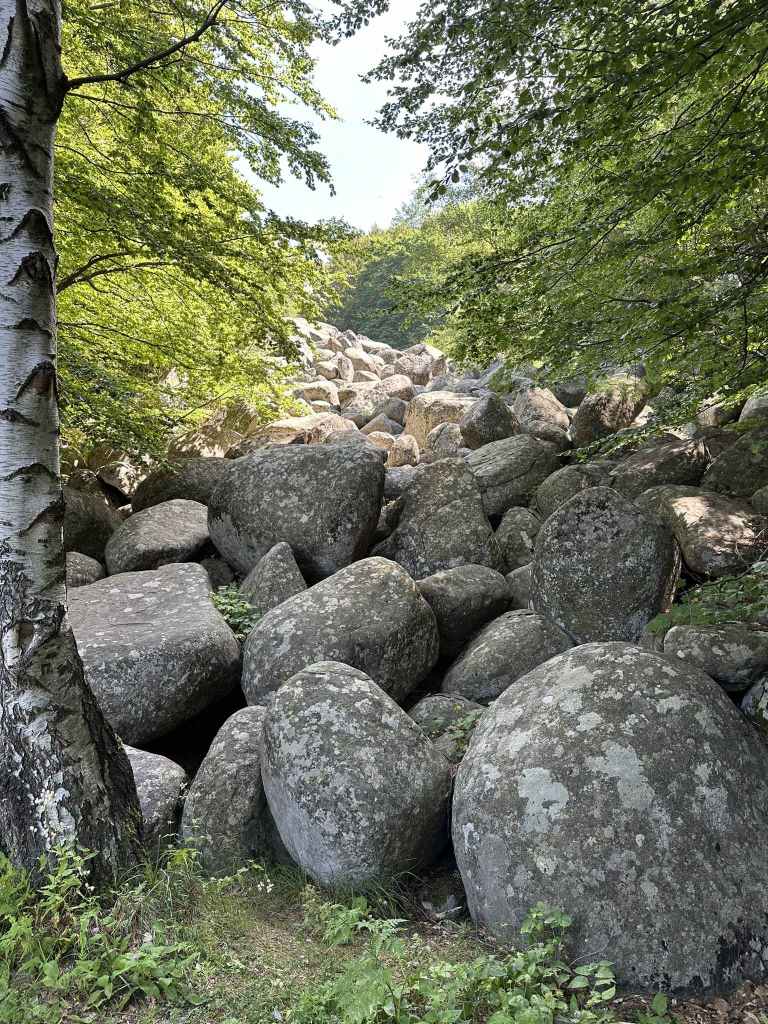
Very soon on the left is a picnic hut, with a small fountain behind it (only trickling water). Fifteen minutes after the picnic hut, there is a stone run, one of those moraine rivers that are so characteristic of Vitosha (and of the Falklands, apparently). Another 200 metres, and there is a wonderful view to the south-west of Studena Reservoir. Another ten minutes, and there is another small fountain on the right, this one without any water. One more kilometre, and you reach the top, with Ostritsa Hut on your right. You are now not far from the walk that begins at Ofeliite.

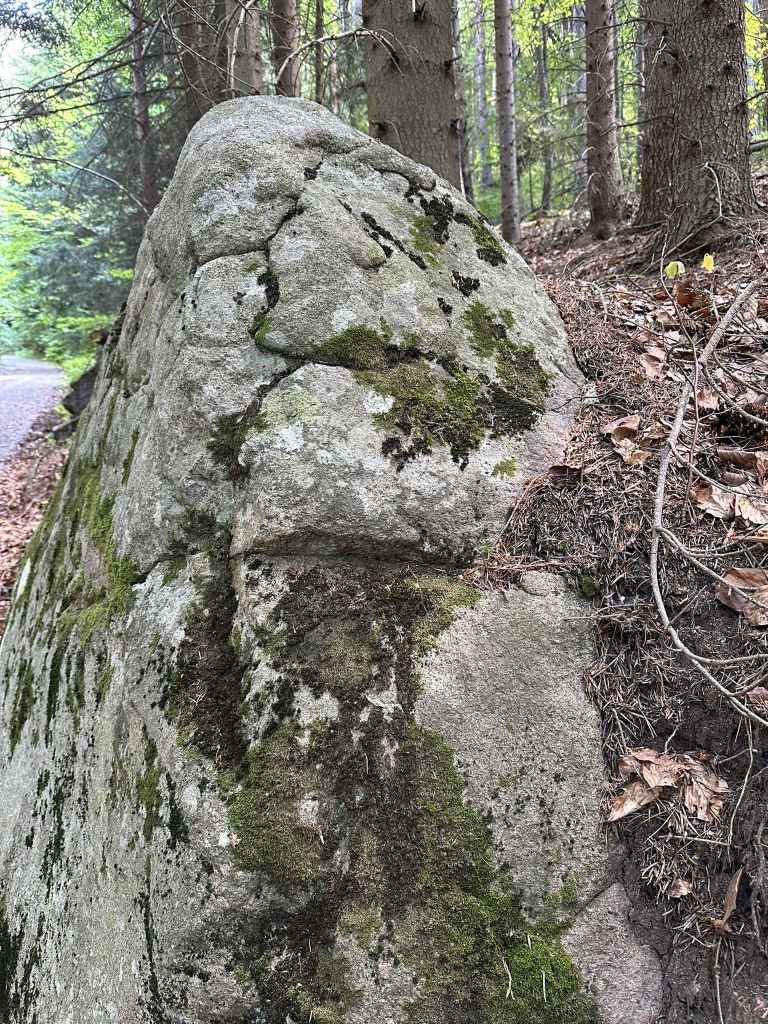
Unfortunately, Ostritsa Hut doesn’t work, but I still ate my lunch, sitting by the hut and the grassy slope that leads to Ostritsa Peak. I then headed back down the way I had come. What makes this path so worthwhile is the beauty of the path itself, which is mostly shaded, the views to the south-west, and the numerous boulders that line the route. You are also on a less frequented part of the mountain.

Back at the bottom, do make time to visit Kladnitsa Monastery, dedicated to St Nicholas, which is only 200 metres further up the road and has a very distinctive depiction of the Trinity on the ceiling of the nave.

12. One

The concept of the Trinity has flummoxed theologians for centuries. We might liken it to the birth of a child (a third person), or the branching out of a tree (a tree needs branches and leaves to bear fruit). In terms of language, we might identify three persons in the number one when written with capital letters: ONE.

And what is it we must believe? We must believe in God the Holy Trinity, Father, Son and Holy Spirit. It’s as simple as that. The rest will take care of itself.

The Christian concept of the Trinity – three persons, one God – has perplexed even theologians over the centuries, but we might think of our own birth to understand it (two people come together in order to create a third, which is why birth and third are connected, pair of letters that look alike b-d). We might also think of the shoot that branches out – the tree that becomes three – in order to grow and bear fruit.

But as language has taught us about the creation of the world, about the importance of belief, about our final destination and the Last Judgement (when an angel will enter the field to glean the wheat), so I think we can turn to language for an understanding of the Trinity.

Three in one. This doesn’t help us. Let us try writing one with capital letters: ONE. Now we can begin to see.

The word ONE comprises three numbers: 0, 2 (on its side) and 3 (back to front). The one number that ONE does not contain is itself: 1.

This is because in chemistry the subscript 1 is not written down. So if we take the first letter, O, to represent God (it has no beginning or end) and decide to write the three persons of the Trinity as chemical formulae, then God the Father would O(1), God the Son would be O2 and God the Holy Spirit would be O3. Three in ONE, literally.

For God the Father, we can read the formula O1 as no one, the end of the progression from the name of God in Exodus, AM, and from the purpose of Adam in the Book of Genesis to name the creatures, so that they mean something, to which he says amen. When we apply the progression of the Greek alphabet, AIO, to these words, from AM we get I’m and om, which with the phonetic pair m-n and addition of final e gives no one, God the Father. We are back to the beginning. From amen-mean-name, we get mine and nemo, the Latin word for “no one”, and omen. Again, we find ourselves back at God the Father, O1, the first person of the Holy Trinity.

Why would God the Father be “no one”? Because it’s the only way he can be everyone. We individual humans are someone – that is, as distinct from someone else, countable nouns, each with a line around them. The closest we can get to “no one” is the figure of the translator, that person who lives on the line, ferrying cultures across, enabling communication and understanding, and enriching people’s lives with what is other. The translator is “no man” – he lives inside the line, in no man’s land. He almost doesn’t exist – he is largely ignored, his name is sometimes omitted, he barely has enough to live on, and yet he believes in the value of the work he is doing… and so he continues beyond the bounds of what should be possible. He starts to push the boundaries of possibility, to test them, to see whether in fact they are real, whether the illusion will kill him or he will live to fight another day.

The translator, in human parlance, is no man. He doesn’t exist. He finds himself in the firing line between two opposite sides (sides that only exist because of the line), without a gun. He raises his arms in a semblance of crucifixion and implores an end to this madness of viewing people and things as external to ourselves. He doesn’t win, he loses, but he speaks the truth.

This is the closest we can come to the divine – “no one” – in this life. There are two indicators of truth: one is coincidence (things that happen together), the other is paradox (an apparent contradiction that turns out to be true). Language is full of paradox. God, who is in fact all that is, is no one. He is nowhere to be seen (which means he can be everywhere), but nowhere is also now here.

God the Son is O2, the chemical formula for oxygen – we breathe him, just as we speak him (because he is the Word) and see by him (because he is the Son/sun). And God the Holy Spirit is O3, the chemical formula for ozone, the layer that protects us from the sun’s rays (which we might understand as the Son’s wrath, existence in a precarious balance).

But let us remember that the letter in the alphabet that represents breath, wind (a word, by the way, comprised of the numbers 0, 1, 2 and 3: WIND), is h, so we can choose to represent the Holy Spirit (pneuma in Greek) as H. Combine H and the chemical formula for oxygen, O2, in reverse (common in word connections) – that is, combine God the Son and God the Holy Spirit – and you have H20, the chemical formula for water. We breathe him, we speak him, we see by him, and we drink him in water.

God is three in ONE. The last symbol, O3, can refer to God the Holy Spirit – the third person of the Trinity – or to the Trinity itself: 3 in One (the mantra om).

We have seen how three Os together spell GOD (just as three egos, three Is, spell ill). And we will find these three Os again in the word WOOD, with a lopsided 3 at the beginning. WOOD, of course, is the ultimate symbol of Christianity: the Cross, which is nothing more than a deleted I.

Language is clearly Trinitarian. It is also Christological.

Jonathan Dunne

Heart of Language 12/15

Next: Heart of Language 13/15

Back to: Contents

11. Believe

Belief activates the spiritual senses and enables us to see. St Paul talks in his Letter to the Romans about justification by faith. Grace is freely given, we cannot earn it. All that Jesus requires of us is that we believe in him.

What we do not see, we have to believe. And paradoxically, it is the act of believing that then enables us to see, when our spiritual understanding is unlocked and our spiritual senses are awakened. Believe in order to see. What the Pharisees (Pharisee = far I see, or so they think!) wanted was to see in order to believe. In Matthew 16:4, when asked to show them a sign from heaven, Jesus gave them short shrift: “An evil and adulterous generation asks for a sign, but no sign will be given to it except the sign of Jonah” (see how closely the word sign is connected to sin, addition of g).

Belief activates our spiritual senses and enables us to see beyond the mere appearance of things. This is why, I think, the word believe so obviously contains be and live. We become fully alive when our vision is not limited to seeing what will satisfy our physical needs.

This is the reason for the break-down in communication during the wonderful encounter between Jesus and the Samaritan woman at the well in John, chapter 4. When Jesus says if she knew who she was talking to, she would ask him and he would give her “living water”, the woman is perplexed. She doesn’t realize that Jesus is talking about spiritual sustenance – not physical sustenance, which always requires us to come back for more (something the system knows and relies on for its continued existence).

He doesn’t even have a bucket (again, this reliance on external objects, objects we can pick up and use), how is he going to give her this living water? Jesus replies, “Everyone who drinks of this water will be thirsty again, but those who drink of the water that I will give them [what he means is those who put their trust in him] will never be thirsty. The water that I will give will become in them a spring of water gushing up to eternal life.”

These are extremely important verses. “A spring of water gushing up to eternal life.” Now, that is surely something worth having. We know that when we drink water from the well, we will be thirsty again, and so we are tied to it, to something external. But what Jesus is talking about appears to be something that comes from within us: “The water that I will give will become in them a spring of water gushing up to eternal life.” It is something whose provenance we cannot perceive.

I think he is talking about belief. The bucket that will enable us to receive this living water is belief. It is all that Jesus requires of us – that we believe in him (even though we do not see him with our physical senses). He wants us to see/hear the message that he is transmitting and to plant the seed of that message in the earth of our heart (the soil of our soul). We are to become like the seed of an apple, which falls into the ground and sleeps for a while before bursting forth anew as a shoot that, in time and with proper care, will grow into a tree, as language tells us.

And so it is that three chapters later – in John, chapter 7 – Jesus decides to attend the Festival of Booths in Jerusalem. The message – about doing the will of God, about doing good and healing people, even if it is on the Sabbath – doesn’t seem to be getting across. When he says that he won’t be with them for long (because he is going to be crucified!!!), they understand he is planning a visit to Greece. It comes to the last day of the festival, and Jesus is feeling pretty frustrated. He cries out, “Let anyone who is thirsty come to me, and let the one who believes in me drink. As the scripture has said, ‘Out of the believer’s heart shall flow rivers of living water’” (Jn 7:37-8).

There it is again – that phrase “living water”. It means that when we believe in him, our life will take on new meaning, we will no longer be limited by the parameters of time, we will be working on a different timescale, or actually on no timescale at all. We will be diving into the white spaces between and behind the words on a page and finding new meaning. We will be entering the words themselves, admiring their structure, as if a word was a church and we could enter it, light a candle, look up into the dome, and even walk around the church three times on Easter Eve, before the light of the resurrection has dawned. We will begin to bear spiritual fruit, not just physical fruit we can eat, touch and confirm, but the fruit of obedience, which is not to put ourselves first in a world of competing egos, but to seek the common good, which might even involve some kind of personal sacrifice, but is incomparably richer and leads to true wealth (the wheat in the Parable of the Tares, which has ears and can hear). This “living water” can only come out of a believer’s heart, of a heart that is open, of a heart that is alive and beating, not one that is closed and withered, that only thinks about itself.

Jesus quotes scripture: “Out of the believer’s heart shall flow rivers of living water.” Except that the word in Greek is not “heart”, it is “belly” (κοιλία). In Genesis 3:20, we learn that Adam named his wife Eve “because she was the mother of all who live”. This is explained by a footnote in the NRSV Bible: “In Heb Eve resembles the word for living.”

So, the verse Jesus quotes could be reduced to belly (“Out of the believer’s heart”) and Eve (“shall flow rivers of living water”). And what do belly and Eve give us? Believe.

Jesus’ message – that all we need to do is believe to become fully alive, to be and live – is contained in the words he speaks. Language is pure theology, a vade mecum for the human who seeks a higher meaning. We just have to have the eyes to see it.

Jonathan Dunne

Heart of Language 11/15

Next: Heart of Language 12/15

Back to: Contents

Symphony

Boulders

dumped by an irresistible force

a primeval behemoth

that has since disappeared

(like T. Rex)

Bones strewn across a field

remnants of an ancient battle

Covered in lichen and moss

Frozen in time

seemingly still

almost impossible to budge

Round, triangular, jagged

Old letters

(there are only so many directions

calligraphy can take)

The man who steals

should be made to transport one

a couple of inches

and then asked

if he wants to steal

again

Only the hermit

knows how to lift one

with his little finger

And the gnats

that bounce on the wind

as if it was solid ground

or gravity had gone out of fashion

In places

they support a bench

or a bridge

and then they submit

gracefully

Then it is we

who put the weight

on them

They sometimes

form part of a path

or allow themselves

to be spray-painted

I have seen them

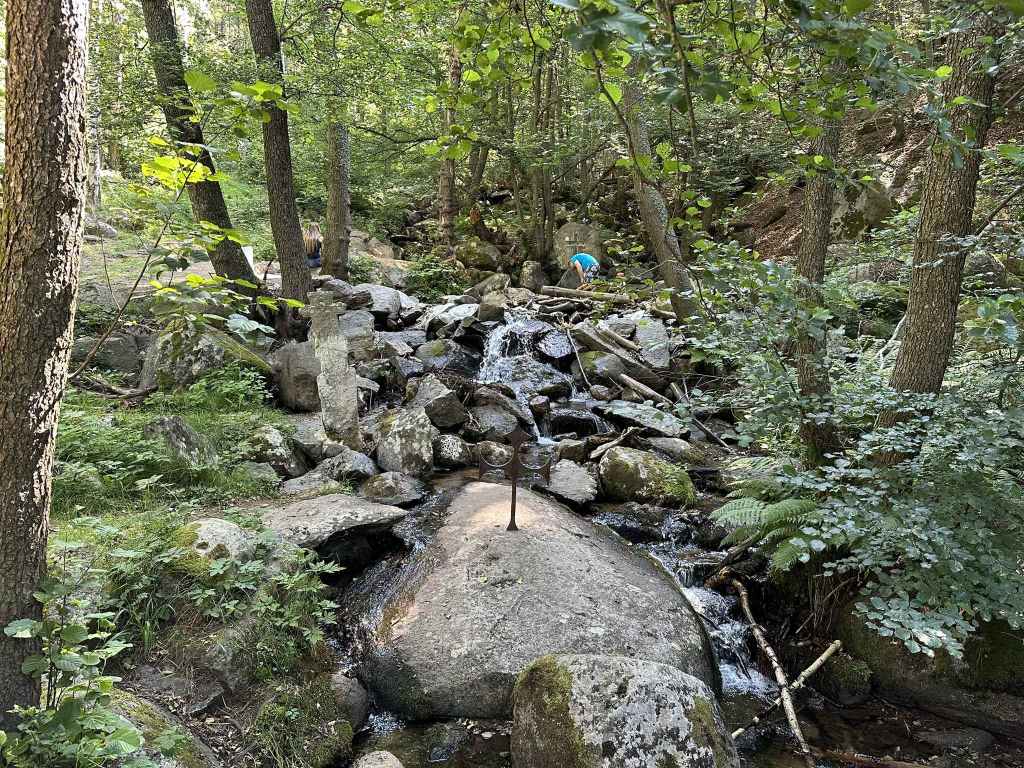
as the base for a cross

by a river

But most of the time

they are a canvas

for the sun’s fluctuating mood

a mappa mundi

a projector screen

on which faces like clouds

witness the passing of centuries

Like us

they sleep

and then all you can see

are the almond-shaped

indentations

of their closed eyes

and the narrow

moustaches

of their upturned mouths

When we sleep

our senses are momentarily

suspended

we cease to see and speak

(to pass judgement)

we become

the base for a cross

a stepping stone

dappled light

our own memory

Blanched stone

An expression

for others to interpret

We are defined

(we define ourselves)

We are spoken

(we do not speak ourselves)

We take our place

in the dictionary

the richest lexicographical

resource

in the history of the universe

Verb, noun, adjective

What we did

what we did it to

what it was like

A chosen few

are prepositions

otherwise language

cannot position itself

At the end of it all

we will sing a chorus

in which matter

is black ink

light the parchment

and only those who loved

will be able

to hear it

Jonathan Dunne

Ostritsa-Selimitsa, Pentecost 2024