How the spiritual meaning of words can bring them close together, and how removing the ego, a line in English (I), from a word can lead to salvation.
The word GOD, when written with capital letters, closely resembles three zeros (000). This is because God is Father, Son and Spirit, three persons in One.
It is curious that the words God and good are so similar, you would think that they share a common root. And yet their etymological roots are quite different: God derives from the Sanskrit hu, meaning “invoke the gods”, and good derives from the Gothic goþs, meaning “bring together, unite”. Their roots are different, but God is good – the words can’t help revealing this.
If God is good, then the devil is evil. Again, you might think that these two words share a common root, but they don’t. The word devil derives from the Greek diabolos, “accuser, slanderer”, while evil is from the Gothic ubils. Their meaning has brought them close.
If we remember that, in the study of phonetics, one pair of consonants pronounced in the same part of the mouth is l-r, and another is f-v, we will see that quite easily devil gives differ. All I have to do is change two of the consonants according to where in the mouth the sounds are produced. If I take a step in the alphabet – from f to g – father gives gather. This would seem to confirm what we saw just now about God being good (goþs – “bring together, unite”). The devil would separate us, make us disagree. The Father would unite us, make us one in him.
Take an earlier step in the alphabet – from d to e – and God gives ego (represented in English by the letter/line I). These are really the two masters we can choose to serve in this life: God (to love him and to love our neighbour) or the ego (to follow our own desires, even at the expense of others).
One makes us a slave to our passions: the ego. The other sets us free. In effect, what he does is save us, and we can see that when we remove the ego, I, from slave (what the ego turns us into), we get save.
In Matthew 6:24, we read that we cannot serve God and wealth (or Mammon). Another word for “wealth” is gold. Again, we see that when we remove the ego, I, from a word, it takes us in the right direction.
The ego in English, I, closely resembles a line. It separates us. It also resembles the number 1, the number we use to start counting. Three zeros make GOD. What happens when we put together three egos, three Is? We become ill.
A text about law, and the proximity of this word to the name of God in Exodus 3:14, I AM.
The word law in reverse reads wall. This is because the law acts as a wall around private property; divine law acts as a wall to protect us from our enemies.
Consonants, the flesh of language, are divided into pairs. One such pair is l-r. If we apply this pair to law, we get war (again, in reverse). Law is a way of avoiding war, if at all possible. Sometimes, however, it doesn’t work and someone crosses the line between us with hostile intent.
But the most beautiful – and the most important – word connection with law is I AM (capital I and lower-case l look alike; w is m upside down). This is the name of God in Exodus 3:14, the name God reveals to Moses at the burning bush. The law is very important in the Old Testament (the law and the prophets, profits). God’s law is about truth, it reflects who he is. I think behind the human laws that we make stands God’s law, reflected in his name I AM. That is, everything is contained in him; we may think we possess things, but we only possess them as gifts from the Creator.
And this connection law-I AM is found in the New Testament, which is about Christ become man and the message he brings. He became man so that we could become gods by grace (not by nature), a process known as theosis. He shows us the way. This word is also in law if we remember that the semi-vowel y corresponds to i.
I AM-law-way is the message contained in the Bible. We can see that all three words contain the progression of the Greek alphabet: from A (the first letter, creation) to I (the Fall, the ego in English) to O (omega, written w in Greek).
If we delete the ego – that is, submit our will to God’s – we get a cross (†), which is also a plus-sign (+). This is the meaning of Christ’s injunction to lose our life in order to find it, a seeming paradox.
One way of writing this plus is ’n’ (as in rock ’n’ roll). If we take the progression of the Greek alphabet, AIW, and substitute the deleted ego, ’n’, we get ANW, which gives us man. This is the purpose of human life – to make this progression away from the ego and become fully man, a word that is linked to law. We achieve it by observing his commandments to love him and to love our neighbour.
This is the inner meaning of language, the one we do not see. We think of language as an external tool that we hold in our hands, but it is like nature, it has its own meaning.
Language has a vertical aspect, a hidden meaning. We have not realized this aspect yet. We have not realized that you can walk into language. Be inside it. Language is architectural. Living and breathing, like the wind.
I approached the main universities in Bulgaria, offering to give a short course on this spiritual aspect of language. I was rejected because I do not have a doctorate, I am not one of them. This is despite the fact that I have worked with language on a daily basis for more than thirty years as a translator of literature.
Academics view language as horizontal, they study its evolution over time. That is, they look at man’s influence on language, man’s speech. Their focus is man-centred. The focus of my book is God-centred. I would like to give an example.
We do not know why we are here, what we are doing spinning on a planet in a corner of the universe or the multiverse. We do not know where we have come from or where we are going. So, in our blindness, we limit ourselves to laying claim, to drawing lines, and it is these lines that separate us. Lines around property, lines around products of the earth so that we can sell them, lines around countries. To cross a line, you must either pay or fight.
This is a terrible perversion of nature – our own and the world’s nature. Buying and selling instead of helping each other. Ownership. Instead of allowing that things pass through us (we are translators), we claim to be authors, to be the beginning and the end.
As far as I can see, there are three ways to escape the line that separates us. The first is to make reference to a third point, to include God in the conversation, and form a triangle, which resembles the capital letter A. The second is to draw a line through the line, to delete it, which while it makes a cross (†), also makes a plus-sign (+), the meaning of the Christian paradox of losing our life in order to find it. And the third is to treat the line as a number, 1, and to count down to zero, 0. To open the line, to breathe air into it.
Triangle, cross, circle. A+O. This means that when we turn away from the line as being too limiting, when we accept our own limits, necessarily we call on the name of God: A+O, Alpha and Omega.
And what is remarkable is that these three symbols can be found in the middle conjunction when it is written with capital letters: AND. A ’N’ O. The reverse of this conjunction is DNA. It is in our DNA to do this. To lose our life in order to find it.
We can see this progression from A to I to O in the Greek alphabet, which ends with the letter omega. That is, the Greek alphabet, which represents philosophy/theology, counts down, from I to O, from 1 to 0. The Latin alphabet used in the West, however, counts up, from I to Z, from 1 to 2. This is the mentality of making a profit, of endless production as an (ultimately futile) justification for our lives.
When we learn to open the line, to turn the letter I into O, to rotate it by ninety degrees, we realize that while LIVE spells EVIL in reverse – that possibility is always open to us – when we replace the letter I with the letter O, we get LOVE instead. That is, when we remove the ego, represented in English by the line, the letter I, and replace it with God, the eternal circle, we get LOVE. In a similar way, SIN becomes SON.
Language wishes to tell us something. But all too often we view language in the same way as the environment, as there to be exploited for our own profit, as a tool to get what we want. Language can teach us. After all, Christ is the Word. When we speak, as when we breathe or drink, we are, whether we like it or not, partaking in Him. That is what my book Seven Brief Lessons on Language sets out to demonstrate. It is the result of an experience of six to nine months when I had just arrived in Bulgaria and language fell apart in front of my eyes, allowing me to go inside it.
With thanks to the translator, Tsvetanka Elenkova, to the book’s referees, Tony Nikolov and Kalin Mikhaylov, the editors, Plamen Sivov, Iliana Alexandrova and Ralitsa Krasteva, and the designer, Bojidar Chemshirov.
Jonathan Dunne
Sofia, 25 May 2023
Езикът има вертикален аспект, скрит смисъл. Все още не сме осъзнали този аспект. Не сме разбрали, че можете да влезете в езика. Бъдете вътре в него. Езикът е архитектурен. Живеещ и дишащ, като вятъра.
Свързах се с основните университети в България, предлагайки да изнеса кратък курс по този духовен аспект на езика. Отказаха ме, защото нямам докторска степен, не съм от тях. Това е въпреки факта, че съм работил с език ежедневно повече от тридесет години като преводач на литература.
Учените разглеждат езика като хоризонтален, те изучават еволюцията му във времето. Тоест, те разглеждат влиянието на човека върху езика, човешката реч. Техният фокус е върху човека. Фокусът на моята книга е съсредоточен върху Бога. Бих искал да дам пример.
Не знаем защо сме тук, какво правим, въртейки се на планета в ъгъл на Вселената или мултивселената. Ние не знаем откъде сме дошли или накъде отиваме. И така, в нашата слепота, ние се ограничаваме до предявяване на претенции, до теглене на линии и тези линии са тези, които ни разделят. Линии около собственост, линии около продукти на земята, за да можем да ги продаваме, линии около държави. За да преминете линия, трябва или да платите, или да се биете.
Това е ужасно извращение на природата – нашата и световната. Купуваме и продаваме, вместо да си помагаме. Собственост. Вместо да позволим нещата да минават през нас (ние сме преводачи), ние претендираме, че сме автори, че сме началото и краят.
Доколкото виждам, има три начина да избягаме от линията, която ни разделя. Първото е да се направи препратка към трета точка, да се включи Бог в разговора и да се образува триъгълник, който прилича на главната буква А. Второто е да се начертае линия през линията, да се изтрие, което, докато прави кръст (†), също прави знак плюс (+), значението на християнския парадокс да изгубим живота си, за да го намерим. И третото е да третирате линията като число, 1, и да броите надолу до нула, 0. Да отворите линията, да вдъхнете въздух в нея.
Триъгълник, кръст, кръг. A+O. Това означава, че когато се отвърнем от линията като твърде ограничаваща, когато приемем собствените си граници, непременно призоваваме името на Бог: А+О, Алфа и Омега.
И което е забележително е, че тези три символа могат да бъдат намерени в средния съюз, когато се пише с главни букви: AND (И). A ’N’ O. Обратната страна на тази връзка е DNA (ДНК). В нашата ДНК е заложено да правим това. Да загубим живота си, за да го намерим.
Можем да видим тази прогресия от A към I към O в гръцката азбука, която завършва с буквата омега. Това означава, че гръцката азбука, която представлява философия/теология, брои надолу от I до O, от 1 до 0. Латинската азбука, използвана на Запад, обаче, брои нагоре от I до Z, от 1 до 2. Това е манталитетът за правене на печалба, за безкрайно производство като (в крайна сметка безполезно) оправдание за живота ни.
Когато се научим да отваряме реда, да превръщаме буквата I в O, да я завъртаме на деветдесет градуса, разбираме, че докато LIVE (ЖИВЕЯ) изписва EVIL (ЗЛО) наобратно – тази възможност винаги е отворена за нас – когато заменим буквата I с буквата О, вместо това получаваме LOVE (ЛЮБОВ). Тоест, когато премахнем егото, представено на английски с линията, буквата I, и го заменим с Бог, вечният кръг, получаваме LOVE (ЛЮБОВ). По подобен начин SIN (ГРЯХ) става SON (СИН).
Езикът иска да ни каже нещо. Но твърде често гледаме на езика по същия начин като на околната среда, като там, за да бъде експлоатиран за собствена печалба, като инструмент, за да получим това, което искаме. Езикът може да ни научи. Все пак Христос е Словото. Когато говорим, както когато дишаме или пием, ние, независимо дали ни харесва или не, участваме в Него. Това има за цел да демонстрира моята книга Седем кратки веседи за езика. Това е резултат от опит от шест до девет месеца, когато току-що бях пристигнал в България и езикът се разпадна пред очите ми, позволявайки ми да вляза в него.
С благодарност към преводачката Цветанка Еленкова, към рецензентите на книгата Тони Николов и Калин Михайлов, издателите Пламен Сивов, Илиана Александрова и Ралица Кръстева и дизайнера Божидар Чемширов.
Hats off to the editors of The Spanish Riveter, a magazine freely available online and published by the European Literature Network, West Camel and Katie Whittemore, for producing a very thorough and inclusive, 294-page issue packed full of interesting writing and features. I can’t think of a better way of dipping into contemporary writing from Spain in all its manifestations: Basque, Castilian, Catalan, Galician…
There are sections not only on the four languages I have just mentioned – I was privileged to be asked to write the introduction to Galician literature on pages 200-204 – but also on publishing, grants, poetry, children’s literature, women’s writing (let us not forget that the last Spanish National Book Award for Fiction was won by a Galician woman writer, Marilar Aleixandre, who wasn’t even born in Galicia and adopted the language later on) and the Latam Boom.
All the people I have worked with over the last thirty years seem to have been included, and this is a testament to the editors’ hard work and open approach.
I fancy that some Galician editors would not agree with Katie Whittemore’s statement that “there is the sense that Spain’s other languages, while perhaps still on the back foot, so to speak, are experiencing growth in the book sector, with more institutional support, as well as a greater appetite from readers both within and without the Spanish territory” (page 8). Francisco Castro, director of the most traditional Galician publishing house, Editorial Galaxia, stated only the other day in the Faro de Vigo newspaper that “the Galician market is getting smaller and smaller, every year it is getting more and more difficult to reach income levels.” He goes on to talk about the great tragedy being experienced in Galicia, “which is the loss of its language,” and affirms that “a market that has to see a language in decline is destined for extinction.”
I would say that literary translators are “destined for extinction” and not much has been achieved since the heady days of the 1990s, when there was much talk of literary translation being a profession. Literary translators are still required to take significant personal risks, they do not receive a salary, sick leave or a pension, very little attention is paid to their work, and the juggernaut that is the English-language book market is hurtling along at such a pace it simply crushes the tossed-aside can of books in translation, offering little space in mainstream media to add to the difficulty of rising printing and distribution costs. We were never much inclined to listen to the other’s voice, which is a shame, really, since this would not only enrich our lives, but also lead to better international relations. Institutions, and the general public, are inclined to toss a coin in the cap of literary translation (without really understanding what it is), not much more.
As a publisher, I would strongly disagree with Alice Banks’ appraisal of grants on pages 62-63. She mentions one source, Acción Cultural Española, whose grants “cover the cost of translation.” This is typical of how it looks on the outside and how it really works in practice. In 2020 I applied for a grant for the Oxford professor John Rutherford to translate a Galician classic, Memoirs of a Village Boy by Xosé Neira Vilas. I asked for 2960 euros and was offered 1332 euros (that is, nine euros per page). That is a long way off the UK Translators’ Association’s recommended *minimum* rate of £100/1000 words (approximately 22 euros/page). Ainhoa Sánchez, the person responsible for literature, confirmed by email that “our grants are a support and are not meant to cover the overall cost, since we do not have the necessary budget.” This is an excuse I have heard many times, but it is not true – you simply support fewer projects with the same budget. I declined the grant, and we published the book on our own. There is a review by Paul Burke on pages 208-209 of the magazine.
But let us celebrate the diversity that this excellently produced magazine has brought to the fore and thank that ever hopeful cohort of translators, editors and publishers who continue to work and strive for translation. There is much to admire here.
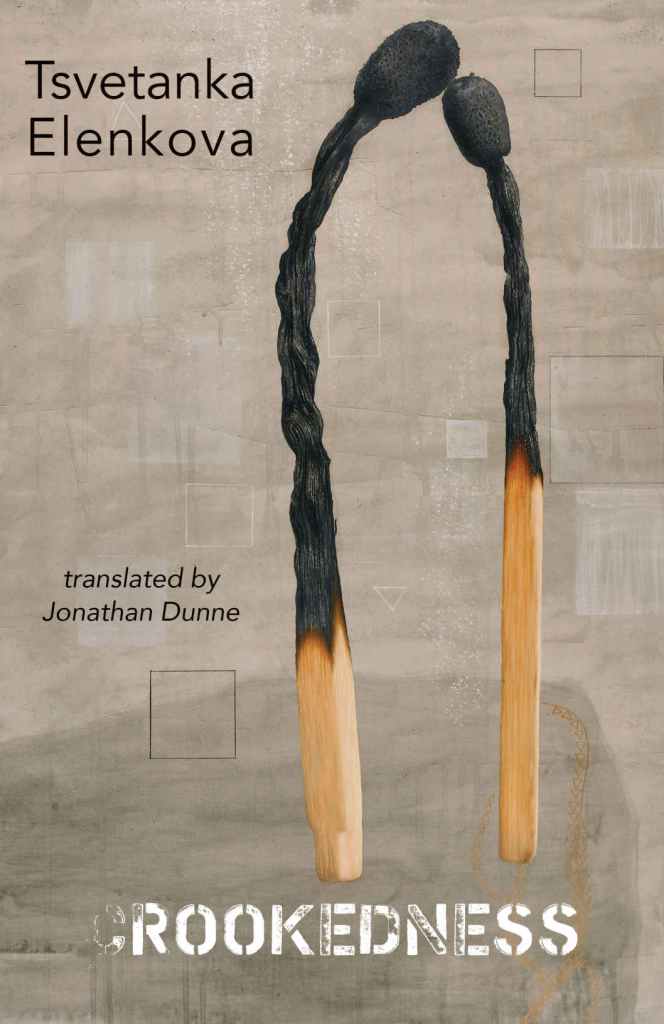
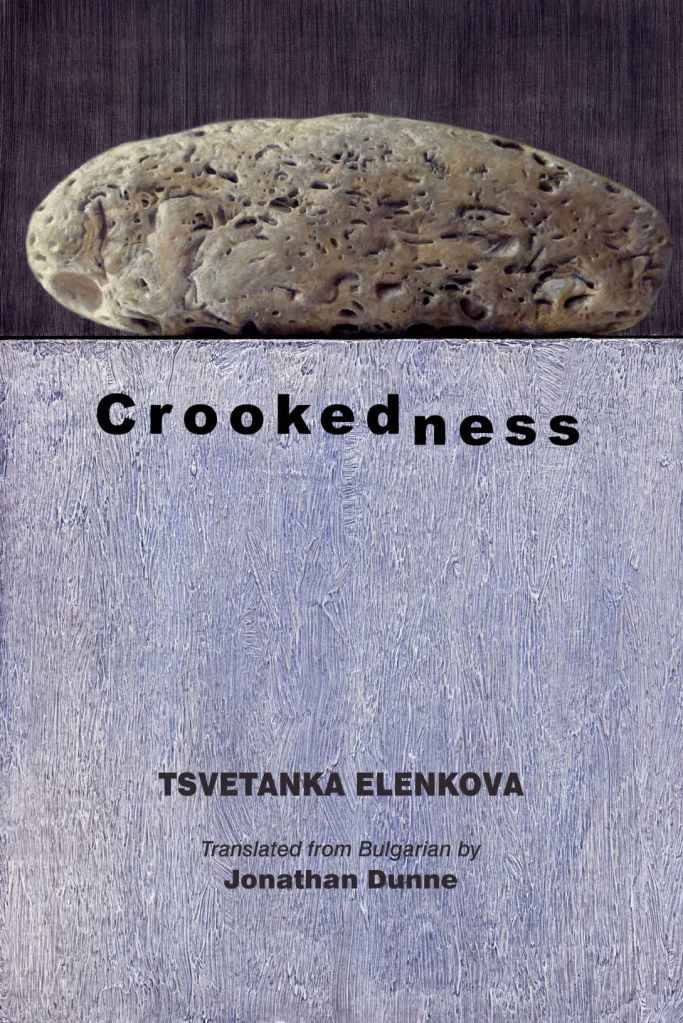
A collection that got slightly lost when it was published by Tebot Bach in 2013, Crookedness by Tsvetanka Elenkova, was happily recovered by Tony Frazer at Shearsman Books in 2019, in a smaller, more manageable edition. This is the second collection by Tsvetanka Elenkova, a poet on a European scale, that I have translated and is soon to be followed by Magnification Forty, which received a PEN Translates award.
It is so rare for a book of foreign poetry to be translated into English, and so little attention is paid to them, that one should be grateful when such a book of quality is reviewed in a magazine of the stature of The Poetry Review, the mouthpiece of the UK Poetry Society. I only just found out that Crookedness received such attention from the Singaporean poet Theophilus Kwek (wonderful name!). Well, I have never had my translation described as “clean, almost earnest” before. Here is the part of the review that deals with Elenkova’s book:
Two other recent translations deal with quieter forms of disappearance and loss. Unlike Zurita, whose canvas is the oceans and seas, Bulgarian poet Tsvetanka Elenkova chooses to dwell on the fine print of the physical world: the echo from a conch, or the wind heard “through the open throat” of a bottle. These images, from her opening poem (‘Pain’), give tender shape to what is otherwise hollow or invisible: “a single slight hiss / as of a punctured bicycle tyre”, or “pain from the emptied body”. She returns in later poems to chart the psychological experience of pain; the death of a friend, for instance, is compared with sitting “under the crown of a broad-leaved tree / which is an upturned conifer […] to watch the coming storm” (‘Hourglass’). The precision of Elenkova’s images shines through (and even transcends) the clean, almost earnest diction of Jonathan Dunne’s translation.
In a new introduction, Fiona Sampson describes Elenkova as a mystic of our times, her “lucid” observations bringing to light “a poetic world […] of religious mystery, mortality, love and desire”. Though Crookedness borrows liberally from tradition, the poet is quick to disclaim immediate parallels with Orthodox iconography: “Your body has nothing in common / with the cross”, she writes (and adds – “or Leonardo / or the sun god”, for good measure). What is at work here is not the stained-glass imagery of the church, but something plainer and still more sensuous: “an interweaving (of the ankles) / an open / eight / a curve (of the wrists)” (‘This Is It’). Such earthy and abundant beauty carries with it always the hard edge of impermanence, unless, of course, it is transformed into poetry. As one of the briefest poems in the collection’s second segment (‘Pansies after Rain’) puts it, “reflection is capture” (emphasis mine).
Crookedness actually contains one of my favourite poems by Elenkova (together with ‘The Time We Are Together’ from The Seventh Gesture, my absolute favourite, and ‘The Train’, which appeared in an issue of The Massachusetts Review and in their special sixtieth-anniversary issue And There Will Be Singing). It’s the poem that opens the book, ‘Pain’:
PAIN

When you hold a bottle and hear the wind
through the open throat
when you put a conch to your ear
the echo pain from the emptied body
and when a single slight hiss
as of a punctured bicycle tyre
finally fills the empty space
like a newborn’s wail
Take it carefully in your arms
and give it or don’t to its mother
but take it carefully
it’s so fragile all cartilage
Give it water or leave it on the shelf
by your head
I feel like a bird the water tries to crush, but without this danger – what kind of flight is it? Accelerating competitor in front of whom is a hard rock.
The best place for nesting is in the eaves, barely a few centimetres wide, beneath which is the abyss. Grooming is primary care. The main occupation, done with skilful étourderie. The fear of water teeming with mammals down below, the first serious conviction.
The sea, which embraces and instantly retreats like a timid or attentive lover.
Defeated armies that withdraw with their dignity intact as after a refusal to dance.
Huge waves like full lips. Waves like ocean waterfalls. Waves that invade like a shower of kisses and don’t let you breathe.
Weightlifters lined up, lifting in perfect synchrony, pushing up the weight of the world record.
Foam – the sea rises. It grows without ascending. Without wanting to, it rises. Like everything that rises, by the way.
Armies of clouds conspiratorially moving on the bias.
Cirrus clouds that depict the giant skeleton of a bird in flight. And then a tractor’s deep furrow in clay soil.
Only a drenched bird, a bird completely submerged in tons of water, has the right to jump to another space.
The ribs of the waves.
Birds that land on moving water.
Foam upon foam.
A bird that playfully sews the air to the blanket of water.
Flowing, running water that floods an island of smooth, calm water.
Birds that proudly resist the wind, as if the right to do so transforms their action into a reasonable position.
There is no similarity between the tide and all other tides.
There is no difference between the tide and the eruption of a volcano or the sun.
from The Heart Is Not a Creator (2013) by the Bulgarian poet Yordan Eftimov, translated by Jonathan Dunne
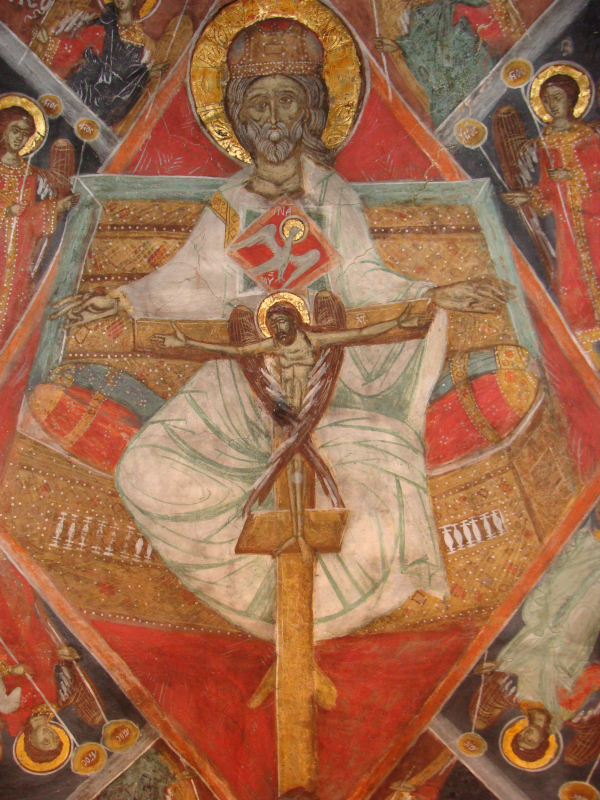
01 Holy Trinity, Church of the Nativity (Arbanasi). The Father embraces the Son. The Father represents eternity; the Son, time. His wings resemble an hourglass. His wings with his torso resemble a heart.
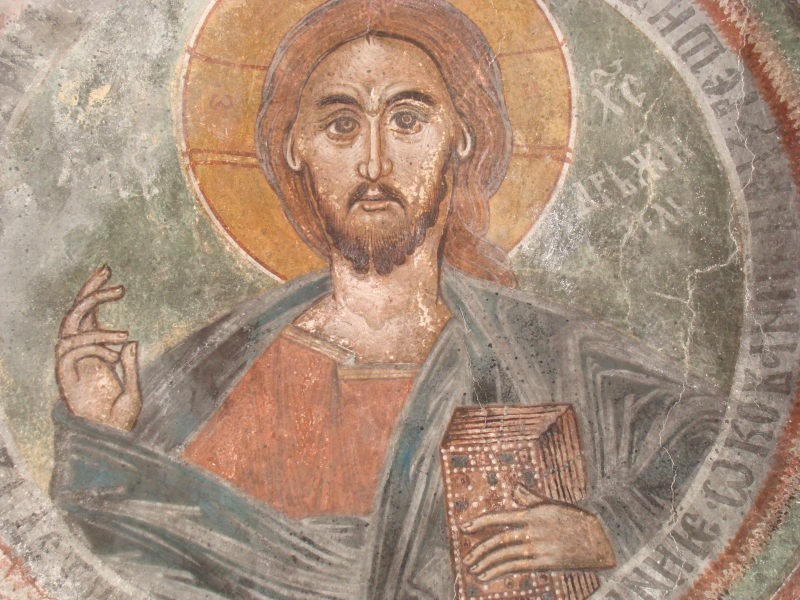
02 Christ Pantocrator, Alino Monastery. Christ’s mouth is slightly ajar, because he is the Word. His face resembles an almond; at the top, a crack, where a shoot will appear.
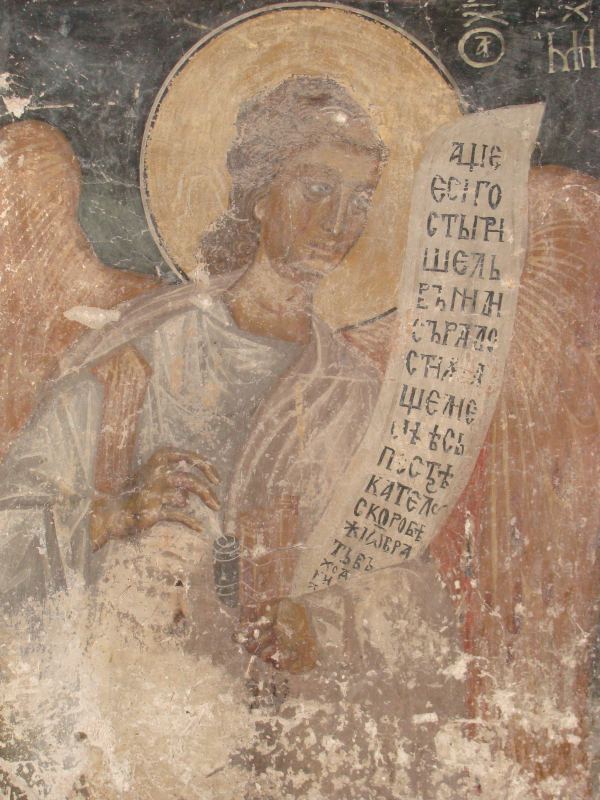
03 Archangel Michael, Berende Church. A very tender image of St Michael. He normally holds a sword. Here he resembles a classical Greek statue.
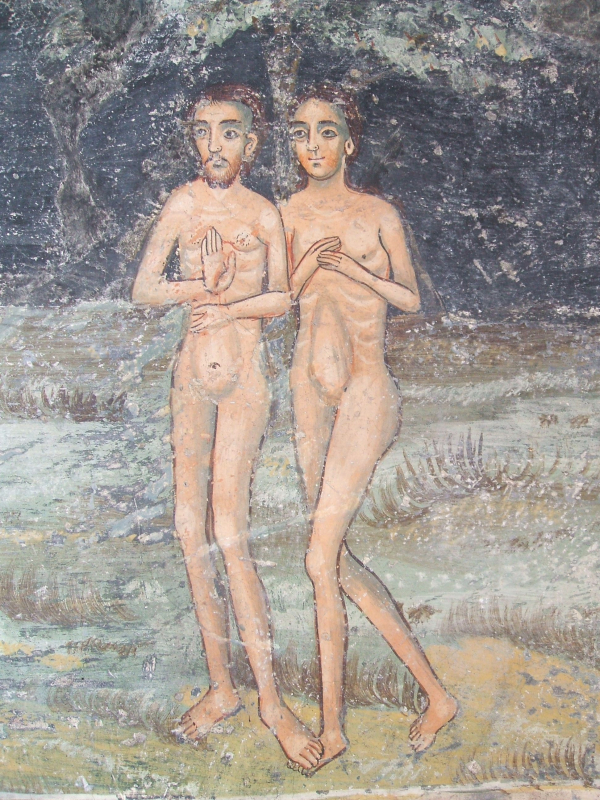
04 Adam and Eve, Iliyantsi Monastery. Adam and Eve are painted against a background of the Tree of Knowledge and its golden fruit, under which there is darkness. Adam holds up his hand, affirming God’s prohibition; Eve is less sure. Adam even steps on Eve’s foot.
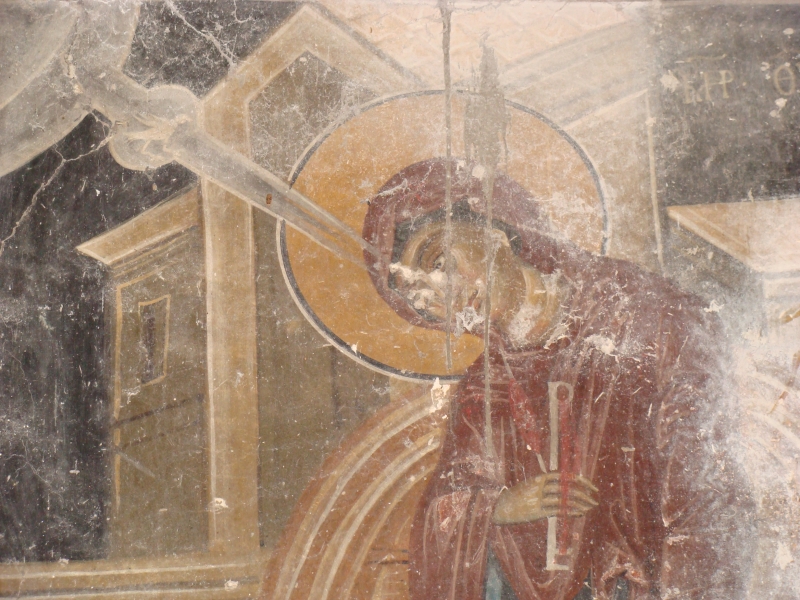
05 Annunciation, Berende Church. The Virgin Mary is with bowed head before God’s will. The dove, by which she will conceive, is aimed at her brain, the rational part of the soul.
06 Nativity, Eleshnitsa Monastery. According to tradition, the Virgin Mary gave birth to Christ without pain. She has turned away, as if aware of the pain that awaits her. Christ in the manger resembles Christ in the tomb, two births, together with baptism.
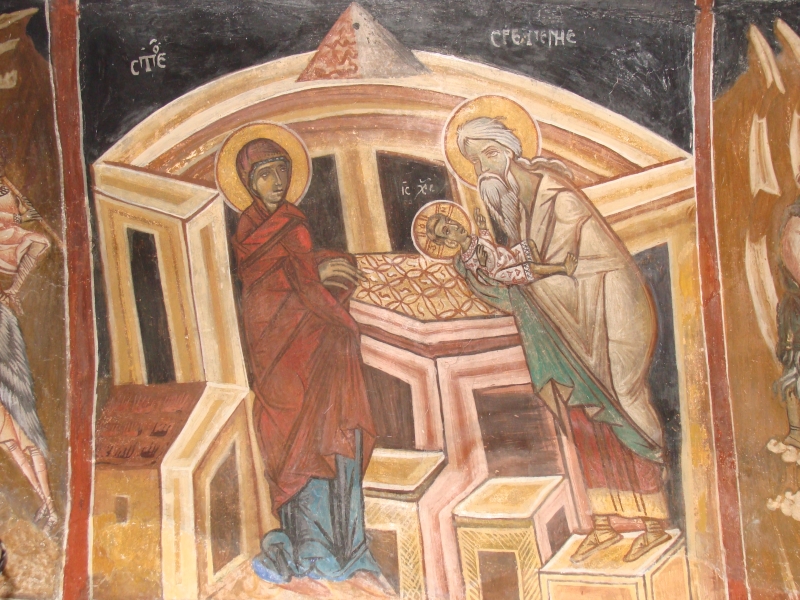
07 Presentation in the Temple, Eleshnitsa Monastery. The Mother and Child are separated for the first time, while Simeon the Righteous holds the Child and receives a blessing from him. Mary’s hand moves towards her child like a spider, but they do not belong to each other.
08 Christ among the Doctors, Seslavtsi Monastery. The dome under which Christ sits is like an egg shell – Christ is new life. The folds of his hair resemble the folds of his brain – Christ is heavenly wisdom.
09 Baptism, Preobrazhenie Monastery. Christ’s body in the river Jordan is like a child’s – not only because we have to be like children to enter the kingdom of heaven, but because it shows his complete kenosis – emptying of himself – in this world.
10 Healing of the Sick, Seslavtsi Monastery. Christ’s hand is three-dimensional, like the Holy Trinity. His body is almost transparent, because he has overcome the world. There is a bitterness in his features.
11 Transfiguration, Strupets Monastery. There are two lights in this scene – red created light, and white uncreated light. The latter resembles the pendulum of a clock, gathering time and eternity into one.
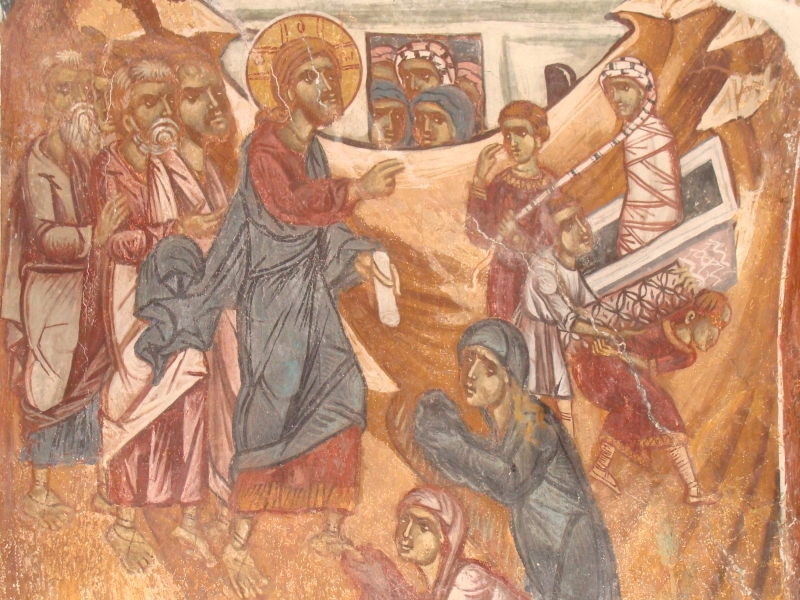
12 Raising of Lazarus, Eleshnitsa Monastery. Christ raises Lazarus with his two fingers, which signify his two natures. Lazarus’ shroud resembles a snake. With his resurrection, Christ overcomes the snake.
13 Entry into Jerusalem, Bilintsi Monastery. Christ is wrapped in his clothes like a baby in a nappy. He rides a donkey the way a child would ride a wooden horse. He will enter the labyrinth of the city, from where he will emerge as the Risen Christ.
14 Cursing the Fig Tree, Seslavtsi Monastery. Even when Christ curses, he blesses. See how the tree, which resembles seaweed, shines with his light.
15 Last Supper, Alino Monastery. The disciples’ hands are open on the table. This is because the gesture of giving precedes the gesture of receiving. From now on, they will give the Word of Christ all over the world.
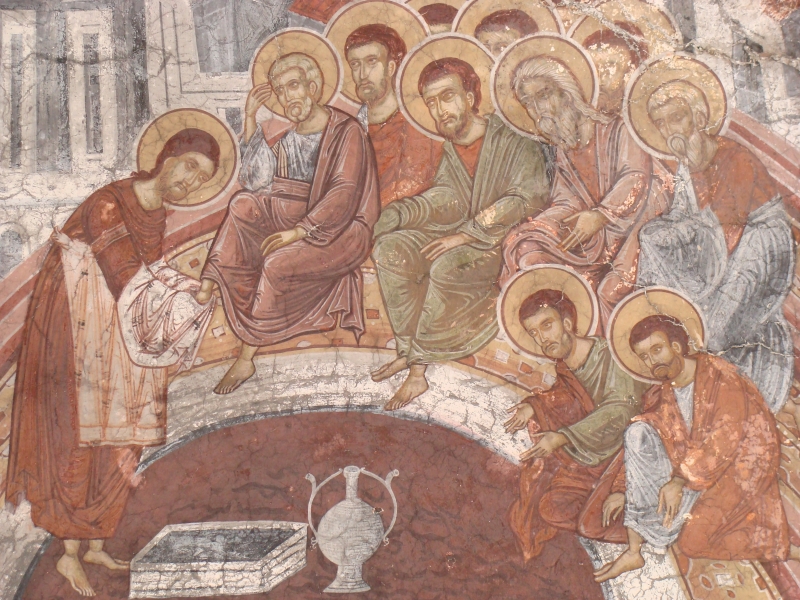
16 Washing the Feet, Seslavtsi Monastery. Christ washes the disciples’ feet, a gesture that mirrors Pilate washing his hands on the following day. In this way, Christ pre-empts Pilate’s question, ‘What is truth?’ Truth is service, not self-justification.
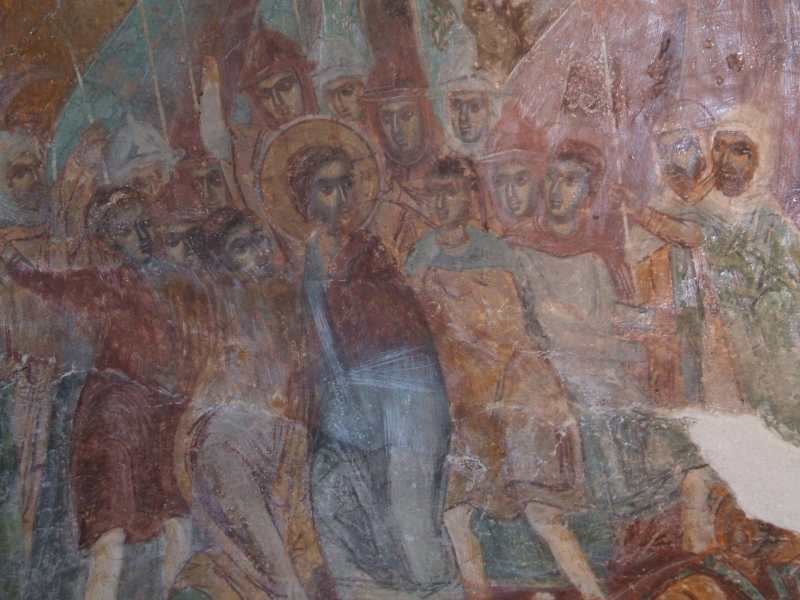
17 Arrest of Christ, Iliyantsi Monastery. It is as if this scene has been taken from a play by Shakespeare. Christ is being pushed from all sides. We can see the swords and helmets of the other people, but not Christ’s hands, because he refuses to protect himself.
18 Crucifixion, Boboshevo Monastery. Christ’s body on the Cross describes a figure of eight. Eight represents eternity, and also the eighth day, the Resurrection.
19 Christ in the Tomb, Malo Malovo Monastery. Christ is already in the sky – see the blue behind his halo. He resembles a fish, a symbol of Christianity. His hands are crossed not in death, but for Holy Communion.
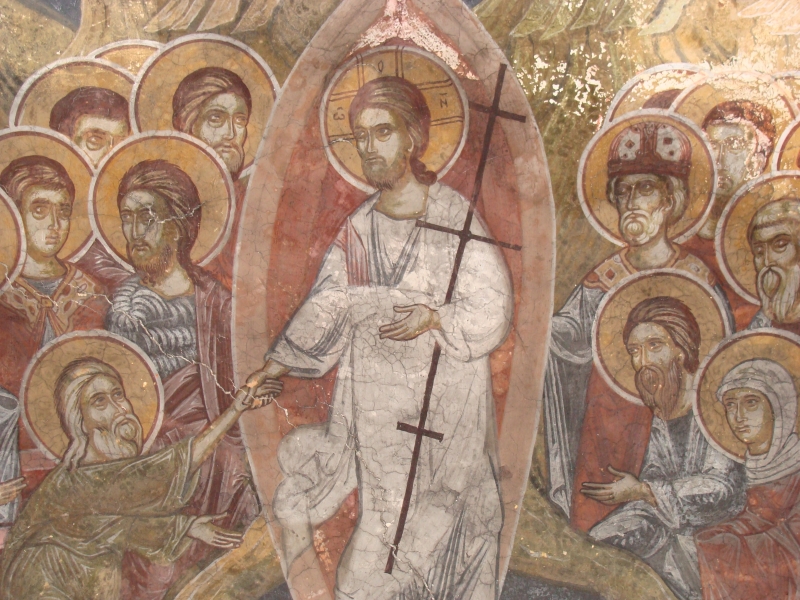
20 Descent into Hell, Seslavtsi Monastery. Christ draws us out of the many waters. He holds a cross, like Jacob’s ladder to heaven. The lower left part of his robe draws a heart – his love for us.
21 Doubting Thomas, Seslavtsi Monastery. The cave is like a womb. Christ is born in a cave. He heals the paralytic who is let down through a cave (a roof). He resurrects in a cave. And he allows Thomas to place his finger in the selfsame wound.
22 Sea of Tiberias, Seslavtsi Monastery. As the disciples throw their net into the sea, so Christ on the shore throws the net in which Peter is swimming. Not only did he make the water holy by his baptism in the Jordan, he has promised to make his disciples ‘fishers of men’.
23 Ascension, Seslavtsi Monastery. Christ’s body is in the egg shell of the universe. He is in the centre because he is the one who nourishes. His body resembles a tear, which in the monastic tradition is a symbol of purity.
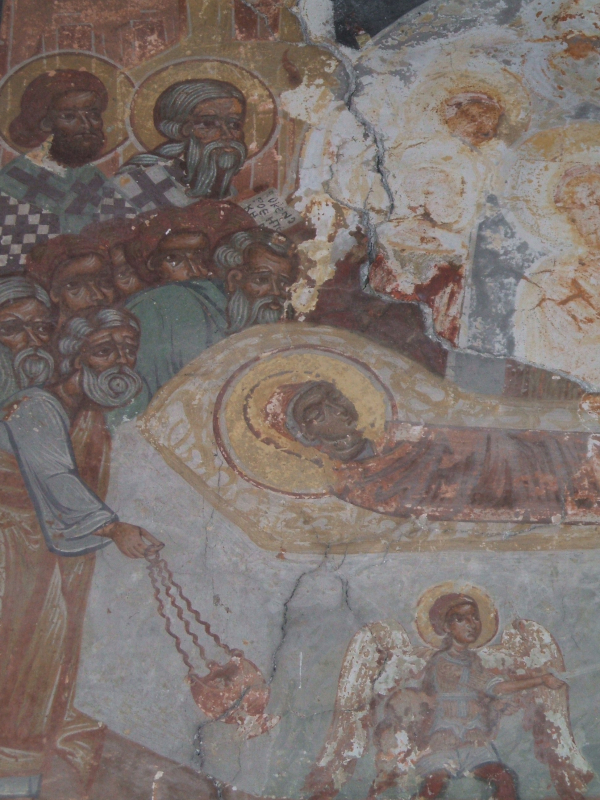
24 Assumption, Karlukovo Monastery. The Virgin Mary is not dead, she is sleeping. Her body resembles the body of Christ in scenes of the Nativity. Her soul is like a baby in Christ’s hands, just as she herself held Christ when he was a child.
There are three major monasteries in Bulgaria: Rila in the south-west (a World Heritage site), Bachkovo in the foothills of the Rhodope Mountains to the south, and Troyan in the Balkan Mountains in central Bulgaria.
But aside from these three major sites, there are many monasteries dotted about Bulgaria, in particular around the capital, Sofia, and many of these are inactive or abandoned. The monasteries around Sofia make up what is known as ‘the Little Holy Mountain’, a reference to the Holy Mountain, Mount Athos in Greece, famous for its monasticism.
You can be in Sofia and not realize that there is a different experience awaiting you only twenty minutes by car from the capital. Unfortunately, many people don’t get this opportunity to travel further afield or don’t know about these places. When you leave Sofia, you enter a different world, one of beautiful nature and one of great spirituality. We do not realize that nature has its own language and it takes time to begin to decipher it.
The Bulgarian poet Tsvetanka Elenkova and I visited 140 monasteries from our home in Sofia during the period 2006-2012. The fruit of this pilgrimage was a series of ten essays by Tsvetanka contained in a book published in Bulgarian as Bulgarian Frescoes: Feast of the Root (Omophor, 2013), accompanied by more than a hundred of my photographs. These essays cover different feasts, from the Nativity of Christ to his Resurrection and Ascension. We have made a small selection of the best images to give people an idea of the riches hidden away in monasteries in Bulgaria that are often abandoned and can be difficult to get to.
The best example is Seslavtsi, a district of Sofia 12 km north-east of the capital. The frescoes here are breathtaking. They were painted by a famous iconographer, Pimen of Zograph, a monk from the Bulgarian monastery of Zograph on Mount Athos who was called by St George in a dream to return to his homeland and to build and paint churches, which he did at the start of the seventeenth century, four hundred years ago. The church containing these frescoes was used for target practice during Communism and is next to a uranium mine. The quality of the frescoes is so good that attempts have been made to cut them out of the wall and take them. The frescoes have not been restored, which gives them a lifelike quality. Once frescoes are restored, they lose something of their spontaneity and acquire a sheen.
Other monasteries containing high-quality frescoes in the environs of Sofia are Alino, a village on the south side of Mount Vitosha, the mountain that overlooks Sofia from the south; Eleshnitsa, a village 25 km north-east of Sofia; and Iliyantsi, a district of Sofia in the north.
Further afield, we find the church of Berende, a village 50 km north-west of Sofia in the direction of Serbia, overlooking a disused railway and with wonderful autumnal colours. Not far away from Berende is the village of Malo Malovo, a very difficult monastery to find. Our first attempt was unsuccessful. We were with our year-old baby and unexpectedly came across some young lads hanging out in the mountain. We caught the glint of metal, beat a hasty retreat and returned a week later, this time without our child, successfully locating the monastery, which was hidden away behind an elevation, perhaps deliberately if one considers that a lot of these monasteries were built during the Ottoman occupation of Bulgaria in the fourteenth-nineteenth centuries, when churches were not supposed to exceed the height of a man on horseback and so had to be dug into the ground.
To the north-east of Sofia, still in west Bulgaria, we find Strupets and Karlukovo. To the west of Sofia lies Bilintsi, on the road to Tran, which has a very attractive gorge. Here, we came across a monk who had taken it upon himself to paint over the old frescoes and who kindly offered us tea in the hovel he was living in (which had a large hole in the ground). Fortunately, his work of ‘restoration’ was incomplete and we were able to photograph some of the original frescoes.
South of Sofia, near the motorway to Greece, is Boboshevo, another excellent monastery for frescoes. And then in central Bulgaria, we have Arbanasi, a hill with old churches next to the medieval capital Veliko Tarnovo. One of these churches is the Church of the Nativity, an example of a building that is sunk into the ground, with sumptuous frescoes inside. A little to the north of Veliko Tarnovo, overlooking the river Yantra, with Holy Trinity Monastery on the other side, is Preobrazhenie (Transfiguration) Monastery, which has a wonderful Wheel of Life fresco on the outside.
These are only some of the monasteries we visited, but they are the ones with the most important images. Our aim in presenting these images is to show the high quality, the naivety (we must become like children to enter the kingdom of heaven), the deep spirituality of Bulgarian frescoes. In the West, our attention is drawn to the likes of Michelangelo and the Sistine Chapel, considered a high example of religious art. Some of these monasteries – Seslavtsi, in particular – can quite rightly be included in the same canon of European religious art.
An English edition of the book Bulgarian Frescoes: Feast of the Root is forthcoming.
Jonathan Dunne
(In the slideshow above, captions are by Tsvetanka Elenkova, photographs and translation are by Jonathan Dunne.)












 Stones Of Ithaca