The Gift of the Church

Readings: Acts 5:27-32; Psalm 150; Revelation 1:4-8; John 20:19-31

The Sanhedrin! Even the name sounds intimidating. One can imagine a row of austere, displeased faces, probably seated on thrones or a podium, certainly higher up, in ornate clothing, with ornate headdresses, peering down at these upstarts, Peter and his gang.

This was the Jewish legislative and judicial assembly. It met in the Temple in Jerusalem, in the Hall of Hewn Stones. It wasn’t disbanded until 425. It wasn’t so long ago that Peter and the other apostles had been beholden to such people, had owed them allegiance.

But now the situation seems decidedly unfriendly. The apostles “were brought in”. They were “made to appear”, in order to “be questioned”. They were informed in no uncertain terms that they had not being doing what they had been told. This small community was challenging the established order!

I wonder how Peter felt as he confronted them. Was he trembling at the knees? Was there a quaver in his voice? Did he feel belittled? Or was he so full of the recent experiences that he had cast all caution to the wind?

He says some things that must have sounded truly shocking. We must obey God over human beings (i.e. not you). He refers to Jesus, this man from Nazareth who had just been raised from the dead, they couldn’t find his body – “whom you killed by hanging him on a cross”. That’s a pretty direct accusation. He has been exalted so that he might bring Israel to repentance. The great House of Israel, of whom I’m sure the Sanhedrin felt like the legitimate representatives, the only ones qualified to discuss such matters. Not only that, but also to forgive their sins. They must have been reminded of the paralyzed man who was let down through the roof, so that Jesus could heal him (Lk 5:17-26). When Jesus told the man his sins were forgiven, there were murmurings among the Pharisees and teachers of the law sitting nearby. To indicate his authority, Jesus then told the paralyzed man to stand up and walk, which he promptly did, shocking them even further.

Peter ends with a reference to the Holy Spirit, “whom God has given to those who obey him”. That doesn’t sound as if it includes the Sanhedrin.

The whole of their world has been shaken, just as the foundations of the earth were shaken at the Crucifixion. Don’t we need something like that to waken us spiritually? I didn’t learn to drive until I was 48. My grandmother didn’t learn to drive until she was fifty, and I wanted to follow in her footsteps. So, I cadged lifts or walked everywhere for thirty years! I was the fourth child, and I think my father was a little exhausted of taking his children out for driving lessons. Anyway, I was more interested in books.

It took me until I came to Bulgaria to learn to drive, and I’m very glad I waited. My instructor, Mr Gujev, really woke me up. He made me realize that I wasn’t in an armchair, watching a film with popcorn, but I was in control of a machine that could kill people. He made me into a very responsible driver. One time, we were on Tsarigradsko Shose in the east of Sofia, driving towards the centre, and he told me to go up to fifty. I was quite happy going at 35, thank you very much, so he pushed his hand down on my right knee and forced the car to go faster. I was petrified initially, but then I began to enjoy it.

Isn’t that how it is with new experiences? To begin with, we’re reluctant, but then, with a guiding hand, we realize there are lessons to be learnt, boundaries to be pushed, and we’re often grateful afterwards. We realize that we have grown.

These men and women have certainly grown as a result of their allegiance to the Nazarene, the one who calls himself “the Alpha and the Omega” in John’s Book of Revelation. The appellation appears three times (also in 21:6 and 22:13), though it’s never quite clear if it refers to God the Trinity or to Jesus Christ.

The name “Alpha and Omega” refers to the first and last letters of the Greek alphabet. He is the beginning and the end. He is the white space behind the language of matter. There is not a time when he was not, to refute the Arian view that Jesus was created.

In our culture, we are very keen on straight lines. We use them to package things. We use them to parcel out land, to create borders. The ego in English is a straight line: I. As is the number we teach our children to count from: 1. The line separates. It is a wall or a tower and liable to fall down.

I can see three ways to escape the line. We can make reference to a third point and form a triangle (a pyramid, which is much more stable). We can delete the line, draw another line through it. This forms a cross, but a cross is also a plus-sign (the meaning of losing your life in order to find it – Mt 16:25). And we can breathe air into the line, open it out – as when you breathe air into a plastic bag or inflate a balloon – and form a circle, in effect counting down from 1 to 0. The triangle, the cross/plus-sign, and the circle.

These three symbols, if you can picture them, spell the name of God in Revelation, Alpha and Omega (A+O). The triangle closely resembles a capital A. Then you have the plus-sign and the letter O. This is the spiritual meaning of the name – it is a call to escape our individuality, our selfishness, and to place ourselves in God’s service, which is the fullness of life.

It is a way of believing, and when we believe, we receive. The Holy Spirit, in the reading from Acts, “whom God has given to those who obey him”. “Life in his name”, in the reading from John. “Eternal life”, in the post-Communion prayer we will hear in a moment.

Jesus says to Thomas, “Blessed are those who have not seen and yet have believed.” He is referring to us, the Church across the ages. He breathed on them and said, “Receive the Holy Spirit.” This verse might be taken to support the inclusion of the filioque clause in the Creed, to say that the Holy Spirit proceeds from the Father and from the Son. But this is not the Orthodox view. This clause was included after the Creed was composed in the fourth century, and it was included unilaterally, at the Third Council of Toledo in 589, not by the Church as a whole.

I believe that Jesus here is offering the disciples the Holy Spirit (“whom God has given to those who obey him”), so that they can forgive others their sins, just as a priest does in the absolution. This doesn’t mean that the Holy Spirit proceeds from him, simply that the Holy Spirit is in his gift, and I think we would be very wrong to go against the authority of such an important theologian as Gregory of Nazianzus, who contributed to the writing of the Creed at the Council of Constantinople in 381.

Christ is the Word. The Holy Spirit is breath. Breath is in the Word, but it comes from the lungs of the speaker.

Do you see how Peter and the other apostles have filled Jerusalem with their teaching? This, despite the fear they felt of the Jewish leaders, which caused them to lock the doors. It is the Holy Spirit that releases us from our fear, that delivers us from the death of sin and enables us to put away the leaven of malice and wickedness. That, and participation in Communion, where we receive the body of Christ and his blood – “him who loves us and has freed us from our sins by his blood”, as it says in Revelation.

Along with Thomas, the doubting one (and who hasn’t doubted? It is a part of faith), we should count ourselves blessed for these gifts – the body and blood of Christ in the Eucharist, the institution of which we celebrated only ten days ago, and the reception of the Holy Spirit, which the Church marks at Pentecost. This is a time of giving, like the air we breathe, the food we eat, the blossoming of spring, not a time to count the cost. Christ has already done that for us when he went to the Cross.

We are language – breath, water, and flesh. Our purpose is to have meaning. We are words on a page, living in eternity. Our job is to believe, so that the Holy Spirit can work through us and we can be imbued with meaning.

Jonathan Dunne, www.stonesofithaca.com

Baptism of Christ

Readings: Isaiah 43:1-7; Psalm 29; Acts 8:14-17; Luke 3:15-17, 21-22

We all speak. That is, we produce sounds with our mouths. After the service, we will gather around the coffee machine and do this. We will discuss the week’s events and thrash out the finer details of this sermon. We will express opinions and hopes and desires. We will enquire after friends. And we will leave, having shared fellowship.

How strange it would be if we all gathered in the entrance hall and didn’t say anything! If we stood in each other’s company with our mouths closed. We might raise our eyebrows or wiggle our ears, but no further communication would be permitted. Eventually someone would snort or yawn, and the spell would be broken. We would laugh and launch into a discussion.

We worship a God, Jesus Christ, whom we call the Word. This is how John the Evangelist refers to him at the start of his Gospel: “In the beginning was the Word, and the Word was with God, and the Word was God.” And we read in chapter 1 of the Book of Genesis that the world was spoken into being. Each paragraph begins, “And God said.” “Let there be light.” “Let there be a dome in the midst of the waters.” “Let the dry land appear.” Etc.

And yet we pay very little attention to speech. This is unusual since I would say that Christianity is a religion of the Word and its ritual is based on the action of speaking. The first thing we do when we speak is breathe out. It is impossible – I think! – to speak as you are breathing in. So, the first element of speech is BREATH. Breath is represented in the alphabet by my favourite letter, the letter “h”.

Then we add voice to our breath and produce the vowel sounds. Think of a baby. A baby is a student of phonetics. It opens its mouth (hopefully not at three in the morning) and adds voice to its breath, producing vowel sounds that may range from an “oo!” to a long, drawn-out “ah!”. But it will generally not produce consonants because consonants involve blocking the flow of air with the lips or tongue and this is more difficult.

A vowel sound is what the doctor asks you to make when they want to examine your throat: “ah!” “A” is the most open vowel there is, so it involves opening your mouth to its greatest extent. It is what we do when we sing. The longer you hold a vowel sound, the more saliva will collect in your mouth, and you will have to swallow. This is because vowels are like water. It is as if a river was flowing through the canyon of our mouths. So, the second element of speech is WATER.

When we obstruct the flow of air with the lips or the tongue, we produce the consonants. Perhaps the easiest consonant to pronounce is the letter “m”. This involves pressing the lips together. “M”. And this is often the first consonant a baby will produce, when it says, “Mama”.

Since the consonants are produced by blocking the flow of air with our lips or tongue, we might say that the third element of speech is FLESH. So, we have BREATH (the letter “h”), WATER (the vowels), and FLESH (the consonants). The three elements of speech, which we practise unknowingly, as when we change gears in a car.

This is how I would analyze the action of speaking: breath, water, and flesh. In chapter 2 of the Book of Genesis, there is a second creation account, which involves the creation of man. In verses 6-7, it reads as follows:

A stream would rise from the earth, and water the whole face of the ground – then the Lord God formed man from the dust of the ground, and breathed into his nostrils the breath of life; and the man became a living being.

Gen 2:6-7 (NRSV)

Most of us, I suspect, would regard speech as the agent of creation as a kind of metaphor, but I think this is exactly what happened. Nowhere in the first two chapters of Genesis does it say that God made the world with his hands, like a potter fashioning clay. It says that he spoke. All through the first two chapters, we read that God said. And the three elements of speech – breath, water, and flesh – are clearly present here: God “breathed into his nostrils the breath of life”, “a stream would rise from the earth, and water the whole face of the ground”, God “formed man from the dust of the ground”. We read later in Genesis 3:19, “You are dust, and to dust you shall return.” This refers to our material body.

We find the same emphasis on the power of speech in Psalm 29: “The voice of the Lord is powerful… The voice of the Lord breaks the cedars… The voice of the Lord strikes with flashes of lightning… The voice of the Lord twists the oaks and strips the forests bare…” That’s pretty impressive – to do all of that only with words. It doesn’t say that God did these things with his hands, and this is a constant in Christian texts and prayers.

We are not able to produce matter with our mouths, but with our words we can have a material effect on our surroundings. We can make someone happy by saying something nice to them. We can make someone cry by saying something hurtful. We can order someone to be killed. Or we can issue a pardon. Our words can be recorded and can influence future generations or even the course of history.

After the creation of man, man – the Hebrew word is “Adam” – is given a task. He is not asked to make the creatures – that is God’s undertaking. He is asked to name them. To apply a word to that particular creature. This occurs in Genesis 2:19-20. Most of us are not in the habit of adding words to the dictionary, of coming up with a name for a horse or a squirrel. But we do name our children, and names are important. They may not fix a child’s destiny, but they do, to some extent, determine their character. There is a Bulgarian name, Milen, which comes from the Bulgarian word for “kind”, mil, and I have noticed that many people called Milen are kind in person. It is as if they live up to their name.

A child is named at their baptism. The priest takes a bundle of flesh and douses their head with water three times, invoking the Holy Spirit. But hang on a minute! Aren’t those the three elements of speech – breath (the Holy Spirit), water (the water of the font), and flesh (the tiny baby)?

In effect, in the sacrament of Holy Baptism, a child is being made into a word of God – not the Word (that is Christ), but they are being called to be Christ-like, to reject the devil.

And what happens in the sacrament of Holy Communion? The priest takes the bread, the fruit of the earth, and the wine, which is a liquid like water, and consecrates them by the invocation of the Holy Spirit. Again, the three elements of breath, water, and flesh are present. We find all three elements in bread, which is made from a dough of flour and water and has air in it.

And what about the first creation account in Genesis, where we read that the waters were separated from the waters and the sky was created, then the waters under the sky were gathered together into one place and the dry land appeared. Aren’t these again the three elements of speech – breath (the sky), water, and flesh (the dry land)?

I would suggest that speech is central to an understanding of the world around us and our place in it. It can effect change, it can bring people to their senses. It can give meaning, as when we take our child and name him or her.

When we are baptized, as Jesus was by John the Baptist in the River Jordan, we have a choice. We can choose what kind of people we want to be. We can decide on the words we will use, on the actions we will take, whether to tell the truth or lie, whether to help others or steal.

We are a word of God. We can choose to be wheat or chaff. We can choose whether to please God or to turn away from him. According to our life, so our definition will be. And this is why we need to cling to the name of Jesus, to think only of him, so that in our earthly pilgrimage we become as much like him as possible. We are made in God’s image, now we must become like him.

Come, Lord Jesus! Amen.

Jonathan Dunne, www.stonesofithaca.com

Photo caption: Letters make good staging posts. Saints Cyril and Methodius, the brothers from Thessaloniki who wrote the Cyrillic alphabet, outside the National Library in Sofia, Bulgaria.

15. Atom

Christ became human so that he might translate for us the meaning of life through parables (Braille, writing for the spiritually blind), but also so that he might translate us when we die. The process of translation, when a word in one language disappears in the translator’s mind in order to reappear in another language, can be likened to death, when someone disappears and is spoken into the language of eternity.

Christ became man in order to show us the road to salvation. He entered his own creation through one of his creatures, Mary. He came to translate for us the meaning of life, because we were at a loss and it needed explaining. He did this by means of parables. We have seen examples. Parable is connected to Braille through the phonetic pair b-p – it is writing for the spiritually blind, for those whose spiritual eyes have not been opened.

But I believe that there is another reason for God to become human, to enter his creation. God is the Author, the source of all that is. We are not the Author, much as we would like to be, because we cannot create out of nothing. We need what already exists, and our purpose is to take this and to turn it into something better, to translate it, just as the translator of a text takes a text written in one language and converts it into another through an unseen, and highly spiritual, process that takes place in the person’s mind as they are translating.

When we are translating a text, there is a point, once we have understood the original (read it, looked up any words we do not know, consulted with the writer or an expert in their work, all the horizontal work of preparation), when the original disappears, it evaporates, the words dissipate, the letters fade away, and out of the translator’s mind, through their fingers as they type on the keyboard, appear new words, words written in another language.

That momentary disappearance, that disembodiment, can be likened to the process of human death. We also seem to disappear, our bodies are put in the ground, and we are no longer seen. We also evanesce, cease to be discernible by the five senses. But in whose mind are we?

I think that Christ became man not only to translate for us the meaning of life by means of parables and his example, but also literally so that he could translate us at our death. An author is the source. A translator acts as a conduit, just as the Virgin Mary did when she acquiesced to bear Jesus in her womb. By becoming human, Christ became the Translator.

We are a text being written. Everything we do in this life takes us in a certain direction. And when we reach the end of our lives, we will be spoken, having been taken up into the mind of the Translator. We will be freed of the constraints of time, and we will enter eternity, the white page on which words are written.

This is why eternal gives two connections. For the first, we must take a step in the alphabet, e-f, and use two pairs of letters that look alike, i-l and n-h (one is an extension of the other). In this way, eternal gives father and I:

eternal = father + I

I think this is because, once we have been spoken, we will have left the speaker’s mouth and be able to see him.

It also spells I am free (phonetic pair m-n, pairs of letters that look alike, i-l and f-t):

eternal = I am free

We will be free of corruption, of the bondage to sin, free to express ourselves without fear (free – the fine line between fear of God and the fire of purification, if we allow fluidity to the vowels; the good news is that it lasts for ever, f-v).

Language contains hidden meaning. The whole of human existence is contained within it. We haven’t realized this. We treat language like an external object, a tool. We use words to bash people on the heads and also to caress them. But we haven’t realized that we ourselves are language, words in the making, spoken into being – breath, water and flesh; h, vowels and consonants – just as we read in the first two chapters of Genesis.

Language tells us the road that we must follow. Christ is very clear about this when he says to his disciples, “If any want to become my followers, let them deny themselves and take up their cross and follow me” (Mt 16:24). This is the way to eternal life, but it passes through denying the ego, drawing a line through the I, which forms a cross, †, but also a plus-sign, + (the meaning of losing our life in order to find it).

We have seen the three ways of moving away from the line by forming a triangle, the letter A, by deleting the I, +, and by treating the line as a number and counting down to O: A+O. These three symbols spell the name of God Alpha and Omega. As soon as we turn our backs on the ego, we turn to God. They are also found in the middle conjunction, and, if we write it with capital letters: AND (A ’N’ O). The reverse of and is DNA – it is in our DNA to do this, to move away from the line, to follow the progression of the Greek alphabet, AIO or AIW.

And when we draw a line through the ego, when we make the sign of the cross (a cross is a deleted I), something extraordinary happens. The progression of the Greek alphabet, with the ego deleted, spells A+O/W (depending on which letter we use to depict omega, a long o or w).

We effect a change at molecular level – the “living water” Christ was talking about, a change of heart, literally, at a level we cannot normally see – because this progression is contained in the word atom, traditionally the smallest particle of matter.

There is a clear connection between language and the environment: seed-root-tree-fruit. A tree that branches out is like a flowering ego, it is no longer a straight line. There is a clear connection between language and the history of the world, from the creation in the Book of Genesis to the Last Judgement, when angels will come to glean the field. And just as we plant a seed outside (as the Samaritan woman fetches water from the well in a bucket), so we must hear the Word of God and plant a seed in our heart.

The one will feed our stomach. The other will give us wings, and change our perception for ever.

Jonathan Dunne

Heart of Language 15/15

Back to: Contents

See also: Theological English (video course); Word in Language (series of articles)

Presopta Place

I am not in a hurry

I am not going anywhere

I am being

as the Celts would say

The rocks smile at me

as they have done

for some time now

I cannot be sure

they are where I left them

They might have moved

an inch or two

a couple of miles

reassembled at first light

when shapes take form

struck a pose

usually smiling

They are old parchments

containing a language we do not speak

we haven’t bothered to learn

of light and shade

cracks and splodges

The universe is language being formed

We ourselves are words in the making

waiting to be pronounced

our definition fixed for the dictionary

what we will be

breath water and flesh

the sound of creation

a hum

lips crashing together

like waves mid-ocean

or mountain goats

as matter

­– flesh, the consonants –

comes into being

the oceans and rivers are vowels

and air God’s breath

the letter h

the beginning of language

We are waiting to be expelled

from this cavernous mouth

that is space

spoken

Black holes are nothing more than throats

and stars are light-bearing larvae

grubs clinging to the palate

As God opens his mouth

(he hasn’t spoken yet

– speech is the general resurrection

the waves that never meet

finally landing on the shore)

space expands

winds rage across the cosmos

carrying particles

– up and off

at and into –

smoke

I am a word

perhaps to form part of a sentence

with you

together we will give meaning

or diverge

like paths in the forest

– Golden Bridges, White Birches –

only to meet

further down the page

or in another chapter

I am breath (h)

vowels (saliva)

flesh (substance)

I am lost

in the Magic Forest

sun-dappled and quiet

waiting to be remembered

Memory is not something that has happened

It is something waiting to happen

the only way

we can be translated

into another reality

is to leave behind

the form we have taken

to all intents and purposes

to disappear

to cover the Translator’s hiatus

until he remembers us

and names us

(a template no longer)

The two conditions for translation

are faith and memory

to leave behind our form

to cease to exist

so we can be expressed

once more

A word dies and is reborn

In that transition

the Translator’s memory

(our speck of faith)

is all.

Jonathan Dunne

Presopta Place (Mount Vitosha), August 2024

13. O WN

Language is thought made manifest. We are words in a dictionary, responsible for and dependent on others. Christ entered his creation, came through the eye of the needle, in order that we might have the courage and confidence to go in the other direction.

We have now seen a correlation between Christ and the environment we live in, but this should not surprise us if we accept that Christ is the Word and the world was spoken into being.

Christ is the Word. It says in the Christian Creed that all things were made by him, they were spoken into being. So physical matter would seem to be the result of language.

When we speak, we make things manifest in a similar way – our thoughts, our observations, our wishes. So we also turn something that did not exist into physical matter. We are using fragments of the Word to do this, as if the Word had been divided among us (like pieces of bread, or shards of a mirror). But the idea is the same – we make things manifest by using language.

So I would say that we speak Christ. Since there is a striking connection between the words son and sun (they are homophones, they sound the same), I would suggest that we see by him. After all, in John 8:12, he calls himself “the light of the world”. Perhaps this can be understood literally (just as the story of creation in the Book of Genesis is literally a description of speech, or the concept of the Trinity is literally three in ONE).

We speak him, we see by him. We also breathe him if we accept that Christ is the Second Person of the Trinity, O2, the chemical formula for oxygen. When we combine this symbol in reverse with the letter for breath, h, to refer to the Holy Spirit, we get H2O, the chemical formula for water. So we also drink him.

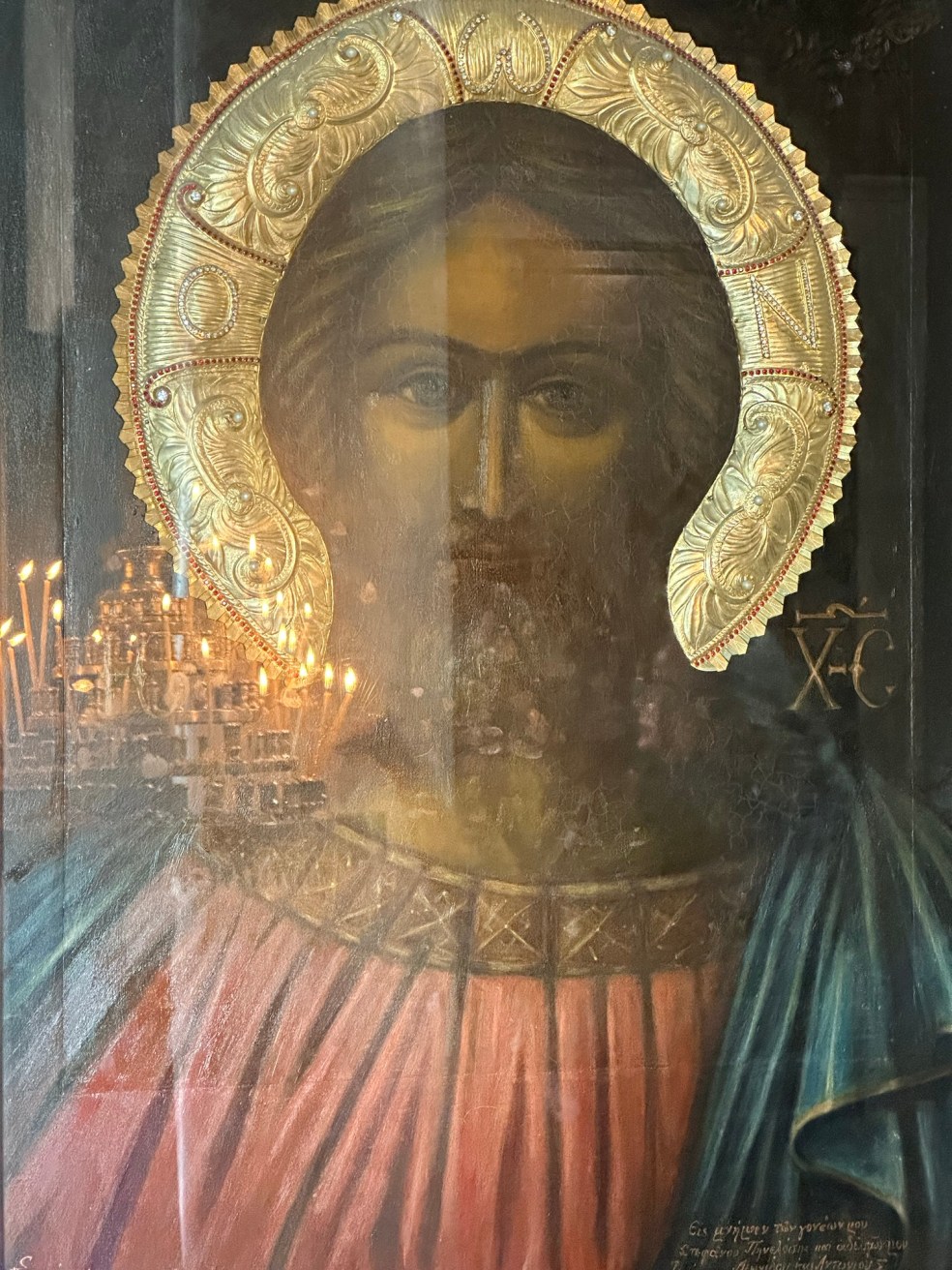
It would seem that our life is completely dependent on Christ, whether or not we believe in him. Enter an Orthodox church and you will most likely see an icon of Christ Pantocrator (“Ruler of All”). In this image, Christ is shown with the beams of the Cross behind him (only three are visible), and in these beams are written the letters O WN.

O WN is Greek for “the being”, which is the translation of the name that God reveals to Moses at the burning bush in Exodus 3:14: I AM. Again, we find here confirmation of the Trinity, because O WN is almost identical to ONE, it’s just that one of the letters has been rotated.

O WN also spells three words in English: own, won and now. Christ claims us as his own; the victory is his, he has won; he is here with us now (the meaning of the name Emmanuel).

I have seen this name written O WH. In Cyrillic, the letter H is pronounced N, and indeed the two letters are very similar (only the crossbar has become slanted). There is also a rough breathing in the original Greek, ὁ ὤν, the reverse apostrophe, which equates to the letter h in English.

If we write the name in this way, then we will see that it spells the words who and how, the result of making the progression AIO from what (A, the letter of creation: “What is this creature?”, “What shall I call it?”) through why (I, the letter of the Fall, an expression of distrust, of disobedience: “Why should I do this?”, “Why should I believe you?”).

Who and how are the questions that we should be asking. What is factual. Why is self-centred. We think that the purpose of life is to amass things and then to share them out, because we were taught at school to count up from 1, to do sums, multiplications and divisions. But actually the answer we are seeking is a person.

Christ gives us the answer to both question words when he says, “I am the way, and the truth, and the life” (Jn 14:6). I am and way are connected if we turn the m upside down and replace the vowel i with its semi-vowel equivalent, y. Both words contain the progression AIW (omega written as w).

We have also seen how when we flee the ego, the I, when we refuse to heed its selfish demands, we automatically create three symbols: A+O, the name of God Alpha and Omega. This can be written A ’N’ O and is found in the conjunction and, the reverse of which is DNA (it is in our DNA to do this). If we write this same progression with the Greek letter for omega, w, we get ANW, which with the w turned upside down gives man. So this denial of the ego, of our innate selfishness, is in the word that describes us (and woman is the same, only it has O3 at the beginning).

The automatic result of turning away from the ego, I, is to say the name of God Alpha and Omega: A+O. By turning away from the ego, we call on him. This is why God and ego are only a step apart in the alphabet (d-e). And him is just I’m with a little breath (h) before it.

This is what makes us human, a combination of hu (Sanskrit for “invoke the gods” and the root of our word “God”) and man – physical beings with the divine spark in them, the potential to become gods by grace if we attend to our true nature, which is not to grab whatever we see out there and to claim it as our own, making a mockery of the divine in us, but to see ourselves as part of the whole, a word in the dictionary, responsible for and dependent on the other. This most ancient way of calling on God – hu – sounds exactly the same as who, the letters we find in Christ’s icon, emphasizing what it is we should be asking.

In the Old Testament, there are two other names of God, apart from I AM. They are YHWH, the Hebrew Tetragrammaton (Yahweh), and El.

YHWH is extremely close to the question word why. So, if we make the progression from I to O, as we did with live-love, sin-son and Christ-cross, opening the line (opening our spiritual Is) to form not a barrier, a wall, but a tunnel that we can walk through, like the proverbial camel through the eye of the needle, just as why gives who, so the name of God in the Old Testament, YHWH, gives O WH, the letters found in Christ’s icon.

And if we place the other name of God from the Old Testament, El, in front of O WH, the two names together spell WHOLE in reverse (keeping the digraph wh together, as we did with earth-three).

This combination YHWH-O WH (why-who) and El-O WH (whole) goes a long way to confirming Christ as the fulfilment of the Old Testament law and prophets. This is why I would say that language is not only Trinitarian (three in ONE), but also Christological.

All physical appearances of God in the Old Testament are said to be by the Logos – that is, Christ – but we are not allowed to touch him. In the New Testament, when he walks among his disciples, eats with them and washes their feet, God himself has entered his creation. He has slipped through the hole – I become O – but in the other direction, so that we will have the courage and confidence to go the other way. This is an extraordinary act of condescension, of coming down to our level, and it was only possible because one of his creatures – namely Mary – acted as a conduit. How else in bodily form do you enter the creation that you have made, if not through one of your creatures?

Jonathan Dunne

Heart of Language 13/15

Next: Heart of Language 14/15

Back to: Contents

Symphony

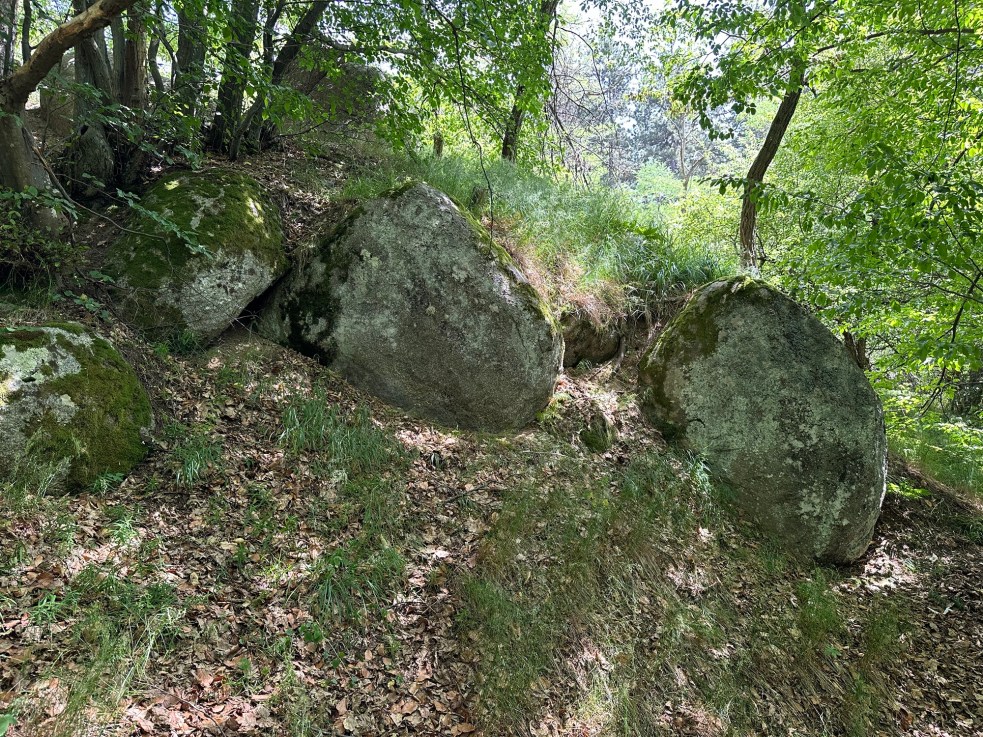
Boulders

dumped by an irresistible force

a primeval behemoth

that has since disappeared

(like T. Rex)

Bones strewn across a field

remnants of an ancient battle

Covered in lichen and moss

Frozen in time

seemingly still

almost impossible to budge

Round, triangular, jagged

Old letters

(there are only so many directions

calligraphy can take)

The man who steals

should be made to transport one

a couple of inches

and then asked

if he wants to steal

again

Only the hermit

knows how to lift one

with his little finger

And the gnats

that bounce on the wind

as if it was solid ground

or gravity had gone out of fashion

In places

they support a bench

or a bridge

and then they submit

gracefully

Then it is we

who put the weight

on them

They sometimes

form part of a path

or allow themselves

to be spray-painted

I have seen them

as the base for a cross

by a river

But most of the time

they are a canvas

for the sun’s fluctuating mood

a mappa mundi

a projector screen

on which faces like clouds

witness the passing of centuries

Like us

they sleep

and then all you can see

are the almond-shaped

indentations

of their closed eyes

and the narrow

moustaches

of their upturned mouths

When we sleep

our senses are momentarily

suspended

we cease to see and speak

(to pass judgement)

we become

the base for a cross

a stepping stone

dappled light

our own memory

Blanched stone

An expression

for others to interpret

We are defined

(we define ourselves)

We are spoken

(we do not speak ourselves)

We take our place

in the dictionary

the richest lexicographical

resource

in the history of the universe

Verb, noun, adjective

What we did

what we did it to

what it was like

A chosen few

are prepositions

otherwise language

cannot position itself

At the end of it all

we will sing a chorus

in which matter

is black ink

light the parchment

and only those who loved

will be able

to hear it

Jonathan Dunne

Ostritsa-Selimitsa, Pentecost 2024

10. IO

If, in the Book of Genesis, the world was spoken into being (and the description of creation in chapters 1 and 2 contains the elements of speech: breath, water and flesh), it means that we ourselves are language, words in the making.

We have seen how the ego in English, I, is a straight line. It resembles the number 1. It could be taken to represent the line that isolates us as individuals, the line that we have used to carve up the earth and divide it into properties, the line that we fight over, the line that needs defending, the line that we use to package the products of the earth and trade in them, the line that we use to build roads and transport them. When we separate ourselves off from others, we lose our shared vision (we can’t see over the fence). We view other people, and the products of the earth, as commodities we can profit from, rather than as God’s creatures for whose spiritual well-being we are responsible. The line – I or 1 – isolates. It creates an illusion of self-dependency.

At some point, this self-reliance crumbles, and we realize that we depend on others. Our spiritual eyes are opened, and we begin to see the world not as “us and them”, but as one shared humanity whose needs (and fears) are more or less the same. We are not so different, our time on earth is limited, but we seem to think that if we keep busy (packaging and transporting goods with the line that alone enables us to count things), we can safely ignore our own mortality, or at least by the time it reaches us, we will be too exhausted to care too much about it.

And so we step onto the line, a moving walkway at the airport that takes us to our gate (which might be 2 or 41, we don’t know). That time (connected with line if we cross out the l and apply the phonetic pair m-n) enables us to safely view the landscape, the runways and planes, with the illusion that it will go on forever and what goes on out there won’t affect us.

But it doesn’t go on forever, which means that our own resources as individuals are limited. Instead of counting up and amassing wealth or memories, we learn to do what the Greek alphabet does and we breathe life into the line, turning it from I to O, omega, a long o, the last letter of the Greek alphabet (compare the Latin alphabet, which counts up from I to Z, or 2).

When the line is opened in this way, it is as if we reach a realization of something deeper at play, we tap into the hidden root system, the root system that was there the whole time, only it was not visible to our eyes, just as there are colours on the spectrum of light – infrared and ultraviolet – that are not visible to our eyes, it doesn’t mean they don’t exist.

And since, as we have seen, the world was spoken into being – the opening two chapters of the Book of Genesis can be understood as a description of speech, with the three elements of breath (h), water (vowels, voice added to breath) and flesh (consonants, breath obstructed by the lips or tongue, with or without voice) – this means that we are surrounded by language, we ourselves are somehow language, words in the making (I believe that this is what death is – to be spoken into eternity). And language can teach us.

So, count down from I to O, from the limitations of the ego to the eternity of God, and instead of live being read in reverse, being somehow distorted, and giving evil, it gives love – love for the other, love for God.

Perhaps you do not believe me, but love and other are connected, you just need to know where in the mouth consonants are produced, forming seven simple pairs, one of which is l-r. Then take a step in the alphabet (t-v, omitting the intervening vowel) and add breath (h). Love-other. The vowels are the same.

We have seen that if we take another step in the alphabet, r-s, other is connected to the Greek word for “God”, theos, and so the two great commandments Christ gives his disciples in Matthew 22 – to love the Lord our God and to love our neighbour as ourself – which together form the core of Christian teaching, are themselves confirmed by language:

love-other-theos

The ego has been taken out of them.

Similarly, we turn from the sin that may have characterized our youth and, having acquired spiritual knowledge, we become children of God, children of the light – son. Again, we achieve this by making the progression in language from I to O.

Even Christ did this by willingly going to the Cross. He counted down from I to O, even though there was no sin in him. He did it to show us the way, the answer to the questions we should be asking: who and how.

So, we have live (evil)-love, sin-son, Christ-cross, all examples of the path we must follow from the selfish demands of the ego to that wonderful moment of realization (and repentance) when we understand that there is more to life than we can see with our physical eyes. Our physical eyes can be used solely for the purpose of identifying and taking in the (external) objects of our desire. When we are subject to our desires, we become disconnected. Fragmented.

When we make the progression from I to O, we become whole again (in our brokenness), because while love is connected to other and theos (the two great commandments), it is also in whole (v-w, addition of breath). Love-other-theos, love-whole.

There is one other word where you will find love, and not surprisingly it is a word connected with language, because a word spoken in anger can destroy, but a word spoken with love builds up.

Again, we have to apply the pair v-w, the phonetic pair l-r and a step in the alphabet, d-e.

Then love gives word. It makes us whole (addition of breath). We are meant to love the other, who as Christ tells us in the Judgement of Nations is God (theos). This is the meaning of love in the English language. It’s the word itself that tells us. Unfortunately, we see language as a way of getting our message across – as something external (a tool) – and don’t realize it is bursting with meaning, like a bud in spring.

Jonathan Dunne

Heart of Language 10/15

Next: Heart of Language 11/15

Back to: Contents

I and Me

The line divides. The line is a wall or a tower. It defines. We use it to mark the borders between countries. To cross the line, you need permission, although nature will cross the line at will. This is a human invention. We use it to indicate private property and enact laws that will punish anyone who trespasses the line without permission. We use it in a sense to make ourselves out to be authors, as if the land, the products of the land, somehow belonged to us. We have misunderstood our role as translators. Our role is to take what is there and to transform it, hopefully for the better, to make it useful (to ourselves and others). But we cannot do anything without the earth and its gifts, as we cannot cook without ingredients. We are recipients.

But we do not like this idea, because it takes away our sense of control. We like to pretend that things begin with us, when they don’t, they pass through us. We cling to the line, because without the line there is a hole, we feel empty.

The ego in English is a line: I. And so is the number 1. We count up from 1 when we do business. We teach our children to do the same. We forget to count from 0. Once you start counting from 1, there is no end, there is no knowing where you will get to, so it produces a sense of uncertainty, not control. We feel the need to produce things (despite the obvious harm to the environment), to make a profit. We put ourselves in control, in the driver’s seat. We make ourselves the subject: I think, I do, I decide. But this is an illusion, or at least it doesn’t last.

A verb has a subject and an object. The subject carries out the action of the verb, the subject is in the driver’s seat (where we want to be). The object is acted on, the object is the recipient of the action. As we grow in the spiritual life (as we grow older), we begin to realize that perhaps our role is more to receive than to do. We receive help, we receive healing, we learn (we receive knowledge). We embrace that hole we avoided earlier, the circle (0), and find it actually makes us whole. Where is the difference between “hole” and “whole”? It is in the letter “w” at the beginning of the second word.

Language, like nature, wishes to tell us something. It is full of spiritual knowledge waiting to be seen, deciphered, harvested. A tree when it begins life is like the ego: a straight line (I). But it does not remain a straight line, otherwise it will be fruitless. So it branches out. It blossoms. And bears fruit. The tree is a lesson in what we have to do with the line, the ego, in our lives. It is an ego turning to God. The line (1) acquires branches and becomes 3 (think of a child’s drawing). This is why “tree” is in “three” (the only difference is breath, the letter “h”), because if it doesn’t branch out, it is not a tree, it is just a stick.

Nature and language wish to tell us something, but we are completely blind to this aspect. We think of nature and language as a tool to be used to our advantage (in short, to make money). But we are not here to make money, we are here to grow spiritually, so that we can prepare ourselves for the life to come. We are here to gain experience. Experience teaches us, it makes us more humble, it make us realize that not everything depends on us.

“I” is a subject. But God does not want us to remain as a straight line (we will not be able to bear fruit if we do). What is the object of “I”? If “I” is the nominative, then what is the accusative, the one who is acted upon, the one who receives? It is “me”.

I-ME. This is the same process undergone earlier by the tree. If we turn these words into numbers, we will see that “I” closely resembles 1, a straight line, but “ME” (written with capital letters) closely resembles two 3s (all I have to do is rotate the letters). When we cede control, when we accept that control was never really with us, when we allow ourselves to be acted upon, when we embrace the hole, the uncertainty, that is at the centre of human existence, then the process of spiritual growth can begin. Then we open ourselves to healing.

We become like the tree. We branch out.

This can be seen in other ways, too. What word sounds like “I”? “Eye”. An eye when it is closed is a straight line. What happens when we open our eyes? The eye becomes a circle. We count down. I-O. This process of opening the line is what God requires of us. We open our eyes and begin to see (“see” is in “eyes”). We open our ears and begin to hear (“ear” is in “hear”).

And it can be seen in language. Take the word “live”. In reverse, this word gives “evil”. That is what happens when we distort the purpose of human life and act selfishly. But if we count down and replace the “I” with “O”, we get “love”. It is the same with “sin” and “son”. Again, the line has been breached, we have accepted that not everything is under our control and have made ourselves receptive to healing (note that this takes an act of will on our part, it is not the response of an automaton, we have free will).

Now, in language, the consonants, the flesh of language, are divided into phonetic pairs according to where and how they are produced in the mouth. One such pair is “d-t”. These two consonants are produced in the same way, with the tongue against the front of the roof of the mouth. The only difference is that “d” is produced with voice, while “t” is voiceless. So they are a phonetic pair.

And what happens when we add this phonetic pair to “see” and “hear”, the result of opening our eyes and ears? We get “seed” and “heart”. So a seed is planted in the earth of our heart, in the soil of our soul.

On this Good Friday in the Orthodox calendar, when Christ himself counted down (I-O) by going to the Cross, I would like to suggest that while we think of language and nature as being at our service (which they are, but not to be exploited), their real purpose is to teach us. They are not tools to make money, they are tools for learning. We become like the tree and branch out (1-3). Away from the line that divides us. Or we count down (I-O). Proof of this can be seen in the landscape that surrounds us, in the language we use every day and in the Christian understanding of the Trinity (3 in One).

Jonathan Dunne, http://www.stonesofithaca.com

Video

Theological English (15): Atom

In this sixteenth video on “Theological English”, Jonathan Dunne looks at the progression from the A of creation to the I of the Fall to the O of repentance/realization, which was the subject of the second video. Having already seen how this progression AIO can be found between words such as “what”, “why” and “who/how”, he examines to what extent this progression can be found inside words. When we draw a line through the selfish demands of the ego (I) and form a cross (†), which is also a plus-sign (+), A+O, we get the name of God in the Book of Revelation at the end of the Bible: Alpha and Omega. This in turn gives “and” (A ’N’ O) and its reverse “DNA”. When we use the Greek letter omega (“w”), we get “man” (A ’N’ W). So the idea expressed by Christ of denying the self, taking up our cross and following him is at the heart of language and in our very genes.

To access all the videos in this course, use the drop-down menu “Theological English (Video Course)” above. The videos can be watched on Vimeo and YouTube.