
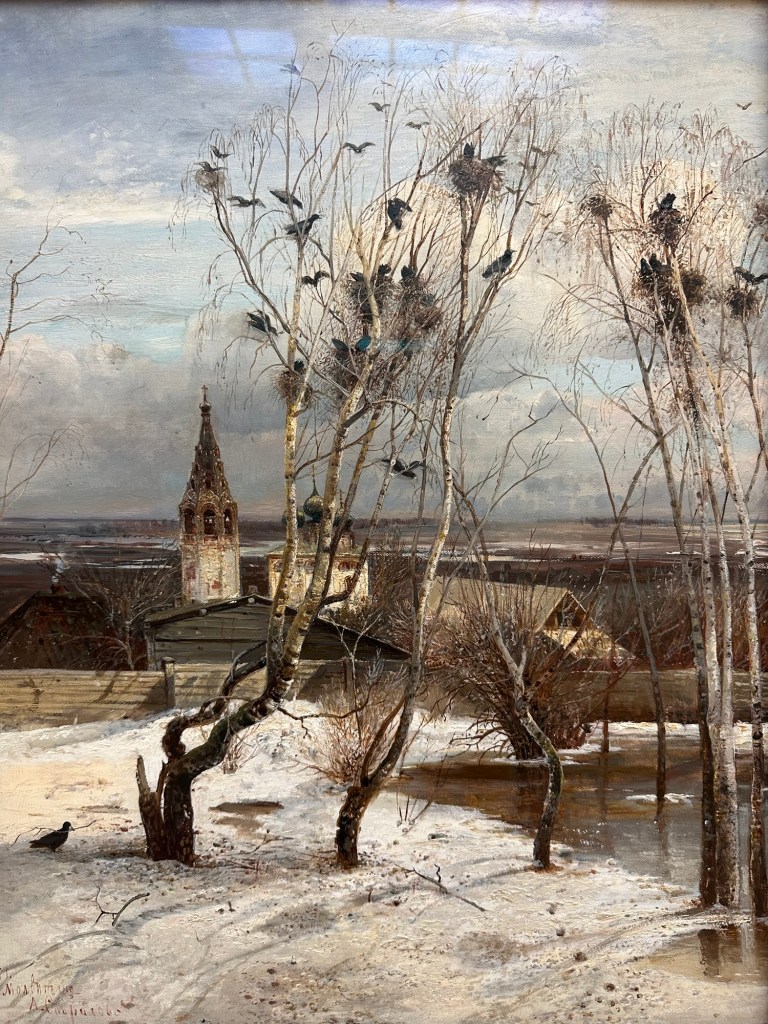
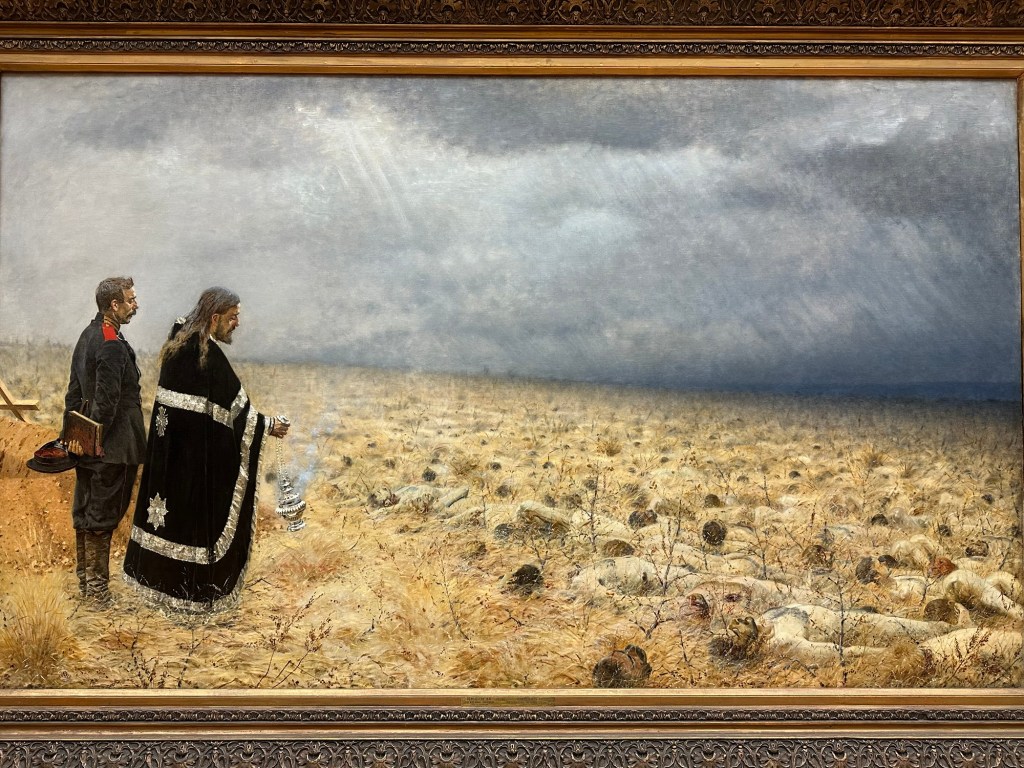
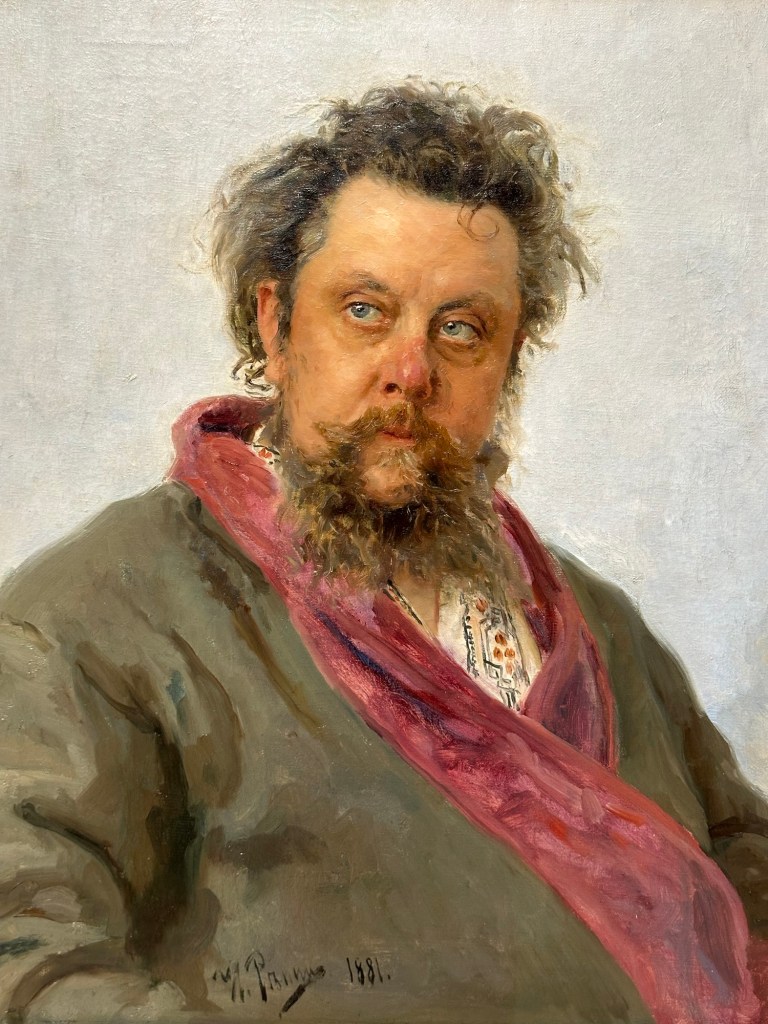
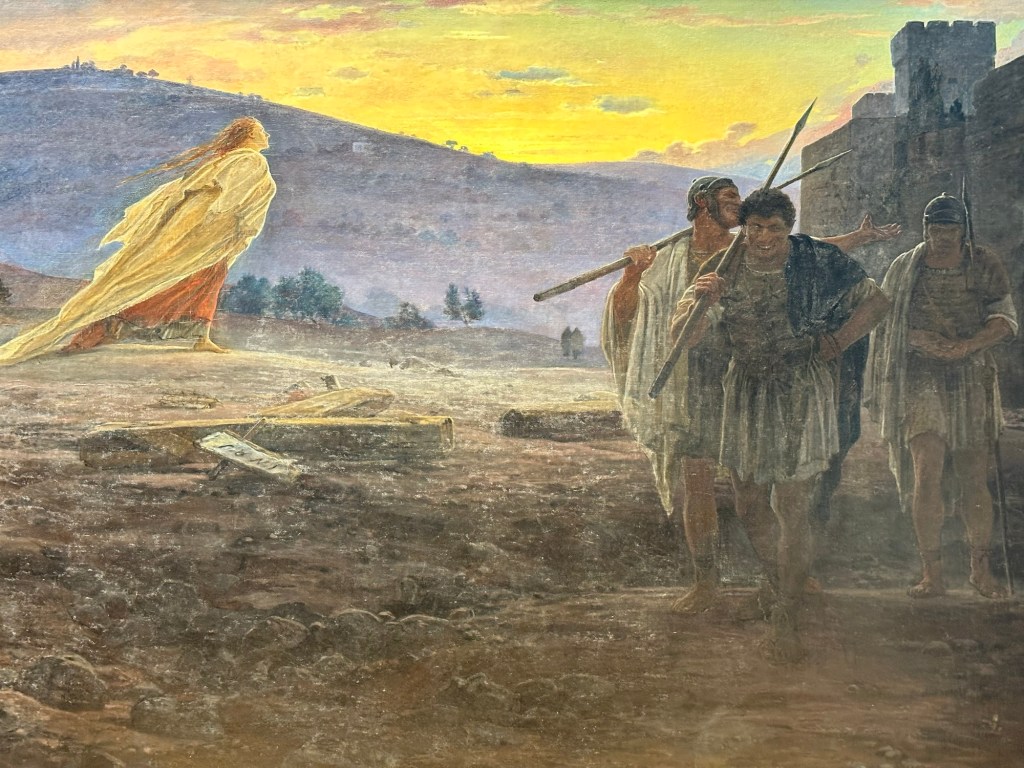
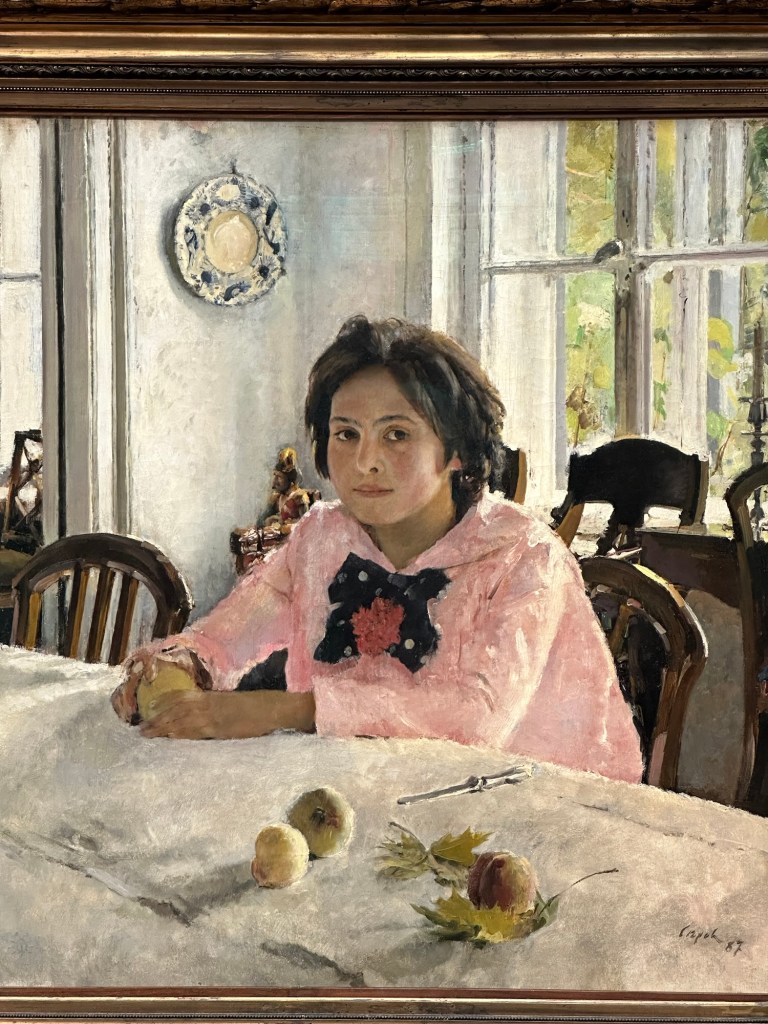
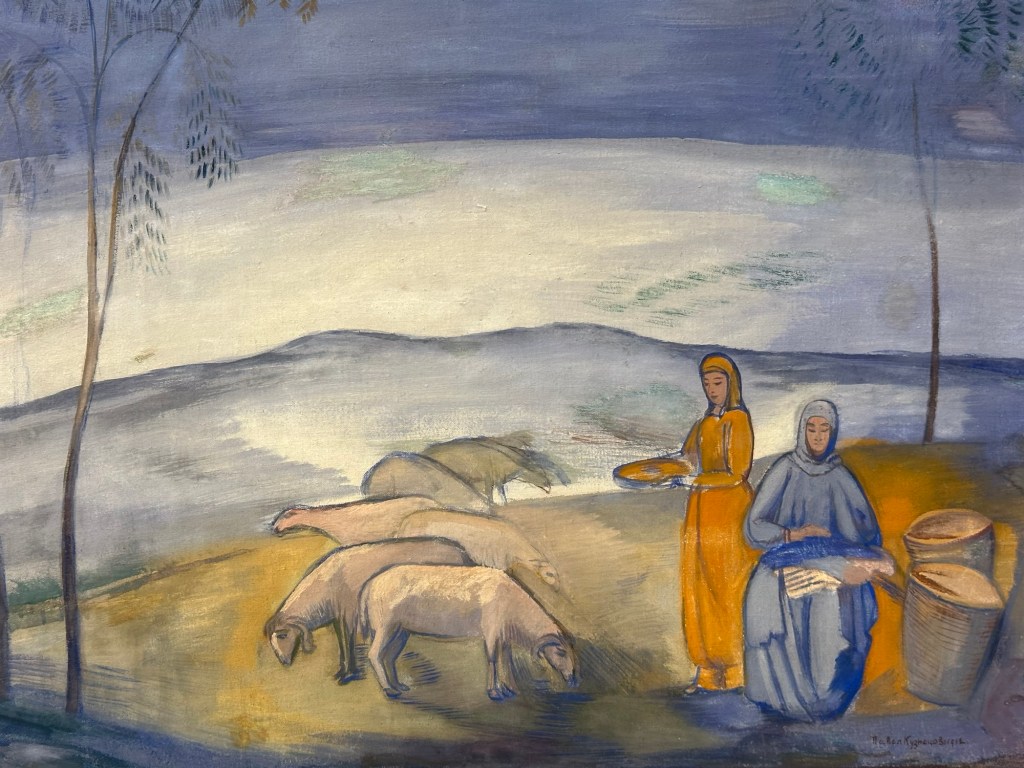
I am not a fan of art galleries – I find them ever so slightly soporific. But not the Tretyakov. I am enthralled. Each new hall – and there are sixty-two of them – reveals a new wonder. I go around, choosing my favourite painting in each room, but soon I have to surpass my limit of one and choose two or three. The paintings go from the eighteenth century (Catherine II’s Victory over the Turks and Tatars) to the mid-twentieth century (these are among my favourites). There are portraits (lots of them), rural scenes, battle scenes, a remarkable and slightly surreal Appearance of Christ to the People by Alexander Ivanov, where the focus is on John the Baptist and the motley crew that have gathered around him (Christ is in the background, and you do not notice him at first). What makes it even more wonderful is the presence in the next hall of the studies the painter carried out for each of the characters in the main painting. They are clearly recognizable. I am touched by Vasily Tropinin, his portrait of a lacemaker (and indeed his self-portrait with the Kremlin behind him). There are portraits of famous writers, from Pushkin to Gogol and Dostoevsky to Chekhov, and composers like Mussorgsky and Tchaikovsky. But my favourite portrait is the magical Girl with Peaches by Valentin Serov, the fruit and cutlery on the table, the plate on the wall, the greenery visible through the window, and the girl’s somewhat nonchalant gaze. She seems to have been captured with ruffled hair before leaping up from her chair to go out into the garden. Serov has a similarly liquid portrait of the last tsar, Nicholas II, and a scene of his happier coronation in the Assumption Cathedral, a bustle of colour and activity, movement and intensity. There is a peacefulness to the Russian countryside (the Russian soul?) – take, for example, The Rooks Have Come by Alexei Savrasov (available as a phone cover in the gift shop) or A Quiet Monastery by Isaac Levitan. There are battle scenes that reflect the futility of war (The Vanquished by Vasily Vereshchagin, with a priest censing the bodies of the dead). Ilya Repin is a master – he is famous for his painting of Ivan the Terrible and His Son Ivan, the tsar having just dealt his son a fatal blow to the head, but I prefer his portraits (his daughter sitting on a branch). I am very impressed by Nikolai Ge and his religious scenes – the Roman soldiers departing the scene of the crucifixion, almost laughing about it, while unbeknown to them, as the sun rises, an angel hastens to the ensuing resurrection. I am not such a fan of Mikhail Vrubel and his blotchy paintings – they seem to like him – but I do like the twentieth-century representatives: Evening in the Steppe by Pavel Kuznetsov, the humour of A Windy Day by Nikolay Krymov, and Constantinople. Dogs by Martiros Saryan.
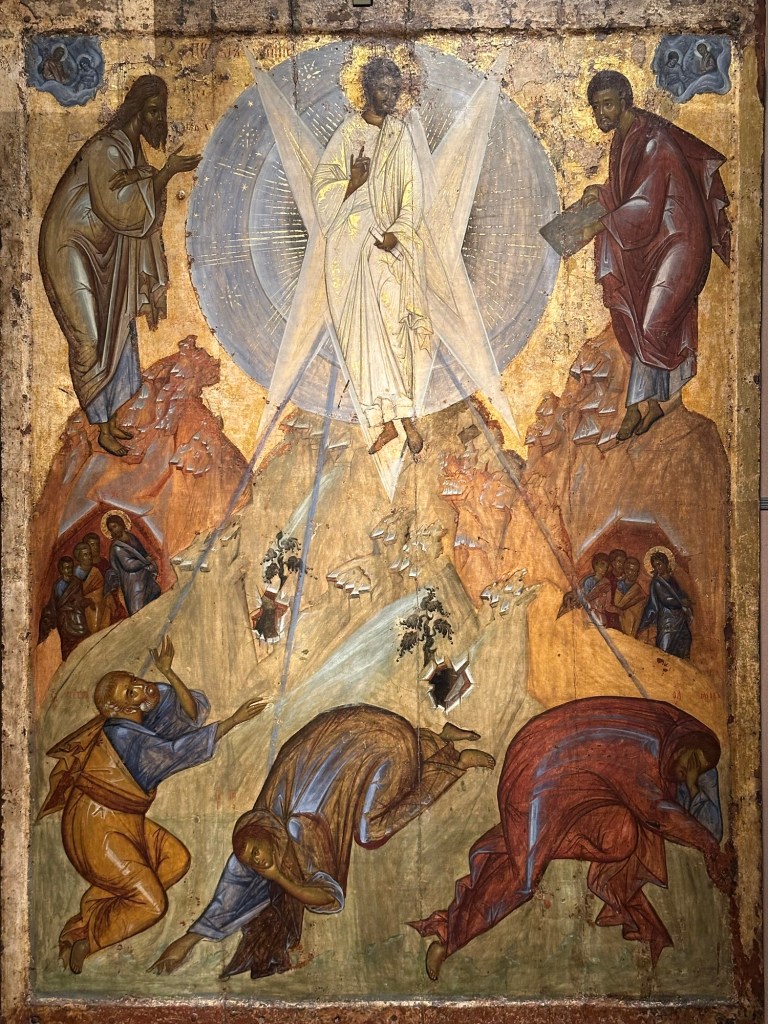
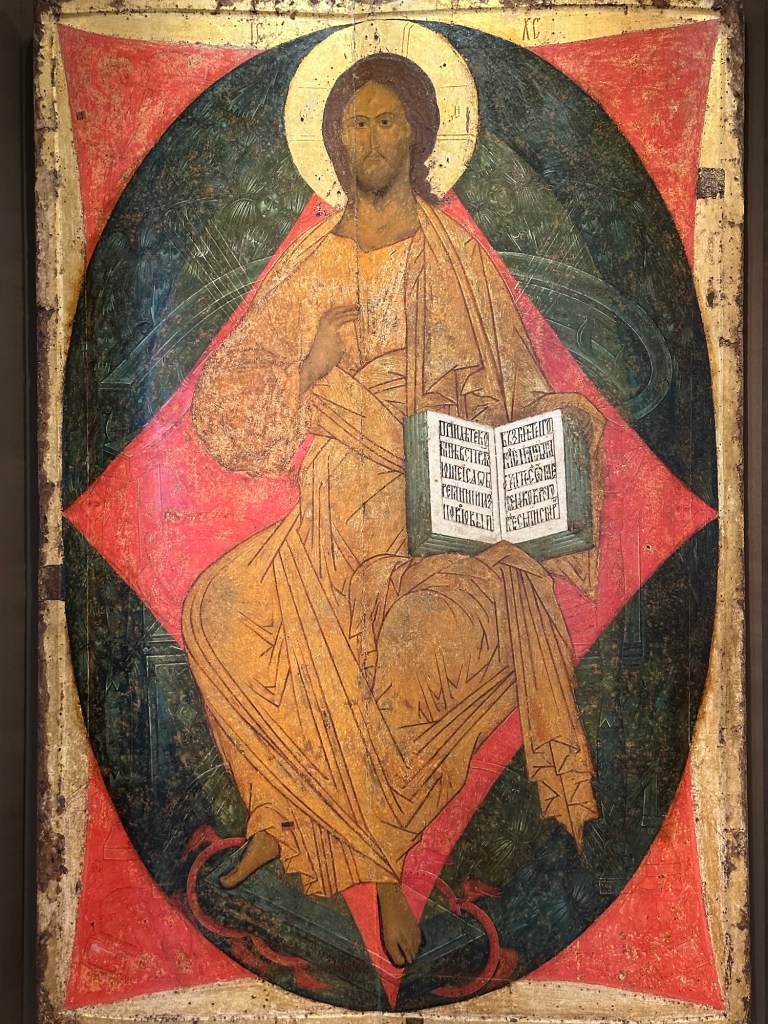
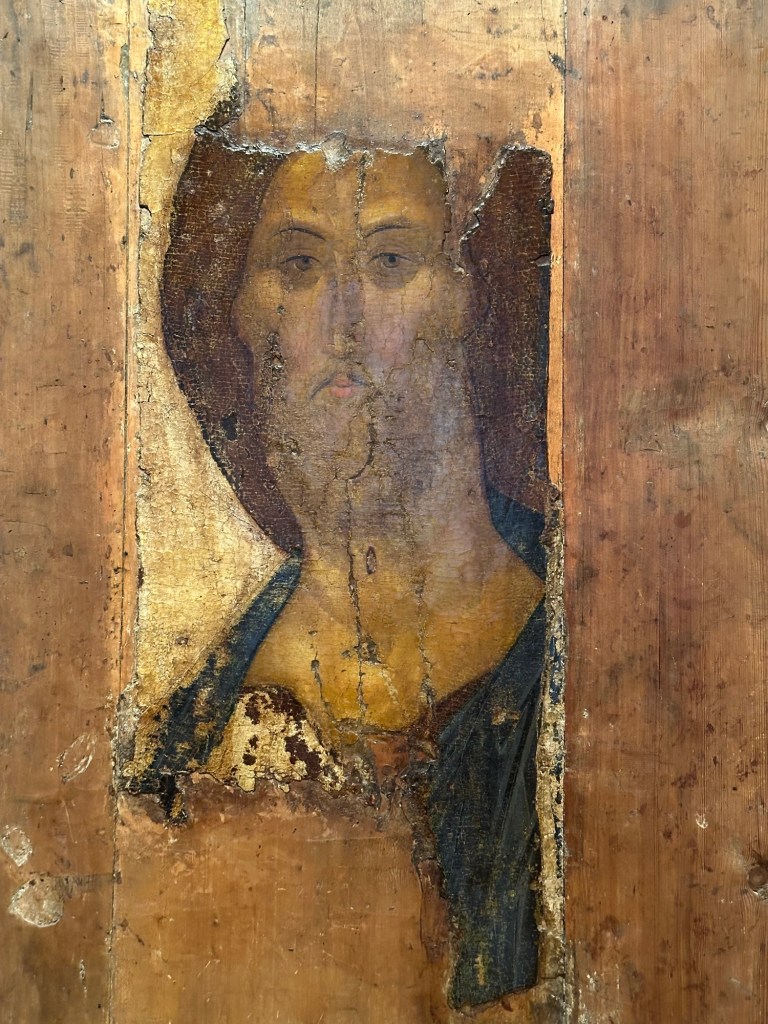
Just when I think I cannot take any more, I reach halls 56-62, the end of the exhibition, with all the ancient icons, and my breath is taken away: St Nicholas and the Annunciation, twelfth-century icons from Novgorod; the early fifteenth-century Transfiguration by a painter of the circle of Theophanes the Greek; a King of Glory from my neck of the woods (the Balkans): Christ in Majesty by Dionisius; and then the crème de la crème, Andrei Rublev and his Saviour and Archangel Michael from the Deesis of Zvenigorod. I think my mouth drops open. A Russian looks at me with bemusement. My phone battery is exhausted, so I sit on the bench and contemplate the Saviour for twenty minutes, as he stares lifelike at me from out of the wood of the Trinity.
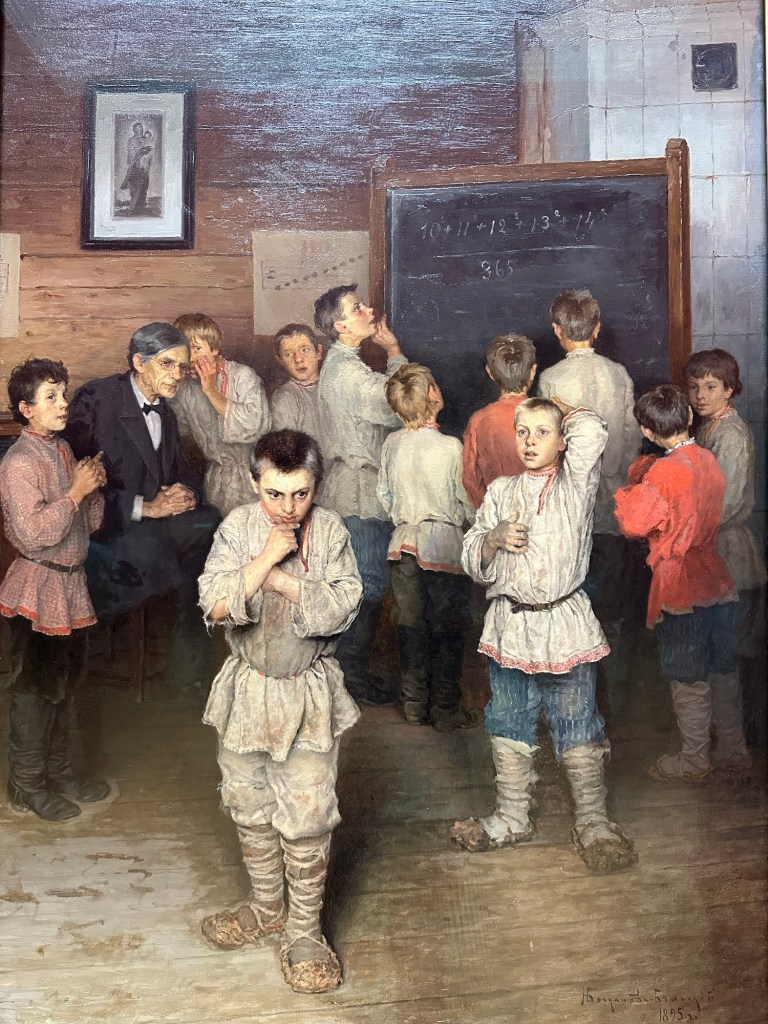
There are so many paintings to take in. I am struck by Nikolay Bogdanov-Belsky’s Mental Arithmetic, the boys in S. A. Rachinsky’s free school racking their brains to get the answer right, again the intensity of their gaze, the shared effort, the wisdom and patience of old age as the teacher waits for them to work out the equation. And this is an overriding impression in Moscow: it is a city of industry, or better industriousness, people working in concert, it is not a city that is standing still.
I decide against doing anything else that day, the Tretyakov is enough, I drink an Earl Grey tea and eat a Danish pastry, and then head back to my accommodation, my mind full of images, models gazing at me from the canvas.
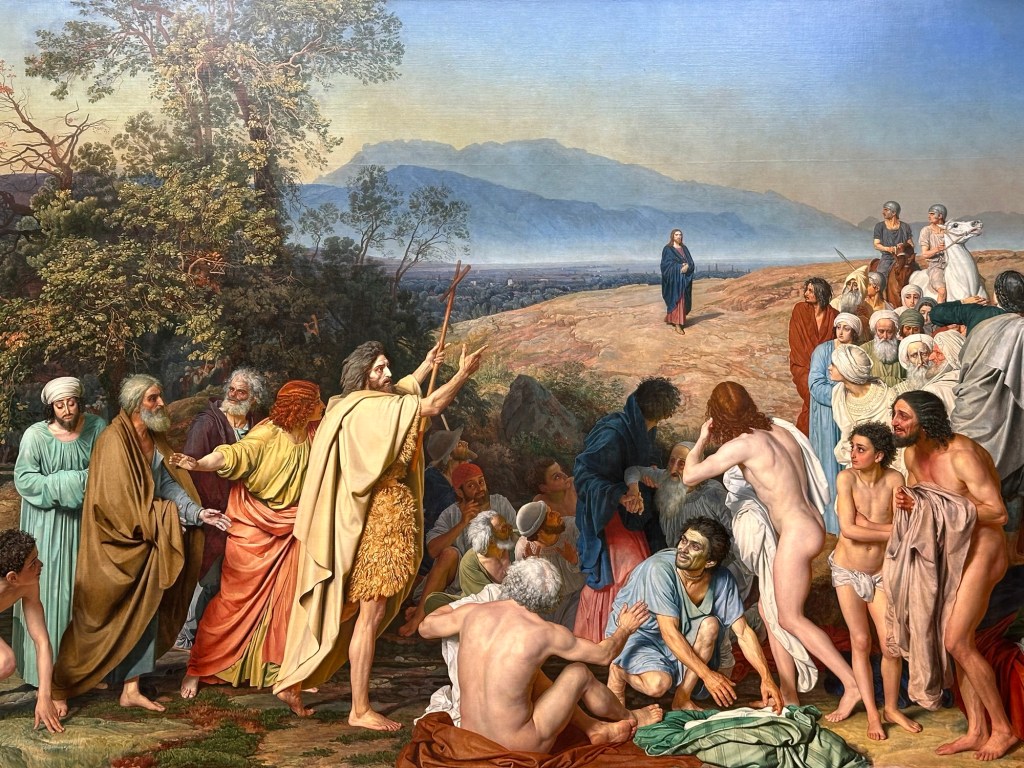
- The Appearance of Christ to the People by Alexander Ivanov.
- The Rooks Have Come by Alexei Savrasov.
- Mental Arithmetic by Nikolay Bogdanov-Belsky.
- The Vanquished by Vasily Vereshchagin.
- Portrait of Composer M. P. Musorgsky by Ilya Repin.
- Heralds of the Resurrection by Nikolai Ge.
- A Girl with Peaches by Valentin Serov.
- Evening in the Steppe by Pavel Kuznetsov.
- The Transfiguration by a painter of the circle of Theophanes the Greek (early 15th century).
- Christ in Majesty by Dionisius (1500).
- The Saviour by Andrei Rublev (c. 1400).
Jonathan Dunne
Next: Moscow Zoo

