7. AM

A refers to creation. I refers to the Fall (or time). O is the symbol of recognition, repentance. This is the progression of human life, contained in the Greek alphabet: AIO. That is, the Greek alphabet counts down from the Fall (from I to O). The Latin alphabet used in English counts up (from I to Z).

The Greek alphabet makes the progression from A (which represents creation, “In the beginning…”) to I (which represents the Fall, or time) to O (a long o, called omega, the last letter). AIO. We tend to associate Greek culture with drama, philosophy and theology.

We tend to associate Latin culture with making laws and building roads. It’s the Latin alphabet that we use in English, 26 letters. But the Latin alphabet, which might be taken to convey rationalism, thinking, doesn’t make the same progression as the Greek one. It goes from A to I to Z. That is, it counts up: from 1 to 2.

It does exactly what we teach our children to do in school. To amass. To count up from the line that represents the ego, I, without taking into account the source, O (the eternal symbol that represents God). A fatal mistake. This contrast in styles, between a more humble East and a more hegemonic West, with its colonies and empires, is very telling.

Let us start by looking more closely at the A of creation. We have seen that the name of God revealed to Moses at the burning bush in Exodus 3:14, perhaps the most important verse in the Old Testament, is AM. This name actually contains the letter A and also the Greek letter omega, w, turned upside down. In God is both the beginning and the end. He is the empty space on which we draw the timeline (there can be no time without eternity).

If we apply the phonetic pair m-n to AM, we get an. This is the indefinite article, the article we use to refer to countable nouns, nouns that can be counted. You can only count if you separate off, if you draw a line around, so God did this – but he didn’t create man in order to trade in him, which is the reason we draw lines around things (barrels, bottles, containers, any kind of packaging, for the purpose of trade). He drew a line around man in order to grant him free will, to make him separate (while, obviously, man’s life is contained in God, without whom he cannot breathe). This is the difference in intention between God and man: one gives freedom, the other thinks about profit.

If we combine the name of God, AM, and the indefinite article, an, we get a man:

AM + an = a man

And the name of that man was Adam. Again, the letter A. But because he is God’s creation, made in his image, he also has the divine spark in him, which is why the letter omega, written o or w, is in his name when written with capital letters: ADAM. His name is a duplicate of God’s in Exodus, AM, using the two ways of writing a long o or omega.

If we read the name Adam in reverse, we find made (I have allowed the second vowel to shift slightly towards the front of the mouth). That is because we are made, not begotten. Only Christ is the Son of God, only he is begotten of the Father before all ages (outside the timeline).

In chapter 2 of Genesis, after the creation of man, God then creates the animals and birds, and asks Adam to name them. Do you see how name is man in reverse, with the addition of final e?

If we shuffle the letters of name, we find mean and amen. By naming the creatures, Adam gave them meaning, and he said amen to God’s will. So, man: name-mean-amen.

God asked Adam what he wanted to call them. What is the primordial question. What is this creature? What will you call it? But, in the Fall, we make the progression from A to I, and instead of what, we ask why. Why should I do this? Why should I believe you? Why signifies distrust (y is the semi-vowel that corresponds to i).

Now that we find ourselves in the time of the Fall (as soon as Adam and Eve are ejected from paradise, the clock starts ticking, this is why the Fall and the ego are represented by a line), we really only have one choice: to go forward. So, we do not attempt a return to paradise, to the world of childish ignorance. We have our knowledge and must use it.

We make the progression of the Greek alphabet, and turn why into who (or how, it’s the same answer). The biggest shift in someone’s thinking is when they make this change from why to who. Pilate, when he asked Christ, “What is truth?” (Jn 18:38), had not made this progression. He had to ask the one by whom all things were made (because he is the Word, and the world was spoken into being) not “What is truth?”, but “Who is truth?” And then Christ might have answered, “I am,” in which is contained the progression of human life: AIO (AIW).

AIO, or AIW (depending on which letter we use for omega, o or w), restores us to ourself. The crucial difference – and the reason we should not want to return to Eden (Garden of Eden spells danger of need) – is that now we have knowledge, knowledge we must put to good use.

Jonathan Dunne

Heart of Language 7/15

Next: Heart of Language 8/15

Back to: Contents
Glozhene-Teteven

This makes for a cracking day, because you get to visit three waterfalls, two in the charming town of Teteven and one in Glozhene. It is then possible to visit the remarkable Glozhene Monastery and even to walk to Morovitsa Cave. For this reason, we got up early and left Sofia at 7.30 in the morning. We were back at 6.30 in the evening. But a word of caution: both Teteven and Glozhene waterfalls are a little famous for not always working at full capacity. We made sure to visit them in May, the ‘waterfall month’, once the snow had started melting and after a few days of rain. This made for a real spectacle.

As for Yamna, which is not far from Teteven as the crow flies, you want to take the A2 motorway from Sofia in the direction of Varna. You go past the exit for Pravets/Etropole and continue to the exit for Dzhurovo and Etropole. Shortly after leaving the motorway, you turn right to Dzhurovo and continue on this road for two kilometres until you reach a T-junction. Turn left here, which is signposted for Golyam Izvor (4 km). After another two kilometres, take a turning on the right (signposted for Golyam Izvor, still 4 km, and Teteven, 15 km). Drive through the pretty village of Golyam Izvor, staying on this road. After leaving the village, you will pass a dirt track on your left, which goes to Glozhene Monastery, our final destination. Keep straight, and in another five kilometres you will enter Teteven.

300 metres after you enter Teteven, the road veers left over a bridge, and immediately there is a T-junction. Turn right here (left will take you to Glozhene, where we will be going later). You now have the River Vit, which flows through Teteven, on your right. Drive into the centre of Teteven. In six kilometres, there is a bridge over the Vit on your right which is signposted for the waterfall, Skoka Waterfall, but do not take this turning. Keep going with the river on your right. You will pass a second bridge over the river, and then a third. Take this third one (500 metres after the first). You will cross the river and pass the town’s market on your left. Keep going straight for 300 metres. There is a little bridge, and immediately a turning on the right signposted for Skoka Waterfall. Turn right here.

Keep going on this road (avoid the temptation to go straight back over the river you have just crossed), and after 2.8 kilometres you will reach a little car park on your right. Park here. The ecopath to the two waterfalls begins here.

You are in for a treat. The distance to the waterfalls is short – 650 metres – and takes only a quarter of an hour, but the path is very pretty, you pass a smaller waterfall, which is still fairly impressive, and at the end of the path there is a hut with the two waterfalls behind it. Skoka is on your left and attracts most of the attention, but don’t miss the much taller Praskalo on your right. If you have chosen to go in spring after the snow melt and some rain, you will not be disappointed. It is very unusual to find two such pretty waterfalls at such a short distance from each other. I kept going from one to the other. I liked Praskalo more, it was less noisy and very spiritual. We spent about 1¼ hour walking to and from the waterfalls.

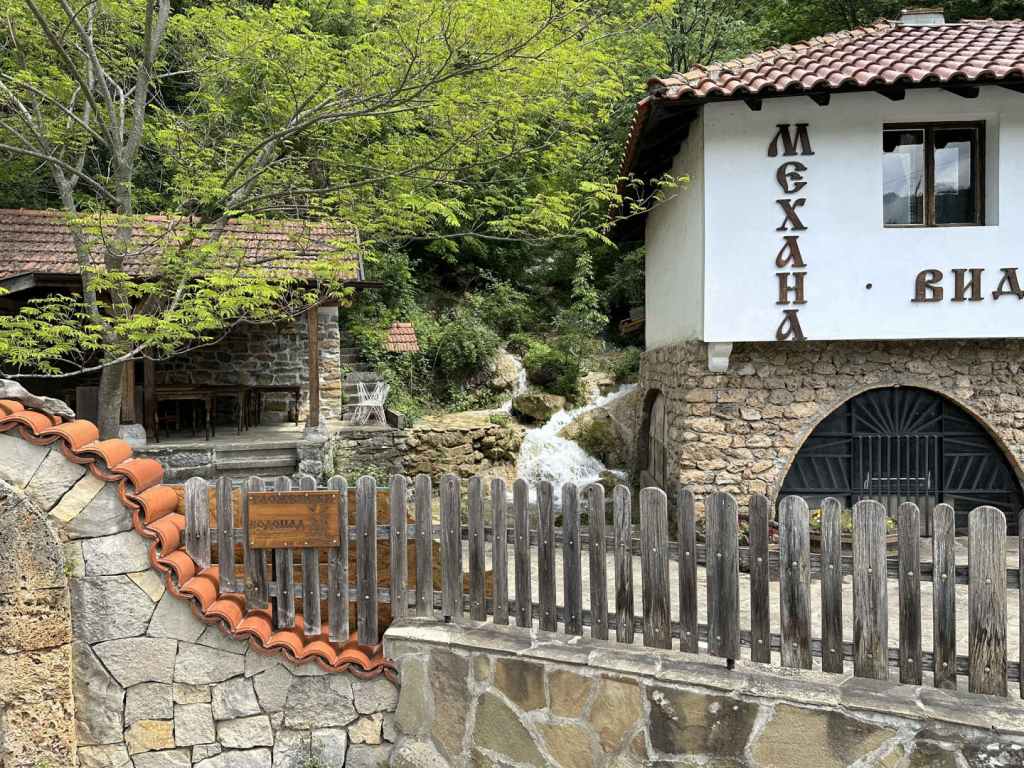
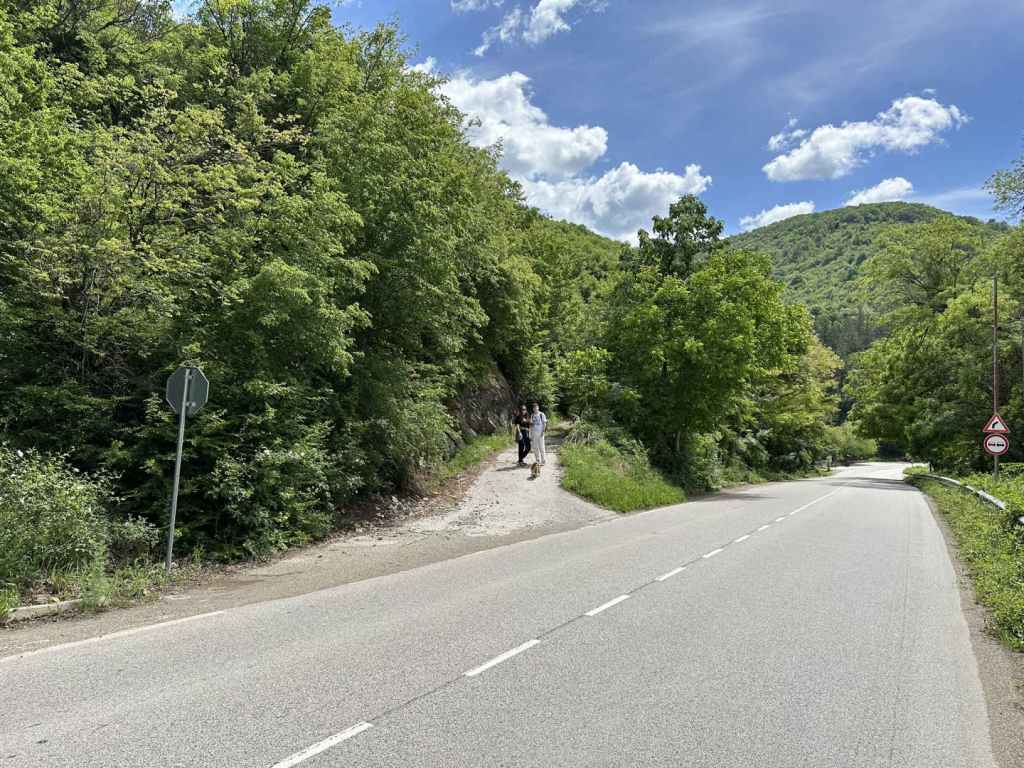
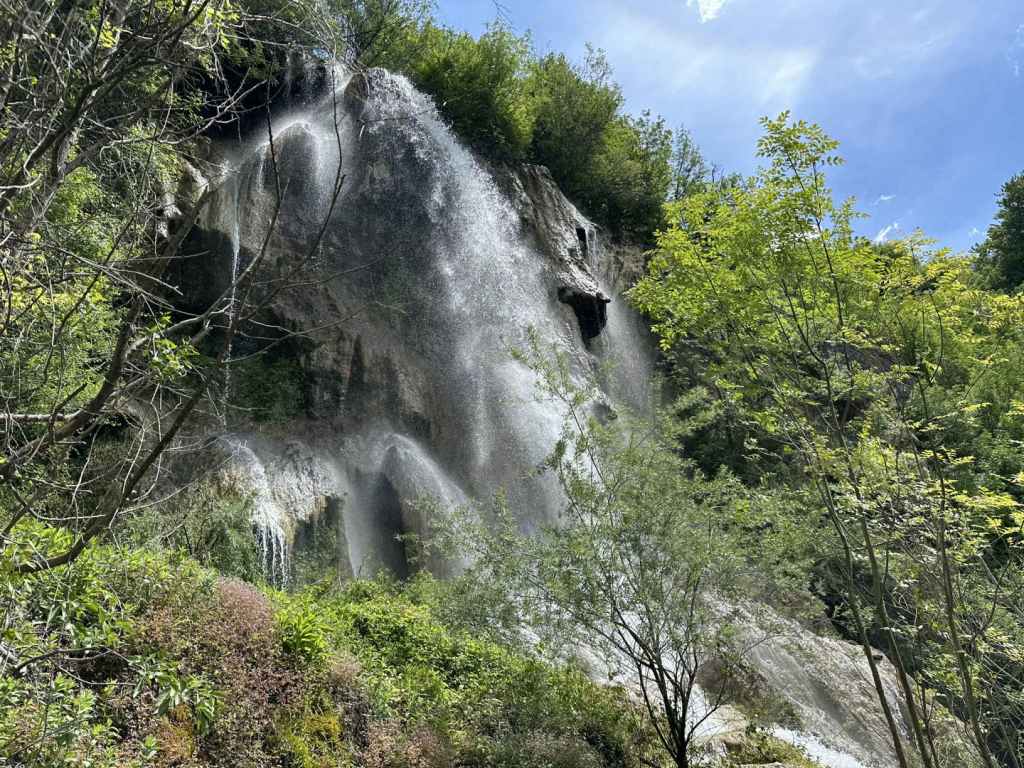
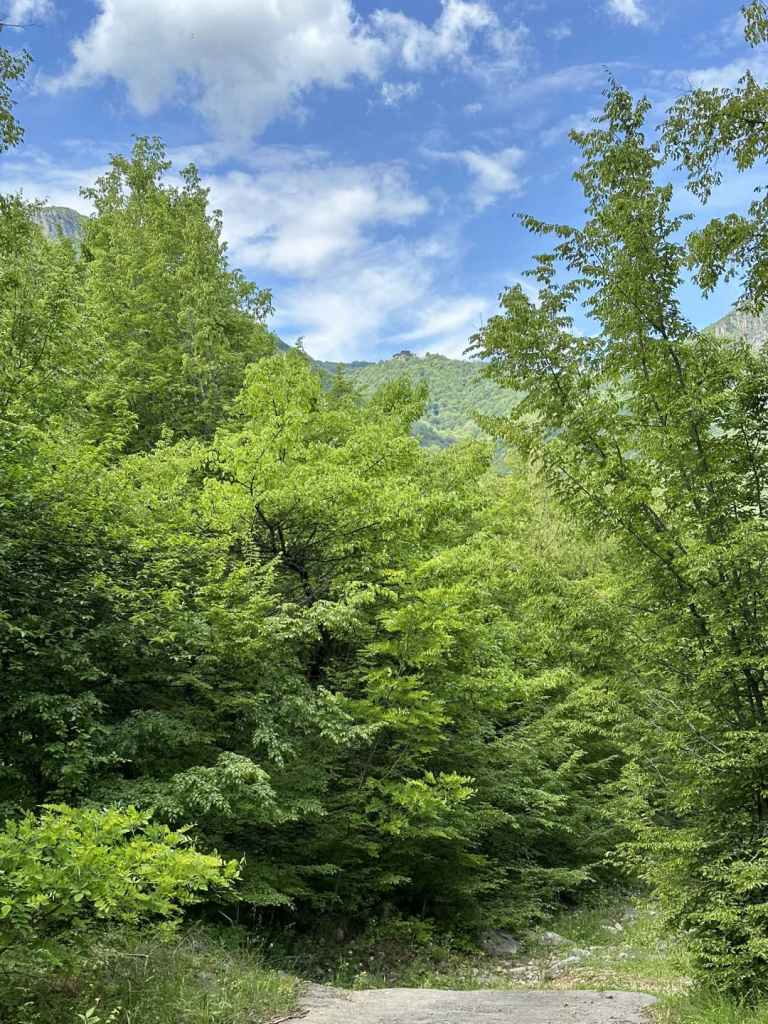
Once you are back at the car, turn around and return the way you have come. Glozhene Waterfall, called Vara because of the limestone, is 13.5 kilometres away. You retrace your route, but having left the centre of Teteven behind, you continue on the 358, ignoring the turning to Golyam Izvor, and 2.4 kilometres after officially leaving Teteven, you will come to a lay-by on the right, next to a mehana or restaurant called Vidrite (‘The Otters’). Park here. In front of the restaurant, next to the road, there is a little sign that says ‘Glozhene Waterfall’. Yes, but the little fall you see in front of you is not Glozhene Waterfall proper, and I dread to think how many people have arrived, taken a photograph and driven off without actually seeing the waterfall itself. To reach the waterfall, you must continue along the road on foot for 120 metres. Next to a STOP sign, there is a partially tarmacked track that doubles back on your right. Follow this track, and in 150 metres you will reach the course of the river. The waterfall is above you, on your left. To reach it, you must now follow a barely visible path on the lefthand side of the river. Just plunge into the trees, you will find it, and this path will take you in 90 metres to the base of the waterfall, one of the most spectacular waterfalls in Bulgaria. I include a map below, showing the lay-by, the restaurant Vidrite (which was closed) and the route from the road 358 to the waterfall. It’s not that difficult, but it does seem to create a lot of confusion!

As you are returning on the track, you will catch a glimpse of Glozhene Monastery on the mountain opposite, our next destination. There is a path from Glozhene Village to the monastery, but most people approach by car from Malak Izvor (the smaller version of Golyam Izvor). To do this, continue on the 358 into Glozhene and after 2.3 kilometres turn left over the River Vit (signposted for the monastery, Yablanitsa, 9 km, and Sofia, 92 km). Continue for 8 kilometres until you reach a turning on your left (signposted for the monastery and Malak Izvor, 2 km). Drive through the village and, after 2.5 kilometres, there is a turning on the left for the monastery.

The distance from here to the monastery is 5.5 kilometres. The road gets steadily worse, and it is difficult for two vehicles to pass each other going in opposite directions. On the way up, we got stuck behind a bus (!) and, on the way down, we got stuck in a hailstorm. But never mind. As you approach the monastery, there is a car park on the left (for which we had to pay 3 leva). There is then a second car park a little further on, and the road stops.

Glozhene Monastery is said to have been founded by a prince from Kiev called George Glozh (who gave his name to the village below) in the thirteenth century. Originally, the monastery, which is dedicated to St George, was down in the village, but the icon of St George kept disappearing and reappearing on top of the hill (a wonderful site with stunning views), so in the end the monks got the message and moved the monastery uphill. You are unlikely to come across a more dramatically located monastery, which helped keep it protected during Ottoman rule. There even used to be a secret tunnel connecting the monastery with the village below, but it was destroyed during an earthquake. You can enter the church and light a candle. There is also a restaurant serving food.

You may find that the day’s excursion has been long enough, but if you still have energy, there is a cave called Morovitsa, one of the longest in Bulgaria, the path to which begins at the gate of the monastery. It is a six-kilometre round trip, which took us 2¼ hours. The path heads right from the monastery and soon becomes a muddy track. In little under one kilometre, this track brought us out into the open, next to a picnic hut. Be careful. You need to join a track that is higher up, on your right. After one kilometre, a path leaves this track on the left, clearly signposted for the cave. The path crosses a stream and then descends rather steeply to the cave. Be careful, because it is slippery. I wouldn’t say this part of the visit is essential – it really depends on your priorities.

To return to Sofia, drive back through Malak Izvor. On reaching the road from Glozhene, go left (signposted for Yablanitsa, 1 km). You will pass under the motorway. Drive into Yablanitsa until you reach a T-junction. Turn left here (signposted for Sofia, 80 km). At the next T-junction, again turn left (signposted for Sofia, 76 km). You will leave Yablanitsa and almost immediately reach the slip road for the motorway. Drive safely!

I had already visited the waterfalls in Teteven and wasn’t planning to include them because we went too early, in winter, before the snow melt. It makes such a difference going in May. Together with Vara Waterfall in Glozhene, they were magical, majestic and mystical.

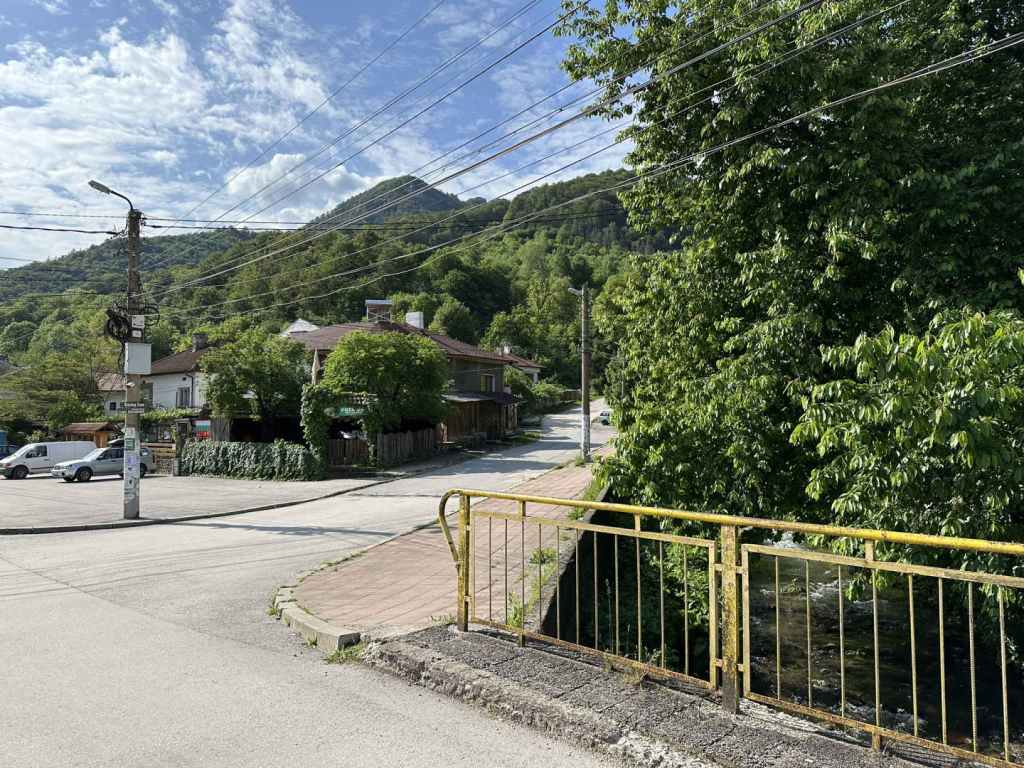
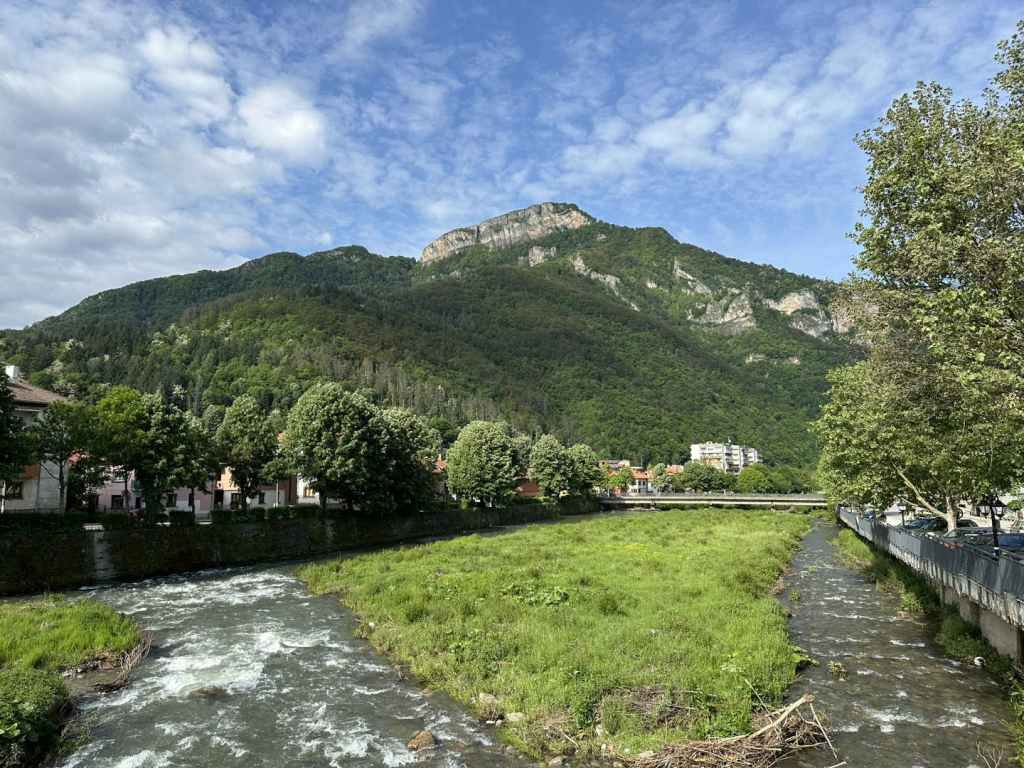
A general view of the River Vit passing through Teteven.
The turning for Skoka Waterfall.
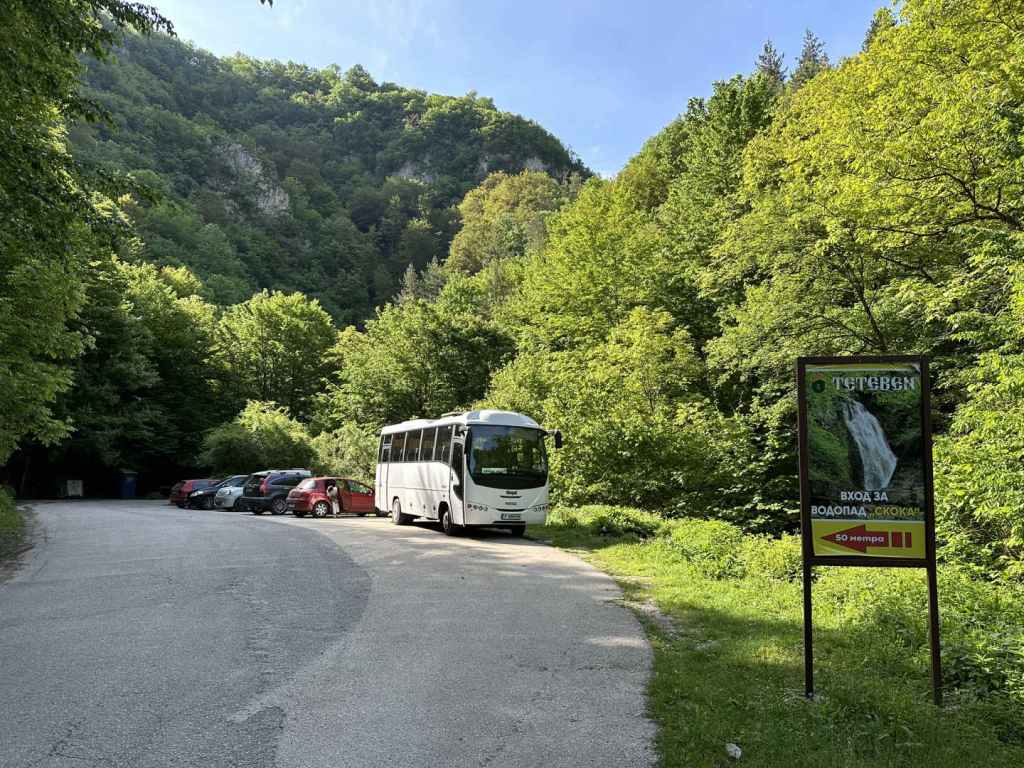
The car park for Skoka Waterfall.
The beginning of the ecopath to Skoka Waterfall.
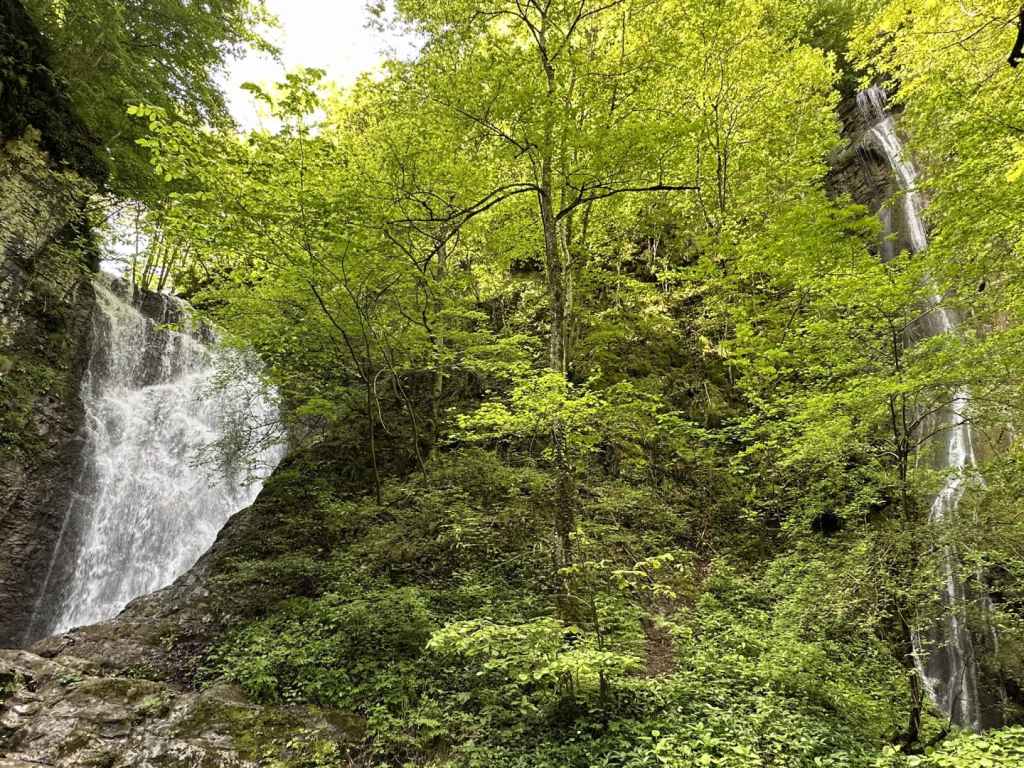
Teteven’s two waterfalls, Skoka and Praskalo, at the end of the ecopath.
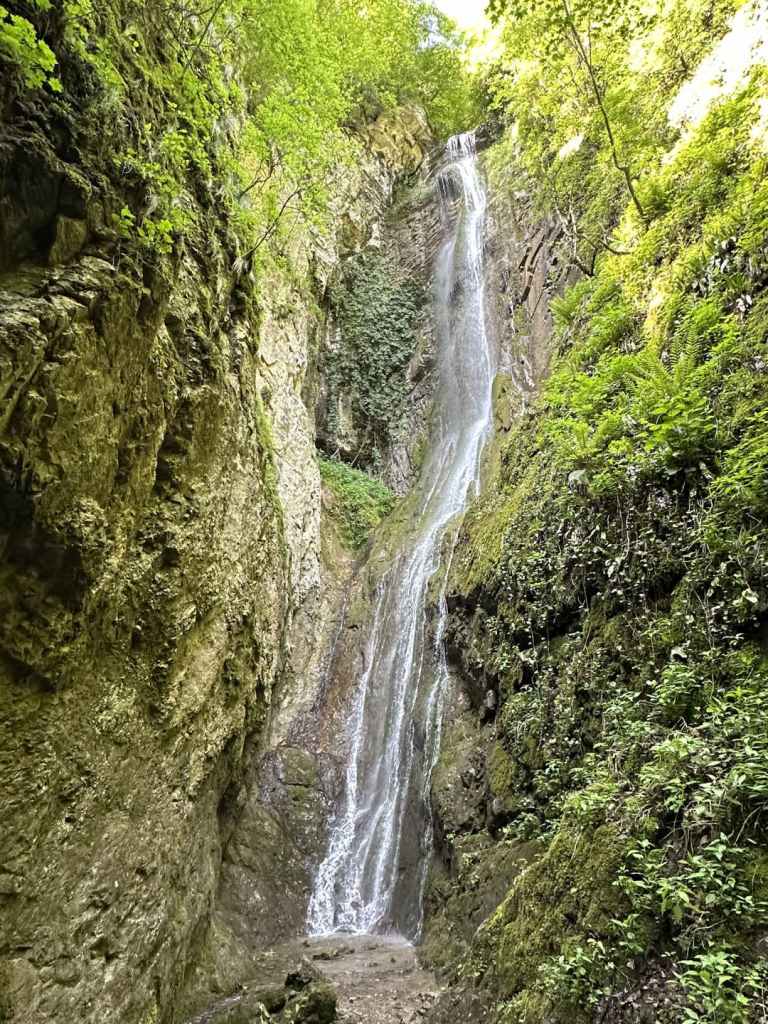
Skoka Waterfall in May.
The spiritual Praskalo Waterfall.
The lay-by before the restaurant Vidrite.
The sign for ‘Glozhene Waterfall’, which is actually much higher up.
The partially tarmacked track that leaves the 358 a short distance away.
Glozhene Waterfall.
The view from the track towards Glozhene Monastery.
The gate to Glozhene Monastery.
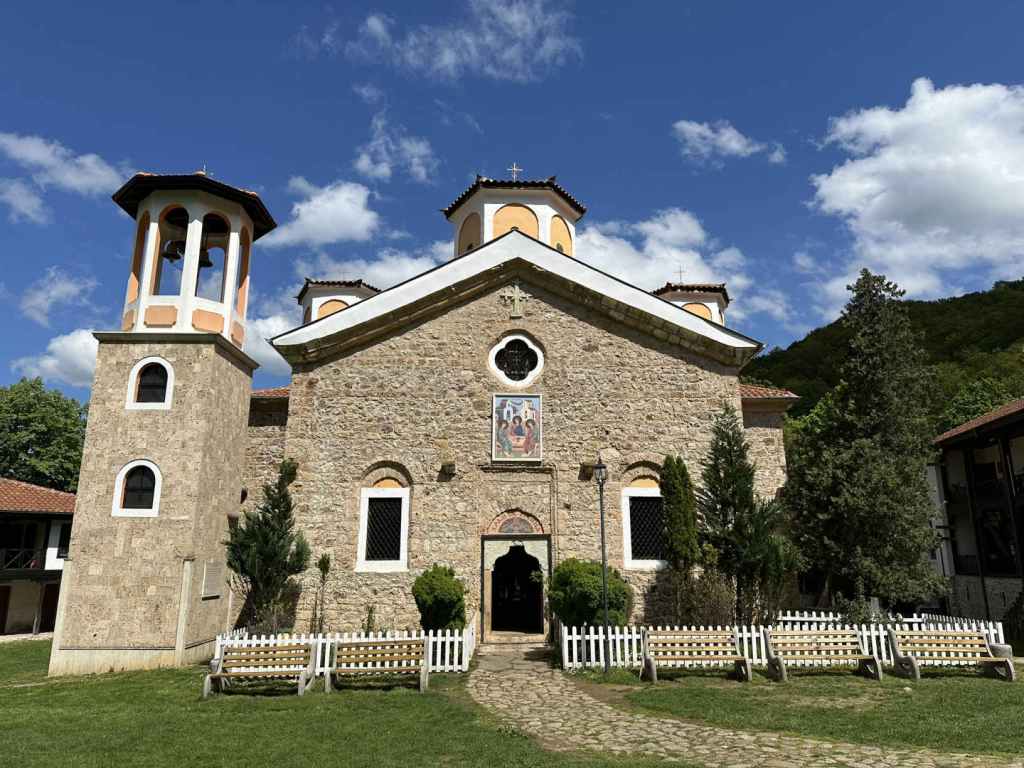
The church in Glozhene Monastery.
Morovitsa Cave.
A map showing how to get from the lay-by next to Vidrite to Glozhene Waterfall above.

6. Heart

When we see and hear – that is, when we acquire spiritual vision – a seed is planted in the earth of our heart. This is why see and hear, with the addition of the phonetic pair d-t, give seed and heart. We need our eyes and ears to be opened.

Seed is also the past tense of see – or it would be, if see was a regular verb. And the past tense of hear would be heart.

This is because the past tense in English, which is written -ed, is pronounced d or t, depending on whether the previous sound is voiced or not. If the previous sound is voiced, for example b, then the pronunciation of -ed is d (mobbed); if, however, the previous sound is voiceless, for example p, then the pronunciation of -ed is t (stopped). It is only if the previous sound is d or t that the sounds have to be separated by a vowel sound and the pronunciation is id (decided).

An inordinate amount of importance is placed on the ability to see and hear in the Gospels. Christ is always crying out, “Let anyone with ears to hear listen!” (Mt 11:15, Mk 4:9). In Matthew 13:16, he tells the disciples, “Blessed are your eyes, for they see, and your ears, for they hear.” He is referring to spiritual vision, which unfortunately is not the kind of vision that is usually taught in schools, because in schools children are taught to label and count, to analyze, to think, to rely on reason, on effort (“work hard, and you’ll get good marks”), and this creates a certain distance between us and the things that surround us, leading to the idea that we can do something with them, such as deal, trade, buy and sell because they are somehow alien to us, external (we adopt the same attitude towards language).

It also encourages the idea that in order to achieve something in this life we must act (do something to something or someone else). If you teach a child to count up from 1 (never from 0), you are encouraging them to think in terms of profit and loss, quantity, what comes in and what goes out, you are encouraging them to trade in the things of this world, which is the whole basis of the dominant system, capitalism (counting up). You are not encouraging them to truly see the things of this world for what they are worth and to rejoice in them. This comes to us naturally, but in the hurly-burly of classrooms it is often extracted. A good example would be a friend of mine’s ability to draw. Before he attended school, he drew beautifully (several of his drawings were published in National Geographic Kids). Once he started attending school and went to art lessons, where he was taught the names of artists and encouraged to remember them, his drawing became analytical, predictable, uninspired. He had lost that innocency of vision that Christ wants us to reclaim because he began to analyze, to do the exercises that he was set, to put everything in boxes, to learn not in order to appreciate, but to pass exams (to achieve a certain mark).

This idea of effort being rewarded is very dangerous, because it leads to the notion that we must always be doing something, and that implies doing something to something, not just letting it be. I have a neighbour who is always cutting down trees and bushes. This morning, another bush had disappeared. I noticed its absence. He obviously feels the need to be busy, but I can’t quite understand why he doesn’t leave them alone. After all, trees provide food, warmth, oxygen, shade, and homes (somewhere to hide) for the sparrows and great tits that populate the local area.

And what do we see with? Our eyes (addition of y). What do we use to hear? The ear (addition of h). So, we have: eyes-see-seed and ear-hear-heart, with the addition of the phonetic pair d-t in the final word of each triplet. This is because in order for the spiritual seed to take root in the earth of our heart, and to effect a change, we must be able to see/hear the message. Otherwise, the words will fall on deaf ears. This is the message of the Parable of the Sower that precedes the passage in Matthew I quoted earlier.

In the first of the Parables of the Kingdom that follow this passage, the Parable of the Tares, there is one who sows good seed in the field of the world – Christ himself – and the enemy (the devil) who comes at night to sow weeds among the wheat. “The good seed are the children of the kingdom; the weeds are the children of the evil one” (Mt 13:38). Weed and wheat are, of course, connected (phonetic pair d-t, addition of h). They are planted in the same field until the time of the harvest, when an angel will come to glean – language here is predicting the future, it is telling us what will happen, just as, in the case of creation, it tells us how the world came into being.

And isn’t it interesting that, of the two, weed and wheat, it is only the second that has ears? It is also, ironically, only the second that leads to true wealth (addition of l) – which is not having more of something, but seeing the wonder in people and things, without the need to possess or exploit them.

Jonathan Dunne

Heart of Language 6/15

Next: Heart of Language 7/15

Back to: Contents
5. Seed

The life cycle is reflected in language; all the words connected with creation, fertility, reproduction, have aer (air) in them, the same aer that forms the basis of speech.

In order to grow and bear fruit, a seed must be planted in the earth. Yes, but how is this process reflected in language?

A seed must be planted in the ground in order to bear fruit. It must be buried. That is, it must disintegrate (not remain whole) in order to give rise to new life. This is surely a metaphor for our own resurrection.

So, a seed dies, and that is why the two words are connected in reverse if we interchange the front vowels e and i. We cannot bring forth new life except by being put in the ground (our ego, that is). We become dead to our selfish demands. And out of that deadness comes a new, unrestricted potential.

Alternatively, we can add the letter l to seed and get sleep (by rotating the letters d and p). Seeds have been known to sleep in the ground for hundreds of years before sprouting and giving forth new life. In the ancient world, early Christians referred to burial sites not as “graves”, but as “resting places”, because the people buried there were not dead, but asleep.

The seed dies and puts forth first a root and then a shoot. Do you see how these words are connected – seed with root (phonetic pair d-t, step in the alphabet r-s), root with shoot (step in the alphabet r-s, addition of h)?

A shoot appears above ground (reminding us of the seed’s existence), and as it does so, it closely resembles a tooth (step in the alphabet s-t) emerging from the gum. Language is often graphic like this.

As the root divides into two (too, addition of r), so the shoot divides into three and becomes a tree (addition of h). It cannot become a tree except by dividing, by putting out branches, as cells divide in the human body. This division, paradoxically, leads to increase.

One is three, as in the case of the Holy Trinity. The tree harnesses the power of the sun (Son) through each leaf (phonetic pair l-r, pair of letters that look alike f-t). It produces a flower, which wilts, giving way to a fruit (froot) with the seed in it. And the whole process begins anew.

So, we have: seed (dies/sleep)-root (two)-shoot (tooth)-tree (three)-leaf-fruit (root), all perfectly reproduced by language.

It is the earth that enables this, and perhaps it is time we notice the presence of air (written aer in Latin and Greek) in so many words that have to do with creation, fertility, reproduction: aer-earth-water-breath, bread, breast (all three sources of nourishment that share the same first four letters with the phonetic pair d-t, addition of h/s)-create-father.

They all have aer in them, just as language is impossible without breath (we add voice to our breath to form the vowels; we obstruct our breath, with or without voice, to form the consonants). This again provides a link between the physical world (we cannot live without breathing) and language (aer is in many words connected with creation).

And by taking a step in the alphabet, r-s, as we did with God-ego (d-e) and father-gather (f-g), we find aer in sea (imagine a sea without aer in it, it would be dead).

This brings us back to the account of creation in the Book of Genesis. On day three, the earth was created (spoken into being), together with the sea, plants yielding seed and the fruit tree.

All reflected in the words we speak.

Jonathan Dunne

Heart of Language 5/15

Next: Heart of Language 6/15

Back to: Contents

Yamna

Yamna is a beautiful village located after the town of Etropole, 95 kilometres north-east of Sofia. The waterfall is called ‘Vranya Voda’, meaning ‘Crow Water’ – legend has it some monks were looking to found a monastery in the vicinity of Etropole and looked at this spot, when a crow alighted. The crow took off, however, and flew to the nearby site of the present-day monastery, but the event – and the name – stuck. It is not a particularly tall waterfall, but it more than makes up for any lack of height by its beauty and the beauty of the surrounding landscape. The waterfall is covered in green and yellow moss, and this makes it quite distinctive.

To reach Yamna, you must take the A2 motorway from Sofia in the direction of Varna. After Botevgrad, leave the motorway where it is signposted for Pravets and Etropole and follow the signs for Etropole, ignoring the signs for Pravets centre. You will pass Pravets Golf Club on your right. Keep going straight. After 3.3 kilometres, turn right for Etropole (still 16 km away). In another 3 kilometres on this road, you will see a sign for Pravets Monastery on your right. Keep going. After another 7 kilometres, again turn right for Etropole (now 3 km) and in 900 metres you will enter the town.

Having entered Etropole, continue on this road for 2 kilometres, where there is a sharp turning on the left, signposted for Etropole Monastery, Yamna and Teteven. Turn left here. The road takes you back on yourself. In 3 kilometres, you reach the village of Ribaritsa, which is where Etropole Monastery is situated. This was an important monastery during Ottoman times, an important scriptorium – many manuscripts were copied here. For now, keep going to Yamna, which is another 5 kilometres. 500 metres after you enter the village of Yamna, the road turns sharply left, and a dirt track diverges from the road on the right. This is the walk to the waterfall. There is a convenient verge just before the dirt track where you can park.

Yamna Waterfall is only half an hour’s walk. In ten minutes (470 metres), a path diverges from the track on the right. This path goes to Etropole Monastery and is said to take 1 hour and 50 minutes. Immediately after this path, there is a second path on the right, with yellow markers. This path will take you to the bottom of the waterfall. If you continue on the track and ignore the two paths, you will come to a field.

Take the second path. The path skirts the forest, which is above you on your right. In five minutes, it crosses a little stream, with views of Yamna on the left. In another ten minutes (1.12 km from the start of the walk), you come to a stream with a limestone bed. This is the stream that flows from the waterfall. The waterfall is up on your right. There is no set path that takes you there – you must walk on one or other bank of the stream, and in 5-10 minutes you will reach the base of the waterfall.

It is only a small area where you can stand, but it is really a privilege to be in front of a wonder of nature, the drops of water sparkling in a clear sky, the moss so soft and intricate. We really enjoyed it. We had lunch further down by the stream. The journey back to where you parked the car will take not much more than twenty minutes.

On the way back, it is imperative that you pay a visit to Etropole Monastery from Ribaritsa village. The diversion is 2.5 kilometres and well worth the effort. Not only does Etropole Monastery have an important history and provide an oasis of peace in the middle of nature, there is a second waterfall behind the monastery called Varovitets! Behind the nineteenth-century church, there is a small door in the wall of the monastery, through which you can gain access to the waterfall, which is only ten minutes away, by following the yellow signs (or the course of the river). It makes for an excellent day trip from Sofia. Not far away is Glozhene Monastery, which also has a waterfall nearby.

500 metres after you enter Yamna, the road veers left and a dirt track diverges on the right. Park here.
The track, which you follow for ten minutes (470 metres).
Take the second path on the right. This goes to the bottom of the waterfall. The track leads to a field.
A view of Yamna on the left.
The path as it arrives at the stream formed by the waterfall.
The waterfall is up on the right, a short climb away.
Yamna Waterfall.
The sparkling water.
The waterfall with the landscape behind.
The moss, a feature of this waterfall!
The katholikon (main church) of Etropole Monastery, built in 1858.
Varovitets Waterfall behind Etropole Monastery.

4. Earth

Our bodies mimic the physical environment – our heart is the earth, our soul the soil, where spiritual seeds can be planted.

Father also contains earth. And heart.

In Genesis 1:9-13, we read that the earth was created on day three, together with the sea, seed and tree (words with which it is connected).

We have seen that the vowels emerge from the throat, where language originates, in a different order from that in the alphabet. The back vowels are u and o, the central vowel is a, and the front vowels are e and i; u and i are close vowels, o and e are mid vowels, while a is an open vowel (this is why a doctor asks you to pronounce this vowel when she wants to look down your throat, because it is the most open vowel there is). So the vowels as they proceed from the throat form an inverted pyramid, according to where in the mouth they are produced:

u                                             i

o                      e

a

Now, vowels are fluid. I have already explained that they equate to water (water forms in the mouth when you hold one for long enough). This is why a vowel can be said to flow (phonetic pair f-v, addition of e). Languages like Arabic and Hebrew don’t even write them down, they only list the consonants. This means it is fairly easy to change a vowel in a word connection, especially if they are pronounced next to each other, such as a and e.

If we maintain the digraph th, then we can see that earth in reverse gives three, the day on which it was created. It also happens to be the third planet in order of increasing distance from the sun. And, in Christian theology, it was created by the Trinity (God in three persons) – the Father (the origin of breath, from whom the Holy Spirit proceeds), the Son (Christ the Word, begotten of the Father) and the Holy Spirit (breath or wind, pneuma in Greek, the basis of all speech). So we can understand why the number three might be so important for earth.

While a seed is planted in the earth in order for it to grow, a spiritual seed has to be planted in another kind of earth – our heart. This is why the two words are connected. It is not enough for us to hear a spiritual message, we have to take the message on board, to let it into our hearts, where the seed of an idea can grow and bear fruit.

We might then remember the layer of something that surrounds the earth like a shell or a circumference: soil. We cannot place the seed on a rock or among thorns if we want it to grow. We must place it in the soil.

Again, when it is a question of a spiritual seed, there is another kind of soil where we must plant it – our soul. This is where the spiritual seed will bear fruit.

So, earth-heart, soil-soul (containing the close vowels, u and i).

Language is drawing a comparison between the physical environment and our own bodies, in which the heart takes precedence (and where the soul is perhaps a layer around it, as soil is a layer around the earth).

Jonathan Dunne

Heart of Language 4/15

Next: Heart of Language 5/15

Back to: Contents
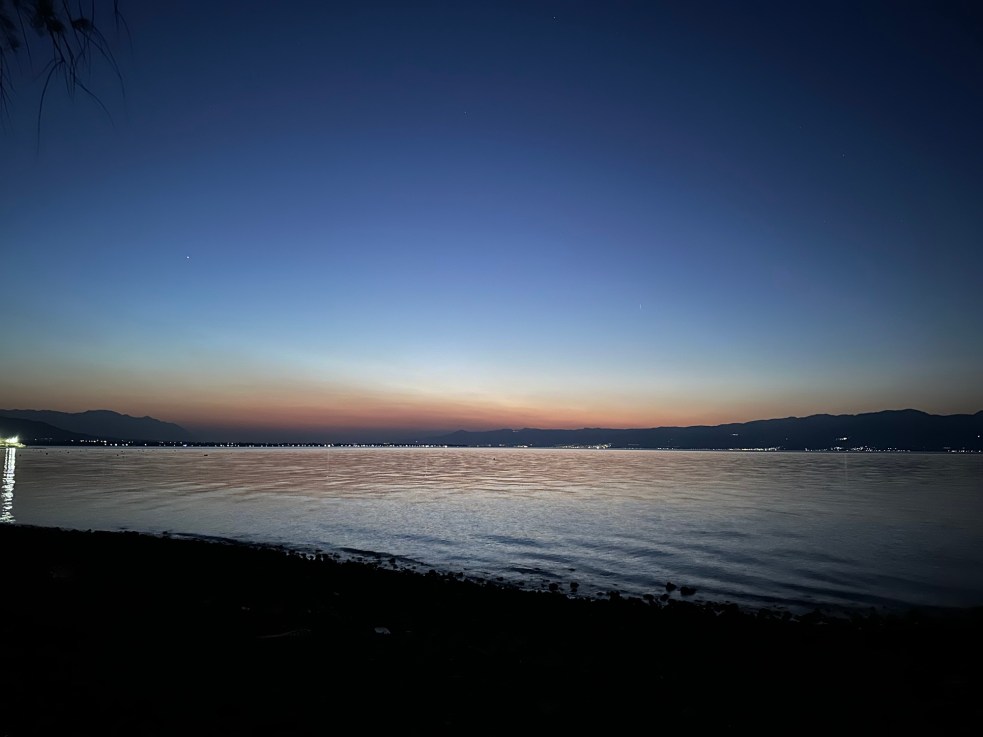
Kamena Vourla

In the distance

is the last

broken shard

home

The tallest

mountain of all

so faint

it almost merges

with the sky

People are not

aware

it’s coming

They swim

in the sea

drink coffee

think of supper

and things

that might have been

revisit their youth

the lessons learned

and not wanted again

You must become

a man

before you can become

a god-man

Christ in reverse

You must know

what it is to hurt

and be hurt

even when it is

undeserved

You stand in the morning

and turn

from the sun’s path

to where the sun

is pointing

That is your ascent

You are not alone

You might even find yourself

in company

like the parrots

in Porphyrios’s cage

nestling up to each other

their necks shaped

for this

Loss is hard

means sleeping with a stranger

the old shape

has gone

been stripped of its punctuation

it is no longer

surrounded by words

it is now a thought

waiting to be spoken

The old text is useless

it can only be recycled

or observed

The smell has gone

the adoration

the string of syllables

proffered

like bubbles in the ocean

The breath has returned

It is being held now

by the Alchemist himself

whose memory has no limit

who only ever ascribes

good intentions

to the languages he has learned

Language is our vehicle

our rocket to the stars

which are full stops

glowing

in the darkness

of our hearts

Sunday, 5 pm

PreviousNextContents
The Alchemist – icon of Christ in Athens Metropolitan Cathedral, dating from the late 1800s.

Aegina

We sit

on white slabs of stone

There are fewer of us

now

The seagulls

horizontal apostrophes

find this funny

or at least

they guffaw momentarily

it’s not easy

keeping punctuation afloat

airborne

and at the same time

keeping up with the boat

Loss

is a small chair

in the church

meant for a child

but the adults use them

Actually

they are quite comfortable

it’s nice

being closer to the floor

the perspective is different

The saint’s eyes

follow you

wherever you go

whatever you may

have thought you were

he knows

Hours of standing in church

that willingness to be there

to stay upright

even when the ship

lurches

That act of resolution

is all we are

is everything

The time passes

seems not to exist

I have experienced this

before

Ten minutes is

two hours

two hours

a gesture

kneeling on the floor

helping someone

unhook their chain

their cross

their anchor

A cross

is all that anchors you

to this world

I look up

The passengers are

even fewer

more whiteness

confronts my eyes

People are black words

time a blank page

waiting to be filled

Saturday, 10.15 am

PreviousNextContents

St Nectarios of Aegina

Piraeus

There is a sign

A man is running

towards some steps

that go down

An arrow

emanating from his chest

points him (you and me)

in that direction

though he is too big

for the stairs

which reach

up to his left arm

he rather looks

as if

he will collide

with the back of them

If he were to stand

on the stairs

where would they take him?

In a downward direction

Back to land

There is no suggestion

that the man

should climb up

to the blue sky

with nothing to hold

onto

The boat is silent

(apart from that hum)

it doesn’t take part

in the people’s conversations

shrieks screams

loud guffaws

or the dog’s bark

It is level with the horizon

the container ships

huts on stilts

for men who fish

on a lungful of air

more shards

the mirror here

in a better condition

almost complete

the force behind it

pushing it to meet

what will come

Friday, 4.15 pm

PreviousNextContents