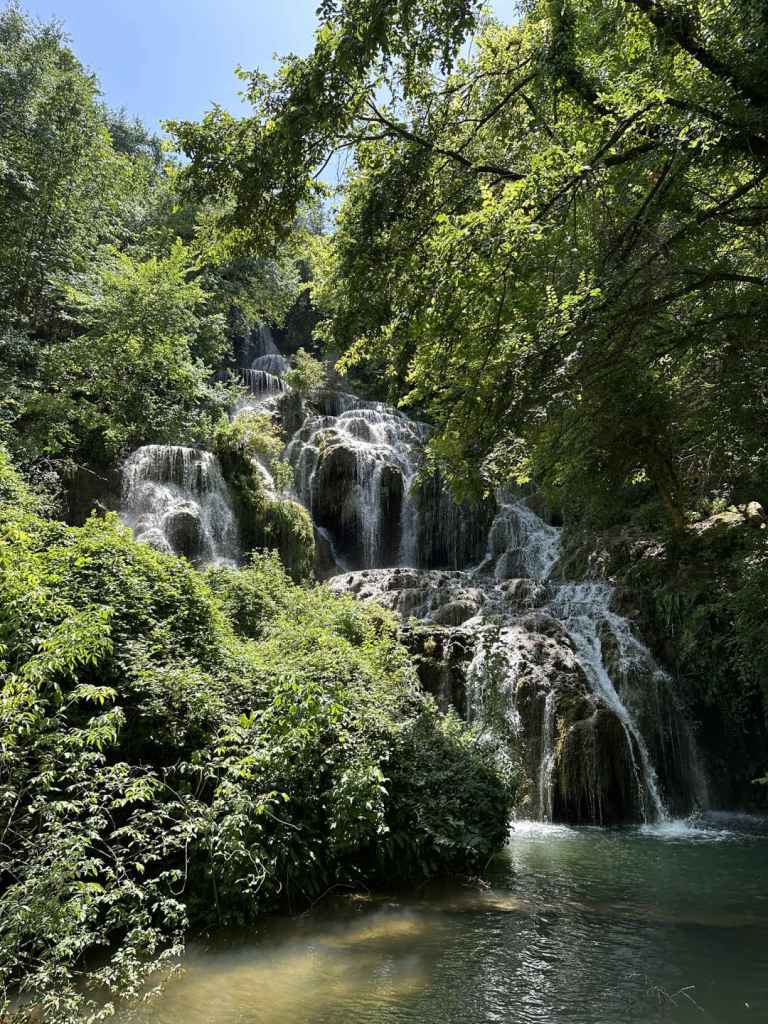
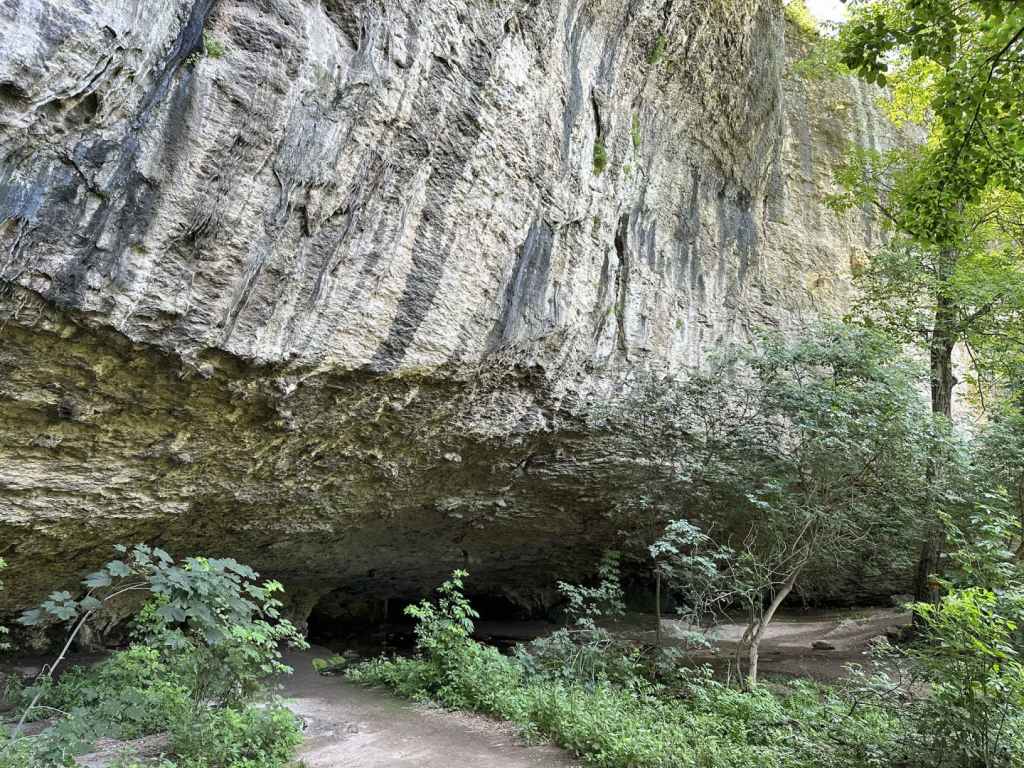
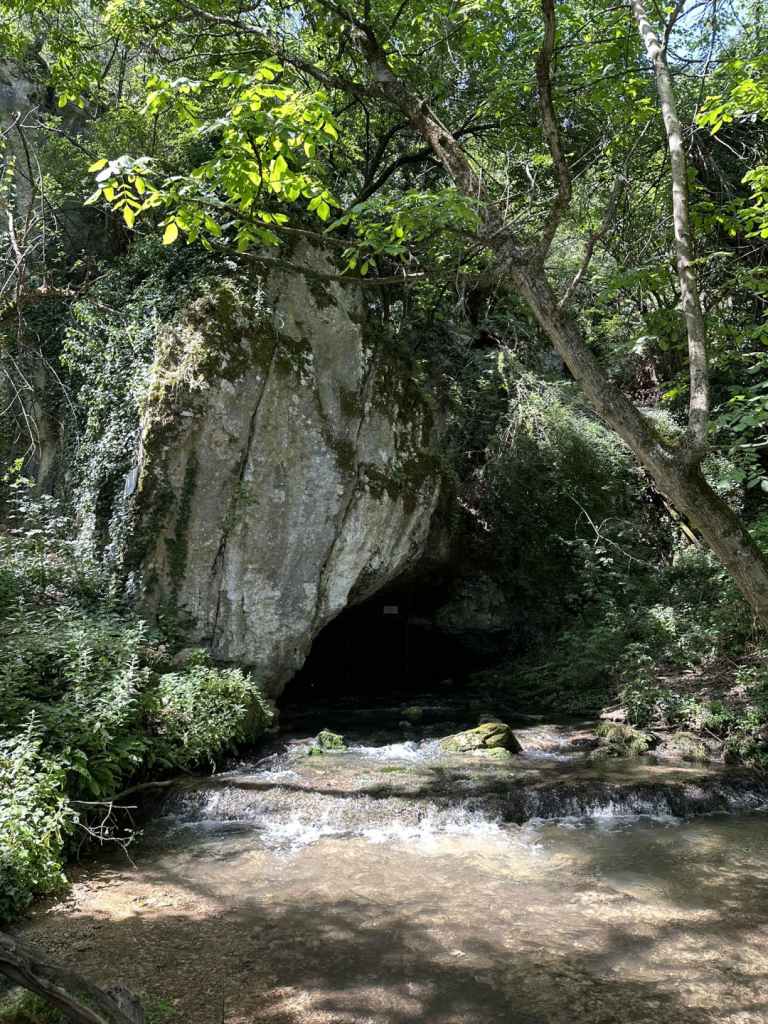
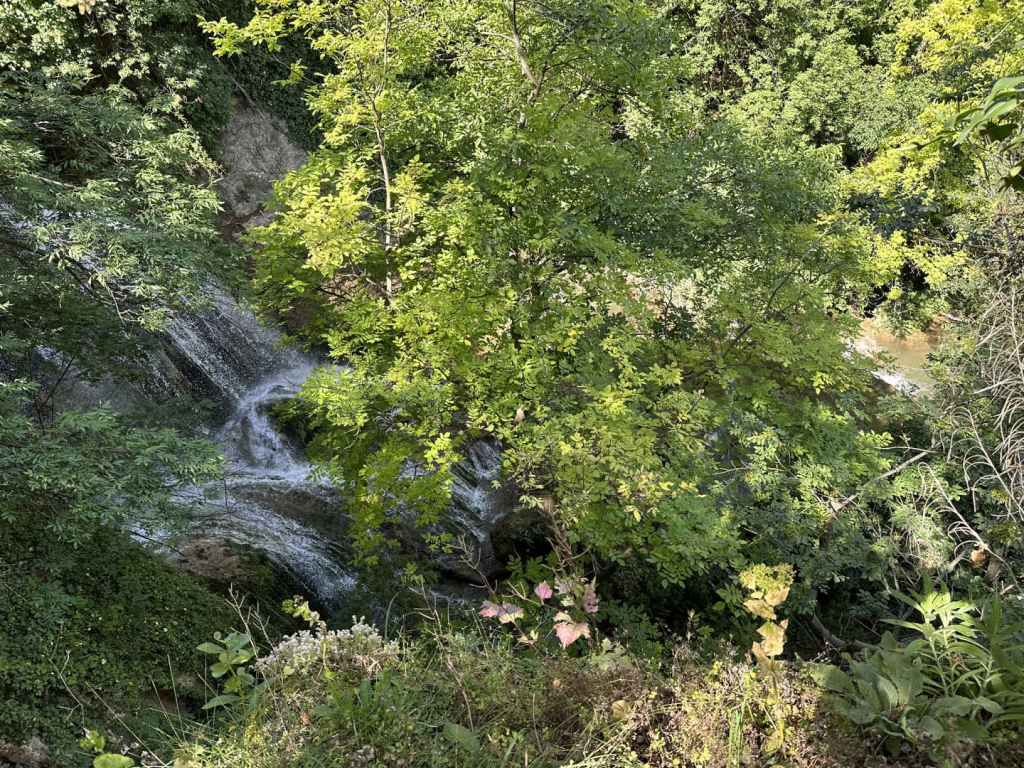
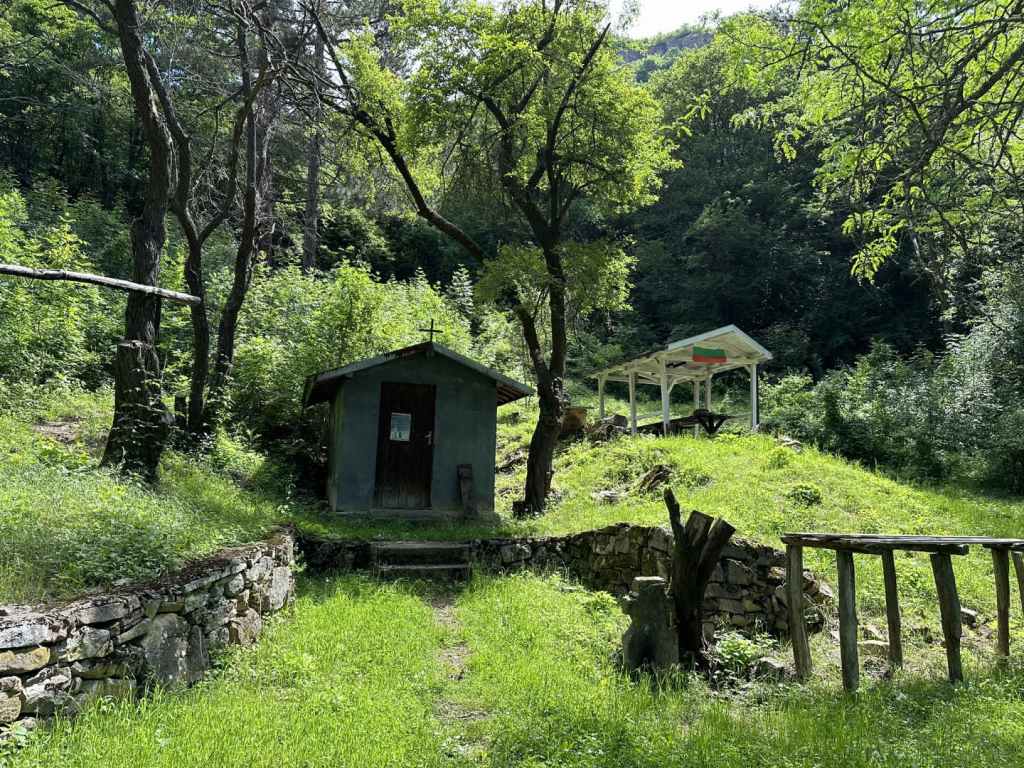
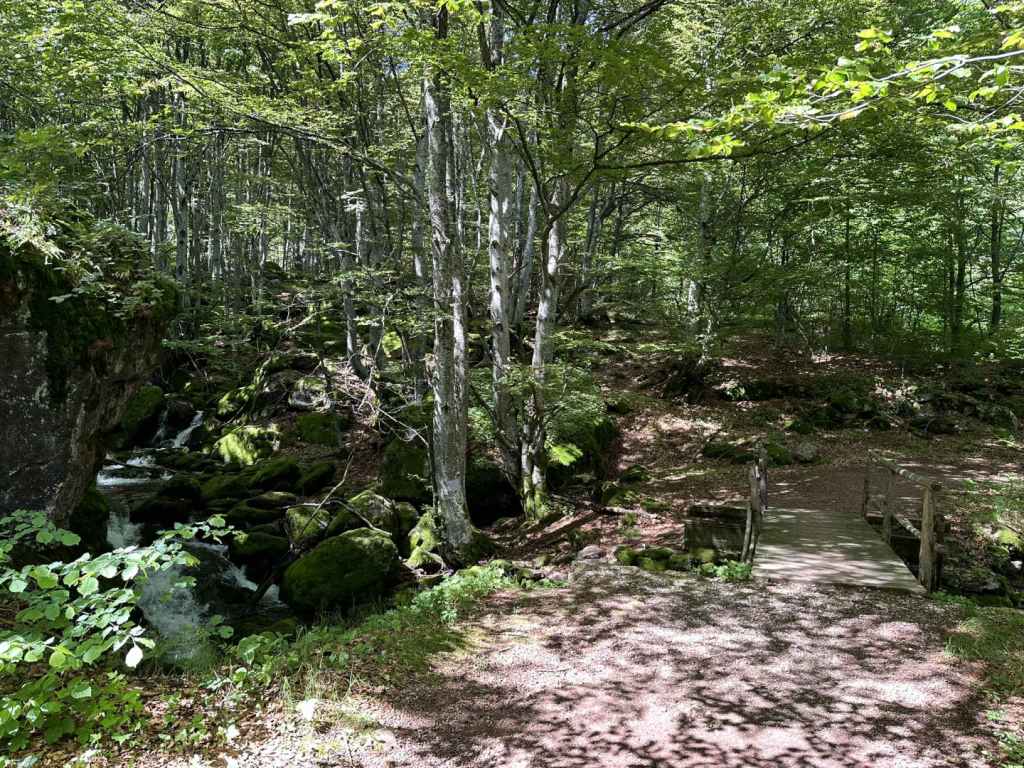
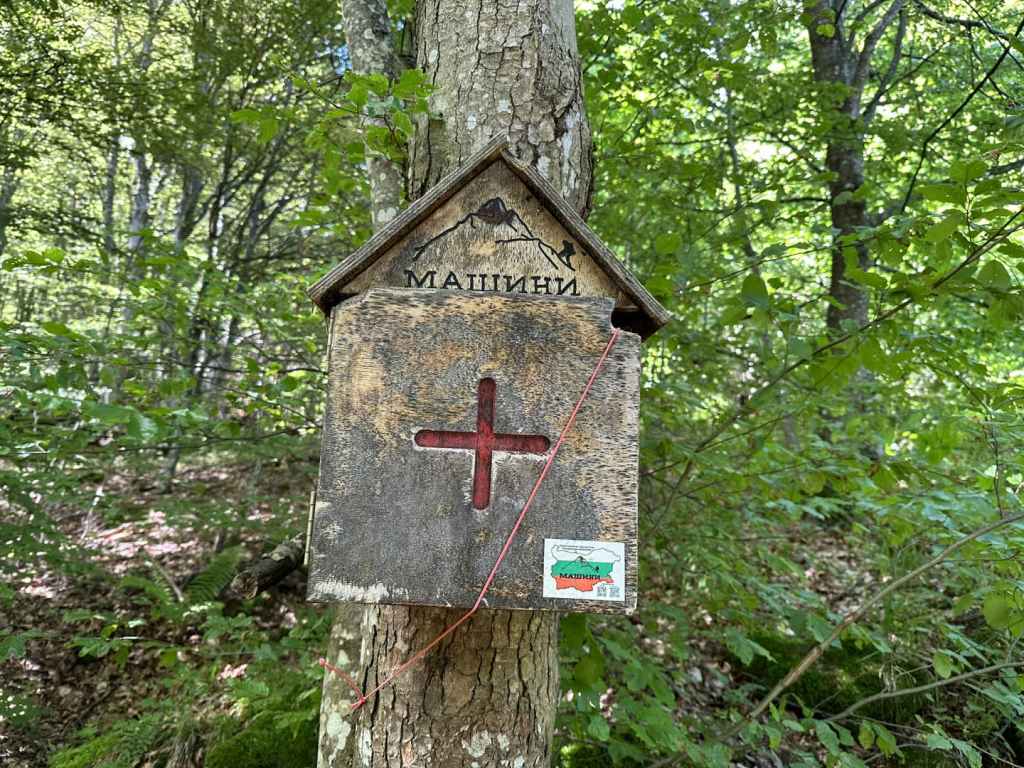
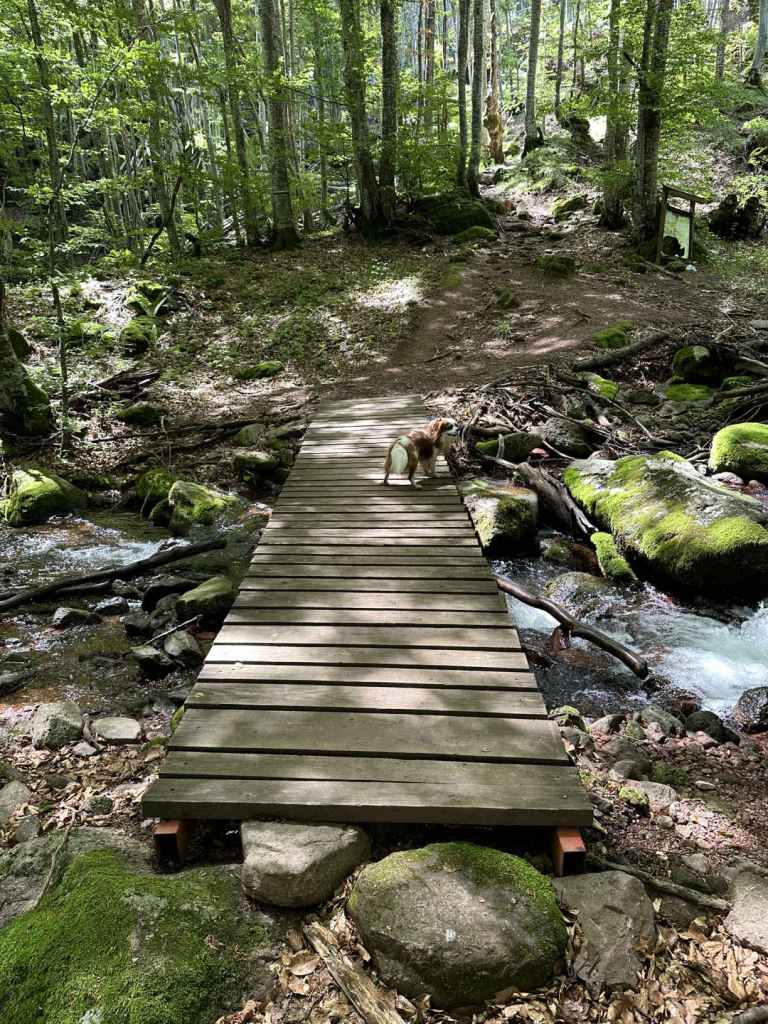
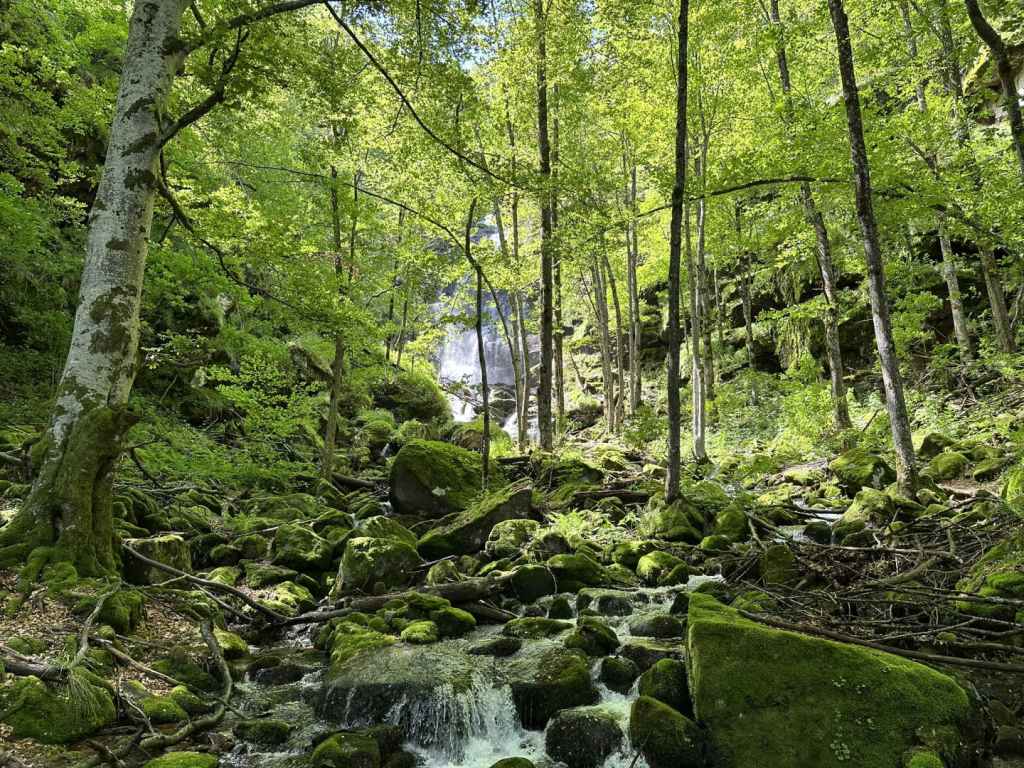
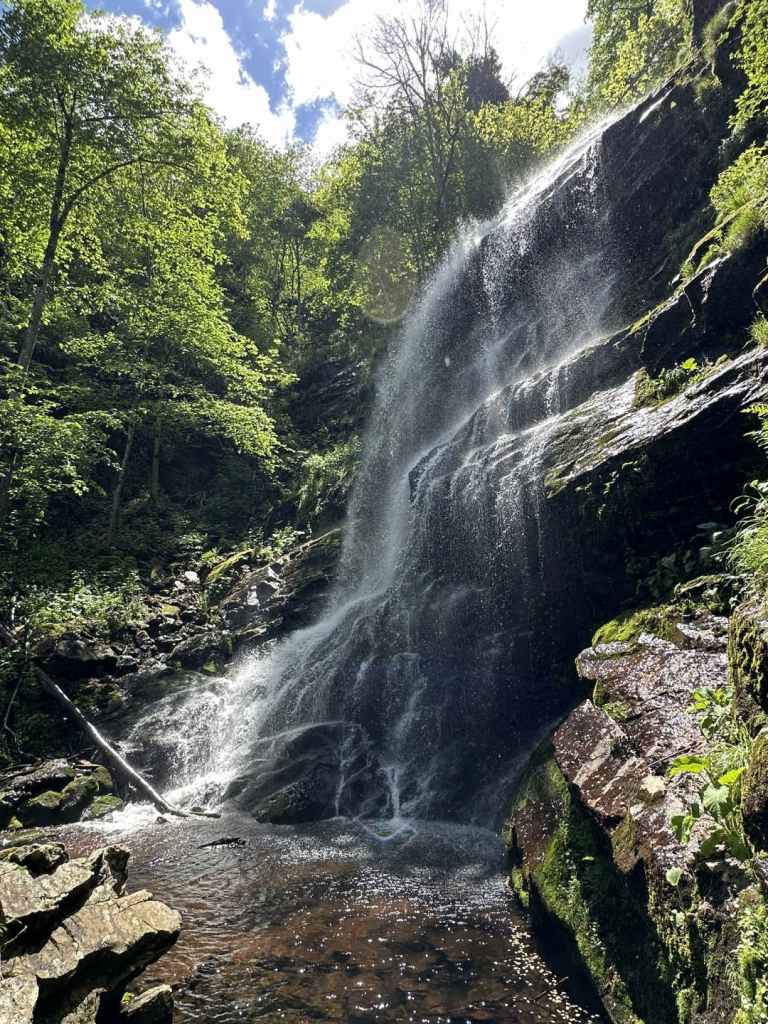
Krushuna can be reached from Sofia, via Lovech, but it’s a long drive there and back in one day. I stayed in Troyan; the other obvious starting point is Veliko Tarnovo. The village is reached from the III-301 road between Lovech and Levski. Depending on the direction you are coming from, you will turn off this road in Aleksandrovo (from Lovech) or Letnitsa (from Levski). The point is that Krushuna is not on the main road and you must leave the III-301, but once you’ve done that, it’s not far. The entrance to Krushuna Waterfalls is 400 metres south of the main square in Krushuna, it’s very easy to find, and there is plenty of parking. When I first went some years ago, it was forest, and you had to find your own way, but now it is a park, Maarata Park, with stalls, restaurants, even a hotel. The waterfall has been tamed, turned into a tourist attraction.
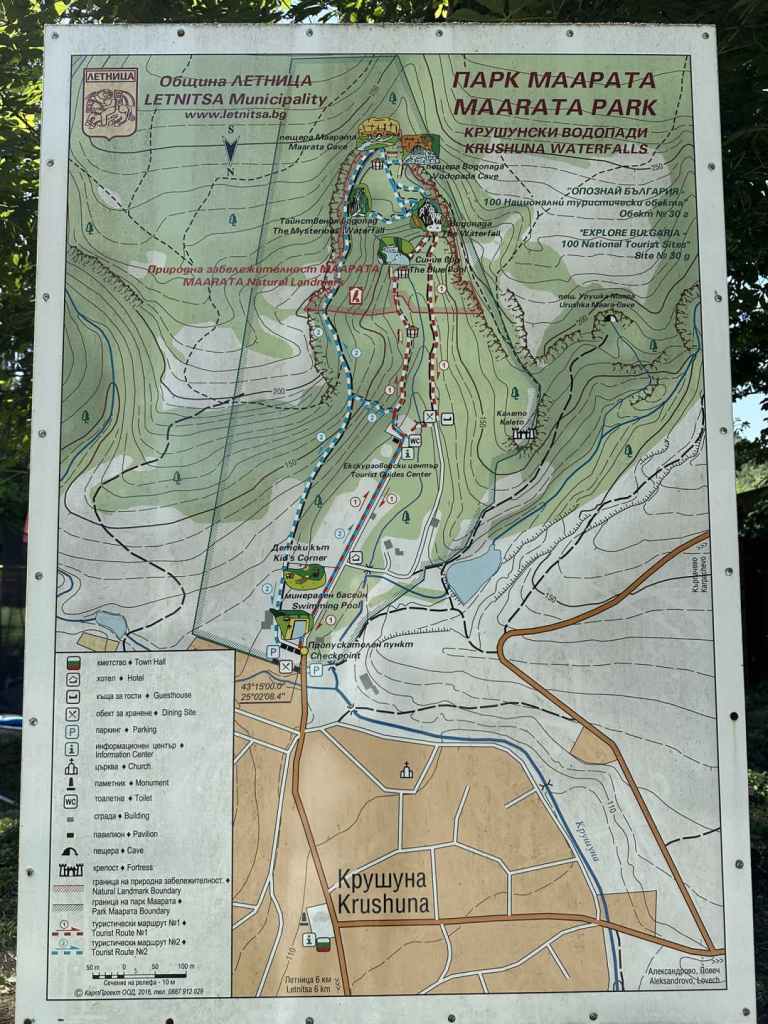
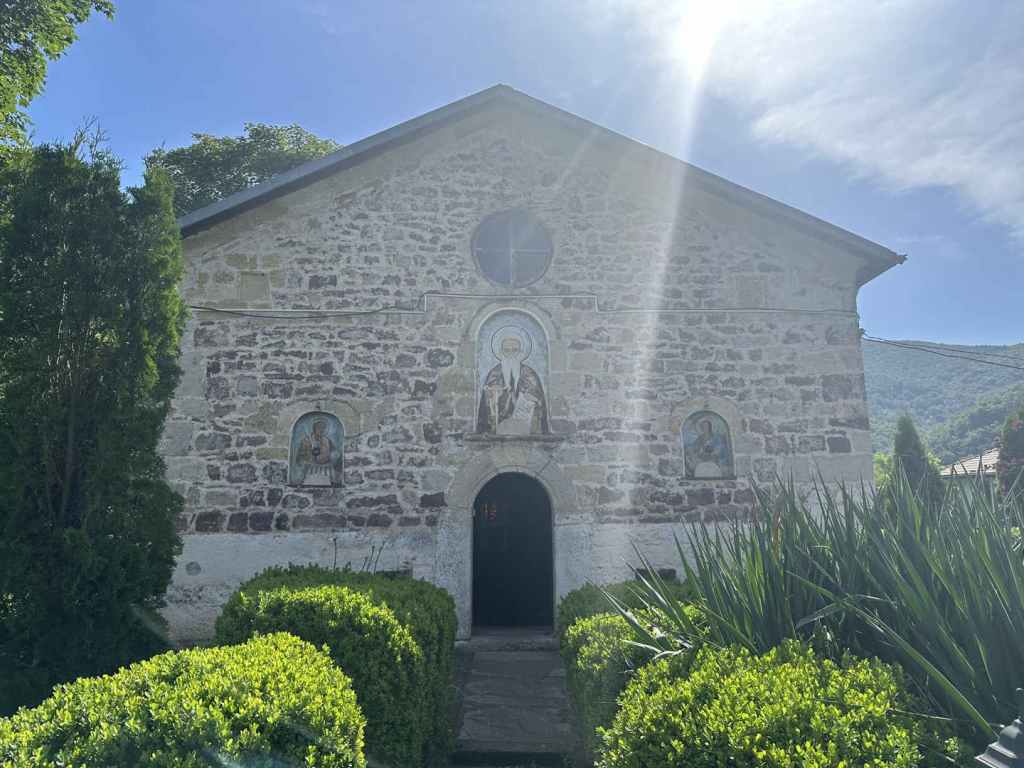
But it is still one of the most beautiful, and best known, waterfalls in Bulgaria. It’s just not wilderness anymore. You must pay a small fee to enter and to park your car (though you could just park in the village), so have some cash with you. Once inside the enclosure, there is a long straight avenue ahead of you, which goes past a hotel on the right, and then a church and a tourist guide centre, for 450 metres. At the end, on the left, is an information board with two routes that you can do, a red route and a blue one.
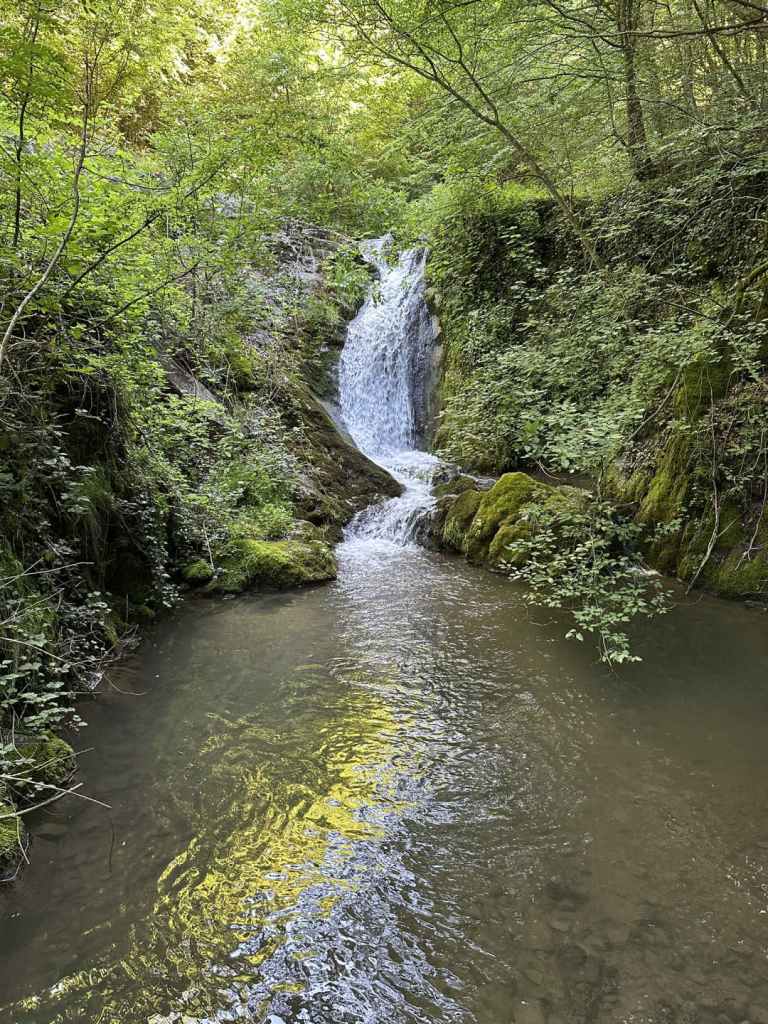
The red route is 800 metres long and takes no more than half an hour. It takes you to the Blue Pool and the main waterfall. Go left at the information board and then right. The path runs along the River Krushuna, sparklingly blue. This no doubt has something to do with the caves up above, where the water comes from. In 300 metres, you reach the Blue Pool, a very pretty sight. There are then some steps up to the main waterfall, as if you are entering the stage at a theatre. There is a viewing platform, from where you can admire the main waterfall, a succession of small falls that combine to impress the visitor. From here, make your way back on the other side of the river. When you reach a guesthouse on the left, go down the steps on your right, past a restaurant and over a bridge, and you will be back where you started.
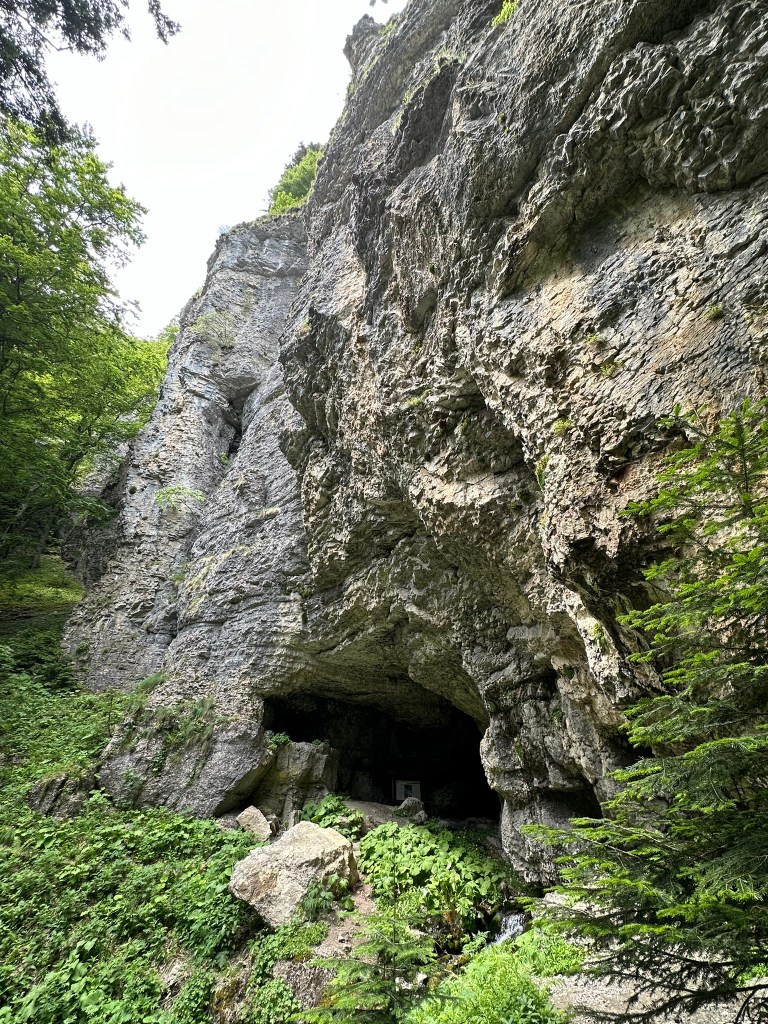
The blue route is longer and takes you above the main waterfall. It is 1.9 kilometres and takes about an hour. Go left at the information board, but this time ascend the steps on your left, which climb steeply for a hundred metres. At the top, turn right. After 300 metres, you have the option to climb the rocks on your left for a ‘panoramic view’ of the rocks and the plain that stretches as far as the eye can see. You don’t have to do this. In another 200 metres, you reach Maarata Cave on your left. Water emerges from tunnels in the rock. Let us call this river 1. You cross a small wooden bridge, and the path goes right. After 50 metres, there is a sign for the Waterfall Cave, which seems to point straight ahead, but no, it is immediately on your left. Water also emerges from this cave, much bluer this time. Let us call this river 2.
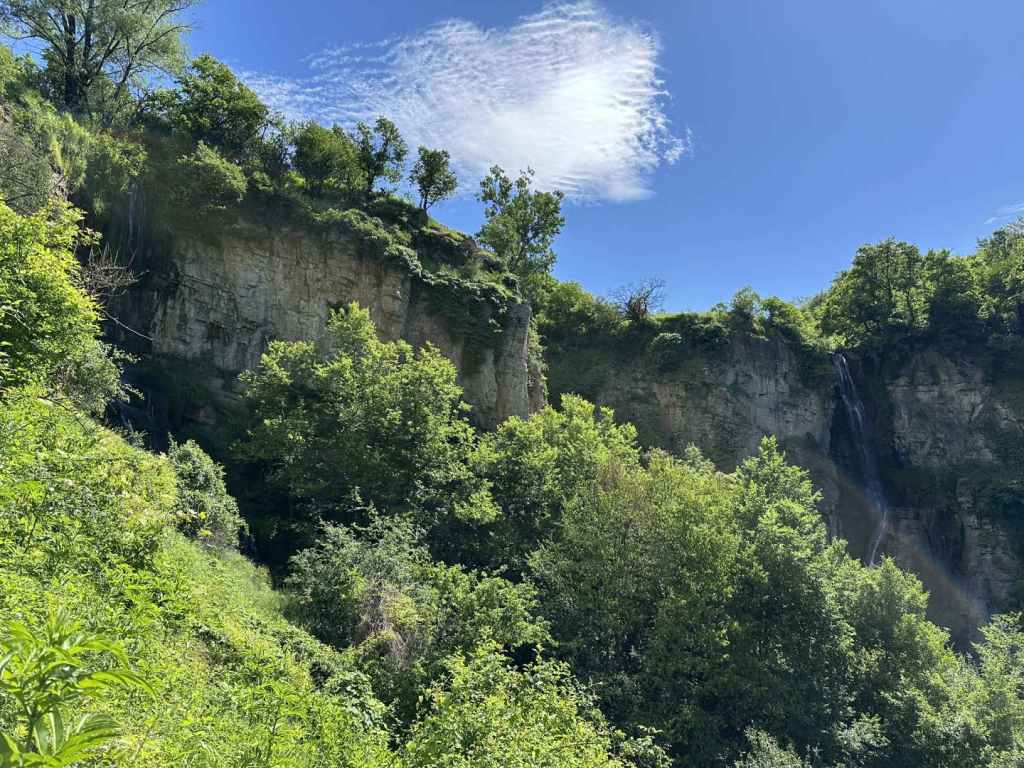
Go back to the path. In 20 metres, there is a path on the left you will come back on. Keep going past two benches and take the path on the right. This will take you to the Mysterious Waterfall, an epithet that could be applied to all waterfalls. In 20 metres, you reach a green railing. The path descends on the right for 50 metres. The railing then goes left, but you turn right here, and in 70 metres you will reach the Mysterious Waterfall, a result of river 1 (the water from Maarata Cave). It looks like a large nose covered in moss. Return to the railing and climb back up, but this time keep going straight, alongside the railing, for 30 metres, which will bring you to the top of the main waterfall, a result of river 2 (the water from the Waterfall Cave). Be very careful here, because there is a large drop.
Now go back to the path you came on, turn right, and the path will bring you in a loop back to where you stopped for the Waterfall Cave earlier. Go back to the wooden bridge by Maarata Cave and return the way you came. When you reach the top of the steps that go down to the information board where you started, there is the option to continue straight. This will take you back to the entrance, swimming pool and shops, by a different route.
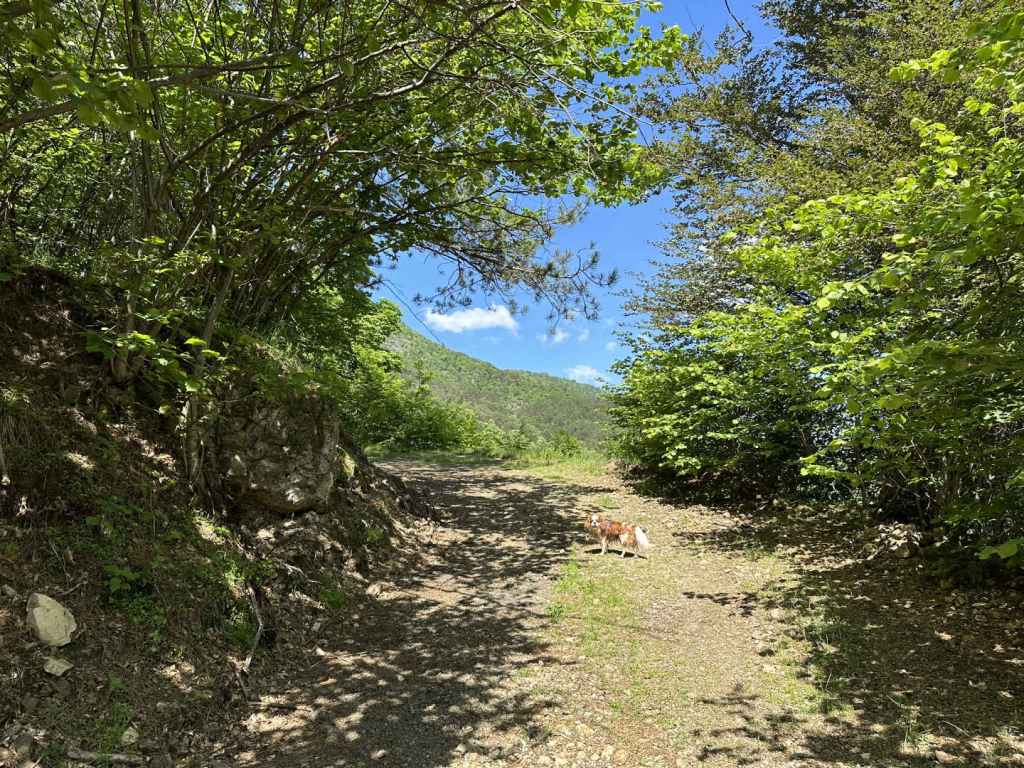
I was nostalgic for the earlier wilderness. I found it strange to visit a place where there was the odd stray dog, I was given receipts (in nature?), I was addressed in Spanish and English. But then I thought the park makes it much easier for groups of schoolchildren to go there, I imagine locals might walk there on a Sunday afternoon, and I enjoyed my double espresso by the river. The waterfall has been tamed, but it is still extraordinarily beautiful.
Krushuna is only 50 kilometres from Vishovgrad, via Pavlikeni and Levski, and could be combined with a visit to this other waterfall unless you decide to combine it with Emen.
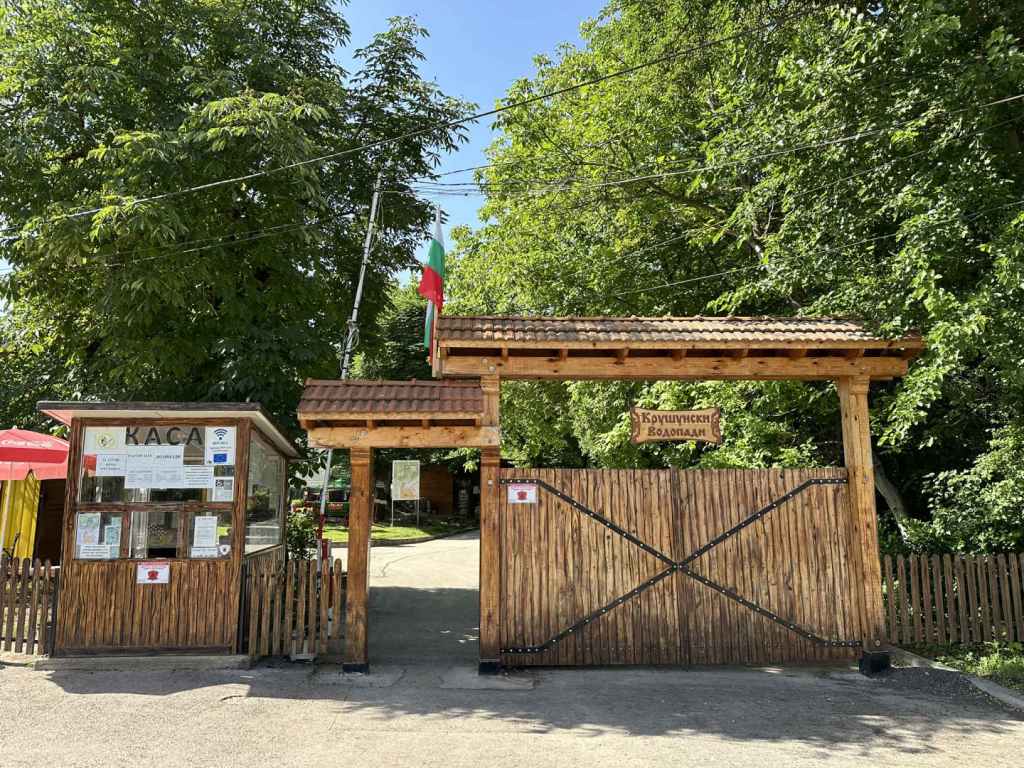
The entrance to the waterfall enclosure, Maarata Park, just south of the main square in Krushuna.
The map detailing the two routes, which for the first 450 metres are the same.
The long straight avenue.
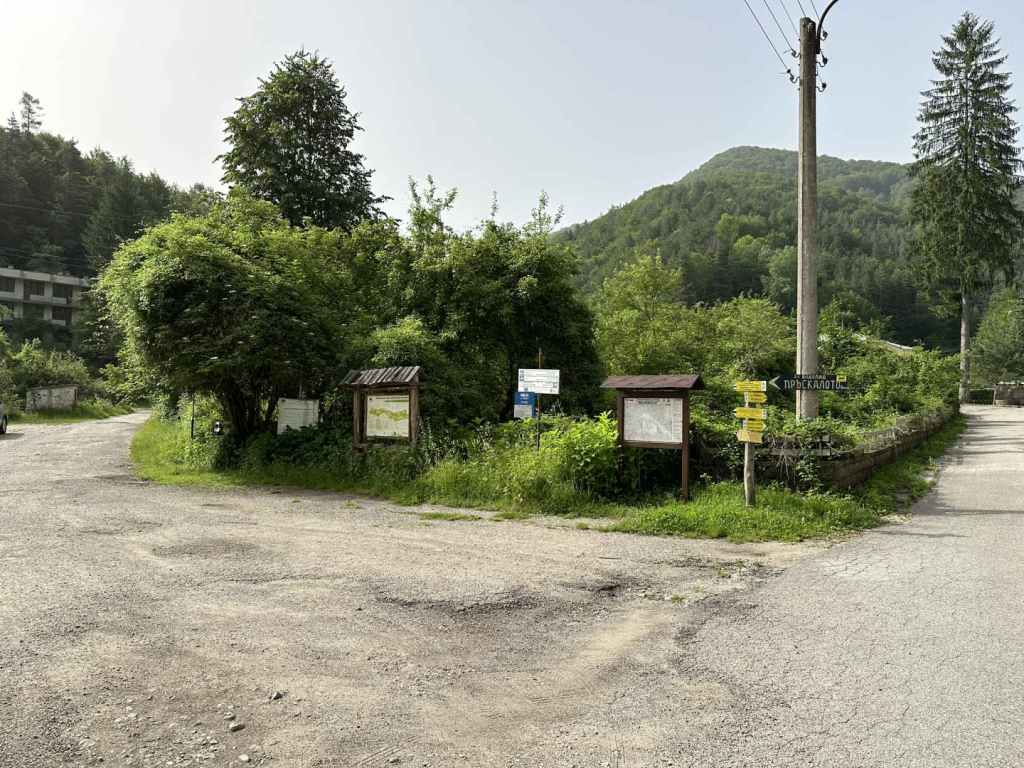
The information board at the end of the avenue, where the two routes diverge.
As for the previous waterfall, Vidimsko Praskalo, Dyavolsko Praskalo is accessed from the town of Apriltsi, directly north of the highest point of the Balkan Mountain, Botev Peak (2376 m). This walk will not take you to the bottom of the waterfall itself, but to a cave called Vodnite Dupki (‘Waterholes’) and to Pleven Hut, the departure point for those wishing to scale Botev Peak. It does, however, offer views of the waterfall from a distance, like the ecopath to Vidimsko Praskalo, leading through some of the most beautiful scenery in this area, with its UNESCO-protected beech forests, which makes it well worth doing. But it has an elevation gain of 636 metres over a distance of ten kilometres, which involves some steep climbs. It should only be attempted in good weather conditions.
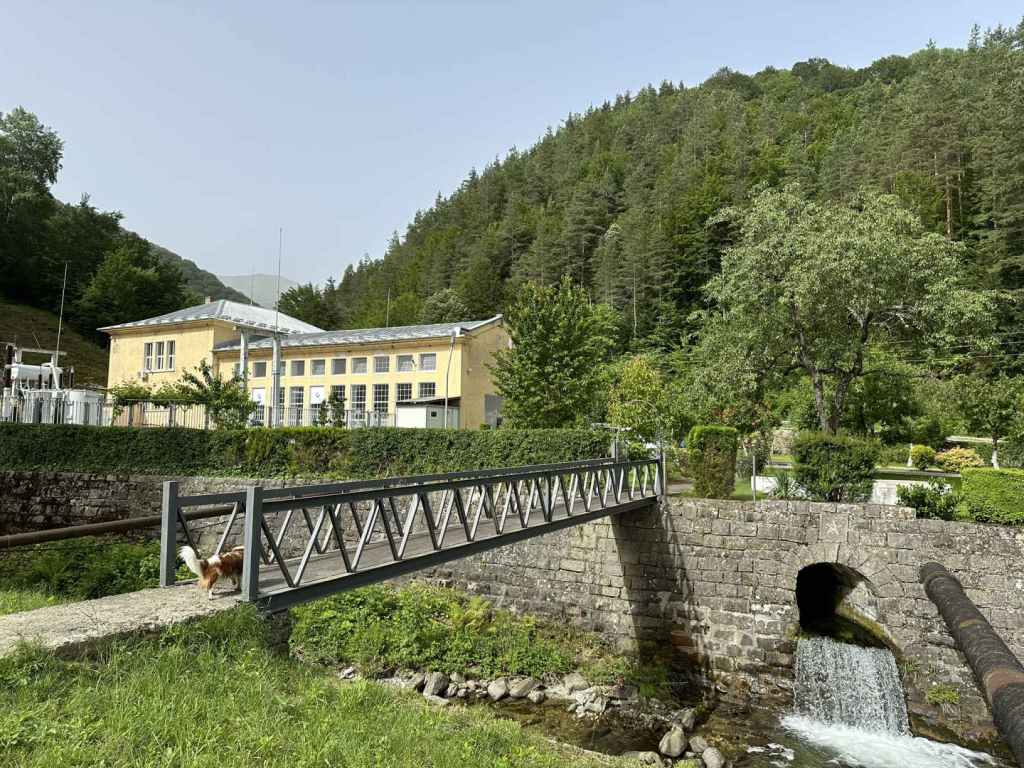
Passing through Apriltsi on the III-607 road, in between the districts of Zla Reka and Novo Selo, take the turning marked ‘kv. Vidima 5’. This turning is next to a bridge over the River Vidima, a river whose source is the waterfall and which features very much in this walk. The road you are on takes you through the centre of Vidima and in 8.5 kilometres arrives at a hydroelectric power station. A turning on the left, directly before the power station, is the start of the ecopath to Vidimsko Praskalo. Continue past the power station on your left. The road becomes quite narrow. In 4.1 kilometres, you reach a car park on your left, with the start of the walk on your right, marked ‘Pleven Hut’. The road continues for a bit, crosses the River Vidima and ends at a second car park, where there is an aerial lift used for transporting goods to the hut.
Having parked the car, you are now ready to start the walk. Take the path that is marked for ‘Pleven Hut’. The River Vidima is on your left. In 440 metres, a path diverges on the right. This is the summer route to Pleven Hut and is the route you will come back on. Continue for another 110 metres, and there is a wooden bridge over the Vidima. A winter route to Pleven Hut continues straight, but we want the route to Vodnite Dupki, or Waterholes, cave, which involves crossing the bridge and then walking uphill through beech forest. The climb becomes quite stiff. At one point, the path doubles back on itself, heading north. It then continues south and, as it does so, you catch glimpses of the waterfall, Dyavolsko Praskalo, through the trees.
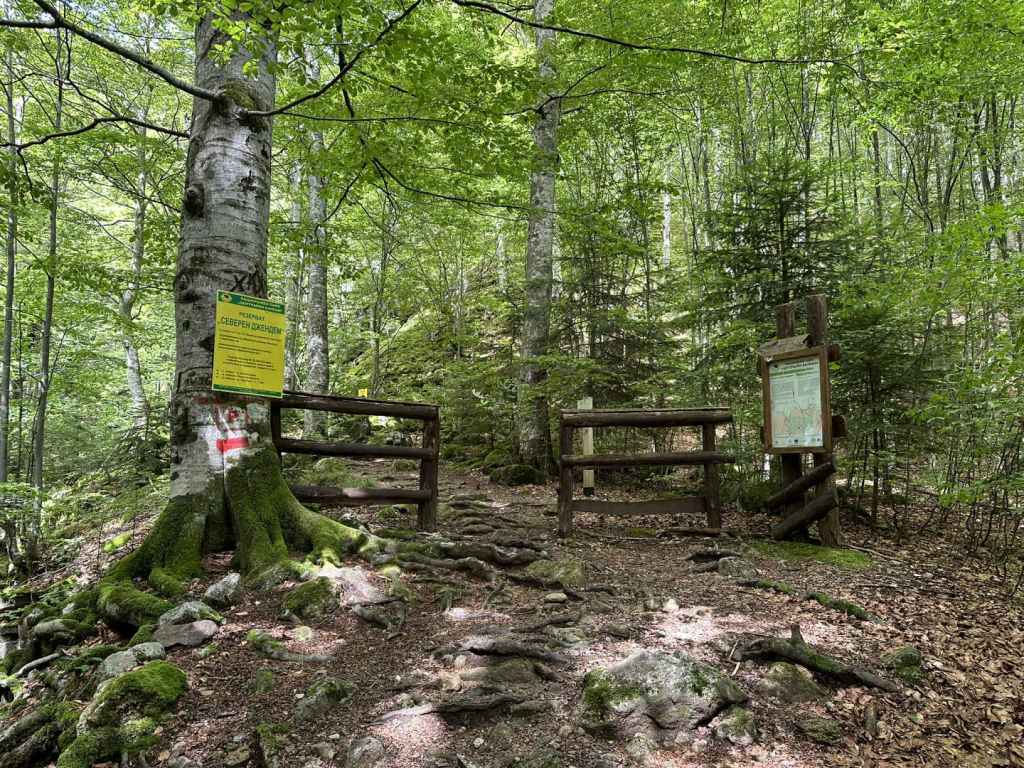
1.7 kilometres after the bridge, you come to a T-junction. The path that goes straight ahead is marked for Pleven Hut and Botev Peak. You want to go left here, to Vodnite Dupki. The path descends in order to cross a stream (soon to become the River Vidima). It climbs again on the other side and, in 300 metres, you can see Pleven Hut across the valley. The path enters the Severen Dzhendem Reserve and descends steeply, going past a moraine field on the right. 500 metres after the sign for the Severen Dzhendem Reserve, it arrives at Vodnite Dupki. As in Krushuna, a stream flows from the cave, accompanied here by cold blasts of air.
The waterfall is a short distance south of the cave. However, because this is a reserve, you are only permitted to go as far as the cave. The path after the cave is noticeably worse, even non-existent, skirting the rocks before entering the valley where the waterfall is situated and the River Vidima has its beginnings. It is best to turn back here. When you reach the T-junction where you turned left earlier for the cave, now follow directions for Pleven Hut. Unmarked paths diverge left and right, but you should look for the yellow signs to the hut. The path again descends before crossing a stream, another tributary of the Vidima. It then climbs on the other side, continuing through beech forest. 1.3 kilometres after the T-junction, you will come to a series of memorial plaques on your left, celebrating the lives of mountaineers who have walked on this mountain. You are now very close to the hut. The path, which until now has been under the cover of the forest, emerges into an open grassy area. There is a shelter for farm animals ahead of you. The grassy slope climbs steeply on your left, in the direction of Botev Peak, and is probably good for skiing in winter. The hut is to your right, behind three other buildings. You’re supposed to go straight and then turn right, with the buildings on your right. You will then reach the entrance to the hut. When I got there, they were listening to very loud, martial Russian music.
What is amazing about the hut is the view from the balcony outside the restaurant. It faces Botev Peak. You can glimpse the wetness of the waterfall to the right of the peak. Vidimsko Praskalo is hidden to the left. This view is unforgettable. I drank copious amounts of tea and exclaimed from time to time. The man running the hut had spent time in Bromley. No wonder he preferred to move back here!
When you have taken your fill, take the path that descends directly from the hut, with green markers and a wooden railing. It is signposted for the locality Mazaneto, which is where you parked the car. The path descends for 1.4 kilometres before rejoining the path you were on earlier, just below the bridge. Turn left here, and in a short while you will be back at the beginning.
The return trip from Pleven Hut to Botev Peak takes about 8-9 hours. It passes the top of Dyavolsko Praskalo, again offering views of the waterfall, but for this you would need to sleep on the mountain.
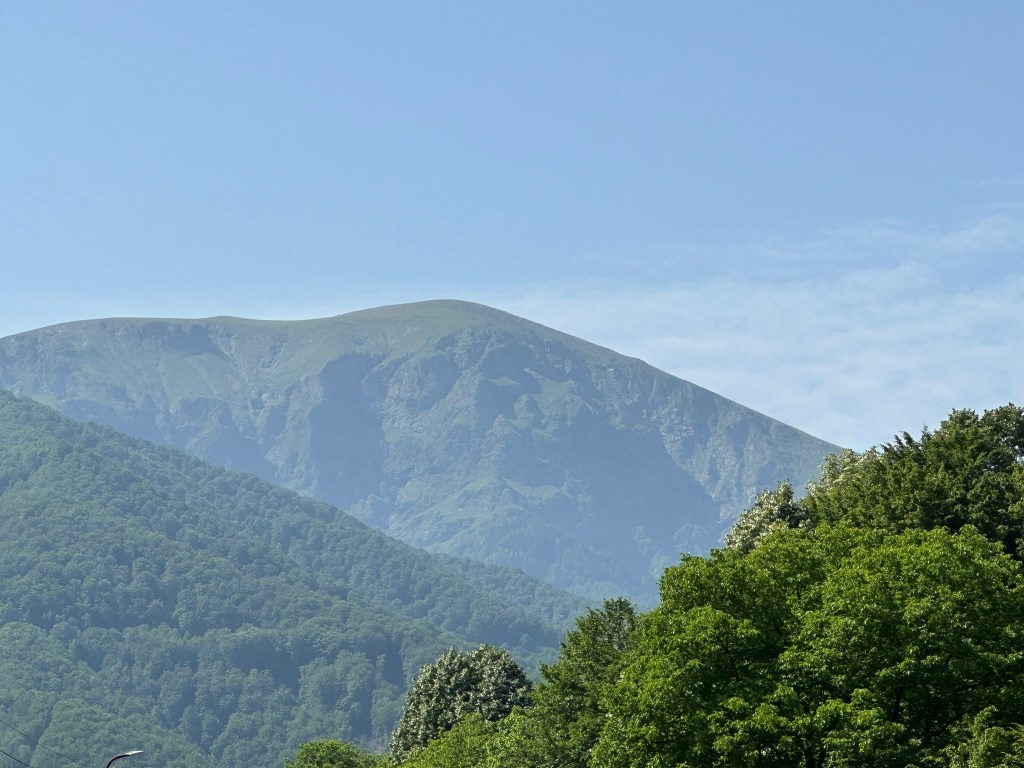
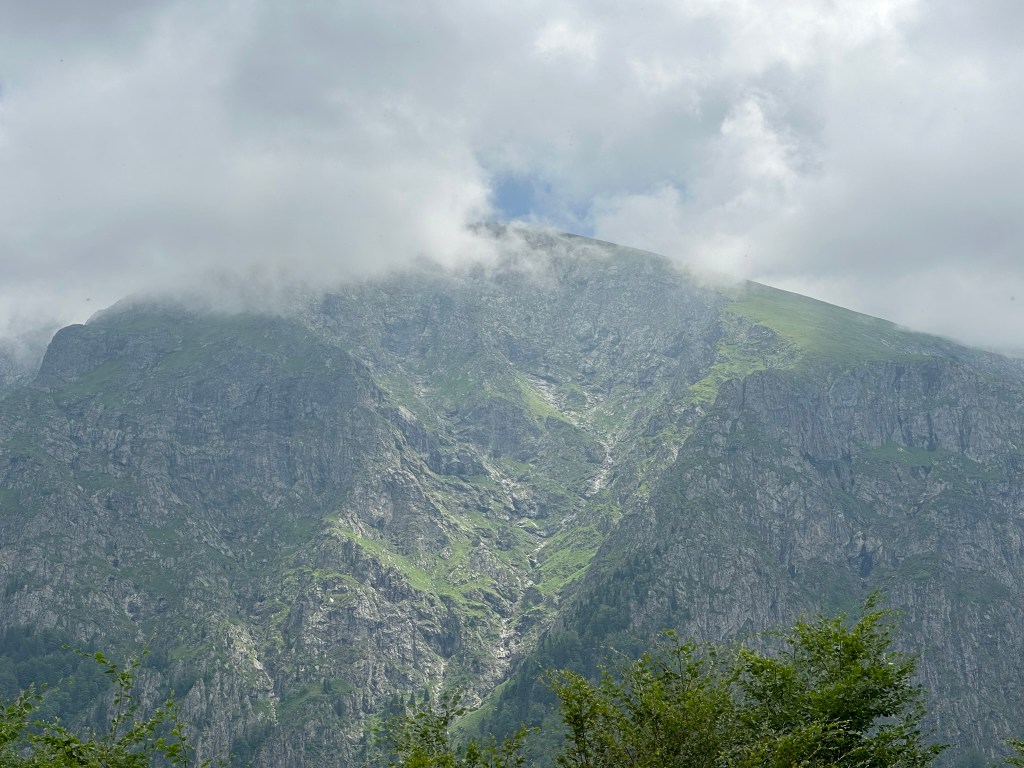
Botev Peak from the road through Vidima.
The start of the walk, marked ‘Pleven Hut’.
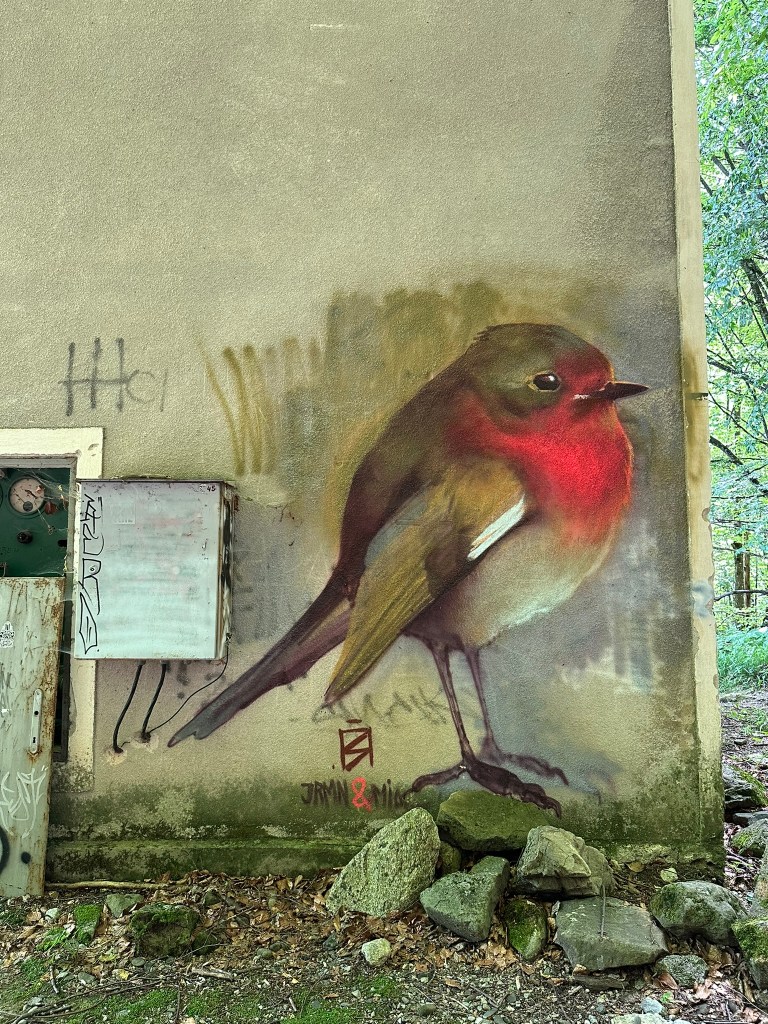
A robin next to the path.
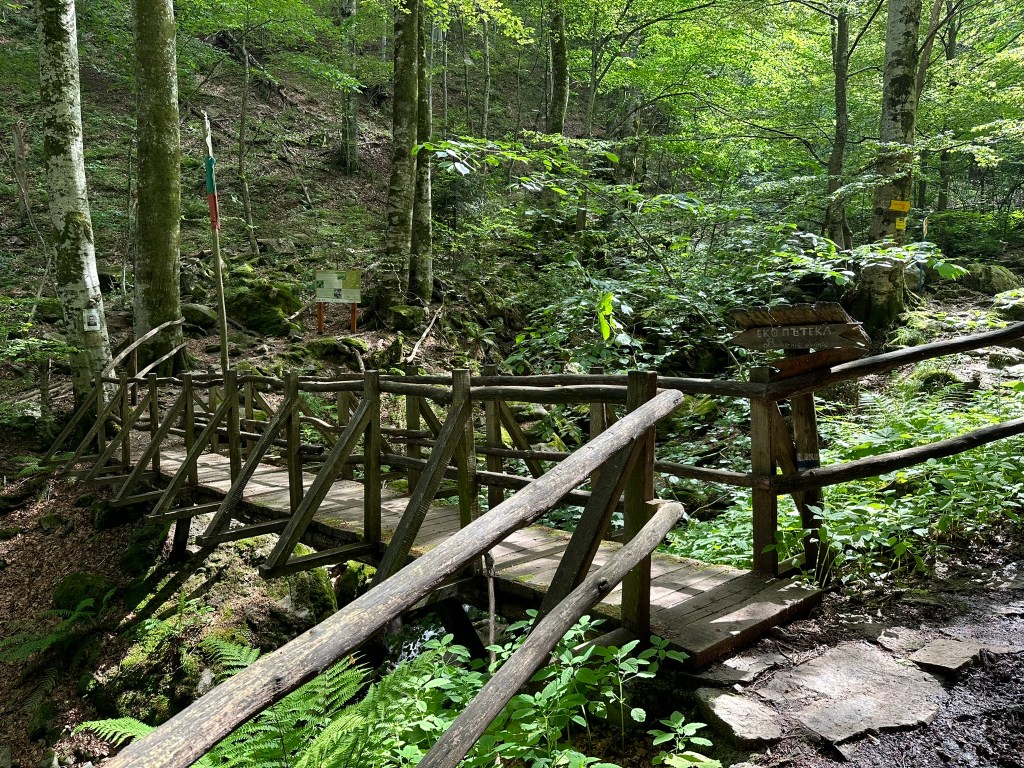
The bridge over the River Vidima. Follow the sign for Vodnite Dupki.
The T-junction – Vodnite Dupki is left, Pleven Hut straight ahead.
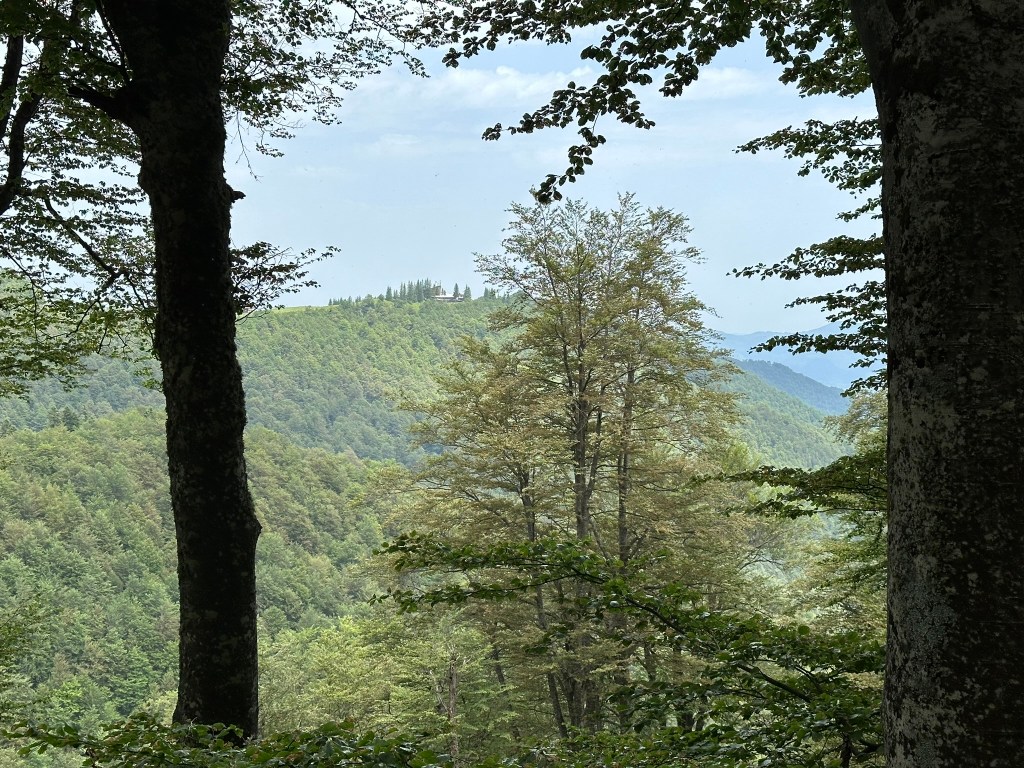
Pleven Hut through the trees.
Vodnite Dupki, or Waterholes Cave.
The view from the cave.
The valley with the waterfall.
Pleven Hut.
Botev Peak from Pleven Hut.
Tea with a view.
The path back to Mazaneto, where you parked the car.
This is a walk into the heart of the Balkan. It takes you to within sight of one of the tallest waterfalls in Bulgaria (most of which are in this region, on the north and south sides of the Balkan Mountain), Vidimsko Praskalo. Praskalo is the Bulgarian word for ‘spray’, ‘sprinkler’, it’s just another word for ‘waterfall’. Vidimsko refers to the nearby village of Vidima. There used to be four villages in this area: Novo Selo in the centre, Zla Reka to the west, Ostrets to the east, and Vidima to the south. In 1976, they decided to club together and form a town, Apriltsi, which was named after the April Uprising of a hundred years earlier, in which the village of Novo Selo lost 142 of its citizens to Ottoman units, who massacred the locals, causing uproar in the West. Bulgaria would become free of Ottoman rule two years later.
A bird could fly from one praskalo to another in a matter of minutes – clustered around Botev Peak there are several, Raysko Praskalo being the highest. But we are mere mortals and must use our feet. There is an ecopath that takes you, five kilometres along a track, and the final kilometre along a path, to a viewing area, from where you can view the waterfall in the distance. Believe me, it is magical, even at a distance. The waterfall is located within a part of the Central Balkan National Park known as Severen Dzhendem, and you’re not just allowed to walk freely. This is one of the routes you are allowed to do.
Make your way to Apriltsi. The town is traversed by the III-607 road. Between Zla Reka and Novo Selo (where the centre is), there is a turning marked ‘kv. Vidima 5’. Take this turning, which heads due south, offering impressive views of the Balkan. Continue on this road for 8.5 kilometres, passing through the centre of Vidima and out the other side. Just before reaching a hydroelectric power station, there is a small turning on the left with lots of signs pointing to the waterfall and the ecopath. It’s impossible to miss. Park your car here.
Now you are on foot. The road immediately crosses the River Vidima and turns right, past the power station on your right. The power station is located between the Rivers Vidima and Praskalska (‘of the waterfall’). You are now next to the River Praskalska and are going to follow it all the way to your destination.
The track you are on, wide enough for a car, crosses the river a couple of times, it even crosses a couple of tributaries and goes past some buildings linked to the water supply, but you are never going to leave it until, after five kilometres, you reach the entrance to the Severen Dzhendem Reserve. Most of the time, the river will be on your right. Sometimes the track will toy with you and make as if to climb away from the river, but it soon returns. Just stay on it, ignoring the turnings to Mecho Chakalo and Turski Rat (obviously one of the people involved in 1876) on your left. In 3.7 kilometres, you will come to a fountain on the left, with a picnic hut on the right. Another kilometre, and you will reach the buildings linked to the water supply, where it is forbidden to go too close to the river (there is another fountain here, and a viewing platform over the river). Stay on the track.
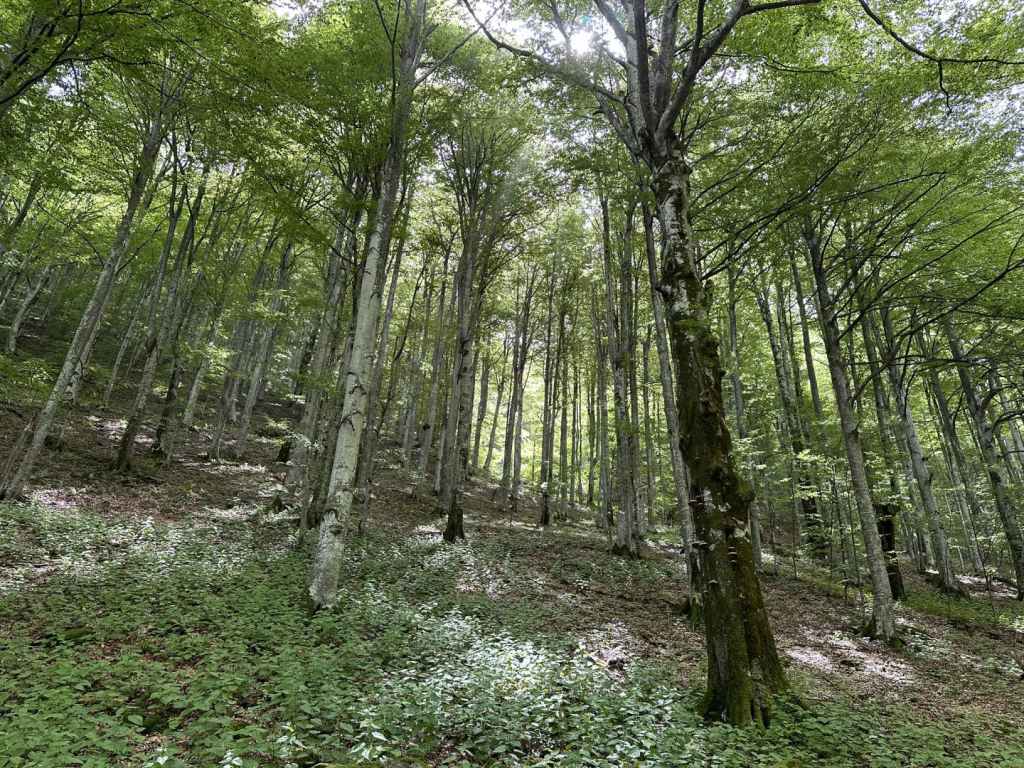
This track that has offered so much finally ends after five kilometres, and you enter the Severen Dzhendem Reserve, where there are beech forests protected by UNESCO. It now becomes a path. You have one more kilometre to go (twenty minutes). You will cross four wooden bridges. Then you will come to a fifth, higher wooden bridge, and suddenly notice the peaks of the mountain up ahead. It’s a startling view. Cross this bridge, and you will come to a small area with wooden benches, where you can sit, rest and admire the waterfall in the distance. It’s incredibly picturesque.
It is not permitted to continue towards the waterfall and, without a guide, it would be difficult to achieve. But it is enough. It’s not always necessary to reach the end, and it’s also good to allow wild animals a little peace and quiet from us. It took me two hours to reach the viewing area from the power station, and 1½ hours to come back. But I have to say I stayed quite a long time, viewing the waterfall (like a destiny) in the distance, and was reluctant to leave.
The River Vidima as it passes through Apriltsi. It goes on to join the Rositsa in Sevlievo, which itself joins the Yantra (the river that goes through Veliko Tarnovo) before becoming part of the Danube.
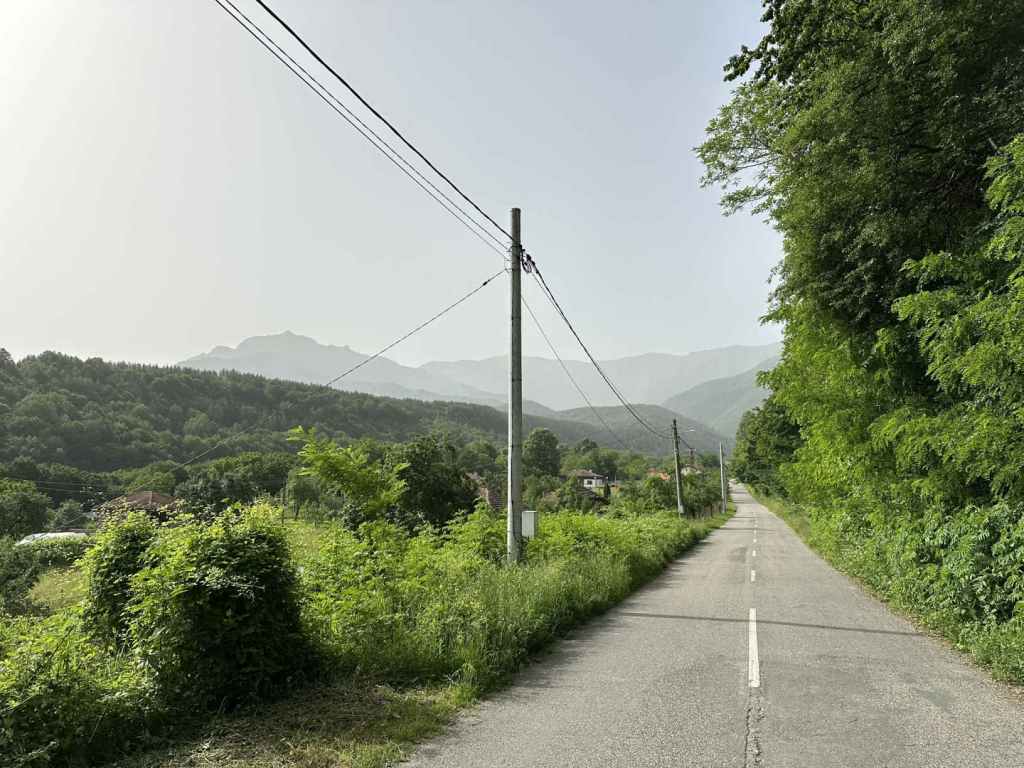
The road due south that passes through Vidima and leads to the Balkan.
The turning on the left for the ecopath to Vidimsko Praskalo. The road on the right continues to Pleven Hut.
The hydroelectric power station on the right.
The track following the course of the River Praskalska.
The river through the trees.
The track higher up.
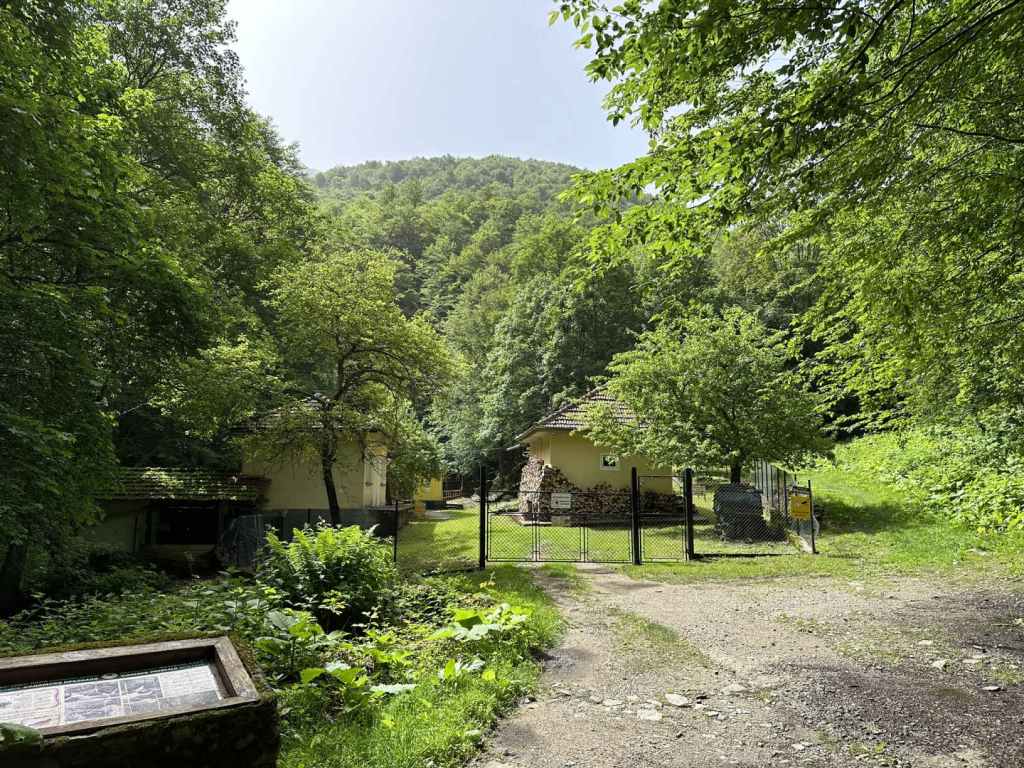
The buildings linked to the water supply.
The entrance to the Severen Dzhendem Reserve, where the track ends and becomes a path.
If, in the Book of Genesis, the world was spoken into being (and the description of creation in chapters 1 and 2 contains the elements of speech: breath, water and flesh), it means that we ourselves are language, words in the making.
We have seen how the ego in English, I, is a straight line. It resembles the number 1. It could be taken to represent the line that isolates us as individuals, the line that we have used to carve up the earth and divide it into properties, the line that we fight over, the line that needs defending, the line that we use to package the products of the earth and trade in them, the line that we use to build roads and transport them. When we separate ourselves off from others, we lose our shared vision (we can’t see over the fence). We view other people, and the products of the earth, as commodities we can profit from, rather than as God’s creatures for whose spiritual well-being we are responsible. The line – I or 1 – isolates. It creates an illusion of self-dependency.
At some point, this self-reliance crumbles, and we realize that we depend on others. Our spiritual eyes are opened, and we begin to see the world not as “us and them”, but as one shared humanity whose needs (and fears) are more or less the same. We are not so different, our time on earth is limited, but we seem to think that if we keep busy (packaging and transporting goods with the line that alone enables us to count things), we can safely ignore our own mortality, or at least by the time it reaches us, we will be too exhausted to care too much about it.
And so we step onto the line, a moving walkway at the airport that takes us to our gate (which might be 2 or 41, we don’t know). That time (connected with line if we cross out the l and apply the phonetic pair m-n) enables us to safely view the landscape, the runways and planes, with the illusion that it will go on forever and what goes on out there won’t affect us.
But it doesn’t go on forever, which means that our own resources as individuals are limited. Instead of counting up and amassing wealth or memories, we learn to do what the Greek alphabet does and we breathe life into the line, turning it from I to O, omega, a long o, the last letter of the Greek alphabet (compare the Latin alphabet, which counts up from I to Z, or 2).
When the line is opened in this way, it is as if we reach a realization of something deeper at play, we tap into the hidden root system, the root system that was there the whole time, only it was not visible to our eyes, just as there are colours on the spectrum of light – infrared and ultraviolet – that are not visible to our eyes, it doesn’t mean they don’t exist.
And since, as we have seen, the world was spoken into being – the opening two chapters of the Book of Genesis can be understood as a description of speech, with the three elements of breath (h), water (vowels, voice added to breath) and flesh (consonants, breath obstructed by the lips or tongue, with or without voice) – this means that we are surrounded by language, we ourselves are somehow language, words in the making (I believe that this is what death is – to be spoken into eternity). And language can teach us.
So, count down from I to O, from the limitations of the ego to the eternity of God, and instead of live being read in reverse, being somehow distorted, and giving evil, it gives love – love for the other, love for God.
Perhaps you do not believe me, but love and other are connected, you just need to know where in the mouth consonants are produced, forming seven simple pairs, one of which is l-r. Then take a step in the alphabet (t-v, omitting the intervening vowel) and add breath (h). Love-other. The vowels are the same.
We have seen that if we take another step in the alphabet, r-s, other is connected to the Greek word for “God”, theos, and so the two great commandments Christ gives his disciples in Matthew 22 – to love the Lord our God and to love our neighbour as ourself – which together form the core of Christian teaching, are themselves confirmed by language:
love-other-theos
The ego has been taken out of them.
Similarly, we turn from the sin that may have characterized our youth and, having acquired spiritual knowledge, we become children of God, children of the light – son. Again, we achieve this by making the progression in language from I to O.
Even Christ did this by willingly going to the Cross. He counted down from I to O, even though there was no sin in him. He did it to show us the way, the answer to the questions we should be asking: who and how.
So, we have live (evil)-love, sin-son, Christ-cross, all examples of the path we must follow from the selfish demands of the ego to that wonderful moment of realization (and repentance) when we understand that there is more to life than we can see with our physical eyes. Our physical eyes can be used solely for the purpose of identifying and taking in the (external) objects of our desire. When we are subject to our desires, we become disconnected. Fragmented.
When we make the progression from I to O, we become whole again (in our brokenness), because while love is connected to other and theos (the two great commandments), it is also in whole (v-w, addition of breath). Love-other-theos, love-whole.
There is one other word where you will find love, and not surprisingly it is a word connected with language, because a word spoken in anger can destroy, but a word spoken with love builds up.
Again, we have to apply the pair v-w, the phonetic pair l-r and a step in the alphabet, d-e.
Then love gives word. It makes us whole (addition of breath). We are meant to love the other, who as Christ tells us in the Judgement of Nations is God (theos). This is the meaning of love in the English language. It’s the word itself that tells us. Unfortunately, we see language as a way of getting our message across – as something external (a tool) – and don’t realize it is bursting with meaning, like a bud in spring.
After the creation of the world (in the beginning, the letter A), we find ourselves in the era of the Fall, which centres around the ego, I. We have to take this line that separates us and open it, count down, perhaps just turn it around, so that we get O.
The correct progression of human life is that represented by the Greek alphabet, AIO (sometimes written AIW). The Greeks are known for their interest in philosophy and theology. Having made the progression from the A of creation to the I of the Fall – the period we find ourselves in – we have a choice: to count up (as the Latin alphabet does, AIZ) or to humble ourselves and count down, AIO.
Language favours the second option. We have seen the examples AM-I’m-om, no one and amen, mean, name-mine-nemo, omen. We go from the name of God in Exodus, AM, through personal importance and gain (I’m, mine) to calling on God again in the Holy Trinity (om) or on God the Father, no one (nemo in Latin).
In the Garden of Eden, between Adam and Eve, there was no competition. So, we have a draw. In today’s world with its competing egos, we set out to win. The vowel in these verbs has changed from A to I. But Christ comes with a different message. He encourages us to turn the other cheek, to lose our life for the sake of the other (in order to find it). So, he encourages us to lose:
draw-win-lose
Here again, we find the progression of the Greek alphabet, AIO (with a silent final e, very common in English, ignore the consonants).
We have seen that we are made to call on God. The first word the human apparatus is capable of producing is a combination of breath, h, and the first vowel to emerge from the throat, u: hu, which is Sanskrit for “invoke the gods” and the root of our word God. We are made to call on God. Similarly, if we turn away from the selfish demands of the ego, represented in English by a straight line, I, we make three symbols, A+O, which spell another name of God, Alpha and Omega. So, again, when we turn away from our selfish desires and embrace the other, we call on God.
In the Judgement of the Nations, Christ goes so far as to tell us that the other is God: “Just as you did it to one of the least of these who are members of my family, you did it to me” (Mt 25:40). If we remember that the Greek word for “God” is theos, we might see a close similarity between other and theos (step in the alphabet r-s). Language confirms what Christ is saying.
It is ironic, therefore, that after Adam and Eve have eaten of the fruit of the tree of knowledge in Genesis, chapter 3, it is God who calls to Adam, “Where are you?” (Gen 3:9). Of course, he knows where Adam is, and he knows what has happened. But by asking this question, which is the question Adam should have been asking, he is somehow indicating to us what our approach should be.
Make the progression from A to I, and from call you have like (in reverse, addition of e). Like is what we do on Facebook. We indicate our preferences. It also gives kill, and there has been plenty of killing in the history of humankind.
Now, count down from I to O, and you get look, which is the message Christ is trying to get across in the New Testament, the importance of opening our spiritual eyes (our egos or Is) and bearing spiritual fruit. We have seen the relevance of this in the Parables of the Sower and the Tares. So, we have:
call-kill, like-look
And then there are the examples that relate to the animal kingdom. Let us start with swan – a white bird, and white is a symbol of purity. Progress towards the ego, and you get swine – pigs in the mire, we have dirtied God’s image by rolling in the mud (just as the prodigal son does in Luke 15, a metaphor for dissolute living). When we come to our senses and realize that the things of this world will not satisfy us for long, we set out to purify ourselves once more, to return to our father, as the prodigal son does, which is not a return to the way things were before (swan), but a movement onwards, to something new: snow. So, we have:
swan-swine-snow
And finally, what is that most ancient mammal if not a whale that continues to patrol our oceans, despite our best efforts to wipe it out? Make the progression from A to I, and you have while, an indication of time. Time started after the Fall, this is when Adam and Eve became mortal, when they were expelled from paradise. Time will end for us individually when we die (the past tense of I) and for the human race when Christ comes again to judge the living and the dead. Now, count down from I to O, and in a while you become whole again. Whole is a remarkable word, and we will see more of it. So, we have:
whale-while-whole
All are examples of the progression made in the Greek alphabet, where we count down from the ego, which is represented in English by the letter I, and turn to God, the eternal symbol O.
Bovska Skaklya, because of its height and dramatic setting, is perhaps better known, but Pod Kamiko is no less beautiful and worth every bit as much effort. There is a good ecopath that takes you from the stadium in Gara Bov to the waterfall, which is on the outskirts of the village of Bov. The walk to the waterfall takes you along the valley of the River Bov, and there are many smaller waterfalls along the way, some of them quite beautiful. The return takes you along the top of the gorge and back to the stadium from the east. The scenery is spectacular, and the waterfall one of the most beautiful I have seen.
Again, to reach Gara Bov, you must take the II-16 from Sofia in the direction of Novi Iskar, Svoge and Mezdra. This road is very windy as it follows the course of the magnificent River Iskar on its way to the Danube, so even though the distance is not great, it takes its time, and there are several speed cameras. Eight kilometres after the picturesque town of Svoge – with its turning to Iskrets (from where you can reach Dobravitsa Waterfall) – you pass the sign for Bov. 1.1 kilometres after this sign, there is a turning on the right, signposted for Gara Bov (1 km) and Bov (4 km). Take this turning. You will drive along the railway, go left under the railway, pass the railway station again on your left. Continue uphill. As the road veers left, immediately on the right is the stadium. Park the car here. If you have travelled by train, exit the station, join the road as it goes uphill and in 800 metres you will be at the stadium.
The ecopath heads north-east, along the course of the River Bov. It passes along the lefthand side of the football pitch and then immediately goes over a wooden bridge. Follow the green markers. The path is very well marked. It begins to climb, with the river on your left. After 700 metres, there is a turning on the right for a monastery, but continue straight. You will see a small waterfall on the left, and then the path again crosses a bridge. Keep following the course of the river, which is now on your right.
You will pass three more small waterfalls, then come out onto a flat rocky area next to the river. More small waterfalls follow on the right (a particularly beautiful one, 280 metres after the rocky area). A few more hundred metres, and you will again cross the river, using a stepping stone. The path now becomes a track and heads away from the river, but only for a short while before veering left again and bringing you out into the open, with the river down below you on your left. The path descends, crosses another bridge and climbs up the other side. When it reaches the top, turn right. In 200 metres, you will cross a small tributary, which immediately plummets down to the river on your right. The path does a zigzag. 340 metres after the tributary, a path on the left leads to the top of the waterfall. You will come back this way, but for now continue straight. You will cross a second tributary and, in less than a hundred metres, see the waterfall straight ahead. The distance from the stadium to the waterfall is 2.9 km and takes about an hour.
The waterfall is magnificent, especially if you go in spring or after heavy rainfall. There is a second, smaller waterfall to the left of this one, which you can see as you climb to the top of the gorge. So, when you have had your fill, return on the same path and take the path that diverges, now on your right, to the top of the waterfall. It is marked “above the waterfall”. It climbs steeply, offering views of both waterfalls, Pod Kamiko and the smaller one to its left, before taking you around the rocks, with views back to Gara Bov and Bovska Skaklya in the distance, and up to the village of Bov. You will not enter the village, but skirt along the top of the gorge. When I went in May, the path here was very overgrown. You basically want to head back in the direction of Pod Kamiko. The path takes you over the top of the smaller waterfall and joins a track. Go right here, and in a short while it will bring you to the top of Pod Kamiko. There is a wooden bridge on the left. Please do not go too close to the edge.
When you are ready, continue along the track, which passes a house on the left. When I was here, the track was blocked by cows and their calves, so I had to make a detour through one of the fields and rejoin the track a little further on with my dog. In 750 metres, the track passes a fountain on the left and then enters a field on the left, but you want to continue between a picnic area on the right and a stone cross on the left. In another 200 metres, you will come to a blue gate. Stay on this track, again avoiding the temptation to enter fields on your left.
In 370 metres, there is another fountain next to a ruined house. The path now enters a field and then continues on the right. As it descends, you will have views of Tserovo (the village before Bov) on the left. Keep descending through the forest. The path zigzags, left-right-left, and in 800 metres reaches a larger picnic area with a small chapel. This is a good place to rest. From here, the path continues left. In 750 metres, it joins a larger track by the River Treskavetz. Go right here, and in one kilometre you will be back at the stadium. The whole route is 7.6 kilometres and took me 3½ hours with ample breaks.
The River Iskar as it passes by Bov.
Gara Bov, the railway station.
The stadium in Gara Bov.
The most beautiful of the smaller waterfalls on the way.
One of the wooden bridges.
Pod Kamiko Waterfall.
A view of the top, the water glistening in the sunlight.
A view of both waterfalls (the smaller one is just visible on the far left).
The Fall – carnal knowledge – enabled us to have our own children, but it also brought about spiritual blindness, which is represented by the ego in English (I, a closed eye when rotated by ninety degrees). We must make the progression to O, an open eye, if we are to see the people and things around us.
In between the vowels a and i in the alphabet is the vowel e. The name of Adam’s partner in Genesis is Eve, “because she was the mother of all who live” (Gen 3:20).
Now there are two coincidences, and coincidences are indicators of truth. The first is the correlation between Eve and eye (v-y is a pair of letters that look alike, one is an extension of the other). The second is the way the words eye and I sound exactly the same.
Eve is taking us in the direction of the Fall (I), but I don’t see this as a bad thing. Without carnal knowledge, without a fall into bed, we could not have children. We had to make this progression in order for the world – and then heaven – to be comprised of our own creations. The alternative was for God to create a clone army, to keep on removing ribs from Adam in order to make more humans. God knew perfectly well what would happen in Genesis, chapter 3. But it was necessary for us to co-partake in creation – after all, we are divine creatures, we bear God’s name (AM is in ADAM). And there is no doubt that children give great joy and make life worth living.
So, the Fall made it possible for us to marry and have children. But with carnal knowledge came spiritual blindness. And this is something we don’t realize. We think when our eyes are opened shortly after birth, we can see. But our physical sight is extremely limited. We see things as objects. We label them. We move them about. We trade in them. We build lines around them (walls, fences) to protect them from others. This is not sight.
And this is why the ego, I, if we rotate the word by ninety degrees, represents a closed eye: —. This explains the correlation between eye and I. The ego is a closed eye, because it is spiritually blind. And we are in this life (apart from to have children) to open our spiritual eyes and to form the letter O. O is eternity. O is an open tunnel. O is a cry of recognition. O is a sigh of repentance. It represents restoration, redemption. Do you see how all these words begin with the prefix re-? It is a return – we are restored to ourselves – but it is a return with knowledge.
We have seen how this progression from the A of creation to the I of the Fall and the O of redemption can be discerned in the question words what, why and who (how).
Let us take the name of God in Exodus, AM, and apply the same progression. AM gives I’m (self-importance). We no longer call on God, we rely on our own resources (only to discover, later on, that they are limited). When we reach the end of our tether, we make the further progression from I’m (the ego gets to be pretty boring with its repetitiveness) to om, a mantra in Hinduism and Tibetan Buddhism. But I don’t mean that. For me, om represents the Holy Trinity: O3 (three in One).
And if we apply the phonetic pair m-n and add final e (which is extremely common in English), we find that om gives no one. Amen-mean-name do the same – they pass through mine (acquisitiveness) to nemo (Latin for “no one”) and omen.
No one – O1 – is God the Father, as we will see in a later chapter. So, again we call on him, just as we did by being human (the first word the human apparatus is capable of pronouncing, a combination of breath and the first vowel to emerge from the throat, the root of our word God). Or by moving away from the line and producing three symbols, A+O, that spell another name of God, Alpha and Omega.
This progression, AIO (sometimes written AIW), is inherent in language. We will see more examples.
Chiprovtsi is a small town in north-west Bulgaria, between Belogradchik and Montana. It is situated on the northern side of the Balkan Mountains, very close to the Serbian border. It is famous for its carpets, but also for its waterfall, one of the most beautiful in Bulgaria. The first time I visited this waterfall, it was raining so much the air was full of water, and it was as if the waterfall was the whole forest.
The drive from Sofia takes three hours. You must take the II-81 road in the direction of Kostinbrod and Montana. You pass through the picturesque village of Gintsi before driving up and over the Balkan at Petrohan Pass. You then descend to Barzia before passing the turning to Berkovitsa, another waterfall, on your left. Ten kilometres before Montana, you leave the II-81 and turn left where it is signposted for Chiprovtsi (35 km). You immediately cross a railway, and then the road veers left (if you go straight, you will end up in the village of Borovtsi). After fifteen kilometres, you reach a T-junction. Again, turn left for Chiprovtsi (18 km). In another ten kilometres, just after the pretty village of Beli Mel, again there is a turning on the left for Chiprovtsi (now 10 km).
Four kilometres along this road, there is a turning on the right for Chiprovtsi Monastery (which is set back 500 m from the road). I recommend a visit to this monastery. I went before the waterfall, when it was still early, and the sunlight and spring flowers were very warming. The monastery is dedicated to Bulgaria’s most famous saint, the tenth-century hermit St John of Rila, who founded Rila Monastery.
Having returned to the road, continue in the same direction, and after 4.5 kilometres you will pass the sign for Chiprovtsi itself. 300 m after this sign, you must again turn left to enter the town (otherwise you will bypass it). You are now on Petar Parchevich Boulevard. Continue along here for 1.3 km and, after you pass the school of the same name on the right, turn left down Petar Bogdan Street (both these Peters were Roman Catholic Archbishops!). Continue for 200 m, turn right onto 23 Septemvri Street for 100 m, then left onto Tocho Voyvoda Street for another 100 m, then right onto Balkanska Street. This is the street that will take you to the beginning of the walk to the waterfall. (If you find this difficult, you can simply ask Google Maps for directions from your location to Chiprovtsi Waterfall, which should lead you through the town and out the other side. The important thing is to end up on Balkanska Street.)
This street leaves Chiprovtsi, heading west. You must drive along it for 4.5 kilometres, at which point the road in front of you becomes a track, and the road itself turns back on itself in the direction of Jar Hut. You do not need to go there unless you want to. Park the car on the grassy verge. You are ready to start your walk.
The walk to the waterfall is 3.2 kilometres and takes about an hour. Follow the track for 1.5 kilometres, at which point it divides. The left branch goes to Jar Hut, as you might expect, but you want the right branch. You will soon hear, and then see, the river on your right. This is the river that forms the waterfall higher up. Continue on the track for another 700 m, at which point there is a bridge over the river. The track now doubles back and descends on the other side, but you want to continue upstream, which means taking a path on the far (west) side of the river. There is a box with a first-aid kit and a picnic table directly after the bridge. The path is on your left after this.
You should now have the river on your left. Walk upstream. In 200 m, a bridge of planks crosses a small tributary. Keep following the course of the other river. The path gets steeper, and at one point comes out into the open (I noticed a lot of fallen trees in May). So long as you keep the river on your left, you will not get lost. In another 300 m, there is a second plank bridge, this time over the river, taking you back to the east side. Now the river is on your right. Another 400 m, and there is a third plank bridge taking you back over to the west side, but by now the waterfall is visible through the trees. I sat with my dog for an hour and a half, and I can say the time just disappeared as I marvelled at the drops of spray, the rocks that make up the waterfall (a waterfall is water and rock), little flowers gleaming in the sunlight in far, out-of-the-way places that I could never reach. It was wonderful.
You are now only a few kilometres from the Serbian border. On the Serbian (south) side of the Balkan, there are also waterfalls, I understand, and a national park. When you have had your fill, simply go back the way you have come.
Chiprovtsi Monastery in the early-morning sunlight.
The turning for Petar Bogdan Street, with the mountains (and the waterfall) behind.
The walk to the waterfall begins 4.5 km south-west of Chiprovtsi. Simply follow Balkanska Street until the road doubles back on itself.
The track as it approaches the river.
The bridge over the river.
The first-aid kit.
The first of three plank bridges (this one over a tributary).
The second plank bridge, taking you back to the east side of the river.
One of several interesting rocks on the way to the waterfall.