V. A Trip to Sergiyev Posad

Sergiyev Posad, of course, is where all this is heading, a town seventy kilometres to the north-east of Moscow and my only excursion outside the capital city. For the hour-long journey, we catch a train from the Yaroslavsky terminal. My son is disappointed that it won’t be one of the newer trains, he says trains to the north-east are the last to be modernized, but it looks fine to me. We will pass through Mytishchi, which my son jokes every visitor to Moscow must go to because a friend of his lives there. We record a short video in which I say what a nice city it is. I see greenery, snaking rivers, houses instead of blocks, lots of tin huts with chimneys poking out of them. I imagine what the scene would look like if it was covered in snow. It’s not as lush as Bulgaria, the climate here is more severe, and the trees are several weeks behind Sofia.

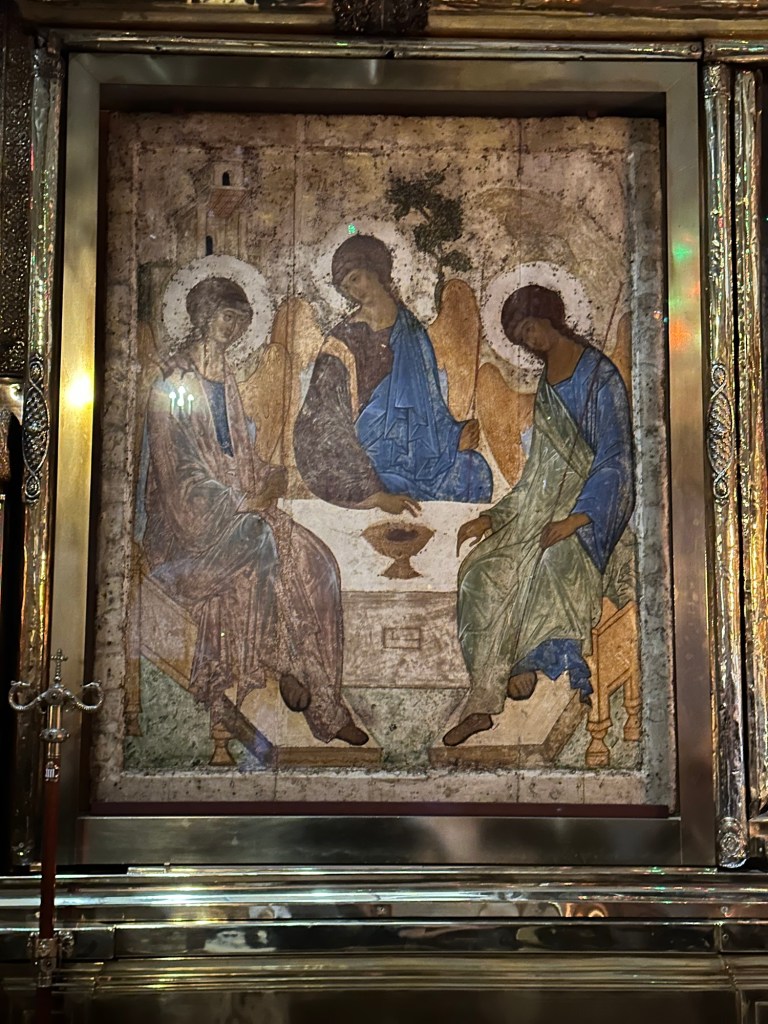
Sergiyev Posad is where the Trinity Lavra of St Sergius is located, Russian Orthodoxy’s spiritual centre. I have wanted to go there for a long time. Not only does it contain the relics of Russia’s most important saint, St Sergius of Radonezh, who lived in the fourteenth century, but the same church that contains his relics houses probably the most famous icon in the world, the Trinity by Andrei Rublev. Russia is famous for three icons: the Trinity; the Vladimir icon of the Mother and Child, which I have seen in the main cathedral in Moscow (at a distance, behind bulletproof glass), a twelfth-century icon sent by the Patriarch of Constantinople to the Grand Prince Yuri Dolgorukiy of Kiev which is said to have protected Moscow from an invasion by Timur in 1395; and the Kazan icon of the Mother and Child, the original of which was lost in 1904 (the robbers were interested in the frame, not the icon itself!), so there are only copies, of which I venerated one on the Kolomenskoye estate, in the church associated with Tsar Alexei Mikhailovich, father of Peter the Great, next to the avenue of lime trees and opposite the former site of his wooden palace.

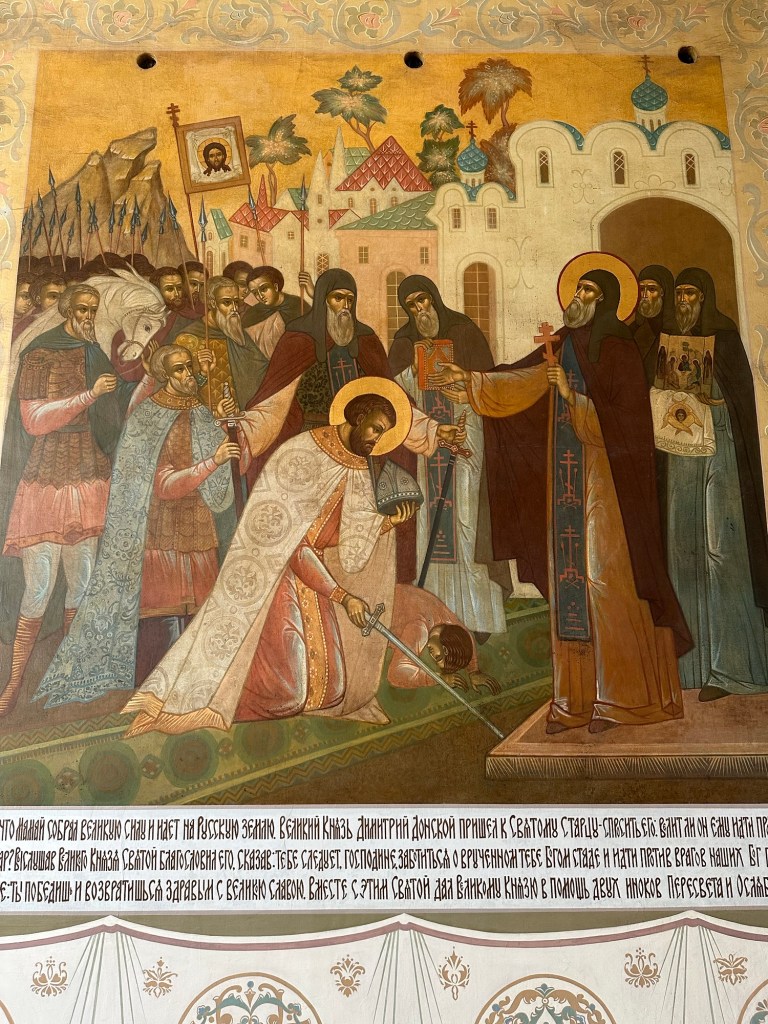
When we arrive in Sergiyev Posad, we walk along the platform and cross the tracks to exit through a barrier. I can glimpse a gold dome in the distance. The town reminds me of a settlement in the Wild West with a main street and not much else. The buildings are ugly, but this is not the point of our visit. We head right, and then left, emerging onto a patch of grass with the Konchura River flowing through it, which offers an attractive view of our destination. My son again takes me a different way, past a memorial of military glory, which really holds little interest for me, until at last I find myself in front of the monastery gate. It is a Sunday, and there is a constant trickle of pilgrims, but nothing overwhelming. I pause for photos in front of the entrance. As we enter, we pass frescoes of St Sergius greeting a flock of doves – his future disciples – and blessing Prince Dmitry Donskoy before he meets the Tatar army at the Battle of Kulikovo, two pivotal moments in the saint’s life, which represent his spiritual authority and legacy.

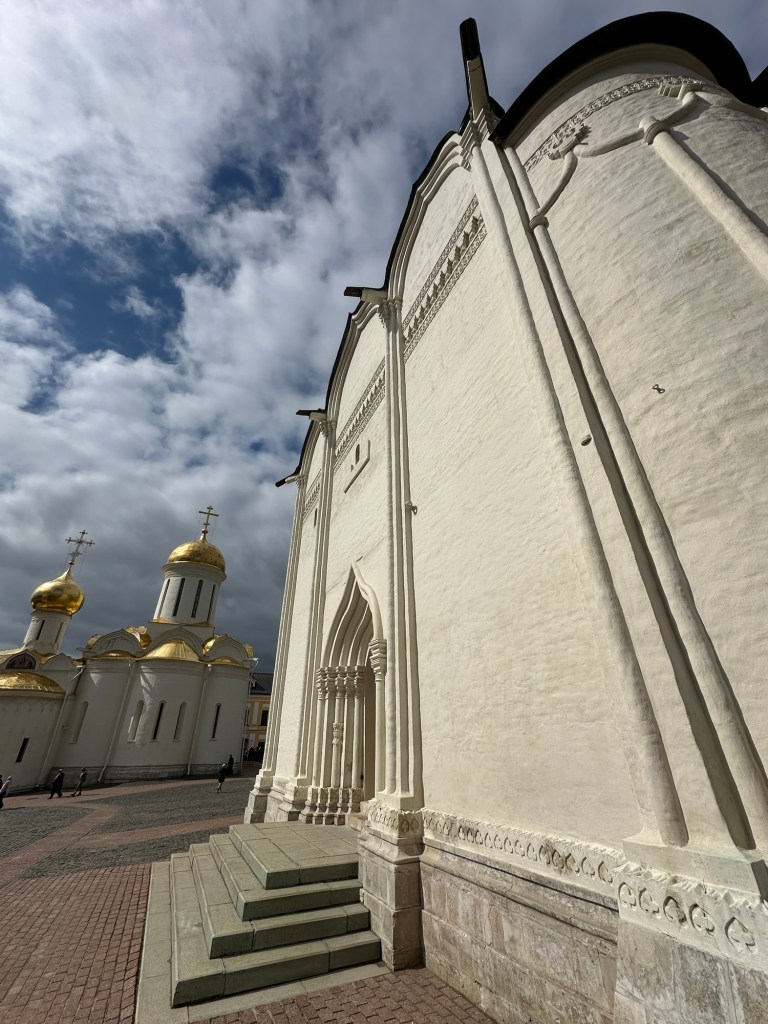
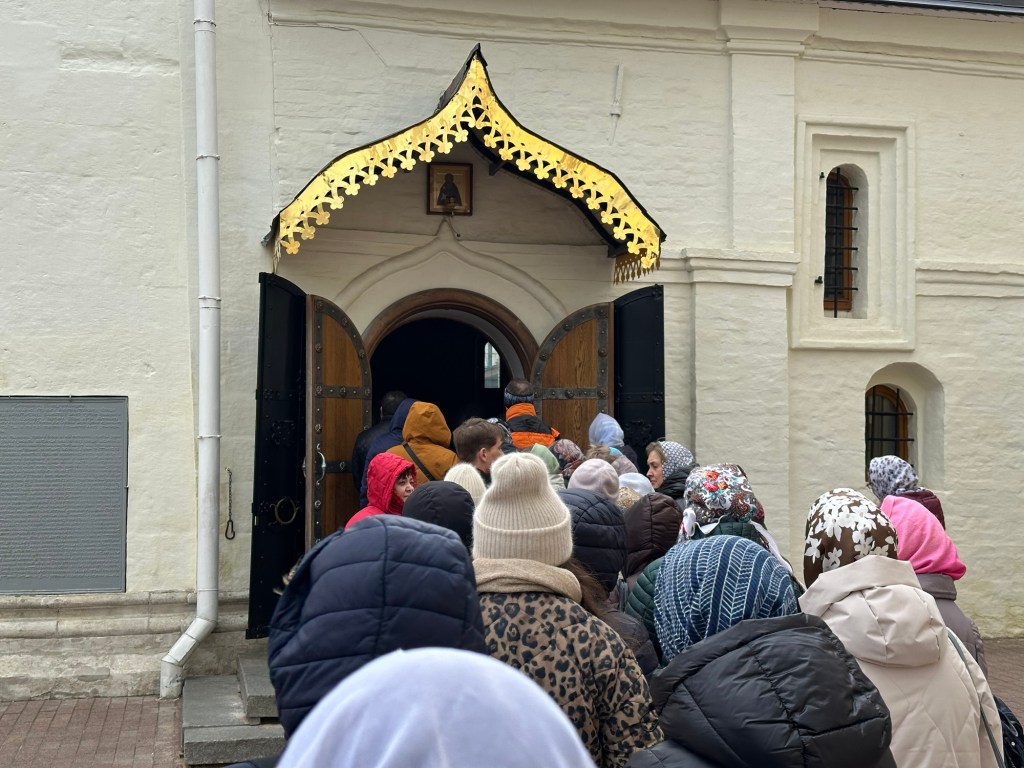
Inside the enclosure proper, we pass the Dormition Cathedral on the right. There is the grave of an elder, which is recent (beneath wood, not stone) and covered in flowers, attracting the attention of numerous pilgrims, some of whom must have known him when he was alive. We then pass the Church of the Holy Spirit, its white walls blazing for a moment in the light of the sun, which emerges briefly from the clouds, and join the queue outside the Trinity Cathedral to venerate the saint’s relics. The wind is biting, but I do not mind this. Actually I like the fact of waiting. It gives you time to reflect and creates a bond with the people around you. A woman comes out and asks us to queue next to the church wall, not out into the square. We are given books of prayers in Russian to the saint. As often in Russian churches, we will enter the church from the side. I have found entrances in Moscow confusing – you’re never quite sure where they are, and when you do find them, you’re never quite sure which part of the building you are in.

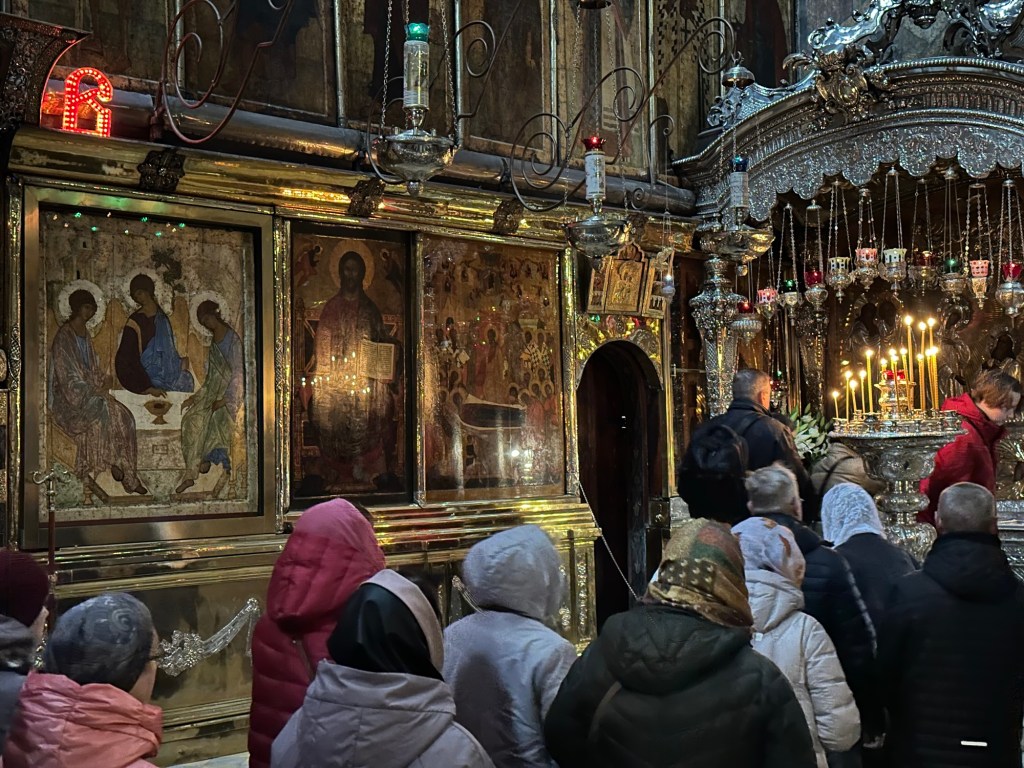
Here, however, on entering the church, we find ourselves in the narthex, candles flaring, those for the living on brass stands that are higher than those for the departed, the metal gleaming where it has been oiled to prevent the wax from sticking. Women busily scrub away, keeping the surfaces clean. The nave is on our left. We turn the corner and, as if entering Noah’s ark, are lined up so that we approach the relics two by two. I’m just glad my son is next to me, and not with someone else. I gaze around, searching for the icon of the Trinity, which I imagine will be in the centre of the church, not on the iconostasis itself, but I am wrong. There is one Trinity to the left of the holy doors, next to the Mother, but I do not think it is this one. To the right of the holy doors, where Christ would normally be… Yes, this is it. I feel certain that this is it, and I sneak a photograph of the image. I know that photography is not permitted, but I also know that Russians love their mobile phones. It is time to turn my attention to the relics, which are in a silver shrine against the wall, to the far right of the iconostasis. A man beckons people forwards, helps them bow, and then urges them on. Orthodoxy is all about movement. People make the sign of the cross. A choir sings – a moleben, perhaps, or an akathist to the saint. The most common words in an Orthodox service are a plea for mercy: “Lord, have mercy.” I am carried forwards, as if on a wave. I see the opening. The face is covered, unlike in Greek churches, where the face is often visible. I bow down and kiss the glass, touch it with my forehead, and kiss it again. I have waited so long for this moment. Already I am descending the steps, back to the nave proper. I do not remember having ascended them. I join the huddle of the choir, turn back in the direction of the relics, I need more time, and begin to pray. And then something very strange happens.

It is as if a channel opens up. I have never experienced anything like this before. It is as if the saint himself is listening. I pray in silence, but feel as if my words are magnified in heaven, are reaching right to God’s throne through the saint’s intervention. I stutter out my prayers, my meagre requests. It is as if I have been asking to see someone important in order to let my thoughts be known, and now I have been given the opportunity, I feel rather flustered. Whereas our words normally form a thread, which may or may not reach its destination, my words now are a thoroughfare, a broad boulevard, a royal road. A link has been enabled between me and heaven, and the one who has done this is lying a few feet in front of me. I know it cannot go on forever and must come to an end. What it would be to enjoy such discourse on a permanent basis! Faith is the enlarging of things. Faith is sight and hearing. So often in this world we feel undervalued, overlooked, when, like the animals in Moscow Zoo, all we want is to be acknowledged – not to engage in trade, not to engage in trickery or deceit, but to be ourselves, fully open. We spend so much time immersed in conflict, but when we meet our own fragility, our own breathlessness, I do not think we have the strength to wish anyone ill. When facing the firing squad in One Hundred Years of Solitude, Arcadio realizes how much he really loved the people he hated most. In death, in fragility, there is no room for hostility.

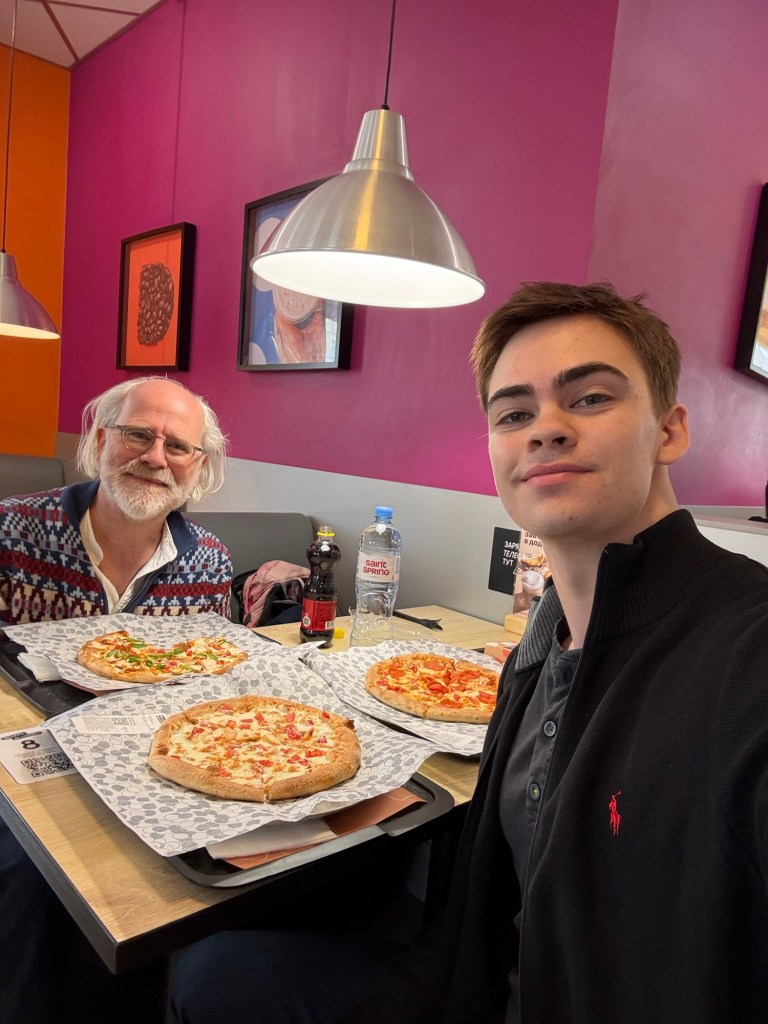
We leave the church and head back to the frontier town. We eat a pizza in Dodo’s. I cannot stop smiling. This is the perfect conclusion to my visit, and I experience enormous gratitude. Orthodoxy is about endurance, something I think people in the West do not understand. You endure, despite the hardships, the obvious persecution. It is not about convenience. It is about being pushed to the limit, to the edge of time itself, and peering over into the chasm of eternity. A saint who has been dead for 650 years opens up the gate to heaven for me. I feel more alive than I have for ages. And I smile, because my son is opposite me. I am not alone. My life has meaning.
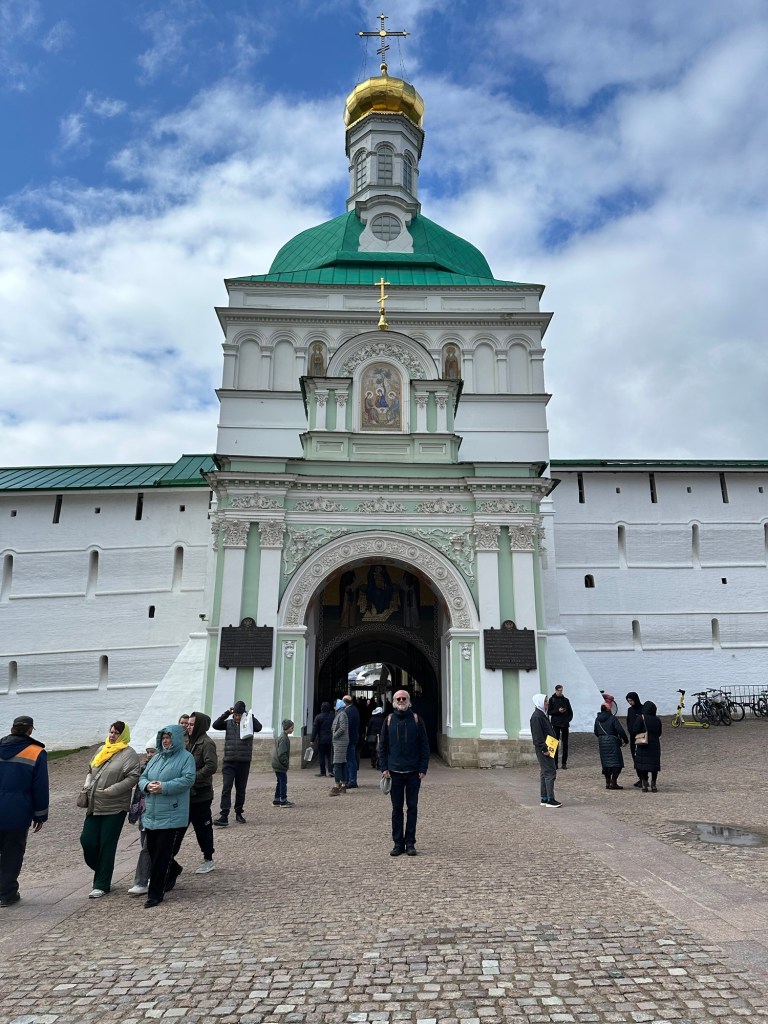
  1. In front of the Trinity Lavra.
  2. St Sergius blessing Prince Dmitry.
  3. The wall of the Church of the Holy Spirit with the Trinity Cathedral on the left.
  4. The queue outside the Trinity Cathedral.
  5. My photo of the Trinity icon, which forms part of the iconostasis in the position normally occupied by Christ.
  6. The Trinity icon in relation to the shrine of St Sergius on the right.
  7. In Dodo Pizza.

Jonathan Dunne

Back to the beginning: Red Square
IV. Moscow Life

The first thing I learn in Moscow is the importance of the metro, which is said to transport ten million people a day. I am given a Troika card, which I can use to travel as much as I like (it costs eight euros for three days). My favourite line is my son’s line, of course – number 9 – and my favourite station is Borovitskaya – right to the heart of the Kremlin. On my first day, I stand on the Bolshoy Kamenny Bridge, the wind blowing down a cold and grey Moscow River, and gaze at the Kremlin towers behind me and the Cathedral of Christ the Saviour ahead. The gold dome is under scaffolding. I will visit it later on the same day, but I make the mistake of approaching the side facing the river, imagining that this will be the main entrance, when in fact the main entrance faces the other way. I’m still confused by this – how could you not face the river?

I eat my sandwich and crisps, still in Bulgaria wilderness mode. After this, I will take to having lunch in some of my son’s favourite restaurants. There is no McDonald’s or Kentucky Fried Chicken, but they have been replaced by Russian equivalents: Vkusno i tochka and Rostic’s (which I mispronounce Rustic’s), which are just as good, if not better. The idea that Russia is straining under the weight of western sanctions is quickly dispelled by a visit to the local mall, where the first thing I see is a large, well-lit western clothes store. Other western products are on offer: cosmetics, for example, or shoes. And where such products do not exist, Russians are more than capable of coming up with their own.

Similarly, people on the metro do not look harassed, afraid of being watched. They look quite calm. Most of them are on their phones, but this is not a Russian phenomenon. IPhones abound. Occasionally, you get a woman with a large tome running to more than a thousand pages, Tolstoy perhaps, like a lunchbox on her lap. Younger people read European classics from an attractively produced series. I spot Guy de Maupassant. I get the occasional glance, more curiosity than anything, I’m amazed at the ease with which Alyosha at Sretensky Monastery identifies me as English, but I am just a passing curiosity. My son teaches me to stand aside as the doors open to let the passengers out, there is a bit of pushing and shoving. Escalator etiquette is the same as in London (stand on the right, walk on the left), so I’m not a complete country bumpkin, though I feel like one.

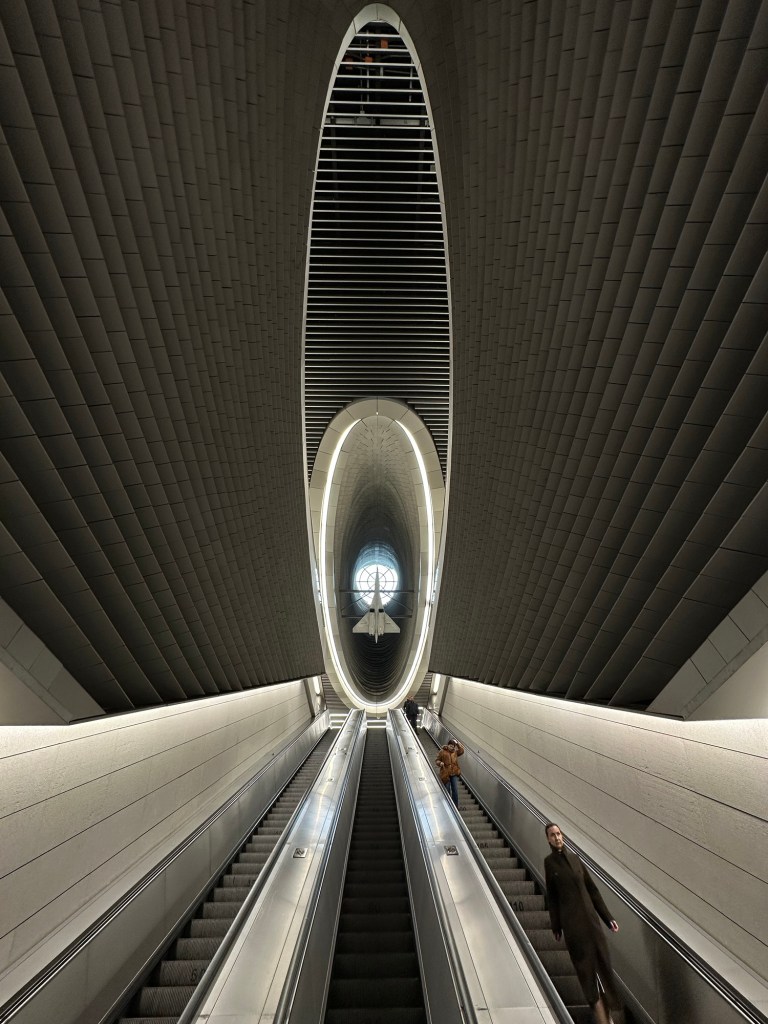
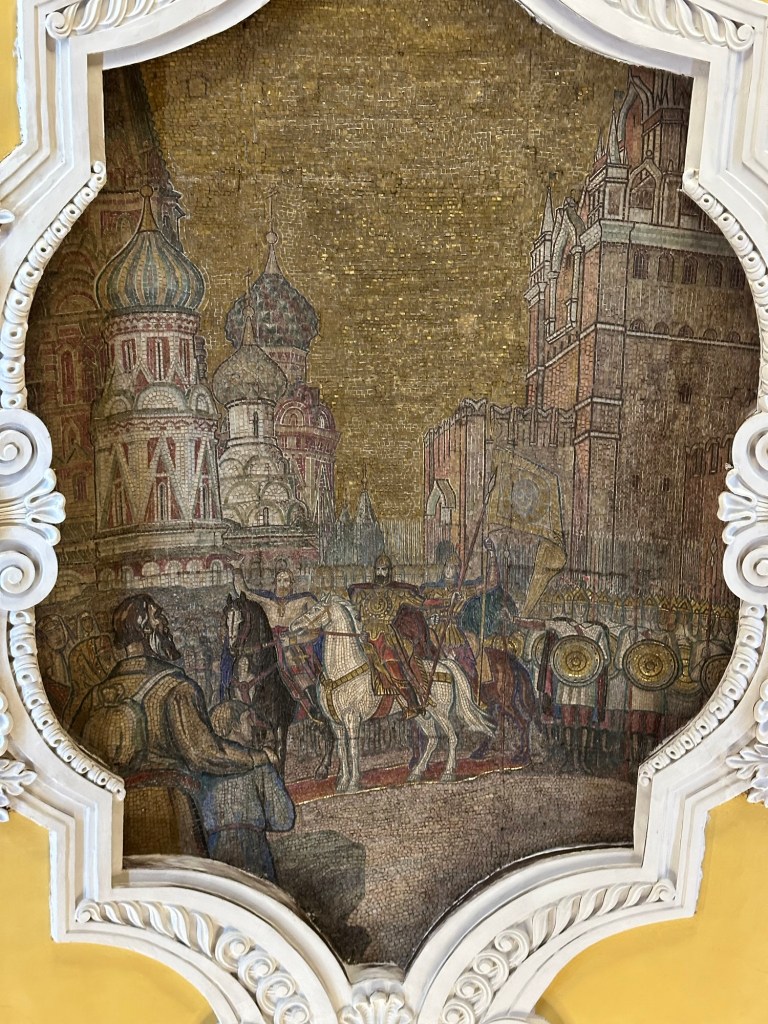
The metro stations are grand. Some of them were built under Stalin – Komsomolskaya is a prime example, with mosaics on the ceiling of generals mustering their troops beneath the banner of Christ or Lenin preaching in Red Square. I have fun taking photographs of my favourite mosaic with St Basil’s Cathedral because it is positioned above the escalator, so I have to keep descending and ascending on the elevator until I think I’ve got a good one. It’s quite hard taking a photograph of the ceiling when you’re travelling upwards. My son waxes lyrical about the station before Vnukovo airport, Pykhtino, where there is a model fighter jet attached to the ceiling above the escalator (again!). The line to Vnukovo airport, 8A, is much more modern.

There are two circle lines: an inner circle line, number 5, and an outer circle line, number 11. Line 5 is remarkably smooth, it feels like travelling on air, and the seats are comfortable, not too close together, divided into groups of two and three, with plugs to charge your phone. Each carriage on the metro is fitted with a screen, which gives information about the new river transport, safety videos for children who get lost (they are to stand beneath a sign on the wall, where they will be spotted by metro staff, who come to reunite them with their parents), videos about places – the Caucasus, Astrakhan – Muscovites might like to visit, a film about the zoo. There are themed carriages – one is devoted to the Bolshoi Theatre – and there is much excitement about Yuri Gagarin because it is the 65th anniversary of his first crewed journey into space aboard Vostok 1 (Vkusno i tochka are offering models of the spaceship with their kiddie menus, and I am tempted to get one). There is a great deal of pride in the country and its achievements, and I don’t think this is a bad thing.

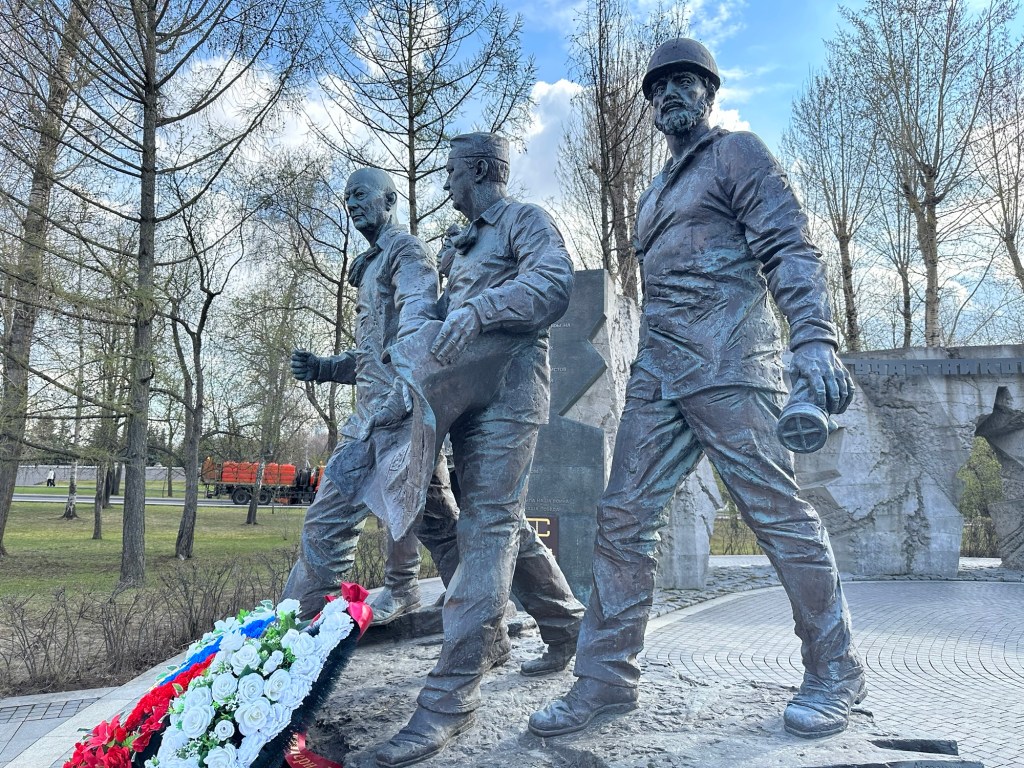
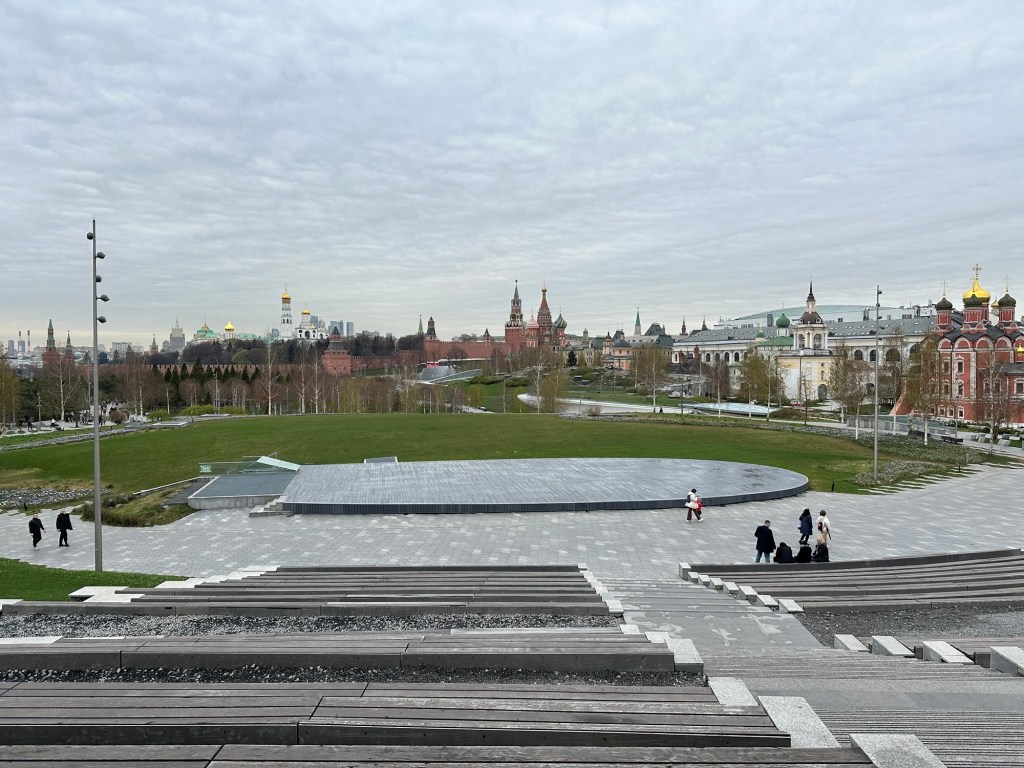
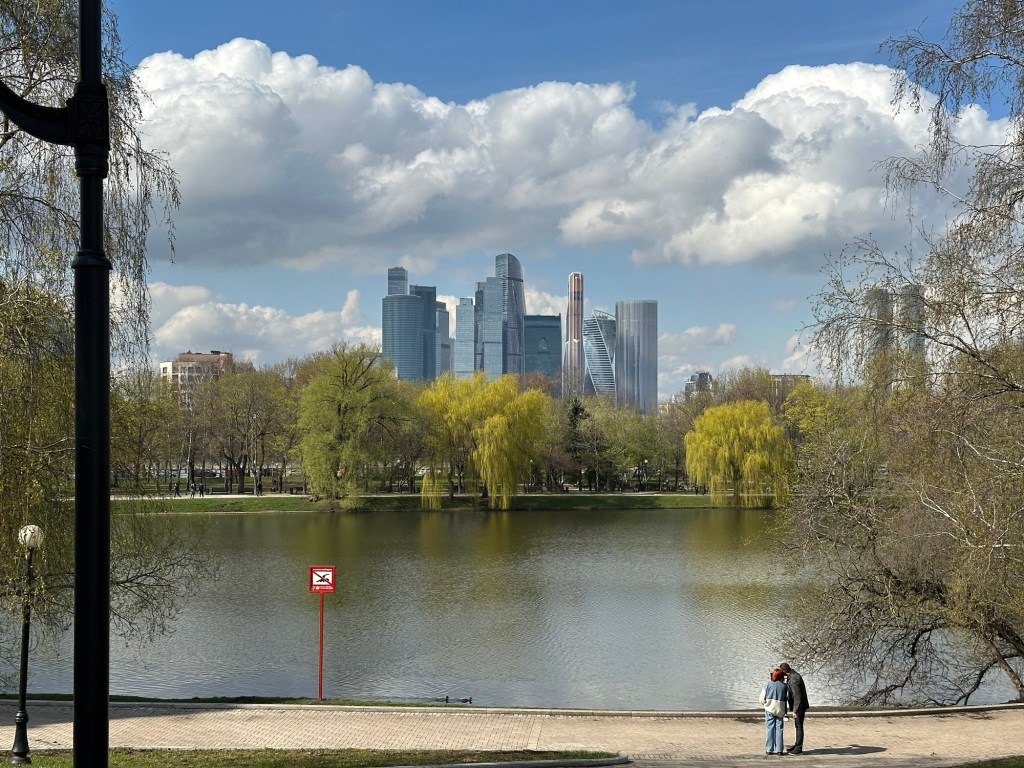
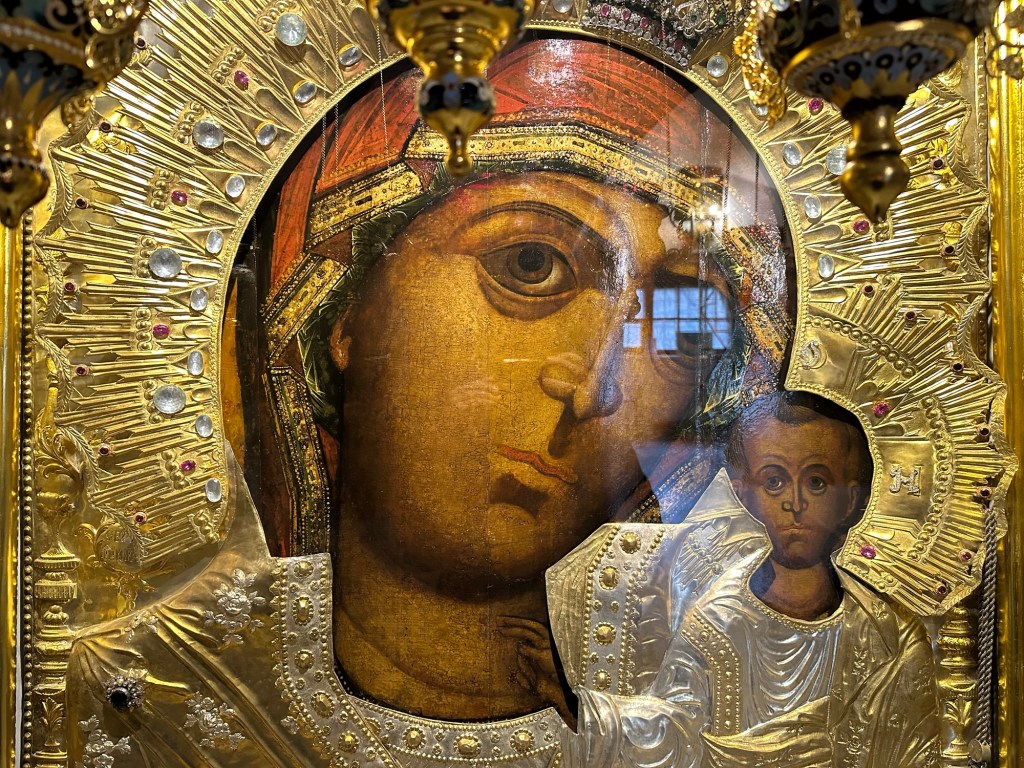
My overriding impression is one of efficiency, of services – public transport, museums, parks – being laid on for Russian citizens to make the most of. There is a sense of order and purpose. The parks are immaculate and extensive. I visit several: Victory Park (dedicated to those killed in the two World Wars and in Nazi concentration camps, as well as to those involved in the clean-up after the Chernobyl nuclear disaster and to hero cities), Zaryadye (next to the Kremlin, with its amphitheatre-like seating and carefully ordered flower beds), Novodevichyi Prudy (next to the famous convent of the same name with its illustrious cemetery), Kolomenskoye (the former royal estate, now open to the public, with its spacious walkway next to the river, perfect for jogging, and a strange bird I am unable to identify, the size of a thrush with a grey hood and round black marks over its eyes like a robber). The buildings in Kolomenskoye are closed – it is a Monday – but the foreman gives me permission to venerate the Kazan icon of the Mother and Child and asks where I am from.

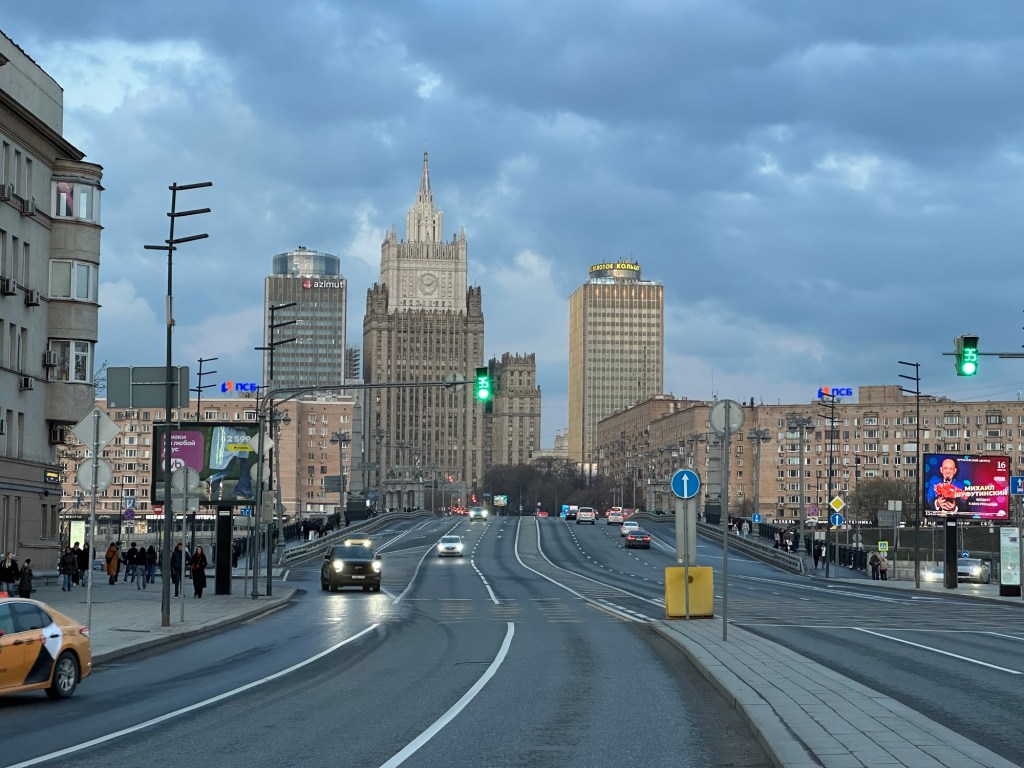
One of my most enjoyable excursions is with my son and a friend to the Arbat district of the city. We pass several buskers. My favourite is a young guy in white trainers, singing a Russian love song – the buskers put out pieces of cardboard with their bank details so you can throw in a few coins on your phone – but there are two energetic violinists playing Vivaldi in an underpass and a guy with an impossibly large balalaika, so large it has to rest on a metal pin. We pass one of Stalin’s wedding-cake buildings, the Ministry of Foreign Affairs, take up position next to the river – my son’s friend jokes that the West thinks the fishermen are snipers in disguise – visit the mall next to Kiyevskaya station (more western products or Russian equivalents), and then take the metro across the river (line 4 from Kiyevskaya to Smolenskaya).

Crossing the Moscow River between Kiyevskaya and Smolenskaya.

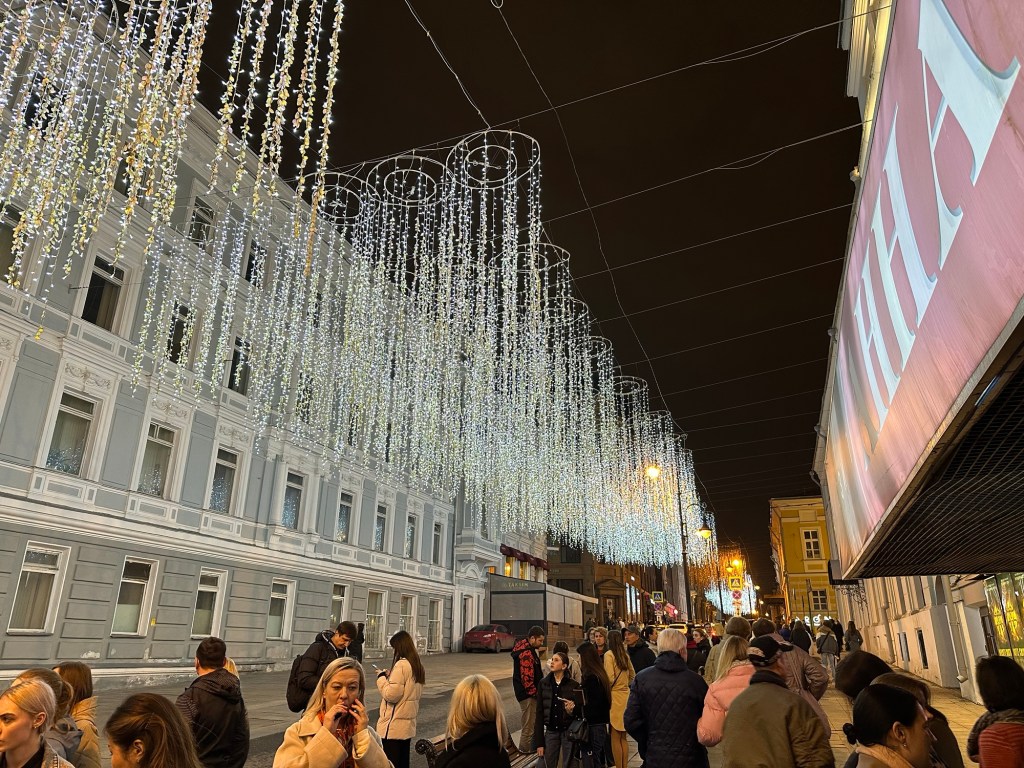
One of my favourite evenings is my son’s blind date at the operetta house. We go to see Monte Cristo. The street outside is lit with dangling lights. I think I will be bored – after all, I don’t really understand the language, the only word I can make out is “love” – but I am struck by the enthusiasm with which the singers and dancers perform and the audience responds. If I were to stay longer, I would go again – to see Anna Karenina, for example. In the interval, I order an apple juice in Bulgarian (I have decided to speak Bulgarian slowly, rather than English) and get what I want. I walk up and down the stairs, imagining I have a seat in a box or the stalls. At the end of the interval, my son turns up with the young woman in question. He is so grown up, and gallant – bringing flowers to a first date. I press her to drink something, and she orders a tea. My son flashes his debit card before I can reach for my change. I sit in the darkness, while the attendant identifies people who are using their mobile phones by squiggling with a red laser on their screens. The couple in front of me – not my son and his date – have argued, and he is now sitting a couple of seats away. She has to lean across to speak to him, but they still manage to take a selfie in front of the stage at the end of the performance. I wonder if the accompanying music – modern rather than classical – is live or recorded. There is a pit, but it doesn’t seem to house an orchestra, because one or two of the dancers jump into it, and I can’t imagine they’re having to dodge musicians as they land. I’ve lost track of who Monte Cristo is, and I can’t quite remember the story (I know it has something to do with false imprisonment and revenge), but I admire the backflips and savour the romantic melodies. When I take my leave of the young woman – my son is going to accompany her to her metro station, where she will be met by her mother – I clutch her hand. She is uncertain, and I want her to be well. The glass bits in her hair remind me of the lights outside, candles in a Christmas tree, stars that glint in a night sky. I find everything touching, perhaps because I know my time is limited.

  1. The mosaic of St Basil’s Cathedral in Komsomolskaya station.
  2. The model fighter jet above the escalator in Pykhtino station.
  3. Monument to the liquidators of the consequences of the Chernobyl accident, Victory Park.
  4. The amphitheatre-like seating in Zaryadye Park.
  5. Moscow City and Novodevichyi Prudy Park.
  6. The Kazan icon of the Mother and Child on the Kolomenskoye estate.
  7. The Ministry of Foreign Affairs and Borodinsky Bridge.
  8. The lights outside the operetta house.

Jonathan Dunne

Next: A Trip to Sergiyev Posad