The elements of speech – breath, water and flesh – are the same elements that are present in the act of creation in the Book of Genesis. The world was spoken into being, which means that we, and the world around us, are a form of language.
Language is made up of three elements: breath, water and flesh.
The first element is breath. Breath forms the basis of all speech. Without breath, you are dead. Breath is represented by the letter h, a letter that is dropped in colloquial speech and silent in some languages, but for me the most important letter in the alphabet:
h (breath)
The second element is water. This is when we add voice to our breath and form the vowels. Hold a vowel sound for long enough, and water will collect in your mouth. The vowels are listed in the alphabet in the following order: a-e-i-o-u. But this is misleading because the vowel sounds are formed, from the back of the mouth (where language originates), in a different order:
u-o-a-e-i (water)
Since breath on its own doesn’t make a word (it only expresses exasperation), the first word that the human apparatus is capable of producing is the combination of breath, h, and the first vowel sound to emerge from the throat, u: hu. You might think this is unremarkable, but, as we have seen, hu is Sanskrit for “invoke the gods” and the root of our word God.
So the first utterance we can make by our very nature is to call on God, just as when we move away from the ego and produce the symbols A+O, we say another name of God, Alpha and Omega. While the science of etymology stipulates that human derives from the Latin word for “man”, homo, I would suggest that really it is a combination of hu and man. We are spiritual beings.
The third element of language is flesh. We obstruct the passage of breath with our lips or tongue (our flesh) and produce the consonants, which can be voiced or voiceless. The consonants are divided into phonetic pairs according to where they are produced in the mouth. There are seven simple pairs:
b-pd-tf-vg-kl-rm-ns-z (flesh)
We see all these elements – breath, water and flesh – in chapters 1 and 2 of the Book of Genesis. Take, for example, Genesis 1:1-2:
In the beginning when God created the heavens and the earth, the earth was a formless void and darkness covered the face of the deep, while a wind from God swept over the face of the waters.
I would suggest that this passage in Genesis is really a description of speech. Or the creation of man in Genesis 2:6-7:
But a stream would rise from the earth, and water the whole face of the ground – then the Lord God formed man from the dust of the ground, and breathed into his nostrils the breath of life; and the man became a living being.
Again, all three elements of language are present, which would suggest that the world was literally spoken into being. This would explain the proximity between space and speak (the letter c, a redundant letter in English, can be pronounced k or s), and also the presence in world of word and lord (the reiterative verse “And God said”).
What is also remarkable is the word these three elements have in common: father. We have seen the phonetic pair f-v, but v is also connected to b and w (think of languages such as modern Greek, Spanish, Latin and German), so through the intermediary of v, I can make the connection f-b/w.
In this way, we see that breath and father have the same letters, water is in father with the addition of h, and flesh is in father with the addition of a (phonetic pair l-r, step in the alphabet s-t).
Transport: by car, or by bus no. 64 and 107 to Boyana Village
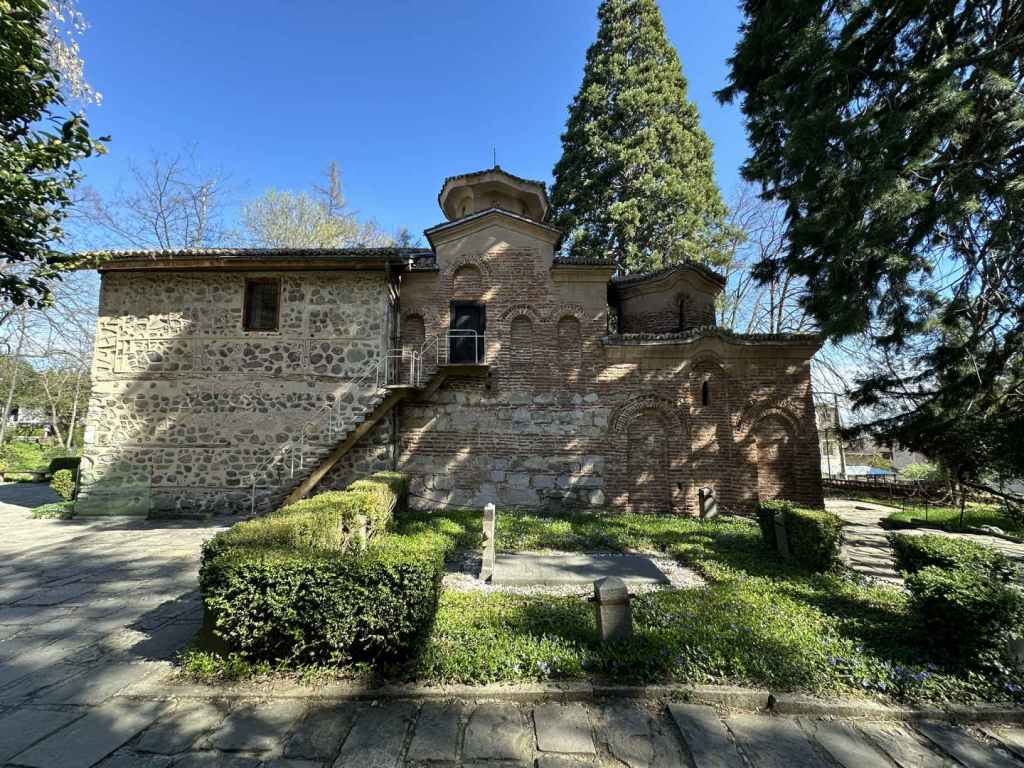
Boyana Church, very near the start of the walk.
The entrance to Vitosha Nature Park from Boyana Village.
The military installation behind barbed wire.
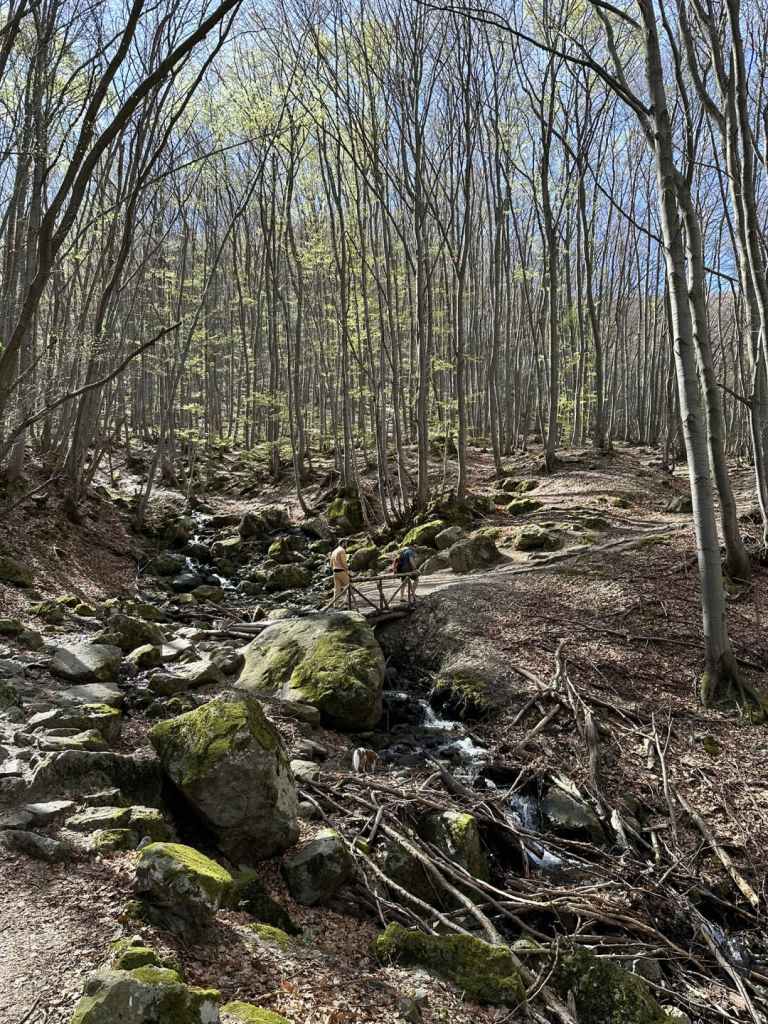
The bridge over a tributary.
Boyana River, like a scarf caught in the trees.
Boyana River, heading north from the waterfall to Sofia.
One of the mini-waterfalls before the waterfall proper.
The approach to Boyana Waterfall.
Arriving at Boyana Waterfall.
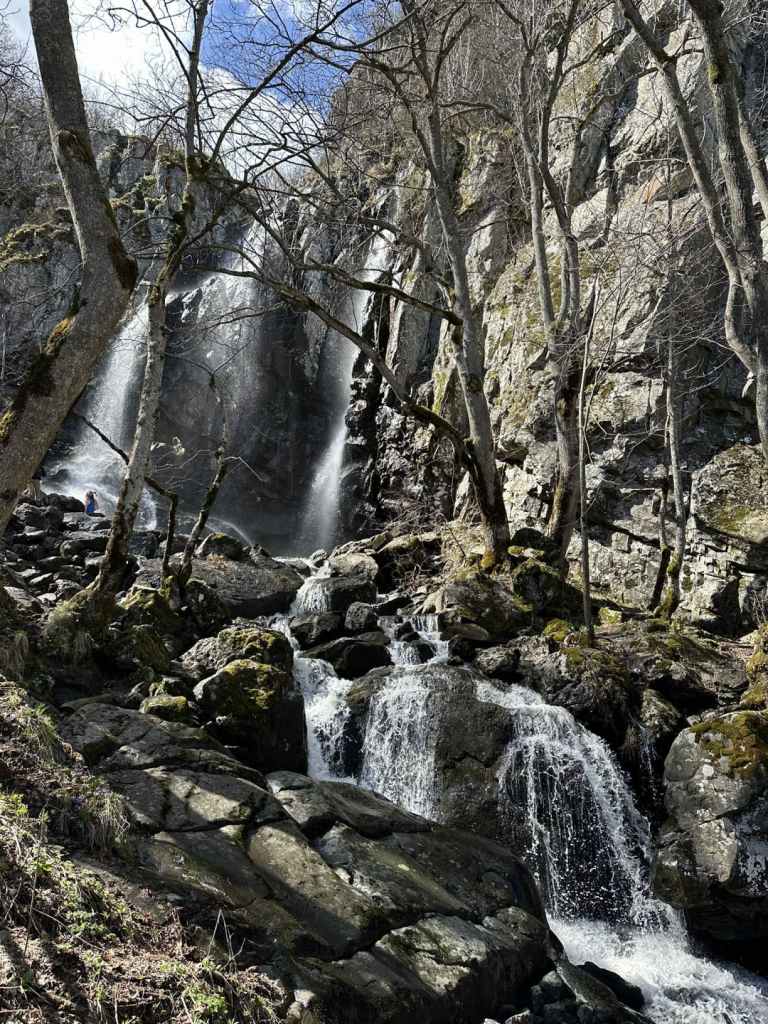
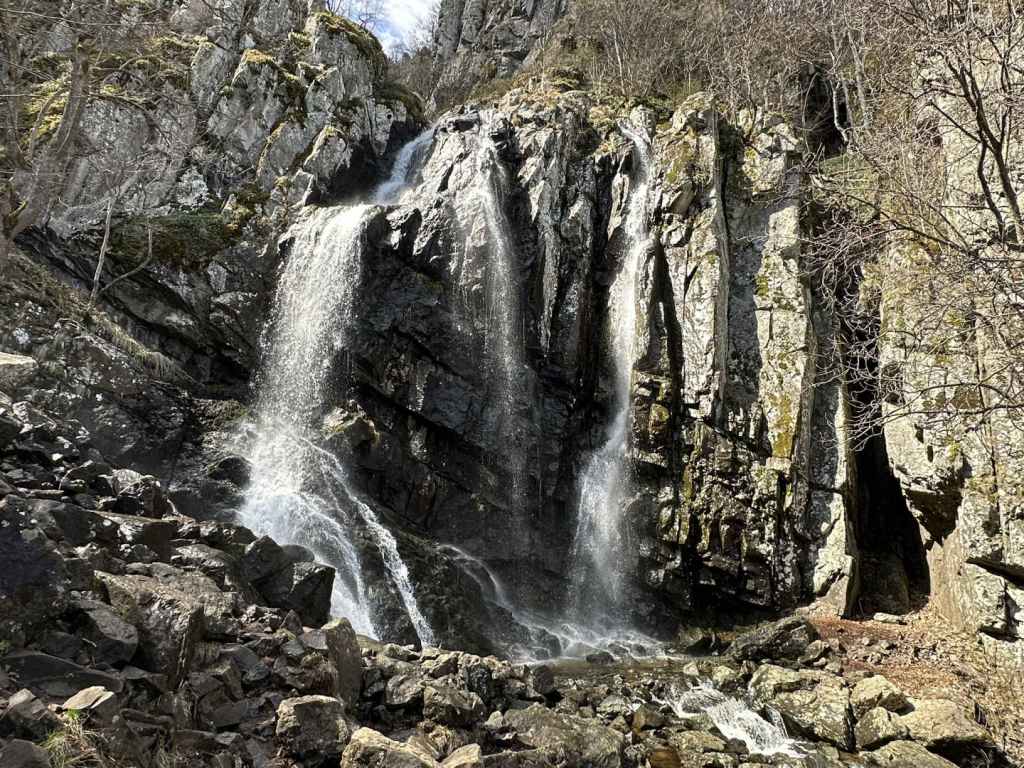
Boyana Waterfall (the Communion of the Apostles).
The path from Boyana Waterfall heading east to Boyana Lake.
A view of Sofia.
Kopitoto in the west. From the hotel, there is another, easier route to Boyana Waterfall.
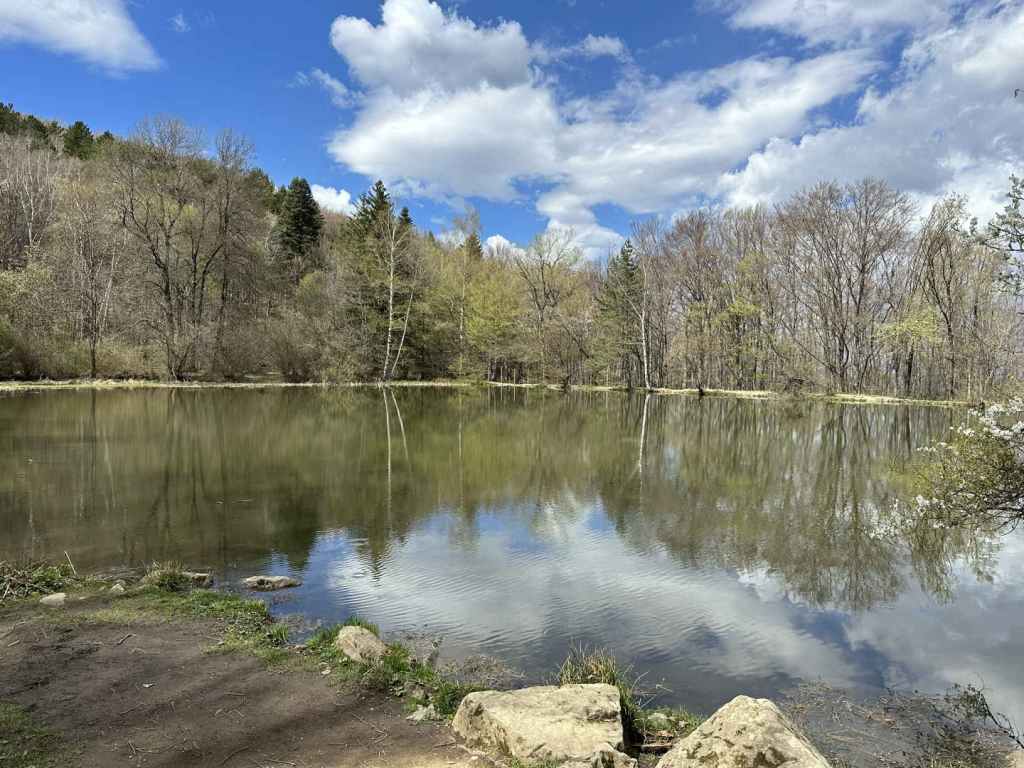
Boyana Lake.
The path heading north from the lake, which brings you back to the starting point.
The start of this walk is very near the famous Boyana Church, one of the principal tourist attractions in Sofia, a World Heritage Site with medieval frescoes dating from 1259. The church is open every day during normal working hours and, although you only get about ten minutes inside (due to conservation measures), it is well worth a visit.
Both the 64 and the 107 buses stop near the church. For the 64 bus, which continues to the next village east, Dragalevtsi, you want to get off at the stop “Boyansko Hanche”, a restaurant on Sborishte Square. The 107 bus will take you all the way to the church, since this is its last stop. By car, you approach Boyana on Bulgaria Boulevard (from where you can see the waterfall on the side of the mountain), go under the ring road and, 200 metres after entering the village, you come to a roundabout. Go left here and, at the traffic lights, turn left. After 400 metres, you will cross Boyana River (which, higher up, forms the waterfall) and, in another 200 metres, Boyana Church will be signposted on the right. Park somewhere near the square.
To reach the church, you go past All Seasons Residence Hotel and continue uphill. The church is about five minutes away and can be visited before or after the walk. To reach the start of the walk, with the entrance to Boyana Church in front of you, go right and continue further uphill. At the top, turn left and, in a couple of minutes, you will reach some stone steps and the entrance to Vitosha Nature Park.
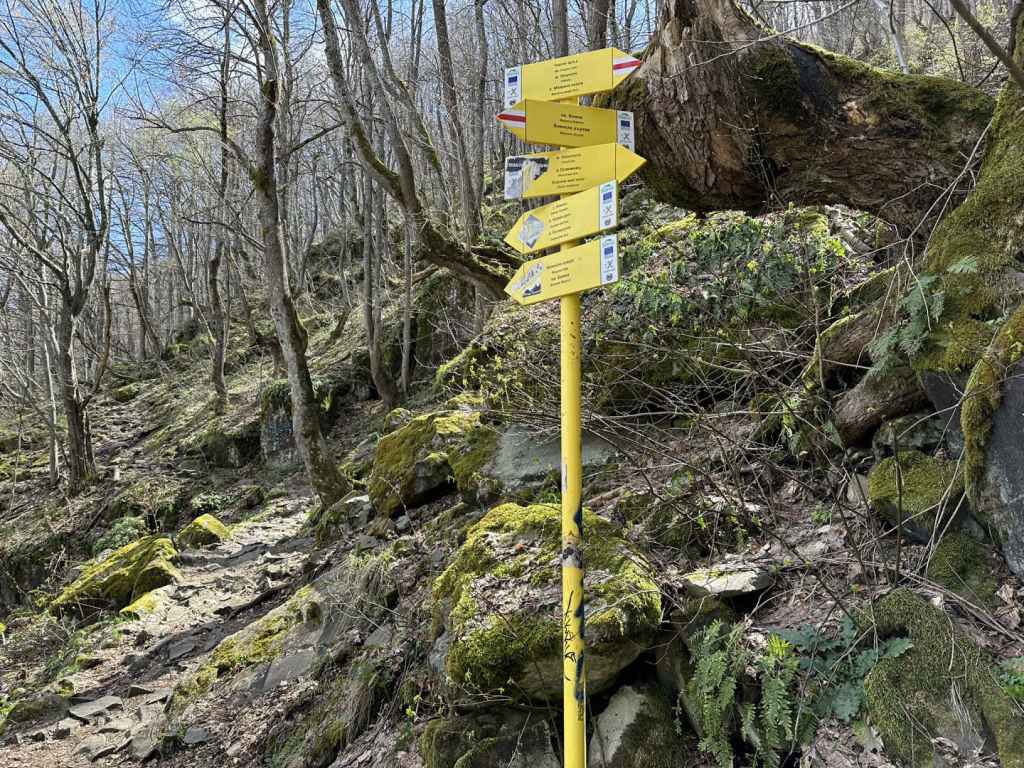
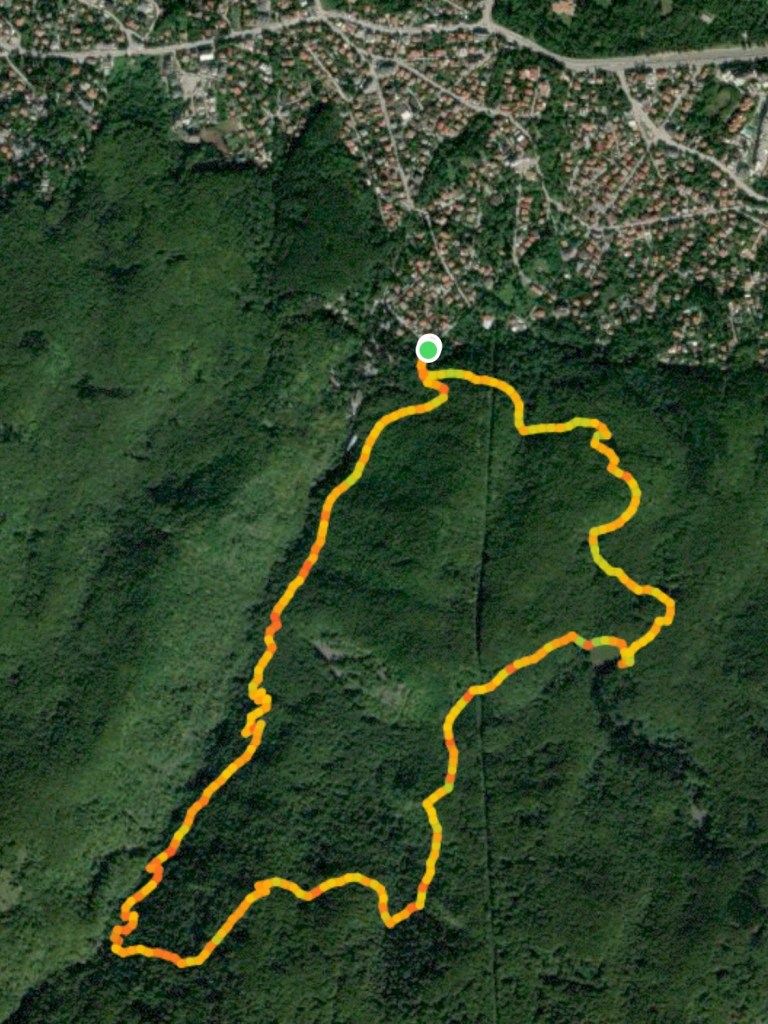
The walk consists of three parts – a stiff climb to the waterfall (1¼ hr, 2.9 km); a gradual descent to the lake (50 mins, 2.3 km); and a return to the starting point (30 mins, 1.7 km). These three parts have red, green and blue markers respectively. As you enter the park (“protected territory since 1934”), you will see a military installation on your right. Follow the red markers. The path takes you uphill and then behind the military installation. You will soon see the river on your right. You will now follow the course of the river all the way to the waterfall. After 1 km, a bridge crosses a tributary from the left. In another 350 metres, a path goes down to the river on the right, but keep left (uphill). The path starts to zigzag and, when you double back on yourself and are facing north, quite often there are pretty views of Sofia through the trees. As you approach the waterfall, the river starts to tumble. There are one or two mini-waterfalls before the waterfall itself. The path here has a metal railing, and at certain points you need to be careful with your footing. There is a rising sense of anticipation as you near the waterfall. It soon appears and is a sight to behold, especially if you go in early spring (during or after the snow melt).
The waterfall reminds me of the Communion of the Apostles in Orthodox churches. It is remarkable how a bubbling stream has now become a burning star pouring forth rays of light. There’s a certain amount of tomfoolery, people taking their shirts off and standing beneath the spray or taking selfies.
After you have taken your fill, you can of course return down the mountain, but I recommend you continue to Boyana Lake. It doesn’t take much longer, and the lake is pretty. Take the path that climbs next to the waterfall, but instead of continuing uphill (south), take the path that immediately forks left (east), which is signposted for Boyana Lake and has green markers. This path meanders around rather than up the mountain. After 350 metres, a path joins from the right. Keep going east. The path begins to descend. In another 300 metres, you will reach a T-junction. Go left here, signposted for Boyana Lake and Dragalevtsi. You will soon cross another tributary of Boyana River. After 1 km, a path joins from the right. Keep going in the same direction (which is now more or less northwards). Several paths diverge to the left. Ignore them. Keep right, and you will soon come to a ruined building, behind which is the lake.
Continue to the north side of the lake, where there are some rocks and people have barbecues. A separate walk approaches the lake from Dragalevtsi Monastery further east. It is normally full of croaking frogs, who like to make their presence felt, but I wouldn’t recommend letting any animals with you drink the water, it’s a little stagnant. Once you’ve had your fill, leave the lake and head north/north-west. A path with blue markers descends the mountain, with the lake behind you/to your left. Follow this path, and in half an hour you will be back where you started!
This walk is an excellent introduction to Vitosha Mountain. It also enables you to visit one of the most famous sites in Bulgaria, Boyana Church. Also in Boyana is the National Historical Museum, which has some impressive exhibits. It is also possible to visit Boyana Waterfall from Kopitoto further up the mountain – in this case, you descend rather than climb to the waterfall, and this is what I did for many years, but I have to say I find the climb from Boyana Village very rewarding. The fact you’re by the river all the way – it’s like she’s taken you by the hand and led you there herself.
The different ways of moving away from the line that represents the ego in English (I), and how the three shapes that result spell a name of God – and a conjunction.
The ego in English is a line: I. It separates us from one another. It has a beginning and an end, like time (a word that is closely related to line, we cross out the l and apply the phonetic pair m-n).
How do we move away from the line that is represented in English by the pronoun I? I can see three ways to do this.
The first is to make reference to a third point, to bring God into the conversation, as if when crossing a river we remember the source of that river in the mountain. From a line, I, we make a triangle, Δ, which closely resembles the letter A (a triangle on stilts):
A
The second is to delete the ego, to draw a line through it (to deny oneself). We have seen that this makes a cross, †, which is also a plus-sign, + (the meaning of losing your life in order to find it):
+
The third is to treat the ego as a number, 1, and instead of counting up, as we teach our children, which has no end, we count down to 0. Again, we make reference to God (0 is an eternal symbol, it has no beginning or end) – we remember him:
O
The three symbols that result when we move away from the line are A+O. These three symbols spell the name of God Alpha and Omega, the first and last letters of the Greek alphabet. That is, when we turn away from the ego’s selfish demands and seek to do good, we necessarily call on God – there is no other way to do this.
And what’s curious is that this name of God, Alpha and Omega, is contained in the middle conjunction, and, if we write it with capital letters:
A ’N’ O (AND)
The reverse of and is DNA. We might say that it is in our DNA to do this. All human life is about understanding that the pursuit of our own desires, to the exclusion of others, will lead ultimately to dissatisfaction. It is when we embrace the other – not simply seek our own ends – that our life acquires meaning.
So, and, that little word that crops up so much in conversation, is like an instruction to turn away from the ego and to embrace the other, their needs, their points of view. It is a plus (our life is enriched), as the word itself indicates.
How the spiritual meaning of words can bring them close together, and how removing the ego, a line in English (I), from a word can lead to salvation.
The word GOD, when written with capital letters, closely resembles three zeros (000). This is because God is Father, Son and Spirit, three persons in One.
It is curious that the words God and good are so similar, you would think that they share a common root. And yet their etymological roots are quite different: God derives from the Sanskrit hu, meaning “invoke the gods”, and good derives from the Gothic goþs, meaning “bring together, unite”. Their roots are different, but God is good – the words can’t help revealing this.
If God is good, then the devil is evil. Again, you might think that these two words share a common root, but they don’t. The word devil derives from the Greek diabolos, “accuser, slanderer”, while evil is from the Gothic ubils. Their meaning has brought them close.
If we remember that, in the study of phonetics, one pair of consonants pronounced in the same part of the mouth is l-r, and another is f-v, we will see that quite easily devil gives differ. All I have to do is change two of the consonants according to where in the mouth the sounds are produced. If I take a step in the alphabet – from f to g – father gives gather. This would seem to confirm what we saw just now about God being good (goþs – “bring together, unite”). The devil would separate us, make us disagree. The Father would unite us, make us one in him.
Take an earlier step in the alphabet – from d to e – and God gives ego (represented in English by the letter/line I). These are really the two masters we can choose to serve in this life: God (to love him and to love our neighbour) or the ego (to follow our own desires, even at the expense of others).
One makes us a slave to our passions: the ego. The other sets us free. In effect, what he does is save us, and we can see that when we remove the ego, I, from slave (what the ego turns us into), we get save.
In Matthew 6:24, we read that we cannot serve God and wealth (or Mammon). Another word for “wealth” is gold. Again, we see that when we remove the ego, I, from a word, it takes us in the right direction.
The ego in English, I, closely resembles a line. It separates us. It also resembles the number 1, the number we use to start counting. Three zeros make GOD. What happens when we put together three egos, three Is? We become ill.
Kostenets is actually two waterfalls. There is Kostenets Waterfall in the village of Kostenets, and then the higher Skalovitets Waterfall at a distance of six kilometres. Both waterfalls are accessed from the village of Kostenets, not the town. Travelling from Sofia, you need to take the A1 motorway in the direction of Plovdiv and take the exit after Ihtiman, which is signposted for Muhovo and Kostenets. After leaving the motorway, you pass through Mirovo (where there is a turning for the Gate of Trajan, a mountain pass that formed the border between Thrace and Macedonia and the site of a famous tenth-century battle between the Bulgarians and the Byzantines, which the Bulgarians under Tsar Samuil won) and then the spa resort of Momin Prohod. Be careful along here because there are lots of speed traps. You then enter the town of Kostenets.
1.2 kilometres after you enter Kostenets, take the turning on your left. This turning takes you under the road you were on and under the railway. Immediately after the railway, take the first turning on the left, which is signposted for the villas and village of Kostenets. Stay on this road, which veers right after the railway station and heads towards the village, five kilometres further south-west. On entering the village, continue past the church and the main square until you reach a roundabout after 1.7 kilometres. Turn left at the roundabout and take the road going uphill. It crosses the Chavcha River and ends at the first of the waterfalls you have come to visit, Kostenets. There are parking spaces on the right of the road.
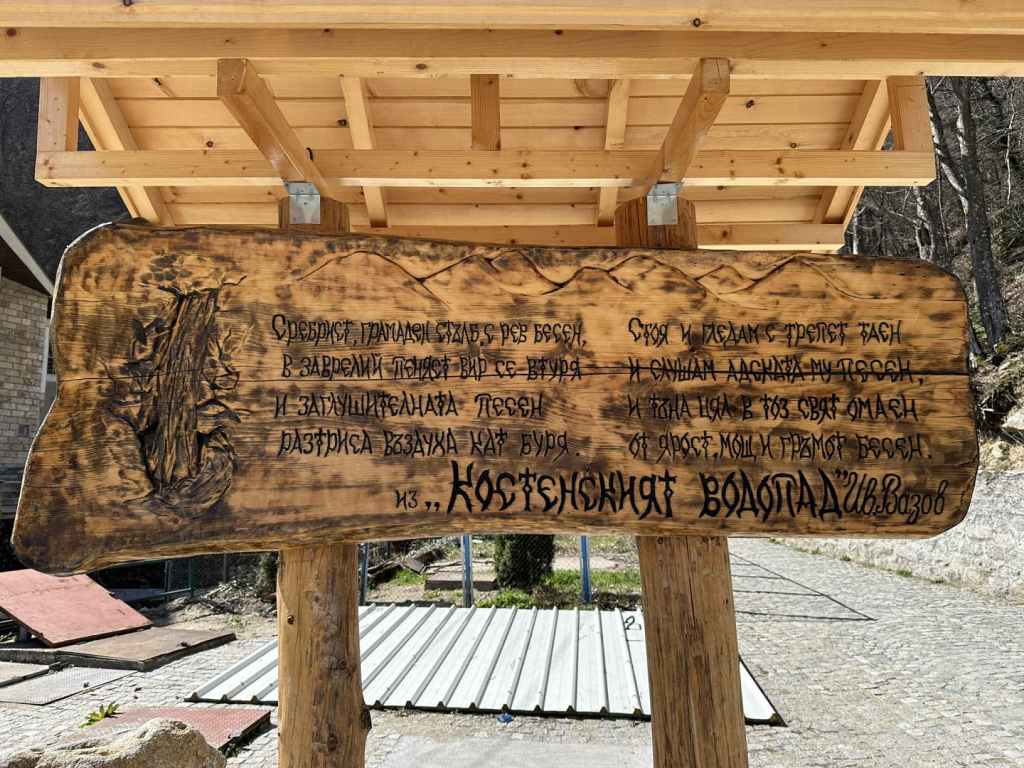
Kostenets Waterfall is small, but very pretty. There is a wooden sign containing part of a poem written about the waterfall by Ivan Vazov and, on the left, Therma Kostenetz, which has mineral pools. The waterfall itself is at the top of some steps. To visit Skalovitets Waterfall, you now have a choice: to walk six kilometres or to drive as far as Gurgulitsa Hut, which shortens the walk considerably. The walk took us an hour and a half. At the wooden sign, cross the river and take the road going uphill, which leads directly to Gurgulitsa Hut. The road loops and meanders, and there are paths through the forest that act as shortcuts, but they are not always obvious, so we stayed on the road most of the time. 2.2 kilometres after you leave the river behind, there is a picnic spot – at this point, we cut through the forest, but before long we were back on the road again. In another 1.4 kilometres, you come to a sort of crossroads. Gurgulitsa Hut is in the trees on your left. This is the distance you will save if you decide to drive to the hut.
Go past the hut on your right, and you come to a barrier, behind which is a field. You now need to turn right (east) and take the path entering the forest. There are numerous arrows, all of which are pointing towards the waterfall, I think. After 350 metres, the path, now a track, descends on the right, but the path to the waterfall diverges on the left. Go down the path on the left, and in another 800 metres of fairly steep descent you come to a bench with a branch of the river behind it. This is not the waterfall. Turn left (again, there is an arrow), after 200 metres cross this branch of the river and continue right, along a dirt track. In another 600 metres, you reach the other branch of the river, where the waterfall is located. There is a picnic shelter. The waterfall is 150 metres upstream.
The two branches of the river become one further downstream. They then join the Chavcha river, which itself joins the Maritsa on its way to Plovdiv and the Aegean. Rivers have their own way of doing things, and it seems to me they’re pretty content to do them, so long as we let them.
There are two other waterfalls on the northern slopes of the magnificent Rila Mountain. They are both further west – Sapareva Banya (Rilska Skakavitsa) and Ovchartsi (Goritsa) – and easily accessible by car from Sofia.
The entrance to the village of Kostenets, with a stork on a pylon.
The wooden sign in front of Kostenets Waterfall, with a fragment of the poem ‘Kostenets Waterfall’ by Ivan Vazov.
Kostenets Waterfall (12 m).
The road to Gurgulitsa Hut, which is fit for vehicles.
The picnic place next to the road, where there is a shortcut through the forest.
3.6 km after the river, the road comes to a crossroads – Gurgulitsa Hut is in the trees on the left.
Gurgulitsa Hut.
At the field, turn right.
The path then enters forest.
After 350 m, it divides. Go left.
Another 800 m, and you come to a bench with one branch of the river (not the waterfall!) behind it. Turn left.
After a short descent, follow the sign for Skalovitets.
You will soon reach the waterfall, which is on the right of the track.
Skalovitets Waterfall (25 m).
The walk to and from Skalovitets Waterfall is twelve kilometres and has an elevation gain of 550 m! This can be reduced considerably by driving as far as Gurgulitsa Hut.
A text about law, and the proximity of this word to the name of God in Exodus 3:14, I AM.
The word law in reverse reads wall. This is because the law acts as a wall around private property; divine law acts as a wall to protect us from our enemies.
Consonants, the flesh of language, are divided into pairs. One such pair is l-r. If we apply this pair to law, we get war (again, in reverse). Law is a way of avoiding war, if at all possible. Sometimes, however, it doesn’t work and someone crosses the line between us with hostile intent.
But the most beautiful – and the most important – word connection with law is I AM (capital I and lower-case l look alike; w is m upside down). This is the name of God in Exodus 3:14, the name God reveals to Moses at the burning bush. The law is very important in the Old Testament (the law and the prophets, profits). God’s law is about truth, it reflects who he is. I think behind the human laws that we make stands God’s law, reflected in his name I AM. That is, everything is contained in him; we may think we possess things, but we only possess them as gifts from the Creator.
And this connection law-I AM is found in the New Testament, which is about Christ become man and the message he brings. He became man so that we could become gods by grace (not by nature), a process known as theosis. He shows us the way. This word is also in law if we remember that the semi-vowel y corresponds to i.
I AM-law-way is the message contained in the Bible. We can see that all three words contain the progression of the Greek alphabet: from A (the first letter, creation) to I (the Fall, the ego in English) to O (omega, written w in Greek).
If we delete the ego – that is, submit our will to God’s – we get a cross (†), which is also a plus-sign (+). This is the meaning of Christ’s injunction to lose our life in order to find it, a seeming paradox.
One way of writing this plus is ’n’ (as in rock ’n’ roll). If we take the progression of the Greek alphabet, AIW, and substitute the deleted ego, ’n’, we get ANW, which gives us man. This is the purpose of human life – to make this progression away from the ego and become fully man, a word that is linked to law. We achieve it by observing his commandments to love him and to love our neighbour.
This is the inner meaning of language, the one we do not see. We think of language as an external tool that we hold in our hands, but it is like nature, it has its own meaning.


















 Stones Of Ithaca