Sopot

The E871 is one of my favourite roads in Bulgaria. It’s even a little difficult to find. There are three roads heading east from Sofia. They all go to the sea. The E83/772 goes to Varna via the medieval capital, Veliko Tarnovo, running north of the Balkan Mountains. The E80/773 goes to Burgas via Bulgaria’s second city, Plovdiv. The E871 doesn’t seem to go anywhere, though it does in fact drop down at the last moment and join the E773 on its way into Burgas – but only at the very last moment. Apart from that, it travels on the warmer side of the Balkan Mountains, the south side, and offers wonderful views of this beast that is the Balkan, scratching its belly (the mountain, I mean) in the early autumn sun.

I say it’s difficult to find because you leave Sofia in the east and if you’re not careful, you end up going to Varna. You have to hang a right, passing through the suburb of Dolni Bogrov, which always at weekends has lines of cars in the slow lane, parked for a market that takes place there and seems very well attended. Once past Dolni Bogrov, you again have to take a right (otherwise you’ll end up going to Varna), and then the journey begins. The road stretches in front of you, like a tree’s shadow, long and straight. You must up and over three hills (the second containing a bust of Bulgaria’s nineteenth-century freedom fighter, Vasil Levski, at its base). You then pass the turning for Chavdar, the first of the waterfalls along this road, which I described in an earlier post. You drive at under 50 km/h through the towns of Zlatitsa and Pirdop, twins joined at the hip. And then the fun starts. Numerous bridges, all with little bumps (I thought I counted five or seven on every bridge), from which people organize bungee jumps when it’s not too windy. Today was extremely windy, so there was nobody in sight (plus it’s the Bulgarian elections).

Just before Karnare, you pass the turning for the second of the waterfalls located near this wonderful road – Hristo Danovo, a stunning straight line like a windpipe. But be careful in Karnare – this is where Bulgaria’s freedom fighter Vasil Levski was betrayed to the Turks by a local priest, Pop Krustio! It’s also where a road dares to cross the Balkan Mountain from south to north, as if it’s suddenly decided to switch sides, passing through Troyan, the third most important Bulgarian monastery after Rila and Bachkovo.

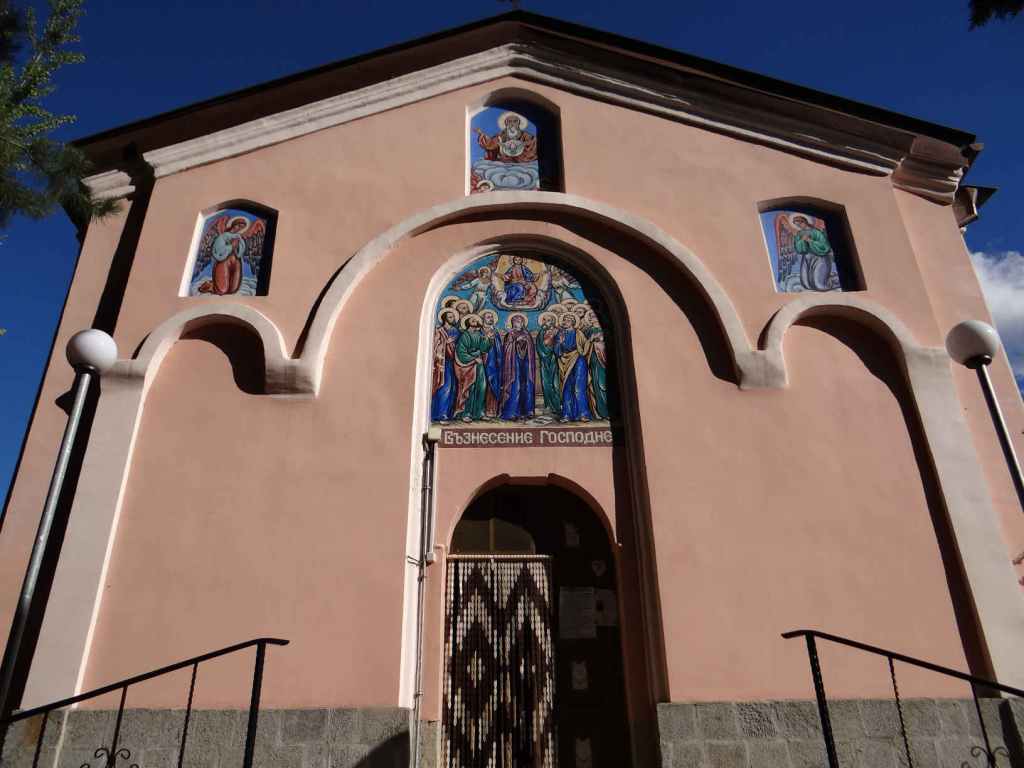
One is not diverted, however, but continues along on the E871 (wonderful road that it is!) and after Anevo, just before entering Sopot proper, you will see a turning on the left for Anevo Fortress (2 km), followed immediately by another turning on the left for Sopot Lift (I think it was written ‘Lift Sopot’, 1 km). This is the turning you need. But you are not going to the lift. You actually need to head to one of Sopot’s two monasteries, the one dedicated to the Ascension of Jesus, which is situated at a distance of 1.2 km from the E871.

So when you see a sign for Sopot Lift (or Lift Sopot) saying ‘200 m’, don’t go there. Continue right and just around the corner the monastery will come into view. There is an open area where you can park the car.

With the monastery in front of you, look to the left. A narrow path hugs the wall of the monastery enclosure before, in theory, heading up the valley to the waterfall. You need to take this path. But this is where things get difficult. Let me explain.

In the past, a nice path ran all the way to the waterfall, passing a small chapel before reaching the waterfall after only 30 minutes. To our amazement, today no path was visible. It ended abruptly at the bridge just behind the monastery and had been replaced by an abyss, a drop down to the riverbed. There is no path anymore. A flash flood – or something like it – appears to have swept away not only the path that used to meander nicely among the trees, but also the very riverbank. There is no riverbank. I am not joking. You are forced to drop down to the riverbed and then to walk along the riverbed. So this outing is not for the fainthearted. But before you become discouraged, let me tell you an hour after we arrived at the waterfall, a gaggle of children all aged under ten arrived as well – I can’t believe how many there were, they started lobbing heavy stones into the pool at the foot of the waterfall – so it can’t have been all that difficult.

But let me repeat: there is no path. There isn’t even any earth. You are on the riverbed, jumping over rocks, threading your way through fallen trees. It took us an hour and a half (a little less coming back – my wife asked me why it’s always easier coming back, I thought it was perhaps because you already know the way). And here’s the lesson from our outing today.

As we walked beside the monastery wall, a glum-faced gentleman in his elder years droned that there was no point going on, the path ended after the bridge. He and his companions had evidently turned around.

Once we were on the riverbed, but still at the beginning, a younger couple (he looked particularly sporty, she was more elegant) also warned us against continuing. Ten minutes, and they had had to turn around.

If we had listened, we would have got back in the car and missed the most amazing beauty. So don’t listen when people try to dissuade you, when they try to make you lose faith. Listen only to your inner voice. It’s like Christ says in John chapter 8, the last day of the Festival of Booths: just believe.

It’s lucky our dog was there to help us choose the best route. I felt like Arthur Morgan in the computer game Red Dead Redemption 2, turning on eagle eye, which enables him to see the trail left by a cart or an animal. You find your way through, you continue up the riverbed (it’s actually very beautiful being this close to the river!), you ignore the gainsayers (don’t go, it’s not worth it!), and at the end you witness incredible beauty.

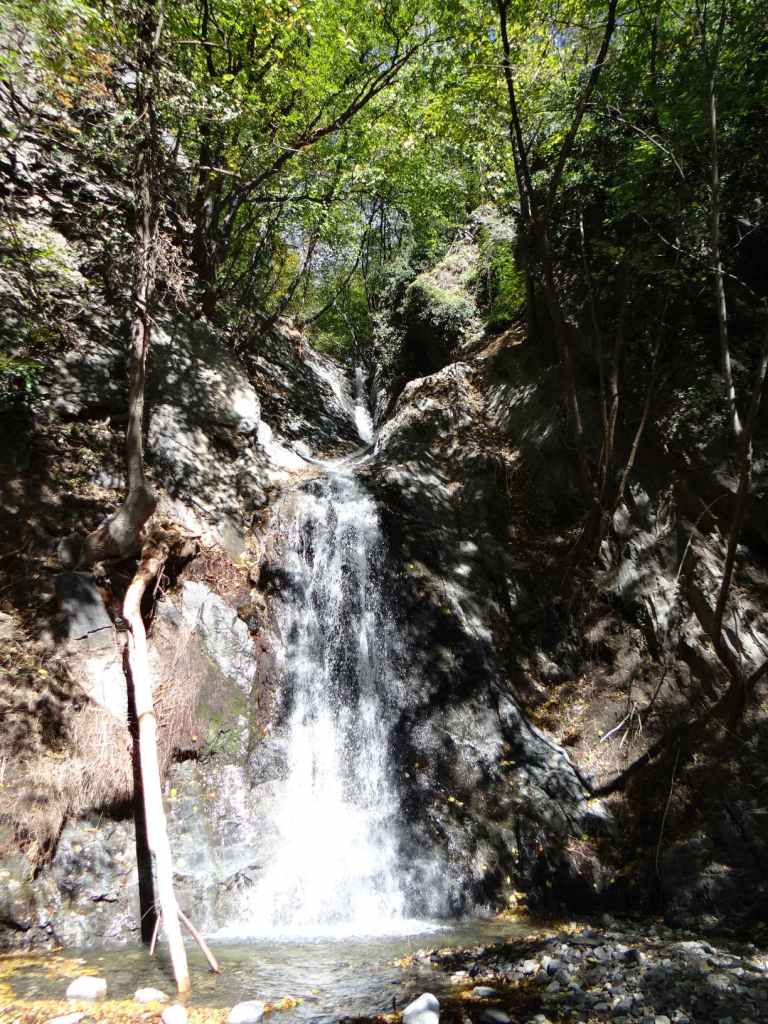
Because Sopot Waterfall is a heart. It is a spring of water gushing up to eternal life (John 4:14 – have you read John’s Gospel? It is a fantastic book of short stories, of intimate encounters). Hristo Danovo is purity. Polska Skakavitsa, southwest of Sofia, is baptism – you cannot help but get immersed. Sopot is love, and so it ranks among my top waterfalls (even if there is no path, even if you have to walk through the air to get there). The water makes the shape of a heart. It is like a knot. A heart is a knot, two interlocked fingers.

And don’t let anybody tell you any different.

The path (it doesn’t last long) follows the wall of the Monastery of the Ascension.
It then abruptly ends. Here you can see how the riverbank has been obliterated – all that is left is the riverbed.
Miraculously, the path does reappear at one moment.
The magic of water.
Here you get a good idea of the terrain that you must cross to get to the waterfall.
The ruined chapel.
A pile of leaves – underwater!
In the absence of a path, people have taken to stacking stones when they reach the waterfall.
Sopot Waterfall.
A close-up of the heart.
The waterfall also resembles an hourglass.
The Monastery of the Ascension, which you can visit on your return.
Video

Theological English (15): Atom

In this sixteenth video on “Theological English”, Jonathan Dunne looks at the progression from the A of creation to the I of the Fall to the O of repentance/realization, which was the subject of the second video. Having already seen how this progression AIO can be found between words such as “what”, “why” and “who/how”, he examines to what extent this progression can be found inside words. When we draw a line through the selfish demands of the ego (I) and form a cross (†), which is also a plus-sign (+), A+O, we get the name of God in the Book of Revelation at the end of the Bible: Alpha and Omega. This in turn gives “and” (A ’N’ O) and its reverse “DNA”. When we use the Greek letter omega (“w”), we get “man” (A ’N’ W). So the idea expressed by Christ of denying the self, taking up our cross and following him is at the heart of language and in our very genes.

To access all the videos in this course, use the drop-down menu “Theological English (Video Course)” above. The videos can be watched on Vimeo and YouTube.

Video

Theological English (14): The Names of God

In this fifteenth video on “Theological English”, Jonathan Dunne looks at the importance of names. “Name” is “man” in reverse with a final “e”, and we read in Genesis chapter 2 that God brought the creatures to Adam so that he could “name” them – in effect, so that he could translate them and choose the right word. God didn’t ask Adam to make the creatures because he is not an author – he cannot create out of nothing. He, and the rest of humankind, are translators. So “name” is central to man’s role in this world. What can the names of Jesus Christ and the Virgin Mary tell us about their roles? And what meaning can we find in the names of people like Strauss and Grant Gustin, and countries like Ukraine?

To access all the videos in this course, use the drop-down menu “Theological English (Video Course)” above. The videos can be watched on Vimeo and YouTube.

Video

Theological English (13): Believe

In this fourteenth video on “Theological English”, Jonathan Dunne looks at the importance of the word “believe” in the Christian Gospel. The word “believe” crops up again and again in the Gospel – this is what God requires of us: to believe in him, to believe in his name, in order to receive – the power to become children of God, eternal life, salvation, healing. When we believe, all things become possible. The video focuses on John 7:38 and the verse from Scripture: “Out of the believer’s heart shall flow rivers of living water.” Once again, language is not only used to convey the message – it is the message.

To access all the videos in this course, use the drop-down menu “Theological English (Video Course)” above. The videos can be watched on Vimeo and YouTube.

Gallery

Water

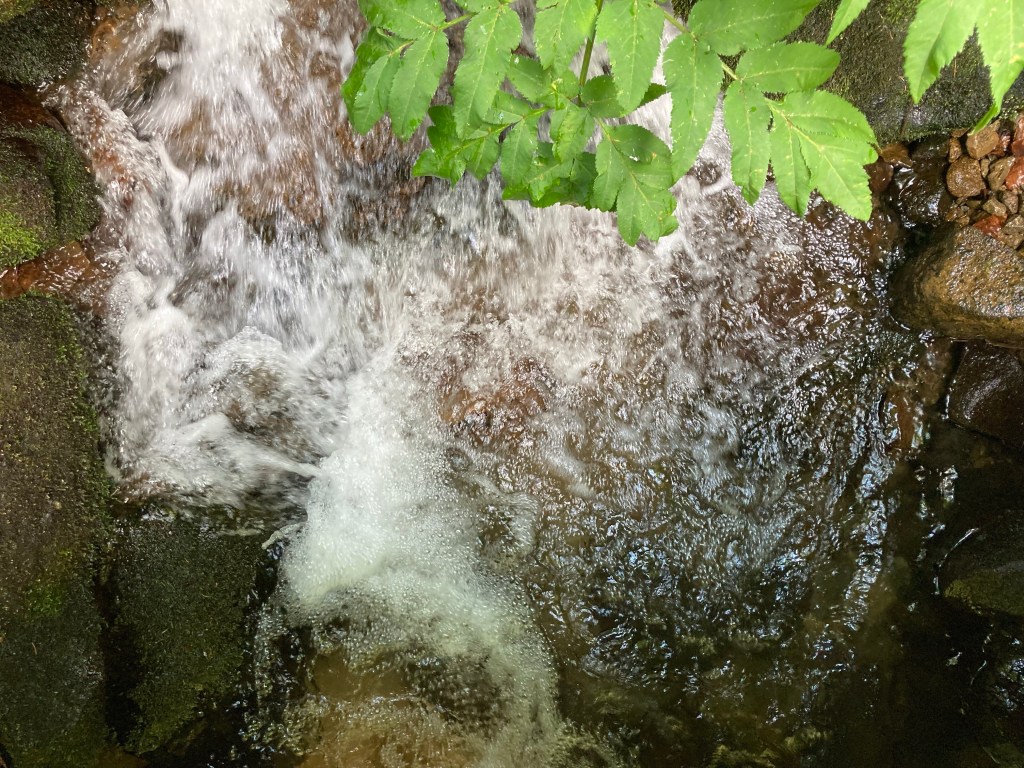
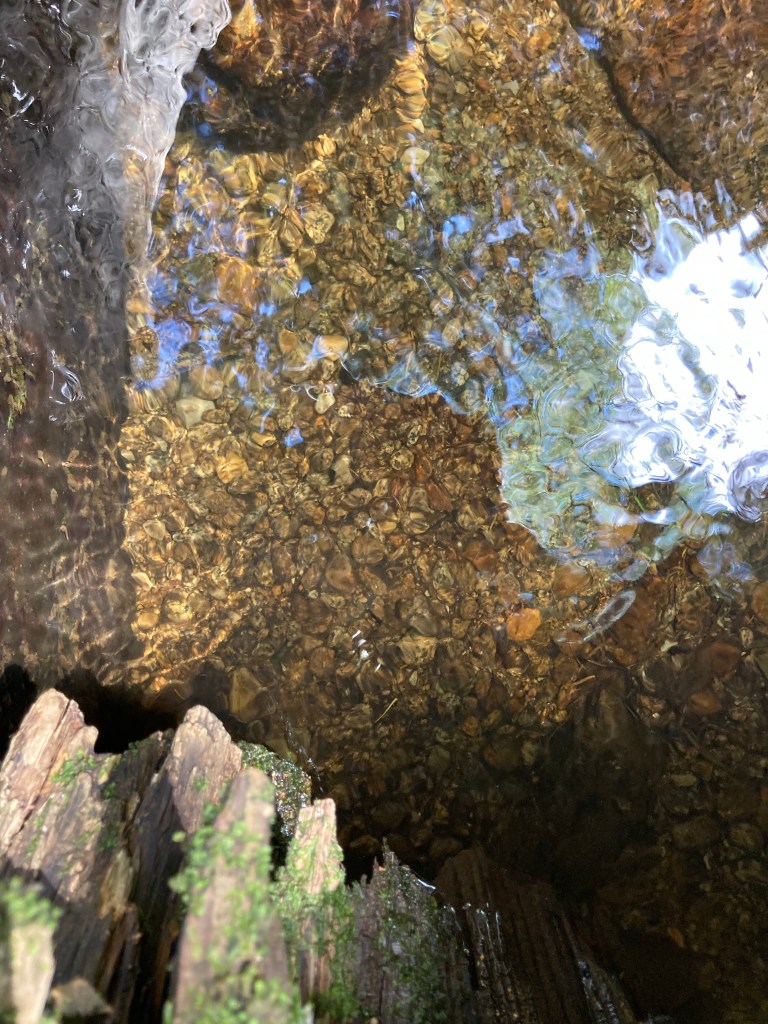
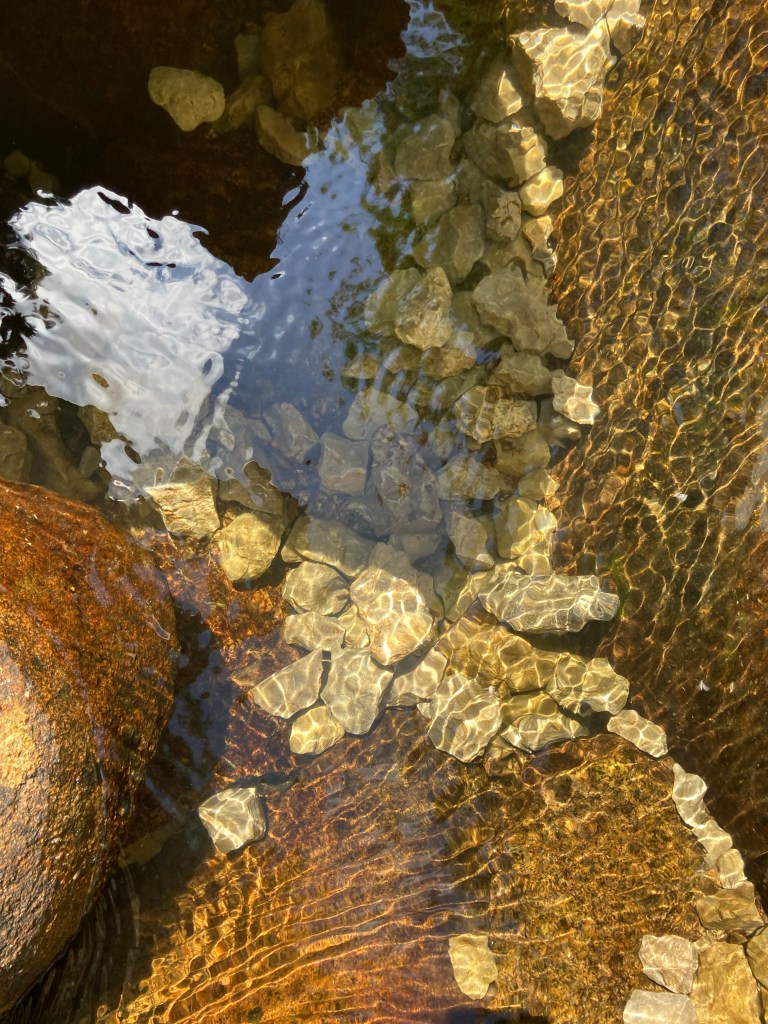
It is remarkable that water has four of the same letters as earth. And where would the earth be without water? Earth has the same letters as heart. Without water, our heart would shrivel up.

What amazes me is the way it flows constantly. Even in the night, when I am not there. During the week. All the time until my next visit, it flows.

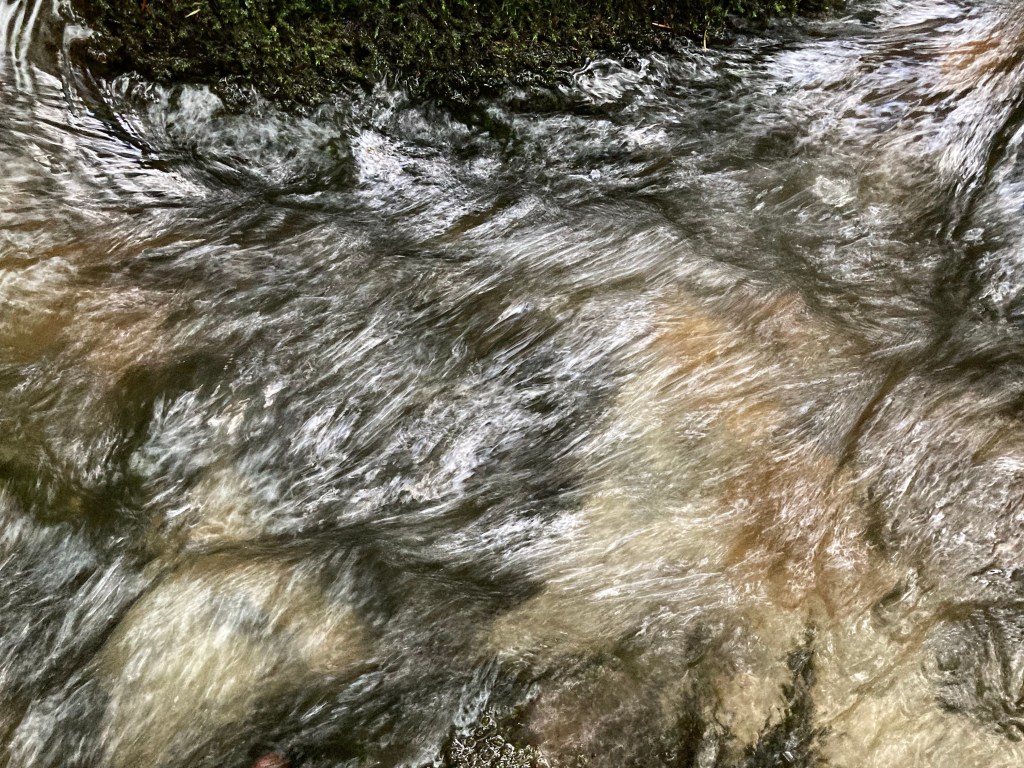
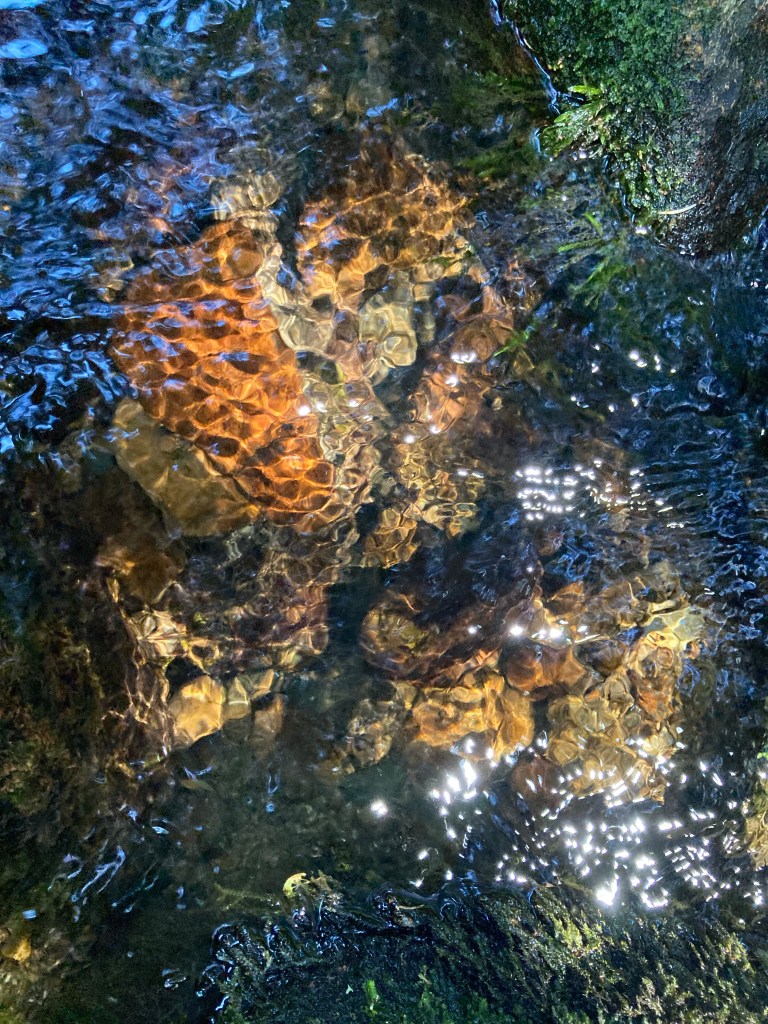
Sometimes it is blue, like the sky. Sometimes it is reddish brown, like a brick. Sometimes it takes on the colour of my shadow.

It is whatever is thrown at it. But sometimes it becomes a blur – too fast for my eyes to distinguish.

In the night, it is black – unless there is a moon, I imagine.

Water always finds a way – even if it has to go underground. Or fly through the air.

On Vitosha, I have seen it so calm it resembled a mirror. But I have also seen it rage after a storm. Then it is no longer transparent, it seems to boil.

We step on the land; without water, we would sink, as in a desert. Too much water, and we swim.

Water lies on a bed of gravel. And rests its head on rock pillows. It rises up from the rock. It slips through gaps. It causes us to build bridges – that is a good thing.

When it enters the air, it is smashed into smithereens.

Later, in the sea, it evaporates to fall on my head. Then I walk through a sauna. The water is so prevalent it climbs up my legs. I have sat in the car as it beat down with unusual ferocity. Still I got out.

I like it when it’s the mountain and me. Today I walked through the hordes, as if I came from another planet. Another age.

Water is most beautiful on the mountain. It is like a curtain. Or a seam. The mountain shudders. Sends the water tumbling. It resists – for now.

I know a secret place where I sit and watch it gleam.

27 August 2022

Text and photographs by Jonathan Dunne, photograph selection by Tsvetanka Elenkova.

Vitosha is the mountain that lies just south of Sofia, the Bulgarian capital.

Video

Theological English (12): Paradox

In this thirteenth video on “Theological English”, Jonathan Dunne looks at paradox as an indicator of truth, as the path towards truth. Sometimes the most obvious statements can be misleading, while what on the surface appears to be contradictory, illogical, can turn out to contain the truth. Christianity is a religion of paradox – the Trinity is “three in one”, we must “lose our life in order to find it”, Christ dies and rises again… All of these are examples of seeming paradox. In this video, we look at Christ’s statement that “many who are first will be last, and the last first” (Matthew 19:30) and how the cycle of physical/spiritual thirst, referred to in the meeting between Jesus and the Samaritan woman at the well in Sychar (John 4), can be broken.

To access all the videos in this course, use the drop-down menu “Theological English (Video Course)” above. The videos can be watched on Vimeo and YouTube.

Video

Theological English (11): Connections – Addition of Letters (1)

In this twelfth video on “Theological English”, Jonathan Dunne continues looking at word connections made by the addition of letters, this time from “i” to “w”. It is curious that “die” contains “be” and “I” (we saw in the previous video that the “world” is a spiritual “womb”, which might explain this). What is even more curious is that “live” also contains “be”, but two “I”s in the first two letters. “Blood” gives “spirit”, as “seed” gives “sleep”. “Word” gives “sword” – our words can become physical, just as God’s words in the beginning created a physical environment. There is a previous video on this theme: “Addition of Letters (0)”.

For the connection between “blood” and “spirit”, see Marcus Plested’s instructive article “‘Give Blood and Receive the Spirit’: The Ascetical Dimension of Mystical Experience” (available online), which looks at the connection between ascetic endeavour and direct experience of God in early Christian literature and how it can be applied today.

To access all the videos in this course, use the drop-down menu “Theological English (Video Course)” above. The videos can be watched on Vimeo and YouTube.

Video

Theological English (10): Connections – Addition of Letters (0)

In this eleventh video on “Theological English”, Jonathan Dunne starts to look at word connections between words that do not have the same number of letters, where it is necessary to add one or two letters. If we do not want to be like Narcissus and only to hear our own voice, we must open our spiritual eyes and ears. This will lead to a seed being planted in our heart. The two greatest commandments are to love God and to love our neighbour: love – other – theos. It is “love” that makes us “whole” (without the initial “w”, a letter that resembles the number “3” and can be taken to refer to the Holy Trinity, all we have is a “hole”). There is a second video on this theme: “Addition of Letters (1)”.

To access all the videos in this course, use the drop-down menu “Theological English (Video Course)” above. The videos can be watched on Vimeo and YouTube.

Haven’t They Noticed My Absence Yet?

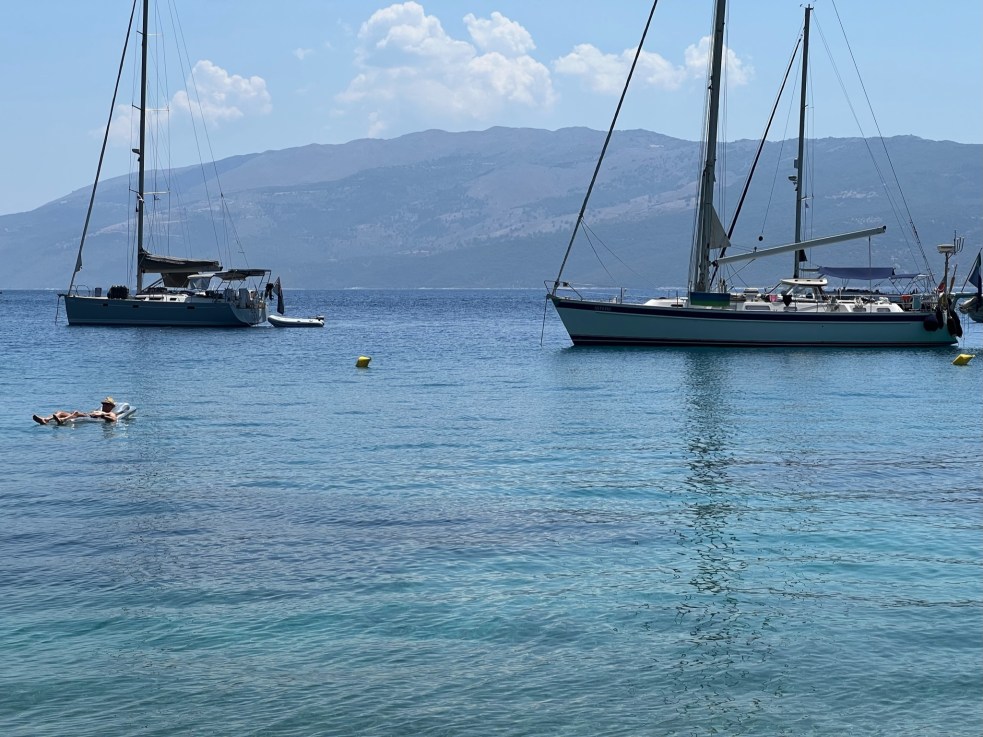
He fell asleep on the lilo

and woke up on the open sea.

How many missed calls are written on the phone buried in the sand?

Is there even a signal in this wild bay found after searching?

Will the sunset come quickly enough?

The burning on the open sea hurts more

than breathing in after laughter.

Haven’t they noticed my absence yet?

A friend affirms

the castaway has been saved already.

Terrible was the wandering sailor’s fate.

Haven’t they noticed my absence yet?

from The Heart Is Not a Creator (2013) by the Bulgarian poet Yordan Eftimov, translated by Jonathan Dunne